Saturday, 25 August 2012

TV REVIEW: Parade's End - Episode One

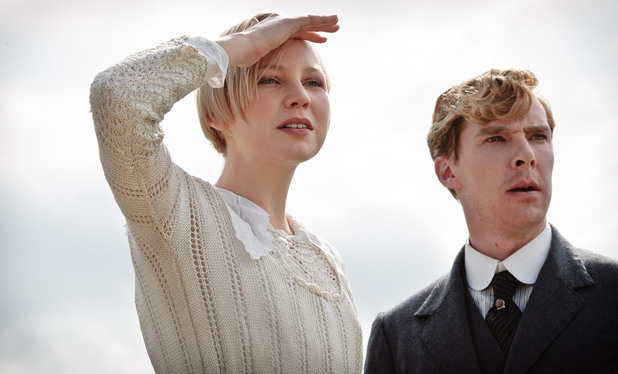
If you hadn't already guessed, we at Assorted Buffery are suckers for period dramas. Or indeed any dramas come to think of it. But mostly those where you have beautiful people swanning about in beautiful clothes and talking in beautiful accents. Now the BBC, ever the purveyors of such drama, have adapted Ford Madox Ford's quartet of novels, Parade's End, starring Rebecca Hall, newcomer Adelaide Clemens and Assorted Buffery favourite, Benedict Cumberbatch.


Parade's End follows the turbulent marriage of Christopher Tietjens (Cumberbatch) to socialite and general mischief-maker Sylvia (Hall) and his subsequent relationship with a young suffragette, Valentine (Clemens). The central marriage is more one of convenience as Tietjens tries to shed his past as a bit of a cad and Sylvia wants to avoid scandal after falling pregnant, though a particularly energetic train carriage encounter suggests there is an attraction between them. It's a beautiful study of a relationship destined to corrupt both parties and enough repression to fuel English stereotypes for years to come. With director Susannah White helming the production and the ever-brilliant Tom Stoppard adapting the novel with a witty and polished script, the first episode of Parade's End was an intriguing, funny and thought-provoking hour.

Aside from the excellent direction and crisp script-writing, the programme's strength lies in its cast; Benedict Cumberbatch is everyone's man of the hour, from literature geeks to sci-fi nerds (he's appearing in Star Trek 2 as the as-yet unnamed foe - come on Gary Mitchell). Here, he masters the stuffiness inherent in Tietjens' logical character and giving him a wit and intelligence that makes him a masterful screen presence. Not particularly loquacious, it's left to Cumberbatch to convey Tietjens' inner conflict with a look, or cursory glance to the side and the moment with the horse was about as close to a breakdown as we're likely to get.


Providing the emotional foil to Cumberbatch's stiff upper lip, Rebecca Hall is a whirlwind of wit, lace and the occasional nipple, perfectly capturing the mercurial Sylvia. Providing much of the comedy, Hall's Sylvia is just as conflicted as Tietjens though without even an ounce of the freedom that he possesses. As we're reminded by the ever-present suffragette movement and Sylvia and Tietjens' own protestations, divorce was not kind to women, nor was wider society. Despite knowing her conduct is less than acceptable, she continues to live how she wants, manipulating whoever she needs to. Ending a relationship at gunpoint isn't for everyone, but Sylvia does it with a smile.

The supporting cast were every bit as good, with seemingly every character actor you could think of drafted in to present a very British period drama. Though not given much to do just yet, newcomer Adelaide Clemens managed to hold her own in scenes with Cumberbatch, giving Valentine a spirited yet rather naive quality. Stephen Graham, playing an intelligent good guy in a role wildly against type, gave good Scotsman and his relationship with Anne Marie Duff's character was very sweet. Elsewhere, Roger Allam cropped up as an indignant military man and Miranda Richardson as a slightly unhinged novelist and both shone with Rupert Everett and Janet McTeer providing a biting relish to their roles.

The first episode was not without a couple of flaws though, particularly in the rather speedy introduction to our main couple. Fast-forwarding through the opening developments of their relationship, it took a while for me to work out exactly where everyone was up to in each scene. However, once we had the anticipated meeting between Tietjens and the elf-like Valentine, everything settled down. We even got the most bonkers cameo ever seen on television (I'd wager that anyway) in the form of Rufus Sewell's buggery-obsessed and more than a little unhinged vicar. It was a glorious moment, perfectly highlighting Edwardian politeness whilst simultaneously revelling in Sewell's wide-eyed performance. Having not read the books, I don't know if his character is set to reappear, but I really hope so.

Much has been made of the potential rivalry between Parade's End and its ITV counterpart, Downton Abbey, with some saying that the BBC were simply trying to get one up on ITV after the disaster that was Upstairs Downstairs. Now, I love Downton Abbey (something you'll probably find out when it's back on television) but high literary drama it is not. In fact, if we're all honest with ourselves, Downton Abbey is to period drama what Coronation Street is to urban realism; the signs and comparisons are there, but it's too ridiculous to be taken seriously. Parade's End, by contrast, is a real thoroughbred period piece, betraying its literary foundations in every line and pregnant pause.

This summer has been a fantastic time for period dramas; with the fantastic Hollow Crown and now Parade's End, my yearly quota for corsets and riding breeches is already on the full side but when it's as good as this, I can stand a little more.

- Becky

You can follow Becky on Twitter @beckygracelea or find more work on her blog at www.beckygracelea.wordpress.com

Tuesday, 21 August 2012

TV REVIEW: The Newsroom - Amen

Apologies for the extreme lateness of this review; life, the universe and everything has been conspiring against me and ensuring that I have no free time for anything. And in terms of The Newsroom, this is a shame because Amen is the best episode yet.


Following the Egyptian ousting of President Mubarak and the teachers' protests in Wisconsin, Amen sees the News Night team scrambling to find someone 'on the ground' in Egypt to report on the protests giving Neal a chance to shine while the ramifications of presenting the news takes on a much more physical danger.

Not one but four members of The Newsroom family find themselves on the wrong end of violence this week, whether that be at the hand of Maggie and a door (Jim), just a particularly sturdy door (Don), punching the face of Rush Limbaugh on a screen (Neal - I actually cheered at this point, who hasn't wanted to do that?) or, more seriously, at the hands of Egyptian protestors (Elliot). While the underlying metaphor of this isn't all that subtle - these people literally bleed for the news - it did allow some keen character development that had previously been lacking for the supporting characters. It also gave us another Sorkin-esque speech when Will resumes his battle with Hope Davis' bitchy journalist, whose name I forget... but that's ok, she's not supposed to be a fully-dimensional character, just someone we hate. But back to the News Night team.

Elliot's a bit of a bumbling fool, more of a figurehead than a driving force behind the 10 o'clock show that Don runs, but his willingness to face danger in order to help out his EP and his assurances that he was always going to do so demonstrate that, whilst he might not be able to say anything insightful about the US electoral system, he still cares a lot about what he was reporting. It also allowed Sorkin to present another side to Don who was fast becoming labelled 'Irritating Douchebag' in my mental assignments of characters. While I still find it unfathomable that someone as lovely as Maggie would be dating him, the guilt he demonstrated after Elliot's attack and his rather admirable battle with a solid oak door let us see the side of Don that got him hired in the first place. As Will memorably put it in an earlier episode, he's a news man, and Sorkin let us see that for the first time with props to Thomas Sandoski for brilliantly layered performance.

This episode belonged to Dev Patel though, finally promoted from bromance-with-Jim comic relief to a central player in the News Night team. It was released in the character biography that Neal had been a victim of one of the 7/7 train bombings and this was brought out here, in a (mostly) well-judged scene that gave him a well-deserved background. Will's Rudy reference was more than a little distasteful but it did lead to the best closing moment of the series so far, in which each character presented a cheque to Will to help pay the ransom of their Egyptian contact. Neal's arc over the episode was great to watch, showing him develop from the idealistic blogger who finally gets his moment to the guilt he feels when he realises his actions may have just got a young man killed. Though thankfully the story has a happy ending, the drama of the situation really did have me thinking Sorkin could have gone very dark.

Amen was fantastic precisely because, for the most part, it focused on the workplace drama and the situations arising from having to get the best news story, rather than the melodramatic happenstances of the staffers. The comic subplot of Valentine's Day felt forced with Maggie attempting to make Jim take Lisa out on a date because, oddly for a chronically single girl, it was her favourite holiday of the year. As a fellow chronically single girl, I found Lisa's apparent enthusiasm for the most couple-y day ever a little strange but hey, her takedown of Jim in the office was actually rather amusing. However, it did jar with the rest of the episode and while I think Sorkin is becoming better at reconciling these two halves of the show, I still think the inclusion of the staff's personal lives a little unnecessary. After all, The West Wing only ever brought in relationship storylines when they were key to the overall developing plot, examples being any time Abbey Bartlett was brought out to rein Jed back in or the escalating fight between Amy and Josh over an upcoming policy. Do that Sorkin, and you'll have me completely hooked.

Just when I was on the verge of giving up on this show, Sorkin gave me this - a soaring, dramatic and tension-filled episode that allowed each character to shine without resorting to too much melodrama along the way (though naturally, there was still a healthy dose of that). That and a Rudy reference was all it took to ensure I'd be back next week.

- Becky

You can read Becky's review of previous episode here.

Follow Becky on Twitter @beckygracelea or find her tweeting for @AssortedBuffery

Tuesday, 14 August 2012

FEATURE: Fifty Shades of Master Bateman

News broke last week that, after he put himself forward to write the upcoming adaptation of Fifty Shades of Grey, Brett Easton Ellis has failed to make the shortlist of screenwriters for the film. Ellis, ever as outspoken and as controversial as his works, announced his interest numerous times via Twitter, casting his ideal actors and even going so far as denouncing openly homosexual Matt Bomer as 'too gay' for the role of Christian Grey. Now, he's definitely off the film with four other writers announced as those in the frontrunning, one of whom wrote Cars 2... And, controversy aside, I can't be alone in thinking that Universal has missed a trick here.

When it was first announced, via his own Twitter page, that he wished to write the film, I was a little surprised. After all, this is a world-renowned and exceptionally popular author wanting to adapt what is arguably, one of the worst-written books ever to hit the bestseller lists. But the more I thought about it, the more it seemed like a great idea. For all its terrible prose, ridiculous catchphrases and questionable sexual politics, Fifty Shades of Grey has the potential to be a dark exploration of issues surrounding Christian's more extreme sexuality and the psychology behind it. The book itself and its two sequels don't really delve into these issues beyond repeatedly reminding us that erstwhile heroine, Anastasia Steele, is the only person capable of making him feel love. Before Ana, Christian is simply an incredibly rich, really really ridiculously good-looking executive with a penchant for violence to specific pieces of music back in his pristine and state-of-the-art apartment. Sound familiar?

To anyone who has read American Psycho, and if you haven't you should rectify this immediately, Christian Grey has a lot of similarities with its central character, the murderous Patrick Bateman (something which Ellis himself has noted). Basically, Christian is a slightly crapper version of Bateman with all the hallmarks that make everyone's favourite American psychopath so interesting; Christian's just a bit less... stabby. For those not in the know, Bateman is a classic symbol of 80s excess; he has to have the latest gadget, be wearing the latest fashions and God help you if you have a better business card than him. Because alongside the extensive critiques of fashion or music albums, he also has quite the talent for sadistic violence, ranging from impulsive killing to torture, rape and mutilation. Granted, Christian never goes this far (or maybe he does, he has a Red Room of Pain after all), but the need for violence in both characters' lives is very much there. Ellis, having created Bateman, naturally has a way in to Christian's psychology and could create a fantastic, three-dimensional character that James fails to fully create.

One of the key themes that could have been explored in an Ellis adaptation is that of the main characters' masculinity and the way their anxieties become manifested in very similar ways. Violence is a key theme of both books and is used by both men to assert control over the environment and the people around them, intrinsically linked to the assertion of their manliness. Patrick Bateman is a man seemingly with everything and prides himself as such, often commenting directly to the reader on the history of his favourite pair of trainers or other such commodities in his possession. Likewise, Christian Grey has got commodities coming out of his ears and relaxes by taking out his boat, driving his sports car or flying his helicopter. Stereotypically masculine, and ever so slightly phallic, possessions are used by Christian to demonstrate not only his wealth, but also the control he has over his environment. These commodities are the aspects over which both men can control, but people are very different and, despite Ana's lack of animation, she's still a remarkably unpredictable factor in Christian's life. The violence committed against humans either consensually or with a rusty coathanger, therefore, becomes an attempt to seize the control both men believe to have lost.

For all the publicity surrounding Fifty Shades and the BDSM aspect of the sex scenes, there isn't a whole lot of the stuff in the novel; it's mostly talking about it with the unsigned contract, light bondage and a bit of spanking (A spanking! A spanking!). The focus is placed upon Christian's need for this kind of lifestyle because he has never really had 'vanilla' sex before. It's all been about him being in control, in power and maintaining that power over the female submissives he has in his possession. When he meets Ana, she (mostly) refuses to be controlled and begins to challenge his dominance. He doesn't like it and retaliates in other, incredibly sexist, ways by buying out the company she works for or dictating what contraception she should be using. Sexually, he maintains his control only through virtue of Ana being about as sexually experienced as a piece of cotton wool. When he does get violent, in the case of the spanking scene at the end of the first book, she runs away from him because she sees just how much he needs that violent control. Inflicting violence on another person is, psychologically, what he needs to get himself off. The same can be said of Bateman though his satisfaction is found not sexually, but in socially gaining over his peers. His entire world is built on him being the best, having the best things and sleeping with the best women. When that's taken away from him, he's lost and the violent aspect of his personality appears to take back the control he believes to have lost from those he feels are superior to him. He kills Paul Owen because Paul is the more successful and popular executive and his torturing and subsequent murder of Christie the prostitute is all about demonstrating his sexual and physical prowess.

Patrick Bateman is built upon these masculine-centered insecurities and when everything is taken away from him, he becomes increasingly more violent in order to assert himself. Much is made in Fifty Shades of Christian's self-confidence issues; he doesn't understand why Ana loves him for example (I don't either, but that's another point entirely) and struggles with this concept. I've had a conversation where an acquaintance tried to assert that Christian Grey doesn't have any issues with his masculinity and instead, the BDSM aspect was all about his 'desire to be loved'. Firstly, vomit. Secondly, he introduces his penis to Ana as the 'most cherished' part of his anatomy so if that isn't symbolic of 'issues with masculinity', I should probably hand back my English Literature degree and give up now. Christian needs to be in control, whether it's freeing his constant erection from his fashionable grey sweatpants, dominating his lover in the bedroom with variety of sex toys or 'protecting' Ana by beating the crap out any guy who comes near her. 

What this comparison, I hope, demonstrates is that Ellis is actually quite perfect for writing the role of Christian Grey - he understands this character, he's written him, albeit in his extremity, before. Whether or not Ellis could adequately create the character of Ana Steele is another matter and would be a far trickier job seeing as she's suffers from a distinct lack of dimension. But if Hollywood were brave enough to see a Brett Easton Ellis adaptation of E.L. James' bonkbuster, I think we'd be looking at a very interesting, extremely dark take on a relationship that has a huge amount of potential to be interesting. And then I would say David Fincher or David Cronenburg to direct please because what this book needs is totally ripping apart and putting back together again with two people who know how to create a darkly compelling story.

- Becky

P.S. I'm sorry I've gone into a little depth here, I know Fifty Shades of Grey is not an actual piece of literature and is really quite appalling. Sorry. Really sorry.

Becky's review of Fifty Shades of Grey can be found here.

You can follow Becky on Twitter here @beckygracelea

Sunday, 5 August 2012

TV REVIEW: The Newsroom - I'll Try To Fix You

After the bombshell last week that Will's job hangs in the balance, it's New Year in the News Night office; Neal is inexplicably trying to convince everyone that Bigfoot is real, Don decides to set Jim up with Maggie's roommate and Will has a run-in with a gossip columnist.


We're four weeks into The Newsroom now and there is something that is really starting to grate on me. No it's not the treatment of the female characters, though we are again on slightly dodgy ground, and it's not the way in which we get perhaps the most heavy-handed news sequence yet. It's the theme music and the title credits sequence. I just don't think it works. It's over-long, insipid and lacklustre whilst we get images of news anchors from the past alongside our heroic reporters of the future. Maybe it's inspired by the music from America's existing news shows? After all, we all know that they're more about the emotion than it is about introducing the news, as Bill Bailey pointed out. It's a small niggle but I'm hoping a second season overhaul might result in some more inspirational music. Perhaps with trumpets.


The show itself continues to the be the one of two halves that remains frustrating to say the least. First up, the good stuff of which there is plenty this week as we get some classic lines from Will. His scene with Charlie about a New York Post article about Will's near-tryst with a gossip columnist (Hope Davis) is full of great lines - "Did you read the New York Post?" "No because my eyes are connected to my brain" - and a real Sorkinesque feel that has sometimes been missing. And the other half of the frustrating rears its ugly head as the episode again loses momentum with the more soapy elements; Don sets Jim up with Maggie's room-mate Lisa, much to her dismay, and there's also the moment Maggie discovers Jim is sleeping with Lisa, despite telling her that this isn't the case. There are two things I don't understand about this sequence of events: 1) Why on earth is Maggie still with Don? He's a plank. 2). In what twisted little world does Jim live in to think it's "sort of" ok that he lied to Maggie? I get he's saying that he lied to her because he likes her and didn't want to hurt her feelings, but that doesn't make it ok, it makes him a coward and an idiot. And, while I'm on this train of thought, I'm going to do a Spanish Inquisition speech; there are THREE things I don't understand about this sequence of events so 3). Is there any way that Maggie would get away with speaking to her boss in the real world the way she speaks to Jim here? No. Sorkin, sort it out.


Ok, with that particular bug-bear over, back to the good stuff of the episode - It's also becoming clear to me that Will is not, as we've been led to believe, the Bartlett of this administration, but the Toby Ziegler (I can't help comparing it to The West Wing, it invites it continually). He's grouchy and bad-tempered, yet ultimately, you can't help but like him as this episode demonstrates brilliantly. The 'fix you' of the title refers to Will's "mission to civilise" which has to be one of the most condescending statements ever uttered by a television character and sums up Will's character perfectly; he's spent so many years being told he's fantastic so naturally he believes he is. Thankfully, he doesn't get away with it, receiving a considerable amount of alcohol to the face as a result. The effect on me was so powerful that even I had to stop myself reaching for my cup of tea and lobbing it at the screen. Now some reviews that I've seen have cited this as a flaw in the episode, that a character could be so patronising was a reflection on bad writing rather than three-dimensional characterisation but I thought it was a great development for a character I've had little reaction to so far. Yes, he's a little annoying and suitably noble but the depth of feeling I've experienced for Will has come nowhere near the sympathy I have with Maggie or my begrudging love of Jim. This was the highlight of the episode for me because, now that I've started to care more about the characters, I'm starting to care more about the show. Yes it's still got its problems but I do think it's starting to get there.


Now I've often said that The Newsroom feels like two halves because you get the good, as previously mentioned, but then you get it balanced with the bad. If you've been following my other reviews, you know that I've been having issues with the way women are portrayed in the show. I said earlier that it isn't as bad this week but it's still there, lurking under the surface like the potential misogyny it is. Displaying an extraordinary lack of awareness, especially considering just how often this criticism has come up, Sorkin recently defended his portrayal of women, rather naively saying there is nothing wrong with it because they are all 'strong' and 'intelligent'. I'm sure they are because we've heard other characters say so, especially in the case of Mac, but he just hasn't shown it yet which is the crucial point. If he starts doing that, we'll start getting more three-dimensional characters and, providing they're given decent storylines to boot, he may see the critics starting to quieten down on the issue. This week, some reviews have cited Hope Davis' character as another thorny characterisation. Perhaps oddly, I don't have a problem with the journalist or the viewers of reality television programmes being women in this episode because, sad but true, this is the case in most situations. What I do have the issue with was the gun totin', crazy stalker date that Will brings back to his apartment. Again Sorkin resorts to stereotypes for the female characters seemingly without putting a lot of thought into it - we've had manic jealous ex-girlfriend, the panicky girl in the corner needing to be rescued and now your standard everyday bunny boiler. What's next? A pregnant woman suffering from violent mood swings and irrationally bitching at everyone because of, you know, hormones? Please God, I hope not. 


My main problem with this episode was the final moments in which we got the soaring chords of Coldplay (which I despairingly anticipated on reading the episode's title) and the news team, conveniently assembled on a Saturday, reporting on the shooting of Representative Gabby Giffords. The hotly-debated issue of gun control, particularly in light of recent events, has never been more present in the media and it was this that formed the main focus of News Night reporting. Unlike previous real life news events, like the BP oil spill, the use of this one struck me as both heavy-handed and a little insensitive, particularly when you consider that the Tucson shooting was only last year. It felt like a cynical attempt at the tear ducts, combining an emotionally charged event with inspiration power chords in order to provoke a reaction. Granted it did this, but I'm not sure I reacted in the intended way; it made for very uncomfortable viewing and it was almost a relief when the episode ended.


The Newsroom continues to be an interesting watch, primarily for the continually fluctuating reactions it provokes. I honestly feel as if I've been put through an emotional ringer every episode, experiencing everything from outrage to cheerful glee and straight back down to a weary despair. It's compelling television and is becoming more so by the week. I just really want the bad half to be brought up to the level of the good because then it will be one cracking hour of drama.


- Becky


You can read Becky's review of the previous episode, The 112th Congress, here.


You can follow Becky on Twitter here @beckygracelea