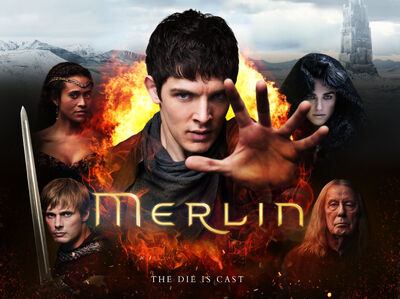
This week sees Merlin off on his own to help a Druid boy and his sick sister whilst the fearsome Sarram of Amata visits Camelot. Arthur seeks to forge an alliance with the unpredictable ruler but Gwen and Morgana have other, more fatal plans.
Merlin (Colin Morgan) is approached by a young Druid boy, Daegal (Alfie Stewart), for help with his sick sister. Unable to refuse, Merlin embarks on a dangerous journey to help the boy, leaving Gaius (Richard Wilson) to cover for him and his duties for Arthur (Bradley James). Meanwhile, Camelot is about to play host to a visit from the Sarrum of Amata (John Shrapnel), a ruler known for his violent tendencies and casual assassinations. The Sarrum forms a key part of Morgana's (Katie McGrath) new plan to kill Arthur and Gwen (Angel Coulby) is only too happy to help. With Morgana ensuring that Merlin can no longer meddle and save Arthur's life, will the once and future king finally meet his end? Well, not just yet.
In case you missed it, it was announced on Sunday night that this series of Merlin was indeed to be the last, confirming rumours that have been going around for a while now. Whilst this is obviously sad news, particularly as Merlin has really hit its stride over the last couple of series, the showrunners were always open about the fact that they saw this as a five-series arc and I think it's very wise of them to stick to their original plan. This does mean of course that we now go into the final few episodes with the knowledge that they are building towards what is hopefully going to be a spectacular finale and a fitting end to the story of this boy wizard.
Returning to this episode, the over-arching narrative of Gwen's evil transformation continue with another impressive performance from Coulby that conveys the character's malevolent intentions with resorting to pantomime menace. I really enjoyed the frankness with which she approached the assassination plans, declaring outright that she just wants her husband dead. It allowed a nice element of black humour to creep into the show and further builds her role into something more interesting than doting servant. The scene in which Merlin and Gwen size each other up, each continuing the lie behind his absence was also fantastic, with both Morgan and Coulby having a battle of wills through only their eyes.
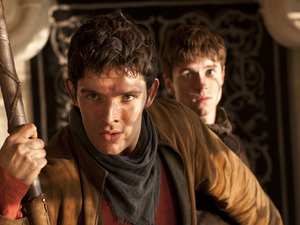
The story itself wasn't particularly groundbreaking beyond Gwen's obvious contributions but it does serve to highlight that Arthur really is a bit of a plank. After last week's poisoning (which could only have been committed by Gwen!) and this episode's failed assassination attempt, he's got to realise at some point that there is someone in the castle trying desperately to kill him. I mean, how many near-death experiences can one man take before he starts a stringent vetting system? However, the writers did build a huge amount of tension into it, particularly during the assassination itself which certainly made you question whether Arthur was going to get out of this one wound-free.
One aspect of the episode that was particularly good this week was the score. I've talked about the music before in Merlin though it is something that I do largely overlook (unless, as was the case before, the entire orchestra were doing their level best to tell me that Mordred was EVIL and SINISTER. Though still largely absent). This week, it worked well to build the tension, particularly towards the final scene and was an interesting mix of nursery rhyme style melodies and the usual string-led crescendos.
For the most part, this was a solid episode, progressing the story further without resorting to quick, unsatisfying resolutions. The Evil Gwen plot continues to intrigue and, with the news of the close of Merlin's story, everything is starting to build towards a big finale. I just hope the writers can pull off something truly amazing that gives these great characters, and the actors who play them, a really good send off.
- Becky
You can Becky's review of The Dark Tower and A Lesson in Vengeance here.
Follow Becky on Twitter @beckygracelea
Or follow her blog beckygracelea.wordpress.com
Monday, 26 November 2012
Monday, 19 November 2012
TV REVIEW: Merlin - The Dark Tower & A Lesson In Vengeance
First of all, I must apologise for my lack of review last week, but unfortunately iPlayer ceased to work at all on my computer (and I missed it when it was on as I was watching Skyfall). However, I am now fully caught up and ready to comment, discuss and generally marvel at some of the worst and best we've seen of Merlin so far.
Yes, The Dark Tower held so much promise and looked like it was going to be an excellent episode that harked by to the really quite wonderful Death Song of Uther Pendragon. After an encounter with snakes conjured up by returning Morgana (Katie McGrath), Sir Leon (Rupert Young) and Sir Percival (Tom Hopper) are left poisoned by some weird magical affliction. But never fear! After a few minutes and some conveniently allotted exposition time, both knights are up, about and on yet another quest for this time, it is Gwen (Angel Coulby) who has been captured. Despite Merlin (Colin Morgan) warning him that this is an obvious trap, Arthur (Bradley James) is hellbent on rescuing his lady love, joining forces with her brother, Sir Elyan (Adetomiwa Edun - who quite honestly, I had forgotten both that he existed and that he was Gwen's brother).
There are many things wrong with this episode which is quite possibly the most infuriating so far of the current run. First and foremost, the sudden focus on Sir Elyan means that his demise at the end of the episode might as well have been flashed up in a gigantic neon sign. I've commented before that the knights are given little to do but ride gallantly and occasionally fight in slow motion and I was wondering whether it would be long before one of them found themselves stuck with the pointy end of a weapon. Sir Elyan has probably suffered most for this as a character, thus giving his death scene absolutely no emotional impact. Bye Elyan, we barely knew ye.
That's just one of many silly things in this episode though that I won't go into individually because I'd be here all day, but the main one had to be the twist ending with Gwen seemingly allying herself with Morgana. Really? REALLY? Had we had a brief scene in which it became apparent that Morgana had enchanted Gwen, then fine, that would make sense. A scene in which Morgana somehow manages to persuade Gwen completely that Arthur is a bad guy? A bit implausible given the characters' history but still would have made the twist work. Having it come out of the blue was just stupid, like the writers just ran out of ideas and decided to throw an M. Night Shyamalan. The optimist in me wants to assume that this is how they'll eventually cover Gwen's betrayal of Arthur, leading to his downfall. In the myths, that's caused by an affair with Lancelot whilst Arthur's away questing, but since they sort of killed off the character, this could be a way for the writers to re-appropriate that particular plot. We shall see.
As ever, the episode was redeemed by the performances, particularly Coulby as the terrified and helpless Gwen and her scenes with Katie McGrath were highlights. Likewise, Colin Morgan and Bradley James continue to excel in their respective roles, adding weight to an otherwise messy and slightly silly episode.
Thankfully, A Lesson in Vengeance was somewhat of an improvement, thankfully not involving a quest but a plot to kill the king. After a nasty tumble of his horse, Arthur discovers that his saddle has been tampered with ad suspicion falls on poor stable hand Tyr (John Bradley of Games of Thrones fame). Arthur is forced to sentence the boy to death as the evidence appears conclusive but Merlin has his own thoughts on the matter and suspects Gwen, Morgana's brand new puppet, to be involved.
While the performances of all concerned are usually excellent, this week's were absolutely outstanding. Colin Morgan doesn't often get singled out for praise as he is often so good as the strong centre of the episode that you tend to forget just how good he is. This week, he completely stole the show with a welcome return from Old Merlin, who gets some of the best lines as he takes on the cook, and a heartfelt attempt to save Arthur's life. We have been shown often of the bond between Merlin and Arthur but rarely do we see what would happen should one of them cease to be. When he believed Arthur to be dead, Merlin's grief was completely overwhelming, both for the character and the audience. It was the first time he seemed at all powerless and Morgan played the moment well.
Elsewhere, we get another good performance from Angel Coulby, channeling Evil Gwen to produce something quite sinister and thankfully lacking in Morgana-style evil smirks. Because Gwen has always been so benevolent, the scene in which she murders Tyr to cover her own back was shocking and disturbing, showing how far Gwen had fallen. The plot did let her down somewhat though as it was something we have seen many times before. Someone we're supposed to trust tries to kill the King, Merlin figures it all out but gets the blame and then saves the day anyway. Granted, having Gwen as the perpetrator definitely skewed things a little but the formula has been used many times before.
I am glad that they didn't solve the Gwen mystery just yet though as it gives us something to look out for and watch progress over the next episode at least. If they do tie it into the original myth, I'll be very interesting to see how it is done as Guinevere's betrayal is a fundamental aspect to the Arthur legend and it would be disappointing if they didn't cover it in some way.
Overrall, A Lesson in Vengeance was a decent episode, not as good as The Death Song of Uther Pendragon (which remains my favourite episode of Merlin this series, possibly ever) but it moved the narrative along nicely and showcased the talents of this ever-improving cast.
But seriously, where is Mordred?
- Becky
You can read Becky's review of The Disir here.
Follow Becky on Twitter @beckygracelea
Or follow her blog beckygracelea.wordpress.com
Yes, The Dark Tower held so much promise and looked like it was going to be an excellent episode that harked by to the really quite wonderful Death Song of Uther Pendragon. After an encounter with snakes conjured up by returning Morgana (Katie McGrath), Sir Leon (Rupert Young) and Sir Percival (Tom Hopper) are left poisoned by some weird magical affliction. But never fear! After a few minutes and some conveniently allotted exposition time, both knights are up, about and on yet another quest for this time, it is Gwen (Angel Coulby) who has been captured. Despite Merlin (Colin Morgan) warning him that this is an obvious trap, Arthur (Bradley James) is hellbent on rescuing his lady love, joining forces with her brother, Sir Elyan (Adetomiwa Edun - who quite honestly, I had forgotten both that he existed and that he was Gwen's brother).
There are many things wrong with this episode which is quite possibly the most infuriating so far of the current run. First and foremost, the sudden focus on Sir Elyan means that his demise at the end of the episode might as well have been flashed up in a gigantic neon sign. I've commented before that the knights are given little to do but ride gallantly and occasionally fight in slow motion and I was wondering whether it would be long before one of them found themselves stuck with the pointy end of a weapon. Sir Elyan has probably suffered most for this as a character, thus giving his death scene absolutely no emotional impact. Bye Elyan, we barely knew ye.
That's just one of many silly things in this episode though that I won't go into individually because I'd be here all day, but the main one had to be the twist ending with Gwen seemingly allying herself with Morgana. Really? REALLY? Had we had a brief scene in which it became apparent that Morgana had enchanted Gwen, then fine, that would make sense. A scene in which Morgana somehow manages to persuade Gwen completely that Arthur is a bad guy? A bit implausible given the characters' history but still would have made the twist work. Having it come out of the blue was just stupid, like the writers just ran out of ideas and decided to throw an M. Night Shyamalan. The optimist in me wants to assume that this is how they'll eventually cover Gwen's betrayal of Arthur, leading to his downfall. In the myths, that's caused by an affair with Lancelot whilst Arthur's away questing, but since they sort of killed off the character, this could be a way for the writers to re-appropriate that particular plot. We shall see.
As ever, the episode was redeemed by the performances, particularly Coulby as the terrified and helpless Gwen and her scenes with Katie McGrath were highlights. Likewise, Colin Morgan and Bradley James continue to excel in their respective roles, adding weight to an otherwise messy and slightly silly episode.
Thankfully, A Lesson in Vengeance was somewhat of an improvement, thankfully not involving a quest but a plot to kill the king. After a nasty tumble of his horse, Arthur discovers that his saddle has been tampered with ad suspicion falls on poor stable hand Tyr (John Bradley of Games of Thrones fame). Arthur is forced to sentence the boy to death as the evidence appears conclusive but Merlin has his own thoughts on the matter and suspects Gwen, Morgana's brand new puppet, to be involved.
While the performances of all concerned are usually excellent, this week's were absolutely outstanding. Colin Morgan doesn't often get singled out for praise as he is often so good as the strong centre of the episode that you tend to forget just how good he is. This week, he completely stole the show with a welcome return from Old Merlin, who gets some of the best lines as he takes on the cook, and a heartfelt attempt to save Arthur's life. We have been shown often of the bond between Merlin and Arthur but rarely do we see what would happen should one of them cease to be. When he believed Arthur to be dead, Merlin's grief was completely overwhelming, both for the character and the audience. It was the first time he seemed at all powerless and Morgan played the moment well.
Elsewhere, we get another good performance from Angel Coulby, channeling Evil Gwen to produce something quite sinister and thankfully lacking in Morgana-style evil smirks. Because Gwen has always been so benevolent, the scene in which she murders Tyr to cover her own back was shocking and disturbing, showing how far Gwen had fallen. The plot did let her down somewhat though as it was something we have seen many times before. Someone we're supposed to trust tries to kill the King, Merlin figures it all out but gets the blame and then saves the day anyway. Granted, having Gwen as the perpetrator definitely skewed things a little but the formula has been used many times before.
I am glad that they didn't solve the Gwen mystery just yet though as it gives us something to look out for and watch progress over the next episode at least. If they do tie it into the original myth, I'll be very interesting to see how it is done as Guinevere's betrayal is a fundamental aspect to the Arthur legend and it would be disappointing if they didn't cover it in some way.
Overrall, A Lesson in Vengeance was a decent episode, not as good as The Death Song of Uther Pendragon (which remains my favourite episode of Merlin this series, possibly ever) but it moved the narrative along nicely and showcased the talents of this ever-improving cast.
But seriously, where is Mordred?
- Becky
You can read Becky's review of The Disir here.
Follow Becky on Twitter @beckygracelea
Or follow her blog beckygracelea.wordpress.com
Sunday, 18 November 2012
SERIES REVIEW: The Paradise
It only ended a few days ago, and I already miss
it.
I’m talking, of course, about The Paradise, product of the BBC’s latest rummage through the
period drama cupboard. Based on an Emile Zola novel and with Sarah Lancashire amongst
the corset bearing cast – it was always going to be good.
The storyline follows Denise, a young shop girl
from Peebles as she embarks on a new life in the city, as well as a new job in
local department store, The Paradise.
The shop is run, naturally, by a devilishly handsome, clever man named Moray
who, naturally, she falls wholeheartedly in love with rather quickly. The
enigmatic Moray, however, is, naturally, engaged to manipulative neighbourhood
gentry type Katherine Glendenning (Elaine Cassidy), who, hell bent on making
Moray love her back no matter what the cost, will stop at nothing to get her
way. Throw in a fantastic supporting cast of other shop workers, including the
aforementioned Ms Lancashire, Stephen Wight and period drama veteran Ruby Bentall,
and a guest appearance from Arthur
Darvill for good measure, and you’ve got the makings, it would seem, of a very
good show.
And lo, it was indeed good. Emun Elliott is
brilliant as the seductive, charming Moray, perfectly capturing the torment of
a man caught between respectability, success and his own feelings with none of
the usual maudlin stiff upper lip, sense of responsibility frequently bestowed
upon us by dramas of the genre. The man never stops smiling, or winking, or
generally looking rather animated for longer than ten seconds throughout the
entire series. At worst, he gets a bit angry – a welcome change from, in my
view anyway, the expressionless men of BBC2’s Parade’s End of a few months back. Joanna Vanderham is adorable as
Denise, refreshingly clever for a period female lead, whilst remaining a
caring, kind and ultimately three dimensional person. Again, and I can't say the word enough it seems, all very
refreshing.
The older characters and generally formal
dialogue, however, keep it safely the other side of the comforting ‘in another
time’ line, making the series, I found, perfect cosy night or lazy Saturday
viewing. It’s also oddly engrossing, possibly because of the team like, homely
atmosphere of the department store, as well as the engaging nature of the
characters’ relationships with each other. The, albeit brief, appearance of the
insanely versatile and ever talented Arthur Darvill didn’t hurt either.
My only real criticism of the show, and I seem to
find myself saying this rather a lot about dramas, so apologies for the
repetition, is the ending. Having led us by the hand into this interesting,
poignant and sweetly funny world, the production team seemed to suddenly let go
and disappear off into the night at the last moment, credits rolling behind
them. Happy and again, very safe, though the ending was, it came about all too
quickly and gave no real sense of resolution or character depth. Which was a
huge shame, really, as I haven’t got a bad word to say about the rest of it.
Anyway, ignoring the irritatingly brief, and all too soon
ending, The Paradise is well worth a
catch on iplayer if you can. If not, the box set would make a lovely Christmas
present- even if you do only buy it for me.
-Jen
You can read more of Jen's writing here: https://memyselfandtheothers.wordpress.com/
Or you can follow her on twitter here: https://twitter.com/jenniferklarge
Monday, 5 November 2012
THEATRE REVIEW: The Merry Wives of Windsor
William Shakespeare's The Merry Wives of Windsor sees the return of one of his most famous creations, Sir John Falstaff (Desmond Barrit) as he attempts to woo Mistress Ford (Alexandra Gilbreath) and Mistress Page (Sylvestra Le Touzel). However, little does he know that the two women are as thick as thieves and hatch their own plot to avenge themselves on Falstaff, whilst Mistress Ford gets the chance to prove herself to her jealous husband (John Ramm). Meanwhile, Mistress Page's daughter, the lovely Anne (Naomi Sheldon) finds herself with three suitors, Master Slender (Callum Finlay), the choice of her father (Martin Hyder), Dr Caius (Bart Soroczyinski), her mother's choice and the outcast-yet-obviously-the-right-one choice, Master Fenton (Paapa Essiedu). In the midst of all these goings-on is Mistress Quickly (Anita Dobson), the only person who seems to have any clue as to what is actually happening.
The RSC production of The Merry Wives of Windsor is easily one of the most accessible performances of Shakespeare I've seen recently. Having no real knowledge of the plot, other than Falstaff's appearance, I had no idea of what to expect, nor of how everything was going to unfold. Well, that's not strictly true, it is a Shakespearian comedy after all. They only ever end one way; all of the fools get their comeuppance, the right people marry each other and everyone ends up happily ever after. The real skill in this production then, was making it the journey to that inevitable ending a really good one, full of pratfalls, witty one-liners and some truly hysterical visual jokes.
The necessity of establishing all of the characters with little or no introduction from the Bard himself is often one of the downfalls of the lesser known plays whereas characters like Hamlet or Macbeth are easily identifiable. The Merry Wives of Windsor does have an ace up its sleeve with the inclusion of the instantly-recognisable Falstaff but nevertheless, the performance got off to a slow start, not helped by the constant scenery changes. The modern-day setting was an interesting choice, allowing for a Merry Desperate Housewives of Windsor interpretation of the play, all middle-class dinner parties and tweed. Yet, unlike say the military setting of Ian McKellan's Richard III, this modernisation didn't really add anything to the play, it just made it easier for underwear-related jokes to be made a little more obviously.
Another downside to the updated setting was the decision to have a huge amount of scenery for each scene. With each new scene requiring several mechanical stage manoeuvres, including a bed appearing from underneath the floor, unnecessary rugby posts descending from the roof and a very unstable house frontispiece for the back of the stage, I found that every scene change took me straight out of the action. Granted, various scenes did not follow into each other but rather chopped and changed between the different subplots, but I found it very difficult to get back into a scene once I had been sat watching the scenery shift for over a minute. I was also sat in the upper circle which meant I could see the majority of the under-stage mechanics and it became very distracting. Shakespearian works never need to be over-produced and this production should have had a little more faith in its audience's imagination.
The Merry Wives of Windsor was very enjoyable, a funny, well-acted piece of entertainment that for the most part, honoured its source material and it would have been far better if the staging decisions had been stripped back to allow the exceptional cast to work their magic uncluttered and moving-scenery free.
*** (and a half for the most inventive use of melons in a Shakespearian production)
- Becky
You can find out more information on The Merry Wives of Windsor here.
Follow Becky on Twitter @beckygracelea
Or follow her blog beckygracelea.wordpress.com
TV REVIEW: Downton Abbey - Episode Eight
Once again, a series of Downton Abbey comes to an end with a slow-burning yet very entertaining and heartwarming episode that takes in sexual politics, baby problems, the Charleston, a madwoman in an attic asylum and a rather jolly cricket match.
Downton Abbey finales have always been overly dramatic affairs, in keeping with the series naturally but always going the extra mile to make you shout 'WHAT?' at the screen whilst throwing that cup of tea you made in the advert break all over yourself. In the first series, it was the breakdown of the Mary and Matthew relationship, Cora's miscarriage and the outbreak of World War One whilst the second saw Bates arrested, the further breakdown of Mary and Matthew's relationship and Sybil running off with the chauffeur. The third finale had a lot to live up to but whilst it wasn't necessarily as dramatic or as shocking as what had come before, it was a fantastic end to the series with every required ingredient that is loved about Downton.
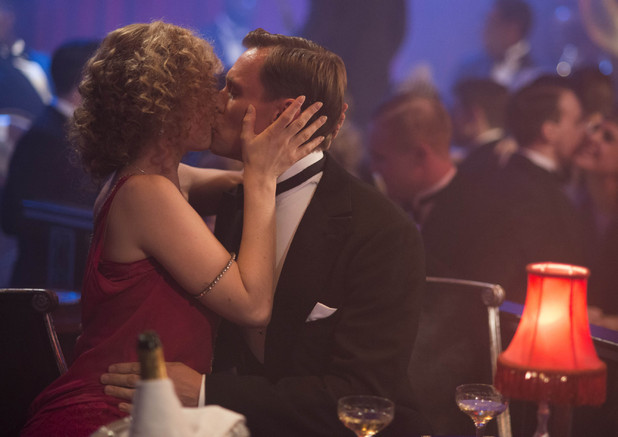
After the kiss last week, Thomas (Rob James-Collier) finds himself preparing to leave Downton as Carson (Jim Carter) is blackmailed into forcing him to go without a reference by spurned footman James (Ed Speleers) who is in turn having his strings pulled by Miss O'Brian (Siobhan Finneran). Thomas finds himself with an unlikely ally in the returning Mr Baaates (Brendan Coyle) who works with Mrs Hughes (Phyllis Logan) and Lord Grantham (Hugh Bonneville) to ensure that the former valet gets to remain at Downton. Meanwhile, Matthew (Dan Stevens) and Branson (Allen Leech) push on with their plan to reform the estate, much to the Lord's chagrin and furthering the best bromance on television at the moment. Mary (Michelle Dockery) is taking herself off mysteriously to London at regular intervals with only Cora (Elizabeth McGovern) really knowing what's going on. The Crawleys take on babysitting duties for a relative, the wayward Lady Rose (Lily James) who is singlehandedly responsible for the lead-in to one of the funniest lines of the series. Edith (Laura Carmichael) continues to write her column but discovers a secret that might change her relationship with her editor and the Dowager Countess (Maggie Smith) and Mrs Crawley (Penelope Wilton) manage to find a suitable position for Ethel (Amy Nuttall) to start again. And then there's a cricket match!
That's a lot of plot but with an hour and a half runtime, Downton had a lot of stuff to get through and each narrative strand was just as entertaining as the next and although, as with the previous episode, the resolutions were pretty much a given, the real strength of this instalment was the writing. Maggie Smith is usually the actress gifted the most sublime one-liners but several characters got their moment to shine. Phyllis Logan's Mrs Hughes has always been the dependable sort and her reaction to Thomas' indiscretion were wonderfully non-stereotypical. The reaction of all the characters to Thomas in fact was a great running joke; apparently, his sexuality wasn't as well hidden as he probably thought it was. The best line of the night though had to go to Dan Stevens for his impeccable comic timing when the flappable Matthew came face to face with a 1920s jazz club: 'It's like the outer circle of Dante's Inferno'. Mr Stevens, I salute you.
Some of the specific plot points were also more to do with placing foundations than bringing certain storylines to a close. With Mary and Matthew now all biologically ready and raring to baby-make, I'd imagine that it won't be too long before Sybil Jr. has a cousin. Likewise, I don't think it will be the last we see of the Lady Rose either though she was more than a little irritating. Then again, with Sybil gone, the family needs another rebel in their midst. Perhaps the most intriguing though was Downton Abbey Does Jane Eyre in the form of the Edith/Editor narrative. Although she's initially shocked that her potential beau has a wife, the revelation that she's more Bertha Mason than Mrs Beeton means that Edith may be heading into another potentially controversial relationship. Let's hope this time, she doesn't get left at the altar (though of course if they continue to follow the Jane Eyre path, she'll do the altar-abandoning...).
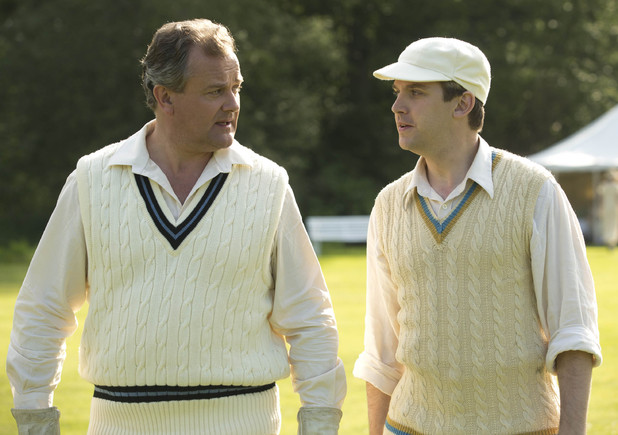
It may not have been as dramatic as its fellow finales, but it was all the better for its gentler pace and lack of major revelations. After some of the truly sad moments in this series, Sybil's death for example, it could have gone from bad to worse but I think that taking the show in a more positive and light-hearted direction was an excellent choice for the final episode. I'd previously thought that Downton could not be any more English if it tried, but then of course they decided to hold a cricket match. All it needed really was the mention of a ginger beer and we'd have some walking stereotypes on our hands (well, more so than we do already). The cricket match could have gone on for a bit longer in my opinion as it would have been hilarious to see Lord Grantham get all competitive and bluster across the wicket. The last-minute police confrontation felt like a very strange after-thougt; more of a quick tying up of loose ends than an actual, credible development. But the status quo is (sort of) restored and it looked like the House might finally beat the Village. Jolly good show indeed.
The final slow motion shot of Lord Grantham, Matthew and Branson going in for a hug was unbelievably cheesy but I could not help having the biggest grin on my face. Rather than eagerly awaiting the Christmas special for a resolution to a cliffhanger, I'm going to be looking forward to it as a regular televisual comfort blanket because when all is said and done, that it is exactly what Downton Abbey is and should be.
- Becky
You can read Becky's review of Episodes Six and Seven here.
Follow Becky on Twitter @beckygracelea
Or follow her blog beckygracelea.wordpress.com
Downton Abbey finales have always been overly dramatic affairs, in keeping with the series naturally but always going the extra mile to make you shout 'WHAT?' at the screen whilst throwing that cup of tea you made in the advert break all over yourself. In the first series, it was the breakdown of the Mary and Matthew relationship, Cora's miscarriage and the outbreak of World War One whilst the second saw Bates arrested, the further breakdown of Mary and Matthew's relationship and Sybil running off with the chauffeur. The third finale had a lot to live up to but whilst it wasn't necessarily as dramatic or as shocking as what had come before, it was a fantastic end to the series with every required ingredient that is loved about Downton.
After the kiss last week, Thomas (Rob James-Collier) finds himself preparing to leave Downton as Carson (Jim Carter) is blackmailed into forcing him to go without a reference by spurned footman James (Ed Speleers) who is in turn having his strings pulled by Miss O'Brian (Siobhan Finneran). Thomas finds himself with an unlikely ally in the returning Mr Baaates (Brendan Coyle) who works with Mrs Hughes (Phyllis Logan) and Lord Grantham (Hugh Bonneville) to ensure that the former valet gets to remain at Downton. Meanwhile, Matthew (Dan Stevens) and Branson (Allen Leech) push on with their plan to reform the estate, much to the Lord's chagrin and furthering the best bromance on television at the moment. Mary (Michelle Dockery) is taking herself off mysteriously to London at regular intervals with only Cora (Elizabeth McGovern) really knowing what's going on. The Crawleys take on babysitting duties for a relative, the wayward Lady Rose (Lily James) who is singlehandedly responsible for the lead-in to one of the funniest lines of the series. Edith (Laura Carmichael) continues to write her column but discovers a secret that might change her relationship with her editor and the Dowager Countess (Maggie Smith) and Mrs Crawley (Penelope Wilton) manage to find a suitable position for Ethel (Amy Nuttall) to start again. And then there's a cricket match!
That's a lot of plot but with an hour and a half runtime, Downton had a lot of stuff to get through and each narrative strand was just as entertaining as the next and although, as with the previous episode, the resolutions were pretty much a given, the real strength of this instalment was the writing. Maggie Smith is usually the actress gifted the most sublime one-liners but several characters got their moment to shine. Phyllis Logan's Mrs Hughes has always been the dependable sort and her reaction to Thomas' indiscretion were wonderfully non-stereotypical. The reaction of all the characters to Thomas in fact was a great running joke; apparently, his sexuality wasn't as well hidden as he probably thought it was. The best line of the night though had to go to Dan Stevens for his impeccable comic timing when the flappable Matthew came face to face with a 1920s jazz club: 'It's like the outer circle of Dante's Inferno'. Mr Stevens, I salute you.
Some of the specific plot points were also more to do with placing foundations than bringing certain storylines to a close. With Mary and Matthew now all biologically ready and raring to baby-make, I'd imagine that it won't be too long before Sybil Jr. has a cousin. Likewise, I don't think it will be the last we see of the Lady Rose either though she was more than a little irritating. Then again, with Sybil gone, the family needs another rebel in their midst. Perhaps the most intriguing though was Downton Abbey Does Jane Eyre in the form of the Edith/Editor narrative. Although she's initially shocked that her potential beau has a wife, the revelation that she's more Bertha Mason than Mrs Beeton means that Edith may be heading into another potentially controversial relationship. Let's hope this time, she doesn't get left at the altar (though of course if they continue to follow the Jane Eyre path, she'll do the altar-abandoning...).
The final slow motion shot of Lord Grantham, Matthew and Branson going in for a hug was unbelievably cheesy but I could not help having the biggest grin on my face. Rather than eagerly awaiting the Christmas special for a resolution to a cliffhanger, I'm going to be looking forward to it as a regular televisual comfort blanket because when all is said and done, that it is exactly what Downton Abbey is and should be.
- Becky
You can read Becky's review of Episodes Six and Seven here.
Follow Becky on Twitter @beckygracelea
Or follow her blog beckygracelea.wordpress.com
Sunday, 4 November 2012
TV REVIEW: Merlin - The Disir
Arthur has angered an ancient goddess and must quest (again) to avenge the death of a knight and face his accusers. Naturally things go wrong and Merlin has a tough decision to make about how to advise his king.
With reports of the death of one of Arthur's (Bradley James) oldest friends and a sorcerer, Osgar (Andrew Tiernan - who never plays a nice guy. Ever.), on the loose, the knights of Camelot venture out to wreak vengeance. In a confrontation with Osgar, Sir Elian (Adetomiwa Elun) and Sir Gwaine (Eoin Macken) get thrown about a bit and Arthur learns that an ancient trio of soothsayers, the Disir (Frances Tomelty, Sian Thomas, Helen Schlesinger) have cast a judgement upon him that will affect his destiny. In defending Arthur, Mordred (Alexander Vhalos) is injured and with Arthur seeking to save his new knight, Merlin (Colin Morgan) is forced to confront his own feelings regarding Mordred.
Well, after complaining that the knights weren't given anything to do in the last episode bar look pretty, the entire opening of the episode was devoted to banterous conversations from the residents of the Round Table. Hurrah! It was a good moment of levity, particularly in Mordred's hazing for his first quest, and allowed us to see a bit more of the wider cast. It didn't last too long though as the episode once again became predominantly a two-hander between the ever-excellent Bradley James and Colin Morgan.
Morgan's performance is always solid and was on display again here in his manipulation of Arthur with the biggest shocker of recent times; Merlin states openly that 'magic has no place in Camelot.' And he was doing so well! It's been apparent that we're moving towards the big revelation for Arthur that Merlin is one of the old religion's most powerful affiliates but we took another massive step back here. It was clear that Merlin considered this a worthy sacrifice for getting Mordred out of the way but in terms of development, it didn't necessarily feel like the right direction.
Speaking of Mordred, he's finally back in the picture after being largely absent for the last two episodes and without any real evidence, the music keeps telling us to hate him. The show's score has never been too invasive but this week, it felt like they needed to let us know that Mordred was SINISTER and DANGEROUS by increasing the volume every time he appeared on screen. In the big reveal scene when a very-alive Mordred is seen on the steps of the castle, the music was so loud and stereotypical that it distracted from any drama that the reveal had. It felt a bit like that moment in Kill Bill Vol.1 when The Bride sets eyes on Vernita Green for the first time and the Ironside theme music plays in a comical 'oh look she's angry' kind of way. Not the best association for a fantasy drama to have in one of its most dramatic moments.
Despite that distracting bit, it was, for the most part a solid episode, but it felt like it mostly made retrograde steps rather than developing the characters further. Whilst we get that Arthur now relies on Merlin's wisdom (we've had a scene in each episode so far, just to make sure we get it), the 'magic has no place' moment took the relationship back to earlier series. Likewise, Gwen seems to have gone from kick-ass warrior queen back to supportive, loyal servent Gwen, constantly telling Arthur how great a king he is. It's frustrating, because everything was going so well on both counts. Now I can't help but feel that is has some ground to make up.
Gwen looks to be getting a more central role next week (though admittedly this is through kidnapping so still not great) and is all set for a showdown with Morgana who seems to have an every-other-episode contract now. With some spooky happenings and Morgana's stare-of-death, let's hope it's a little more progressive than The Disir.
- Becky
You can read Becky's review of Another's Sorrow here.
You can follow Becky on Twitter @beckygracelea
Or follow her blog beckygracelea@wordpress.com
With reports of the death of one of Arthur's (Bradley James) oldest friends and a sorcerer, Osgar (Andrew Tiernan - who never plays a nice guy. Ever.), on the loose, the knights of Camelot venture out to wreak vengeance. In a confrontation with Osgar, Sir Elian (Adetomiwa Elun) and Sir Gwaine (Eoin Macken) get thrown about a bit and Arthur learns that an ancient trio of soothsayers, the Disir (Frances Tomelty, Sian Thomas, Helen Schlesinger) have cast a judgement upon him that will affect his destiny. In defending Arthur, Mordred (Alexander Vhalos) is injured and with Arthur seeking to save his new knight, Merlin (Colin Morgan) is forced to confront his own feelings regarding Mordred.
Well, after complaining that the knights weren't given anything to do in the last episode bar look pretty, the entire opening of the episode was devoted to banterous conversations from the residents of the Round Table. Hurrah! It was a good moment of levity, particularly in Mordred's hazing for his first quest, and allowed us to see a bit more of the wider cast. It didn't last too long though as the episode once again became predominantly a two-hander between the ever-excellent Bradley James and Colin Morgan.
Morgan's performance is always solid and was on display again here in his manipulation of Arthur with the biggest shocker of recent times; Merlin states openly that 'magic has no place in Camelot.' And he was doing so well! It's been apparent that we're moving towards the big revelation for Arthur that Merlin is one of the old religion's most powerful affiliates but we took another massive step back here. It was clear that Merlin considered this a worthy sacrifice for getting Mordred out of the way but in terms of development, it didn't necessarily feel like the right direction.
Speaking of Mordred, he's finally back in the picture after being largely absent for the last two episodes and without any real evidence, the music keeps telling us to hate him. The show's score has never been too invasive but this week, it felt like they needed to let us know that Mordred was SINISTER and DANGEROUS by increasing the volume every time he appeared on screen. In the big reveal scene when a very-alive Mordred is seen on the steps of the castle, the music was so loud and stereotypical that it distracted from any drama that the reveal had. It felt a bit like that moment in Kill Bill Vol.1 when The Bride sets eyes on Vernita Green for the first time and the Ironside theme music plays in a comical 'oh look she's angry' kind of way. Not the best association for a fantasy drama to have in one of its most dramatic moments.
Despite that distracting bit, it was, for the most part a solid episode, but it felt like it mostly made retrograde steps rather than developing the characters further. Whilst we get that Arthur now relies on Merlin's wisdom (we've had a scene in each episode so far, just to make sure we get it), the 'magic has no place' moment took the relationship back to earlier series. Likewise, Gwen seems to have gone from kick-ass warrior queen back to supportive, loyal servent Gwen, constantly telling Arthur how great a king he is. It's frustrating, because everything was going so well on both counts. Now I can't help but feel that is has some ground to make up.
Gwen looks to be getting a more central role next week (though admittedly this is through kidnapping so still not great) and is all set for a showdown with Morgana who seems to have an every-other-episode contract now. With some spooky happenings and Morgana's stare-of-death, let's hope it's a little more progressive than The Disir.
- Becky
You can read Becky's review of Another's Sorrow here.
You can follow Becky on Twitter @beckygracelea
Or follow her blog beckygracelea@wordpress.com
TV REVIEW: Downton Abbey - Episodes 6 & 7
In the aftermath of Sybil's sudden demise, Branson and Lord Grantham are at loggerheads, Matthew and Lord Grantham are at loggerheads and in fact, Lord Grantham falls out with just about everyone. Cora seeks to blame him, the Dowager Countess goes into damage repair, Bates is officially in the clear and Edith takes steps to escape her solitary lifestyle.
After the monumental upheaval that was the fifth episode ,which saw one of the most beloved characters leave the show, Downton Abbey seems to have scaled back quite a bit. Episode Six continued in the excellent vein established by its predecessor and was thankfully not as weepy or traumatic. Maggie Smith has never given a bad performance in the show and here, she was excellent again, attempting to solve the marital difficulties between Cora and Robert.
Whilst it handled it excellently, the episode was very much a foundation for the conflicts that are to arise for the remainder of the third series. They say you should never talk about religion at a dinner party though Lord Grantham was sort of asking for it by inviting the local Reverend round in an attempt to convince Branson that the christening should not be a Catholic ceremony. However, he failed to understand the power of the Crawley women en masse and the poor Reverend found himself made a complete fool of by the girls and Branson. It was a great scene, written well for the characters and allowing the Dowager Countess to once again steal the show.
Elsewhere, Matthew is still campaigning for his estate reformation though much of it is falling on the deaf ears of Lord Grantham who appears to be doing the 1920s equivalent of sticking his fingers in his ears and repeating 'la la la' at a loud volume until Matthew goes away. Though of course Matthew is right, because he's Matthew and he's awesome and I'm getting carried away again. Nevertheless, there's still an issue here and the treatment of the estate is fast becoming the most symbolic presence of the twentieth century in Downton. Whilst Lord Grantham represents the stoic attitudes of his predecessors, Matthew's middle-class pragmatism demonstrates the need for change. It's always been an interesting dynamic and one that is being continually brought to the fore after the first episode's insistence of the oncoming modernisation of the post-war era.
Whilst it handled it excellently, the episode was very much a foundation for the conflicts that are to arise for the remainder of the third series. They say you should never talk about religion at a dinner party though Lord Grantham was sort of asking for it by inviting the local Reverend round in an attempt to convince Branson that the christening should not be a Catholic ceremony. However, he failed to understand the power of the Crawley women en masse and the poor Reverend found himself made a complete fool of by the girls and Branson. It was a great scene, written well for the characters and allowing the Dowager Countess to once again steal the show.
Elsewhere, Matthew is still campaigning for his estate reformation though much of it is falling on the deaf ears of Lord Grantham who appears to be doing the 1920s equivalent of sticking his fingers in his ears and repeating 'la la la' at a loud volume until Matthew goes away. Though of course Matthew is right, because he's Matthew and he's awesome and I'm getting carried away again. Nevertheless, there's still an issue here and the treatment of the estate is fast becoming the most symbolic presence of the twentieth century in Downton. Whilst Lord Grantham represents the stoic attitudes of his predecessors, Matthew's middle-class pragmatism demonstrates the need for change. It's always been an interesting dynamic and one that is being continually brought to the fore after the first episode's insistence of the oncoming modernisation of the post-war era.
In Episode Seven, Branson's brother comes to stay and causes a bit of a stir as Branson decides that he will go reside with him in Liverpool with Sybil Jr while Lord Grantham huffs and puffs a bit. Again. Matthew locks horns with Lord Grantham over the management of the estate and manages to offend the existing estate agent while eventually winning the argument. Edith goes on a date with her new editor as she prepares to write her column and finally looks as if she's going to enjoy herself for at least a little while.
For a series that has been pretty great so far, the penultimate episode was actually pretty lacklustre in its predictability. The central conflicts that had been developing in the previous episode just sort of fizzled out, without any real explosion or argument. The issue of the state in particular had practically signposted episodes earlier that it was going to be the way in which Branson stayed at Downton Abbey. The christening was always going to go Branson's way, as predicted by Mary, and additionally, the return of Mr Bates had all the dramatic tension of a damp newspaper seeing as it was inevitable anyway.
One plotline that still has great potential though is the developing relationship between footman Jimmy and everyone's favourite panto villain, Thomas. Although we predicted in an earlier review that their relationship might be of a romantic nature, Julian Fellowes is still toying with us. The scene between Thomas and Mr Carson in the aftermath of the kiss was excellent from the knowing way that Carson handled the issue to James-Collier's performance. He's long been one of the standout actors and it is always good to see him given something else to do other than plot and scheme with O'Brian. It also offers Downton an opportunity to explore the issue of homosexuality in that time period and how vilified it was. But then again, that kiss was not necessarily one-sided... Could it be a case of Jimmy protesting too much or is he genuinely so disgusted by Thomas that he'll get him fired?
Another plus point of this episode was Hugh Bonnville's performance; despite all of his incredulity, Lord Grantham is forced into giving way on just about everything he disagreed with in previous episodes this time and Bonneville is managing to make his performance thankfully more than one note. The christening in particular was a fine exhibition of both his dramatic and comedic skills and was a nice, gentle scene with which to end the episode.
One plotline that still has great potential though is the developing relationship between footman Jimmy and everyone's favourite panto villain, Thomas. Although we predicted in an earlier review that their relationship might be of a romantic nature, Julian Fellowes is still toying with us. The scene between Thomas and Mr Carson in the aftermath of the kiss was excellent from the knowing way that Carson handled the issue to James-Collier's performance. He's long been one of the standout actors and it is always good to see him given something else to do other than plot and scheme with O'Brian. It also offers Downton an opportunity to explore the issue of homosexuality in that time period and how vilified it was. But then again, that kiss was not necessarily one-sided... Could it be a case of Jimmy protesting too much or is he genuinely so disgusted by Thomas that he'll get him fired?
Another plus point of this episode was Hugh Bonnville's performance; despite all of his incredulity, Lord Grantham is forced into giving way on just about everything he disagreed with in previous episodes this time and Bonneville is managing to make his performance thankfully more than one note. The christening in particular was a fine exhibition of both his dramatic and comedic skills and was a nice, gentle scene with which to end the episode.
Other than the final scenes between Jimmy and Thomas, which could lead to some interesting issues being presented, there just seemed to be a lack of spark in the episode this time.
- Becky
You can read Becky's review of Episode Five here.
Follow Becky on Twitter @beckygracelea
Or follow her blog beckygracelea.wordpress.com
- Becky
You can read Becky's review of Episode Five here.
Follow Becky on Twitter @beckygracelea
Or follow her blog beckygracelea.wordpress.com
TV REVIEW: Merlin - Another's Sorrow
This week, Morgana is back in the game as she carries out a fiendish deception that fools the entirety of Camelot, including Merlin, in order to trap Arthur and kill him once and for all.
After Odin (Fintar McKeown), an old enemy of Camelot, takes the country of Princess Mithian (Janet Montgomery) and captures her father (James Fox), it becomes apparent that it's another plan from Morgana (Katie McGrath). With Mithian as captive, Morgana heads to Camelot and deceives Arthur (Bradley James) and Merlin (Colin Morgan) with her old woman guise. The knights set out to rescue the King but Morgana's trap lays in wait.
For more casual fans of the series, it may not have been obvious that this episode saw the return of several old faces. As was oft-repeated, Odin has been Arthur's sworn enemy for a while now, after Arthur killed his son way back in the second series and then retaliated by killing Uther. Princess Mithian also returns, having escaped an engagement to Arthur in the last series; their relationship isn't really commented on by any party but the gallant king naturally rushes to her aid when she asks for it.
Which leads us on to the next discussion point; old Morgana. We've already seen ageing spells with Merlin (who makes a very convincing and funny old man) and now it is Katie McGrath's turn. Rather than the comical and mischievous performance that Colin Morgan gives, McGrath goes full sinister, creeping and skulking about whilst controlling the entire situation. It's an impressive display and one that further demonstrates McGrath's development. It does help that her character is finally written for a bit more successfully (likewise with Gwen) which gives both actresses more to work with. There was also a lovely, rare moment between Arthur and Gwen (Angel Coulby) which shows how their relationship has progress in marital bliss.
However, for the most part, this episode has been the most lacklustre of the series, devoid of the tension that had made the first three episodes so compelling and generally not as involving as many previous episodes. The plot was as transparent as one of the castle's anachronistic windows and held little in the way of actual excitement. The Odin-Arthur feud was more than a little strained, although I was pleasantly surprised by the outcome. And when are people going to start listening to Merlin when he has a bad feeling. He's a wizard and he's ALWAYS right.
What is also beginning to look a little odd is the lack of interaction with Arthur's knights. I mean, these are some of the most famous Sirs in history, Gwaine and Percival in particular, and yet they barely have a line; they just skulk awkwardly in the back of scenes. Eoin Macken has always been a highlight as the rakish Gwaine and is afforded a couple of lines and an admittedly welcome cheeky grin, but it's a far cry from the time he has been given in earlier episodes. Also, much was made about Mordred's threat to Arthur but he's barely been seen since, not even appearing in this episode. Some of my favourite moments in past episodes have been the interaction between the excellent ensemble cast but they've been reduced to set-dressing.
The next episode will hopefully correct some of these niggles and also apparently features the magical version of the Black Spot. Arthur could be in trouble... will Merlin be there to save him? Well, yes.
- Becky
You can read Becky's review of The Death Song of Uther Pendragon here.
You can follow Becky on Twitter @beckygracelea
Or follow her blog beckygracelea.wordpress.com
What is also beginning to look a little odd is the lack of interaction with Arthur's knights. I mean, these are some of the most famous Sirs in history, Gwaine and Percival in particular, and yet they barely have a line; they just skulk awkwardly in the back of scenes. Eoin Macken has always been a highlight as the rakish Gwaine and is afforded a couple of lines and an admittedly welcome cheeky grin, but it's a far cry from the time he has been given in earlier episodes. Also, much was made about Mordred's threat to Arthur but he's barely been seen since, not even appearing in this episode. Some of my favourite moments in past episodes have been the interaction between the excellent ensemble cast but they've been reduced to set-dressing.
The next episode will hopefully correct some of these niggles and also apparently features the magical version of the Black Spot. Arthur could be in trouble... will Merlin be there to save him? Well, yes.
- Becky
You can read Becky's review of The Death Song of Uther Pendragon here.
You can follow Becky on Twitter @beckygracelea
Or follow her blog beckygracelea.wordpress.com
Labels:
Angel Coulby,
Arthur,
BBC,
Bradley James,
Colin Morgan,
Eoin Macken,
Fintar McKeown,
Guinevere,
Gwaine,
James Fox,
Janet Montgomery,
Katie McGrath,
Merlin,
Morgana,
Richard Wilson
Friday, 2 November 2012
FILM REVIEW: Skyfall
Skyfall, the third Bond film with
Daniel Craig playing the infamous title role and the first with Sam Mendes at
the helm, has a release date which marks the 50th anniversary of Dr No- the first ever Bond film.
As
well as being charmingly placed historically, it’s also the film MGM
productions hoped would drag them out of past financial troubles, bounce back
from the utterly plot lacking Quantum Of
Solace (2008), as well as aiming to attract both old and new fans alike.
So no pressure then.
Fortunately,
it achieves nearly everything on its to-do list with flying colours. Despite
the attempt towards a sort of 21st Century Bond from the very
beginning of the Daniel Craig era, this one comes the closest, whilst still remaining
witty, visually spectacular, engaging and, honestly-really good fun.
Without
wishing to give too much away, the film opens on James and fellow MI6 agent
Eve, sharply played by the wonderful Naomie Harris, as they chase a shady
looking character who just so happens to have the details of every double agent
lodged in a terror cell the world over. When ordered to ‘take the bloody shot’
by a deliciously ruthless M (Judi Dench), Eve accidentally hits her fellow
agent, rendering him ‘missing presumed dead’. He proceeds to enjoy the quiet
life in a way only James Bond really could, only returning to London to report
for duty when he learns of an attack on MI6 HQ, right in the heart of London.
Once
back, he meets the brand new and brilliantly nerdy Q, played by Ben Whishaw, as
well as Mallory (Ralph Fiennes), the new Security chairman. M then makes the questionable
decision to send the damaged Bond back out into the field in search of the
perpetrator of the attack, who she suspects is someone she used to know- a
journey which also takes Bond rather further back into his own past than we’ve
seen before.
Several
sensitively placed innovative camera tricks at key moments make this a
beautifully shot film, with impressive set pieces and locations on a huge
scale. It also has far more of a storyline than several of its predecessors, as
we are drip fed equal parts subtle and not so subtle hints along the way, with
a couple of juicy twists thrown in for good measure. It also does a lot more
thematically than I anticipated, with dialogue tropes and metaphors referencing
the overall narrative arc and feeding into it. It is also well paced, and, for
the most part, satisfying for fans and newcomers both.
Hugely
pleasing for Londoners, Skyfall follows
on nicely from this Summer’s spotlight on the capital, with many key moments
happening in all too familiar locations. Residents will particularly enjoy rush
hour scenes, which, although not nearly busy enough, give audiences a chance to
see Bond in an everyday world he, for all his competencies and skills in the
field, knows very little about.
Also
on the plus column were director Sam Mendes’ fine cast. Naomie Harris’
character brings a lot to the franchise for female fans, with her sparky and
assertive performance- a presence only added to by the formidable figure of
Judi Dench’s M. We’re far from there yet ladies, don’t be over hasty with the bunting,
but there were a couple of moments in Skyfall,
which I count as at least one more than in any other Bond film, where it
almost, almost felt as if Bond were
having a professional conversation with fellow people, as opposed to the
stereotypical subordinate sex objects and bossy matriarchs we’ve seen before. Phallic
symbols and naked women were kept to a tasteful minimum in the title, treatment
of the Foreign was less horrifically problematic than usual, and Judi Dench was
used to her full potential for the first time since her “because I think you're
a sexist, misogynist dinosaur” opening speech back in Goldeneye. Ben Whishaw’s young, floppy haired Q also added a lovely
new dynamic, softly manoeuvring the spy genre out of the macho boys’ club it so
often becomes.
Skyfall is a well-made and emotionally
arresting film, which I was able to enjoy without the usual concern for ‘the
Other’ that the Bond franchise usually induces.
My only real worry, and with it my only real criticism, is the end. There are heaps of fan pleasing moments, self-referential jokes and clever little winks to the audience, true. And plot wise, it’s damn near close to perfect. All boxes are ticked, and the story is taken full circle whilst simultaneously moving forward to a new era.
I
am proud to call myself a fan of the Bond franchise, but as well as this I’m
also a woman, and, most days at least, a woman with a brain. On a personal
level, I was bitterly disappointed that, having made so much progress in a positive direction, it was all taken away again at the last moment. Frankly I’d
dearly love to be able to enjoy the films just as much as the boys without having
to switch my brain off, constantly waiting to be returned to the ‘norm’ of a
subordinate position.
So
as a fan, I loved it. A satisfying story, well put together, with fantastic set
pieces, emotional moments and witty lines in equal abound. As a woman, however
it all niggled just a little.
It
seems a grave shame that one always seems to be at the other one's expense.
****
(and a half, for the niggle)
Jen
You
can read more of Jen's writing here: https://memyselfandtheothers.wordpress.com/
Or you can follow her on twitter here: https://twitter.com/jenniferklarge
Subscribe to:
Posts (Atom)


