Sunday, 31 March 2013
TV REVIEW: Doctor Who - The Bells of Saint John
Doctor Who returns for the second part of its seventh series run and follows on from the events of the excellent Christmas special The Snowmen (you can read Jen's review of that here). Clara Oswald (Jenna-Lousie Coleman) is now a nanny in London 2013, looking after the children of a family friend. When she runs into some trouble with 'the internet', she calls a helpline and is put straight through to The Doctor (Matt Smith) who just happens to be hiding out in a monastery in 1207. He's a monk now. Monks aren't cool. Meanwhile, the problem with the internet isn't limited to Clara's laptop as people all over London are being uploaded into a mysterious corporation's database, heading by Miss Kislet (Celia Imrie).
Jenna-Louise Coleman continues to delight as new companion Clara, the modern version this time, immediately establishing herself as a great foil to Matt Smith and importantly, she's very different from the Ponds. Though I'm personally still getting over losing Rory, Clara is just too much fun to dislike and I'm looking forward to her future adventures and the discovery of why she keeps dying. Smith remains a magnetic presence as the Doctor and though a couple of his ticks have become a little wearing, he still captures both the light-hearted and darker sides to the Doctor well. His determination to keep Clara alive again was touching whilst the line 'I can't tell the future, I just work there' was a cracker, delivered perfectly.
Whilst the central pair quite rightly command the majority of the attention, there was such a great supporting cast, particularly Celia Imrie's wonderful Miss Kislet. Calm and collected, she was an excellent bad guy and props must also be given to the many extras who had to provide impressions of her as they did well to capture her tone. Kislet may have been restored to her factory settings but can we please have her back again? She was just brilliant. There was also a most welcome return for Richard E. Grant as the Great Intelligence. In fact, I was so pleased to see him back, I may have let out an involuntary squeak. Now that we have an established Big Bad for the series, I'm guessing we're going to see more of him which is a big plus. No one does icy villainy better than Mr Grant (sorry Celia).
Opening with a direct-to-camera warning, the parallels to Moffat's previous triumph, Blink, were clear, as were the narrative connections to the techno-paranoia of Charlie Brooker's Black Mirror. Technology in this series can often be the enemy and it was so once again here; this time it was the potential terror of the wifi network. With well-trod themes of lost identity and entrapment, the story was surprisingly fresh. New director Colm McCarthy, managed to keep a tight rein on the packed storyline that, whilst full, did not overstay its welcome. As Jen and I have often observed in our reviews, Doctor Who is often the victim of its runtime, delivering an action-packed build-up but falling spectacularly in the denouement. Here though, The Bells of St John built the story well and provided a satisfactory ending without it feeling rushed or scrambled.
One of the most joyous things about this episode were all the neat touches that Moffat threw in. There were lots of little jokes, including the source of 'the bells of Saint John' and some wonderful lines thrown in here and there. There were also potential clues hidden in the episode. From the 'eleventh chapter' to the book being written by an Amelia Williams, there were plenty for avid followers to pick up on. Plus, there was a welcome return for the fez. Fezzes are cool. Naturally, there will nevertheless be a dissection of these references, but whether they're signifiers for future events or not, it was a lot of fun for a fan to sit and spot them all.
- Becky
You can follow @AssortedBuffery on Twitter or like our Facebook page.
FILM REVIEW: Trance
One of the most fascinating things about Danny Boyle is he is a man who doesn't seem to visit the same genre twice, ensuring that you're never entirely sure what to expect from him next. Off the big screen, it's been a big couple of years for the director, what with that Olympic Ceremony, and his foray into theatre with his excellent adaptation of Mary Shelley's Frankenstein. During that period, he managed to set aside some time to direct a film; that film is Trance, bursting on to the scene with the same dark, twisted energy that announced Boyle as a startling new film-maker with Shallow Grave, nineteen years ago.
The parallels with Shallow Grave don't end there, following the (mis)fortunes of three lead characters, tied together by a central MacGuffin. In the earlier film, the events revolved around three friends and a briefcase of money, but in Trance, its three relative strangers who become linked to a valuable painting, Goya's Witches in the Air. Simon (James McAvoy) is the inside man, an art auctioneer with a gambling problem that he can't afford to pay off. Seeing the painting as his way out, he enlists the help of gangster Franck (Vincent Cassel) to steal it, but during the heist, the painting goes missing. Simon is the only person who knows the location but unfortunately, a blow to the head ensures he forgets where he has stashed the painting. Despearate to get his painting back, Franck enlists the help of an enigmatic hypnotherapist, Elizabeth (Rosario Dawson) to delve into Simon's mind and help him retrieve the memory.
The heist itself is impressively staged, with a thudding soundtrack from Underworld's Rick Smith to help the proceedings while the introductory monologue from Simon allows a few neat jokes to be made at the auction house's expense. It also sets the tone for the rest of the film in terms of its aesthetics; everything is bright and shiny, yet with a darker, grittier undercurrent that comes more to the fore as the proceedings continue. Boyle has always showcased his settings well and London in Trance is no different, offering a background in hues of blue, orange and red to create that glossy sheen. The screenplay by Joe Ahearne and John Hodge builds upwards from the heist, layering scenes based in reality and Simon's mind upon each other, with hidden meanings revealed brilliantly later.
At first, certain signifiers make it quite easy to be able to distinguish reality from Simon's trances but once those lines become blurred in Simon's own head, it does too for the audience. At first, this is well-utilised by Boyle to obfuscate the situation for the audience, ensuring that you are completely involved in trying to decipher meanings and symbols. It is baffling, mesmerising and infuriating all at once and for the most part, Boyle handles it well, utilising all of these things at once to create a palpable tension. It is always refreshing to watch a film that credits its audience with intelligence but unfortunately, sometimes it does go too far and errs on the side of alienating, dragging you out of the scene as you try desperately to figure out what is happening.
It also isn't helped by the fact that, while all ridiculously good-looking, the three lead characters just aren't all that likeable. The actors are all excellent, but McAvoy and Cassel are outshone by Dawson's calm and measured performance as the enigmatic hypnotherapist. Trusted with far more to do than any film I've seen her in previously, Dawson's Lamb runs the gamut of archetypes, from femme fatale to victim and everything in between. However, there's only so much about these characters that you can relate to in their beautiful apartments, rich lifestyles and soaring careers.
Then there is the dizzying final act that redeems the small flaws of the film. Like a well-placed punch to the stomach, the denouement is not designed to knock you out but will definitely cause you to stagger. As the three leads shift and change, so too do your loyalties until you're not entirely sure who you're meant to be rooting for or even if you are meant to root for anyone at all. After various twists, about-turns and shifts in direction, the big reveal not only packs a narrative punch, but also an emotional one with a motivation that inspires both sympathy for one character and revulsion for another. Whether you've predicted this outcome or not (I did to a certain extent), it can't be denied that the performances of the three leads keep you engrossed whilst Boyle focuses the camera in on them so much that you don't really have much of a choice.
Despite its flaws, Trance is a labyrinth of a film and a work of great imagination. It doesn't quite match the heights of Boyle's previous work but it is entertaining and puzzling enough to keep you interested. As you fall deeper into trance upon trance, you'll find yourself questioning what is reality and what is all in Simon's head and the film deserves a second watch, if only to see if you can figure it out.
****
- Becky
Follow @AssortedBuffery on Twitter or like our Facebook page!
Friday, 29 March 2013
TV REVIEW: In The Flesh - Episode Two
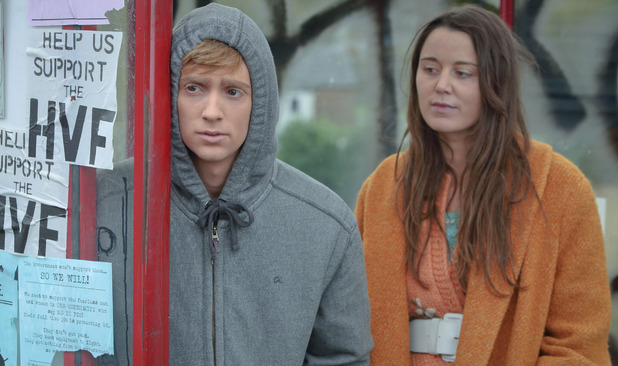
The second episode of BBC Three's excellent zombie drama continues with Rick returning to Roarton and Kieran continuing to deal with his troubled homecoming as best he can.
The beauty of this episode is that if you took away the supernatural elements, there is still a touching and affecting story about a troubled relationship at its heart. The build-up to the meeting between Rick and Kieran was deftly handled, drip-feeding information about their relationship rather than stating anything explicitly; Rick's emotional reaction to hearing of Kieran's death was a small but significant moment and Kieran's constant glances towards portraits of Rick said far more than any few lines stating they were in a relationship could have done. Whilst it is again yet to be stated outright, the two are, or were, in love with each other and having to deal with the consequences of this in their small-town nightmare would have made for an intriguing drama in itself. The fact that they are both undead goes even further to making the waters that little bit more muddied.
Rick and Kieran's relationship may be transferring some of the show's themes from the more metaphorical to the more literal, but there is still plenty to be mined from the way in which In The Flesh is using the zombie aspect to elaborate and explore different themes of prejudice. The Partially Deceased Syndrome and its sufferers have become a well-handled symbol of any societal outcast and this week, various were explored. The obvious was the relationship between Rick and his father Bill, a man who clearly has a difficult time accepting his son for who he is. We get lines loaded with meaning about Rick's handling of guns, his treatment of women and his drinking habits and for Bill, this is all about creating his son into the ultimate masculine symbol. I suspect that, with his animosity towards Kieran, Bill deep down knows that Rick is gay, but refuses to acknowledge this fact, just as he knows his son is a PDS sufferer, but will not treat him as such, nor will he allow anyone else to.
Elswhere in the episode, the performances continue to be excellent and Bevan's Amy is breath of fresh undead air in the town of Roarton, challenging prejudices and provoking all of the characters into thinking about their situations just that little bit more. I'd like to see more of Kenneth Cranham's hate-spouting vicar, but he forms an intriguing background figure though given little more development than as a physical manifestation of the town's prejudice. Evets also continues to portray the conflicted father well, able to register his internal struggle with his son with little more than a frown. However, it is to the two leads who I reserve the most praise; Walmsley and Newberry have managed to make an undisclosed relationship very affecting in just a few short scenes and the exchange between the two of them in the Jeep was a fantastic piece of drama.
With only one more episode remaining in this current run, there are a lot of loose ends to be tied up for the characters in In The Flesh, but with a series that has stated its intent and carried out its purpose with such confidence, I have every faith that we will be provided with a satisfying conclusion. Now all we need is for BBC Three to commission another series.
- Becky
You can read Becky's review of Episode One here.
@AssortedBuffery on Twitter
Assorted Buffery on Facebook
Denial and the subsequent hypocrisy are very much the key themes of this episode with Bill Macy (Steve Evets) having to deal with his PDS sufferer son Rick (David Walmsley) returning from Afghanistan and the fallout of his return for the Human Volunteer Force. Keiran (Luke Newberry) continues to struggle at home as he is forced to hide from the town whilst his parents try to keep the news of Rick's return from him. Fortunately, his existence is interrupted by the arrival of Amy (Emily Bevan), a loud and proud PDS sufferer who helps Luke out of his shell. Once Rick and Keiran are reunited, even more tension comes to the fore in the small town of Roarton as none of the residents are quite sure how to deal with having PDS sufferers in their midst.
The beauty of this episode is that if you took away the supernatural elements, there is still a touching and affecting story about a troubled relationship at its heart. The build-up to the meeting between Rick and Kieran was deftly handled, drip-feeding information about their relationship rather than stating anything explicitly; Rick's emotional reaction to hearing of Kieran's death was a small but significant moment and Kieran's constant glances towards portraits of Rick said far more than any few lines stating they were in a relationship could have done. Whilst it is again yet to be stated outright, the two are, or were, in love with each other and having to deal with the consequences of this in their small-town nightmare would have made for an intriguing drama in itself. The fact that they are both undead goes even further to making the waters that little bit more muddied.
Rick and Kieran's relationship may be transferring some of the show's themes from the more metaphorical to the more literal, but there is still plenty to be mined from the way in which In The Flesh is using the zombie aspect to elaborate and explore different themes of prejudice. The Partially Deceased Syndrome and its sufferers have become a well-handled symbol of any societal outcast and this week, various were explored. The obvious was the relationship between Rick and his father Bill, a man who clearly has a difficult time accepting his son for who he is. We get lines loaded with meaning about Rick's handling of guns, his treatment of women and his drinking habits and for Bill, this is all about creating his son into the ultimate masculine symbol. I suspect that, with his animosity towards Kieran, Bill deep down knows that Rick is gay, but refuses to acknowledge this fact, just as he knows his son is a PDS sufferer, but will not treat him as such, nor will he allow anyone else to.
Elswhere in the episode, the performances continue to be excellent and Bevan's Amy is breath of fresh undead air in the town of Roarton, challenging prejudices and provoking all of the characters into thinking about their situations just that little bit more. I'd like to see more of Kenneth Cranham's hate-spouting vicar, but he forms an intriguing background figure though given little more development than as a physical manifestation of the town's prejudice. Evets also continues to portray the conflicted father well, able to register his internal struggle with his son with little more than a frown. However, it is to the two leads who I reserve the most praise; Walmsley and Newberry have managed to make an undisclosed relationship very affecting in just a few short scenes and the exchange between the two of them in the Jeep was a fantastic piece of drama.
With only one more episode remaining in this current run, there are a lot of loose ends to be tied up for the characters in In The Flesh, but with a series that has stated its intent and carried out its purpose with such confidence, I have every faith that we will be provided with a satisfying conclusion. Now all we need is for BBC Three to commission another series.
- Becky
You can read Becky's review of Episode One here.
@AssortedBuffery on Twitter
Assorted Buffery on Facebook
Thursday, 28 March 2013
TV REVIEW: Broadchurch - Episode Four
Broadchurch is a very curious mix of both generic and good, the success of which is something I can't quite put my finger on. As Jen and I have observed over the past few episodes, a lot of the material is quite generic; we've had the suspect close to the family who turned out to be a red herring. He also happened to be involved in an affair that wasn't exactly a surprise. Then there are the various shady characters around the town who all have 'potential suspect' badges all hunted down by the detective with a murky past and unknown medical condition. And yet I'm still hooked.
To the show's credit, the fantastic ensemble cast sell the small town paranoia well, offering up a convincing dynamic between the outcasts and the tight-knit community. And whilst many characters may be wearing these suspect badges, as I shall now call them, I have yet to actually call which one of them may be the murderer. In more traditional murder mysteries, there would be another body by now to help guide both us and the detectives to whodunit. At this stage, I'm thinking Arthur Darvill's nervy reverend is something to do with it. Until this episode it had been Pauline Quirke, but she just got a bit too obvious.
In fact, Quirke's scenes this week were the only bad note in an otherwise excellent instalment. Her confrontation with the other plumber, creepy Nige (Joe Sims) was badly written, something you'd find in an awful episode of Eastenders instead of a tightly scripted ITV drama. Likewise, her threat to the newspaper editor was almost laughable. It's Pauline Quirke. Unfortunately, despite her acting ability, she is just not threatening. Bringing the character out of the shadows has unfortunately reduced her impact; before, she was a sinister presence and now, she seems to be becoming a cartoon villain. Or at least the next Phil Mitchell.
Alongside Susan Wright's upgrade to priority suspect, this episode also saw more things come to light about newsagent Jack. Bradley's performance was perfectly pitched, balancing the grumpy town elder with the vulnerable old man he became later in the episode as his past came back to haunt him. With the increased press presence in Broadchurch, something tells me that Jack will suddenly be thrust into the prime suspect spot, despite his assurances to the Latimers that he wasn't the killer.
As we're now halfway through the series, I think it's fair to say that revelations will start coming thick and fast though if Broadchurch continues to successfully shield its hand, it will be a while before we can predict Danny's killer.
- Becky
Sunday, 24 March 2013
TV REVIEW: Broadchurch - Episode Three
Last week, we saw father of the deceased, Mark
Latimer, taken down ol’ Broadchurch nick for a spot of questioning. Having
seemingly lied about his whereabouts on the night his son disappeared, claiming
to have been with a ‘friend’ he’d rather conveniently forgotten the name of,
later remembering it to be hapless colleague Nige Carter (Joe Sims), not to
mention the discovery of blood on the family boat, he was fast inching his way
up to number one on the list of suspects. At least, that is, until lead
investigators DI Hardy (David Tennant) and DS Ellie Miller (Olivia Colman)
uncovered the truth. Unfortunately, however, so later did wife Beth (Jodie
Whittaker).
Meanwhile, Susan (Pauline Quirke) was acting
progressively more suspiciously, behaving in such a hostile way towards the
police that one can’t help but be surprised that she hasn’t been imprisoned for
something or other already, whilst Will Mellor’s bumbling psychic, Steve,
became more and more desperate to give Beth his message from Danny. Which he
duly did. In other local news, Arthur Darvill’s Reverend Paul Coates crossed
over into
please-let-me-help-I’m-having-a-bit-of-a-professional-crisis-over-here
overdrive, being the only person in the know about Beth’s baby. The two super
sleuths were also as persistent as ever, although with some actual motive
behind Karen’s (Vicky McClure) behaviour revealed, and editor Maggie (Carolyn
Pickles) remained as hostile to all outside creative influences as ever.
So yes, plot developments. Most striking, was the
discovery of Mark’s not so very subtle affair with local hotelier Becca Fisher
(Simone McAullay), it being reasonably obvious from the get go that he wasn’t really responsible for the death of his
son. He was also introduced as a suspect
far too early to ever really be believable. We all know from our heritage of
countless detective programmes and crime novels that the real killer is always the wild card that swoops in at the end – the
one who was there all along but nobody ever really considered. That said, the
sympathetic, totally un-shifty and sort of on the periphery and thus actually a
little bit of a suspect award would currently have to go to Reverend Coates,
were it to go to anyone. And in these
times of general and widespread Church distrust, I can’t help but feel that,
not only would it be a tad cliché if Darvill’s character turned out to be the
murderer, It would also be far too reminiscent of a game of Cluedo come to life
for my liking.
Episode 3 also saw a little bit of character
development between the two police detectives, Hardy and Miller, with Ellie
inviting Tennant’s Hardy round for dinner, because that is ‘what people around
here do’. Clearly unhappy about the fact, she wouldn’t take no for an answer,
leaving us looking forward to a welcome bit of light relief in the form of a
cosy family meal gate-crashed by the matriarch’s grumpy and not terribly
popular boss. And in a TV series about the murder of a childhood, family
breakdown and town suspicion- goodness knows we could do with it. Meanwhile
Beth developed a feistiness towards her husband, admittedly born from mistrust,
that it seems we may see more of in later episodes.
Sp things are moving along nicely down in
Broadchurch. Much in the same way as you’d expect from almost any detective
series, but nicely nonetheless.
Broadchurch is next on tomorrow night, 9pm, ITV1.
Jen
Monday, 18 March 2013
TV REVIEW: In The Flesh - Episode One
A concept so original, it's actually quite startling that no one had thought of it before, In The Flesh is set in the aftermath of a zombie uprising, a world in which the undead have been rehabilitated and medicated to become Partially Deceased Syndrome (PDS) sufferers. Focusing in on one PDS sufferer in particular, we follow Keiran (Luke Newberry) back to his parents' home as he deals with his new affliction and the consequences of both that and his death back in 2009. Meanwhile, a group known as the Human Volunteer Force (HVF), who really really don't like anyone with PDS and will take quite violent steps to stop them coming back into the community, remain on their guard in Keiran's home town.
Good horror or science fiction is always at its best when acting as a mirror to our own society, rather than just offering up victims to be sliced or diced by the mad scientist. In The Flesh does this brilliantly, packing in more metaphors, analogies and themes than you can shake a zombie-killing cricket bat at. The most obvious is the theme of prejudice and the notion of PDS can be applied to just about any form you can think of. With its reality of living with a disease and relying upon daily medication, my first thought was of PDS as a metaphor for HIV and In The Flesh would not look out of place as a reaction to the public stigmatisation of that particular condition.
The village of Roarton, a microcosm for wider society, brings a whole new meaning to the phrase 'grim up North' and it is this particularly that highlights the satirical side of this horror narrative. The emphasis on people who are seen as 'not quite human' could be a cypher for homophobia or racism, invading the community of 'normal' people and supposedly destroying them from within. The role of the church is also thrown in there with Kenneth Cranham's fire-and-brimstone vicar extolling all sorts of Biblical justification for the alienation of the PDS victims.
Then there's also the Biblical references in the zombie gathering taking place online and gearing up for the revolution, building in another potential theme of religious fanaticism. It's not all big soaring institutional metaphors though, there are also smaller themes like the breakdown of a family, the loss of a child and sibling relationships. Like I said, it's jam-packed, but the satire of In The Flesh is finely tuned and extremely cutting, whilst the quieter drama also packs a punch.
For a first time television writer, Dominic Mitchell's script is assured and confident, weaving in all of these themes without it seeming too shoe-horned in. It is also to its benefit that it chooses to go at a slower pace rather than trying to draw in viewers by packing the episode full of action it doesn't need. Kieran's flashbacks to his zombie days are more than enough to give you an idea of what the zombie uprising was like and fills enough of the gore quota to keep horror fans happy. The pace allows for the more philosophical aspects of the narrative to develop and I'm particularly interested to see where the plotline of the fanatical Bill Macy (Steve Evets) and his PDS son goes.
The pace also allows the action-orientated sequences to shine with the climactic confrontation between the HVF and Ricky Tomlinson's character, Ken. Ramping up the tension, with the Walker family believing the HVF are on the way, we get a big showdown in the street as poor Ken's PDS wife is dragged into the street. As set pieces go, it was both suspenseful and heart-breaking as we see just how far Bill Macy is willing to commit to his cause. I'm hoping that it is this scene that sets the tone for the rest of the series; a strong, social commentary drama with a dash of action thrown in.
An already intriguing concept to begin with, In The Flesh is off to a cracking start and if this is the standard of the rest of the series, we're going to be in for a treat. Zombies may be the go-to supernatural creature at the moment, but this is a different take on a genre close to saturation; let's just hope it remains as original and as sharp as its first episode.
- Becky
You can follow Becky on Twitter @beckygracelea or on her blog beckygracelea.wordpress.com
Assorted Buffery is now on Facebook and on Twitter @beckygracelea
Sunday, 17 March 2013
TV REVIEW: Broadchurch- Episode Two
Well, well. Kudos Productions have been busy. Having produced last week’s mini-series, Mayday here, their other, one assumes, main creations for 2013, Broadchurch is now showing on The Other
Side. Otherwise known as ITV.
As Becky wrote here in her review of Episode One, Broadchurch follows the after events of the murder of 11 year old Daniel Lattimer, late of the small seaside town. The show's main focus is on the reaction of Daniel’s family, as well as on the detectives
running the operation, led by a very beardy, broody David Tennant as DI Alec Hardy,
and the considerably warmer, perhaps slightly hapless DI Ellie Miller (Olivia
Colman). Last week’s episode, as Becky said, was very much an establishing
episode, with the audience catching glimpses of potential storylines, tensions
and even suspects through our introduction to the townspeople and their
home. We’ve met the ever-versatile
Arthur Darvill’s Reverend Coates, shifty Susan (not to be confused with Ripper Street’s long Susan), played by
Pauline Quirke, David Bradley’s papershop owner, Jack, and now Will Mellor as a
reluctant psychic.
If last week’s was a
character focused episode, then, this
week was the turn of themes- themes which we can tell will shape the drama of
the rest of the series. Top of the list, and all the more noticeable since the
days of Leveson, is the theme of Press interference and ethics. Young reporter
Oliver Stevens (Jonathan Bailey) caused outrage in last week’s episode by
breaking the news of the story via twitter. This week, he’s gone a step
further, befriending visiting Daily Herald journo Karen White (Vicky
McClure). Local Press old guard Maggie
Radcliffe (Carolyn Pickles), editor of the local paper, is less than thrilled
with this development. We can only speculate as to whether this is a result of
the fictional Daily Herald’s striking resemblance to the Daily Mail. Regardless of her reasons,
though, it is clear from DI Hardy’s reaction to her alone that Ms White is
trouble with a capital phone hacking.
Next on the list of
popular tropes is suspicion. An obvious one in a TV series about murder, I’ll
grant you, but what with Daniel’s mother Beth (Jodie Whittaker) handing the
police a list of suspects which turns out to be a list of all their friends,
coupled with Pauline Quirke’s Susan lonely, watchful life on the cliff, not to
mention the fact that Daniel’s own father is a suspect- suspicion is here to
stay. So too is religion, and the idea of life after death. Most obviously, we
see this through Reverend Coates (Darvill), and his TV appeals and attempts to
help the family. We also now have Steve Connolly (Mellor), a phone engineer who
claims to have received a message from Daniel about his death. He in turn
receives a frosty reception at best from Tennant’s DI Hardy, a man in serious
danger of turning into a living snowman if he doesn’t crack a smile by the next
episode.
For fan as I am of
David Tennant, or DT, as I prefer to call him, I’m not convinced as yet that
this will turn into one of his better performances. At the moment, his performance is
outshone in most scenes by the warm simplicity of Olivia Colman's. I know her character is far more likeable character to begin with, so she does have something
of a headstart, but with Tennant’s role it feels as if the writers are
trying a little too hard to make him into some sort of rude, moody iceman.
Particularly as there are clear signs of emotional torment and a dark past just (about)
under the surface. So far, so cliché. Arthur Darvill is giving a strong enough
performance as the local vicar, as is Susan Brown as Liz Roper, Danny’s
grandmother. Although they are all, in turn overshadowed by Jodie Whittaker’s
heart-breaking performance as the grieving mother.
Again, as Becky mentioned, Broadchurch is currently running the risk of becoming just another detective drama, simply going through the motions rather than trying anything particularly new. I love a detective show as much as the next person, more, I'll wager, but it's always far more exciting to watch something that is not only done well, but is doing something exciting.
Next week’s episode
seems set to focus on the latest suspects, and will, I would imagine, delve a
little deeper into the mind of DI Hardy. Not too much, though, there’s another
six episodes to go yet.
Broadchurch is next on tomorrow night,9pm, ITV1.
Jen
Saturday, 16 March 2013
TV REVIEW: Being Human - The Last Broadcast
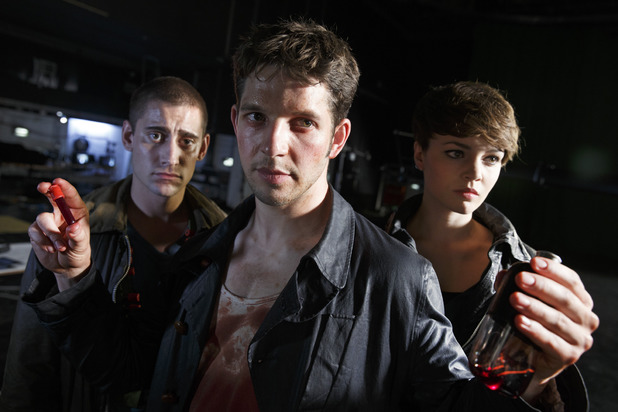
And so the final episode of Being Human comes to pass, with blood, tears and a song and dance number, it's time to say goodbye to Hal, Tom and Alex.
The final episode, with its apt title The Last Broadcast, brought in pretty much everything that had ever made Being Human great in the first place, with a little bit of Buffy and Supernatural thrown in. Hatch (Phil Davis) has risen, Hal (Damien Molony) is on a bit of a rampage, Tom (Michael Socha) is preparing to kill his best friend and Alex (Kate Bracken) is back in her coffin with her decomposing corpse for company. With the Devil bringing about his very own apocalypse, can the trio reunite long enough to stop him? As the Devil observed way back in the first episode, a trinity is bad news for him, and so it proves.
Opening with Hal performing Putting on the Ritz amidst newly vamped victims was a ballsy move, but set the tone for this offbeat finale with its mixture of horror and comedy. Molony clearly has a ball playing the evil side of Hal, though the recent introduction of a split personality proved to be a bit jarring in this final episode. However, when it leads to lines like 'Oh I was good again. It was ghastly', I can definitely cope. This was one of the areas where Buffy's influence shone most clear; as I observed in the previous review, the split personality of a vampire was toyed with frequently in Buffy and Angel and again, the battle for good Hal raged here. We also got a Buffy-style action sequence thrown in for good measure with the excellent fight between Tom and Hal.
Tom and Hal's relationship was one of the strongest points of Series Four, their completely different outlooks on life making for some brilliant comedy, as well as your requisite dramatic conflict. The conflict was brought very much to the fore here. A lot of Tom's character development has been about his innocence and naivety so it was good to be reminded of just how much of a badass he is. Likewise with Hal, we hear often about his dangerous, Kia-Ora side so it's refreshing to actually see some of this before the series ends. That's pretty much it for the action of the episode though as Whithouse opts to go for a more quiet, character-driven approach to the end of the world.
Each character is given a chance to live their lives again, without their supernatural curses and it is in these quieter moments that this episode truly excels. Davis proves to be a quietly menacing antagonist and has a great scene with each of our heroes as the Devil creates another world for them. Bracken's alternative was particularly heartbreaking as she is faced with the choice of not going on her fateful date with Hal whilst Tom's was really sweet, bringing back one of the best guest stars the series has had in Ellie Kendrick's Allison. Hal's origin story led to a welcome return for Leo, but each separate choice for the three characters were bittersweet. Part of you wished for them to live happily without each other, whilst the rest of you begged to get the three of them back together because that is how it is supposed to be, as Hal observes.
Thankfully, the three do decide to turn their backs on the Devil and fight together. Now, all credit to Toby Whithouse for not taking this in the expected direction; with the binding ritual for the Devil involving the deaths of all three heroes, I spent the entire episode dreading that this would happen. Thankfully, Whithouse decides to go with a bit of a twist. The gang fight off the Devil and through an expected self-sacrifice by Rook (well, he had to redeem himself somehow didn't he?), they defeat him. The dispossession of the Devil though, was more than a little related to Supernatural no? I mean, demons possess humans with black smoke through their mouths and exit in the same way. A small point, but it was a distraction.
And so we come to the ending; seemingly the gang is back together, they finally got the humanity that they so craved and settle down to watch the Antiques Roadshow. Then, we got a rather lovely pan across the fireplace to the mementoes of the previous residents of Honolulu Heights; Mitchell's fingerless gloves, George's Star of David, Annie's teacup, Nina's scan, Eve's bib before resting on the newest incumbents including the origami wolf that Hatch created in Tom's ideal world.
Now any fan of Blade Runner will know the ambiguity of origami animals but for me, it's the camera tilt that suggests all is not what it seems. When we think back to Hal's ideal world, it could be that the Devil listened to him when he said that he should have put them all together. "It's incomplete without them!" So we're left with question; are the gang all human again and happy? Or has the Devil actually won and just left them in their own happy ideal world? Personally, I want so badly to go with the former, it just seems the more fitting end to the series, to have them all human again. That and I'm a sucker for a happy ending.
With previous alumni moving on to bigger and better things, let's hope the same can be said for Molony, Bracken and Socha; they've been a real credit to this series and won a lot of us die-hards over. Being Human has always done finales well and this was no different, tugging the heartstrings, tickling the funny-bone and providing a truly fitting end to what has been, despite a few flaws, a wonderful series. And so we say goodbye to Hal, Tom and Alex... It would have been nice to spend more time with you.
- Becky
You can read all of Becky's previous Being Human reviews here.
Follow Becky on Twitter @beckygracelea or on her blog beckygracelea.wordpress.com
You can also now like Assorted Buffery on Facebook! Go onnnn.
Sunday, 10 March 2013
FILM REVIEW: Stoker
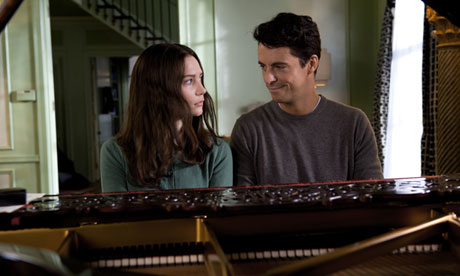
Written by Wentworth Miller, previously the star of Prison Break, Stoker depicts the events that occur after the death of Richard Stoker (Dermot Mulroney). At his funeral, his brother Charlie (Matthew Goode) returns to the family home, meeting Richard's wife Evie (Nicole Kidman) and his daughter India (Mia Wasikowska). Enigmatic and intriguing, Uncle Charlie immediately has the attentions of the two women and it's not long before a power struggle ensues between the three Stokers.
Having already proved himself to be a visionary director with the Vengeance Trilogy, Park Chan-Wook was faced with the challenge of bringing his unique brand of twisted cinema to an English-speaking audience. With a starting point like Miller's screenplay, a resident of the 2010 Black List, the foundations were already there. Though predictable at times, the narrative is a twisted grim fairytale (pun intended), full of literary and cinematic references that give added meaning to its events. You only have to look at the detailed artwork for the film (see the poster above) to see how well put-together all of the references, both internal and external, are. Alfred Hitchcock's Shadow of a Doubt is the obvious one with their shared Uncle Charlies but everything from Shakespeare (for an excellent article on this, head over to Waxen Hearts for a look at Stoker and Hamlet) to the Brothers Grimm makes it in there. It may just be the literature geek in me, but it is a screenplay I would really like to read as it strikes me as a text in and of itself, ideally suited to analysis and criticism.
The fairytale element is one that struck a particular chord with me, as Stoker strikes me as a twisted retelling of Snow White, especially as a coming of age story. Despite it not being an overt aspect of the film, does far more with that story than either Snow White and the Huntsman or Mirror Mirror managed to as direct adaptations. India, with her pale skin, black hair and lips that become more red throughout the film, vies for the attention of her Uncle Charlie, a weird cypher for the prince. That leaves Evie as the evil stepmother, and though she is actually India's biological parent, they share little in common and it is clear that she sees her daughter as her rival, rather than her family. It's yet another aspect to what, on paper, could have simply been another family melodrama, but these allusions make the film a rich experience.
Like the multi-layered screenplay, technically speaking, Stoker is a true marriage of every element needed in a film. In particular, the combination of Chung-hoon Chung's cinematography with Nicolas de Toth's editing is wonderful throughout, bringing together key images from different moments in the film, changing and adapting their meanings as the story evolves. We see consequences of actions, before the actions themselves have chance to tell their own part of the story or bringing new meaning to scenes we saw in different parts of the film. It's a testament to the director and editor that these images don't alienate the audience, but enable the film to become even more engrossing whilst adding to the unsettling atmosphere.
Another example of this marriage of elements is the use of sound throughout the film. The sound editing is a masterful addition to the fragmented narrative, punctuating the more still scenes with jarring noises of ordinary actions, heightened by the stillness of the Stoker household. The scene in which Charlie offers India her first sip of wine would have been noteworthy anyway as a first temptation scene, but is granted more significance through the volume shift. India's drink of wine is not only visible, but highly audible, almost uncomfortably so. Clint Mansell's score works well with this discomfort and is excellent throughout, though slightly overshadowed by one piece by Philip Glass. Entitled Duet, it was written by Glass especially for the film and is a light motif throughout before getting an entire scene devoted to it. This scene was the standout from the entire film for me; a masterclass in building tension, exploring a wide variety of themes without any dialogue and it is, quite simply, breathtaking.
Stoker is a film that demands repeat viewings; it is too layered and too intricate for one viewing to simply do it justice. It won't be to everybody's tastes and it is certainly one of the most unsettling films I've seen for a long time, but this is to its credit. I just can't get it out of my head.
*****
- Becky
You can find us now over on Facebook and also on Twitter @AssortedBuffery
Subscribe to:
Posts (Atom)