Thursday, 31 March 2016

FEATURE: Buffy the Vampire Slayer - Who Are You

Previously on Buffy the Vampire Slayer: Buffy put Faith in a coma for 8 months prior to the Mayor's Ascension, but the rogue Slayer awakes and goes after Buffy, swapping bodies with her. The Scoobies have steadily been growing apart over the course of the season and fractures are getting worse.


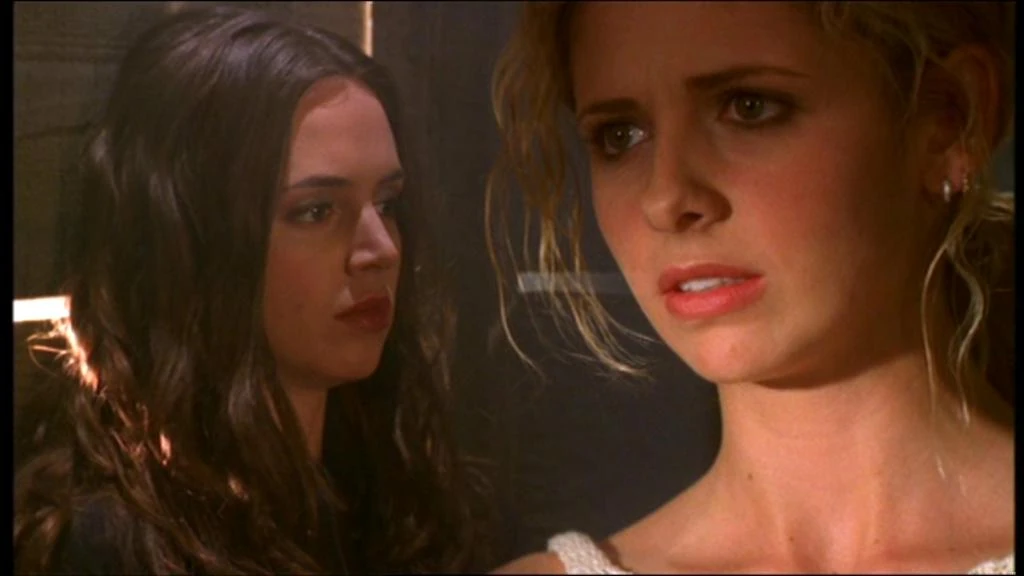
Picking up directly after This Year's Girl, Faith finds herself trying to get used to Buffy's world and her body, picking up on the events that she's missed and the people she hasn't met yet (Anya, Spike). She takes advantage of her new freedom and the trust that everyone has placed in Buffy to get on and do what she wants for a bit. Meanwhile, Buffy is trapped inside Faith's body, dragged away first by the cops and then by the agents from the Watchers' Council, unable to convince anyone of who she says she is. As Faith has to get accustomed to being the good guy for a change and the effect it has on her, Buffy finds life on the other side difficult, fighting her way back to her own body.

Who Are You marks the halfway point of Buffy the Vampire Slayer and the turning point for Faith as she realises that she might need saving after all. It's an extremely clever way of doing it. Much of Faith's resentment towards Buffy is borne out of the things that our Miss Summers is surrounded with - friends, family, people who love and respect her - people that Faith has never had in her life and didn't know how to accept when it was offered to her. It's key that Faith's big freak-out comes after Riley tells her, believing her to be Buffy, that he loves her. He doesn't mistreat her, he doesn't use her, he simply wants to be with her. 

After that moment, Faith starts to see redemption as something she might want after all. That saving people and doing the right thing might be the path she wants to go down. Sarah Michelle Gellar's performance is a fantastic one, asked to perform a character that is so completely different to Buffy and to convey one of the character's most important moments within that. The climactic fight between Faith and Buffy brings out all of Faith's self-loathing, something which will be explored more once she appears in Angel soon. It's interesting though that once they've switched back, Buffy doesn't seem to have learnt anything from her time as Faith. She still sees her as a criminal who needs to be dealt with rather than someone who needs to be understood and helped. Maybe Faith has a point about that stick up her butt after all...

On the opposite side, Eliza Dushku gets to play the hero and does so with aplomb, capturing Gellar's mannerisms with ease, ensuring you never forget which one of them you're watching at any moment in time. Gellar may seemingly have the harder job, but it's Dushku on whom the episode's success relies. Her line delivery all the way through as Buffy is brilliant, particularly her scene in which she tries to convince Giles of who she is. The way she says "you were inching!" is perfect. Even the eyebrow movements are recognisably Buffy's.

There are interesting little moments in here about Tara's future role in the group, confirming her relationship with Willow for a start, but also, she's the first person to notice that Buffy, as Willow believes her to be, is not herself, something which the Scoobies miss. Later on, Tara and Buffy would go on to develop quite a close relationship, partly due to Tara's perceptiveness and Buffy's willingness to trust her. It's a good measure of just how fractured the Scoobies are at this stage in the season. None of them notice Buffy's exceedingly odd behaviour until it's pointed out to them in no uncertain terms. Tara proves to be the key to the episode, an essential component in the gang who they don't realise they need just yet.

But the episode belongs to Faith, a deeply fascinating character and one who undergoes one of the biggest arcs, probably behind only Spike's and Willow's respective stories over the course of the show. Bringing her back, positioning her once again in opposition to Buffy, but with considerably more sympathy, is a genius move, another soaring high point in the ridiculously mixed fourth season. 

We've still got a bit to go, but hey, have you heard about this amazing Jonathan guy? He's a superstar.

Quote of the Week: 

Faith: You're not going to kill these people.
Vamp: Why not?
Faith: Because it's wrong.

Let's Get Trivial: The expiration date of Joyce's credit card, glimpsed briefly, is May 2001, the month in which Buffy will die for the second time. 

Sunnydale Who's Who: The credits list "Eliza Dushku as Buffy" this time around.

- Becky

You can read Becky's look at previous episode, This Year's Girl, here.

Follow @AssortedBuffery on Twitter
Or like our Facebook page

Monday, 28 March 2016

FEATURE: Angel - The Prodigal

Previously on Angel: Wesley's working for Angel Investigations now and Angel has carved out a troublesome relationship with Kate, a detective with the LAPD who has a difficult relationship with her father. Angel's human self, Liam, had a bad one with his own father, killing his family once he became Angelus after being turned by Darla.


It's all about the daddy issues in this episode as the title suggests, opening with a scene back in 18th century Ireland between pre-vampire Angel - Liam - and his father before cutting ahead to our current Angel battling a demon. There's an encounter with Kate and her father, it all gets a little awkward and the vampire slinks off to try and work out what the demon is doing. It turns out it's a largely peaceful demon and Angel needs to find out why it attacked the train when it's usually the demon equivalent of a kitten. As he digs deeper, it turns out that Kate's father might be involved somewhere along the line, dealing demonic drugs disguised as auto parts.

This episode should probably come with an advanced "David Boreanaz does his Irish accent again" warning, but it's interesting to delve back into the past we hear about much more than we see (probably due to aforementioned accent). The episode pulls off the clever move of combining the Buffy episode Becoming flashbacks and new ones that expand upon those stories, namely the slaughter of Angel's family at his own hand. It's a grisly reminder of everything our hero has to atone for and where it all began, as well as how he got his nickname; his sister believes him to be a returning angel. It also brings back Darla, which is always a good thing (and who becomes increasingly important as the series goes on).

For both Kate and Angel, their respective relationships helped shape who they are as people/vampires; for Kate, she became a cop in order to try and win the respect that was denied to her by Trevor after her mother died. For Angel, it's about defying his father in death as he did in life, destroying what he loves. Weaving them together makes the themes of the episode thuddingly transparent and with all the subtly of a brick through a window, but daddy issues are never really an understated thing to deal with. 

It doesn't help that Kate is still such a non-character, originally introduced as an unknowing human element in LA and as a potential love interest for Angel. That didn't really work out so she got her daddy issues back story. But that's all there really is to her character at this point; resentment towards Angel and her father. The episode advances her acceptance of the supernatural side of the city, but without that audience connection to her, it's tough to really care. She keeps wandering into situations she doesn't really understand, waiting for Angel to come and get her out of it. She may be able to kick ass, but it's hard to feel for a character that feels a far cry from the energy and subversion of the Buffyverse women we're used to.

As such, it's one of those episodes where the B plot tends to be a little more fun. Cordelia's decided to fit a security system in the offices to guard them against demons entering the property whenever they feel like it. Wesley and Angel aren't fussed, but eventually Cordelia gets it in place... just in time for a demon attack. How it warns them? It lets them know which door has been opened. As the fight ensues around the office, Cordelia looks despairingly on as invading demons are announced with "The left door is ajar" and Angel defenestrating one to the narration of "The window is open." It may just be one scene, but it's a moment of much needed levity in a grimdark episode.

You know it's probably not going to be the best episode when Angel gets his Irish accent on, but The Prodigal is serviceable enough for what it wants to do. If it hadn't been for Cordelia's security woes, I might not have been so forgiving of it though. It's just a bit dull.

Quote of the Week:

Angel: No, this is strictly recon. I need to know exactly what we're dealing with before we make any moves.
Wesley: Right you are! A deliberate, cautious approach would be the most sensible plan. Fools rush in.
Cordelia: No, he wants you to stay here.

Inventive Kill: Kate bags another vampire by shooting him in the shoulder to distract him and staking him before he realises she knows what she's doing.

LA Who's Who: The barmaid who points out Liam to Darla would be one Christina Hendricks, marking her first appearance in the Whedonverse before going on to become our infamous Mrs Reynolds in Firefly

- Becky 

You can read Becky's look at previous episode, I've Got You Under My Skin, here.

Follow @AssortedBuffery on Twitter
Or like our Facebook page

Thursday, 24 March 2016

FEATURE: Buffy the Vampire Slayer - This Year's Girl

Previously on Buffy the Vampire Slayer: When Kendra was killed by Drusilla, Faith was called, a Slayer from Boston with some mental health issues and a passion for turning to the dark side. Buffy put her in a coma before the big fight with the Mayor and there she's remained. The Initiative is crumbling with Adam on the loose and Riley's hospitalised.


Buffy is still reeling from Riley being taken away from her and Adam running loose around Sunnydale, dissecting demons and generally being a bit horrible. However, a more immediate problem is on the way. Faith, in a hospital since her scrap with Buffy before Graduation Day, has woken up and has escaped. The rogue Slayer is on the move and after Buffy, reeling from finding out that not only has she been in a coma for eight months, but Graduation Day has failed and Buffy succeeded in killing the Mayor. She goes after our little Buffster with a neat weapon the Mayor managed to leave her.

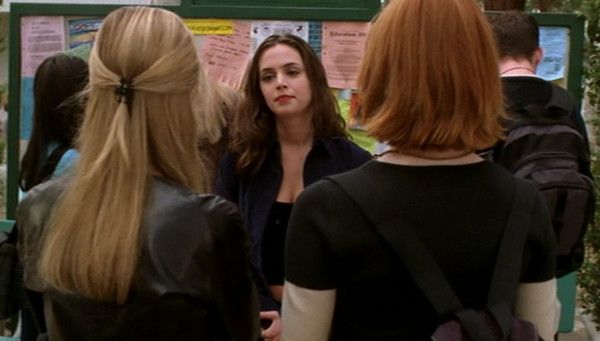
After the considerable awfulness that has been the last two episodes, I've been so looking forward to getting to the Faith episodes because a) they have a real classic Buffy feel about them and b) Eliza Dushku is awesome in this role. She slips back into it fast, a riot of pent-up energy and rage that's directed in the Scoobies' direction. Her first scene with Sarah Michelle Gellar also snaps back into the antagonistic relationship their characters' share with their quips and begrudging respect for each other. It's amazing how quickly the Initiative stuff falls away once she arrives and the quality of the season once again soars. Plus, Joyce comes back!

Kristine Sutherland's absence has been notable from this season, a voice of reason to counter Giles and the others with wit and style. Donald Petrie's script acknowledges this by having Faith use it to get to Joyce, mocking her with hypotheses that Buffy has forgotten them both because she's so damn selfish. Of course, Joyce gives as good as she gets and takes the piss out of Faith with glee. Glorious. I do feel a little sorry for the 1630 Revello Drive though; it's been months since it had to have any repairs done to it. It must have been so peaceful. Poor house.

An interesting element of the episode, amongst others, is seeing into Faith's dreams. Buffy's prophetic dreaming crops up as needed, but This Year's Girl allows us to see into another Slayer's psyche and it's Faith's so it's twisted. Obviously. It positions Buffy as the bad guy, a Terminator-like presence determined to ruin her life. It's a swift way of reacquainting us with their antagonistic relationship, as well as clueing us in to the eventual topsy-turvy nature of the follow-up episode, Who Are You. 

Christophe Beck's ethereal score in the sequences are truly amazing, especially the horror-esque vocal refrain that haunt Faith as she's being chased by Buffy. It gives the dreams an even more wacky quality, removed from the rest of the episode but highly important for what's to come. Hello, Dawn foreshadowing; it's the second reference we get from Faith about her after the Little Miss Muffet line in Graduation Day Part 2. He's a canny bugger, is that Whedon.

Most of all though, and it's something the worst episodes of the fourth season are missing, is that it's so damn entertaining. Dushku seizes her return with gusto and reminds everyone why we all love to hate Faith in these pre-redemption and her fights with Buffy are scrappy and dramatic. Those fights are also ones for the longterm fans; we know how good both of them are so there's no pauses, no need for orchestrated dynamic shifting. It's just two skilled fighters going at it and you're never quite sure which one is going to come out on top in each one. 

This Year's Girl is the first of a two-parter and ends on one heck of a cliffhanger. I remember watching that for the first time, hearing "five by five," realising what happened and then being ridiculously angry that I need to wait another week for the resolution. Fortunately, the power is in my hands to watch it right now. You guys have to wait another week for what I think of it, but I'm sure not many of you are particularly angry about that.

Five by five.

Quote of the Week:

Giles: Well, we have to find [Faith].
Willow: What about Adam?
Xander: I'd hate to see the pursuit of a homicidal lunatic get in the way of pursuing a homicidal lunatic.

Inventive Kill: Adam, unseen for the episode, dissects a demon and leaves it hanging between trees for the Scoobs to find. Lovely.

Let's Get Trivial: The shop where Faith stops to admire the knives in the window is the same shop that she and Buffy broke into back in Bad Girls.

- Becky

You can read Becky's look at previous episode, Goodbye Iowa, here.

Follow @AssortedBuffery on Twitter
Or like our Facebook page
Monday, 21 March 2016

FEATURE: Angel - I've Got You Under My Skin

Previously on Angel: Angel Investigations now consists of the Dark Avenger himself, Wesley and Cordelia, but the ghost (not literal ghost) of Doyle hangs over the three of them. 


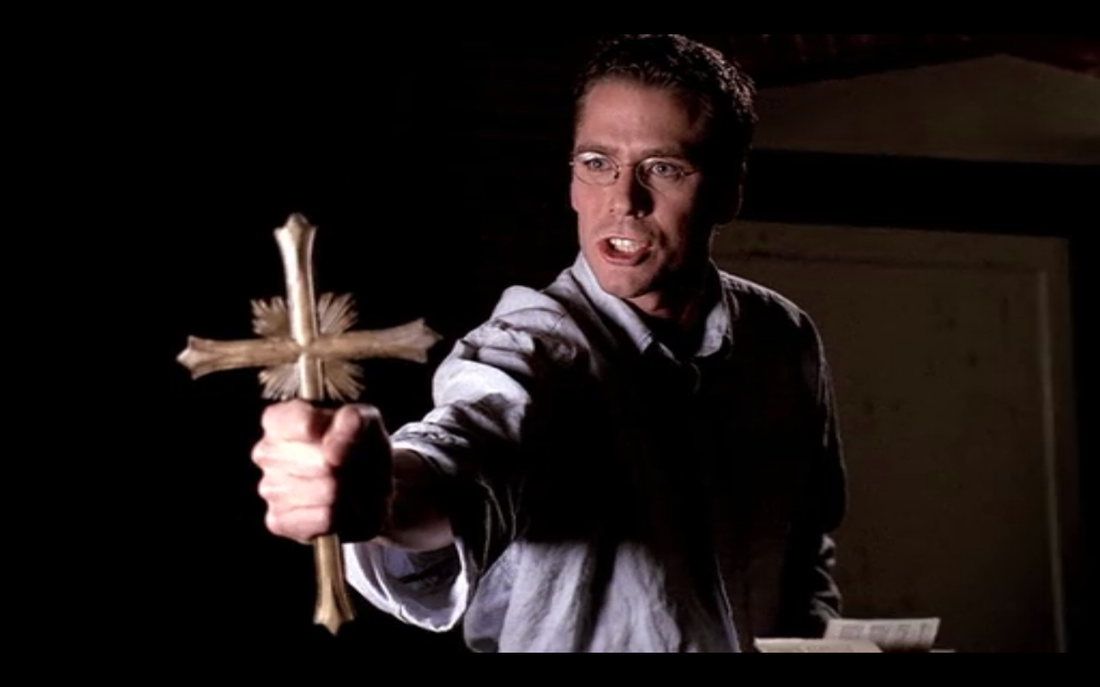
After Cordelia has a vision of a suburban home and a young boy, Angel and Wesley head over to the address just in time for Angel to save the boy, Ryan, from being run over by a car. Wesley does a little investigating whilst Angel is with the family and discovers the luminescent bodily excretions (yum) of an Ethros demon, which is possessing one of the family. The gang spring into action, discovering that it's Ryan who is possessed, not the father as initially suspected. They decide an exorcism is the only way to go. However, as events take their course, it turns out that the demon might not be the biggest foe they have to face this week.

I've Got You Under My Skin marks another move into the darker territory that previous episode She explored, the whole episode defined by a deeply ominous quality from the moment of Cordelia's vision. It's probably the most full tilt that the series has so far gone into horror and the possession aspect of the story allows it liberally reference one of the pinnacles of the genre in The Exorcist. There are little nods, like Cordelia's fear that everything was about to get really vomity, to the wider themes of the episode; family and the traumas that they both suffer and inflict. 

For Angel, it's means of working through his grief surrounding Doyle and his empathy for Mr Anderson, the family patriarch, trying to desperately keep their family together despite the odd occurrences and violence that follows them around. There are the first hints towards Wesley's troubled relationship with his father through a brief line he has about fathers terrorising their children and it's something the demon uses against him during the exorcism. And it establishes that Wesley is prepared to kill Angel if he needs to, something which the vampire acknowledges is a good thing. Hey, we've all seen what he gets like.

The great twist in the episode, of course, is that the demon isn't the one everyone should be worrying about, but Ryan himself (a Whedon addition, reportedly). It's a really clever feint, especially the reveal that the demon was trying to get Ryan to kill himself in order to save those around him. When a soulsucking demon wants someone dead, they're probably not very nice. And so it proves when Ryan attempts to set fire to his sister whilst his parents are locked in their room. All of the work that his father had done to try and keep Ryan safe, protect him from the horrendous acts that have been committed, is undone by virtue of the demon escaping and Ryan being allowed to cut free.

It gives the episode a bleak message; some people simply can't be saved. Just as with Doyle, who willingly sacrificed himself and could never have been saved by Angel, Ryan isn't to be redeemed here. That's where the horror comes from in this episode. Although the score is wonderfully ominous and the atmosphere created by director RD Price and Jeannine Renshaw's script is fantastic, it's the simple, horrifying thought of powerlessness that defines the episode. 

I've Got You Under My Skin should feel like another filler episode and indeed starts off that way, but the marriage between the episode's plot and themes is perhaps one of the best so far and a real statement of darker intent. Ryan may have been taken into custody to get the help that's needed, but there feels like no real resolution simply because the bad guy here is just a little boy, not someone Angel can sink an axe into. Angel was always advertised as grimmer than its Sunnydale-based relative, but it gets fun when the show fully embraces that.

Quote of the Week:

Angel: [Cordelia's] making brownies.
Wesley: Oh is that what I smell? I thought I tracked something in...

- Becky

You can read Becky's look at previous episode, She, here.

Follow @AssortedBuffery on Twitter
Or like our Facebook page

DVD REVIEW: Frankenstein


After adaptations dating back to 1910, you would be forgiven for dismissing yet another screen outing of Mary Shelley’s Frankenstein, and the men who have played both the infamous titular Doctor and their human, not monstrous, creation. There have been many, and several more via television and stage; even an ex-member of Bros was birthed as the wretch. Yet none is more renowned than James Whale’s 1931 version. Even if unseen, all are familiar with its star, Karloff in that Jack Pierce make-up and it is often this and its sequel The Bride of Frankenstein, which are heralded as the yardstick by which all filmic adaptations have been measured. Not unfairly so but it was never as true to the original novel as once thought and most versions, if not all, fall down on their fidelity to Shelley’s 1818 novel. In 2015, there were two new attempts: one which received a cinema release and Bernard Rose’s. 

Rose, not unfamiliar with literary adaptations, has given audiences some wonderful variations on numerous works of literature: from Paperhouse (1988), Candyman (1992) to his Tolstoy quintet: Anna Karenina (1997), Ivans XTC (2000), The Kreutzer Sonata (2008), Boxing Day (2012) and Two Jacks (2012). He even claimed at FrightFest 2015 that it is comforting to have a source material to hide behind. He needn’t worry, his attention to detail and dramatic creativity really serve this story above all else.

Despite the novel’s weight within the Gothic and Romantic, Rose’s 21st century Frankenstein straddles Gothic h
orror, the supernatural, and drama, and updates to a modern context and downtown LA. It also remains largely faithful to the original text and uses the chapters from “The Monster’s” point-of-view as the basis for his voiceover narrative and the inner monologue of Monster/Adam (Xavier Samuel). 

The film may be called Frankenstein but for all intents and purposes, he is one; the (brain)child of researchers Elizabeth (Carrie-Anne Moss) and Victor Frankenstein (Rose regular, Danny Huston). Adam is the result of a 3D printer which has created and shaped the human form and is the first real success in what is seemingly a long line of failures. While he resembles the form of a grown man, Adam is a baby. He is unable to support his own body weight, has difficulty focusing, eats and sleeps much like a newborn. 

It is an astonishing performance by Xavier Samuel who brings such soul to a role which has him largely mute for the majority of the film. Samuel has produced a fascinating and varied filmography since making (personal favourite) The Loved Ones (2009) in his native Australia and has an incredible face even under heavy prosthetics; his ability to emote in such a way is impressive. When he opens his eyes, Victor actually yells - in an obvious homage/parody however you wish to look at it of Clive’s character in Whale’s film – “He’s alive!” Once he is, so is the film. 

Samuel’s Adam is a creation of life not a reanimated corpse, he symbolises the advancement and the potential dangers of technology and yet is more than a metaphor. For all his physical detriments, he feels, thinks and is perfectly human; a modern John Merrick. 

Thankfully, Elizabeth is a partner in the research facility in Rose’s version. It is interesting that in spite of Shelley's famous feminist parentage, it is a London-born male film director who actually gives the character, Elizabeth a more prominent role. By supplanting Victor in this way, it gives more depth to the film. She is also the maternal that Adam wants to return to after his escape, and in this aligning there is a more primal notion to the story, perhaps even Oedipal reading. She is the first person he sees when he awakens and like most animals, he imprints and any notion of the ridiculous when a grown man is seen suckling from the teat of a bottle dissipates as a standing testament to Samuel’s performance. Instinctively, his first few words are ‘mama’ and dada’ which seems to touch Elizabeth more, albeit briefly, than Victor. 

Sadly, the new family is short-lived as necrosis attacks Adam’s tissue, the flesh-eating bacteria and breakdown of cells render him monstrous and thus he begins to associate with this and even adopts the name “Monster” for a time. Far from the perfect specimen they thought they had created, Victor and Elizabeth make the decision to essentially euthanise their infant son. From then on, Adam is alone and flees to shed his innocence and experience the world, such as it is.

Noise, aggression, pollution, often violent confrontation as society greets him; when they don’t he is able to appreciate nature in all its beautiful, calming glory. It’s a motif which is dotted amongst the pages of the novel and its obvious Romanticism links are weighted in Adam’s relationship with the natural world and surroundings. This is a film, for all its brief horrific moments (amongst others, there is an appalling moment with a surgical saw… God bless Randy Westgate’s incredibly realistic looking effects make-up) about societal privilege, man’s consciousness, his commune with nature and, above all, love. 


Some shots are reminiscent of Botticelli/Michelangelo; religious iconography shapes the Oedipal readings while the police state which inhabits LA and preys on the homeless community keeps a tight and suffocating grasp. It’s a fascinating take on one of the themes in the original novel and one which is so palpable, resonating on a profound topical level. How many individuals are shot, assaulted and/or murdered based on the way they look? How many police officers believe they are above the law?

Most will know the outcome of Frankenstein whether via the novel or the previously released films or stage productions, as well as specific plot points, most of which are restored and depicted here. The blind man is played by an outstanding Tony Todd, reuniting with Rose for the first time in 22 years. Here he is transposed as a homeless blues singer who ‘takes in’ Monster and teaches him to speak (and sing), act in company and generally fend for himself on the street and, above all, gives him hope. That is until it is cruelly taken away.

It has taken approximately 85 years to produce a film on par with Whale’s and a couple of hundred to finally see one which does the novel justice and serve Shelley’s narrative. That said, Rose’s Frankenstein is as beguiling as it is beautiful, as dark as it is primal and disturbing. It’s quite the feat to breathe new life into something which has saturated modern culture and present something as visceral and emotional as this. See it, it’s stunning. By using the voiceover narrative which frames the story it affords the audience a stronger connection with the lead. Perhaps, that’s why it is so moving, cathartic and tear-inducing; he is Adam, not a monster.

- Hel

Follow @AssortedBuffery on Twitter

Or like our Facebook page

Thursday, 17 March 2016

FEATURE: Buffy the Vampire Slayer - Goodbye Iowa

Previously on Buffy the Vampire Slayer: Buffy joined the Initiative, asked too many questions and then Maggie Walsh tried to have her killed. It didn't work. Instead, the creature that Walsh has been working on kills Walsh in a nicely Oedipal penetrative way. Riley takes the news that his surrogate mom has tried to kill his girlfriend badly and leaves the Initiative. Sort of. He's back this week. Oh, and Spike's still bechipped and in hiding from the Initiative.


Last episode, The I in Team, rattled through the big Initiative break-up build-up at quite the speed, leaving poor Goodbye Iowa to pick up the pieces. Reeling from Maggie trying to kill her, Buffy realises the Scoobies probably aren't so safe now and decides to take them into hiding in Xander's basement. Riley's not coping very well with the idea that his world is falling apart somewhat and looks to blame it on just about everyone else, including Buffy. When he goes a bit mad in Willy's Place (it's upmarket now, you see), she drags him back to Xander's and realises that the Initiative have been doing a little more to him than any of them realise. They confront Walsh's colleague, Angleman about the 314 project, dubbed Adam, who conveniently shows up and reveals himself to the world, explaining that he's not the only experiment in the Initiative, but that Riley is too.

As with last week's mythology-full, but truncated episode, Goodbye Iowa has a huge amount going on in it (to the point where I even considered running the lengthy plot summary gag from last week again - there is that much). And like its immediate predecessor, it's trying to do too much from the word go. The two main thematic threads, Riley's world falling apart and Adam's Frankenstein's monster-like discovery of the world, that they could have easily had an episode each, but the parallels between the two were clearly too juicy to not place together. Riley, so certain in his black and white cornfed view of the world is forced to learn things anew, just as Adam is doing with his newfound life.

The Frankenstein connections have been obvious since Adam was revealed and boy does this episode run with them. Playing out like a loving reference to the original tale and Whale's adaptation, Adam wanders around Sunnydale, killing children and generally causing a bit of damage whilst he tries to learn more about the world. The creator/creation relationship that should be explored here, as with Shelley's novel, ended with Maggie on the end of a skewer so there's not much depth to Adam as a villain other than he's seemingly invincinble, but hey, Buffy blew up a giant snake at the end of last season so I'm sure they'll find a way, guys.

Similarly, Riley finds out that Maggie has been doctoring him, turning him into another of her maternal creations. But Maggie's gone and thus, no real catharsis for Riley's character can be reached by having him confront her. Not to mention that emotional fallout of that doesn't really land, mostly because the series hasn't really given us any reason to root for Riley other than him being Buffy's beau (how refreshing for this to happen to a male character though, am I right?!). 

The thing is though, despite the episode packing so much into its runtime, I run out of things to say about it pretty quickly. Long-time readers of this rewatch will know this is rarely a case with a Buffy episode, but everything is operating on a really surface level interpretation of the themes its examining. Even Willow's burgeoning relationship is little more than euphemism at this stage, though it is fun to spot all of those nods to their romance that my little 12 year old mind innocently skipped over before. 

I always maintain that the Initiative was probably a better idea on paper than what happened when it was translated to the screen. There's all sorts of potentially interesting things going on here thematically (primal vs technology, Slayer vs humans, birth vs artificial creation) that never really go anywhere, even in the final stages of the season. With the potential of those ideas and the soaring high points of the season so far (and to come), the show has never felt more frustrating. Thankfully though, Whedon returns to a lot of these themes in The Cabin in the Woods which we can all agree is awesome.

I might just go and watch that instead.

Quote of the Week:

Buffy: I'm going to the crime scene to see what I can find out. You guys research the Polgara demon. I want to know where it is. When I find it, I'm going to make it pay for taking that kid's life. I'll make him die in ways he can't even imagine... That probably would've sounded more commanding if I wasn't wearing my Yummy Sushi pyjamas...

Inventive Kill: Adam meets an innocent little boy. And kills him. Adam sucks.

Sunnydale Who's Who: This is the last episode in which we see Buffy's weaselly informant, Willy the Snitch. He's mentioned later on in the series so we know he lives to weasel another day.

- Becky

You can find Becky's look at previous episode, The I in Team, here.

Follow @AssortedBuffery on Twitter
Or like our Facebook page