Previously on Buffy the Vampire Slayer: A secret government organisation known as The Initiative have been operating literally underground at UC Sunnydale. Buffy's dating one of their rejects and fighting their Big Bad, Adam, a patchwork monster of human and demon. Meanwhile, the Scooby Gang's feeling the pressure of living apart; Xander and Anya feel excluded, Willow's dating Tara and only just told people, Giles remains unemployed and Buffy's got her hands full. Spike, helpfully, has been pulling their strings.

After the big bust-up at the end of The Yoko Factor, Buffy goes off to find Riley, but of course finds him gone. He's with Adam, finding out that he was a part of the super-soldier program that Maggie Walsh was putting together and that he also has a chip in his nervous system that Adam can use to control him. The Scoobies all set about recovering from their fight, each as upset as the other at what has been said. However, a little bit of communication soon sets them right and they come up with a plan to stop Adam, magically joining themselves into one body. Buffy's.
The fourth season stands as the only that openly flouts convention by not featuring a two-parter finale as the last two episodes. It's a bold move to wrap up everything major in the season in the penultimate episode, but it's probably for the best given the lukewarm reception to the Initiative plotline. Restless ends up embodying a far better season finale than anyone expected, but I'll save my enthusiasm for that one until next week.
The Initiative stuff is still ridiculously blah. I really couldn't care less about Adam's super-race plan because, although it's clear that there is something thematic link between Adam's composite soldiers and the Scooby Gang united in one goal, it's executed so badly. It's not an inherently bad idea by any stretch, but the quality difference between the two thematic plot strands is vast simply because of who is involved. We don't really know (or like) Riley enough to care too much that he might become part of Adam's composite demon army.
The real meat of the episode is the Scooby Gang themselves, the characters we know and properly care about. As I said last week, seeing the Scoobies fight is never fun and the problems between them all have been building all season. The best moments come as a result of the gang rediscovering their friendship. The lift sequence, in which Buffy and Willow have a heart to heart, is adorable, culminating in a hug that brings the gang back together again.
It may make the joining spell a little on-the-nose metaphorically speaking, but it's a neat way to wrap up their combined plotline for the season. I love that it's a natural (albeit magical) way of combining their respective skills and functions within the group versus Adam's biological and scientific way of doing things. Like Buffy says, the Initiative is messing with primeval forces it doesn't understand the final battle between Scooby-Buffy and Adam is that clash made manifest. Let's just ignore the really dodgy sound effects as the spirits combine within Buffy. The voice effect of having them all speak at the same time is very cool though. That moment also points out a key difference between Buffy and the Slayers that came before her; she's never on her own.
After a nice Dr Strangelove board meeting, the Initiative is abandoned and the case closed in a move that feels a little more Mulder and Scully. Let's just be grateful that we got Cabin in the Woods eh? A much better take on the shady government installation type deal.
Quote of the Week:
Willow: Nervous?
Xander: No way. I'm full of that good old kamikaze spirit.
Giles: Xander, just because this is never going to work, there's no need to be negative.
Inventive Kill: Scooby-Buffy rips out Adam's core glowy thingy. Perfect.
Let's Get Trivial: After Nicholas Brendon remembered the established continuity from earlier in the show, the line "see what you get for taking French instead of Sumerian?!" was changed from "see what you get for taking Spanish instead of Sumerian?!"
- Becky
You can read Becky's look at previous episode, The Yoko Factor, here.
Follow @AssortedBuffery on Twitter
Or like our Facebook page
Previously on Buffy the Vampire Slayer: Oz departed Sunnydale after realising that he wasn't as in control over the werewolf as he thought, leaving a heartbroken Willow in his wake. She developed a relationship with Tara, a fellow witch, instead which is now a romantic one.

The Scooby Gang meet to discuss Buffy's recent lack of demonic activity and the Initiative's sudden rise in inmates with Tara joining them in an official capacity for the first time. However, at the end of the meeting, Oz returns, throwing the wolf amongst the pigeons. His return not only causes problems for Willow, but also for Buffy as the revelation that he's a werewolf prompts Riley to exhibit some extreme anti-demon sentiments, naturally getting Buffy's back up. When Oz runs into Tara on campus, he realises that she's involved with Willow and the resultant reaction causes him to wolf out. When he's captured by the Initiative, Riley is finally forced to choose between Buffy and his career in order to get Oz out before he gets hurt.
Oh Oz. You continue to break my heart with your wolfy soul-searching. It may be an episode heavy on the Initiative (though thankfully points out they're all dicks in the process), but it's also one heavy on the emotion, particularly for Willow. We all know how badly the break-up with Oz affected her so seeing him back tugs on the heartstrings almost instantly. It's a lovely little goodbye episode for the two of them after the abrupt end to their relationship back in Wild at Heart, whilst also marking a new beginning for Willow. She finally reveals her relationship with Tara to Buffy and confirms it to Tara too. It's all a bit heartwarming.
New Moon Rising itself deals with the unconventionality of love in a variety of ways, largely seen through the metaphorical prism of humans in love with demons in order to. Buffy reacts the way she does to Riley's black-and-white view of the world because she's no stranger to an unconventional relationship, as we all know, and ends the episode telling Riley about her past with Angel. His belief that Willow's relationship with Oz is somehow lesser because he happens to be a werewolf doesn't quite function entirely as a metaphorical homophobic reaction to a lesbian relationship, but the recognisable attitudes are there. Buffy flying off the handle at him in defence of her friends is a wonderful moment, built on beautifully by the scene in which she finds out that Willow and Tara are dating.
That scene is one of the best conversations in the Buffy-Willow friendship, a testament to how strong their connection is, but also to how the show functions as an examination of human experiences. There's no demonic parallel here; it's just simply two best friends having a heart to heart in which one happens to reveal she's in a lesbian relationship now. Buffy's reaction, momentary wiggins followed by complete and utter acceptance, feels so human as does the trust that Willow immediately places in her best friend. It takes a hell of a lot to shake that relationship, let's face it. Buffy gets the opportunity to practice the acceptance that she preaches to Riley and for Willow, it allows her to properly begin her relationship with Tara.
The episode itself, aside from having it as the source of conflict for Oz and Willow, doesn't make a huge deal out of it when it so easily could have done for effect. Oz's problem with Tara is just that she has replaced him in Willow's affections and he didn't expect that to have happened with anyone. But there's no soaring, dramatic music, no tearful revelations or torturous monologuing. It just happens that two people have fallen in love. The show has a few faults over the years, but the Tara and Willow relationship still feels like one of their most quietly revolutionary moments, particularly at a time in which gay relationships on TV weren't as commonplace as they perhaps are now.
Watching it all these years later, New Moon Rising feels as if it's another step in the show's maturity with its deft handling of social issues that it has always had, but with perhaps more confidence in itself. The fourth season is a tricksy one, as I've mentioned a few times before, but it does form an effective bridge between the high school years of seasons 1-3 and the more adult years of 5-7. It's not surprising it feels a little muddled after it has to refind its feet, but this episode is a good demonstration of how it's getting there.
Quote of the Week:
Giles: How did you get in?
Spike: The door was unlocked. You might want to watch that, Rupert, someone dangerous could get in.
Buffy: Or someone formerly dangerous and currently annoying.
Let's Get Trivial: Although she would go on to become one of the show's most beloved characters, there was an initially negative reaction to Tara following this episode because she was seen to be breaking up Willow and Oz all over again.
Demonology 101: This episode proves that the werewolf condition is something that can be controlled. It doesn't necessarily impact the television side of the series, but Oz's continuing story in Season 8 explores it further.
- Becky
You can read Becky's look at previous episode, Where the Wild Things Are, here.
Don't forget, Becky's also doing an Angel rewatch alongside the Buffy one. Check out her look at Five by Five here.
Follow @AssortedBuffery on Twitter
Or like our Facebook page
Previously on Buffy the Vampire Slayer: Buffy put Faith in a coma for 8 months prior to the Mayor's Ascension, but the rogue Slayer awakes and goes after Buffy, swapping bodies with her. The Scoobies have steadily been growing apart over the course of the season and fractures are getting worse.
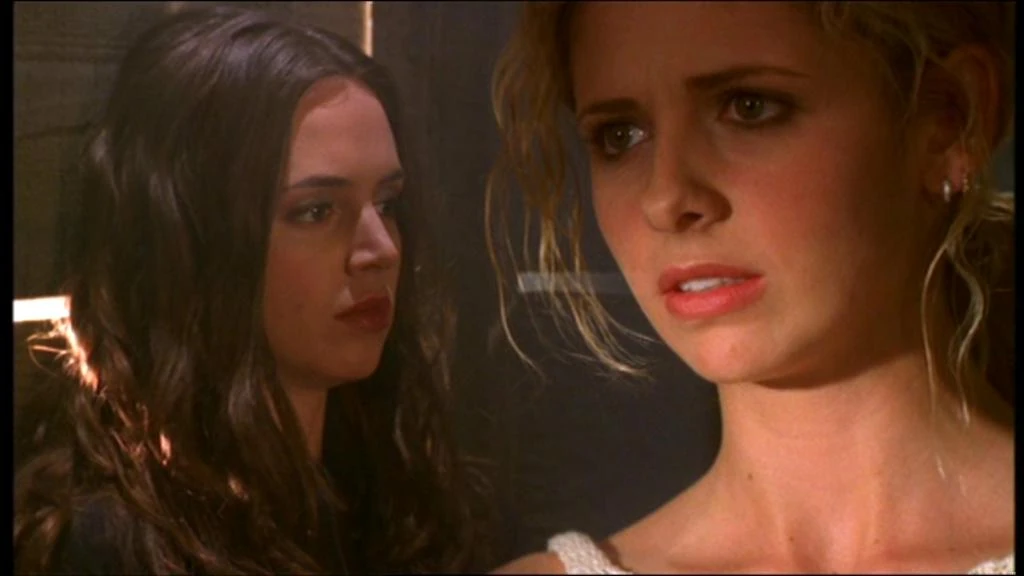
Picking up directly after This Year's Girl, Faith finds herself trying to get used to Buffy's world and her body, picking up on the events that she's missed and the people she hasn't met yet (Anya, Spike). She takes advantage of her new freedom and the trust that everyone has placed in Buffy to get on and do what she wants for a bit. Meanwhile, Buffy is trapped inside Faith's body, dragged away first by the cops and then by the agents from the Watchers' Council, unable to convince anyone of who she says she is. As Faith has to get accustomed to being the good guy for a change and the effect it has on her, Buffy finds life on the other side difficult, fighting her way back to her own body.
Who Are You marks the halfway point of Buffy the Vampire Slayer and the turning point for Faith as she realises that she might need saving after all. It's an extremely clever way of doing it. Much of Faith's resentment towards Buffy is borne out of the things that our Miss Summers is surrounded with - friends, family, people who love and respect her - people that Faith has never had in her life and didn't know how to accept when it was offered to her. It's key that Faith's big freak-out comes after Riley tells her, believing her to be Buffy, that he loves her. He doesn't mistreat her, he doesn't use her, he simply wants to be with her.
After that moment, Faith starts to see redemption as something she might want after all. That saving people and doing the right thing might be the path she wants to go down. Sarah Michelle Gellar's performance is a fantastic one, asked to perform a character that is so completely different to Buffy and to convey one of the character's most important moments within that. The climactic fight between Faith and Buffy brings out all of Faith's self-loathing, something which will be explored more once she appears in Angel soon. It's interesting though that once they've switched back, Buffy doesn't seem to have learnt anything from her time as Faith. She still sees her as a criminal who needs to be dealt with rather than someone who needs to be understood and helped. Maybe Faith has a point about that stick up her butt after all...
On the opposite side, Eliza Dushku gets to play the hero and does so with aplomb, capturing Gellar's mannerisms with ease, ensuring you never forget which one of them you're watching at any moment in time. Gellar may seemingly have the harder job, but it's Dushku on whom the episode's success relies. Her line delivery all the way through as Buffy is brilliant, particularly her scene in which she tries to convince Giles of who she is. The way she says "you were inching!" is perfect. Even the eyebrow movements are recognisably Buffy's.
There are interesting little moments in here about Tara's future role in the group, confirming her relationship with Willow for a start, but also, she's the first person to notice that Buffy, as Willow believes her to be, is not herself, something which the Scoobies miss. Later on, Tara and Buffy would go on to develop quite a close relationship, partly due to Tara's perceptiveness and Buffy's willingness to trust her. It's a good measure of just how fractured the Scoobies are at this stage in the season. None of them notice Buffy's exceedingly odd behaviour until it's pointed out to them in no uncertain terms. Tara proves to be the key to the episode, an essential component in the gang who they don't realise they need just yet.
But the episode belongs to Faith, a deeply fascinating character and one who undergoes one of the biggest arcs, probably behind only Spike's and Willow's respective stories over the course of the show. Bringing her back, positioning her once again in opposition to Buffy, but with considerably more sympathy, is a genius move, another soaring high point in the ridiculously mixed fourth season.
We've still got a bit to go, but hey, have you heard about this amazing Jonathan guy? He's a superstar.
Quote of the Week:
Faith: You're not going to kill these people.
Vamp: Why not?
Faith: Because it's wrong.
Let's Get Trivial: The expiration date of Joyce's credit card, glimpsed briefly, is May 2001, the month in which Buffy will die for the second time.
Sunnydale Who's Who: The credits list "Eliza Dushku as Buffy" this time around.
- Becky
You can read Becky's look at previous episode, This Year's Girl, here.
Follow @AssortedBuffery on Twitter
Or like our Facebook page