Wednesday, 25 July 2012

TV REVIEW: The Newsroom - The 112th Congress

The third episode of The Newsroom follows News Night's change in direction opening with Will McAvoy apologising for previous failures and issues a promise to deliver the news that everyone needs to hear, rather than what they want. But not everyone is happy with this turn of events.


The well-constructed episode so far, The 112th Congress opens with another Sorkin-typical speech with Will (Jeff Daniels) stating that he has failed in his duty as a news anchor to report the facts rather than sensationalism. First step: taking on the Republican Tea Party over the course of sixth months, starting with Will going to Charlie (Sam Waterston) with his outrage about how his party has been tainted by its association with the right-wing group (yes we get official confirmation this week; Will is a Republican, an interesting move for the overwhelmingly Democrat Sorkin). We get Will taking on various Tea Party members in some fantastic interviews while Mac (Emily Mortimer) holds court over an energised newsroom. Cut within the six month period is a board meeting involving Charlie and an imperious Leona Lansing (Jane Fonda), discussing the ratings and financial consquences of Will and Mac's mission to hold the Tea Party to account. Oh and then there's some soapy drama stuff with the ongoing flirtation between Maggie (Alison Pill) and Jim (John Gallagher Jr) while her boyfriend Don (Thomas Sandoski) is again a bit of an idiot. Mac also has to deal with Will's new array of dates that he keeps parading around the office and doesn't do it particularly well.

Starting to really hit its stride as far as the actual programme of News Night is concerned, The Newsroom brought us the take down of the Tea Party that we all longed to hear but never got outside of satirical programmes. The cross-section of interviews and reports that Will conducts are masterful and well-written with plenty of cheerworthy moments for everyone's favourite "affable" news anchor. The cuts away to Charlie's boardroom meeting also add to the drama of the situation; we're seeing the consequences play out way ahead of any of the other characters with ratings drops and threatening words all demonstrating that Will isn't going to win the vote of his superiors with his actions. We also get a little bit of Will's past history, he's a genius by all accounts, a former prosecutor with a fantastic track record and an ability to become, as Charlie states, a lawyer for the American people.


The meeting was one of the highlights of the episode, a masterclass in tension built through the bold decision to have Jane Fonda, one of the biggest names yet to appear, sit silently watching for the majority of the time. Despite a rather dodgy Jesus/Noah joke, Fonda was fantastic as a CEO keen to stay in power and desperate to do anything to keep it. With her parting threat, she could provide an intriguing enemy for the News Night team and any scenes between her and Sam Waterston are going to sizzle. Elsewhere, another highlight was the developing friendship between Jim and Dev Patel's Neal with the pair carrying most of the episode's comic relief. Patel has had little to do as Neal so far except some necessary exposition but here we're starting to see a little more of him and his various scenes with Gallagher Jr were very funny. It offers a more human side to the team outside of the ridiculous relationship entanglements that they find themselves in and seeing the pair talk about Wikileaks whilst bemoaning their ability to scare off girls was well-judged in the wider narrative of the episode, showing they've got more to say than quickfire newsroom speak.

It's important to stress at this point that The Newsroom was doing so well, really well to the point where I was actively thinking to myself "this is more like it!". I was engaged in the characters' efforts to stick it to The Man, representing both the Tea Party and their corporate bosses. I revelled in the humour and drama of the News Night programme itself and felt inwardly triumphant when Will made a crack about a misguided comment on the press. I was there, I was in it!

And then Sorkin struck again with the terrible characterisation of the women in the show. Sloan Sabbith (Olivia Munn) gets a brief moment to shine when she notices something Will had missed during the live election coverage, only to be shouted down before she gets chance to do anything. Then, the transformation of Mac from strong, confident executive producer into a jealous harridan was an extreme jarring point because once again we see her not being able to handle her personal life when it clashes with the professional. We've had no indication that she still has residual feelings for Will despite feeling guilty about how their relationship ended three years before. We get treated to a couple of scenes in which she passive-aggressively insults Will's dates to their faces whilst his jealousy upon discovering she actually has a boyfriend is limited to a short exchange with Jim and brushed off just as quickly.

Then there's the ongoing Jim and Maggie saga which, despite myself, I'm a little swept up in, rooting for them to get together because they have a fantastic chemistry and I really want to like Jim because at times, he's adorable. Sorkin, however, is making this very difficult by continually giving him moments in which he rescues or patronises Maggie for no real reason. The scene where he gallantly sweeps to her rescue after she suffers a panic attack was excruciatingly irritating. We're told by Don (who is also an idiot here, leaving Maggie on her own with a sweeping comment about how she "thinks she's dying") that she regularly gets panic attacks yet Jim takes it upon himself to tell her exactly what she should be doing, despite the fact that she clearly knows this because she's been through it before. I was very much with her when she said "I wish your face would stop moving so I could punch it" because he was such a condescending plank in that scene. He does get points for later stating that he won't swoop in on Maggie immediately after her seemingly gazilionth break-up with Don, but the damage was done.

The Newsroom is one of the most frustrating programmes I've seen in a long time, becoming split into two shows between the compelling, absorbing drama of News Night itself and the soap opera-like shenanigans of the staffers. The panic attack scene had me a hair's breadth away from switching it off all together but the Tea Party/corporation narrative drew me back in, albeit begrudgingly. With news breaking this week that Sorkin may or may not have fired most of his writing staff, I can only hope that this goes some way to ironing out the inconsistencies for the already-guaranteed second season.

- Becky

You can read Becky's review of the previous two episodes here.

You can also follow her on Twitter @beckygracelea

Sunday, 22 July 2012

TV REVIEW: The Hollow Crown - Henry V

The final episode of The Hollow Crown charts the reign of Henry V and in particular, his rise to become a warrior king, accepting the challenge to invade France with the scene set for a crucial battle on a field in Agincourt.


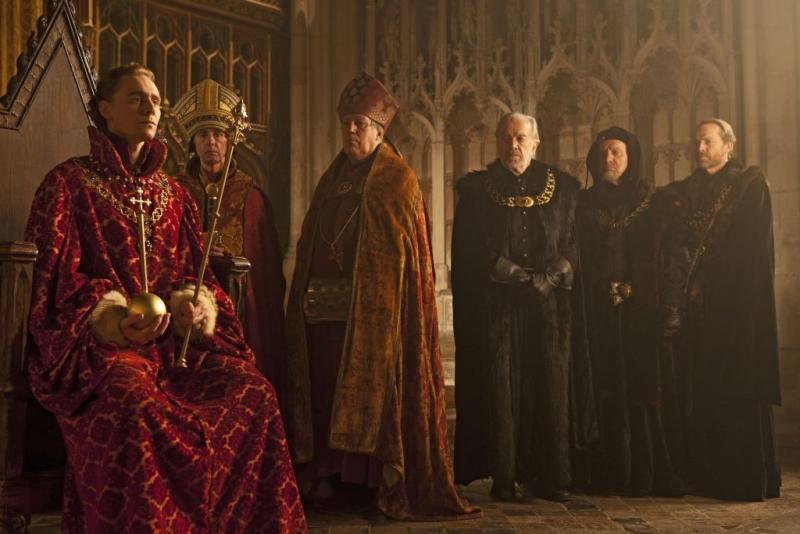
King Henry (Tom Hiddleston), now sporting a rather impressive goatee and a kingly codpiece (I wasn't actively looking, it was just very obvious), is reigning over a more peaceful England. That is until the French ambassador shows up with the challenge from the Dauphin to test his mettle against the French forces. Never one to back down from a fight, Henry accepts the gauntlet, deftly avoiding an assassination attempt and assembling an invading force from across England with the encouragement of Exeter (Anton Lesser) and York (Paterson Joseph). The scene is set for one of the most famous confrontations ever and as the two armies close in on the fields of Agincourt, Henry must prove that he is worthy to wear the English crown.


The character arc for Henry, going from Prince Hal to the King of England over the course of three plays, has been one of the highlights of The Hollow Crown with assured performances from Tom Hiddleston charting each stage of the character's progression. His first appearance in the episode, riding across the fields before hurrying into the throne room, demonstrate that he's still the same man who enjoyed partaking in a pint or two at the tavern but has now accepted his responsibilities as King. Keen to prove himself, the challenge from the French ambassador allows him to do so and his acceptance was a great point of entry into the most war-ridden plays of the Henriad. Whilst it's not quite a 'This is Sparta' moment, Henry's message to the Dauphin's ambassador is very clear; he's on his way and he's bringing a lot of friends with him. 


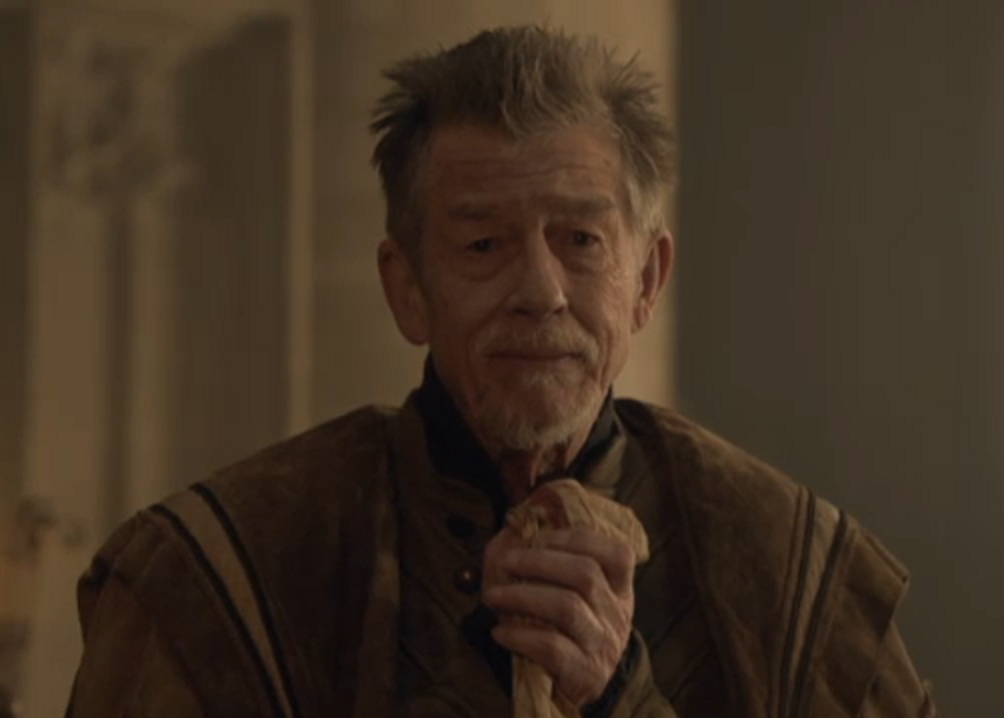
Famously, Shakespeare knew of the problems of presenting a play set mostly at war in France whilst having very little scenery to convey this setting so he created the role of the Chorus, a character whose sole purpose was to aid the audience in their imagination. Naturally a television programme has considerably more resources than an Elizabethan theatre but the decision to include the Chorus as a narrator in the guise of John Hurt's raspy tones proves inspired. The narration adds to the cinematic feel the series has worked hard to create and adds an increasing sense of familiarity to the proceedings. After all, Henry is a character we have followed since his youth and becomes someone you feel you know and could fight alongside, evident within the narrative itself; Henry spends half of his time conversing with the men around him, regardless of whether he is low or high-born.


This continues when we get to the actual war scenes, some of the most well-known in literature, the drama and pace is continued but with the emphasis placed on Henry as a king of the people (as practised with Falstaff in Mistress Quickly's tavern). The 'Once more unto the breach' scene is a particular highlight and rather than the usual posturing adopted for a rallying speech that has been seen in the likes of 300 and Troy, director Thea Sharrock adopts a more intimate approach. Henry is on the ground with his men rather than sat astride his horse, speaking to each one of them in turn and the speech becomes more than just a soundbite to later be termed 'epic'. The St. Crispin's Day speech, a bastion of English Literature, is similarly understated yet just as powerful, rousing and inspiring without descending into over-dramatic shouting. Hiddleston delivers both as measured, well-thought out addresses and with a gravitas that suits the King of England on a battefield. This king is very much one of the people, a link back to his earlier days as an honourary resident of East Cheap and the loyalty he inspires is easily seen in these moments.


The Battle of Agincourt itself is a thrilling piece of television, well-befitting of one of the most famous battles in English history. From the overwhelming odds stacked against the invading forces to the bloodiness of the battle itself, the audience is allowed to get up close and personal to the fighting, making it the best battle sequence in the whole of The Hollow Crown. Shakespeare did not shy away from presenting the negative aspects of the battle either, namely Henry's decision to execute the French prisoners they had taken and neither does Sharrock, showing the scene in all its cold brutality. It adds to Henry's character, given him a multi-dimensional quality; he's not just a hero to be glorified but also a man who makes rash decisions and mistakes as a result. 


Additionally, we also see that Henry's romantic side as he must secure the hand of the French princess. Yes, this episode isn't all manly blood and guts, we even get some romance in the mix with a lovely scene between the King and his future bride, Princess Katherine. One of the best scenes in the play, the couple have to navigate the language barrier between them, offering Hiddleston a chance to show his romantic lead potential with the kind of bumbling attempt at wooing that Hugh Grant would be proud of. This scene, also thanks to an adorable turn from Melanie Thierry as Katherine, provides a peaceful and (mostly) happy ending to a character that we've seen develop over the course of the series. The decision to include Henry's funeral as the final scene provides a bittersweet note to the finale. It returns the series full circle to its themes of inheritance and the weighty responsibility of kingship, leaving the throne to Henry's infant son and I'm not ashamed to admit, I shed a tear or two during the Chorus' final speech.


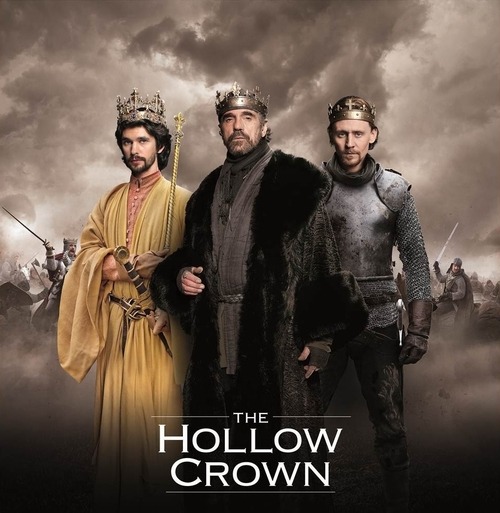
The Hollow Crown has been a triumph from start to finish and Saturday nights are going to be poorer now that it has all finished. Well-edited and beautifully presented, this is Shakespeare as it should be experienced in all its muddy, bloody and drunken glory. From the tumultuous reign of Richard II, through the family dramas of Henry IV and the final, climactic battles of Henry V, each episode has brought its own themes and classic moments to the fore with fantastic performances from every single cast member. I cannot praise it enough and, if you haven't caught it or missed an episode, I urge to go and watch it all because it could be a while before we see Shakespeare done in such a fantastic and enjoyable way for some time.


- Becky


You can read Becky's review of The Hollow Crown - Henry IV Part Two here


You can find more of Becky's writings here http://beckygracelea.blogspot.com or follow her on Twitter @beckygracelea

FILM REVIEW: The Dark Knight Rises

It's been eight years since Gotham last saw the Batman, wanted for the murder of white knight Harvey Dent, Bruce Wayne is shut up inside his manor and peace reigns in the city. However, a mercenary by the name of Bane has other ideas and sets about reducing Gotham City to its knees.


Christopher Nolan's vision of Batman has been revolutionary from its very beginning, transforming not only the summer blockbuster, but also the superhero movie, reaching dizzy heights with The Dark Knight. A resounding success with audiences and critics alike, the sequel was helped in no small part by Heath Ledger's anarchic performance as a truly terrifying Joker. Anticipation for The Dark Knight Rises then has been marked by the fact that it has to follow one of the best superhero movies ever and that it has to provide a satisfactory end to a fascinating exploration of the Caped Crusader. Thankfully, Nolan and his impressive cast rise to the challenge, providing us with a truly memorable ending for the Dark Knight Trilogy in what is easily one of the best films of this year so far.


Following a broken and emotionally worn out Bruce Wayne (Christian Bale), The Dark Knight Rises charts the return of the Batman after the manhunt that was launched at the end of The Dark Knight when he is believed to have murdered Harvey Dent. Still mourning the loss of childhood sweetheart Rachel Dawes, Wayne has hung up his cape, seemingly for good and his neglect has led Wayne Enterprises down a dark route with board member Daggett (Ben Mendolhson) planning a hostile takeover. Slinky cat burglar Selina Kyle (Anne Hathaway) and masked man mountain Bane (Tom Hardy) are key players in Daggett's plan but both have their own agendas to carry out. Meanwhile, Commissioner Gordon (Gary Oldman) and police officer John Blake (Joseph Gordon-Levitt) are watching over a seemingly peaceful Gotham City. But, as Kyle wryly observes, a storm is coming and no one is prepared for it.


Worries that this film would go down the same route as previous superhero threequels Spider-man 3 and X-Men: The Last Stand are thankfully unfounded and despite the many characters, new and old, and various plotlines, Nolan keeps a steady hand over the proceedings. A couple of characters fail to make a big impression, especially Matthew Modine who is easily forgotten in the wider spectacle of the film. Likewise Marion Cotillard delivers a fairly bland performance for the first two acts before suddenly shifting into gear later. However, the rest of the performances more than make up for it. Gary Oldman is as dependable as ever while Christian Bale delivers his best Bruce Wayne to date, giving us a very mature look at the physical and emotional tolls upon a man with two very distinct identities. Both Wayne and Batman have a very clear character arc over the course of the film and Bale handles both well with a more emotional connection available than there has been in the previous films. Michael Caine's Alfred is again the moral centre of the proceedings and his scenes with Bale brought out the best in both actors, delivering a nuanced pseudo-father/son relationship that felt very real.


But the outstanding performances belonged to the newcomers to the franchise with Anne Hathaway pretty much stealing the show right from the beginning. Catwoman has always been a mercurial figure, ambiguous to the end and Hathaway pitches it perfectly, switching emotions in the blink of an eye with a welcome sense of humour. Continuing the current run of excellent portrayal of female characters in superhero films, it's great to see another heroine who can not only look good in a catsuit but physically and mentally match her male counterparts with relative ease. Her chemistry with Bale is excellent, ensuring that any scene with the two of them is a real highlight and something to look forward to. Joseph Gordon-Levitt's idealistic John Blake is another standout and further proof that the man is yet to deliver a bad performance.  As a villain, Tom Hardy's Bane had a tough act to follow with Ledger's Joker and delivers a worthy performance, every bit as terrifying as his predecessor but in an entirely different way. Whereas the Joker was shocking in his unpredictability and sheer desire for chaos, Bane is all physical intimidation powered by an intense belief in what he's doing.  Hardy's vocals took a little getting used to but gave Bane a unique voice and his speech about giving Gotham back to the people was imbued with a delicious sense of irony.


The action sequences also benefit from this emphasis on character-driven storytelling. Any scene with Catwoman (though she is never referred to as such) and Batman fighting together has an inbuilt sense of humour with the two working in collaboration almost immediately and whilst going for all-out spectacle, Nolan still manages to create a sense of intimacy with those involved. Perhaps the best example of this is the first confrontation between Bane and Batman, a brutal and intense fight sequence that is designed to make you wince. Stripped of any music, all you can hear are the blows connecting with the two bodies and the grunts of physical effort. Nolan also holds the shot just long enough to make it slightly uncomfortable and the slow cuts add to the tension of an already suspenseful scene. Important for both plot and character development, this is a moment that stays in the memory long after the credits have rolled.


The characters are where the film's true strength lies, carrying you through a plot that, at times, is both a little difficult to follow and some slow moments early on. The first two acts in particular were a little plodding and occasionally it did feel as if the pace had slowed too much. There are enough twists and turns throughout to keep you interested and thanks to the great performances, you find yourself swept up in each character's journey. But then there's the third act. Awesome from start to finish, the last forty-five minutes of the film is a triumph of cheerworthy, fist-pumping moments and an ending that was just perfect for the trilogy as a whole. Without going into details, I sat in the cinema for the last two minutes of the film with the largest grin on my face. Providing a satisfactory resolution to this incarnation of Bruce Wayne's journey was always going to be tough but Nolan passes with flying colours, staying true to the character he and Bale have crafted whilst also providing plenty of crowd-pleasing moments.


After the success of The Dark Knight, it would have been easy for Christopher Nolan et. al. to all rest on their laurels, knowing full well that the hype surrounding their final film would have been enough to net them a decent box office. Thankfully for us, they do no such thing and deliver what is easily one of the best blockbusters of the summer and a fitting end to one of the greatest trilogies of all time. I don't think I'm alone when I say that I'll miss the incarnation of the Batman universe but the ending is just so brilliant that I wouldn't want anyone else but Nolan to come along and mess with it.


*****


- Becky


You can find more of Becky's writings here http://beckygracelea.blogspot.com or follow her on Twitter @beckygracelea


TV REVIEW: The Newsroom So Far

Aaron Sorkin's latest television project is his first since the ill-fated Studio 60 on the Sunset Strip and having found success in Hollywood with The Social Network and Moneyball, his attention has turned to the drama of a primetime news show, News Night. It has been savaged by critics here and across the pond so far, seemingly keen to pull down the Sorkin success story, but is it completely unfounded? Or has Sorkin perhaps got a bit too preachy for his own good?


The first episode, We Just Decided To, follows Will McAvoy (Jeff Daniels) after he delivers a blistering takedown of a female student who asks him during a public debate why America is the greatest country in the world. In typical Sorkin fashion, Will gives us a list of reasons of exactly why America cannot be considered as such anymore, providing us with statistics to prove it and a rather rose-tinted view of the country's history to show what it could be again (but more on that later). Brought in to aid the News Night rehabilitation, Will's ex-girlfriend MacKenzie McHale (Emily Mortimer) signs on as executive producer at the request of drunk executive Charlie Skinner (Sam Waterston) and brings along her associate producer Jim Harper (John Gallagher Jr.) for the ride. Already in place is beleaguered and accidentally promoted Maggie Jordon (Alison Pill), outgoing executive producer Don Keefer (Thomas Sadoski) and Will's blogger Neal Sampat (Dev Patel). News Night wants to provide a non-biased, intelligent look at the news that allows the American electorate to know exactly who and what they're voting for.


One thing that Aaron Sorkin has always been able to do is write a cracking pilot, filled with fast-talking, intelligent people who work to do their best in whichever field they're in, be it politics or television, all constantly residing in a pressure cooker of intensity. The Newsroom pilot is no different; from the fantastic opening speech from McAvoy about the ills of the United States to the race to get their show on the air. The characters in the first episode are all compelling, each coming with their own backstory, quickly explained but just as relevant. Particularly interesting are Mac and Jim's background, both having returned from several years reporting on the front line in Afghanistan and Iraq and I am hoping we explore the effects of this in later episodes. A ragtag bunch of people at this stage in the proceedings, the future News Night team are brought together over the breaking news of the 2010 BP oil spill.


Yes, that's right. The Newsroom's central conceit is that it takes the news of the recent past and retells it, how it should have been told (according to Sorkin). Now Sorkin has stated in various interviews that this show is intended to be a love letter to the news and yes, to show certain things how it should have been told. Future episodes will take on the Republican Tea Party and the age-old debate of gun control.  I don't pretend to be anywhere near as fantastic a writer as Sorkin, but this technique just smacks of being lazy. There's no need to create these problems or find issues that provide allegories for our reality because they're already there in the past, waiting to be re-written. One of the main criticisms levelled against the show is that it's constantly on a soap-box, preaching from its office of intelligent people who know better. And I have to agree. Sorkin's programmes have always been politically aware and full of intelligent people who know better, especially in what is, in my opinion, one of the greatest shows of all time, The West Wing.


Following the policy-making of a Democratic Oval Office provided the chance to comment on real-world issues but within a specifically relevant setting. Importantly, The West Wing created an alternate reality, one in which the same history was present but the present and future was all slightly different. The Newsroom, however, is set very much in our reality, only two years or so before and it allows Sorkin to glorify his team as the true voice of American news, reporting these events how they should have been reported because, as is often wryly observed, hindsight always has perfect vision. Thanks to a convenient coincidence (Jim's sister works at Halliburton whilst his college room-mate works at BP), News Night are able to focus on the potential environmental disaster before anyone else even thinks that there might be that significant a consequence. All that being said, the pilot episode was fantastically entertaining, full of quickfire dialogue and tense moments. The final scenes of the News Night programme itself matched the sort of thrill that you used to get when Jed Bartlett delivered speeches back in the Oval Office.


What a shame then, that the second episode, News Night 2.0 goes downhill so rapidly, you'd think Sorkin had a cancellation wish. The actual story itself, an episode of News Night concerning the Arizona immigration law, SB1070, goes wrong when a source drops out and the team scramble to find less-than-suitable candidates to provide the 'for' side of the debate, is inspired. After Maggie's ex-boyfriend turns out to be an aide to the Governor and she accidentally insults him over the phone, Jim takes the fall for her whilst the bookers find someone to replace him. The News Night episode is classic car-crash television with a former Miss Oklahoma runner-up and a gun-totin' neighbourhood watch man providing much of the comedy. It was also good to see a show go wrong after the relentless righteous broadcasting we saw in the pilot episode and is perhaps proof that whilst Sorkin is attempting to re-write the news as it should have been reported, it might actually not go so well once in a while.


However, it is what is happening in the rest of the episode that drags the quality down by a country mile, specifically, Sorkin's writing for the female characters which is downright insulting that it borders on misogynistic. We know from the very beginning that Mac and Will once dated three years ago but with the way she starts to act, you'd think they had broken up the week before. Mac acts in increasingly unprofessional ways, careering about trying to convince every one that Will is actually a nice guy for no readily available reason. Attempting to satirise the media's reliance on hiring beautiful women, Olivia Munn's character Sloan Sabbith is a genius-level economist and as Mac observes, she's hired because she looks fantastic in a skirt. Then there's Maggie's unfortunate dating history which leads to the whole News Night mess in the first place. The initial scene between Maggie and Jim in which she convinces him that is perfectly capable of doing the pre-interview for the Governor of Arizona was great and really endeared her to me, especially considering my own position as a nearly-graduated, very unemployed person with a passion for the media. But then, it turns out that the man she speaks to on the phone happens to be an ex-boyfriend who cheated on her and she makes an unprofessional comment that means the Governor drops out.


Jim gallantly swoops to her rescue and takes the fall so Maggie keeps her job. Now I like Jim, he's adorable, John Gallagher Jr has great chemistry with Alison Pill and they're clearly being set up for a Donna/Josh type relationship. Whereas Donna and Josh would debate and match each other step for step, Jim is already placed as the superior with Maggie trailing behind him trying not to screw up again. So here we have two women, incapable of separating their professional lives from their personal, both having to be rescued from utter humiliation by the men in their lives. Way to go Sorkin. Coming from the man who gave us CJ Cregg and Abbey Bartlett and Donna Moss, all of whom were intelligent and adept at keeping their lives separate, this was incredibly disappointing. We're supposed to be past stereotypes like these and seeing Mac and Maggie, two characters who were so compelling in the pilot, descend into shrieking harpies became a real sticking point and really altered my opinion of the episode.


The Newsroom has been a highly frustrating watch so far because there is a great show in there trying to get out but unfortunately, the decision to place it in the past and the characterisation of the women of News Night has meant it has not got off to a great start. I'm going to stick with it because all shows take a while to find their feet and Sorkin is a fantastic writer, but I can't help thinking that this time, his tendencies have passed brilliant and become more than a little self-indulgent.


- Becky


You can find more of Becky's writings here http://beckygracelea.blogspot.com or follow her on Twitter @beckygracelea

Thursday, 19 July 2012

SERIES REVIEW: Blackout


 So Blackout, the BBC’s latest mini-series ended this week. Brought to us by the same production team as last year’s infinitely cheerier Single Father, starring a veritable dream team of David Tennant and Suranne Jones, Blackout starred fellow ex Doctor Christopher Eccleston. Although he’d doubtless despise that link. 


 Christopher ‘oh so very serious’ Eccleston , as we like to call him here at the Buffery, plays alcoholic council worker Daniel Demoys, a gruff sort of chap prone to bouts of violent behaviour when under the influence, none of which he can remember the morning after. Set in a rainy undisclosed city clearly modelled on Manchester, episode one charts  Demoys’ slow realisation that he has killed a fellow council worker. Having coming to his senses after saving the life of a young witness in a drug trafficking trial, he must atone for that, whilst simultaneously comforting the deceased’s distraught daughter, played with appropriate distress by Rebecca Callard, as well as saving his collapsing marriage with wife Alex (Dervla Kirwan). Oh and he also had an affair with a rather over idealistic blonde woman by the name of Sylvie, (MyAnna Buring) although that didn’t seem to consist of much more than the odd bit of action in a club stairwell.

Got all that?

In Episode 2, we see Daniel’s decision to become mayor, which allows him to set the world to rights whilst enjoying the professional success that goes along with it, earning him brownie points with wife Alex. It will come as no surprise however, that darker forces are at work here, protecting Daniel’s secret and burying any traces of the past for their own evil ends. These not so subtly sinister undertones bubble precariously close to the surface as the episode progresses, helped in no small way by Andrew Scott’s scene stealing Detective Bevan, and all set to the show’s murky film noir style backdrop.

This paved the way for the third and final episode, details of which I will not reveal here in case any of you haven’t quite caught it on 'the Iplayer' yet.

There's a lot to like, here. Eccleston gives his usual dependably intense performance, with atmospheric lighting and make-up allowing him to look extra stare-y. Dervla Kirwan is an equally reliable actress, although I’d have liked to have seen more of her.The dialogue is true to the unnamed gritty metropolis (Manchester) it is written to represent, the production values are excellent, and the storyline skilfully instils a sense of growing unease and anxiety. Which obviously again ties in with all the shots of chlaustrophobic skyscrapers, endless drizzle and murky grey-green street lighting of the city (Manchester).


It is very stylish.

If I have a problem with it though, it’s that it’s too stylish. Call it personal taste but I think it could have used just a touch more realism in places and a little less glossing over the details. This is particularly apparent in any scenes which even remotely consider alcoholism as a concept, as sufferers are labelled simply ‘drunks’, with that being the end of it. ‘I’m a drunk’, they say. ‘But why, how?’ we shout, unheeded at our screens. For a programme centred on the idea of alcoholic blackouts, the alcoholic side of it is barely touched upon. We see Demoys’ attempts to avoid the booze, but we have no idea how we developed the relationship with ‘the sauce’ that he did.

The same can be said of the ending. Again, I won’t give away too much, but it just doesn't come across as having been well thought out. It’s hurried over and unsatisfying- which is a shame when so much of the production is entirely the opposite.

Worth a watch, but possibly another sad case of style over substance.

Blackout is available on BBC Iplayer until this Monday 23rd July.


-Jen


You can read more of Jen's writing here: http://memyselfandtheothers.wordpress.com/ 
Or follow her on twitter: https://twitter.com/jenniferklarge

Wednesday, 18 July 2012

TV REVIEW: The Hollow Crown - Henry IV Part Two

The third episode of The Hollow Crown and the second part of Henry IV follows the aftermath of the Battle of Shrewsbury, the decaying relationship between Prince Hal and Falstaff and the King dealing with the rebellions which continue to flourish in an uneasy England.


Lord Northumberland learns of Harry Hotspur's death and flees to Scotland for safety. The Archbishop of York plots another rebellion against Henry IV who is weakening after the toll of the battle. Hal is still torn between his old life and his new role as the heir apparent and has to come to terms with the fact that he soon might be King. Meanwhile, Falstaff is being chased by the Lord Justice, determined to keep him away from corrupting the young prince once again, but Falstaff is confident in Hal's love for him, believing that once Hal is King, he will bestow Royal offices upon his portly friend.


While still possessing the bawdy comedy and the slapstick of the first part of Henry IV, Part Two is a much more serious piece of work, dealing with the complications of growing up and accepting your responsibilities. The journey here is Prince Hal's, begun in Part One, but reaching its destination in Part Two as he cements his position as the honourable heir apparent and shedding the rebellious youth who we saw in the previous play. Tom Hiddleston, reliable as ever, manages to avoid falling into the trap of playing the two as very different halves of the same person, but instead gives us a nuanced performance that captures the development of Hal. The cheeky prankster is still there but is measured by his realisation that shedding Falstaff and the other residents of East Cheep is the way to go. The coronation scene in which Hal finally banishes Falstaff from his life and the country was emotional, both in terms of seeing finally become King Henry V but also the act of banishment itself. Simon Russell Beale has portrayed one of Shakespeare's most famous characters with a great balance of both the comic and tragic elements that Falstaff possesses.


As always with Shakespeare, a lot of the very important character developments are shown through the use of soliloquy and the two most powerful scenes in this episode were those given over to Henry and Hal as they contemplate the effects of kingship, for as Henry mournfully observes, 'uneasy lies the head that wears the crown'. Both Jeremy Irons and Hiddleston capture your attention in their separate moments and the setting of both scenes in the throne room really develop the sense of the inevitablity of kingship. Hal is very aware that his father's death is necessary for him to become King and the internal conflict of this was well-pitched and enhanced the emotional weight of the scene. The focus isn't all on the kingly pair though with Hal's younger brother John also getting a look in on the action. His takedown of the rebellion alongside Westmoreland was a properly triumphant moment and whilst not entirely honourable, it was a well-handled bait-and-switch for both the audience and the doomed rebels.


The episode's shortcomings are few but can probably be traced back to the play itself. Nowhere near as famous as the plays that come before or after, it is also not as strong structurally or dramatically. The few standout scenes I've mentioned are just that, exceptional pieces of theatre that provide great moments for actors and audiences alike. However, those in between lack some of the punch of the other moments. Whilst the farcical chase between the Lord Justice and Falstaff culminating in all out street brawl would probably work very well on stage, on screen it felt out of place with the more sombre tone that Part Two took. I'm well aware of the necessity to further separate the characters of Hal and Falstaff, but the jumps in tone sometimes felt a little jarring. That being said, I would watch Julie Walters in anything and her take on the beleaguered Mistress Quickly was one of the highlights of both plays.


The Hollow Crown is one impressive piece of television and I'm already eagerly awaiting the next instalment. Whilst Part Two didn't quite match up to the dizzying heights set by the truly brilliant Henry IV Part One, it held its own for the most part and gave Irons, Hiddleston and Beale plenty of moments to shine. Next week, we get to see Hal as Henry V in all his St. Crispin's Day glory and I'm already feeling just that little bit more patriotic.


- Becky


You can read both Becky's and Jen's reviews for Henry IV Part One here and here.
Or follow Becky on Twitter @beckygracelea

Thursday, 12 July 2012

BOOK REVIEW: Fifty Shades of Grey

Yes, you read that title right... For the first ever Assorted Buffery book review, I'm about to assess the merits of the new fictional phenomenon currently gracing the bookshelves of most women and some men everywhere; the veritable pornocopia that is E.L. James' Fifty Shades of Grey. Badly written, badly executed and quite unintentionally hysterical, I can safely say that it's one of the most entertaining books I've read in a while. 

In a short space of time, Fifty Shades has become one of the most talked about books of recent times, influencing everything from failing marriages to what classical music people want to listen to (reports are indicating that sales of pieces mentioned have shot up). Women want to find their own Christian Grey and from what I've read, most men either want to thank him or punch him in the face. So what is all the fuss about? It was originally created as Twilight fan fiction, something that is immediately horrifying, and all the hallmarks are still there; controlling, "mercurial" hero who has a dark secret and a heroine who has no discernible personality traits and bites her lip so often that I'm honestly surprised it didn't fall off. Anastasia Steele, or Ana as she prefers, is an English Literature student about to graduate when she meets the enigmatic billionaire Christian Grey (Steele/Grey - get it? They're like totally meant to be together). Less of a plot and more of an excuse for an increasing amount of sex scenes in random locations, Ana finds herself pulled into the mysterious and controlling world of Grey as she finds herself questioning what exactly does she want from a relationship where she regularly finds herself tied to things. 

So just who are Ana and Christian? Well aside from being as multi-dimensional as your standard piece of cardboard, they're actually pretty annoying. Ana, for example, clearly does not belong to the 21st century, acting like a throwback to a time when women were demure and had no worldly knowledge whatsoever. I've no problem with her being a virgin because it allows her to approach Christian's tastes with a healthy dose of WTF but what university student doesn't have a laptop in 2011? Or a mobile phone? Or an EMAIL ADDRESS? My friend's dog has an email address for crying out loud. Her inability to deal with the outside world, despite being of one of the most computer-literate generations there has ever been, makes her seem like an idiot. Meant to be an intelligent, free-thinking woman, Ana has the capacity to be a decent heroine but one glance at Mr Grey and his piercing gaze, all principles fly out of the window and she ceases to have any redeeming features. The most annoying Ana-aspect though is that she's followed at all times by her angelic, judgemental subconscious and her permanently peppy and devilish inner-goddess. Throwing in a bit of Freud 101 despite having clearly never read any psychoanalysis, James sees the subconscious and inner goddess (bleurgh) as voices of reason or passion but instead, the italicized pair unintentionally form one of the best fictional comic double-acts since Fred and George Weasley. 

Then, of course, there's Christian Grey, dancer, pilot, piano player and all-round douchebag. How anyone can be this perfect is beyond me and that doesn't add to his allure, it just makes him seem all the less realistic, an untouchable set of abs in some well-fitting sweatpants. The only time his character actually appealed to me was in the various flirty emails that were sent between the pair. When he wasn't being ridiculously controlling and paternal (a scary trait in its own right), he was actually quite charming, displaying a sense of humour that's much more attractive than his conveniently messy hair. But every dark, brooding hero has to have his dark secret and it's not how he manages to say everything either "darkly" or "dryly". No, his little obsession is with BDSM. Maybe it's a personal taste thing, but I just don't understand why this man is sending thousands of women into a frenzy, wishing for their own version. I have no issue with the BDSM aspect (people can do whatever they like as long as its consensual and above board) but his Red Room of Pain sounds more like the Brown Room of Really Boring Furniture, making it about as erotic as the Antiques Roadshow. And if anyone ever spoke to me the way he speaks to Ana, all they'd see next would be the door swinging shut. But, he's like, so hot. So I guess that makes it ok.

But I'm not really that naive, I know people aren't reading this because of the characters, or the plot, or even the frankly god-awful prose; they're reading it for the sex scenes. Ranging from your standard "vanilla sex" (her words, not mine) to riding crops and insertable silver balls, we get sex in a boat house, in the shower, on the desk but not, as Ana mournfully observes, on the piano. Because attempting to play Für Elise with your arse must be, like, the sexiest thing ever. Despite the author's best efforts and the considerable stamina of her characters, none of this was particularly erotic, mainly due to the way in which James describes everything. I find it difficult to take anything like this seriously when the narrator consistently refers to her genitals as "down there" or "my sex" because you would think thesaurus.com offers a little more. Also, how many times can a person "shatter into tiny pieces" every orgasm before their molecular structure starts to have issues? Women are not made of china, thank you very much. Then there's Christian's sex talk which is consistently hilarious. Take for example, this little beauty: "I don't make love. I like to fuck... hard". At this point, I was laughing so hard, I had to walk away from the book for five minutes just to recover and Ana's exclamation of "Orgasm! Another one!" brought tears to my eyes.

The book isn't all sex and inadvertent hilarity though and, if you think about it, it is actually quite disturbing. That people think that this relationship is romantic, one that is based on the woman being entirely submissive, not only sexually, but socially, is very worrying. James gives us the entire contract that is held between the two of them and details the conditions set by Christian which include dictating how much Ana eats and how she dresses. I'm determined to not get involved in the debate around the sexual politics of this novel because they are so horrendously awful, it'll just result in my typing angry capitals of RAGE across the screen. But, to put it briefly, the relationship between the two of them is not good; he's controlling, manipulative and scarily aware of her monthly bodily functions. He infantilises her throughout the book, "admonishing" her about everything from not eating to drinking too much, forces her to drive a different car and what contraception to use. Granted, she gets points for not giving into him easily on everything, but she's not about to win any awards for Best New Feminist Icon.

With Fifty Shades of Grey, I know it's supposed to be entertainment and it definitely can't be taken seriously, but it won't stop me being a little angry at the portrayal of Christian and Ana yet despite the terrible prose, dubious sexual politics and woeful characterisation, I was completely hooked. I read the entire book in one sitting and will shortly be obtaining the next two in the trilogy, a fact of which I am a little ashamed. I don't care about the characters, I find the entire thing about as erotic as stamp-collecting and it is so badly written, I spend half the time laughing at it. Nevertheless, I want to read on, I want to know what happens. At one point, Ana thinks that "perhaps in the morning, this might not read like a bad joke" and I thought the exact same thing about this book, but it still does, it's still awful. All that being said, I can't deny I enjoyed it. It's bloody hilarious and all credit to E.L. James because she actually got people to buy this crap by the bulkload. And I can't argue with that.

Now if you will excuse me, I need to stop my inner goddess from tango-ing out the window.

- Becky

You can find more ramblings from Becky here http://beckygracelea.blogspot.com
Or you can follow her on Twitter @beckygracelea 

Monday, 9 July 2012

TV REVIEW: The Hollow Crown - Henry IV Part One: A Thoroughly Modern Monmouth


Having been a fan of Henry IV Part 1 for many years now, I feel obliged to present my own addition to Becky’s already ample review.

You’ve already read Becky’s review (and if you haven’t, go do so here) and so assuming you’ve got the Henry basics down by now, I’m just going to jump straight in.

Crucial to this tale of a wayward prince’s return to honour in defence of his father, is the Bard’s slick use of contrast. Much like a modern day domestic soap opera, no sooner have we settled into one group dynamic, be it that of the court, the rebels or the tavern, than some imaginary narrator figure clicks their fingers and we’re propelled headlong into a whole new atmosphere, usually one the total antithesis of the place we’ve just left.

The play just wouldn’t work without it, and Richard Eyre’s version captures it beautifully. I’m not usually one to praise scene shortening in adaptations, primarily because it means I then feel the need to explain the missing bits to everyone else in the near vicinity, but here, the editing marries the different plotlines together in a way which does not take away from the original pattern, but adds to it. Moving slyly from scene to scene, Eyre’s adaptation catapults Hal’s coming of age (and sobriety) story into something more epic, clever, heartfelt and ultimately more modern than I’ve seen this play before.

The magic of cinema, as it were, and as Becky has already mentioned,  allows it a bigger scale than previously, the real terror and grit of war coming across in the frost bitten, blood soaked battle scenes. The wardrobe and set decisions fit the brief, too. In fact I’d like to take my hat off immediately to whoever had the idea of putting Hal in a vaguely Elizabethan leather jacket, and you can almost smell the beer from the tavern scenes and feel the laughter reverberating from the walls.

It all feels generously updated, cinematic and well thought out.

Ultimately though, it’s the performances in this production that make it feel as thoroughly modern as it has long deserved to be.  Eyre’s shift in focus from the history of the play to the relationships within it puts to bed my one traditional criticism of this play- the slightly two dimensional nature of its main characters.  All too frequently they are concepts and symbols for directors to play with before they are people, and we can only guess at their inner world.  Not so here. Eyre’s cut and paste approach to the longer speeches comes into its own, and we’re given much needed proof that there’s more in the heads of Hal and Falstaff than big ideas, ego and booze.

Speaking of Hal, kicking the notable performances list off in style is Tom Hiddleston’s Prince. I’ve long thought Harry Monmouth the original lovable rogue, and Hiddlseton shows him off for exactly what he is. He’s sexy, suave and self-centred but with enough of a prankster’s cheeky streak to make you fall head over heels for Shakespeare’s most dapper royal regardless. Here he’s a joy to watch, with Hiddleston’s inclusive and charismatic performance making you not only want to be a part of his gang, but really feel that you’re in on the joke, whichever one it is at the time, every step of the way.
Eyre also goes to town on the gleeful closeness and camaraderie of Hal and best pal Poins (one of our beloved Unsung Heroes), who, through a combination of careful direction and well-timed close-ups, is finally brought to the foreground not as a plot device, but as an accomplice in his own right. (Hooray!)  


 The pivotal relationship between Hal and Falstaff is just as spot on, with the score brought in at key moments to highlight their tragic co-dependence. It’s not hugely subtle, but it does the job, and again, they all feel like real people you could meet down your local of a Friday night, rather than stuffed up Received Pronunciation cut outs. 
 
 Hostpur, I had a few initial problems with. Apologies, Becky. Brilliant though Joe Armstrong’s performance is, I just didn’t feel the parallels between himself and fellow Harry, Prince Hal, were as obvious as they should be for the play’s intricate design to be seen at its best.

But then I decided that I’d missed the point. It does happen, from time to time. I decided that Eyre’s Hotspur wasn’t an obvious parallel, not in error, but precisely because he wasn’t supposed to be. You wouldn’t get two similar looking kids, both born of power, born on the exact same today and mirroring each other’s stance and booming voices in a modern drama or in reality for that matter, and so you don’t here. Hotspur suitably rants and raves enough to do his name proud, but again he’s a character in his own right, with his own motivations and merriments- not just there as a mirror image of his adversary.   

Oh and Julie Walters? A born Mistress Quickly, a fantastic casting coup and a great excuse to have her sat in a pub with an equally grubby looking Maxine Peake.

The effect of all of the above is that this production feels more like an action film, the story of which could have been thought up last week, not an adaptation of a play from four hundred years ago, based on an even older story. Its blend of domestic drama, friendship and battle drama is alive and well here, and as a result we can empathise with its characters and see ourselves and our friends in them more than we ever have.

It’s gritty, edgy and even tragic, but most of all it’s just gloriously good fun.

And you can’t say fairer than that for a play set in a tavern. 

- Jen


You can read more of Jen's writing here: www.memyselfandtheothers.wordpress.com 
And can follow her on twitter here: www.twitter.com/jenniferklarge

Sunday, 8 July 2012

FILM REVIEW: The Amazing Spider-Man

Peter Parker books himself a date with a radioactive spider after he decides to pursue the mystery of his parents' disappearance, meeting desperate geneticist Dr. Curt Connors on the way who may have a small lizard problem.


When The Amazing Spider-Man was announced instead of a Sam Raimi-led Spider-Man 4, the majority of the free world with an emotional investment in the titular web-slinger cried out "Why?!" and went into immediate anger mode. For most, it was just too soon to even consider a reboot, the story was too familiar and Raimi had, despite a woeful third film, left his indelible mark on the franchise. Whilst it still might be a little too recent for audiences to put the other franchise out of their minds, thankfully The Amazing Spider-Man manages to touch on the same plot points whilst putting its own unique spin on the proceedings.


The film opens with a young Peter Parker being left by his parents with his Uncle Ben (Martin Sheen) and Aunt May (Sally Field). Time goes by and now a fully adolescent Peter, in the shape of Andrew Garfield, has grown into the kind of nerdy kid who gets hit in the face with a basketball but still manages to look winningly attractive in a hoody and can exhange awkward banter with Gwen Stacy (Emma Stone). After discovering a briefcase of his father's, Peter is led on a trail to Oscorp where he meets his father's partner, Dr. Curt Connors (Rhys Ifans) and a certain radioactive spider. Then there's the familiar discovery of powers and, through a tragedy, what comes with great responsibility. Running in parallel with Peter's discovery is Connors' own transformation, pushed into testing himself with a supposedly restorative formula only to discover that the lizard DNA likes to take over.


Thanks to the success of Sam Raimi's Spider-man, most people interested in this film will already know the story of Peter's transformation into Spidey, beginning with the bite and ending with the vengeance quest after the death of Uncle Ben. Instead of taking the speedy approach as Raimi did, Marc Webb goes his own way with the story, slowing it down to allow the characters to develop into their various roles. Martin Sheen's Uncle Ben is afforded a great deal of screen time and scenes with Peter so when the inevitable shooting happens, it really packs an emotional punch. This also spills over into Peter's vengeful reaction, seemingly more realistic because the audience has seen the relationship between him and his uncle. The slow pace seems a little odd at first, after all, the big spectacle of the film is the donning of the famous red and blue suit, but it allows you to become truly involved in Peter's development. It adds to the discovery of his powers, so instead of the fast canteen scene that Raimi gave us, Webb offers several comical montages where Garfield displays some great slapstick timing in a fight with toothpaste and water taps which gives the film a light-hearted tone sometimes missing from Spidey's previous incarnation.


That's not to say that the aptly-named Webb isn't afraid to go dark; indeed, the Curt Connors narrative deals with some fairly big moral dilemmas. The great tragedy of Connors is not that he is an inherently bad guy, but one who is initially intent on doing good. His cross-species research that affects both Peter and himself, is born out of a desire to find cures for some of humanity's most feared disorders and diseases. When the Lizard completely takes over, this desire to do good becomes his undoing as his evil plan revolves around the improvement of the human race, rather than the destruction of it. Ifans puts in a decent performance as this version's first villain, morally conflicted yet still with the desire to succeed for himself. I would have liked to have seen more of a descent from Connors to Lizard which only really occurred in one scene. With so much time devoted to the development of other characters, Connors was rather neglected and as one of the most interesting, conflicted villains in Spider-man's vast rogues' gallery, he deserved just that little bit more time.


Previously successful with (500) Days of Summer, Webb knows how to create believable characters and devotes the first act to developing them. The film's biggest strength is the central performance from Andrew Garfield who brings Peter's nerdiness, technical genius (note the re-appearance of the proper mechanical webslingers) and wisecracking to life, giving us a Spider-man that is much closer to the one we know from the comics. Many people doubted whether a 27 year-old could convince as someone ten years younger but he transforms his body to reflect his teenage self. He's helped greatly by his co-star Emma Stone who manages to build a very real, convincing relationship between Peter and his first love interest, Gwen. Their awkward scenes together are less Twilight (as some reviewers suggest) and more reality, conveying the nervous moments like asking someone out or meeting your girlfriend's parents. Speaking of which, Denis Leary gets a lot of laughs in his role as Gwen's father and manages to get a couple of action scenes in as well. I could watch Martin Sheen read the telephone book and he again excels here, giving Uncle Ben the gravitas needed to provide Peter with his chief motivation and his interaction with Sally Field's Aunt May is a real highlight in the first act.


But what really endeared me to this film was the presentation of Gwen Stacey, not as your traditional damsel-in-distress, but as more of a sidekick to Spider-man. Female characters in superhero films, especially the love interests, tend to get given just that to do; turn up, look pretty, scream a lot when they're inevitably kidnapped by the villain. This was something Sam Raimi's Spider-man films never quite got right for me because Mary-Jane never really did anything except conveniently get wet and shout a bit. Recently this has got slightly better in more recent blockbuster superhero films such as Avengers Assemble, but it is still quite rare to see a female character who is actively involved in the plot. It was a real highlight therefore in Webb's version, helped by a great performance from Emma Stone, that Gwen forms an integral part of Peter's development and the big battle at the end of the film.


While Webb is successful at bringing the human element into a genre as fantastical as that of the superhero, he's not quite mastered the action sequences. While the CGI fly-throughs of New York are just as impressive as those in the previous incarnation but sometimes the action is a little lacking in tension. A rescue from a falling car is well-handled, to the point at which it becomes a little more memorable than some of the bigger sequences later. The finale in particular lacks some of the tension that we've come to expect and when this is a movie competing with the likes of Avengers Assemble and The Dark Knight Rises, you would expect the action sequences to be a little tighter. That being said, capturing the way Spider-man moves is no easy task but it is one that succeeds in this film, particularly in his confrontation with the car thief, a scene notable for Garfield's improvised wise-cracking.


Yes the story is familiar and it naturally follows a lot of the same plot-points that the audience knows but Webb and his capable cast successfully create a new spin on it. With a full trilogy planned, this first instalment promises much and whilst not quite the amazing of the title, this is a Spider-man I'll be happy to see again on the big screen.


***


- Becky

TV REVIEW: The Hollow Crown - Henry IV Part One

The Hollow Crown continues this week with Henry IV Part One, the second in the tetralogy of history plays and a personal favourite of both of us here at Assorted Buffery. With Richard II establishing Henry Bolingbroke as King, Shakespeare moves into showing the events of his troubled reign.


Henry IV Part One follows the rise of Prince Hal (Tom Hiddleston) from drunken reprobate to warrior heir apparent after his father, King Henry (Jeremy Irons) faces an uprising from the Welsh rebel, Owen Glendower (Robert Pugh) and Harry Hotspur (Joe Armstrong). Beginning in East Cheap with Poins, Shakespearian Unsung Hero Number 10 (David Dawson), Mistress Quickly (Julie Walters) and the excessive drinker and cowardly storyteller, John Falstaff (Simon Russell Beale), Hal must grow up from playing pranks to leading his father's army and, as this is Shakespeare, we get tragedy, fearsome confrontations and more than your usual amount of debauchery.


As with Richard II, the action flits between several places as the play follows the King, his son and the rebellious Hotspur throughout, but unlike the previous episode, the cuts in between felt a lot more measured and well-judged. The tavern scenes in particular were a highlight, providing much of the comedy as Hal and Poins humiliate Falstaff repeatedly for no particular reason other than that they can. The battle scenes towards the end of the play did betray the episode's budget somewhat as, rather than being treated to extensive armies a la Lord of the Rings, we got close-ups of twenty men crammed into a shot to make it look like there's a lot. Thankfully, it didn't detract too much from the drama itself as once the fighting started, the frenetic battling was enough to hold your attention. My only complaint was that they didn't include the hilarious scenes in which Hotspur's ally, the Douglas, marches round the battlefield attempting to kill the King, only to repeatedly discover he's just killed another man dressed like the King. However, when you've got Falstaff bumbling through the battle trying not to die, the laughs were still there to be had.


It's safe to say that there is not one bad performance in this entire episode. The minor characters, particularly those in the tavern, provide a great background for the central figures to shine, supporting them well. Even Maxine Peake managed to steal a scene without saying more than one or two lines. Simon Russell Beale's Falstaff was every inch the drunken, bombastic figure that we all know and love, combining the comic and tragic inherent in the character well, especially in the scene in which he is 'playing' Hal. His plea to not leave Falstaff behind was heartbreaking, a man desperate to cling on to what little vicarious glory he has left. As the wilful and aptly-named Hotspur, Joe Armstrong was a forceful presence and never resorted to simply playing the villain. Hotspur in the play provides an opposite character arc to Hal, beginning as noble and honourable before falling too far from grace to be truly redeemed and Armstrong captured his inner conflict perfectly. Michelle Dockery, as his wife Kate, provided a great foil to her husband with excellent chemistry between the pair showing a fiery marriage based on a mutual respect, adding to the tragedy of the play's outcome. 


But Part One belonged very much to Jeremy Irons and Tom Hiddleston as the central father and son who begin in conflict but end united. Hiddleston's star is firmly in the ascendancy after fantastic performances in big blockbusters like Avengers Assemble, but here he proves he can play the conflicted hero too. In the afore-mentioned play scene in the tavern, the moment in which he realises that he must re-take his place at the heir apparent was excellently pitched with just the loss of a smile to convey a key character development. Also, his impression of Jeremy Irons was brilliant, spot-on in everything from intonation to posture, providing extra comedy to an already funny scene. Irons' acting talent has long been something to be reckoned with and their confrontation scene was a masterclass to watch. As a king struggling to hold on to a legacy that was never his to begin with, Irons lets the conflicted emotions come to the forefront, the guilt at his own situation and the rage towards his son filling every single line. 


My expectations were particularly high as it is the play I've been most looking forward to seeing adapted, but Henry IV Part One more than surpassed them, offering all of the themes that make the play so compelling. Next week, we're into the sequel, Henry IV Part Two, as we see a father and son united and Hal moves further away from Falstaff to his destiny as the future King of England.


- Becky


You can read Becky's review of The Hollow Crown - Richard II here.