Showing posts with label BBC. Show all posts

Wednesday, 25 November 2015

TV REVIEW: London Spy - Blue


After the slower pace of the first two episodes, the violent opening to London Spy's third instalment comes as a bit of a shock to the system as Danny is dragged out of his bed by the police. It turns out the crime scene of Alex's death was littered with various bits of paraphernalia from Danny's earlier life when he was much more carefree and also careless. As the net closes in on him, he turns to Scottie for help, who willingly obliges to take up his friend's cause when he's in dire need. Danny is forced to confront elements of his past in order to start getting answers about a future that is no longer in his control.

Some thrillers make themselves about the mystery at the heart of the narrative and forget the characters operating at the heart of it. One of the best things about London Spy has been that focus on character first with the drama arising out of Danny's experiences, his relationships and the slow erosion of his life by unseen forces. Cleverly though, Tom Rob Smith also knows when to expand that story into one of institutions, prejudice and the establishment. As Danny's search continues, it gets wider in scope and in turn, feels more hopeless than ever. There's no establishment quite like the British one for closing down anyone wayward. As Scottie says towards the end of the episode, they're "quite alone."

The episode reinforces on nearly every level by becoming quite the assault on the senses at times. During Danny's interview with the police, the score punches its way into the scene at uncomfortable levels, mirroring his own desperation. After the emotional fallout of his HIV test, the music that has provided a pulse-like presence throughout is conspicuously absent, allowing his overspill of anxiety to become the only sound we hear. It's a deft combination of sound and silence that constantly unsettles throughout the episode. Moments of relative calm are just that, a brief pause before Danny dives further into the conspiracy around him.

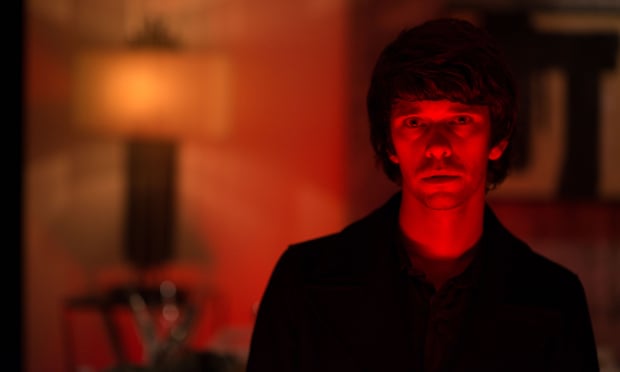
It helps that the series has its heart one of the best actors working today. Ben Whishaw has been a captivating presence since the start, but it's Blue that pushes him further than any of the previous episodes have done. The Danny we met in the first episode - carefree, charming and laidback - has all but disappeared, replaced with a frightened, paranoid man unsure of anything. The scene in which he was told of his HIV infection, forced upon him by those that seek to discredit him, is a performance of heartrending brilliance, remarkable in its restraint and still completely devastating.

In that plot development, the episode also produces a searing criticism of social prejudices still manifesting within our society about sexuality and lifestyle choices. Tom Rob Smith utilises these prejudices to feel every bit as frustrating as the forces currently circling Danny and sealing him off from the truth behind Alex's death. Like the idea of the establishment (not only ours, but our allies now too), the prejudice that Danny will face as a result of his diagnosis feels overwhelming in its scale. One only has to look at the reaction Charlie Sheen's HIV revelation to realise how close to the truth this aspect of Danny's story is.

Elsewhere in the episode, London Spy's impressive supporting cast continue to make their presence felt in the series. Jim Broadbent is ever reliable; please forgive the wild speculation that I'm about to indulge in, but something doesn't feel quite right about Scottie. He's just a little too good to be true and if anyone knows about all the dark secrets of Danny's past that could be used against him, it's Scottie. Following on from Charlotte Rampling's turn, Mark Gatiss gleefully ups the sinister feel of this episode with ease. He used to play the kind of skincrawlingly indecent people every now and again, but this is the first drama I've seen in a while to truly capture the man's extraordinary range as a possible villain.

Having spent the first two episodes building this world, Blue feels like an uncontrollable slide into darkness as Danny's quest continues. Not content with simply functioning as a thriller, the episode's underlying social criticism enhances the plight of its central character and fully exploits the emotional responses of its audience without ever feeling cynical. Superb.

- Becky

You can read Becky's review of previous episode, Strangers, here.

Follow @AssortedBuffery on Twitter
Or like our Facebook page

Tuesday, 17 November 2015

TV REVIEW: London Spy - Strangers


Still reeling from the revelation that Alex wasn't at all who he said he was, Danny embarks on his own personal quest to prove that his boyfriend was murdered. The police still refuse to believe that Danny was completely unaware of Alex's S&M lifestyle so he turns to the press to try and tell his side of the story. After they run a double-page spread exposing all sorts of nasty things about both Danny and Alex, he is invited to stay at his former lover's parents' house, where the mystery deepens even further.

Thanks to the opening episode taking its time to establish both Danny and Alex, as well as the central mystery around which the series will now revolve, the second episode is allowed move forward with that puzzle. Strangers throws a lot of information at us during its runtime; Danny is in possession of something which needs to be cracked by a code, Alex's mother perhaps knows more than she is letting on and Danny is being watched, maybe aided, by a mysterious American who leaves him his card. The bulk of the episode is devoted to Alex's family and his unconventional upbringing with a mother (the wonderfully sinister Charlotte Rampling) who pushed him hard to realise his potential.

Whishaw is mesmerising in the central role; even simple things like staring out of a train window seem vitally important to understanding what Danny's going through at this point in time. It's a measured performance though and given that the series rides on Danny's emotions, Whishaw takes care to ensure it never strays into anything disproportionately overt. The after-dinner library scene with Rampling is beautifully taut, each character playing their cards close to their chest, Frances especially. She's a classic domineering mother, but someone who absolutely still believes she did the right thing for her son. 

There's a curious relationship developing as a result of the differences between Danny and Alex in how Danny views the rest of the world. Whilst Alex was devoted to reason and order, Danny is much more intuitive, something which proves to be a strength as he starts to move into Alex's world. He realises that two older people masquerading as Alex's parents aren't who they say they are not with reason, as Alex's actual mother points out, but with feeling. Likewise, he instantly knows which Alex's room is because "it's the loneliest room" he's ever been in. It's an intriguing idea, one which branches off from the usual dogged investigation of deduction and reason into one of feeling and irrationality. The fact that Danny is a bit haphazard and openly emotional could be what allows him to see things others can't.

That idea of sight and seeing is built into the episode, a continuation of the noirish themes that dominated the first instalment. As Danny makes his way through Alex's childhood home, everything is partially covered, hidden by dust sheets or overtaken by ivy and obscured from view. Lamps only half-light rooms, leaving vast swathes of the house in complete darkness. In Alex's room, everything is left uncovered as this is where Danny understands by simply knowing his partner well enough to see his room the way he left it. It does mean that the episode loses its subtlety in places. Danny making his way through the maze may have seemed like a clever symbolism during production, but it jars with the more intelligent sets elsewhere.

As it's only five episodes long, I'm expecting the pace to pick up more in the next few episodes, but so far London Spy has felt refreshing in its slow unfolding. It's more befitting of the emotional tragedy that lies at the heart of its mystery and Danny is a suitably unconventional hero to follow the revelations with. It may not be the most subtle, but it's certainly captivating.

- Becky

You can read Becky's review of previous episode, Lullaby, here.

Follow @AssortedBuffery on Twitter
Or like our Facebook page


Monday, 9 November 2015

TV REVIEW: London Spy - Lullaby


London Spy revolves around Ben Whishaw's Danny, a fairly carefree man living a life of clubs and late nights in between his shifts in a warehouse moving boxes and scanning barcodes. On a morning after the heavy night before, he meets Alex (Edward Holcroft), a fastidious, socially awkward banker. 

Despite their obvious differences, they strike up a tentative conversation that evolves into a serious, months-long relationship, in which both of them appear to be heavily invested. Danny soon introduces him to an old, also gay friend, Scotty (Jim Broadbent), who seems to have met Alex before, despite the denial of both parties. Before long, the mystery around Alex increases and Danny finds himself in a situation far beyond his expectations.

There's an embrace here with the noirish elements, which gives the show an evocative feel; Danny gazes out of his window into the lives of others a la Jimmy Stewart in Rear Window and Alex is a classic noir archetype, albeit in male form, an homme fatale around whom the central mystery builds. He cuts a handsome, enigmatic form and Holcraft manages the tricky task of performing a character who feels like a blank slate, but bringing forth Alex's unique kind of warmth in his scenes with Whishaw's Danny. 

Director Jakob Verbruggen works well with Holcroft to portray Alex as just slightly out of step with the world around him. He appears on the edge of shots, just out of the main focus of the camera or emerging out of the grey London landscape, nearly camouflaged in his also grey running gear. It's easy to understand Danny's fascination with this mysterious, beautiful stranger and again, the audience sees him often through Danny's perspective, blinding us to the secrets yet to be revealed.

Lullaby wisely doesn't throw us into the espionage deep end just yet, instead devoting its runtime to the development of that crucial relationship between Danny and Alex. The scenes between them are intimately shot and their scenes together are really quite sweet, offering a tender grounding for whatever lies ahead. The dynamics of their relationship shift elegantly throughout its development with Danny's experience allowing him to take the lead before it becomes apparent that he is just as emotionally broken as Alex and needs him perhaps more than we initially realised.

Though the slow pace may put some people off, it feels crucial to what follows in the revelations that the last few minutes of the episode brought us. An audience must understand why a person such as Danny would take such risks to find out what killed Alex and therefore, building their relationship and showing their increasing devotion to each other provides us with that motive. It also means that not only does Alex break Danny's trust, but he also breaks ours. It was apparent he was a man with secrets, but the extent of which comes as a shock, particularly his apparent Christian Grey alter-ego. 

Ben Whishaw is easily one of the most interesting actors around today, as capable of spinning a one liner out as Q in the Daniel Craig Bond movies as he is of carrying the dramatic weight of a series such as the criminally cancelled The Hour (no, I'm still not over that). He's the most fantastic chameleon of an actor and to find him in an espionage thriller on BBC Two is a welcome development. He anchors the drama and provides an emotional centre for the audience in contrast to Holcroft's still performance, one which I'm sure will continue as the series develops.

Too many television thrillers like to confuse their audience early with plot twist upon plot twist so the slow and simple opening to London Spy is refreshing, whilst it is also fully aware of the archetypes it is playing with. With an intriguing set-up and a stellar cast still waiting to make their entrance, London Spy looks set to be a rewarding viewing experience.

- Becky

Follow @AssortedBuffery on Twitter
Or like our Facebook page


TV REVIEW: Doctor Who - The Zygon Inversion

As The Zygon Inversion opened on a clone of Clara (Jenna Coleman) firing a missile at the plane holding The Doctor (Peter Capaldi) and Osgood (Ingrid Oliver), with the real Clara trapped beneath London in a weird pod prison thing, you could be forgiving for thinking this was going to an all-out battle, let’s all shoot at each other and set things on fire sort of an episode. But it really, really wasn’t. Clever, topical and stridently anti-war, this was Who with a message, and it worked.

According to The Doctor, what people should do ‘in the first place’, before they even think of fighting, is talk. And The Zygon Inversion very much practiced what he preached. Apart from a spot of parachuting and a few unfortunate incidents later on, this episode consisted, almost entirely of talking. Not managing to thwart Bonnie/Zygella from firing the missile, despite giving it a damn good try via their psychic link, Clara found herself locked in a battle of wills with her counterpart, whilst The Doctor and Osgood tried to find their way to her. And that was where the battle of wills really started, as The Doctor effectively refereed between leader of the Zygon rebels Bonnie, and UNIT leader Kate (Jemma Redgrave). 

But we’ll come to that.

Meanwhile, the doubling provided a great opportunity for Jenna Coleman to flex her acting muscles. I have a slight theory that she’ll be one of those sort of characters where as soon as she’s gone, we’ll realise how great she was. She’s a grower.

And I know I say it every week but I’m going to do so again. The show continues to be genuinely laugh out loud funny. I’m not sure it’s ever been that until this series, but I like it. A lot. Much of it comes down to the fact that Capaldi’s excellent delivery makes everything feel a little unsteady and unpredictable. In the heavier scenes, this can be electrifying. In the funnier moments, it’s just plain hilarious. ‘Ah London… what a dump!’ being one such example. Both he and the writing work together to take you in directions you never expected to go, all in the space of a line.

There’s a splendid mythology developing around UNIT now, as we re-visited The Black Archives. They always felt a little bit shoe-horned in before, but now they have more of a proper place in the story arc. Speaking of which, is there anybody on the planet who doesn’t completely love Osgood? No, thought not.

We saw more of the same themes throughout the episode as we’ve seen all series, as we met more hybrids and pairings, particularly evident when Bonnie completed the broken Osgood pair, as well as this episode and its predecessor’s titles. Not to mention the ongoing trope of The Doctor solving the problem by talking, at length. We saw it with Davros way back at the start of the series, with The Woman Who Lived and now with Kate and Bonnie, as they both quite literally stand with their fingers on the button, ready to destroy each other.

Whole essays could be written on that scene. I’ll restrain myself, but between the powerful anti-war and pro-immigration messages, the memory wiping, Capaldi’s even-more-excellent-than-usual performance and the striking image of the pair (another one) of the red and blue boxes, we’d have enough to talk about for hours. As it was, it was yet another example of Capaldi’s brand of Doctor. His power is very much in his words – and he intends to use them. The result was seriously powerful stuff.

Others have commented that these last two episodes have been a little boring, perhaps slightly pedestrian, as The Doctor rode in a plane not the TARDIS, and two policeman who weren’t policeman walked slowly down a road and didn’t actually attack anybody…But to do so is to miss the point. They were always supposed to be a little quieter. The Zygons aren’t particularly scary, which is why ‘the enemy within’ angle works so well. And that’s what gave the episode its message – we all just want to get on with life, but disillusionment happens, and we need to talk about it, not just blow each other up like ‘screaming kids.’

And with that much emotional clout, surely the show can only keep getting better and better?

Becky will be here to tell you next week.

P.S I concur. *Applauds for Action Rebecca Front*

Follow @AssortedBuffery on Twitter
Or like our Facebook page

Wednesday, 4 November 2015

TV REVIEW: Doctor Who - The Zygon Invasion

First of all, let me apologise for the lack of reviews for the previous two episodes, both Jen and I were afflicted with unfortunate life things and the good Doctor had to fall by the wayside for a couple of weeks! But we are back and what a cracker of an episode to return to.


The Zygon Invasion finds the peace treaty negotiated between human and Zygon back in the 50th Anniversary special, The Day of the Doctor, under a considerable threat. The treaty, forged by Osgood and Osgood (one human, one Zygon), allowed 20 million Zygons to settle in human form all over the world provided they keep their true species hidden. When one Osgood is killed back in the last series, the other Osgood is consumed by grief and the negotiated peace begins to break down. Zygons want their freedom and will stop at nothing to get it. As they repeat throughout the episode, it's a game of 'truth or consequences.'

The idea of consequences is something this series has been playing with a lot where the Doctor is concerned, as decisions of his past have considerably affected his future. Here, it's dealing with a treaty that he oversaw to save both the humans and the Zygon race as well as the death of Osgood and the shaky ground that treaty is based on. The Day of the Doctor was itself along those themes as the Doctor came to terms with his part in the apparent destruction of Gallifrey during the Time War and it makes sense that The Zygon Invasion, a pretty much direct sequel to that episode, should pick up those themes too.

We are not only dealing with that, but the whole episode functions as an analysis on our own society and the fears that we constantly deal with. The idea of a 'secret invasion' has come up a lot as part of the European refugee crisis, that the refugees aren't fleeing because their country is consumed by war and their lives are in danger, but because they're secretly after our benefits/jobs/homes or that they are secretly terrorists on their way to undermine our country through violence. You name it, a tabloid newspaper has printed it. The parallels run through The Zygon Invasion with abandon, from the white and black logo that Osgood sits under during her demand video to UNIT consistently arguing that there was no way the human population would react to the Zygon presence with anything but fear and xenophobia.

That critique of our society is painted in large brush strokes and does get a tad heavy-handed at times, but it gives the episode a greater depth than simply offering up some sci-fi based entertainment. It allows for some wry commentary from the Doctor, whose function has often been to point out some of the more ridiculous and dangerous aspects of human behaviour during his relationship with Earth. And the Zygons want something that feels deeply humane; to be allowed to live and stay true to themselves without judgement. It's pretty ambitious stuff for a Saturday evening family show and really great to see Who again striving to do something more than simply entertain.

This political background provides a solid foundation on which to build the narrative of the episode and to spin out some really great sequences from it. Being the first of a two-parter meant the story was paced better, a recurring theme in this series and it's been much stronger for it. There's an oppressive, paranoid atmosphere to it all so we are aware there are twists coming, but they lose none of the impact for that or guessing what twists they might be. The Zygons' abilities are also utilised for great dramatic effect as soldiers are confronted with Zygon copies of their families, planting a seed of doubt about the reality of the situation. The drone pilot confronted with copies of her family on the steps of the building she's about to bomb offers a neat counterpoint to the inhuman use of drones; it personalises a destruction that is usually kept at a distance.

This series of Doctor Who has been consistently strong and it seizes the opportunity to take on a bigger, global story now that everyone has settled in for the ride. This episode left us on a whopper of a cliffhanger and Jen will be here to discuss how that plays out next week.

Oh, one final thing. Can we get a round of applause for Action Rebecca Front? She was awesome.

- Becky

You can read Jen's review of Before the Flood here.

Follow @AssortedBuffery on Twitter
Or like our Facebook page

Tuesday, 13 October 2015

TV REVIEW: Doctor Who - Before The Flood


Having spent a good deal of the forty five minutes of ­­­­Before The Flood watching from behind my hands, I can happily conclude that this episode scared me more than most Doctor Who episodes. 

Travelling back to the time the spaceship first landed, The Doctor (Peter Capaldi) left Clara (Jenna Coleman) et al behind on the submarine fending off the ghosts – who now included an eerie ghost Doctor in their number. Inconveniently locked in his own time stream, he found himself up against the terrifying Fisher King, desperately trying to stop anyone else, winding up as a ghostly transmission device. 

Terrifying seems a good place to start with this episode. Several scenes of the episode wouldn’t have felt out of place in an indie horror film. And that’s before we even consider the Fisher King. A shell-fish, cockroach type of creature with all the warmth of The Grim Reaper, The Fisher King gave us our second, totally brand new, totally nightmare-inducing monster of the series – not bad for episode four. It was also a noticeably long time before we got a good look at him, which may have frustrated some, but for me, artfully built on our innate fear of the unknown. 

When we weren’t busy being terrified of the Fisher King, it’s worth mentioning that the invasion themes, Cold War and military style settings of Toby Whithouse’s writing married together perfectly. So too did the two different time streams and locations in that perfectly executed countdown sequence, The Doctor linking the two with this own timeline. Much akin to the night and day settings of the submarine, this episode was very much the shade to Under The Lake's light, literally much darker in places because of the minimal lighting, and with far fewer jokes, the stakes felt high here, even though we knew that, ultimately, The Doctor and Clara would probably be fine. 

Particular stand out moments include Sophie Leigh Stone’s Cass having to feel for the vibrations along the floor to find out that an axe wielding ghost was right behind her, and O’Donnell (Morven Christie) cowering round a corner from the Fisher King. Indeed senses were a key theme throughout, with Cass without hearing, the ghosts without eyes and, without the phone, Clara and The Doctor unable to talk. The Beethoven’s 5th Framing Device worked well, too - the episode needed tying together somewhat as the timey-wimey elements were slightly more complicated than usual and not terribly well explained in places. Fortunately, Capaldi’s style is perfectly suited to the occasional breaking of the Fourth Wall.

I couldn’t help but slightly regret the fact that Missy didn’t jump out of the preservation pod at the end, umbrella in tow, yelling ‘surprise!’ at the top of her voice, so integral does her character now feel to the Doctor Who universe. But admittedly that may just have been me. 

Ably supported by a fantastic cast of secondary characters in both episodes of this pairing, the Capaldi/Coleman partnership itself continues to flourish (another reason why the absence of Missy was perhaps a good thing). Naturally this can only mean, even if we didn’t know it already, that we may well be about to lose Clara. The Doctor departing the scene without her, with two other companions in tow, felt a little like a test run for Capaldi sans Coleman. Much as Clara can be outshone by the nearest 40 watt desk lamp in some of her more 2D moments, she feeds off Capaldi’s energy well, provided a great straight woman to The Doctor’s emotional eccentricities. It will certainly be interesting to see who ends up replacing her.

Again, I pulled slightly the short straw here reviewing part two of the story, as the concluded episodes do tend to suffer a little of the anti-climax. But it’s a minor quibble really in what was another strong episode. So many of last series’ outings just felt like filler – I’m still waiting for that to happen this time around, but I feel like it might be a while off yet.

Next week look’s brilliant, as has every next episode preview so far.

Becky will be here to walk you through The Girl Who Died.

Follow @AssortedBuffery on Twitter
Or like our Facebook page