Showing posts with label Ben Whishaw. Show all posts

Wednesday, 25 November 2015

TV REVIEW: London Spy - Blue


After the slower pace of the first two episodes, the violent opening to London Spy's third instalment comes as a bit of a shock to the system as Danny is dragged out of his bed by the police. It turns out the crime scene of Alex's death was littered with various bits of paraphernalia from Danny's earlier life when he was much more carefree and also careless. As the net closes in on him, he turns to Scottie for help, who willingly obliges to take up his friend's cause when he's in dire need. Danny is forced to confront elements of his past in order to start getting answers about a future that is no longer in his control.

Some thrillers make themselves about the mystery at the heart of the narrative and forget the characters operating at the heart of it. One of the best things about London Spy has been that focus on character first with the drama arising out of Danny's experiences, his relationships and the slow erosion of his life by unseen forces. Cleverly though, Tom Rob Smith also knows when to expand that story into one of institutions, prejudice and the establishment. As Danny's search continues, it gets wider in scope and in turn, feels more hopeless than ever. There's no establishment quite like the British one for closing down anyone wayward. As Scottie says towards the end of the episode, they're "quite alone."

The episode reinforces on nearly every level by becoming quite the assault on the senses at times. During Danny's interview with the police, the score punches its way into the scene at uncomfortable levels, mirroring his own desperation. After the emotional fallout of his HIV test, the music that has provided a pulse-like presence throughout is conspicuously absent, allowing his overspill of anxiety to become the only sound we hear. It's a deft combination of sound and silence that constantly unsettles throughout the episode. Moments of relative calm are just that, a brief pause before Danny dives further into the conspiracy around him.

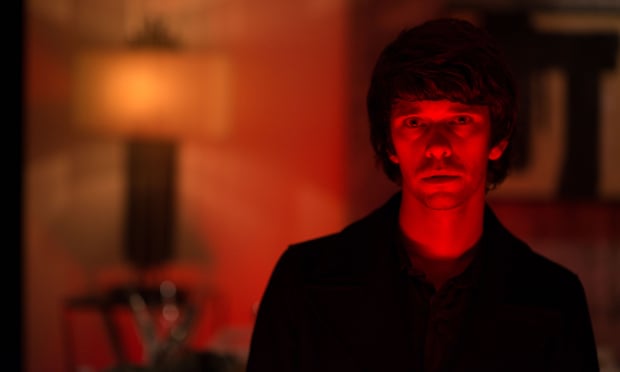
It helps that the series has its heart one of the best actors working today. Ben Whishaw has been a captivating presence since the start, but it's Blue that pushes him further than any of the previous episodes have done. The Danny we met in the first episode - carefree, charming and laidback - has all but disappeared, replaced with a frightened, paranoid man unsure of anything. The scene in which he was told of his HIV infection, forced upon him by those that seek to discredit him, is a performance of heartrending brilliance, remarkable in its restraint and still completely devastating.

In that plot development, the episode also produces a searing criticism of social prejudices still manifesting within our society about sexuality and lifestyle choices. Tom Rob Smith utilises these prejudices to feel every bit as frustrating as the forces currently circling Danny and sealing him off from the truth behind Alex's death. Like the idea of the establishment (not only ours, but our allies now too), the prejudice that Danny will face as a result of his diagnosis feels overwhelming in its scale. One only has to look at the reaction Charlie Sheen's HIV revelation to realise how close to the truth this aspect of Danny's story is.

Elsewhere in the episode, London Spy's impressive supporting cast continue to make their presence felt in the series. Jim Broadbent is ever reliable; please forgive the wild speculation that I'm about to indulge in, but something doesn't feel quite right about Scottie. He's just a little too good to be true and if anyone knows about all the dark secrets of Danny's past that could be used against him, it's Scottie. Following on from Charlotte Rampling's turn, Mark Gatiss gleefully ups the sinister feel of this episode with ease. He used to play the kind of skincrawlingly indecent people every now and again, but this is the first drama I've seen in a while to truly capture the man's extraordinary range as a possible villain.

Having spent the first two episodes building this world, Blue feels like an uncontrollable slide into darkness as Danny's quest continues. Not content with simply functioning as a thriller, the episode's underlying social criticism enhances the plight of its central character and fully exploits the emotional responses of its audience without ever feeling cynical. Superb.

- Becky

You can read Becky's review of previous episode, Strangers, here.

Follow @AssortedBuffery on Twitter
Or like our Facebook page

Tuesday, 17 November 2015

TV REVIEW: London Spy - Strangers


Still reeling from the revelation that Alex wasn't at all who he said he was, Danny embarks on his own personal quest to prove that his boyfriend was murdered. The police still refuse to believe that Danny was completely unaware of Alex's S&M lifestyle so he turns to the press to try and tell his side of the story. After they run a double-page spread exposing all sorts of nasty things about both Danny and Alex, he is invited to stay at his former lover's parents' house, where the mystery deepens even further.

Thanks to the opening episode taking its time to establish both Danny and Alex, as well as the central mystery around which the series will now revolve, the second episode is allowed move forward with that puzzle. Strangers throws a lot of information at us during its runtime; Danny is in possession of something which needs to be cracked by a code, Alex's mother perhaps knows more than she is letting on and Danny is being watched, maybe aided, by a mysterious American who leaves him his card. The bulk of the episode is devoted to Alex's family and his unconventional upbringing with a mother (the wonderfully sinister Charlotte Rampling) who pushed him hard to realise his potential.

Whishaw is mesmerising in the central role; even simple things like staring out of a train window seem vitally important to understanding what Danny's going through at this point in time. It's a measured performance though and given that the series rides on Danny's emotions, Whishaw takes care to ensure it never strays into anything disproportionately overt. The after-dinner library scene with Rampling is beautifully taut, each character playing their cards close to their chest, Frances especially. She's a classic domineering mother, but someone who absolutely still believes she did the right thing for her son. 

There's a curious relationship developing as a result of the differences between Danny and Alex in how Danny views the rest of the world. Whilst Alex was devoted to reason and order, Danny is much more intuitive, something which proves to be a strength as he starts to move into Alex's world. He realises that two older people masquerading as Alex's parents aren't who they say they are not with reason, as Alex's actual mother points out, but with feeling. Likewise, he instantly knows which Alex's room is because "it's the loneliest room" he's ever been in. It's an intriguing idea, one which branches off from the usual dogged investigation of deduction and reason into one of feeling and irrationality. The fact that Danny is a bit haphazard and openly emotional could be what allows him to see things others can't.

That idea of sight and seeing is built into the episode, a continuation of the noirish themes that dominated the first instalment. As Danny makes his way through Alex's childhood home, everything is partially covered, hidden by dust sheets or overtaken by ivy and obscured from view. Lamps only half-light rooms, leaving vast swathes of the house in complete darkness. In Alex's room, everything is left uncovered as this is where Danny understands by simply knowing his partner well enough to see his room the way he left it. It does mean that the episode loses its subtlety in places. Danny making his way through the maze may have seemed like a clever symbolism during production, but it jars with the more intelligent sets elsewhere.

As it's only five episodes long, I'm expecting the pace to pick up more in the next few episodes, but so far London Spy has felt refreshing in its slow unfolding. It's more befitting of the emotional tragedy that lies at the heart of its mystery and Danny is a suitably unconventional hero to follow the revelations with. It may not be the most subtle, but it's certainly captivating.

- Becky

You can read Becky's review of previous episode, Lullaby, here.

Follow @AssortedBuffery on Twitter
Or like our Facebook page


Monday, 9 November 2015

TV REVIEW: London Spy - Lullaby


London Spy revolves around Ben Whishaw's Danny, a fairly carefree man living a life of clubs and late nights in between his shifts in a warehouse moving boxes and scanning barcodes. On a morning after the heavy night before, he meets Alex (Edward Holcroft), a fastidious, socially awkward banker. 

Despite their obvious differences, they strike up a tentative conversation that evolves into a serious, months-long relationship, in which both of them appear to be heavily invested. Danny soon introduces him to an old, also gay friend, Scotty (Jim Broadbent), who seems to have met Alex before, despite the denial of both parties. Before long, the mystery around Alex increases and Danny finds himself in a situation far beyond his expectations.

There's an embrace here with the noirish elements, which gives the show an evocative feel; Danny gazes out of his window into the lives of others a la Jimmy Stewart in Rear Window and Alex is a classic noir archetype, albeit in male form, an homme fatale around whom the central mystery builds. He cuts a handsome, enigmatic form and Holcraft manages the tricky task of performing a character who feels like a blank slate, but bringing forth Alex's unique kind of warmth in his scenes with Whishaw's Danny. 

Director Jakob Verbruggen works well with Holcroft to portray Alex as just slightly out of step with the world around him. He appears on the edge of shots, just out of the main focus of the camera or emerging out of the grey London landscape, nearly camouflaged in his also grey running gear. It's easy to understand Danny's fascination with this mysterious, beautiful stranger and again, the audience sees him often through Danny's perspective, blinding us to the secrets yet to be revealed.

Lullaby wisely doesn't throw us into the espionage deep end just yet, instead devoting its runtime to the development of that crucial relationship between Danny and Alex. The scenes between them are intimately shot and their scenes together are really quite sweet, offering a tender grounding for whatever lies ahead. The dynamics of their relationship shift elegantly throughout its development with Danny's experience allowing him to take the lead before it becomes apparent that he is just as emotionally broken as Alex and needs him perhaps more than we initially realised.

Though the slow pace may put some people off, it feels crucial to what follows in the revelations that the last few minutes of the episode brought us. An audience must understand why a person such as Danny would take such risks to find out what killed Alex and therefore, building their relationship and showing their increasing devotion to each other provides us with that motive. It also means that not only does Alex break Danny's trust, but he also breaks ours. It was apparent he was a man with secrets, but the extent of which comes as a shock, particularly his apparent Christian Grey alter-ego. 

Ben Whishaw is easily one of the most interesting actors around today, as capable of spinning a one liner out as Q in the Daniel Craig Bond movies as he is of carrying the dramatic weight of a series such as the criminally cancelled The Hour (no, I'm still not over that). He's the most fantastic chameleon of an actor and to find him in an espionage thriller on BBC Two is a welcome development. He anchors the drama and provides an emotional centre for the audience in contrast to Holcroft's still performance, one which I'm sure will continue as the series develops.

Too many television thrillers like to confuse their audience early with plot twist upon plot twist so the slow and simple opening to London Spy is refreshing, whilst it is also fully aware of the archetypes it is playing with. With an intriguing set-up and a stellar cast still waiting to make their entrance, London Spy looks set to be a rewarding viewing experience.

- Becky

Follow @AssortedBuffery on Twitter
Or like our Facebook page


Friday, 2 November 2012

FILM REVIEW: Skyfall


 Skyfall, the third Bond film with Daniel Craig playing the infamous title role and the first with Sam Mendes at the helm, has a release date which marks the 50th anniversary of Dr No- the first ever Bond film.

As well as being charmingly placed historically, it’s also the film MGM productions hoped would drag them out of past financial troubles, bounce back from the utterly plot lacking Quantum Of Solace (2008), as well as aiming to attract both old and new fans alike.

So no pressure then.

Fortunately, it achieves nearly everything on its to-do list with flying colours. Despite the attempt towards a sort of 21st Century Bond from the very beginning of the Daniel Craig era, this one comes the closest, whilst still remaining witty, visually spectacular, engaging and, honestly-really good fun.

Without wishing to give too much away, the film opens on James and fellow MI6 agent Eve, sharply played by the wonderful Naomie Harris, as they chase a shady looking character who just so happens to have the details of every double agent lodged in a terror cell the world over. When ordered to ‘take the bloody shot’ by a deliciously ruthless M (Judi Dench), Eve accidentally hits her fellow agent, rendering him ‘missing presumed dead’. He proceeds to enjoy the quiet life in a way only James Bond really could, only returning to London to report for duty when he learns of an attack on MI6 HQ, right in the heart of London.

Once back, he meets the brand new and brilliantly nerdy Q, played by Ben Whishaw, as well as Mallory (Ralph Fiennes), the new Security chairman. M then makes the questionable decision to send the damaged Bond back out into the field in search of the perpetrator of the attack, who she suspects is someone she used to know- a journey which also takes Bond rather further back into his own past than we’ve seen before.

Several sensitively placed innovative camera tricks at key moments make this a beautifully shot film, with impressive set pieces and locations on a huge scale. It also has far more of a storyline than several of its predecessors, as we are drip fed equal parts subtle and not so subtle hints along the way, with a couple of juicy twists thrown in for good measure. It also does a lot more thematically than I anticipated, with dialogue tropes and metaphors referencing the overall narrative arc and feeding into it. It is also well paced, and, for the most part, satisfying for fans and newcomers both.

Hugely pleasing for Londoners, Skyfall follows on nicely from this Summer’s spotlight on the capital, with many key moments happening in all too familiar locations. Residents will particularly enjoy rush hour scenes, which, although not nearly busy enough, give audiences a chance to see Bond in an everyday world he, for all his competencies and skills in the field, knows very little about.

Also on the plus column were director Sam Mendes’ fine cast. Naomie Harris’ character brings a lot to the franchise for female fans, with her sparky and assertive performance- a presence only added to by the formidable figure of Judi Dench’s M. We’re far from there yet ladies, don’t be over hasty with the bunting, but there were a couple of moments in Skyfall, which I count as at least one more than in any other Bond film, where it almost, almost felt as if Bond were having a professional conversation with fellow people, as opposed to the stereotypical subordinate sex objects and bossy matriarchs we’ve seen before. Phallic symbols and naked women were kept to a tasteful minimum in the title, treatment of the Foreign was less horrifically problematic than usual, and Judi Dench was used to her full potential for the first time since her “because I think you're a sexist, misogynist dinosaur” opening speech back in Goldeneye. Ben Whishaw’s young, floppy haired Q also added a lovely new dynamic, softly manoeuvring the spy genre out of the macho boys’ club it so often becomes.


Skyfall is a well-made and emotionally arresting film, which I was able to enjoy without the usual concern for ‘the Other’ that the Bond franchise usually induces.

My only real worry, and with it my only real criticism, is the end. There are heaps of fan pleasing moments, self-referential jokes and clever little winks to the audience, true. And plot wise, it’s damn near close to perfect. All boxes are ticked, and the story is taken full circle whilst simultaneously moving forward to a new era.

I am proud to call myself a fan of the Bond franchise, but as well as this I’m also a woman, and, most days at least, a woman with a brain. On a personal level, I was bitterly disappointed that, having made so much progress in a positive direction, it was all taken away again at the last moment. Frankly I’d dearly love to be able to enjoy the films just as much as the boys without having to switch my brain off, constantly waiting to be returned to the ‘norm’ of a subordinate position.

So as a fan, I loved it. A satisfying story, well put together, with fantastic set pieces, emotional moments and witty lines in equal abound. As a woman, however it all niggled just a little.

It seems a grave shame that one always seems to be at the other one's expense. 


**** (and a half, for the niggle)


Jen

  
You can read more of Jen's writing here: https://memyselfandtheothers.wordpress.com/


Or you can follow her on twitter here: https://twitter.com/jenniferklarge


Sunday, 1 July 2012

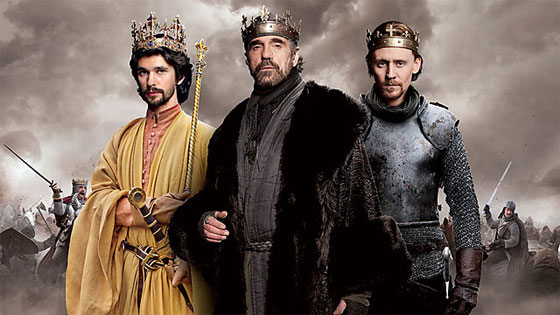
TV REVIEW: The Hollow Crown - Richard II

As you may have gathered, here at Assorted Buffery, we're more than a little enthusiastic about anything in the arts and we're even more enthusiastic about Shakespeare. So you can probably imagine our reaction when we discovered the BBC were adapting Shakespeare's second history tetralogy (Richard II, Henry IV Parts One and Two, Henry V) under the title of The Hollow Crown. Now I can't speak for Jen, but I was positively giddy.


First, a confession; Richard II is one of the few Shakespeare plays that I have neither seen nor read so I'm taking a lot on faith that the BBC have adapted the text well for the screen and will only be assessing its merit as a television programme (I'll be much more on it when we get to the Henrys IV and V). The BBC has always excelled in its Shakespeare adaptations and this is no exception; lavish, dramatic and full of scene-stealing British actors. Kicking off the series, Richard II follows the exploits of the titular royal (Ben Whishaw) who seizes the lands and money of John of Gaunt (Patrick Stewart) after his death and provokes his exiled son, Henry Bolingbroke (Rory Kinnear) to rise up against him. Also starring David Suchet, Tom Hughes, Tom Goodman-Hill, James Purefoy, David Morrissey, Lindsey Duncan and Clémence Poésy, it's a veritable Who's Who of established and rising acting talent and follows the courtly intrigues that lead into a battle for the crown.


Ben Whishaw gives us a great central performance as King Richard, who Shakespeare sees as responsible for the War of the Roses. Never quite sure of where he's going next, Whishaw gives Richard a slightly terrifying edge; he refuses to listen to advice and changes his mind faster than the unpredictable British weather. He's not a particularly good king, more concerned with preening about in the latest swishy cape than with where the money's coming from and Whishaw's constant haughtiness captures this perfectly. His final monologue on his fall from grace is truly haunting, inspiring sympathy for a man broken by his inability to rule. Rory Kinnear gives a strong and more stable performance for Bolingbroke, the moral centre of the play who fights for England rather than himself, ably assisted by Suchet and Morrissey as his supporters. John of Gaunt is a relatively small role, a Shakespearian cameo if you will, but I defy anyone not to feel even a little patriotic when he gives his 'This England' speech, especially when delivered in Patrick Stewart's dulcet tones.


In terms of playing to its audience, the theme of patriotism throughout the episode ties in well with the current outburst of country loyalty we've been seeing this year thanks to the Jubilee and the Olympics (as I write this, I can hear the crowds in my flat as the Olympic Torch is passing through Leamington Spa). Various characters speak of the glory of England, but like the crown itself, it sounds hollow and false, because elsewhere we're being told what a dire state the country is in. The poor are exploited by the rich who just line their pockets and get richer - Richard's domain is an England that has fallen from grace, is rigid in its social categories of rich and poor and is on the brink of collapse. Shakespeare has long been known for providing a commentary for a wide of variety of social situations but I can't be alone in thinking that the England of Richard II bears a more than passing resemblance to our own.


Part of the problem with Richard II though is, for me at least, it does feel very much like a prequel, setting up the events for the considerably more action-packed Henry plays. You see the early seeds of the conflict with the Welsh, Bolingbroke as King and an England that stands on the brink of civil war but we move around too much to really focus on what's happening now, rather than in the future. Cutting from the coast, to Lancaster, to Wales all very quickly but Richard is at its strongest when you stay in one place for a considerable amount of time. A standout scene is one in which Richard holds a council on the beach where the sense of his own potential defeat permeates the atmosphere, contrasting greatly with the sun that beams down on the actors.


That being said, Richard II is still miles better than half of the stuff currently on television and The Hollow Crown is a fantastically ambitious project that I am eager to see to the end. Next week is Henry IV Part One, which is one of my favourite plays, and next Saturday night, I have most definitely got a date with oh-so-dashing Prince Hal (Tom Hiddleston). Oh if only that were true.


- Becky