Friday, 30 May 2014

THEATRE REVIEW: Handbagged - Vaudeville Theatre - ★★★★


For just over ten years, The Queen and her then Prime Minister, Margaret Thatcher, were the two most powerful women in Britain. Born just six months apart, one was born into her role whilst the other chose it. One, despite the most privileged upbringing imaginable, hovered, and indeed still does, somewhere in the political centre, even, dare I say it, leaning slightly left. The other, despite being the daughter of a shop keeper, went on to become a Prime Minister viewed, probably correctly, as one of the most controversial and right-wing Britain has ever seen.

What went on in the weekly meetings between the two of them, closely guarded by the Palace, will never be divulged, leaving us only with speculation. Which is where Moira Buffini’s Oliver Award winning comedy Handbagged comes in. Currently at the Strand’s Vaudeville Theatre, having successfully transferred from the Tricycle, its script functions as an imagining of what may or may not have been said at those meetings, based on historical context and what was in the press at the time. And probably some guesswork and artistic license to boot. Despite its focus on just two characters, the play has a cast of six. Each of the leading ladies is portrayed by two actresses apiece, as each has both an older and a younger self – usually all on stage at the same time. The Queen is played by both Marion Bailey as her older self, and by Lucy Robinson as her younger counterpart, whilst Fenella Woolgar and Stella Gonet take on the younger and older PM respectively. Actors Neet Mohan and Jeff Rawle then divide the remaining roles up between them.

Unsurprisingly, however, it is the four women, and the excellent script they’re gifted with that really carries this play. Not a line is delivered out of place- each is deployed with impeccable comic timing as the two women argue with restraint, and even politeness over major political issues, as well as struggling to even make connect enough to make basic conversation. Their inability to find a mutually enjoyable choice of cake for their meetings is a particularly revealing example. The meta-theatrical element of having two women portraying each leading lady also allows for some deliciously barbed disagreements in all directions, even between older and younger versions of the same character, really helping the alleged ‘clashes’ leap off the page into a live, comic existence. The general hilarity is only added to by the spooky accuracy of each actress’s portrayal of the political and historical icons. Fenella Woolgar as Mags, the younger of the two Margarets, particularly shines, although really I’m splitting immaculately coiffured hairs.

Despite all the comedy, and believe me there’s plenty of it, this play is also really quite interesting, covering the entire span of the Iron Lady’s rule, with mentions of riots, apartheid, Balmoral and Rupert Murdoch, to name but a few. As someone who grew up in the 1990s, I knew relatively little about the 80s political struggles which really defined Thatcher’s time in office. It was also worthwhile to see the Queen’s own troubles, with Charles and Diana and the Commonwealth mapped against Thatcher’s political timeline, as this only added to the contrast between the two women, and to the verging on tender poignancy with which their latest years are covered in the latter quarter of the play.

It was precisely this history, however, that a great deal of my fellow audience members seemed to struggle with. I’ve been trying ever since leaving the theatre to block out one particularly loud American tourist whispering, if you can call it that, ‘Is this before or after Victoria?’ to the person sat next to her. Though it pains me to admit it, perhaps she’s got a point. Throughout Handbagged, Neet Moham, as the youngest member of the cast, alludes to events the ‘younger members of the audience’ might not know about, explaining it and bringing them back in. It occurred to me, seeing just how many tourists were in the audience, that an odd ‘and the tourists amongst you won’t know this’ explanation or two might have helped considerably.  As a comedy, Handbagged  is hard to fault. It just may have benefited from being slightly more inclusive in some places, great that it is for a knowledgeable British audience that the reference are so specific-  if only so that more people could laugh as heartily at the jokes as the rest of us were.

Really, though, that is a small quibble in the context of what is an immensely quick witted, and astonishingly well performed play. The characterisation is excellent, and never strays into ‘handbags at dawn’ middle aged warring women caricatures, despite what the taglines say. As the Queen herself says, when asked if the meetings are different because the new PM is a woman, ‘No. It is different because she is Mrs Thatcher.’

The play’s greatest success lies in how clearly it pulls that off. It’s fun, but clever fun- a real insight into what might have gone on between the two formidable leaders.

And you don’t even have to sit around a rainy Balmoral picnic to get it.

Handbagged is running at the Vaudeville Theatre until 2 August.


★★★★

Jen

Follow @AssortedBuffery on Twitter
Or like our Facebook page.
You can read my own blog here or follow me on twitter here

Thursday, 22 May 2014

FEATURE: Sequel! - Indiana Jones and the Temple of Doom

Today marks the 30th Anniversary of the cinematic release of Indiana Jones and the Temple of Doom. Paul Bullock of From Director Steven Spielberg has been leading a week-long celebration, culminating in a live tweet commentary of the film tonight (May 23rd, 8pm GMT). Our contribution is from Charlie as he turns his attention to Dr Jones...


It's almost impossible to create art that doesn't reflect some facet of the creator. The moods, the relationships, the events that happen during the creation more often than not seep through to shape it, whether you like it or not. One of the better examples of this is Indiana Jones and the Temple of Doom, which is notorious for being uber-dark and nasty, violent, and generally quite scary, as well as in some quarters being seen as racist. The film celebrates its thirtieth anniversary this May, so it's perhaps an ample time to talk about what is a severely underrated film.

The situation is this: Raiders of the Lost Ark has just made a bundle of money, Harrison Ford is even more of a global superstar than he was before, and Indiana Jones is an instant heroic icon. So George Lucas and Steven Spielberg get to thinking about another one, while Spielberg makes E.T. and George puts the finishing touches to the Star Wars saga via Return of the Jedi. But despite the huge success of the film, the production of Jedi has a bittersweet ending as Lucas' marriage to editor Marcia Lucas ends in bitter circumstances (Spielberg had also ended a relationship in 1980 with actress Amy Irving).

Screenwriter Lawrence Kasdan, who wrote Raiders (as well as Jedi and The Empire Strikes Back), refused to be involved citing his dislike of the story, and has since said that the film comes out of a "chaotic time" in both Spielberg and Lucas' lives. He's not wrong. Temple of Doom has a mean streak a mile wide, but I don't see it as a bad thing - after all, much of it's a horror film. The funny thing is that it almost feels like Spielberg and Lucas made two different movies and threw them together - George an intense and nasty horror movie, Steven a parody of the previous film (as well as many others). What was birthed from those two fathers is a child that may be dysfunctional at times, but is still a hard one not to love. After all, who doesn't enjoy seeing hearts being ripped out of people's chests?

But before we look at the good points, let's see what gets people so up in arms about the film. First: the racism. In the film, Indiana travels to India and meets people who not only eat bugs, but enslave children and make people drink blood, as well as the aforementioned removal of the major organ. The Thuggee cult in the film is actually semi-based in reality, albeit much less fantastic. It was more of a gang, and they were literally thugs - they went around India murdering people. The idea of a terrifying cult that did unmentionable things was something that was thought to exist, only recently have theories come forward that it was created by the British in Colonial India to reflect their fears. It's also a massive homage to Gunga Din, which reflects Spielberg's love of old movies.

Things like the dinner scene - where the guests are served up beetles, snakes, and eyeball soup, not to mention chilled monkey brains - are mean but fun gags, although this is the part where I could genuinely see people being upset at the portrayal of the Indian people. But I don't think it's intentional, and I don't think Lucas and Spielberg set out to make the 1984 version of Birth of a Nation as many people seem to think. Willie Scott, however, is another matter.

After the smart, resourceful, and strong female character of Marion Ravenwood, Willie Scott seems like a trip back to the stone age. She's vapid, materialistic, and does very little besides scream or complain. It's not hard to see her character being birthed out of the bad feelings of George Lucas' broken marriage. She also has no significance to anything in the film, other than being a love interest for Indy. I can tolerate her in the film, but I can certainly see why people hate her guts. It's also pretty uncomfortable seeing what she's put through, from walking through a tunnel crawling with insects, to being lowered into a hot pit.

The film also creates its own problem simply by adding a title card that says "Shanghai, 1935". This immediately sets it as being a prequel, which means what follows doesn't make a huge amount of sense. I can deal with a couple of things - the sword gag callback where Indy reaches for his gun only to find his holster is empty is brilliant - but Indy in Raiders begins the film as a skeptic who states "I don't believe in magic, a lot of superstitious hocus-pocus" but ends the film as a changed man after witnessing the power of the almighty first hand. Surely he would be a bit more open-minded if he'd previously seen the effects of black magic and the sankara stones going up in flames due to the misappropriation of Kali and Shiva?

So yeah, the picture is not without its flaws. But it's also breathlessly exciting, funny, scary, and absolute bonkers, and a massive tribute to movies. The opening is spectacular, as Kate Capshaw twirls her way through a Cantonese version of the Cole Porter standard 'Anything Goes'. There's a double-meaning here, as Spielberg and Lucas here tell the audience that they better prepare themselves, as there's no telling what the pair are going to throw at them. Anything goes indeed.

The Indiana Jones here is not really the same as the reluctant hero in Raiders. The UK marketing for Temple stated in bold letters "THE HERO IS BACK", and while it's an obvious sequel reference, it's also reflective of the old-school heroism in the film, where Indy ends up taking up a moral crusade on behalf of the village and as a result we get the kind of swashbuckling heroics that would turn Errol Flynn to jelly, under the guise of "fortune and glory". But also unlike Raiders, in Temple the hero falls.

As I mentioned earlier, much of the film dives into horror territory, with much of the tropes of the genre around that time such as legions of bugs, human sacrifice (no cats and dogs living together), and Mola Ram's heart-removal service. Even the setpiece at the beginning in the nightclub, where a poisoned Indy stumbles around Club Obi-Wan looking for the antidote, has some surprising violence, from the death of Jones' waiter friend ("Into the great adventure, I go first Indy!") - which by the way is filmed in a fantastic way, with the picture following popping champagne bottles around the room, until one of the pops turns out to be a gunshot, with copious amounts of blood blooming on the waiter's shirt. But that's like Sesame Street compared to when Indy skewers one of villain Lao Che's cohorts with a flaming kebab.

There are plenty of nasty deaths in the film - from simple gunshot victims to the vicious hanging of a thuggee from a ceiling fan to the uber-thuggee (played by Pat Roach, the massive bloke who kicked Indy's ass by the flying plane) who gets pulled under a rock crushing machine, leaving a ghastly trail of claret behind. But the obvious one is that heart scene - where Mola Ram reaches into the chest of a poor gentleman and rips out his still-beating heart, displayed in full technicolor glory. Dripping with bright red blood, the heart is animatronic and actually pulsates as Mola Ram grins with a lusty relish.

So the picture is pretty mean, and as a result of not only containing lots of deaths but almost revelling in them, it ended up inspiring the PG-13 rating in the USA (along with another project under the double-S, Joe Dante's Gremlins). But it's also ridiculously funny and dripping with uber-quotable wisecracks. The most famous is funnily enough oft-misquoted - Short Round's "Hey Dr. Jones, no time for love!" after Indy sticks his hand down Willie Scott's dress - but there's also "Hold on to your potatoes", "That's why they call it the jungle, sweetheart!", "This Nurhache's a real small guy!", and the brilliant "Short cut!" "Yes Indy?" "I said Short CUT!". Like Raiders, Temple is at its best when it makes light of desperate situations. It's both mean and funny seeing Kate Capshaw squirming through the bug tunnel while all sorts of giant insects crawl all over her, but it's funnier when she's fumbling at the release mechanism while Indy is shouting at her, ending with that impeccable line reading by Harrison Ford: "We. Are Going. To DIE!"

And the humour is needed to counteract some terribly bleak material, mainly around Indy actually turning to the dark side courtesy of a little blood cocktail. Seeing Jones drink blood from the creepiest goblet in the history of the world - a zombified human head that looks like something Leatherface would be proud of making - is bad enough, but it's horrifying to see the hero of the picture being a complete asshole, not only sending Willie down into the fire pit (although I think some would applaud that) but striking child sidekick Short Round. The scene that always disturbed me the most was seeing Indy alone in a darkened room convulsing while under the influence of the Black Sleep of the Kali Ma. There's a sense of hopelessness throughout that section of the film that makes Indy's eventual awakening from the trance all the more triumphantly powerful.

The scene where Indy comes back is also the one sequence that really brings up Spielberg's family motif. Shorty's act of catching Indy with fire to bring him out is prefaced by "I love you, Indy!" and the scene ends with the trio together - but while Indy and Willie share a Hollywood kiss, the real warmth comes from the exchange of hats between Indy and Shorty, and the following embrace. Another father-son moment that has a lot of heart, and the only scene in the film that comes close to Spielberg's much-accused - and generally misunderstood - "sentimental" side.

And of course, there's the action scenes. While on the subject, the reunion scene is followed by the longest period of action in the film that doesn't stop until they return to the village, beginning with the most iconic image from the picture: that uber-heroic shot of Indy's silhoutte in the tunnel. The first half of the film is no slouch either - we get a great nightclub fight that includes Indy and and Willie running across the room behind a gong as it's spattered by gunfire; the jump from a crashing plane and subsequent slalom down a giant mountain and into rapids in a dinghy; and the fight between Indy, Shorty and the Thuggees to save Willie. It's all at a breathlessly exciting pace, which is why the film was was actually slowed down to allow it to breathe a little.

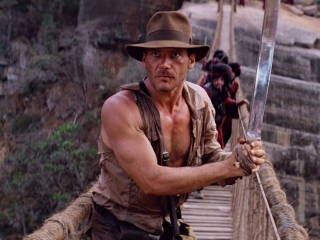
But there's not much breathing room, especially not towards the end, where you have Indy freeing all the slaves who themselves overrun their captors followed by that nutty mine car chase (which was an idea left over from Raiders) followed by our heroes being chased by a mass of water ("Water! Water!.... WATER!") followed by *that* rope bridge scene. It's just an incredible spectacle seeing Indy in the middle of that rickety bridge surrounded by enemies, and suddenly he comes out with his version of the Kobayashi Maru, with another immortal line: "Mola Ram! Prepare to meet Kali - IN HELL!" Rope bridge, meet machete. And then you have Indy and Mola Ram fighting on the remains of the bridge, ending in the evil bastard being eaten by crocodiles.

The ending is something I've always loved, just because of how damn happy it is. Indy, Willie, and Shorty walking into the village to the strains of the Raiders March is such a great moment, and then when the bridge kicks in the kids run to their parents and, well, it's bloody emotional. And while the final moments where Indy wraps his whip around a departing Willie may be seen as a bit inappropriate, it follows another quotable set of lines by Capshaw ("I'm going home to Missouri, where they never feed you snakes before ripping your heart and lowering you into a hot pit!"). Of course, it ends on another Hollywood kiss, but it's a great one, accompanied by a bunch of cheering kids and a wonderfully effervescent rendition of the march. 'Scuse me, I have something in my eye.

Actually, it's probably a tie between John Williams and Harrison Ford in terms of who contributes the most to the success of the film. Ford is never better as Jones, and handles both the action and the comedy perfectly, as well as the Black Sleep scenes. Williams' score is a marvel, from his brilliant intro to the opening musical number, to the great themes of the slaves, the love theme, and Short Round's theme, with the latter being used especially well in the end titles when it's interpolated with the Raiders March. The music walks the mickey-mousing line and features copious renditions of the march, so much so that Spielberg asked Williams to tone it down for The Last Crusade.

A special note has to go to Amrish Puri: he's amazing as Mola Ram, with a great commanding screen presence, and the creepiest laugh this side of Mark Hamill's Joker. But everyone does a fine job, even Capshaw, especially with what she's given to work with. I have a multitude of reasons for loving this movie, but the main one is just that it's so barmy, and as a result so much fun. It's kind of sad that both Lucas and Spielberg have basically disowned it, and that it has so much of a bad reputation, especially when there are so many other movies out there that ape it and get better press.

I guess considering it's been thirty years, Indiana Jones and the Temple of Doom's chances of being reassessed as a classic are probably not too great. But I don't mind too much being in a minority as long as this flick is around. Great action, great comedy, great music. You never know, maybe a future generation may discover it and rate it up a bit higher than most people. That's one of the best things about being a father and a movie fan, you can introduce all these great pictures to your kids regardless of what the masses say about them.

Of course I'll wait until they're thirteen...

- Charlie

To keep up with the rest of Temple of Doom week, follow @paulbullock on Twitter or check out the hashtag #TODweek

Follow @AssortedBuffery on Twitter
Or like our Facebook page

FILM REVIEW: Godzilla


The last time Hollywood tried to make a Godzilla movie, it was as disastrous as one of the monster's attacks on Tokyo. It was made by people who had no concept about Godzilla as a character, Toho's films, and not only was it a dreadful film in itself, it was a Godzilla film by name only (and even that has been downgraded by Toho to "Zilla"). In contrast, Gareth Edwards' Godzilla implicitly understands the Big G, as well as the mechanics of blockbusters and their seemingly all-you-can-eat menus.

Godzilla is all about tone. It instantly establishes this with a great opening credit sequence that shows just why main titles are so important; they're a brilliant way to get the audience in the mood and prepare them for what's coming, to summarise the tone and the themes of the film in one short sequence. Godzilla does this perfectly and then immediately launches into building up what we've all come to see: monsters. A prologue set fifteen years earlier shows scientist Ken Watanabe (named Sherizawa as a homage to the 1954 original) discovering monstrous egg sacs, and following this we're introduced to the human drama as nuclear plant supervisor Joe Brody (Bryan Cranston) loses his wife (Juliette Binoche) in a heartbreaking scene where the plant goes into meltdown.

Much of the film is shown from the eyes of children, and this sequence nails it down with a wonderful shot of Joe's son Ford watching from the school window as the plant is destroyed. Flash forward to present day, and a grown up Ford (Aaron Taylor-Johnson) has to leave his wife (Elizabeth Olsen) and son in San Francisco to go and rescue his father from prison in Japan. It turns out Joe has been researching all kinds of things since the disaster, and believes the meltdown was a cover up for something else.

The "something else" is not what you think it is - in fact, it's the main antagonists of the film, a pair of gigantic monsters determined to mate and unleash their hellspawn upon the earth. Called MUTOs (Massive Unidentified Terrestrial Organism), they're pretty badass, and while the male has wings and the ability to fly, the female of the species is as expected much bigger and badder. Enter Godzilla.

Godzilla here is presented as a force of nature, a creature to restore its balance, and while the film still portrays him as something that can do a great deal of damage to us and our civilisation, it's clear that this picture sees G as the hero - which is brilliantly satisfying. There's a an interesting theme of control here - Sherizawa gives the usual speeches about the arrogance of man versus nature, and he knows Godzilla is the key to saving the world, while the military try and do everything they can to stop the monsters, mainly around nuclear warheads (the MUTOs are attracted to radiation), nothing goes their way at all, and in the end there's no choice but to leave it to Godzilla to save us all.

Speaking of Godzilla, Edwards expertly teases his appearance all the way through the film. We see parts of him - his back plates piercing the water like a shark fin as he swims is one of many homages to the cinema of Steven Spielberg - but it's like the title character in Alien, we don't know exactly what he looks like and how big he is, so it's down to our imagination to fill out the blanks. And once he appears in his full glory, we're not let down. He is immense, wonderfully designed, and has actual character. There's a nobility in this Godzilla that comes straight from Tokyo; he's an animal for sure, but there are other things going on. And once his mind is made about restoring balance, nothing is going to get in his way.

To be honest, the thrill of seeing Godzilla is something I haven't experienced for a long time. My wife and I found it hard to keep still and not fistpump when the fighting started, and the initial moment when he uses his radioactive breath is an utter crowdpleaser, and if I were not a reserved British gentlemen I would have been whooping and hollering at that moment. The fight scenes are crazy and brutal, but while there is as much collateral damage as you'd imagine, the film goes to great pains to show people being evacuated from the area.

A lot has been said about the human characters in the film, and really, I had no problem with any of them. Another nod towards Spielberg is the importance of family, with the non-monster plot based around Ford trying to get home to his family. But seeing as this is a Godzilla film and not a David Mamet drama, they're given just about the requisite amount of character needed. The actors do well with the material (and the expected crazy lines that come with these kind of movies), and provide the right amount of emotion to give you that hook to keep with Ford. There's also an interesting use of "found footage" here while the human stuff is going on - we see images of the MUTOs and Godzilla on all kinds of CCTV cameras and military images, which again, is a good tease for the final fight.

The sound is incredible, especially where the monsters are concerned. Godzilla's roar has been updated just enough, and the way it reverberates is nothing short of stunning. The MUTOs have great sound design, and the constant destruction is mixed well enough that it doesn't give you a headache, but it doesn't fade into the background either. Alexandre Desplat's fantastic score fares well amongst the effects, and his driving theme for Godzilla gives the character a nice dramatic weight. However, if you're looking for any music by Akira Ifukube, you'll be sadly disappointed.

It's not a perfect film. Ford's story does feel like it's over-extended at times to allow for more time to wait before the big fight, and I could have done without the constant big-eyed shots of Elizabeth Olsen while she's in the shelter. I'm also undecided about Godzilla's post-fight nap, but I suppose he deserves it.

One of the overwhelming feelings I felt after seeing Godzilla was an immense sense of respect for Gareth Edwards. As a longtime Godzilla fan, I felt he did us and Toho proud, and most of all, he did the Big G proud. Godzilla has been through a lot over the years, especially by the West, and for Edwards to bring him back this way, and to get the character like this - well it makes me a very happy G-fan. Visually spectacular, but with a visceral feel that strikes at the core of the character, Godzilla really is the blockbuster to beat this year. And I have a feeling he'll still be kicking everyone else's ass at the end of the year. Put that in your pipe and smoke it, Smaug.

- Charlie

Follow @AssortedBuffery on Twitter
Or like our Facebook page

Monday, 19 May 2014

BOOK REVIEW: The Gentleviewer's Obsessive Guide to Buffy the Vampire Slayer (Second Edition)

You may have noticed on your perusal through our fair blog that I am something of a Buffy the Vampire Slayer fan. It might have been my bio that gave it away or perhaps the fact that I am currently engaged in re-watching the entire series and writing about it. It's a show that built up a cult following over time and those fans have remained devoted ever since. Buffy destroyed the town and left our screens, nearly eleven yeas ago to the day, but, as Kathleen Mattson's exhaustive new book proves, there is still a huge appetite there for all things Sunnydale.

One such area is the growing academic criticism around the show. Often praised for its witty and insightful explorations of gender issues, Buffy has become a locus for students and academics of television and cultural studies. Mattson's The Gentleviewer's Obsessive Guide is an excellent resource for Buffy scholars, an extensive and easy-to-use guide to every single episode of the series, including the unaired pitch pilot. The format allows you to dip in and out of the guide as you see fit or to simply track down who wrote which episode. Clear, concise and very readable, the book is everything a reference guide needs to be.

Whilst my own love for Buffy hasn't quite extended to academic research (give it time, folks), the guide has already proven highly informative for my ongoing project. The clear and concise way in which information is presented ensures an easy navigation to the episode of your choice and a whole host of tidbits along the way. I struggle with reading things online and whilst sites like the Buffy Wikia are useful, there's nothing quite like having an actual book in your hand. I'm with Giles on that one. The guide therefore has the added advantage of being physical presence in this Buffy fan's life, within reach and without slow loading times.

A feature that I found particularly interesting was Mattson's decision to include a section on character and relationship arcs from the series. Buffy, Willow, Xander, Giles, Angel, Spike and Anya each get their own section in which Mattson maps out their respective character arcs and the episodes that slot in alongside this. There are also lists which outline the key relationship paths such as Buffy and Angel or Willow and Tara. This decision offers an interesting way in which to view the series and one in which meaning may be changed or certain events made more or less significant. In doing so, Mattson provides viewers with a suggested alternate viewing that puts a whole new spin on a series already known so well. You could pick out your favourite character and just trace their journey throughout the series, following these paths and losing all the filler.


As an academic resource, it is clearly excellent, but it also remains accessible for people who are just plain trivia nuts. Reminiscent of The Watcher's Guides, a series of books produced alongside the show, the individual chapter sections offer a breakdown on different aspects of the episode from the music to behind the scenes facts and quotations. For example, the entry for the third season episode, The Prom, points out that it is Sarah Michelle Gellar's favourite episode (closely followed by Hush and The Body, if you're interested) before pointing out the references to Robert Frost's poem Stopping By Woods on a Snowy Evening. 

I consider myself fairly up to date on my Buffy trivia, but Mattson's book is so detailed and encompassing that she has picked out things I'd not spotted. It's a book to pour over and absorb, to glance at when needed or to simply track down a song that you heard in that episode one time. Whether you're simply a fan or a scholar looking for a handy reference guide, The Gentleviewer's Obsessive Guide to Buffy the Vampire Slayer offers all things to all people. It's now always at my side when writing my next Buffy post.

You can out more information about The Gentleviewer's Obsessive Guide to Buffy the Vampire Slayer on the Facebook page here. The book itself is available on Amazon here. As a fellow obsessive, I cannot recommend it enough.

- Becky

Follow @AssortedBuffery on Twitter
Or like our Facebook page

TV REVIEW: In The Flesh - Episode 3


It's an episode of a slower pace than the previous two instalments, focusing on the relationships that have been both developing and fracturing since the beginning of the series, picking up from where the last episode left off. Jem is still reeling from killing Henry and attempts to confess to MP Maxine Martin, who instead works with Gaz to cover up the death though his motives are more personal than merely keeping the status quo. Simon and Kieren are placed together in the Give Back Scheme at the local surgery where the treatment of rabids angers Simon. As he makes moves to do something, Kieren talks him down, leaving Simon disappointed in him. Elsewhere, Freddie tries to make amends with his ex-wife Haley in their home, despite her being in a relationship with someone else in that very house. However, all of this falls to the wayside when Freddie skips a dose and goes rabid with Haley trapped inside with him

Fresh off the back of winning the BAFTA for Best Mini-Series at this year's awards, In The Flesh continues to demonstrate its key strengths, namely that of putting character development at the forefront of everything supernatural that is going on. The tragic tale of Freddie, the small business owner forced into the Give Back Scheme, and Haley's relationship breakdown forms the spine of this episode. It opens with their wedding video and a mournful Freddie reminiscing about happier times. It's easy to forget that Freddie is a PDS sufferer at the beginning of the lock-up scene; it's a classic post-break-up attempt at getting the girl back, complete with apologies and promises to change. Haley's confession that she has grown up and wants something more stable from a relationship wouldn't look out of place in a romantic drama, but here, it's given the added danger of Freddie forgetting his dose.

In a beautifully tense sequence, Freddie starts to turn with a jammed door preventing Haley from escaping. The space that had seemed so adorable during its initial moments with its fairy-lights and over-eager romanticism suddenly becomes a claustrophobic ticking time bomb. Camera angles close in on Freddie's decaying face contrast sharply with the wide shots of people trying to get in to the lockup. A seemingly innocuous scene that threatens to erupt into something considerably more dangerous is one of In The Flesh's greatest strengths and it's a moment that sends ripples across the episode, impacting on both developing and fracturing relationships alike as well as both the pro-life and pro-death sides of the argument.

Simon and Maxine each represent an extreme of this and Dominic Mitchell has so far been keen to demonstrate their parallels despite their differences. Early in the episode, we get a glimpse of both characters on their own. Simon's prayer alludes to his faith, confirmed later in the episode when he begins to take on a preacher role within the PDS sufferers group. Meanwhile, Maxine's is glimpsed voyeuristically through a keyhole; the audience is not yet welcome into her privacy in the same way that we are afforded Simon's. There have never been outright good and evil characters in In The Flesh; Mitchell's writing has been far too nuanced for such black-and-white interpretations. However, there is a sense that Maxine is losing some of that as her scene portrays her as a little unhinged. There's clearly something in her back story that has caused her to become so extreme, but it appears to be pushing her towards a more two-dimensional antagonist that would jar with the rest of the show.

For Kieren, it's another pivotal moment that brings him ever closer to Simon as he becomes increasingly more capable of standing up to those around him. It's been building since the first episode when he stood up to Gaz and gives up his job at the pub to defend Amy and Simon. He's clearly working up to some kind of explosion, suppressing his frustration at those around him in order to keep the peace. But in moments like this, he shows flashes of the anger that Simon can take advantage of in his quest to get Kieren more on his side. That tension is building further, smack bang in the middle of Simon and Maxine's respective machinations and the episode closes by making sure we know exactly which way Kieren is swaying.

It's not all doom and gloom though. As ever, the marvellous Emily Bevan provided some much needed levity to the proceedings in her sulky interactions with Phillip, who has managed to make sure she's by his side as part of the Give Back Scheme. Her line reading of 'Village of the damned, how may I help you?" was a big laugh out loud moment and her cheery interactions with Kieren are always amusing to watch. However, Bevan's skill lies in keeping Amy the right side of annoying and there is constantly the underlying sense of something more tragic, whether it's the hand tremor or overhearing Kieren arrive and presumably hearing him kiss Simon. She's the heart of the series and I'm very interested to see how that final scene affects the psychology of her character.

Despite the ongoing extension of the show's mythology, this focused episode acts as a stark reminder of the insular brilliance of the first series, entirely enclosed in Roarton itself as the uneasy piece begins to fracture. The use of a slower pace to build to that taut final sequence is an excellent example of the way in which In The Flesh goes from small town character drama to horror in a space of seconds and the series continues to go from strength to strength.

- Becky

You can read Becky's review of the second episode here.

Follow @AssortedBuffery on Twitter
Or like our Facebook page

Friday, 16 May 2014

FEATURE: Look What I Found on Netflix - Wreckage

This tagline has absolutely nothing to do
with the film. Nor does that person. I don't
know who that is.
Welcome to a new feature here on Assorted Buffery called Look What I Found on Netflix. It's pretty much exactly as it says on the tin. Every fortnight, an intrepid writer* will search the depths of Netflix to root out a film they've never heard of and write about it. It could be good, it could be bad. It could be both. This week, Becky will be looking at Wreckage, a film starring Scoot McNairy and Aaron Paul, both considerably more famous for things that are a lot better.

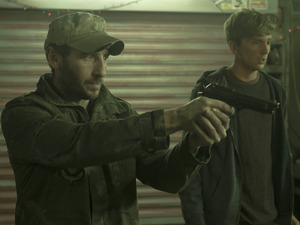
The writing process for Wreckage appears to have been to write a load of horror movie cliches on post-its and arrange it into some form of plot, or rather, a series of scenes that could at the minimum be called a plot. See, there's these two kids who get involved in a domestic shooting. Then there's this girl who's trapped in her broken down car and gets helped by a mysterious enigmatic stranger. But forget both of those, because it is actually about four friends who peruse a junkyard and get picked off one by one. Only, they don't really get picked off one by one, everyone who comes to rescue them does. Kind of.

At one point, the Sheriff exclaims "nothing makes any sense here does it?" which pretty much sums up the entire film in one handy bit of unintentional meta-commentary. There's a drag race that starts out of nowhere over a long distance and the three people who were in the car before the race casually wander over at the end as if they were there the whole time. There's that opening sequence that pretty much gives the identity of the killer away if you happen to be paying attention and then another sequence after that in which some random girl gets stalked by a creepy truck driver. Only for him to be killed, we assume, by the killer. That girl never appears again. 

Dialogue volume seems to operate whispery conversation or REALLY LOUD EXCLAMATIONS, which isn't helped by the dialogue itself taken from the 'How to Write Horror Movie Scripts' handbook. The central cast try to invest everything into it with Aaron Paul and Mike Erwin taking things Very Seriously indeed. They're aided by a very shouty and crotchety performance from Roger Perry (eagle-eyed Trek fans, yes that is Captain John Christopher of TOS fame) who just gets increasingly more exasperated with the situation. Me too, Captain Christopher, me too.

It's all looking a bit serious and po-faced. And then Scoot McNairy shows up. McNairy, so great in Monsters, hams it up as a hillbilly junkyard owner, complete with comedy accent and jam-jar glasses. It's his arrival that pretty much stumps any attempt to take this film seriously such is the extent of the stereotype. He even wears dungarees for crying out loud. Suddenly, here is a character who has wandered in from a Scooby Doo episode who by all accounts should be the murderer and it makes this whole exercise worthwhile. He states the obvious, he runs around like a lunatic and panics at the first sign of trouble. He shares way too much information about his uncle's colostomy bag. Most importantly of all, he's hilarious.

And therein lies the trouble with Wreckage. There's a nagging feeling throughout that this might have actually made a good movie or at the very least a passable horror (there are no scares here). If you stripped away the killer's back story (and made them look at least a little different when in disguise) and just focused on the group of young people who go to a junkyard and die in a variety of ways aspect of the story, it'd be quite neat. There's a Final Destination level of humour that it strives for and often hits at the expense of any tensions; McNairy's hick is a classic example of this, whilst one of the shock deaths would not look out of place in the aforementioned franchise. However, everyone else seems to be playing it straight, especially Mike Erwin who tries to imbue everything he says with gravitas, but instead just sounds a little constipated.

Even with its flaws, or perhaps because of them, Wreckage is very entertaining. It manages to spectacularly flub its landing and yet somehow you don't really care. You spend half your time trying to work out what sequences are related to which, why characters are making decisions that are even more stupid than your standard horror movie victim and just what film Scoot McNairy thinks he's signed up for. It would be an excellent film to play a horror cliche drinking game to. Perhaps with something weak, because there's one at least every five minutes. Please drink sensibly everyone. And save one for me.

- Becky

*If you're interested in contributing to future editions of Look What I Found on Netflix, drop us an email - assortedbuffery@hotmail.co.uk

You can follow @AssortedBuffery on Twitter
Or like our Facebook page.

FEATURE: Buffy the Vampire Slayer - Beauty and the Beasts

Previously on Buffy the Vampire Slayer: Oz is a werewolf, but locks himself in the library to avoid maiming anyone. Angel's returned from the hell dimension Buffy sent him to, but she doesn't know it yet as she's too busy dating Scott.


The episode opens and closes with Buffy's voiceover, reading extracts from Jack London's The Call of the Wild, as Willow watches Oz in full werewolf mode at the library. When Xander falls asleep on Oz-watch and a vicious animal attack takes place, suspicion is instantly placed on his wolfish self. The gang desperately try to hunt down another possibility as Oz begins to wrestle with the idea that he may have killed someone. Meanwhile, Buffy's patrol causes her to run into a feral Angel, chaining him up in the mansion and hoping he's not the one causing the attacks. What is actually happening is that a friend of Scot's, Pete, has turned himself into a rage monster after trying to 'macho' up to impress his girlfriend Debbie.

A curious thing happened whilst watching the opening of this episode. I realised that I had absolutely no recollection of it. I've definitely seen it before because this isn't my first Buffy re-watch rodeo, but there was nothing in my brain that made me go 'oh, it's this episode!' Watching it back now, it's largely because it's not very good. It's one of the few cases where the themes overtake the story and it results in an episode that had a lot of potential, but one which falters in its execution. Domestic violence is ostensibly the major focus with the added exploration of masculine duality, the sensitive exterior versus the beast within.

The plot itself lacks the usual metaphorical zing, but that's because it's largely not that metaphorical. The domestic violence that Debbie experiences is very real and somehow, having Pete take some serum to Hulk-rage his way into it feels like a clumsy add-on. It would have been far more powerful if it had been a human killer at the centre of it all, something fairly rare in the Buffyverse. Not only would it have enhanced the exploration of violence in Buffy's world, but it would also have provided a much more nuanced examination of masculine duality alongside Oz and Angel. Both of those characters have a monster not of their making as part of their personality whereas Pete creates his through that glowing serum thing. Would it not have been more powerful in this instance if he was just an ordinary guy who became a monster?

Part of this problem is that we don't see much of Debbie and Pete in the episode beforehand apart from exchanging flowers and sweet nothings. Whilst this adds to the domestic violence/behind closed doors angle, it also ensures that the revelation that Pete is behind the killings because of his love for Debbie feels tacked on. There's no real effort to get to know Debbie and Pete as characters before he turns into his own personal Hyde. When the violence does come, we're sympathetic to Debbie purely because of the situation and that makes it feel a little exploitative and the domestic violence angle very heavy-handed. The episode is much stronger when dealing with the vaguer notions of duality and inherent violence within characters like Oz or Angel. Because we've known these characters for a comparatively longer time, their respective narratives are more compelling and thematically a whole lot more interesting.

It also means their own stories get sidelined towards the end of the narrative in favour of a gungho chase scene through the corridors of Sunnydale High. Oz wrestling with his wolf side starts here as he starts to wonder whether they are entirely separate entities, or whether it is something he has to deal with in his human side. Angel meanwhile has been so broken by his hellish experiences that he's feral, concerned only with protecting Buffy by the episode's end. I'd much rather have seen more of Oz trying to come to terms with his potential murder status because Seth Green has the nuances of his character down early on. The wry humour becomes a defence mechanism and his relationship with Willow suffers because he doesn't want to put her in harm's way. I know we go on to see this later in the fourth season, but this feels like the perfect episode to have introduced it properly, rather than as a vague introduction to someone else's plot.

The strongest scene of the episode is when Buffy and Willow confront Debbie in the bathroom and quickly set about trying to convince her that Pete is not worth all of the violence. Debbie employs the language often used by victims of domestic abuse to justify their partner's actions (whilst Pete does the same to justify his own). Buffy has previously shown she abhors any form of violence against women and goes hell for leather in trying to convince Debbie otherwise. However, it's one of those situations where Buffy can't save everyone and Debbie runs back to Pete only to die at his hand. It's a tragic ending for her character and would have been more effective had the narrative pushed their relationship to the forefront more.

Just about everything in this episode feels a little off. The script doesn't sparkle with its usual wit, which is surprising considering its a Marti Noxon-led episode and the story feels disparate, despite its obvious thematic connections. It's the first dud so far of the third season, but next week, it's Homecoming so get your party dress on.

Quote of the Week:

Willow: Hey at least this time it's not your boyfriend who's a cold-blooded... [Oz walks over] jelly doughnut.

Let's Get Trivial: Those chains that Buffy uses to restrain Angel? They're in a chest with Drusilla's dolls. Which means those are Spike and Dru's sex chains. Yep.

- Becky

You can read Becky's look at the previous episode here.

Follow @AssortedBuffery on Twitter
Or like our Facebook page

Wednesday, 14 May 2014

TV REVIEW: Game of Thrones - The Laws of Gods and Men


The first half of this fourth season of Game of Thrones has been decidedly wobbly. I realise I'm in the minority of this thinking, but I've found aspects of really quite dull, which is something I'd never thought I'd say about this show. Last week's episode felt like a step in the right direction with a nifty action sequence and finally some plot development regarding the men of the Night's Watch which had been dragged out beyond belief. Thankfully, The Laws of Gods and Men goes some way to prove that all of that set-up will be worth it come the rest of the season.

Part of the reason that this episode is so strong is because each scene feels connected thematically in a way that earlier episodes haven't. It's all about identity this week, taking on the roles you're supposed to have rather than the ones you necessarily want. Right from the opening scenes in Braavos (which was absolutely stunning and all credit to the visual artists for creating something so beautiful), characters are rebuilding themselves in the only ways that are open to them. For Davos, he has to remake himself as the loyal servant of the true king when faced with Mark Gatiss' deliciously arrogant Tycho Nestoris of the Iron Bank. Stannis also has to constantly re-iterate that he is the rightful King, not Tommen, despite everyone now pretty much ignoring him because he's got no cash. It's still a scene that feels largely like set-up, but the presence of Gatiss and Davos' impassioned speech elevated it to a worthy opening scene for what followed.

The return of Yara Greyjoy is a welcome one as she is one of the more enigmatic and interesting Westerosi female figures. With Theon now decidedly not himself and assuming the identity of Reek, their conflict is not only one of family loyalty, but of an internal, traumatic identity crisis. The violence and claustrophobic nature of the scene added to the turmoil, emphasising Reek's weakened presence in the face of both Ramsay and his more powerful sister. It also harks back to Theon and Yara's relationship; they barely know each other with Theon having been brought up in Winterfell whereas Ramsay has much more power over him. Alfie Allen's performance has been an under-appreciated one, but his journey from arrogant, misguided Theon to broken and tortured Reek has been exceptional. He shares a great chemistry with Iwan Rheon as Ramsay and the pair have gone on to form one of the most interesting partnerships of this season, in a weird Stockholm Syndrome-y way.

After checking in with Dany too (who is unwittingly becoming the tyrannical oppressor she's supposed to have overthrown), we return to King's Landing where things are about to kick off in a big way. It's time for Tyrion's trial and, casting our minds back to his time at the Eyrie, we all know that it's not likely to go well. The build-up to the trial feels like the preparation for Blackwater, albeit on a smaller scale because it feels doomed. Cersei has been steadily manipulating everyone around her and rigging it in her favour, one of the judges is Tywin and Tyrion wasn't exactly the kindest person to Joffrey when he was alive. In short, he's doomed.

Despite this, the trial manages to throw up a fair few shocks along the way, particularly when it comes to the witness testimonies. People like Pycelle and the odious Meryn Trant were always going to testify against Tyrion and take pleasure in doing so, but Varys and Shae? Two wholly different set of variables. Varys has always been somewhat of an ally  to Tyrion and his seeming betrayal of his friend is captured in that great moment when Varys says 'I never forgot a thing'. It's an excellent reminder that Varys has no allegiances, something which his earlier scene with Oberyn (Pedro Pascal once again knocking it out of the park with just a handful of lines).

Many people are rightly praising Peter Dinklage for this scene, particularly the blistering speech he gives at the end, but for me, its his reactions to Shae's testimony that deserve all the plaudits. Betrayal is felt with a simple look and that nuanced performance continues into that brilliant speech to finish it all off becoming the monster everyone thinks he is, if only for a minute. I also enjoyed the performances of those around him. Charles Dance is always on form as Tywin and I enjoy any scene in which Jaime tries to get one over on his father. Nikolaj Coster-Waldau handles Jaime's weakness, his family, so well and his performance captured that desperation and helplessness in the face of Tywin's manipulation. Jaime is another forced to face up to his identity, played by his father into accepting his role as son and heir to Casterly Rock, all in exchange for his brother.

Like many Game of Thrones episodes, this one was bookended by two fantastic scenes, but unlike the rest of this season, the filler has been excellent throughout. It feels less like playing for time now and more as if we're seeing actual narrative progression towards the back half of the season. 

- Becky

You can read Becky's review of the previous episode here.

Follow @AssortedBuffery on Twitter
Or like our Facebook page

Monday, 12 May 2014

TV REVIEW: In The Flesh - Episode Two

Kieren's plans to leave Roarton are scuppered when a new government policy designed to bring PDS sufferers back into the community by making them into slaves, sorry, volunteers. Enforced with a grin by Victus MP Maxine, Kieren has no choice but to remain behind. His dissatisfaction brings him closer to Undead Prophet disciple Simon, who may have less than professional designs on Kieren, whilst Amy's shakes get worse and she is forced to see the doctor. Elsewhere, Jem is still struggling with her PTSD and is subjected to a cruel prank by one of her new friends. Facing a personal crisis and drinking crappy booze, she falls in with an old HVF comrade and goes out on a disastrous patrol.

There's a lot going on in this episode, building from the expansion of the show's world that began in the first episode. Dominic Mitchell has established a brilliant mythology for In The Flesh and it is one that keeps growing organically, bringing us further into the quirks of this world without it jarring. It allows him the opportunity to explore various themes across this episode including personal struggles such as depression, PTSD and addiction, as well as wider political issues, the most interesting of which could be the path to extremism on both ends of the spectrum.

Represented by the pro-living Maxine and the undead Simon respectively, the village of Roarton is being pulled both ways depending on your living status. Wunmi Musako and Emmett J. Scanlan are the newcomers to the cast, but it is to their credit that they fit right in with Mitchell's established world. Channelling Professor Umbridge with every sanctimonious grin, Musako has crafted an antagonist that is an absolute joy to loathe. Her bright and shiny disposition, whilst saying some truly awful things, is the perfect counterpoint to Scanlan's calmer and more cryptic Simon. 

Scanlan gets the big speech of the episode, a glimpse back into his pre-death self which revealed his drug addiction and nihilistic attitude. It goes a long way to explaining his character and why he buys into the Undead Prophet's teachings as well as keeping him suitably enigmatic. Despite this, it leaves his motivations largely unclear and when he intimates he might have feelings for Kieren later in the episode, I can't quite decide whether it's genuine or another way to get Kieren on side. He's a fascinating addition to the series and his role in Roarton is proving to be one of the most interesting aspects of this expanded world.

The brilliantly on-the-nose satire of the Give Back scheme was the highlight of the episode, particularly the gratingly cheesy government-made video introducing the scheme to a crowd of incredulous PDS sufferers. Little more than slave labour, it's another method of keeping the PDS sufferers in place and ensuring that they are kept track of. The incredulous reactions, particularly Emily Bevan's, provided some great comic moments, but it also illustrated that, in enforcing these restrictive policies, the pro-living are on the way to creating the extremism that they fear. The PDS population are fast becoming more disenfranchised, separating themselves off from the community and turning to drugs (sheep's brains apparently. Mmm). At least it's not Blue Oblivion. Oh, wait...

At the centre of this is poor Kieren who really couldn't have worse luck if he tried. Trapped once more in Roarton and forced into the Give Back scheme, he finds himself increasingly weary and angry with the current events, drawing him ever closer to the charismatic Simon. Luke Newberry's performance underpins that frustration with a desperate sense of hopelessness, allowing Kieren to become the audience's connection to the ULA. Depending on how this storyline develops, this could be a fascinating exploration of why people find themselves drawn into extremist attitudes. Kieren may be able to detach himself from Amy's wackier ideas now, but if he continues to butt heads with Maxine, the Undead Prophet might become more appealing.

I've spent much of this review talking about the PDS characters because, let's face it, it's very rare that the zombie characters in a supernatural show are the most interesting. However, Mitchell's strength with In The Flesh is that it manages to balance the zombie and human stories. Jem is at the forefront of the human side of things, still reeling from the after-effects of her time in the HVF. Harriet Cains has always been one of the outstanding actors and continues to be so here, reminding us that Jem was only a child when she was forced to take on something violent and dangerous to survive. When she kills poor Henry (who distractingly reminded me of 'cheesy peas!'), it's another trauma to process and considering she's not doing so well with the others at the moment, Jem's path is set to get darker, pulling her closer to Maxine as Kieren gets closer to Simon.

The best supernatural shows thrive on being able to create a world that feels organic and immersive and believable characters operating within that. In The Flesh captures both brilliantly as well as threading in some fascinating thematic developments, which the second episode has in spades.

- Becky

You can read Becky's review of the previous episode here.

Follow @AssortedBuffery on Twitter
Or like our Facebook page


Wednesday, 7 May 2014

FEATURE: Buffy the Vampire Slayer - Faith, Hope and Trick

Previously on Buffy the Vampire Slayer: Buffy was killed by the Master, but brought back to life by Xander. This calls a new Slayer to the fold, Kendra, who is then killed by Drusilla, for which Buffy is blamed and gets kicked out of school. Oh, and she also killed Angel who has been showing up in her dreams rather a lot since. So much death. *launches into Mal Reynolds interpretive dance*


Introducing several of this season's major players in one big swoop, Faith, Hope and Trick is aptly titled, bringing with it a new Slayer and a Medium Bad into the equation (leading into the reveal of the actual Big Bad later). Poor Scott, the Hope of the title, doesn't really get much else to do, but at least he functions as a nice play on the names of three virtues and gets to make moon eyes at Buffy. Mr Trick announces himself with style when he pulls up to a drive-thru and decides the attendant is on the menu rather than any farm fresh chick. And then there's Faith (yay, Eliza Dushku!), first seen cuddling up to a guy whose dance moves can be described as sketchy at best (listed hilariously in the credits as Disco Dave - he and Disco Stu from Community should form a troupe). Buffy quickly realises he's probably been dead since the 70s and promptly rushes out to take him down, only to find Faith is perfectly capable of handling it herself.

The introduction of Faith is one which immediately sets the cat amongst the pigeons; Xander's instantly attracted to her, Oz develops a typical laconic respect whilst everyone else hangs on to her every word or flirtation. Except Buffy, that is. It instantly sets up an antagonism between Buffy and Faith, even almost bringing them to blows at one stage, as well as their various differences. It's encapsulated perfectly in the scene in which they patrol; Buffy is pinned down by two vamps whilst Faith tries to decapitate another using only her fists. All the while, she's screaming, yelling and generally acting like a crazy person. Buffy simply wants to dust and move on, knowing the dangers of expelling too much energy, but Faith's got issues and she's taking them out on Henchman #3. 

As Buffy later recounts the incident to Giles, she comments that Faith isn't playing with a full deck and thus makes the understatement of the century. Faith has clearly got issues, whether it is compulsively lying to the Scoobies (no one ever gets to hear the full alligator story) or breaking down completely when Kakistos arrives at her door. She'll go on to become one of the most fascinating and memorable characters in the Buffyverse and it makes it a little odd to see her here, when she more readily displays weakness around Buffy than she ever will again, except perhaps in front of the Mayor (who gets another namecheck this episode) and Angel, who identifies with her a fair bit.

The other interesting aspect of the episode is the way in which Buffy is instantly jealous of the hold Faith produces over her friends and family. She comments to both Giles and Joyce that it feels like Faith is taking over her life (uber-foreshadowing there). However, Faith is set up to be the exact opposite, even down to the way they look; Buffy spends a large part of this episode in softer, pastel colours whilst Faith is dark or bold and rarely anything lighter. She's the anti-Buffy (someone we will actually see later in this season), enraged by personal conflict and not at all concerned with those around her. The strong thread running throughout Buffy's character is that she continues to do her duties because it saves people. Faith thinks it's fun. 

With so much to set up across its run-time, Faith, Hope and Trick doesn't quite retain the same energy that Anne or Dead Man's Party possessed. The three episodes can be viewed almost as their own mini-trilogy as Buffy slowly comes to terms with the events of Becoming and, if thought of like that, it does strengthen Faith, Hope and Trick somewhat, particularly with the final sequence. The end of the episode is a wonderful sequence as Buffy finally follows her own advice and confesses that Angel was ensouled when she killed him followed by Giles admitting to Willow that there was no spell; he was just doing a fatherly thing and helping her to move on. 

It's such a beautifully played emotional moment and I can't hear Christophe Beck's Buffy/Angel theme without wanting to cry. Buffy's process of moving on starts with this and moves into her accepting a date with Scott and leaving the ring that Angel gave her on the floor of the mansion, finally saying goodbye to him. Alas, the Powers That Be have other ideas. Whilst I adore the Angel spin-off and the character he becomes, there's still a part of me that wished they'd left their relationship with this ending. It was such a good send-off both for his character and the time that they spent together, as well as giving Buffy more freedom, that it seems a bit of a shame that they brought him back (only a minor one, mind). However, I also remember how it felt to see that cliffhanger ending for the first time as he crash-lands on to the floor of the mansion and the excitement that brought with it (pre-Internet having days for me too when I first watched this - I had no idea that was what was in store).

It's a slightly weaker episode, yes, but it's an impressive introduction to one of the most beloved characters in the canon. With Angel back on the scene, Faith on the side of good for a bit and Trick in town, the third season really does get off to a cracking start.

One last thing, anyone else remember that Buffy's kicking the bucket trick made it into the GameBoy Colour game?

Quote of the Week:

Oz: I'm wondering about your position on werewolves (to Faith)
Willow: Oz is a werewolf!
Buffy: It's a long story.
Oz: I got bit.
Buffy: Apparently not that long.

Inventive Kill: Faith doesn't so much use a stake as an entire beam of wood to dust Kissing Toast. Oops, sorry, Kakistos.

Let's Get Trivial: That's Darling Violetta performing at The Bronze in this episode, who would later go on to produce the brilliant theme for Angel.

- Becky

You can read Becky's look at Dead Man's Party here.

Follow @AssortedBuffery on Twitter
Or like our Facebook page

Monday, 5 May 2014

TV REVIEW: Game of Thrones - First of His Name


Opening with Tommen's coronation, First of His Name is another episode which ranges across Westeros and Meereen, but rather than check in with everyone they possibly can, we get several focused scenes with select characters. In King's Landing, we follow Cersei through various conversations as she attempts to secure the future for Tommen as well as checking with Oberyn about Myrcella. Arya and the Hound have another confrontation, this time about what kind of sword is required to kill a man whilst Brienne finds herself coaching Pod into doing something useful as her squire. Sansa and Littlefinger have arrived at the Eyrie, greeted by her mad cousin Robyn and her mad aunt Lysa who promptly marries Littlefinger and lets the entire castle in on their wedding night. Finally, Jon's troupe closes in on Craster's Keep to take down the mutineers.

The previous two episodes have had a fair few issues with them, perhaps the most obvious of which was pacing. Oathkeeper was seemingly various long exposition scenes sandwiched between two outstanding sequences to open and close the episode. First of His Name has a similar problem, but this time, the strongest scenes are threaded throughout the narrative, which boosts the pace somewhat. It still feels like certain scenes are in there just to remind audiences of characters or to pad out the story until the next Big Event, but there were three key moments in this episode where it felt like Game of Thrones had begun to rediscover its groove.

Tommen's coronation was a nicely sombre affair tinged with humour as Margaery continued to apply her claws to the latest Baratheon on the Iron Throne. Her conversation with Cersei, in which the two acknowledged their mutual goals and respective ambitions was particularly well done and both Natalie Dormer and Lena Headey rose to the challenge admirably. Margaery and Cersei really aren't too dissimilar and seeing them exchange euphemistic conversation whilst actively trying to undercut each other is a delight. It also acts as a useful reminder of the ways in which women learn to survive in Westeros that doesn't involve some sort of sexual violence as a catalyst. Margaery is ambitious and knows her family affords her a certain amount of privilege. She can also work her assets in a way that no doubt Cersei once did. Cersei on the other hand resorts to her role as a matriarchal figure to get things done, namely by ensuring that Tommen will be married to a strong ally.

Speaking of females surviving, one who has done remarkably well for herself is Sansa, who believes herself to be in a safe place when she arrives at the Eyrie, only to discover her aunt and her son are quite bonkers. Kate Dickie's performance was gloriously unpredictable, calm and inviting one minute then all wild stares and accusations the next. Praise should go too to Sophie Turner who has managed to turn what was once a wholly unsympathetic character to someone we actively fear. Granted, Joffrey helped this transition, but it it was galling to see Sansa get to what she thought was finally a safe place only to have the rug pulled from underneath her once more.

Of course the big reveal in this moment is that it was Littlefinger and Lysa behind the poisoning of Jon Arryn which kickstarted all of these events way back when. With the death of Jon Arryn, Littlefinger put himself in a position through which to provoke the antagonisms between the Lannisters and the Starks whilst ensuring that he can keep the situation to his advantage. So far, so good. Long have people said that Littlefinger is the most influential man in Westeros and this goes some way to prove that. When Lysa asks why he cares so much about Sansa, she assumes it is because he fancies her for himself, which is a fair assumption really as Sansa is supposed to look how Catelyn did at the age when Littlefinger fell in love with her). However, with Sansa in his keep and Lysa in his marriage bed, Littlefinger has access to two of the most important strongholds in Westeros, the impenetrable Eyrie and the last known remaining heir to Winterfell. 

Michelle MacLaren is once again on directing duties and produces another stunning episode. I particularly loved the framing of the final shot in Meereen with Dany stood on the balcony with her back to both the camera and Ser Jorah, watching over her as ever. It was a beautiful visualisation of their relationship and how the power dynamic has evolved and shifted since their first meeting at her wedding. Another admirable sequence was the climactic fight between Jon and Karl, lit hauntingly by the central fire and shot at a frenetic pace. Then, of course, there was that final cathartic shot of Longclaw bursting through Karl's mouth which has to be one of the best non-Joffrey deaths of the series so far. Erlack.

It is that final sequence, coupled with the scenes in the Eyrie, that elevated this episode from another substandard affair. After what felt like weeks of the Night's Watch discussing the mutineers, something finally got done and in a suitably brusque and brutal fashion. It was also surprisingly emotional when Bran looked on to see Jon, failing to get his attention before being convinced it was probably best he didn't talk to his brother. Like Arya arriving at the Twins just in time for the Red Wedding, it was heartbreaking to see the two brothers gets so close without actually meeting (though for the longer narrative, it was preferable that they didn't). I also loved the simple scene with Jon as he is reunited with Ghost. It's a small moment but it's not often you get people reunited with friends or family on this show. Let's savour it when it happens.

It was in the minor scenes that once again those little niggles showed. Whilst Brienne and Pod provided some welcome relief, Arya and the Hound appeared again to re-tread the same ground they've already gone over in at least three episodes; life is hard, Arya needs to harden up. Maisie Williams and Rory McCann are one of my favourite partnerships on the series, but I can't help feeling they're being overused. It was welcome to see Williams' water-dancing which was beautiful to watch and to hear her finally say her list in front of the Hound, but again it felt like the scene went on to long to get their relationship to a point we knew they were at. It's a toxic one that Arya would do well to get away from, but it's belabouring the point somewhat now.

An improvement on last week's episode, First of His Name is all in all a mixed affair, but it is saved by two sequences which work to further the plot rather than delay it, injecting some much needed danger into the proceedings. We're now halfway through the season when things, traditionally, start heating up so let's hope this ascent continues.

- Becky

You can read Becky's review of previous episode, Oathkeeper, here.

Follow @AssortedBuffery on Twitter
Or like our Facebook page

THEATRE REVIEW: Dead Party Animals - Hope Theatre

                                                                                             Photo by Christopher Tribble

The premiere of Thomas Pickles’ Dead Party Animals at The Hope Theatre, Islington last week, is best described as an evening of new additions. Not only is The Hope Theatre London’s newest venue committed exclusively to new writing, and not only is this Pickles’ first play, but he is also the winner of the inaugural Adrian Pagan Playwriting award. The primary criteria of this prize is that the entrants be part of the Theatre world, be it as technician, actor, usher or stagehand – just so long as they’re not a writer by trade.

This first winning play then, is a one man show written and performed by Pickles. It follows a group of friends on an evening out, beginning with the boys and girls separately, as each group gets ready for the big night, inevitably colliding unceremoniously in a loud, busy club, sweaty with too many bodies and too much fake tan. The boys trade jokes and bravado whilst the girls slather themselves in make-up and jewellery, dropping ‘babes’ like punctuation. As the night progresses, Pickles’ character starts to lose his grip on reality, and we get the distinct impression, through his razor-sharp blend of dialogue and poetry, that this is down to more than just the drink.

As a performer, Pickles is ludicrously watchable. Every character is expertly brought to life in his homely (to me, at least) East Lancashire accent. Each facial expression and subtle change of voice is faultlessly judged through both Pickles’ own writing and Adam Spreadbury-Maher’s direction. The members of this gang of mates may be vacuous and self-involved, but the performance of the actor portraying them is anything but, his choice of style giving him the freedom of expression to create a crystal clear window into the minds of the group with just a few choice words. It is to his credit that the frequent use of poetry doesn’t jar, as it so easily might have, but allows his dialogue to flow seamlessly from one thumping, drink fuelled scene to the next.

There are moments of brilliance in this production, the subtle tangling of bed sheets around the stage, for one, as it blends the fantastical of the protagonist’s imagination with the reality of the club, and with it the theatre space itself. The sound and use of recognisable lyrics give even the most hardened rejecter of your typical Saturday night hang-out a burst of claustrophobic, thudding bass. You can almost feel the floor sticking to your shoes as you leave, smell the night’s takeaways as you escape into the cold air and feel the hundreds of bumping, grinding bodies. Again, it is to Pickle’s credit that a one man show with no set to speak of manages to be quite so visual.   

The world the visions conjure, however, is a bleak one. The boys spend their time trying to sneak a grope of as many girls as they can, by any means necessary, whilst the girls don’t appear to have a single brain cell to rub between them, interested only in the clothes on their backs and the drinks in their hand. Whilst I have no doubt that this ambition-less, seedy world is exactly the world Pickles wants us to see into, for me it was just a little too empty, a bit too bleak. We’ve all seen this world all too often on the weekend streets of our home-town, and I’m just not sure that for many of us, it’s one we want to willingly spend time in.

The play is a fantastic achievement, and a worthy award winner. For me, however, as with the lives of the characters it paints, there was just a little something missing.

Maybe it was because I didn’t have a drink…


Jen

Dead Party Animals will be at The Hope Theatre until 24 May.


Follow @AssortedBuffery on Twitter
Or like our Facebook page.
You can read my own blog here or follow me on twitter here