Over the course of October, I shall be watching one horror movie a day and reviewing it right here for your reading pleasure. I haven't seen any of the films I'll be watching before and you can find the full list here.
The Freeling family live in a nice, quiet slice of new suburbia in a planned community called Cuesta Verde. Steven (Craig T.Nelson) is a real estate developer with the firm who built the community and who are now planning to build more homes alongside it, despite there being a graveyard in the way. Steven's wife Diane (JoBeth Williams) takes care of their three children, Dana (Dominique Dunne), Robbie (Oliver Robins) and little Carol Anne (Heather O'Rourke). One night, Carol Anne wakes up and begins communicating with a TV set on static after the channel closes down for the night. Soon, a series of bizarre events occur around the house. The Freelings find it exciting at first, but when Carol Anne goes missing and Robbie is attacked by the tree in the back yard, the family realise what a nightmare they've found themselves in.
Haunted house movies aren't my favourite sub-genre in the horror catalogue, often used as a collection of familiar tropes rather than telling a convincing story of a home under threat. In recent years, there seems to have been a fair few of them, all with their own twist on the idea of hauntings or simply playing it straight but doing it well. I've liked some a lot (The Conjuring from last year's Shocktober for example) whilst others have squandered their potential (Insidious, I'm looking at you). Therefore, revisiting a classic of the genre seemed to be a must for this month and Poltergeist is the kind of film I used to hear discussed by my friends at school at an age when horror movies had been heavily restricted by my parents.
Often there's a balance that has to be found in haunted house films between the family at the heart of it and the ghostly shenanigans going on around them. The lines between who did what may have been blurred since the film's release, but having Steven Spielberg (a family-focused film-maker if ever there was one) and Tobe Hooper (master of horror) writing, producing and directing gets this balance right. The specific sequences designed to horrify you do exactly that, building up the creepy elements before moving into outright shock tactics to scare you. The big set piece of the tree taking Robbie and the closet sucking Carol Anne into it is practically perfect, taking bits of everyday life that are supposed to be safe and transforming them into something scary and threatening.
The family at the heart of it are all portrayed with excellence, particularly JoBeth Williams as a fierce mother determined to do whatever she can to protect her kids, even if it means jumping into a weird portal to another dimension closet. Her fight alongside Steven to keep their family together is the emotional heart of the movie and the film spends time with them before the paranormal stuff takes hold so we understand what they're fighting for. With the ghosts snatching Carol Anne, it also gives the family a reason to stay behind in a house that's tormenting them.
There's also a great dig running through about the greed of corporate America and its willingness to exploit in order to promote their little slice of the American Dream. It opens with 'The Star Spangled Banner' playing after a channel signs off for the night, a rousing patriotic moment that gets increasingly more ironic as the film progresses. Corporate suit Lewis Teague brags about his achievements and in doing so, reveals to Steven that their house was built on an old cemetery too. It's a quite literal occurrence of a company bulldozing the past in order to put a high price on the future. Of course, the bodies in the graveyard, the souls not allowed their rest and trapped in the Freelings' house get the last laugh, rising out of the ground and destroying the house with them.
It's easy to see why Poltergeist remains so influential and recommended in a day and age full of haunted house movies. Suburban hauntings are somehow that little bit worse than finding a creepy old period property and Poltergeist taps into that, centring the family and building our terror out of theirs.
- Becky
You can find my other Shocktober '15 reviews here.
Follow @AssortedBuffery on Twitter
Or like our Facebook page

Another week, another sequel hits cinemas across the globe. With seemingly every single thing being remade, reimagined, rebooted and exploited, it’s no surprise that we finally get to see the fourth instalment of Steven Spielberg’s last flagship franchise. It took fourteen years and several different approaches to finally realise this latest chapter with 38-year old Colin Trevorrow at the helm. John Hammond’s original dream finally came to pass and millions of people from around the world get to experience it on a daily basis. By the time the plot of Jurassic World kicks in, the park itself is a bit of a tired attraction that’s struggling to sustain itself financially. New generations are hardly impressed by old school dinosaurs and that’s why new genetic experiments take place in order to create a more scary and entertaining creatures. That’s how the formidable Indominus Rex is born. And yes, we already know how it goes...
Aside from a new monster to drive the show, there’s no moving away from the used formula. Many action beats and character moments are direct nods to existing sequences from this franchise, as expected. There are no big surprises in store for jaded audiences; we know pretty much exactly what’s going to happen and who might survive this ordeal. The script itself is based on a very Spielbergian construction of setpieces, in which certain things need to happen at specific points in films like this. Colin Trevorrow’s direction is not exactly fresh at any point but it does the job nicely. In this sense, it very much recalls J.J. Abrams’ efforts on Super 8 from 2011. A large group of characters is introduced in this new chapter and one can’t help but feel many of those feel slightly short-changed in an incredibly overcrowded script. They’re mostly reduced to simple variations on different characters we’ve already met with one or two traits that should distinguish them among the crowd.
Having said that, the cast itself is likeable. Bryce Dallas Howard gets the most screen time and gets the hardest job. Her Claire Dearing is a cold businesswoman, John Hammond’s successor and main female action protagonist – all at the same time. Her transformation is the most visible arc in this story and, as such, the most likeable. Chris Pratt is a convincing enough as Velociraptor trainer Owen Grady but his part is also more predictable and not quite as developed. Not that there is any opportunity for that; he mostly fulfils the role alpha male in a big production (also quite literally). Two young brothers, played by Ty Simpkins and Nick Robinson, are not as annoying as one might expect, even if they’re journey is another cynical recapitulation of things we’ve already seen in Lex and Tim storyline from the 1993 film. We also get to meet a large group of supporting characters and, among those, Irrfan Khan, Jake Johnson and Lauren Lapkus stand out the most. No Jurassic Park film can do without an arrogant corporate type and/or military type and Colin Trevorrow gives us both in Vincent D’Onofrio’s Vic Hoskins.
It’s a good thing that Trevorrow manages to inject a lot of humour and irony into this otherwise calculated summer romp. When several technicians discuss among themselves the concept of Indominus Rex, one character points out how lame the concept of genetically enhanced dinosaur sounds next to “old-school Jurassic Park”. Here, filmmakers successfully predicted reactions to early trailers. While all previous films contained humour and one-liners, Jurassic World is more self-conscious about it. And that’s largely a successful attempt to win over cinema audiences.
One of the key elements are creatures themselves. Indominus Rex itself isn’t quite as interesting visually; even Spinoraurus from Joe Johnston’s Jurassic Park III had a bit more personality that separated it from other beasts. This one, by its very hybrid nature, doesn’t linger in mind as much. It’s interesting that the fakeness and accuracy of resurrected dinosaurs is also addressed in the film by the returning character Dr. Henry Wu (played by B.D. Wong). He points out that they are essentially fictional creations, a result of educated guesswork. This one, almost throwaway, element neatly resolves much of a conflict between rigorous scientists and dreaming filmmakers and it also plays nicely into the ethical angle of this concept.
One of the spectacular selling points of Steven Spielberg’s film was the visual idea itself: seeing man and dinosaur together in a realistic fashion. Since then, technology has moved forward. There’s no more need for excessive use of physical puppets that played such a crucial part 22 years ago. But one truly misses the great artistry of Stan Winston’s animatronics. As sophisticated and convincing as computer graphics can be, it’s still not the same. Nobody is impressed by CGI anymore. That aspect itself forms an interesting parallel to the story in which many kids are hardly impressed by what they’re seeing, not matter how breathtaking.
The films puts in a lot of references to the original one, of course. That cannot be avoided. But it does so with relative restraint. It’s a clever idea that John Hammond’s Jurassic Park is a relic of its time, not unlike the animals themselves. Along the ride, we get to see some familiar elements, overgrown by jungle and completely forgotten by modern caretakers. John Williams’ iconic music is also treated as creation from another era, almost completely forgotten in modern digital world. His two primary themes (along with a cameo of The Lost World tune) bring back the element of nostalgia, without overstating the point too much.
In the world of sequels and reboots, latest Jurassic Park film certainly doesn’t feel like an event anymore. The original was a gimmick, true, but it managed to turn this disadvantage into a truly dazzling spectacle. It gave its generation a classic that comes along every now and then. It’s worth pointing out that Jurassic World isn’t that. Not even close. But filmmakers are also smart enough to address that head on. They recapitulate a lot of elements with new twists, as it happens with continuations like this, but also manage to look at thus franchise from certain distance. While it might feel slightly cynical in its self-conscious resurrection, Jurassic World still manages to entertain. And that’s more than can be said about its two predecessors.
- Karol
Follow @AssortedBuffery on Twitter
Or like our Facebook page
Today marks the 30th Anniversary of the cinematic release of Indiana Jones and the Temple of Doom. Paul Bullock of From Director Steven Spielberg has been leading a week-long celebration, culminating in a live tweet commentary of the film tonight (May 23rd, 8pm GMT). Our contribution is from Charlie as he turns his attention to Dr Jones...

It's almost impossible to create art that doesn't reflect some facet of the creator. The moods, the relationships, the events that happen during the creation more often than not seep through to shape it, whether you like it or not. One of the better examples of this is Indiana Jones and the Temple of Doom, which is notorious for being uber-dark and nasty, violent, and generally quite scary, as well as in some quarters being seen as racist. The film celebrates its thirtieth anniversary this May, so it's perhaps an ample time to talk about what is a severely underrated film.
The situation is this: Raiders of the Lost Ark has just made a bundle of money, Harrison Ford is even more of a global superstar than he was before, and Indiana Jones is an instant heroic icon. So George Lucas and Steven Spielberg get to thinking about another one, while Spielberg makes E.T. and George puts the finishing touches to the Star Wars saga via Return of the Jedi. But despite the huge success of the film, the production of Jedi has a bittersweet ending as Lucas' marriage to editor Marcia Lucas ends in bitter circumstances (Spielberg had also ended a relationship in 1980 with actress Amy Irving).
Screenwriter Lawrence Kasdan, who wrote Raiders (as well as Jedi and The Empire Strikes Back), refused to be involved citing his dislike of the story, and has since said that the film comes out of a "chaotic time" in both Spielberg and Lucas' lives. He's not wrong. Temple of Doom has a mean streak a mile wide, but I don't see it as a bad thing - after all, much of it's a horror film. The funny thing is that it almost feels like Spielberg and Lucas made two different movies and threw them together - George an intense and nasty horror movie, Steven a parody of the previous film (as well as many others). What was birthed from those two fathers is a child that may be dysfunctional at times, but is still a hard one not to love. After all, who doesn't enjoy seeing hearts being ripped out of people's chests?
But before we look at the good points, let's see what gets people so up in arms about the film. First: the racism. In the film, Indiana travels to India and meets people who not only eat bugs, but enslave children and make people drink blood, as well as the aforementioned removal of the major organ. The Thuggee cult in the film is actually semi-based in reality, albeit much less fantastic. It was more of a gang, and they were literally thugs - they went around India murdering people. The idea of a terrifying cult that did unmentionable things was something that was thought to exist, only recently have theories come forward that it was created by the British in Colonial India to reflect their fears. It's also a massive homage to Gunga Din, which reflects Spielberg's love of old movies.
Things like the dinner scene - where the guests are served up beetles, snakes, and eyeball soup, not to mention chilled monkey brains - are mean but fun gags, although this is the part where I could genuinely see people being upset at the portrayal of the Indian people. But I don't think it's intentional, and I don't think Lucas and Spielberg set out to make the 1984 version of Birth of a Nation as many people seem to think. Willie Scott, however, is another matter.
After the smart, resourceful, and strong female character of Marion Ravenwood, Willie Scott seems like a trip back to the stone age. She's vapid, materialistic, and does very little besides scream or complain. It's not hard to see her character being birthed out of the bad feelings of George Lucas' broken marriage. She also has no significance to anything in the film, other than being a love interest for Indy. I can tolerate her in the film, but I can certainly see why people hate her guts. It's also pretty uncomfortable seeing what she's put through, from walking through a tunnel crawling with insects, to being lowered into a hot pit.
The film also creates its own problem simply by adding a title card that says "Shanghai, 1935". This immediately sets it as being a prequel, which means what follows doesn't make a huge amount of sense. I can deal with a couple of things - the sword gag callback where Indy reaches for his gun only to find his holster is empty is brilliant - but Indy in Raiders begins the film as a skeptic who states "I don't believe in magic, a lot of superstitious hocus-pocus" but ends the film as a changed man after witnessing the power of the almighty first hand. Surely he would be a bit more open-minded if he'd previously seen the effects of black magic and the sankara stones going up in flames due to the misappropriation of Kali and Shiva?
So yeah, the picture is not without its flaws. But it's also breathlessly exciting, funny, scary, and absolute bonkers, and a massive tribute to movies. The opening is spectacular, as Kate Capshaw twirls her way through a Cantonese version of the Cole Porter standard 'Anything Goes'. There's a double-meaning here, as Spielberg and Lucas here tell the audience that they better prepare themselves, as there's no telling what the pair are going to throw at them. Anything goes indeed.
The Indiana Jones here is not really the same as the reluctant hero in Raiders. The UK marketing for Temple stated in bold letters "THE HERO IS BACK", and while it's an obvious sequel reference, it's also reflective of the old-school heroism in the film, where Indy ends up taking up a moral crusade on behalf of the village and as a result we get the kind of swashbuckling heroics that would turn Errol Flynn to jelly, under the guise of "fortune and glory". But also unlike Raiders, in Temple the hero falls.
As I mentioned earlier, much of the film dives into horror territory, with much of the tropes of the genre around that time such as legions of bugs, human sacrifice (no cats and dogs living together), and Mola Ram's heart-removal service. Even the setpiece at the beginning in the nightclub, where a poisoned Indy stumbles around Club Obi-Wan looking for the antidote, has some surprising violence, from the death of Jones' waiter friend ("Into the great adventure, I go first Indy!") - which by the way is filmed in a fantastic way, with the picture following popping champagne bottles around the room, until one of the pops turns out to be a gunshot, with copious amounts of blood blooming on the waiter's shirt. But that's like Sesame Street compared to when Indy skewers one of villain Lao Che's cohorts with a flaming kebab.
There are plenty of nasty deaths in the film - from simple gunshot victims to the vicious hanging of a thuggee from a ceiling fan to the uber-thuggee (played by Pat Roach, the massive bloke who kicked Indy's ass by the flying plane) who gets pulled under a rock crushing machine, leaving a ghastly trail of claret behind. But the obvious one is that heart scene - where Mola Ram reaches into the chest of a poor gentleman and rips out his still-beating heart, displayed in full technicolor glory. Dripping with bright red blood, the heart is animatronic and actually pulsates as Mola Ram grins with a lusty relish.
So the picture is pretty mean, and as a result of not only containing lots of deaths but almost revelling in them, it ended up inspiring the PG-13 rating in the USA (along with another project under the double-S, Joe Dante's Gremlins). But it's also ridiculously funny and dripping with uber-quotable wisecracks. The most famous is funnily enough oft-misquoted - Short Round's "Hey Dr. Jones, no time for love!" after Indy sticks his hand down Willie Scott's dress - but there's also "Hold on to your potatoes", "That's why they call it the jungle, sweetheart!", "This Nurhache's a real small guy!", and the brilliant "Short cut!" "Yes Indy?" "I said Short CUT!". Like Raiders, Temple is at its best when it makes light of desperate situations. It's both mean and funny seeing Kate Capshaw squirming through the bug tunnel while all sorts of giant insects crawl all over her, but it's funnier when she's fumbling at the release mechanism while Indy is shouting at her, ending with that impeccable line reading by Harrison Ford: "We. Are Going. To DIE!"
And the humour is needed to counteract some terribly bleak material, mainly around Indy actually turning to the dark side courtesy of a little blood cocktail. Seeing Jones drink blood from the creepiest goblet in the history of the world - a zombified human head that looks like something Leatherface would be proud of making - is bad enough, but it's horrifying to see the hero of the picture being a complete asshole, not only sending Willie down into the fire pit (although I think some would applaud that) but striking child sidekick Short Round. The scene that always disturbed me the most was seeing Indy alone in a darkened room convulsing while under the influence of the Black Sleep of the Kali Ma. There's a sense of hopelessness throughout that section of the film that makes Indy's eventual awakening from the trance all the more triumphantly powerful.
The scene where Indy comes back is also the one sequence that really brings up Spielberg's family motif. Shorty's act of catching Indy with fire to bring him out is prefaced by "I love you, Indy!" and the scene ends with the trio together - but while Indy and Willie share a Hollywood kiss, the real warmth comes from the exchange of hats between Indy and Shorty, and the following embrace. Another father-son moment that has a lot of heart, and the only scene in the film that comes close to Spielberg's much-accused - and generally misunderstood - "sentimental" side.
And of course, there's the action scenes. While on the subject, the reunion scene is followed by the longest period of action in the film that doesn't stop until they return to the village, beginning with the most iconic image from the picture: that uber-heroic shot of Indy's silhoutte in the tunnel. The first half of the film is no slouch either - we get a great nightclub fight that includes Indy and and Willie running across the room behind a gong as it's spattered by gunfire; the jump from a crashing plane and subsequent slalom down a giant mountain and into rapids in a dinghy; and the fight between Indy, Shorty and the Thuggees to save Willie. It's all at a breathlessly exciting pace, which is why the film was was actually slowed down to allow it to breathe a little.
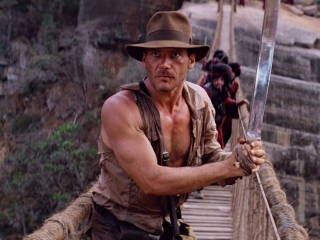
But there's not much breathing room, especially not towards the end, where you have Indy freeing all the slaves who themselves overrun their captors followed by that nutty mine car chase (which was an idea left over from Raiders) followed by our heroes being chased by a mass of water ("Water! Water!.... WATER!") followed by *that* rope bridge scene. It's just an incredible spectacle seeing Indy in the middle of that rickety bridge surrounded by enemies, and suddenly he comes out with his version of the Kobayashi Maru, with another immortal line: "Mola Ram! Prepare to meet Kali - IN HELL!" Rope bridge, meet machete. And then you have Indy and Mola Ram fighting on the remains of the bridge, ending in the evil bastard being eaten by crocodiles.

The ending is something I've always loved, just because of how damn happy it is. Indy, Willie, and Shorty walking into the village to the strains of the Raiders March is such a great moment, and then when the bridge kicks in the kids run to their parents and, well, it's bloody emotional. And while the final moments where Indy wraps his whip around a departing Willie may be seen as a bit inappropriate, it follows another quotable set of lines by Capshaw ("I'm going home to Missouri, where they never feed you snakes before ripping your heart and lowering you into a hot pit!"). Of course, it ends on another Hollywood kiss, but it's a great one, accompanied by a bunch of cheering kids and a wonderfully effervescent rendition of the march. 'Scuse me, I have something in my eye.
Actually, it's probably a tie between John Williams and Harrison Ford in terms of who contributes the most to the success of the film. Ford is never better as Jones, and handles both the action and the comedy perfectly, as well as the Black Sleep scenes. Williams' score is a marvel, from his brilliant intro to the opening musical number, to the great themes of the slaves, the love theme, and Short Round's theme, with the latter being used especially well in the end titles when it's interpolated with the Raiders March. The music walks the mickey-mousing line and features copious renditions of the march, so much so that Spielberg asked Williams to tone it down for The Last Crusade.
A special note has to go to Amrish Puri: he's amazing as Mola Ram, with a great commanding screen presence, and the creepiest laugh this side of Mark Hamill's Joker. But everyone does a fine job, even Capshaw, especially with what she's given to work with. I have a multitude of reasons for loving this movie, but the main one is just that it's so barmy, and as a result so much fun. It's kind of sad that both Lucas and Spielberg have basically disowned it, and that it has so much of a bad reputation, especially when there are so many other movies out there that ape it and get better press.
I guess considering it's been thirty years, Indiana Jones and the Temple of Doom's chances of being reassessed as a classic are probably not too great. But I don't mind too much being in a minority as long as this flick is around. Great action, great comedy, great music. You never know, maybe a future generation may discover it and rate it up a bit higher than most people. That's one of the best things about being a father and a movie fan, you can introduce all these great pictures to your kids regardless of what the masses say about them.
Of course I'll wait until they're thirteen...
- Charlie
To keep up with the rest of Temple of Doom week, follow @paulbullock on Twitter or check out the hashtag #TODweek