Wednesday, 27 February 2013

TV REVIEW: Being Human - The Greater Good


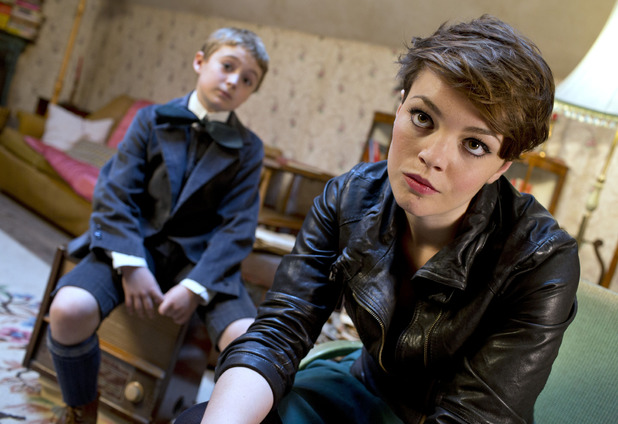
Being Human moves on apace this week as two supernaturals are introduced to the already delicate balance of Honolulu Heights. After Rook (Steven Robertson) and his department are shut down, he must find a new place for manchild/werewolf Bobby (Ricky Grover) to live and sends him off to stay with Tom (Michael Socha), Hal (Damien Molony) and Alex (Kate Bracken). Meanwhile, Hal also agrees to try and wean vampire Crumb (Colin Hoult) off human blood. Needless to say, it all goes a bit awry and thanks to Captain Hatch (Phil Davis) and his creepy influence, our three heroes end up having to deal with more than they had intended.

This was an episode of doubles and reflections, offering a chance for Tom and Hal to see what they could have become in different circumstances. For Tom, it is a life without parents, without MacNair and his influence, cast through the mirror of fellow werewolf Bobby. We see Tom adapting to life in a senior role in the hotel and feeling like he has to lie about how good he is in order to seek Bobby's approval. Not that it is needed however as Bobby is already hero-worshipping Tom from the moment that they are introduced. The comedy of their relationship was really quite sweet and developed nicely and believably over the episode. Both characters majorly struggled with parenting and confidence issues and it was good to see Tom once again acting as a character in his own right rather than as merely a foil for the other two.

We're clearly heading for more vampire-ghost romance between Hal and Alex with a couple of not-so-subtle side glances and Crumb developing a weird jealousy complex. The narrative with Crumb was one of the more interesting aspects of the episode, offering a weird sort of double for Hal to contend with. Not only is the relationship with Alex explored through Crumb's involvement, but also Hal's own personality and his way of dealing with his blood addiction. Unfortunately, it all doesn't work and it feels like Crumb is offering a glimpse into Hal's fate if he can't control the bloodlust that has been steadily brewing since the end of last series, culminating in the basement-set split personality scene.

Evil Hal is clearly on the way in and Molony sells the idea of the two personalities well, particularly in the basement scene with Crumb, switching between the two almost effortlessly. The concept of a vampire as a man with two personalities is something that has been played with before, most notably in Buffy the Vampire Slayer with Angel/Angelus. Whereas that was wholly spiritual in origin (Angel was with a soul, Angelus without), Hal's appears to be a natural extension of his psychological anxiety. With his obsessive compulsive behaviour, it sort of makes sense that dissociative identity disorder could get thrown in there too. In terms of vampiric psychology, it's a fascinating take on the mythology and I'm not sure if it's been done before so I'm interested to see how it develops.

This episode made me realise something. Before, I was sad but resigned to the fact that, after this series, Being Human would be no more. As an audience, we hadn't spent much time with this trinity just yet and it seemed acceptable that we wouldn't get to. They weren't Annie, Mitchell and George so they'd be easier to say goodbye to. But then the next few episodes happened. We saw a huge amount of character development in that time, allowing us to get to know Hal, Tom and Alex just that little bit better and let us see them bond as a trio.

Now I don't want them to go.

I'd like at least another series to allow them to develop slowly like we saw the others do, rather than have it sped up over the six episodes. The fewer episode amount has really aided this series, tightening up the usual filler stories into something more relevant and more developed. Guest stars have largely been utilised to their full potential rather than just being irritating/comical/evil for a few scenes before disappearing again. Rook, in particular, is a fascinating character and I love the fact that the Civil Service has a supernatural branch. These ideas and characters have a lot of mileage left in them yet and I'm worried that we'll not get a satisfying conclusion that does them all justice. Then again, they do say you should never outstay your welcome and if this series is anything to go by, then Being Human is going out on a high.

- Becky

You can read Becky's review of previous episode, Pie and Prejudice, here.

Also, you can now like us on Facebook here! In the words of Mrs Doyle, "go on!"- and of course, we're on Twitter @AssortedBuffery


Monday, 25 February 2013

TV REVIEW: Ripper Street - What Use Our Work

If you've been following our reviews for Ripper Street, you know I've been very critical from the start whilst Jen has maintained a bit of optimism until last week's episode completely wore her down. This week is the final episode of the series and in honour of this, I decided to leave behind my previous criticisms and go into this episode with an open mind, ready to be wowed and amazed by the grand finale.


Yeah, that didn't happen.

The problem with this episode, and indeed the series as a whole, is that we all know that Jack the Ripper was never caught. Instead, the tension is wrung from Jackson's false arrest. Could he hang for being the Ripper?! Well no, because he's one of the main characters and Ripper Street has been commissioned for a second series... So then, we must rely on the ingenious ways in which Jackson (Adam Rothenburg), Reid (Matthew MacFadyen) and Drake (Jerome Flynn) prove the American's innocence. Which would be great, if they focused on this at all. But he then gets forgotten about for the REST of the episode (until the end when he solves it all very quickly by becoming Sherlock Holmes). Instead, we get a lonely hearts killer who kidnaps Rose for his own human trafficking gains.

Now forgive me once again for point this out, but the series is called Ripper Street no? So is too much to expect that the Ripper actually features in it all, bar a token association episode and as a convenient plot device? It also can't be a coincidence that Victor Silver shares his last name with one of the Ripper suspects, but this isn't even alluded to once by the episode. Whilst it was all good to have the mystery of Reid's daughter rumble along, the main cliffhanger last week was Jackson's arrest. To not focus on that for more than a quarter of the episode is, to this viewer, frankly rather baffling. But no, once again, the Ripper is used as a hook to get the audience back again and then dropped like a body in the Thames.

We also get the supposed tension between the three leads themselves. Suddenly, Drake does not want to have anything to do with Reid, despite no real build up to this whatsoever besides a couple of frowns and snarky remarks. Now, a good central team falling out can be done very well; Buffy did it in the Season 4 episode The Yoko Factor and produced enough tension to build up to the next episode in which the Scoobies quite literally come together to defeat The Initiative. I'm guessing that Ripper Street were going for a similar effect, but it didn't really work. You need to care about the characters to care about whether or not they become friends again at the end and unfortunately, I still don't.

Another thing I've noticed whilst watching this episode in particular, is the odd way that people talk. The dialogue is usually quite timeless, neither modern nor overly historical. Then occasionally, we get 'I know not' or 'you shall never see me more' and then Emily's overly dramatic 'you raise a hope that sinks its claws into me', feeling a little bit like someone swallowed Dickens and decided to regurgitate it sporadically throughout the script. Now I'm all for flourishes in language, but you should either go for full, lyrical dialogue (a la the excellent Deadwood) or just stick to regular speech. Combining the two just seems frankly quite odd.

This, rather conveniently, sums up the problem of Ripper Street for me. It's trying to be too many things at once without a healthy regard for any of them apart from being 'gritty'. The police procedural elements have never been particularly intriguing, nor unpredictable, with a lot of the culprits easily spotted and reveals foreshadowed. The historical context hasn't really added anything other than to give a grimier setting in which to operate and a chance to show how awful Whitechapel was back in the late nineteenth century. The two have never really worked well together, with the historical context abandoned once it ceases to be needed for the advancing police case. The mixture has never really worked.

Ripper Street will be back for another series, but I'm not sure Jen and I will be.

- Becky

You can read all of our previous Ripper Street reviews here.

On Facebook? Want to get all the links to our news and reviews? Like the Assorted Buffery page here!

You can also find us on Twitter @AssortedBuffery

Sunday, 24 February 2013

TV REVIEW- Ripper Street - A Man of My Company


Pumicing my feet. Painting my toe-nails. Tidying my room. These are just a few of the lovely things I managed to accomplish whilst watching last week’s Ripper Street, all of which proved an infinitely more valuable use of my time than the programme itself.

On the distinct off chance that any of you do still actually care, here’s a brief summary of the episode’s events. ‘A Man of my Company’ finally cleared up for us the mystery surrounding Long Susan, or Sporadically-Thrown-Into-An-Episode-Every-Now-And-Again-As-A-Token-Feisty-Female-Character-And-An-Attempt-To-Elicit-Something-Resembling-Intrigue Susan, as I like to call her, and Captain Jackson. I know, hurrah indeed. I won’t give it away here for those of you yet to watch it on iplayer, but it’s a humdinger! (It’s not). Meanwhile, the murder of a shipping engineer set to transform the fortunes of his company, before his premature death, obviously, keeps the ever-eager Detective Reid and his trusty sidekick Bennet busy, neither batting an eyelid when Jackson acts even more oddly than usual, almost literally morphing into Captain Jack Sparrow before our very eyes. There’s an interesting storyline afoot with the deceased engineer’s wife, played by the wonderful Shauna Macdonald, also of previous Spooks fame, although as has become the all too frequent case with Ripper Street it’s never really enough to hang your hat on.

Again, we’re thrown random references to the elusive Pinkertons, again without any real explanation as to WHO ON EARTH THEY ACTUALLY ARE. I’d like to know, really I would. (Although I admit I could have missed that when rummaging around my dressing table for a nail file). For me, half the fun of period dramas is the easy, uncomplicated glimpse into the characters’ social context and contemporary issues. History with an emphasis on the story part, I suppose. Ripper Street, however, seems to only get so far with this before losing faith in the intelligence of its Sunday night audience and chucking us back in the direction of Really-Not-In-It-Very-Much-Apart-From-As-A-Useful-Hanger-For-Some-Lovely-Dresses Susan. Don’t get me wrong, as an actress I’ve grown rather fond of MyAnna Buring, I just wish they’d give her a bit more to do. Credit where credit’s due, though- there are some lovely set pieces, and the production values remain high as ever. The final showdown between Jackson and his Pinkerton pals is well shot and well scripted, with his London loyalty throughout actually coming across as quite touching in a show that gives rather a bleak outlook on the morality of the nation’s capital, save for the godlike Reid, of course.

What the show is missing, and missing in a big way, are its overall character and narrative arcs. They are there, after all, we’ve seen them! They’ve been like shadows in the corner of your eye when you’re half asleep – but they’ve been there! They’re the alarming scars peeking out from under Matthew Macfadyen’s shirt, Detective Abberline’s teeny tiny obsession with catching the Ripper, or indeed anyone who could possibly have spoken to/seen/brushed past the Ripper once in the street after an evening of one too many ales. Reid’s wife, Emily, even, picked up for an episode or two and then dropped as quickly as that orphanage keeper lady Reid kissed that one time and then never mentioned again, ever, could even contribute to something in the way of an overall plot, if they’d only use her. Indeed, Jerome Flynn’s Bennet Drake is the only character to really show any signs of development, and even that storyline is only given airtime of approximately twelve seconds.

There’s so much there to work with, I’ve said that all along. It’s just that it seems to be perpetually abandoned in favour of a nice shot of some cobbles or YET ANOTHER be-corseted prostitute. Which would be appropriate, welcome, even, if the show itself made even the slightest nod to its namesake, which since the first episode, it has resolutely avoided.

This being my last turn at reviewing Ripper Street, I will not be covering next week’s episode. However from the preview, it appears that maybe, just maybe, Reid and Abberline are going to have another crack at catching Jack. Or something. And maybe, just maybe, all those mysterious little plot threads that have so far only been snatched at like wispy bits of Victorian cobweb will actually be wrapped up, and we’ll all feel delightfully satisfied that we invested so much of our time and energy in this show.

It will be up to my esteemed co-editor to tell you whether or not that has been the case, but I really, really hope it is. Although I suppose I could always use the hour to read a book or do some stretches if not.


Jen


Ripper Street is next on tonight, BBC 1, 9pm.


Stop press! Assorted Buffery now has a Facebook page! You can Like it here. Go on, why not?


You can also read more of my nonsense/writing here: https://memyselfandtheothers.wordpress.com/

Or you can follow me on twitter here: https://twitter.com/jenniferklarge

Monday, 18 February 2013

TV REVIEW: Being Human - Pie and Prejudice

This week sees another ghost and a werewolf join the gang at Honolulu Heights whilst Rook makes an important decision about his future, or lack of it.


Tom (Michael Socha) and Hal (Damien Molony) still continue their squabbles in the hotel after Hal is promoted to acting manager following the suggested death of poor Patsy in last week's episode. Tom's feeling a little worthless but is perked up by the arrival of another werewolf, Larry (Julian Barrett), who he feels can educate him in the ways of being successful. Elsewhere, Hal takes part in his yearly visit to old friend Lady Mary (Amanda Hale), a ghost who he has known for 200 years. Alex (Kate Bracken) decides to tag along so she can meet another ghost, but soon discovers that Lady Mary isn't really who she appears to be and that the two share certain similarities. Meanwhile, Rook (Steven Robertson) faces a life of unemployment, left with the horrors of his work, until a solution appears in the form of an unlikely alliance.

With only six episodes in this series, a lot of work has been done to establish the three leads and their relationships as quickly and as efficiently as possible. Last week saw Captain Hatch (Phil Davis, though absent for this week) comment on how a trinity is a thing of strength, and something that could possibly stand in his way. So this week, we see the three divided, each worried about their own struggle and what might just happen to them if they're left alone. Lady Mary stands as an example for Alex of a woman who has waited around for Hal only to be betrayed by him time and again without her knowledge and then . Tom sees in Larry what he could become and almost accepts a lonely defeat whilst Hal is just downright dangerous when left to his own devices.

Naturally, by the end of the episode, we have it made clear that these three rely on each other for their survival and for their humanity. Whilst it is something that we saw a lot of in the Mitchell/Annie/George years, we hadn't had a moment so far that solidified this relationship for the new trio of supernaturals. It also gave us some all-important character development individually, particularly for Alex, who has always been so fiercely autonomous that her plea for the boys to remain with her for her sake held much more weight. She understands the importance of their unique dynamic in terms of keeping each other safe from themselves and others. Of course, with Hal going off the rails quite spectacularly, it can't all last.

Am I the only one though who wants to see Hal let loose a bit? We've all seen what happens when Mitchell fell off the wagon (Box Tunnel Massacre anyone?), but we've only actually heard and seen in flashes just how bad and evil Hal can get. With the added pressure of the Devil rising in strength, I can only assume that this might mean we get to see what we only saw a glimpse of this episode. He's a fascinating character and I think the one who I am going to miss most in the future; a vampire with OCD anxiety issues was an inspired bit of writing and Molony's performance has only gone from strength to strength. The character feels like it has many avenues within it to explore and it will be a shame that we probably won't get to see all of the possibilities Hal has.

The shining light of this episode though was Michael Socha's performance as poor, lost Tom. Although the plot was a slight retread of George's experiences with Sully in the first series, this was more about replacing a father figure than a dodgy, smelly flatmate. Tom's floundered a bit so far this series as a character, more as a foil to Hal than anything in his own right. Here, we get to see what a lost little boy Tom really is, having not been brought up to know anything but the rough life of a vampire-killing werewolf. His misguided notion of success as a person was heartbreaking to watch yet also quite pertinent to a culture of people obsessed with owning the next best thing or having the most money. It led to some nice scenes between the three leads, particularly the scenes at the tent; Alex and Tom had never really interacted before, but being the two experiencing the most anxiety about their situations, it felt natural that they should confide in each other.

Alex's thread of plotline with Lady Mary was a mixed affair throughout the episode. After the initial comedy of Mary not being all Hal had cracked her up to be and some rather flagrant language, the jokes wore off quite quickly, particularly the nightclub scene and the incessant use of profanity afterwards. I wouldn't consider myself easily offended when it comes to language, far from it (and if you know me, you know I can turn the air blue with the best of them), but this felt as if it was just done too much for effect. There's only so much novelty to be wrung out of a woman in full Regency regalia saying 'fuck' repeatedly. On the other hand, it was important to show the effect that Hal has had on his victims, lingering on in their lives despite having destroyed them quite readily before. Though he has shown regret with Alex, this is clearly a foreshadowing of what could possibly define their relationship.

All in all, this was a solid, if not great, episode that befits its position in the middle of the series. With a lack of Captain Hatch, the menace levels were decreased but there was still enough development to keep the plot ticking along nicely. We've now passed the halfway point so I think we can expect things to start ramping up towards the big finale quite quickly.

- Becky

You can read Becky's review of Sticks and Rope here.

Did you know Assorted Buffery is now on Facebook? Give us a like!
We also witter away on Twitter @AssortedBuffery

Friday, 15 February 2013

TV REVIEW: Being Human - Sticks and Rope

Being Human returns this week with more Captain Hatch, some Hal/Tom-related hilarity and the poshest and most obnoxious child since Veruca Salt decided she wanted a bean feast. Whatever that is.


While Tom (Michael Socha) and Hal (Damien Molony) continue to try and make a living at the hotel, Alex (Kate Bracken) finds herself without a whole lot to do now that she's a ghost. Thankfully, or not, along comes child ghost Oliver (Benjamin Greaves-Neal) to entertain/exasperate her as they both haunt Honolulu Heights. Elsewhere, Rook (Steven Robertson) finds out that his department is likely to face cuts despite his protests whilst Crumb (Colin Hoult) gets nastier and finds himself a minion. Captain Hatch (Phil Davis) meanwhile stirs up the conflict between Hal and Tom during the Employee of the Month race and continues to get stronger feeding off of the energy.

Usually Being Human episodes can be slotted into two categories; there are those episodes which serve as filler stories which see some character development but tend to leave the bigger series arc alone, which is left to the mythology-themed episodes. This one was a curious mix of both, which didn't necessarily affect the quality, but did mean that it was a little odd in the way that only Being Human can. 

We knew from last week that the Devil/Hatch feeds off the energy produced by a vampire-werewolf conflict so this episode saw him stoking up the usual Hal and Tom superiority conflict through the Employee of the Month competition. It led to some brilliantly funny scenes like Hal trying desperately to throw the competition by becoming bad at everything and the pair engaging in an afternoon-tea specific food fight (look closely and you can see Molony trying desperately not to laugh). The pair continue to have a great chemistry whilst Molony displays some serious comic talents, getting some of the biggest laughs of the episode.


The plot development was given to Alex this week which was a logical step seeing as she had been with us the least amount of time. Through the use of irritating ghost-child Oliver, we find out about Alex's family background and her relationship with her brothers. Once again, the balance between the light and the darker scenes was keenly struck and made Alex's defence of Oliver carry a greater emotional weight. As a big sister to two brothers myself, it really struck a chord. We also learn that Alex's inclusion in the group could cause particular trouble to Captain Hatch's plan. Whilst a werewolf and a vampire on their own benefit him, a trinity is apparently something else. Perhaps this goes to explain why such trinities exist (i.e. Annie, Mitchell and George or Pearl, Hal and Leo) or at the very least why Alex hasn't crossed over yet.

Speaking of crossing over, our plot arc for the series continues to rumble on with the arrival of the 'men with sticks and rope'. It's been a while since Being Human actually produced any major scares, but these three freaked me out completely. Their arrival signals that the barriers between worlds are starting to decay and Hatch is beginning to get strong. In another freaky moment, he increased the blood pressure on poor Halstruck Patsy until her eyes and nose began to bleed. Lovely. He also spent the whole scene detailing his ENTIRE plan. It was the only bum note in an odd but decent episode; it felt too exposition-y - which could be a slight negative note to the series' shorter episode run (6 instead of its usual 8).

Which brings us to the sad part of this review, because this series will be the final one we shall see for Being Human. I did think to myself that you couldn't go much bigger than the Devil during the last episode and wondered where they would go for another series so it's not surprising that it is coming to an end. It is, however, very sad as I was just starting to really warm to the new cast and really enjoy their chemistry. Being Human has always been about the interaction of its leads and the new three have been the best thing about this new series. So we approach the end with sadness but if these two episodes are anything to go by, Toby Whithouse has got a fitting end for us in store. Let's hope so anyway.

- Becky

You can read Becky's review of The Trinity here.

You can now like us on Facebook - find our page here. Or you can follow us on Twitter @AssortedBuffery

Wednesday, 13 February 2013

THEATRE REVIEW: The Winter's Tale

The Royal Shakespeare Theatre hosts a new production of The Winter's Tale before it sets off on tour, featuring madness, romance and an unusual amount of Morris dancing.


The Winter's Tale follows the tragic collapse of several relationships at once after Leontes (Jo Stone-Fewings), King of Sicilia, believes his wife Hermione (Tara Fitzgerald) is having an affair with his best friend, Polixenes (Adam Levy), King of Bohemia. Everything goes wrong in spectacular fashion, leading to Leontes and Hermione's daughter Perdita being abandoned on the shore in Bohemia, Hermione dead and Leontes deeply repentant yet ultimately powerless. Many years later, Perdita (Emma Noakes) meets Florizel (Gavin Fowler), Polixenes' son, and begins a romance that could redeem and restore the happiness that has been lost.

The first thing to be said about both the play itself and the performance of it is that it is all a very mixed bag. For the play, this is due to Shakespeare's mix of genres and styles, leading to a narrative that goes from tragedy to comedy and just about everything in between. It's a heady mix that provides a fascinating tale of relationships, both familial and romantic, and all the ups and downs that come with them. In performance though, this was unfortunately translated into a varied medley of great acting, dodgy accents and some weird directional choices. I went to see it with my friend Thomasin, who has also reviewed it on her blog, which I think you should definitely check out. It's a great review, and though our opinions differ greatly on some aspects (more on that later), we've agreed about most things.

First up, the good stuff. The central performance of Stone-Fewings as Leontes was pitch-perfect, capturing the wild, sudden descent into madness which the character must go through, whilst tempering it wih the mournful need for redemption in the second half of the play. Rakie Ayola as Paulina, Hermione's loyal friend, was a fantastic performance that embraced the capriciousness and bullish nature of the character without falling into full caricature as the temptation could often be. In the second half, Pearce Quigley's Autolycus was the stand-out character and the actor had a real gift with the Shakespearian language, seemingly knowing instinctively where the jokes were. It was a masterclass in comic timing which was unfortunately lessened by the occasional switches back into modern English, but for the most part, it was a highlight in what wasn't a great second act.

The set was another example of the 'mixed bag' effect that this performance generated. In the opening scenes, the set looked luxurious, a pre-Raphealite palace full of cushions and rugs that perfectly fitted the ostentatious royal party, all leisurely drinking and bare-footed dancing. At the back, though, was an animation projected on to a screen that depicted the edge of the castle and the sea beneath. Contrasted with the beauty of the stage set, the screen looked out of place and though it was used in a rather neat way of conveying the mood of the scene and the passage of time, it achieved nothing that could not have been done better with the right sound and lighting effects.

One of the major points of contention between Thomasin and myself was Tara Fitzgerald's debut RSC performance as wronged queen Hermione. Whilst Thomasin loved the 'vivacious', loud and brash performance giving by Fitzgerald in Hermione's trial, I felt that it lost the character somewhat. Hermione is supposed to be the calm to Leontes' storm and her logical speech is the complete antithesis to his unfounded rage. Whilst I wouldn't expect her to be as still as a statue (Literature Joke Klaxon) in this scene, I felt that a lot of what makes Hermione's character so brilliant was lost amongst Fitzgerald's over-emphasis and wild gesticulation. I liked her in other scenes of the play, particularly the opening, but I felt that the trial scene didn't pack the emotional punch that it could, and should, have done.

Now, The Winter's Tale is a play famous for possessing within its hallowed pages one of the most famous stage directions in cinematic history; exit, pursued by a bear (coincidentally, one of mine and Jen's Shakespearian Unsung Heroes). Part of the excitement of going to see this play was to see how they do the bear, which not only functions as a form of entertainment, but also as a destructive device that heralds the end of the tragedy half of the play and begins the comedy. It's so important, I found myself speculating beforehand; Would they make it comical? Would they make it horrific and scary with sharp pointy teeth? Would they get a man in a bear suit? Would they, in fact, somehow get a REAL bear?! (Ok I may have got carried away with that one). So which option did they go for?

Well, none of the above.

No, the directorial decision here was to utilise the ugly video projection screen at the back to animate some sort of weird sea bear thing that loomed across the back wall for a second before disappearing and leaving a wave of incredulity in its wake. "That was it?" I declared to Thomasin, staring aghast at the screen which at this stage, was also obscured by the huge tower construction that Leontes lay trapped on so the bear couldn't even be seen properly by the audience. When the shepherd and his son come on afterwards to talk about the animal attack, much of the comedy was lost from the conversation, simply because the bear hadn't had enough of a presence to warrant it. A man in a bear suit may have looked cheesy, and I don't necessarily think that would be the best option, but it would have at least garnered a major reaction from the audience.


Unfortunately, this also marked the downturn in the quality of the play. The second half was a muddled loud affair that seemed more like a showcase for the cast's Morris-dancing talents than it did for their acting skills. By the time we got on to the third iteration of a giant, seaweed monster thing thrusting about the stage, I was just willing the story to continue. It also didn't help that Emma Noakes' Perdita was an odd interpretation of the character; many comments are made in the play about Perdita's inherent nobleness, revealing her identity as a princess, but this made no sense with the decision to have Perdita speaking in an awful northern accent and making crude jokes.

What struck me most about this production was the feeling of lost potential. Despite my personal issues with Fitzgerald's interpretation of Hermione, the first half was a very strong affair, capturing much of what makes The Winter's Tale such an interesting play. Had this continued into the second half, it could have been a great interpretation of what is a very odd, yet brilliant play. A muddled second act let it down and unlike Leontes, could not be redeemed by the final, and iconic, statue scene.

***
In case you missed it, here's the link to Thomasin's review.

- Becky

You can now like Assorted Buffery on Facebook to get all our latest reviews and features - just click here!

Or follow us on Twitter @AssortedBuffery

Saturday, 9 February 2013

TV REVIEW: Ripper Street - Tournament of Shadows


This week's pseudo-historical tickbox is the dock workers strike of 1889, giving us a chance to see our intrepid bowler-hatted heroes take on the British government, Russian spies and Jewish anarchists. There's lots of fighting The Man this week, whether that's the anarchist revolutionaries railing against an unfair system or Reid fighting against his superiors or Special Branch. 

Once again, we don't actually go into any of the interesting stuff like the rise of Communism or the working conditions that the dockers faced, the impact of massive Jewish immigration or the anti-Semitism that permeated the culture. No, instead we get far-flung conspiracy theories of shady government operatives and corrupt double agents. 

There's also a really hamfisted attempt to cram some Marxist language in there with words like 'commodity' thrown around, just to add some legitimacy to the historical setting. That, however, is not enough. It's like E.L. James going on about a 'subconscious' and then trying to claim Fifty Shades of Grey is an elegant psychoanalytic reading of sado-masochism. A couple of references does not relevant context make. 

I find it difficult to watch something that has such little care for its context other than as a dramatic device. It feels like lazy writing, something which I feel this series has been guilty of right from calling it Ripper Street to entice viewers in and then having pretty much bugger all to do with Jack the Ripper. It's lazy and insulting to its audience.

Tournament of Shadows also sees a weird genre mash-up this week whereby we seem to have entered into a weird espionage thriller that mashes the terrorism fears of our modern society with the usual period drama. It's completely bonkers. I'm not saying historical accuracy is a must for either of these points, but at least try and make it relevant to the time period you've chosen to set it in.

It's still all very well-performed and I've even warmed to Adam Rothenburg's Captain Jackson, despite him very much fulfilling the token 'rogue cop' role. Matthew MacFadyen again deals well with the dark and tortured side of his character, although I wasn't quite sure what making out with the widow was all about. His pleading scene with his wife, however, was one of the only times I've felt emotionally moved by what I've seen onscreen, so points for that. Also, how many times does poor Jerome Flynn get whacked in the face in this series? I'm sure every episode has seen his cheek or forehead get split, or his eye blackened. He must be aching to get back to Westeros.

But I still maintain that this is just a distinctly ordinary police procedural, that just happens to be in fancy dress.

- Becky

Assorted Buffery now has a Facebook page! You can 'like' us here.

You can follow Becky on Twitter @beckygracelea

Monday, 4 February 2013

TV REVIEW: Being Human - The Trinity


Being Human returns for its fifth series, with a new vampire-ghost-werewolf trio and a new Big Bad but still with the same wicked sense of humour. At the end of last series, Annie (Lenora Crichlow) destroyed the vampiric Old Ones leaving behind newly ghost-ed Alex (Kate Bracken) to look after werewolf Tom (Michael Socha) and vampire Hal (Damien Molony). The trouble is, Hal has been on the blood again and must go cold turkey in order to prevent further destruction. Upon his release, the boys head to a hotel to find a job. At this hotel, there resides a rather nasty pensioner, Captain Hatch (Phil Davies) who is hiding a rather dark secret. 

Right from the flashback opening scene, in which Hal tumbles with werewolf Lady Catherine, this new series of BBC Three's supernatural success seems determined to make the mythology bigger and badder than before. Whereas the origins of Being Human was very much about the three supernaturals trying to make their way in the world as quietly as possible, the new cast is given a much richer world to inhabit, one in which the Devil takes form as the Big Bad. It's a bold move and one that may alienate those of us who have been with Being Human from its humble beginnings. I am one such viewer but the fact that this is happening to a new cast makes it a little more palatable. Had it been Annie, Mitchell and George facing down the Devil, I would have been more than a bit peeved.

The new trinity, as they are so called, have a different dynamic to the original trio, particularly through the way in which the traits of the characters have shifted. Whereas Mitchell was feral and weakened by addiction, Hal is controlled, calculating and crippled by anxiety disorders. Alex is the complete opposite of Annie, feisty and confrontational where Annie was nurturing and maternal. Tom's good-natured manners make him perhaps the closest figure to his predecessor as George was quite similar, though George was never capable of quite so much violence. The three actors share an easy chemistry too; Hal and Tom were already a pre-packed comic double act but with the weariness of Alex in the mix, we're set for some great moments.

There were a fair few of these in the first episode, mostly thanks to Damien Molony's Hal who doesn't view going cold turkey as torture, but rather being forced to sit in a room that is very untidy. Molony was the highlight of the previous series, bringing a dangerous edge to his performance as the OCD-suffering vampire. He's well-matched though, particularly by Bracken; the scene in which Alex finally breaks down and yells at Hal for being complicit in her death marks one of the true strengths that the series has always managed. The shift between comedy and drama can sometimes be something that jars in an episode, an awkward shift in tone. Toby Whithouse, however, always manages to find the ideal moments to slide from one to the other, aided with assured performances from his cast.


One of the strongest elements of the series has always been in its Big Bads. While Jason Watkins' Herrick or Andrew Gower's Cutler cast a long shadows over any who follow them, having Phil Davies appear as the devil himself will surely dispel any lingering memories. He's an actor who specialises in nasty, slightly disturbing characters and he's already made quite the stamp on the first episode. There is also the mysterious Rook, last seen mopping up and taking Alex's body away and the accidentally-created vampire Crumb, a victim given the power to become the bully. It will be interesting to see how the hierarchy forms with the latter two characters, but you can guarantee they'll make worthy adversaries for our supernatural trinity.

It's an excellent start to the series, reminding us all of the reason why we loved the it in the first place, albeit with a larger canvas than there was before. If it continues in this vein, then we're in for a cracking series. Though this is Being Human, so it's natural to expect a couple of dodgy filler episodes. Next week's looks like it has a Tom/Hal food fight, which if their cafe conversations are anything to go by from last series, is reason enough to tune in.

- Becky

You can now find Assorted Buffery on our Facebook page. Like us for up-to-date reviews and features and anything else that takes our fancy.

You can follow Becky on Twitter @beckygracelea
Or on her blog beckygracelea.wordpress.com

Saturday, 2 February 2013

TV (SORT-OF) REVIEW: House of Cards


The American version of seminal British drama House of Cards hit the website Netflix this week, marking a landmark development in broadcasting, premiering a television series without it actually being on any television channels (hence the 'Sort-Of'). The first episode was available on Thursday night, and is still available to view for free, with the rest of the series following on Friday for subscribers. Needless to say, I've now watched all but two (hey, Saturday's a day off, I've had time) and the series, whilst very different from its well-spoken, Ian Richardson-starring counterpart, is nearly just as good.

With backing from some of Hollywood's major players like executive producer and director, David Fincher and other notables like Joel Schumacher, the pedigree behind House of Cards is formidable. It has been adapted from the novels by Michael Dobbs and based on Andrew Davies' series by Beau Willimon, (The Ides of March - a much underrated film, give it a look if you can). It's all very slick, without feeling over-produced but anyone looking for West Wing style idealism might be disappointed as it's a bit like someone took Aaron Sorkin and slowly punctured all his dreams until he became a hollow, bitter and twisted version of himself and then punched him in the face for good measure. This isn't the nice, do-gooding potential world of politics, but the nastiest kind that many conspiracy theorists suspect actually exists, where back-stabbings and betrayals are merely routine. 

Starring Kevin Spacey as the Machiavellian Francis J. Underwood, House of Cards follows our anti-hero through the corridors of power as he conspires to take the new President of the United States. Pre-election, Underwood was supposed to take the Secretary of State role, but instead he is told that he must remain as the Majority Whip, a 'glorified plumber' as Underwood puts it. Along with his wife Claire, played with Lady Macbeth-like cool by Robin Wright, and ambitious journalist Zoe Barnes (Kate Mara), Underwood steadily manipulates everyone around him to manoeuvre himself into the position he wants. 


House of Cards opens with a scene that perfectly encapsulates both the rest of the series and Underwood's character; a dog has been run over and while giving a speech directly to the audience about the two kinds of pain, Underwood puts it out of its misery. It's a shocking opener and one that you don't entirely expect, even if you are familiar with Spacey's predecessor, Francis Urquhart, from the original series. It firmly establishes the tone; this is a ruthless political world in which the weak will be put down, most probably by Underwood. It foreshadows a key plot development too much later in the series, one that is even more jawdropping.

Spacey's portrayal of Underwood is key for the entire series as it is the kind of story that lives or dies with its central character. He had big boots to fill, following Richardson in what is widely regarded to have been his best role, but Spacey does the right thing; he doesn't seek to emulate or mimic Richardson. Instead, there are a couple of subtle nods but Spacey very much goes his own way with Underwood, here transformed into a Southern gentleman rather than the Tory patrician. He's charismatic, charming, slimy and repugnant, yet you can't help go along with him. Part of this lies in the decision to keep Underwood breaking the fourth wall; the audience is complicit in every single one of his schemes or thoughts. If there's a moment in which he has to shift gear or go into the offensive, we get a quick look to the side, a momentary glance that conveys enough subtext to fuel a Harold Pinter play.


The rest of the cast are equally good, particularly Robin Wright as Claire Underwood. The marriage between the pair doesn't seem to be one of romantic love, but of mutual appreciation. Each will resort to anything to achieve their goals, including using each other to get what they want. There are little scenes between the pair, often with the two of them smoking at the window, in which the noise of politicians or lobbyists dies down and we simply get to see the two of them plan their next move. It's like watching an extremely elaborate chess game (which Underwood specialises in naturally) play out as they move pieces, knock others off and bring others back in to play. The Underwoods aren't necessarily the nicest couple, but they're certainly inherently watchable.

Like its characters, House of Cards is relentless from start to finish, building plot after plot and wrapping you up in all of Underwood's intricate scheming. Having all of the episodes available on Netflix, one after the other, also means that you can follow what is, at times, the kind of twisty-turny (technical term) narrative that needs to be seen all at once. Whether or not you choose to view it in this way is entirely up to you, but it's a very convenient way of viewing this captivating series. Just make sure you have enough time to sit down and watch all thirteen episodes at once.

- Becky

You can now find Assorted Buffery on Facebook! Like our page here.

Follow Becky on Twitter @beckygracelea
Or on her blog beckygracelea.wordpress.com