Wednesday, 30 January 2013

TV REVIEW: Ripper Street - The Weight of the World


We, and by that I mean myself and the four others of you still watching it, have now arrived at Episode 5 of the BBC’s Ripper Street. And, having stuck with it from the beginning and genuinely enjoyed a good deal of the series, this week was a bit of a non-event, really.

It wasn’t so much that it came across as a filler episode, but more that I hadn’t the foggiest what was going on for the majority of it, and had run out of energy to try. So if, like me, you spent your Sunday evening shouting ‘but who is he? Since when was he talking to her? What’s he doing over there and WHY IS THERE A HORSE?’ here is a little summary of what actually did happen in 'The Weight of One Man's Heart'.

When a gang of robbers steal some valuable jewels, returning all but one blue sapphire, Inspector Reid is puzzled, convinced that something is not right. Meanwhile, Sergeant Drake has, somewhat inexplicably, fallen in love with Rose the prostitute. She in turn simply wants to be an actress, and would rather like someone to find the cash to help her to do that, thank you very much. Naturally, given his condition, Drake wishes to help, but is saddened, however by the knowledge that he is not ‘a man of means’. The sudden re-appearance, then, of one of his Colonels in the army, complete with revenge plot to steal rather a lot of money, naturally causes him to question his true loyalties, put his head into a bucket of cold water and generally have something of a personal crisis.

All good thoughts, or at least near enough. Matthew Macfadyen takes something of a back seat in this episode, looking particularly brooding and intense at the station whilst his right-hand man wanders around the East End questioning his life choices. Ordinarily, this would be a mistake, given that his character is the strongest in the show by some margin. Jerome Flynn, however, gives the pest performance of the series so far, with his conflicted Bennet Drake just about saving what feels like an over-rushed and under-thought plotline. Iain Glen is suitably tortured as the ex-army villain, whilst Adam Rothenberg is delightfully cocksure and quick witted as ever as Captain Jackson, even appearing relatively sweet at choice moments. No sign of Mrs Reid, and very little of Long Susan, which gave Charlene McKenna’s Rose centre stage in the somewhat limited female character stakes.

The production values, score, and performances, then, remained as strong as ever. What let this episode down was its plot. It wasn’t believable, and felt thrown together and badly thought out. Without the occurrence of a murder, Reid and Co had little to do, leaving the balance of the show hanging by a thread not strong enough to carry it.

And I’m still not entirely sure what the horse was all about. 


-Jen


You can read more of Jen's writing here: https://memyselfandtheothers.wordpress.com/

Or you can follow her on twitter here: https://twitter.com/jenniferklarge


Sunday, 27 January 2013

FILM REVIEW: Zero Dark Thirty


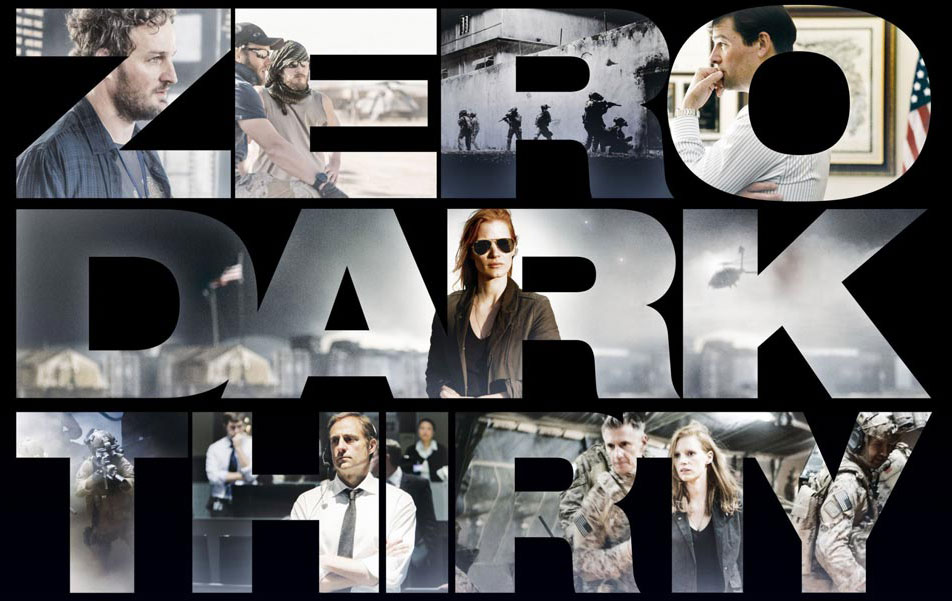
Following the twelve-year hunt for al-Qaeda head, Osama Bin Laden, Zero Dark Thirty focusses in on Maya (Jessica Chastain), a young CIA agent who believes that a courier may hold the key to his location. Aided by an elite team of intelligence operatives, Maya painstakingly narrows in on Bin Laden's location, devoting her entire career to this one objective. Despite attacks being made on her life and those around her, Maya's determination persists throughout the twelve years, eventually leading to a raid on what is believed to be Bin Laden's hiding place.

Opening with audio from 9/11, Zero Dark Thirty states its intent right from the start; this isn't going to be a comfortable watch. It is in fact, a surprisingly exhausting film that, despite its nearly 3 hour run time, never really lets you have a moment to breathe and take it all in. Whilst the compound raid is one of the most tense sequences I've seen for a long time, the rest of the film is a constantly mounting crescendo to that point. It's a testament to Kathryn Bigelow and screenwriter Mark Boal that they have managed to craft such a compelling and thrilling account of over a decade long of surveillance where the audience already knows the outcome. This isn't the espionage world of Fleming, but more that of Le Carre, where most of the time is spent at desks, pouring over footage or phone records than actually running around chasing the bad guys down the street. In this film, the bad guy is never seen until his death; he's spectral, haunting the moves of each character, particularly that of Chastain's Maya who devotes her entire career to his capture. 

Chastain's performance is the film's strongest element, subtle and understated but also extremely powerful. Maya's arc from a CIA rookie who flinches during torture to a woman who barely emotes when someone attempts to kill her is well-measured and authentic. Despite not being an overly emotional performance, Chastain provides a figure with which we cannot empathise with, but align ourselves to. It's also incredibly refreshing to see a female character in a film who isn't immediately given a love interest or a tragic back story to give her a motive for being so strong-willed and driven. She exists as a single character in her own right, rather than as a result of a relationship with another character. Of course, it does help that she is based on a real CIA agent, but Bigelow's dramatic license could have seen her given a personal tragedy to make her pursue this course. Thankfully, Maya is defined purely by her actions within the film; she's a CIA agent just trying to do her job and the film is all the better for it.


Chastain is well-supported by the other cast members too, each with varying levels of screen time. None are given any form of back story beyond the realm of the film, but each character feels fully rounded and essential to the unfolding narrative. As Maya's colleagues, Jason Clarke's Dan and Jennifer Ehle's Jessica create the most lasting impressions, representing both the agents' inhumanity and their compassion; Dan tortures his detainees for leads whilst Jessica bakes a cake for a potential source. Mark Strong's battle-weary George also stands out and his scene with Stephen Dillane was noticeable for its sheer desperation and even with their smaller roles, both Joel Edgerton and Chris Pratt make their mark on the third act of the film. The strength here is that Bigelow takes what is a highly political topic with global ramifications and transforms it into something smaller, more intimate; it's a film about the people who brought about these events and the sacrifices they make to do so, rather than the events themselves.

Zero Dark Thirty has also come in for its fair share of criticism regarding the film's depiction of torture as the way in which this trail to Bin Laden was started. However, as Bigelow stated herself, 'depiction is not endorsement' and in no way does it ever feel as if tortured detainees are the reason behind Bin Laden's death. The film makes the point in different ways that intel gathered under duress was not wholly reliable, nearly putting an end to Maya's courier theory at one point and failing to prevent attacks in others. The torture scenes (a small part of the film, despite what the media furore would have you believe) themselves are graphic and deeply unsettling and the audience is placed in a highly uncomfortable position throughout, but at no point does it feel as if the film-makers are supporting the detainee programme. In fact, the film remains curiously apolitical on this subject; it is presented as a fact without emotion, without an argument either way. When Obama declares that the detainee programme is to end, it does and no comment is made on the subject other than that the CIA must now adapt its methods. It's left to the audience to decide whether this was the right course of action or not. 

Admittedly, I was quite surprised by the distance that was placed between the film-makers and the subject of the film as I had gone in expecting it to be a pro-American retelling of the death of the man who was behind one of the greatest tragedies in history. The apolitical stance taken on the torture scenes continues throughout the film however, again forcing the audience to judge the ethics of what is taking place. This was especially present during the raid on the Abbottabad compound itself. Rather than presenting a SEAL team who knew exactly what they were doing, the level of uncertainty in the group is palpable, from the briefing to the raid itself. Bigelow doesn't shy away from showing the more controversial aspects of the raid, with women and children present in the compound. It's the most impressive sequence in the film and, despite knowing the outcome, you wait with baited breath as SEAL Team 6 make their move.

Technically speaking, Zero Dark Thirty is meticulously crafted with an attention to detail that creates a greater feeling of authenticity and adds to the documentarian style of the film. In particular, the production design deserves a special mention with its accurate reproduction of the compound at Abbottabad; without this, the raid sequence would not have been so effective and, combined with the use of night vision, the final act of the film was completely immersive. Elsewhere throughout, the excellent score was also essential in the build-up of tension; never intrusive yet always mildly unsettling. Quite why it didn't receive an Oscar nomination is frankly beyond me. 

Bigelow's direction works well to combine all of these elements to create a film that is not what I would describe as likeable or entertaining, but challenging, fascinating and a thoroughly deserving topic of discussion. There's a lot left to say about Zero Dark Thirty because it is a film that does not provide you with any of the moral or political answers you might expect it to; instead, it simply tells you a story. Where you stand on the events of that story, or how you feel about it, is left entirely with you to decide.

*****

- Becky

Follow Becky on Twitter @beckygracelea
Or on her blog beckygracelea.wordpress.com

FILM REVIEW: Django Unchained


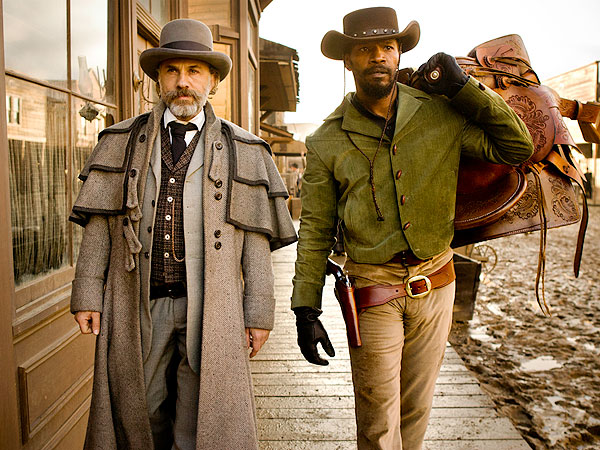
After altering the history of World War II in Inglourious Basterds, Quentin Tarantino has turned his unique attentions to nineteenth century America and the slave trade. Django Unchained follows the story of titular slave Django (Jamie Foxx), freed by Dr King Schultz (Christoph Waltz), a bounty hunter seeking Django's help in catching a quarry. The pair then team up and work towards rescuing Django's wife, Broomhilda (Kerry Washington) from extravagant plantation owner Calvin Candie (Leonardo DiCaprio) at his home, Candieland.

The structure of the film is set up early in an exchange between Django and Schultz in which the German bounty hunter reveals the story of Broomhilda's namesake, a princess in German legend who is  imprisoned atop a mountain and guarded by both hellfire and a dragon before being rescued by the hero Siegfried. From this point on, we're treated to a Spaghetti Western (or Southern as Tarantino prefers) rewriting of this fairytale and as such, gives us probably the most structurally conventional Tarantino we've ever had. There are the odd illustrative flashbacks, but for the most part, the narrative plays out in a linear fashion. Tarantino's love of the spaghetti genre is present in every single frame, from the fast zooms into characters' faces or the brief appearances of stock characters like the Sheriff or the U.S. Marshall, though they are re-worked into the wider fairytale narrative rather than simply hitting the usual beats of the genre. 

One of the film's best aspects is its excellent cast; from the brief cameos to the starring roles, each actor performs their roles with relish. DiCaprio in particular looks like he's having a whale of time as Candie, a man who is both a gentleman and a brutal killer. Likewise Waltz has a flair for performing Tarantino's dialogue and was given some wonderful speeches while Foxx gives a strong, mostly silent performance that imbues Django with a dangerous physicality. It is Samuel L. Jackson though whose performance as Stephen, Calvin's right-hand man, that lingers long in the memory afterwards. He's given the most complex character, a slave who believes in slavery and who cannot comprehend Django's freedom or attitude. 


The film has also been subject to plenty of controversy for its depiction of a highly sensitive issue, but whilst it wasn't necessarily sensitively handled (this is Tarantino after all), at no point did it feel as if the violence against the slaves was glorified or glossed over. Violence in the film was often cartoon-like, explosions of blood bursting all over the place after someone is shot, but this is predominantly utilised for the white characters' deaths, not the slaves. In fact, any violence against the slave characters made for extremely uncomfortable viewing, particularly the 'mandingo' fight that takes place in Candie's first scene. Tarantino naturally doesn't shy away from depicting the brutality of the fight, but he is clearly focussing in on it, not to glorify or gloss over, but to make you uneasy.

There are some truly brilliant moments in here, particularly in the first third of the film which was uniformly excellent. In particular, the Ku Klux Klan raid against Django and Schultz was a masterpiece of comic structuring with the drama of the raid itself providing a starkly dramatic contrast to the hilarity of the gang beforehand, debating the practicality of their masks. It's a Blazing Saddles-level of humour, taking a group as horrific and evil as the KKK and reducing them to a laughing stock in just a few lines. It was by far my favourite moment of the film, but unfortunately, the rest didn't quite match up.

Part of the problem was that the film was just too long, and many of the scenes within it needed trimming down (which makes you realise just how good Tarantino's partnership with Sally Menke was). Once the characters set off for Candlieland, the film slowed to a snail's pace and only recovered in brief moments towards the end. The dinner scene in Candieland was a classic example, building up to a tension akin to that of the tavern scene in Inglourious Basterds. The plot also took an illogical turn, with an over elaborate scheme for getting Broomhilda back and an extra half an hour of narrative that simply didn't need to be there. As a result, the film is uneven, flashes of brilliance tempered with scenes that are simply too long and too overwrought.

However, there is one element of the film that is consistently excellent throughout and that is the soundtrack. Tarantino has always been famous for selecting brilliant musical accompaniments for his films and here is no different. Once again, the anachronistic songs work well, giving Django in particular a timeless quality, fitting in well with the timeless quality that the fairytale structure provides, despite the specific mid-nineteenth century setting. Ennio Morricone's contributions also ensures that it is set firmly within the spaghetti western tradition by providing an aural link that everyone associates with this particular genre. It's a brilliant soundtrack and is likely to be considered one of the director's best.

It's just a shame that Django Unchained in its entirety is a wildly uneven film, hampered by a final half that operates on a slow pace, yet featuring some fantastic moments and brilliant performances. It had the potential to be great, but unfortunately, never quite hits a consistent high and also features probably the worst Quentin Tarantino cameo yet.

***

- Becky

Follow Becky on Twitter @beckygracelea
Or find her on her blog beckygracelea.wordpress.com 


Saturday, 19 January 2013

TV REVIEW: Ripper Street - The King Came Calling


Despite beginning to wonder if the world at large is actually even aware of the BBC’s Ripper Street, it being not so much under the radar as not even in range, we at Assorted Buffery are soldiering on with it. My esteemed co-writer has been less than thrilled with it so far, see here. I, on the other hand, rather liked Episode 1 'I Need Light' , Particularly enjoying the subtle historical references, which were tastefully alluded to without being shoved down your throat.

So what did Episode Three, ‘The King Came Calling’ have to offer?

Well the ‘King’ of the title is not anyone of any regal descent, for starters, and actually refers to the contemporary nickname of cholera, widely referred to as ‘King Cholera’. Historical reference number one. Fearing the spread of the disease once again in Whitechapel, (they do seem to have it tough down there, between the Ripper and fatal digestive diseases, it’s a wonder no one moves…) Reid and his team pull ‘victims’ into the police station, so that the cocky Captain Jackson can determine what they really died off. Thus dispelling local panic and saving the day. However, hounded by the new age press, historical reference number two, what they actually discover is much, much worse than the King, as the boys discover that a serial killer is in fact on the loose once again. Slipping St Anthony’s Fire, a type of ergotism poisoning into the local flour supplies, historical reference number three, this shady character is not only causing a spot of general alarm and chaos but systematically wiping out the sexual deviants of East London. Historical reference number – okay I think they may have gone off on one a bit there.

Slightly iffy history aside, this episode made for a good old fashioned romp of a whodunit. Captain Jackson’s reckless approach to autopsy, and cavalier attitude to almost everything else is happily chuckle inducing, with MacFadyen’s Inspector Reid palpably earnest, in contrast all but choking on his own hard working nature. Although how he is supposed to have known about exact nature of the poison, being a policeman not a medic I'll never know.

Less of a role for Jerome Flynn’s Sergeant Drake this week, as we are instead fed the mildly irritating do-good side story of Reid’s wife Emily on her attempts to find homes for local down and outs. Mainly prostitutes. Sort of a historical reference, so Buffery points for that, but this storyline felt suspiciously shoe horned in, only really present to make us feel sorry for Emily when she later becomes poisoned, coming into contact with a disease meant for the very people she’s trying to help. The desire to manipulate the audience being a little too obvious, dear old Emily had plot device swathed about her person even more so than usual. 


Whilst the production values remained fairly high, a few dodgy edits and cut short scenes aside, this episode largely, and sadly, felt a lot less cool than the previous two. I enjoyed it, sure, the intrigue was built up well, and there was just the right amount of suspense for a Sunday night police – sorry historical police drama. But when you consider that the first episode was all about pornography and prostitution, and the second a knife wielding, Victorian child gang – poisoning peoples’ bread and cakes just doesn’t really cut it as a concept. If you’ll excuse the many-layered pun. Lord alone knows what Jack the Ripper would have made of it, anyway.

Ripper Street is still worth a watch, but it needs to up its game a little. I loved that the first episode was shocking, cocoa-spill inducing even, but 'The King Came Calling' caused barely a ripple.

More please, but better.


The next episode of Ripper Street will be shown tomorrow night, 9pm.


-          Jen


You can read more of Jen's writing here: https://memyselfandtheothers.wordpress.com/

Or you can follow her on twitter here: https://twitter.com/jenniferklarge
Tuesday, 15 January 2013

FILM REVIEW: Les Miserables


With several household names, a smattering of West End talent, a visionary director as well as a-never-done-before live song filming process, Tom Hooper’s Les Miserables would already have earned the hysterical excitement surrounding it, not to mention the countless award nominations trailing in its wake on those credentials alone. Throw in the fact that it’s based on one of, if not the most successful musicals of all time, and it’s almost too much to bear.

Staying relatively true to the stage story, as well as throwing in the odd extra titbit from Victor Hugo’s doorstop of a novel, Les Miserables follows Jean Valjean (Hugh Jackman) a freed convict who breaks parole hoping to become a ‘better man’. With his formidable arch nemesis Inspector Javert (Russell Crowe) perpetually snapping at his heels, Valjean adopts the orphaned Cosette (Amanda Seyfried), the daughter of a desperate prostitute who once worked in his factory (Anne Hathaway). Meanwhile, a group of students plot rebellion and revolution against the French bourgeoisie, fed up of living like slaves whilst the ‘fat ones’ reign supreme. One of these students is Marius, (Eddie Redmayne). Well-intentioned but essentially naïve, Marius is, in the knowledgeable words of Michael Ball, ‘a bit of a drip’. Nonetheless, the sparky Eponine, (Samantha Barks) daughter of the conniving Madam and Monsieur Thenardier (Helena Bonham Carter & Sacha Baron Cohen), the former guardians of the young Cosette, is head over heels in love with him. To poor ‘Ponine’s dismay, Marius and Cosette fall in love with each other, with Valjean’s love for his adoptive daughter taking him right into the midst of the uprising in order to protect the object of her desire, putting his own life on the line along with the plucky students.

With so much character development going on within the context of such massively emotive ideas, Les Miserables has always been an epic story. Showing Cameron Mackintosh’s production on the big screen for the first time, however, allows a sense of scale like never before. The opening scene, as the camera sweeps into the harbour where the starving convicts pull in the ships, is breath taking, as is the cliff top on which Valjean rips up his papers and begins his life anew. Hooper’s relentless close ups on his actors also make it a far more intense journey than before, with the live singing only adding to the feeling of immediacy. There is no escape, with every bead of sweat, every fleck of spittle and every eyelid twitch on the downtrodden character’s faces blown up in front of us.


Few actors could live up to such scrutiny, and Hugh Jackman in particular truly delivers. Emphasising the emotion in his words by speaking, or even whispering choice parts of his songs, the words ‘Oscar nomination’ would be circling the air life flies around his prison-shaven head even if it hadn’t already been announced. Anne Hathaway gives the performance of her career so far as the desperate Fantine, as does Eddie Redmayne, who gives a searingly real rendition of the beautiful 'Empty Chairs at Empty Tables'- don’t forget your tissues. Russell Crowe has been dividing opinion, and will most likely continue to do so. In terms of acting ability, he has the perfect level or presence and authority for Javert but, sadly, without the singing voice to back it up. A little touch he himself decided to add to the character not long before Javert’s suicide is heart-warming, however, and perfectly demonstrates the subtle beginnings of the character’s eventual break down.  Baron Cohen and Bonham Carter have a lot of fun with the Thenardiers, showing them more as a unit than has been done before, with Amanda Seyfried and Daniel Huttlestone looking the part as Cosette and Gavroche.

It is with Sam Barks and with the students, however, that the talent of the stage show comes alive, tying together a rendition of the ever rousing ‘One Day More’ that it is difficult not to applaud. Aaron Tveit is fabulous as their passionate leader Enjolras, with many of those following him played by actors from the stage show over the years.  Their deaths feel every bit as important and poignant as they do in the Queen’s Theatre, but, seeing their eyes as they die in the way that we do, it is no surprise that it feels even more heart wrenching. The reprise of 'Do You Hear The People Sing?', more tragic than triumphant here, deals the final blow to what is an exhilaratingly exhausting emotional experience.


Les Miserables, far from taking anything away from the phenomenon that is the stage production, manages to add the stories behind the songs with a level of detail you simply cannot get from the back of the Upper Circle in the theatre. They could never exist without each other, but I think each will continue to enrich the experience of the other in years to come.

Do you hear the people sing? I bet you a french flag and half a corset that you will, even if you’ve never been a part of Les Mis before. As a long time fanatic, I haven’t been able to get them out of my head for days.


Not that I've tried.

**** (and a half)

-         - Jen

You can read more of Jen's writing here: https://memyselfandtheothers.wordpress.com/

Or you can follow her on twitter here: https://twitter.com/jenniferklarge

Wednesday, 9 January 2013

FEATURE: Why You Should All Be Listening to Cabin Pressure

Here at Assorted Buffery, we're fairly big fans of certain rising star Benedict Cumberbatch, just in case you hadn't noticed. I've thought he was one to watch as far back as his starring role as Stephen Hawking and in the excellent but criminally under-seen Stuart: A Life Backwards (also starring Tom Hardy - do look it up if you get chance, both actors are truly brilliant). One thing that I've always done when I've liked an actor is to seek out other works of theirs and on one such hunt, I discovered Cabin Pressure.

In case you haven't come across it, Cabin Pressure is a BBC Radio 4 sitcom, written by John Finnemore, about an extremely small airline, MJN Air, which consists of one plane, two pilots, an airline manager/stewardess and a rather enthusiastic, though ultimately useless, steward. Captain Martin Crieff (Benedict Cumberbatch), First Officer Douglas Richardson (Roger Allam), Caroline Knapp-Shappey (Stephanie Cole) and her son Arthur (also John Finnemore) take on a wide variety of jobs across the world, but inevitably, things go awry and flights never go quite according to plan.

So why should you track down this particular radio gem? Well quite simply, it's one of the funniest things on radio (or television actually) right now, full of acerbic one-liners, devestating put-downs and intricately weaved plots leading to hilarious punchlines. Finnemore's scripts work in great partnership with the actors, generously granting each one their moment in the spotlight. What also helps is that the characters are well-rounded, adding pathos to their funniest moments. For example, the captain, Martin, is your classic under-achiever and much of his comedy is mined from this fact, but also a fair amount of character development too. He isn't just a stereotype, he's a person down on his luck who just happens to get into hilarious situations.

The performances are also routinely excellent; Roger Allam steals the show with his dry delivery, often getting the best one-liners and his battles with Stephanie Cole's Caroline are always a highlight. Finnemore's Arthur is a character that in the hands of a lesser performer could be extremely irritating, but instead thankfully remains endearing. The cast also have a great chemistry and I can imagine that attending the live recordings are an absolute riot. Should we be fortunate enough to get a fifth series, I'll most definitely be in line for tickets.

The fourth series of Cabin Pressure has just started, with the first episode airing earlier this evening and absence has not harmed the show one bit. There were fears that Benedict Cumberbatch might not return now that Hollywood has come knocking rather violently at his door (quite right too), but he's back in the Captain's hat as Martin. This episode covers a Birling Day, a big event in the Cabin Pressure world in which multi-millionaire Mr Birling pays them an absolute fortune to fly him to the rugby, usually the Six Nations, but here it's the World Cup. However, instead of going to Twickenham, they end up travelling to Timbuktu. Or should that be Timbuktu Timbuktu? 

You can now listen to the episode in full over on iPlayer here. Trust me, it's worth it!

- Becky

Follow Becky on Twitter @beckygracelea. She can also be found tweeting with Jen on the @AssortedBuffery account.

Or follow her blog beckygracelea.wordpress.com