Showing posts with label Leonardo DiCaprio. Show all posts

Wednesday, 29 May 2013

FILM REVIEW: The Great Gatsby


To go into Baz Luhrmann’s The Great Gatsby expecting the definitive adaptation of F Scott Fitzgerald’s iconic American novel, is to set yourself up for a fall, a tumble short of your dreams, to paraphrase a line from the book itself. And that’s not because it is a bad adaptation, per se, but because there simply never will be a definitive Great Gatsby film. It’s far too complex and brilliant a story for that. It’s also, like all novels, open to interpretation, and different people see different things in it.

Gatsby is a story told through the eyes of a young man named Nick Carraway (Tobey Maguire), cousin of the glamorous, beautiful and filthy rich Daisy Buchanan (Carey Mulligan). After visiting her and her husband, Tom (Joel Edgerton) as well as the stylish sportswoman Jordan Baker (Elizabeth Debicki), Nick finds himself invited to one of the legendary parties of his mysterious neighbour, Jay Gatsby (Leonardo DiCaprio). Increasingly fascinated by his wealthy, enigmatic new friend, Nick uncovers, and is drafted in to help rekindle, a lost love affair between Daisy and Gatsby, one which was over before it really had the chance to get started. Whilst Daisy has been married to a wealthy but adulterous husband who dashes off with mechanic’s wife Myrtle Wilson (Isla Fisher) in semi-secret every five minutes, Gatsby has been yearning for her, building up an empire just to impress her, to make her believe he has grown beyond his initially limited means and can now be a worthy suitor for her.  But has he built his hopes on solid ground?

With gorgeous, sensuous cinematography and a level of pacing perfectly matched to the original texts’ novella status, Lurhmann’s adaptation has a beautifully dreamlike feel to it. Despite being so camp and outlandish it remains remarkably true to the novel, giving just the right amount of focus to each subplot, and adding in only the framework of Nick’s visits to a psychiatrist- an addition which actually works rather well. The hip hop soundtrack so many condemned only adds to the trance like state the film instils, and even in the apparently archaic 2D in which I watched it the party scenes were so convincingly dizzying as to make you feel drunk. The novel’s key set pieces are served justice too, resonating long after the camera has moved on. The first meeting of Nick with Daisy and Jordan is particularly well carried off, as is The Valley of Ashes and the image of Gatsby standing on the edge of his pier, reaching out for the green light which means so much both to the plot of the novel and American Literature as a whole. I could go on, but I shall, with some difficulty, restrain myself.

The casting is equally well judged, with Tobey Maguire presenting a convincing portrayal of Nick the unreliable narrator, by definition an infamously difficult character to pin down. Isla Fisher sparkles as Myrtle the temptress.  All brash colours and hammed up accent, she is every bit the contrast to Carey Mulligan’s floaty Daisy. Mulligan’s performance is in equal parts striking and understated, as she seems to revel in both the selfish nature of her character as well as feelings of vulnerability and entrapment. We feel everything we’re supposed to feel about Daisy, at the points were supposed to feel it in her portrayal’s capable hands. Joel Edgerton gives a surprisingly captivating performance as the unsympathetic Tom, capturing both the insecurities of the character as well as his all-consuming arrogance.  Elizabeth Debicki is also suitably slinky as the tricksy Jordan Baker, looking every inch the jazz kitten and giving off just the right sense of aloof detachment. 


 No consideration of this adaptation, this film and indeed this novel would be complete, however, without a proper look at its principal character, and in fact I’m ashamed I’ve left it until this point in my review. Tragic, hopeful, totally ridiculous and yet seductively mysterious, Jay Gatsby is the glue holding it all together. Fortunate, then, that DiCaprio is made of such strong stuff- because he really is outstanding. He brings a softness to the role missing from Robert Redford’s version, capturing the humour in some of his character’s actions, as well as heightening the tragedy- no mean feat.  He brings Gatsby’s “extraordinary gift for hope” right up to the surface, and is incredibly likeable whilst he’s at it. He also looks 100% the part. In fact, when he utters the immortal words “I’m Jay Gatsby”, we cannot help but answer “yes, you are”.  

With the exception of its rushed and inaccurate treatment of a certain scene I won’t mention for spoiler reasons , this beautiful, sensuous film really hammers home the tragedy of Gatsby’s story, and introduces a whole new level of understanding, via his story’s effect on Nick. All great adaptations should achieve this in one way or another, and Baz Luhrmann’s achieves it in several. Not only that, but it gives us Leonardo DiCaprio in a role he was most probably always supposed to play.

We may not have found our definitive The Great Gatsby, but, thanks to Luhrmann, we’ve found our definitive James Gatz. 


**** & 1/2

Jen
Follow @AssortedBuffery on Twitter
Or like our Facebook page.

You can read my own blog here or follow me on twitter here


Sunday, 27 January 2013

FILM REVIEW: Django Unchained


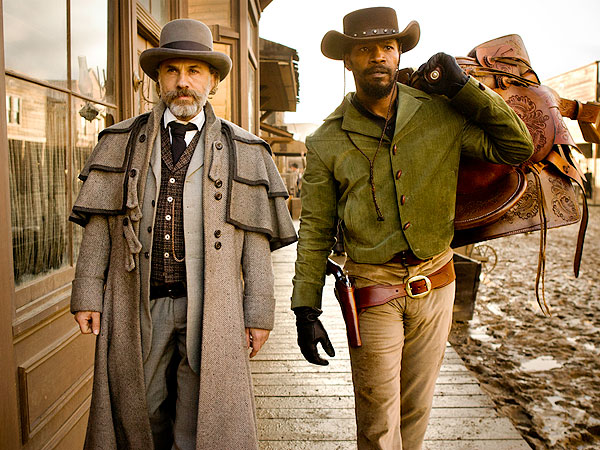
After altering the history of World War II in Inglourious Basterds, Quentin Tarantino has turned his unique attentions to nineteenth century America and the slave trade. Django Unchained follows the story of titular slave Django (Jamie Foxx), freed by Dr King Schultz (Christoph Waltz), a bounty hunter seeking Django's help in catching a quarry. The pair then team up and work towards rescuing Django's wife, Broomhilda (Kerry Washington) from extravagant plantation owner Calvin Candie (Leonardo DiCaprio) at his home, Candieland.

The structure of the film is set up early in an exchange between Django and Schultz in which the German bounty hunter reveals the story of Broomhilda's namesake, a princess in German legend who is  imprisoned atop a mountain and guarded by both hellfire and a dragon before being rescued by the hero Siegfried. From this point on, we're treated to a Spaghetti Western (or Southern as Tarantino prefers) rewriting of this fairytale and as such, gives us probably the most structurally conventional Tarantino we've ever had. There are the odd illustrative flashbacks, but for the most part, the narrative plays out in a linear fashion. Tarantino's love of the spaghetti genre is present in every single frame, from the fast zooms into characters' faces or the brief appearances of stock characters like the Sheriff or the U.S. Marshall, though they are re-worked into the wider fairytale narrative rather than simply hitting the usual beats of the genre. 

One of the film's best aspects is its excellent cast; from the brief cameos to the starring roles, each actor performs their roles with relish. DiCaprio in particular looks like he's having a whale of time as Candie, a man who is both a gentleman and a brutal killer. Likewise Waltz has a flair for performing Tarantino's dialogue and was given some wonderful speeches while Foxx gives a strong, mostly silent performance that imbues Django with a dangerous physicality. It is Samuel L. Jackson though whose performance as Stephen, Calvin's right-hand man, that lingers long in the memory afterwards. He's given the most complex character, a slave who believes in slavery and who cannot comprehend Django's freedom or attitude. 


The film has also been subject to plenty of controversy for its depiction of a highly sensitive issue, but whilst it wasn't necessarily sensitively handled (this is Tarantino after all), at no point did it feel as if the violence against the slaves was glorified or glossed over. Violence in the film was often cartoon-like, explosions of blood bursting all over the place after someone is shot, but this is predominantly utilised for the white characters' deaths, not the slaves. In fact, any violence against the slave characters made for extremely uncomfortable viewing, particularly the 'mandingo' fight that takes place in Candie's first scene. Tarantino naturally doesn't shy away from depicting the brutality of the fight, but he is clearly focussing in on it, not to glorify or gloss over, but to make you uneasy.

There are some truly brilliant moments in here, particularly in the first third of the film which was uniformly excellent. In particular, the Ku Klux Klan raid against Django and Schultz was a masterpiece of comic structuring with the drama of the raid itself providing a starkly dramatic contrast to the hilarity of the gang beforehand, debating the practicality of their masks. It's a Blazing Saddles-level of humour, taking a group as horrific and evil as the KKK and reducing them to a laughing stock in just a few lines. It was by far my favourite moment of the film, but unfortunately, the rest didn't quite match up.

Part of the problem was that the film was just too long, and many of the scenes within it needed trimming down (which makes you realise just how good Tarantino's partnership with Sally Menke was). Once the characters set off for Candlieland, the film slowed to a snail's pace and only recovered in brief moments towards the end. The dinner scene in Candieland was a classic example, building up to a tension akin to that of the tavern scene in Inglourious Basterds. The plot also took an illogical turn, with an over elaborate scheme for getting Broomhilda back and an extra half an hour of narrative that simply didn't need to be there. As a result, the film is uneven, flashes of brilliance tempered with scenes that are simply too long and too overwrought.

However, there is one element of the film that is consistently excellent throughout and that is the soundtrack. Tarantino has always been famous for selecting brilliant musical accompaniments for his films and here is no different. Once again, the anachronistic songs work well, giving Django in particular a timeless quality, fitting in well with the timeless quality that the fairytale structure provides, despite the specific mid-nineteenth century setting. Ennio Morricone's contributions also ensures that it is set firmly within the spaghetti western tradition by providing an aural link that everyone associates with this particular genre. It's a brilliant soundtrack and is likely to be considered one of the director's best.

It's just a shame that Django Unchained in its entirety is a wildly uneven film, hampered by a final half that operates on a slow pace, yet featuring some fantastic moments and brilliant performances. It had the potential to be great, but unfortunately, never quite hits a consistent high and also features probably the worst Quentin Tarantino cameo yet.

***

- Becky

Follow Becky on Twitter @beckygracelea
Or find her on her blog beckygracelea.wordpress.com