Showing posts with label Don Johnson. Show all posts

Friday, 27 June 2014

FILM REVIEW: Cold in July


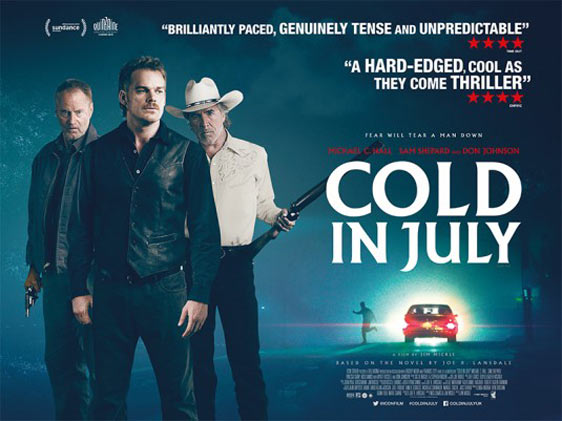
After shooting a man attempting to rob his house, Richard Dane (Michael C. Hall) finds himself at odds with the man's father, Ben (Sam Shepard), newly released from prison. Based on Joe R. Lonsdale's novel of the same name, Cold in July is a gloriously twisting affair, captured here by Joe Mickle in a haze of Texas sunshine and thunderstorms.

To try and define the film in narrower generic terms than a 'thriller' feels as if I'm doing the film a disservice. It both feels conventional and yet utterly unique at the same time. Thanks in large part to a narrative which defies prediction, the film is an amalgam of various different elements in references that come together to form a nicely satisfying whole.

There are a fair few references to be found within Cold in July the most obvious of which are the kind of sweaty 80s thrillers Patrick Swayze tended to star in. The clearest and most consistent homage is the John Carpenter-esque score that underpins the action. Switching from pulsating bass lines to soft, tinkling piano throughout, Jeff Grace's score never quite lets you settle. There's a sense of urgency even in the quieter moments that keeps everything just the wrong side of comfortable.

As the plot continues to defy expectations, that discomfort remains as the events get ever darker. Despite expanding in such unpredictable ways, the narrative develops in a wholly organic fashion. An accidental discovery here leads to another revelation further along the way. It also doesn't forget about the characters along the way; each moment impacts upon their developing arcs and affects their future decisions. It's simple stuff really, but it is incredibly refreshing to view a film that is entirely aware that an increasingly dark set of circumstances will see its characters react in very different ways.

The performances are particularly excellent with Hall's portrayal of Richard performing a fine balancing act between a guilty wreck in ill-fitting checked shirts and a man determined to correct a mistake. Sam Shepard, as the vengeful father Ben, cuts an imposing figure, but one that is imbued with increasing depths as the film goes on. However, it is Don Johnson in a supporting role who livens up the screen, a man of twisted morality who somehow becomes the compass for the other characters; he doesn't necessarily point them in the legal direction, rather the direction that will bring them some form of emotional closure.

As keen as the film is to explore various facets of masculinity, which it does admirably, it does mean that some of the other roles feel a little underwritten. Vinessa Shaw's Ann, Richard's wife, suffers in this respect and it is often unclear what effect she is supposed to be having on Richard's life. In some scenes, she performs an antagonistic function whilst in others, she lapses into a supportive wife. Shaw's performance is solid, but it feels like there are gaps missing with her character and she pretty much gets forgotten about as the film progresses.

That niggle aside, Cold in July is a fascinatingly twisting affair, never content to offer the audience a rhythm to settle into or a pattern to predict. If you haven't read the Joe R. Lansdale book on which it is based, I'd advise avoiding any prior knowledge and just let it unfold before you in all its uncomfortable glory.

- Becky

Follow @AssortedBuffery on Twitter
Or like our Facebook page


Sunday, 27 January 2013

FILM REVIEW: Django Unchained


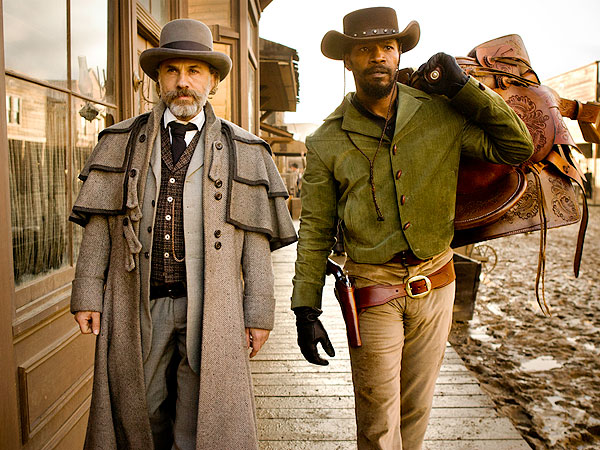
After altering the history of World War II in Inglourious Basterds, Quentin Tarantino has turned his unique attentions to nineteenth century America and the slave trade. Django Unchained follows the story of titular slave Django (Jamie Foxx), freed by Dr King Schultz (Christoph Waltz), a bounty hunter seeking Django's help in catching a quarry. The pair then team up and work towards rescuing Django's wife, Broomhilda (Kerry Washington) from extravagant plantation owner Calvin Candie (Leonardo DiCaprio) at his home, Candieland.

The structure of the film is set up early in an exchange between Django and Schultz in which the German bounty hunter reveals the story of Broomhilda's namesake, a princess in German legend who is  imprisoned atop a mountain and guarded by both hellfire and a dragon before being rescued by the hero Siegfried. From this point on, we're treated to a Spaghetti Western (or Southern as Tarantino prefers) rewriting of this fairytale and as such, gives us probably the most structurally conventional Tarantino we've ever had. There are the odd illustrative flashbacks, but for the most part, the narrative plays out in a linear fashion. Tarantino's love of the spaghetti genre is present in every single frame, from the fast zooms into characters' faces or the brief appearances of stock characters like the Sheriff or the U.S. Marshall, though they are re-worked into the wider fairytale narrative rather than simply hitting the usual beats of the genre. 

One of the film's best aspects is its excellent cast; from the brief cameos to the starring roles, each actor performs their roles with relish. DiCaprio in particular looks like he's having a whale of time as Candie, a man who is both a gentleman and a brutal killer. Likewise Waltz has a flair for performing Tarantino's dialogue and was given some wonderful speeches while Foxx gives a strong, mostly silent performance that imbues Django with a dangerous physicality. It is Samuel L. Jackson though whose performance as Stephen, Calvin's right-hand man, that lingers long in the memory afterwards. He's given the most complex character, a slave who believes in slavery and who cannot comprehend Django's freedom or attitude. 


The film has also been subject to plenty of controversy for its depiction of a highly sensitive issue, but whilst it wasn't necessarily sensitively handled (this is Tarantino after all), at no point did it feel as if the violence against the slaves was glorified or glossed over. Violence in the film was often cartoon-like, explosions of blood bursting all over the place after someone is shot, but this is predominantly utilised for the white characters' deaths, not the slaves. In fact, any violence against the slave characters made for extremely uncomfortable viewing, particularly the 'mandingo' fight that takes place in Candie's first scene. Tarantino naturally doesn't shy away from depicting the brutality of the fight, but he is clearly focussing in on it, not to glorify or gloss over, but to make you uneasy.

There are some truly brilliant moments in here, particularly in the first third of the film which was uniformly excellent. In particular, the Ku Klux Klan raid against Django and Schultz was a masterpiece of comic structuring with the drama of the raid itself providing a starkly dramatic contrast to the hilarity of the gang beforehand, debating the practicality of their masks. It's a Blazing Saddles-level of humour, taking a group as horrific and evil as the KKK and reducing them to a laughing stock in just a few lines. It was by far my favourite moment of the film, but unfortunately, the rest didn't quite match up.

Part of the problem was that the film was just too long, and many of the scenes within it needed trimming down (which makes you realise just how good Tarantino's partnership with Sally Menke was). Once the characters set off for Candlieland, the film slowed to a snail's pace and only recovered in brief moments towards the end. The dinner scene in Candieland was a classic example, building up to a tension akin to that of the tavern scene in Inglourious Basterds. The plot also took an illogical turn, with an over elaborate scheme for getting Broomhilda back and an extra half an hour of narrative that simply didn't need to be there. As a result, the film is uneven, flashes of brilliance tempered with scenes that are simply too long and too overwrought.

However, there is one element of the film that is consistently excellent throughout and that is the soundtrack. Tarantino has always been famous for selecting brilliant musical accompaniments for his films and here is no different. Once again, the anachronistic songs work well, giving Django in particular a timeless quality, fitting in well with the timeless quality that the fairytale structure provides, despite the specific mid-nineteenth century setting. Ennio Morricone's contributions also ensures that it is set firmly within the spaghetti western tradition by providing an aural link that everyone associates with this particular genre. It's a brilliant soundtrack and is likely to be considered one of the director's best.

It's just a shame that Django Unchained in its entirety is a wildly uneven film, hampered by a final half that operates on a slow pace, yet featuring some fantastic moments and brilliant performances. It had the potential to be great, but unfortunately, never quite hits a consistent high and also features probably the worst Quentin Tarantino cameo yet.

***

- Becky

Follow Becky on Twitter @beckygracelea
Or find her on her blog beckygracelea.wordpress.com