Sunday, 30 March 2014

FILM REVIEW: Captain America: The Winter Soldier

Phase Two of Marvel's Cinematic Universe has been progressing well since The Avengers/Avengers Assemble (delete according to country) took the box office and the audience by storm. With Iron Man 3 and Thor: The Dark World now safely successful and out the way, it is the turn of the first avenger himself, Captain America, to take the spotlight.


The Winter Soldier finds Steve Rogers (Chris Evans) still struggling to adjust to life in the 21st century when morals are murky and bad guys even more so. When an attack is launched on Nick Fury (Samuel L. Jackson) and SHIELD from within, Steve goes on the run with Black Widow (Scarlett Johansson) in tow to track down who is behind it. They face a considerable foe, however, pursued at all times by a mysterious masked assassin known only as the Winter Soldier (to reveal who is playing him constitutes a spoiler, but I will say that they are very good).

Directors Joe and Anthony Russo take over from Joe Johnston on this solo outing, having cut their teeth on the action-packed episodes of Community and with them comes a new shift in direction. It has been long mooted that after the rollicking adventure tone of The First Avenger, The Winter Soldier would be much more in the political thriller vein and though the politics is lacking, the thrills are plenty and frequent. The action sequences are inventively staged, featuring some of the most impressive scenes of the Marvel universe so far. A hostage rescue mission set piece to open the film throws you into the action immediately and the stakes steadily build throughout the film. The hand-to-hand combat in particular is brutal, bringing with it shades of Jason Bourne (there is even an explicit nod to that franchise in one shot), and any scene in which Captain America faces off with the titular Winter Soldier is suitably intense.

As with the Bourne references, there are plenty of other influences to spot throughout the film. The vehicle chases call Ronin to mind whilst a daylight exchange of bullets has Michael Mann's Heat stamped all over it. This is both to the film's success and its detriment. On the positive side, it offers plenty of homages to spot for the discerning film/TV geek and comes across as a genuine love of the genre on the part of the Russos. Whilst reproducing the tense, shifty atmosphere of films such as The Fugitive and Three Days of the Condor ensures that the audience is swept up into the conspiracy aspect, it also ensures that any film fan versed in the language of the thriller can see the plot coming a mile off. Twists aren't so much hinted at as signposted and, though there were a couple of surprises along the way, it was largely predictable.

However, the real strength of the film is in the performances and character work, ensuring that those twists are still keenly felt when they occur. Chris Evans delivers a wonderfully measured performance, capturing Rogers' charm but also his turmoil of dealing with a world that bears no resemblance to the one he saved back in the 1940s. He is aided well by Scarlett Johansson, given much more of a character arc this time around and managing it brilliantly; Natascha Romanoff has long been one of the most fascinating and enigmatic characters in the MCU and Johansson starts to peel back the layers well whilst still maintaining an opaqueness to the character. Kevin Feige may argue that after this, a Black Widow film isn't needed, but I can't think of a better reason than Johansson's performance here. She needs her own adventure.

In the more minor roles, Anthony Mackie brings some welcome comic relief and enough of a back story to ensure that once the bullets start flying, you care as much about what is happening to him as you do the main characters. Robert Redford brings a certain amount of class, along with Jenny Agutter who gets a fantastic moment all to herself. Although I won't mention the actor explicitly in case you've managed to avoid the identity of the Winter Soldier, they do a wonderful job of conveying the character with little more than facial expressions, often half-obscured by a mask. Indeed, even if you are aware of who the Winter Soldier is, it adds another layer of tension to the proceedings as you wait to see when the discovery will be made by the other characters.

This emphasis on character work ensures that The Winter Soldier is perhaps the most emotional film of the Marvel universe to date. Each character feels vulnerable and exposed, the stakes feel high and there are moments when you genuinely aren't sure whether a character is going to make it out alive (even with foreknowledge of actors' multi-picture contracts). Outside of the action sequences, there are plenty of quieter moments that carry an emotional heft, particularly those in which Rogers is dealing with the loss of the life he should have had or Romanoff dealing with the consequences of hers. The relationship between them is built well and the obvious chemistry between Evans and Johansson helps, exchanging quips with ease and hitting the more emotional beats of their scenes.

Personally speaking, this is easily the best of Marvel's solo outings, managing the balance between character development and action brilliantly, much like Iron Man 3 before it. It certainly whets the appetite going ahead for the rest of Phase Two with the insane-looking Guardians of the Galaxy and The Avengers: Age of Ultron. There are also interesting ramifications for the wider Marvel universe and it bodes well for the future.

****

- Becky

Follow @AssortedBuffery on Twitter
Or like our Facebook page

Thursday, 27 March 2014

FEATURE: Buffy the Vampire Slayer - Killed by Death

Previously on Buffy the Vampire Slayer: Angel's gone all evil after sleeping with Buffy and has stepped up the psychological torture, killing Jenny who is the only person who could have restored his soul. Said ritual is now on a floppy disc (remember those?!) down the side of her desk. 

Buffy is struck down with a severe bout of flu which seriously impacts on her slayage. In a confrontation with Angel, she is nearly killed and collapses at the scene. Whilst in the hospital, she learns that children have been dying mysteriously and a boy named Ryan tells her that Death is coming for the children. In feverish dreams, she sees a grotesque figure stalking the children and comes to the conclusion that there is something malevolent at work in Sunnydale General.

I have a small confession to make. I haven't watched Killed by Death since the first time I saw it when I was eleven years old. It was the only Buffy episode to have ever scared me silly. And when I say silly, I mean 'kept the light on, didn't sleep very well, was determined Der Kindestod was coming to get me type' silly. I never went back to watch it again, even on my other re-watches. You see the sacrifices I'm willing to make for you, dear Reader? 

Watching it back, it isn't quite so scary as I remember, though there is a very definite sense of dread creeping throughout the episode (it helps not being a child anymore and therefore not a key part of Der Kindestod's diet). The prospect of Buffy being off her game and weak is already a bad one; we're so used to her being indestructible that seeing her nearly killed by Angel early on establishes the high stakes of this particular instalment. This is also aided by following on from Passion; we've seen Angel kill someone close to the gang now and it means that he feels even more dangerous as an adversary now. He's predatory too, cropping up at the hospital with flowers only to be warded off by a defiant Xander. On top of all of this, the foe that Buffy needs to fight is largely unseen, appearing in doorways and snickering in the background.

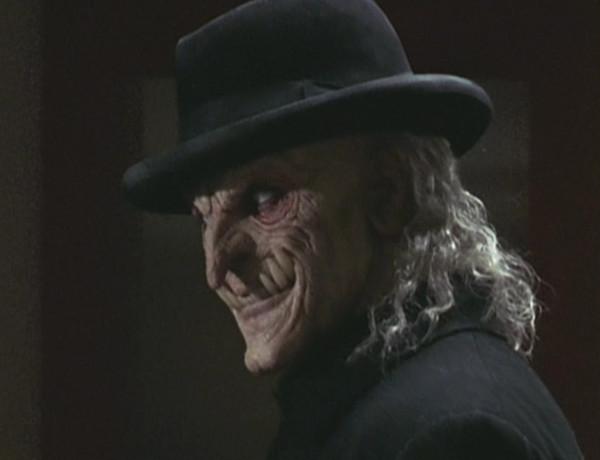
Der Kindestod is a great example of the special effects and design work that goes into making a Buffy villain. There's clear nods ahead to the design of the Gentlemen who appear later in the series; his elegant, long fingers and bowler hat giving him the oddest air of a banker with a bad skin problem and an underbite the Druids could use as a place of worship.* Similarly to the aforementioned Gentleman, there's a fairytale quality to Der Kindestod that adds to his creepiness; like Freddie Kreuger or Goethe's Erlking, he preys and feeds on children, taking them from under the watchful gaze of the adults. That the children must be ill and therefore even weaker makes him a truly despicable villain and surely one of the worst in Buffy's considerable list of adversaries.

The rewatch of Killed by Death also happened to coincide with me reading Stephen King's It, something which is thematically similar to the narrative here. In both stories, it is a monster who preys on children who cannot be seen by adults, forcing the children to take their own action and confront their fears. As King writes, 'The fears of children are simpler and usually more powerful' and this gets to the heart of why both It and Killed by Death are so scary. Children always possess vivid imaginations when it comes to scary things. Pennywise the Clown can easily be dismissed as the project of an over-active fear complex, likewise, because the adults can't see Der Kindestod, they ignore his existence. Cordelia even states outright that Buffy is making it up in order to have something to fight. Children aren't believed when they say there is a scary monster under their bed.

Watching this episode when I was eleven, I wasn't just seeing something for Buffy to fight, I was seeing a demon that was tailored specifically to get me. The fact that he lurks in doorways and has weird creepy eye tentacle things just made it that much worse. I had nightmares about Der Kindestod for a good couple of weeks after the episode aired and as I said before, I never went back to it. I've just finished reading It and I've also been scared stupid by it. There's something powerful in both narratives' ideas of facing your childhood fears and overcoming them. Der Kindestod may have been a small, fleeting one for me (compared with my ongoing battle with porcelain dolls), but even just going back to this episode felt like I'd said goodbye to something that used to scare the crap out of me.

Another link between both this episode and King's novel is the theme of survivor's guilt, faced by both Buffy and Bill Denborough in their respective stories. For Buffy, it's the double whammy of not being able to kill Angel before he killed Jenny and not being able to save her cousin Celia when she was younger. If there's a problem with Killed by Death, then it's here because it just doesn't push that psychology with Buffy enough. We get a few fleeting references as to how Celia died and that it affected Buffy by giving her a lifelong fear of hospitals, but there are very little consequences to this. It should have been entirely about Buffy overcoming this fear, learning that she can't save everyone and saving children in the process. In It, Bill eventually comes to terms with his brother's death over a long, troubled period from childhood to adulthood when he is forced once again to face the thing that killed it. Obviously, the novel has more room to explore this (and at 1400-odd pages, does so very well), but it felt like Buffy dropped the ball a little on the thematics of this episode.

That aside, it's still a chilling episode and one that I don't think gets enough credit in the Buffy fandom. I may be slightly biased as this is the first time I've seen it in thirteen years and I had quite the visceral reaction to it the first time round, but it's more than just a filler episode. It's just a shame that it only hints towards some strong character development, rather than actually following it through.

* Always wanted to link Buffy and Red Dwarf somehow. There'll be another one in Season 6 - props to people who can tell me what and in which episode.

Quote of the Week:
Xander: You don't know how to kill this thing.
Buffy: I thought I might try violence.

Let's Get Trivial: One of the things I loved on seeing this episode again was the reference to DC Comics' Power Girl and Buffy playing her in games with Celia. Our Summers has always been a superhero

You can read Becky's look at Passion here.

- Becky

Follow @AssortedBuffery on Twitter
Or like our Facebook page
Friday, 21 March 2014

FEATURE: Appreciating Tom Lehrer's Musical Genius

"Spring is here, spring is here / Life is skittles, life is beer / I think the loveliest time of year is the Spring / Don't you? 'Course you do"

So begins Tom Lehrer's seasonal classic 'Poisoning Pigeons in the Park'. Yes, you've read that right; it's a romantic ode to a new relationship based on going to an arboreal location and despatching members of an avian species. It's a brilliantly witty and spritely tune, capturing that sudden change of mood everyone experiences when the temperature rises a little, the sun comes out and birdsong fills the air. It just happens to also be about killing off said birds. And maybe a squirrel or two as the speaker suggests enthusiastically towards the end of the song.


The song perfectly sums up the humour and lyricism that define much of Lehrer's work. It's blackly comic and very catchy, accompanied at all times by his expert piano playing. Whilst Lehrer's lyrics are instantly memorable and easily appreciated, it can be easy to forget how musically talented he was too. Often aping musical styles, Lehrer could easily switch between these to suit his particular mood. In one particularly brilliant moment, he deconstructs the song 'My Darling Clementine' and runs the gamut of musical stylings from Mozart to Gilbert and Sullivan (in which he starts to sound a lot like Danny Kaye). It's masterful and still hilarious to boot.

A mathematician first and foremost, Lehrer first started writing songs as an undergraduate to entertain his friends. He also served in the US Army, notably stationed at Los Alamos (the influence of which is clear in the song 'It Makes a Fellow Proud to be a Soldier') and went on to teach political science at MIT. However, it was his songwriting skill that won out, performing in nightclubs in Boston. Famously, the author Isaac Asimov saw him onstage during one of these performances. 

Lehrer found fame through word of mouth as people spoke enthusiastically about his particular brand of satire, particularly thanks to the students on the Harvard campus who bought the first record he put together. My own discovery of Lehrer was thanks to a group of students making a dodgy cassette tape one night, my dad inheriting it post-university and losing it down the back of our cassette cupboard. It was discovered when I was about 10 as the family engaged in one of those slightly ineffectual clean-outs and we put on the tape in a battered old cd-cassette combo. A fair amount of roaring laughter later and a love of the Lehrer was born.

Where once my dad had made slightly dodgy cassette tapes, I followed. An English module in Year 7 was based around the idea of a ballad and we had to track down our own and bring them in to share with the class. Remembering that Lehrer wrote a song entitled 'The Irish Ballad', I played it to the assembled 11 year olds and watched as my teacher got more and more uncomfortable as the song went on. It's about a young Irish woman murdering her family in various comical ways before confessing all to the police because 'lying she knew was a sin'. My friends thought it was brilliant and I passed around some more cassettes to them, spreading that love a little further.

There's an impish sense to Lehrer's music that perfectly appealed to slightly mischievous 11 year olds with little else to rebel with. Although his songs deal with some weighty topics, they do so in a disarmingly innocent fashion. For years, I thought 'I Got It From Agnes' (known as 'I Got It From Sally' in earlier versions) was a nice little ditty about the pervasiveness of the common cold rather than sexually transmitted diseases. The references to incest and bestiality went completely over my head as I sang along; 'She got it from her daddy / Who just gives her everything'. It is a song that rewards on repeated listenings whilst growing up, not least because I wasn't worldly wise enough to realise its actual subject matter, but because the satirical edge becomes more keenly felt when you witness the slightly odd relationship developments of your friendship group (though, as far as I'm aware, neither family members or dogs featured in this).

There's a good chance you too will have come into contact with Lehrer at school, perhaps without even realising it. I've lost track of the amount of people I've played his stuff too who have gone "Oh this is the guy who did 'The Elements Song'!" It seems many a chemistry class was subjected to Lehrer rattling off the Periodic Table to 'Major-General's Song' by Gilbert and Sullivan. In fact, Daniel Radcliffe even performed it once on The Graham Norton Show and delighted this Lehrer fan (and one friend from school who got back in touch to ask if I'd seen it). I have yet to learn beyond 'Therrrrre's Antimony, Arsenic, Aluminium, Selenium...'. 

Lehrer's political satire (check out 'We Will All Go Together When We Go' for a perfect ode to Cold War paranoia and equality for humanity) was what made his name, going on to write for the US version of That Was The Week That Was and appearing here in the UK on The Frost Report. Though he has since finished performing in public, his influence over musical satirists and comedy is quite the legacy.

For me, Tom Lehrer will always bring back the memory of being sat around the kitchen table with my family, listening to the crackly old cassette whirring through ten of his songs. We learnt the words almost instantly and it became the soundtrack for many a car journey. Now that I'm older, I've learnt to appreciate the political bite that bursts forth from a lot of these songs and the witticisms that lay within. Every year, when Spring arrives, it's time to dust off the old Lehrer collection (on CD now - the original cassette is back in the dusty cupboard awaiting another clear out) and have a good old singalong.

Now, if on Sunday you're free, why don't you come with me and we'll poison some pigeons in the park? Or, you know,  just sing. Probably safer. I don't really mind pigeons.

Honourable Mentions (most of these can be found from the links above):

The Hunting Song
Lobachevsky
Oedipus Rex
The Masochism Tango
Bright College Days

- Becky

Follow @AssortedBuffery on Twitter
Or like our Facebook page

Friday, 14 March 2014

THEATRE REVIEW: We Are Proud To Present - Bush Theatre ****

Normally, the whole watch the play- review the play dynamic is a simple enough one to carry out. With a production such as ‘We Are Proud to Present…’ at Shepherd’s Bush Theatre, or, to give it its full title, We Are Proud to Present a Presentation About the Herero of Namibia, Formerly Known as Southwest Africa, From the German Sudwestafrika, Between the Years 1884 – 1915, this relationship becomes somewhat more complex. And that’s putting it lightly.

Set in the present day, the play introduces us to a group of young actors, half of whom are black, half of whom are white, as they attempt to present the story of the race motivated genocide of the Namibian Herero tribe by German invaders – the first genocide, we are told, of the 20th Century.  A ‘rehearsal Holocaust’. However, as the company begin to bicker amongst themselves, over issues both racial and artistic, the story becomes increasingly difficult to tell. What perspective should it be told from? What evidence do they need? Can a white woman play an African tribeswoman? Can a black actor play a German soldier? Can anybody, white or black, really understand what life was like for the Herero? The piece descends progressively further into a post-modernist anarchy, as its 90 minute duration hurtles on, with art imitating life, and issues of identity, race and ownership culminating in an unsettling, challenging theatrical climax, the content of which I won’t reveal here, particularly as I’ve forgotten to provide any spoiler warnings.

For some, this production would doubtless be terrifying. The frequency with which the fourth wall completely disappears is, frankly, rather alarming. As a result, there is no real sense of security for the audience, with art and life, actor and character blending in and out of each other throughout. Unsettling as this no doubt is, and disaster though it could be in the wrong hands, in reality it’s little less than a triumph. Jackie Sibblies Drury’s script is poignant, questioning and, somewhat surprisingly, very funny – but ultimately, it’s clever. The initial chaos as the company decide exactly how they’re going to present the ‘lecture that’s only sort of like a lecture and then…kind of like an overview before the lecture, which is before the presentation’, in its friendly colloquial style relaxes you, and draws you in. It’s your leg up into the world of the play, or rather, the world of the rehearsal room, without which the whole production wouldn’t be half as effective or, come to think of it, as enjoyable.

The cast each capably carry the complicated narrative arcs of at least two characters each, the actor and the role they’re tasked with portraying. Gbolahan Obisesan’s excellent direction keeps it relevant, and accessible, with appropriate tweaks where necessary to the original more Americanised script. However, just as we begin to relax, the actors descend into chaos once again, each interrupting the improvised style action at crucial intervals, breaking character to ask questions about the story, why they’re telling it, and how they’re telling it. But whose story is it anyway? Whose decision is it to make? A superb set design by Lisa Marie Hall, the physical structure of which is taken apart as the action disintegrates, as well as innovative use of a handheld camera only adds to the sense of chaos and, ultimately, discomfort. Throughout, however, we never lose the sense that this is entirely the point. 
It is never messy, never so out of control that we lose faith, leaving us free to ponder the difficult questions it raises of us.

It is rare to find a production which forces you to really think quite like this one does. For some, admittedly, it could be a tricky production to really appreciate, with the ending in particular leaving you in need of a large brandy. Incidentally, nigh on impossible to end as it no doubt was, for me, it did leave you feeling a little abandoned as an audience. Again though I’m confident that was entirely intentional, the inclusion of even a curtain call would (hopefully) have alleviated the need to turn to a stiff drink to recompose myself without losing any of the sense of shell-shock.  

That said, this really is an inspiring night at the theatre, as entertaining as it is thought provoking, and often as comic as it is tragic. It also has one of the best hashtags going, with #WeAreProud emblazoned on chalk boards around the venue. Choosing to go, at least, is a no-brainer, although do be prepared to use your noggin once you’re there.

We Are Proud To Present... is running until 12 April at Bush Theatre, Shepherd's Bush.
Suitable for Ages 14+.


Jen


Follow @AssortedBuffery on Twitter
Or like our Facebook page.
You can read my own blog here or follow me on twitter here

Thursday, 13 March 2014

FEATURE: Buffy the Vampire Slayer - Passion

Previously on Buffy the Vampire Slayer: Giles and Jenny's relationship has fractured due to the revelations of her part in ensuring Angel loses his soul, Angelus continues to taunt the gang and Buffy finds herself struggling to keep him at bay.


I'm writing this first paragraph before I even begin watching this week's episode because there are few episodes that stick so clearly in the mind like Passion does. Several images immediately come to mind when someone talks about Passion; Willow's fish, the drawing of Buffy left on her pillow, the final chase, the rose petals... Even now, I'm getting a little upset just thinking about it. It's an episode that revels in its own darkness, because Angelus' particular brand of emotional torture gets to take centre stage and we get literally into his head. Very few Buffy episodes use a voiceover, but its sparing use over the course of the series' run really allows it to work effectively, hammering home the emotions of the episode in which it is featured. David Boreanaz is on voiceover duties here and the thought of it gives me the shivers.

Passion finds Angelus stepping up his game when it comes to torturing Buffy and her friends. The cold open follows his gaze as he stalks Buffy whilst she dances at the Bronze and then follows her home to draw pictures of her while she sleeps. The gang work on a de-invitation spell to prevent Angelus from entering their various homes and Cordelia's car, which comically comes equipped with garlic bouquets later on. Meanwhile Jenny is trying to repair her reputation with the group by tracking down what's needed for the Ritual of Restoration which would give Angelus back his soul. She slowly rekindles her friendship with Willow and works to do the same with her relationship with Giles, the pair agreeing to meet on a date once she has finished translating the ritual. Angelus, however, has other ideas.

After the levity of Bewitched, Bothered and Bewildered, the psychological horror of Passion is quite the gear change, but handled characteristically well thanks to Ty King's script and Michael E. Gershman's direction. The opening scene's voiceover and the gaze-focused camera-work create the edgy, uncomfortable atmosphere that permeates the episode, placing us within Angelus' mind. We see some of the action throughout from Angelus' gaze, particularly the scene in which Buffy and Willow find out about Jenny. The focus on Buffy, Joyce and Willow with the stalking in the first half of the episode is a feint of sorts before the real attack takes place. We've heard much about Angelus' particular brand of villainy before and after he turned, but this is the first time we've really seen him in action. It's chilling.

David Boreanaz's performance in this episode is one of his best, getting to play all the playfully dangerous facets of Angelus' character and rolling with it. The scene with Joyce at the doorstep in which he reveals the true extent of his relationship with Buffy is masterful in its manipulation. Kristine Sutherland also puts in a wonderful performance here, discovering that Buffy hasn't exactly been telling her everything. It's a pre-cursor to her finding out about Buffy's dual life later in the season and it's handled well, demonstrating the strength of their relationship when its tested.

However, most of the preceding episode is to establish this tense atmosphere, building up to the moment in which Angelus confronts Jenny about her attempts to restore his soul. The chase through the school is made even more dramatic by the knowledge that everyone who could possibly help Jenny is elsewhere; there is no last minute dramatic rescue as Buffy bursts through the doors, Jenny is completely alone. Famously, Whedon ensured that Boreanaz was in full vamp face for this particular death, because he didn't want viewers to hate Angel, but to entirely associate this with his other half. As with Buffy, it's the moment in which the audience finally sees Angelus' ruthlessness. It also serves as a double-edged revelation; this is the first instance of Whedon's characteristic willingness to kill off characters to demonstrate a point. Here, it's no character is safe.

As if killing Jenny hadn't been enough, the final ten minutes of the episode continue to show Angelus' emotional torture. The scene where Giles discovers Jenny's body, mistakenly thinking she'd set up a romantic date for the two of them, is one of the most heartbreaking sequences Buffy produced in its seven seasons. La Boheme is playing on the record player; the specific piece is O soave fanciulla, the piece the central couple sing to each other as they realise they are falling in love. It's a choice dripping with irony, much like the rest of the scene and it's another turn of the screw as Giles ascends the stairs to find her body. Angelus reminds me of Heath Ledger's Joker in this respect; yes there is an endgame, but really he just wants to see how far he can push people before they break entirely.

Giles very nearly does break entirely, going off on a vengeance mission half-cocked and overly emotional, leading to Buffy bursting in to save the day and beat the crap out of Angelus before saving Giles' life. If you hadn't already shed a tear at the discovery of Jenny's body, or the near-silent phone call as Buffy and Willow find out, then you certainly will as Buffy hits Giles to calm him down and then clutches him as he sobs uncontrollably. I'm an emotional wreck by the end of this episode every time I see it. This last viewing was no exception.

I've mentioned before that I'm a fairly emotional television watcher, I get far too wrapped up in these things. However, Passion stands out as one episode in which it is entirely justified. We've been getting to know these characters over the course of twenty-nine episodes and the Scoobies always felt like a family from the outset. By killing off a character who has been with us from the beginning and who means so much to people in the group, Passion forces us to confront the nightmarish world they live. Sure Buffy died, but she was always going to come back somehow. Jenny won't. The fragility of life on the Hellmouth suddenly is pulled sharply into focus and, building into the final episodes of the season, it becomes increasingly apparent that the stakes are too high for everyone to get out alive.

Quote of the Week:

Angelus: Passion... it lies in all of us. Sleeping, waiting, and though unwanted, unbidden, it will stir, open its jaws, and howl. It speaks to us, guides us... passion rules us all. And we obey. What other choice do we have? Passion is the source of our finest moments; the joy of love, the clarity of hatred, and the ecstasy of grief. It hurts sometimes more than we can bear. If we could live without passion, maybe we'd know some kind of peace. But we would be hollow. Empty rooms, shuttered and dank... without passion, we'd be truly dead.

Let's Get Trivial: In an interview with the BBC, Anthony Head revealed this to be his favourite episode.

- Becky

You can read Becky's look at Bewitched, Bothered and Bewildered here.

Follow @AssortedBuffery on Twitter
Or like our Facebook page

Friday, 7 March 2014

FEATURE: Buffy the Vampire Slayer - Bewitched, Bothered and Bewildered

Previously on Buffy the Vampire Slayer: Xander and Cordelia are now officially a couple, Buffy and Angel are still at loggerheads and Willow appears to have moved on from her best friend with newbie Oz.


Bewitched, Bothered and Bewildered finds the gang approaching Valentine's Day with a mixture of both excitement and trepidation; newly single Buffy discovers that Angelus has a particular penchant for torturing his victims and their puppies on Valentine' Day whilst both Xander and Willow are getting ready for a Valentine's Day actually in relationships. However when the pressures of popularity get to Cordelia and she dumps Xander on the day itself, he takes drastic steps to get his revenge, employing Amy, now a practicing witch, to cast a love spell on Cordelia. However, Amy's still a fledgling and magic used for personal gain never goes very well so Xander actually enchants the entire female population of Sunnydale to fall obsessively, madly in love with him. Even Drusilla.

Over the past few episodes, it's become slowly apparent that Xander can be kind of a dick. Not just to the women in his life, but just in general. It's a fairly accurate phase for a teenage boy to go through and in that sense, Xander's flawed character does feel very genuine, even if it is slightly galling to realise that one of your favourite characters isn't quite how you remembered them. Whilst this episode isn't the apotheosis of Xander's dickishness (hello Becoming or maybe even Hell's Bells), it does showcase it supremely. The cruel intent to manipulate Cordelia understandably comes from a place of heart, but with Buffy's equating of magic with drugs, the idea of a love spell is essentially like vengefully Rohypnolling someone (there's a reference to Roofies in the episode itself). 

That it backfires leads to some wonderful comic karma as well as a chance for Xander to redeem himself when forced to deal with the advances of various Sunnydale women, not least of all Buffy. The scene with Buffy goes some way to repair his reputation in my eyes because he knows she is not actually consenting to do the things she's offering, trenchcoat and all. The idea of consent was addressed in the earlier episode Reptile Boy much less successfully, offering a mixed moral message that tended to suggest it was Buffy's fault she was drugged and nearly eaten. It is handled slightly better here with Xander taking responsibility for his actions and it being made clear that it is the fault of the drugger, rather than the druggee. 

Whilst this episode is ostensibly Xander-centric, I'd argue that it's actually more important for the long term development of Cordelia. In this episode, she dumps Xander unceremoniously because her friends, Harmony in particular, have decided that he's not cool enough or worthy of her. Unable to reconcile her popularity with her boyfriend, Cordy chooses the latter and breaks Xander's heart in the process. Although callous here, she later stands up to Harmony declaring her to be a sheep and making it clear that Cordelia Chase isn't afraid of anyone. It's the beginning of her journey that would culminate in Angel where she realises that she doesn't actually have to be mean all the time. It feeds into one of the dominant messages of Buffy of always being true to yourself and you will never be alone if you are.

Aside from the development of the Xander-Cordy relationship, the episode is also a comedic delight, a lot of the humour wrought from the seduction attempts of Sunnydale's various ladyfolk. They're also particularly hilarious in the post-Belieber/One Directioner era when teenage girls exhibit all the signs of crazy people). Drusilla wants to make Xander immortal so she can love him forever, Willow decides to kill him after he rejects her advances and Amy turns Buffy into a rat for the majority of the episode. There's even a hilarious moment for Joyce coming over all MILF before getting a little psychotic in her own home. The ladies of Buffy rise to the challenge and some of the one liners are particularly sharp. Buffy's exchange with Oz once she regains her human form remains one of their characters' best interactions whilst Giles' yelling at Xander carries a fair amount of satisfaction as well as humour.

One of the strongest aids to the humour of this episode is Christophe Beck's lively score. Music has always been an integral element of Buffy but Bewitched, Bothered and Bewildered is perhaps the first where it really has a chance to shine. Beck uses strings to up the ante on the episode's playfulness, allowing them to form an accompaniment that is more akin to the scene-setting of a silent movie than the usual background filler of a teen TV score. It is also impressive how the tone of the score switches easily between the aforementioned playfulness into the darker escalation of tension that builds throughout the episode, particularly when Xander and Cordy are trapped in the basement. It helps to keep the pace on what could have been a repetitively structured episode.

Bewitched, Bothered and Bewildered does suffer slightly by appearing after the sublime Phases and before the heartwrenching Passion; it's memorable more for the humour than its message. However, it does allow Xander to be both annoying and redemptive whilst giving Cordelia a time to shine. Another strong episode then and this season just keeps getting better. Shush. We're not at Go Fish yet.

Quote of the Week:

Cordelia: "You know what you are, Harmony? You're a sheep."
Harmony: "I'm not a sheep!"
Cordelia: "You're a sheep. All you ever do is what everyone else does, so you can say you did it first. And here I am scrambling for your approval when I'm way cooler than you because I'm not a sheep. I do what I wanna do and I wear what I wanna wear, and you know what? I'll date whoever the hell I wanna date! No matter how lame he is..."

Demonology 101: This is the first time the phrase Big Bad is used, a phrase which has become synonymous with the master threat of a television season, first coined by Buffy when she calls Angel 'the big bad thing in the dark'.

Let's Get Trivial: Buffy spends the majority of the episode as a rat because Sarah Michelle Gellar had to be in New York to host Saturday Night Live. The episode was written in a matter of days to accommodate this.

- Becky

You can read Becky's look at Phases here.

Follow @AssortedBuffery on Twitter
Or like our Facebook page.

Wednesday, 5 March 2014

FEATURE: Line Of Duty - My New Favourite Thing


I don’t know where I was for the first series of Line Of Duty, presumably residing under a stone, but, regardless of this omission from my televisual CV, the show’s second series has well and truly sky-rocketed its way into the much coveted position (a girl can dream) of My New Favourite Thing.

Starring a gaunt, alarmingly changeable Keeley Hawes, Line Of Duty follows the progress of a police anti-corruption unit, as they investigate the actions of a female police officer suspected of assisting in a fatal ambush on a police convoy. For the uninitiated, the convoy in question was tasked with transporting a vulnerable witness to a new safehouse due to an immediate and credible ‘threat to life’. All involved, including the witness himself, perished. Except, that is, for DI Lindsay Denton (Hawes) who emerged unscathed but for a spot of decorative whiplash. ‘Seemingly unhinged’ being rather the tip of the iceburg to say the very least, Denton seems an obvious fit for the role of ‘guilty as charged’, but is all as clear cut as it seems?

Sucker for a police drama though I wholeheartedly admit to being - I blame the uniforms- this particular show is easily a cut or three above the rest. Its nearest ancestor undoubtedly being fellow BBC production Spooks, also starring Hawes, it has echoes of the same brutality and cruel unpredictability. In short, nobody is safe. It’s also easily as addictive. Wednesday night is re-born ‘Line Of Duty’ night in my flat, despite my being the only current resident watching it. Missing an episode simply isn’t an option. Part of the reason for this is the plot – with more twists and turns than a helter skelter, it’s impossible to foresee developments without the aid of a highly qualified psychic. Jed Mercurio’s script really is excellent. Always wholly believable, dripping with gallows humour, it shocks without resorting to the shock factor, steering clear of police drama clichés to create an edgy new style all of its own.

Another reason for tuning in so compulsively, however, is the utterly outstanding performances of all involved. Vicky McClure, Adrian Dunbar and Martin Compston are all totally fabulous, but it is Hawes who steals the show week after week, scene after scene. One moment psychopathic, the next hugely vulnerably and pitiful, Hawes’ real and clever performance keeps us on our toes from opening seconds to credits. She’s also bravely low on the make-up front, bearing in mind the harshly low interrogation style lighting favoured by a lot of the generic ‘office’ rooms the show is filmed in, even joking in the Guardian ‘I don’t think anyone has ever looked so bad on TV’. Clearly she’s never seen My Big Fat Gypsy Wedding, but nevertheless if she doesn’t win a Bafta I’m throwing my telly out of the window in protest.

Slick, sharp and hard as nails, this is a miss it, miss out sort of drama. Set the record on your Sky plus box and huddle round your laptop for BBC iplayer – this is one show not to just ‘never get around to watching’.

But I must dash, the next episode starts in 79 minutes.


Jen