Over the course of October, I shall be watching one horror movie a day and reviewing it right here for your reading pleasure. I haven't seen any of the films I'll be watching before and you can find the full list here. Mild spoilers ahead.
Directed by Jennifer Kent and starring Essie Davis and Noah Wiseman, The Babadook was one of the most critically acclaimed horrors of recent years, bursting on to screens to near universal enthusiasm. The film follows Davis as Amelia, a single mother who is still mourning the death of her husband, killed in a violent car crash as they made their way to the hospital for the birth of their son, Sam. Sam's life and her husband's death are inextricably linked with Sam's difficult behaviour plaguing Amelia's already fractured mental state. When a mysterious book, Mister Babadook, appears on Sam's shelf, Amelia is forced to confront the troubles she has been running from in the form of the sinister, ever-present Babadook. It also happens to be one of those movies that unsettles you to your core in that spine-tingling, shivering way that makes for a truly disturbing experience.
Much of that is due to the way in which the film uses the Babadook itself. It's a nebulous, almost formless presence, skittering across ceilings and looming out of the shadows without it ever really taking shape. The black space it creates becomes a locus of Amelia's terror but also a useful tool for any thematic analysis of the film. The Babadook represents her grief for her husband, taking his form and forcing her to relive his death. Other readings of the film have seen it as emblematic of depression, the symptoms of which Amelia experiences throughout the film, as well as maternal fears on behalf of her son; she is unable to cope with his strange behaviour and the Babadook gives that focus.
Kent's sparing use of the creature is an excellent move, allowing the attention to remain on the human characters at the heart of it. The best horror is always rooted in that idea of humanity, building on our most primal fears and giving them a voice that has the power to corrupt. Amelia's arc over the course of the narrative has similarities with The Shining's Jack Torrance, the Babadook representing the demon she must overcome just as the Overlook Hotel acts as the malevolent force manipulating Torrance. Both are responsible for their family's safety, their resilience tested.
The focus on the mother/son relationship feels somewhat refreshing for the genre and the intensity is maximised through their characterisation. Kent remembers that we must care for these characters in order for the shocks to land successfully, that the scares must be earned rather than forced. Essie Davis' marvellous performance is the heart of the narrative, a powerful mix of vulnerability and strength that never devolves into baseless histrionics. Even in the early scenes, her fragility is bolstered by an innate determination to keep everything going without admitting that she needs help.
Her relationship with her son is a tempestuous one, born out of the link between Sam's birth and her husband's death, which muddies the waters somewhat in how she treats him. Noah Wiseman's wide-eyed innocence and heartfelt desire to protect his mum deepens the emotion at the heart of the film. It isn't a simple case of maternal protection, but a mutual one; she comes to realise that she needs him just as much as he needs her. It isn't something that is neatly resolved by the end of the film either, another aspect that feels genuine. Their troubled relationship has improved, but their experiences are something they will always live with rather than something that can be vanquished entirely.
It is inevitable that a certain amount of caution is needed when approaching a film as praised as The Babadook was last year; although I endeavour to ignore other views when sitting down to a film, the commentary around it inevitably colours expectations. And for this particular film, my expectations were particularly high, a mix of my own excitement and others' enthusiasm. Fortunately, Kent's film more than met them, providing an eloquent exploration of grief, crumbling relationships and depression.
- Becky
You can find the full list of Shocktober films here - links will be updated as reviews go live.
Follow @AssortedBuffery on Twitter
Or like our Facebook page
Over the course of October, I shall be watching one horror movie a day and reviewing it right here for your reading pleasure. I haven't seen any of the films I'll be watching before and you can find the full list here. Minor spoilers here.
Being a teenage girl can really, really suck. It's something that films tend to focus on, usually in its depiction of the way in which girls can make the lives of their friends or enemies as worse as they possibly can. It tends to manifest itself in comedies more than anything else like Mean Girls or Heathers (two high points of the genre, it has to be said). However, the horror genre is also pretty well-suited to exploring the minefield that is female adolescence. Brian de Palma's original adaptation of Carrie (which I won't be comparing this one to, as difficult as that may be) is a brilliant example; so too is The Craft, a film I maintain is one of the best to ever capture just how horrible girls can be to their friends, with or without magic.
Kimberley Peirce's Carrie is the second Stephen Kind adaptation in my watch after yesterday's Misery. Carrie is a book which happens to have had an enormous effect on me when I first read it as a teenage girl who really wasn't enjoying her high school experience. Part of the reason that Carrie stuck with me is because of the bodily horror element because, as everyone who has gone through it knows, adolescence is weird. I mean, really weird. And if you're a girl, the explanations you get about what's happening range from the purely biological to the pretty damn vague. Carrie's experience of getting her period without knowing what it was may seem extreme, but it's an extension of bodily fears that we all go through.
It's the physical element, the terror of the functions of the female body, that the film gets very right. The opening scene in which Julianne Moore's Margaret gives birth to Carrie whilst believing she is dying is particularly chilling. It carefully and quickly establishes Margaret's fanaticism as well as the trouble she will have accepting Carrie when she grows up. She views her as a test, a way of proving her faith to God. When your mother is already viewing you as a burden, it's probably not going to end well. The religious extremism side of things is something that creeps into King fairly often, though he also explores stories in which strong faith can be a positive and rewarding experience. Here, it most definitely isn't.
The ever-dependable and awesome Julianne Moore is excellent here as Margaret, pulling just short of cartoonish, but making a suitably awe-inspiring villain. Chloe Moretz does well opposite her, catching the awkward and gawky vulnerability that characterises Carrie, but doesn't do so well post-prom when Carrie embraces her powers. Her arc across the film is largely well observed, even if the mastering of her powers happens far too quickly. The other characters though barely register beyond their assigned teenage stereotypes. As the other villain of the piece, Chris Harginson, Portia Doubleday is purely a high school bitch whilst Ansel Elgort makes for a good, if unremarkable heroic jock figure as Tommy Ross. Gabriella Wilde fairs a bit better as the more sympathetic Sue Snell, but there's barely a character to work with.
The main problem with the film is that it just doesn't go far enough, nor does it build well to the infamous climax. Carrie's powers are understood too quickly and there's barely any atmosphere to latch on to. It's a shame, because there are some interesting ideas at play, particularly updating it to a modern setting that includes Youtube and smartphones. But again, it falls short of using that element to its full potential. Cyber-bullying is a massive issue in schools and it could have been used to add another level of horror to Carrie's torment. Instead, it's picked up and dropped when the plot requires it.
There are a few shining moments in this adaptation, mainly involving Julianne Moore and any scene she shares with Moretz, but there's nothing especially involving here. Just read the book again instead.
- Becky
You can check out the full list of Shocktober reviews so far here.
Follow @AssortedBuffery on Twitter
Or like our Facebook page
Over the course of October, I shall be watching one horror movie a day and reviewing it right here for your reading pleasure. I haven't seen any of the films I'll be watching before and you can find the full list here.

Directed by Rob Reiner and scripted by William Goldman, the dream team behind The Princess Bride, Misery is a very different tale of love or, more accurately, obsession. The film follows Paul Sheldon (James Caan), a writer beloved of many for his series of historical romps centred on a character named Misery. Her name proves apt for more than just her own misfortunes as Paul finds that he isn't being taken seriously and wants to branch out into something completely different. However, on the way to deliver his new manuscript, a blizzard descends and he crashes his car in the snow. He is discovered by local woman Annie Wilkes (Kathy Bates) who drags him, mostly dead, back to her house and nurses him back to health. It's nowhere near rosy though as she quickly reveals herself to be his 'number one fan' and is really not very happy when she discovers Paul has killed off Misery in his latest book.
Stephen King has stated that the novel chronicles his battles with substance abuse through Misery in metaphorical terms, as well as a way to deal with the negative reactions his fans had had to his previous book. I bet he also had one or two creepy fan letters to deal with too. Fandom is a curious and often wonderful thing; one of the best things in the world than to fervently discuss and share something you love with other people. With the arrival of the internet came a place in which fans could get together and talk about their favourite things, whether it's who is shipping Mulder and Scully in the early days of forums or posting endless Sherlock gifs on Tumblr now. Mostly the stuff is harmless and far be it from me to decry it on a site on which I am currently engaged in a Buffy the Vampire Slayer rewatch.
But there is always the scary element of fandom, the side where it turns obsessive and nasty, turning violently against a person who doesn't share the same interests as you. One only needs to make a derogatory comment about Justin Beiber/Benedict Cumberbatch/One Direction/Kristen Stewart (delete as appropriate) on Twitter to see hordes of fans descend upon you to tell you exactly why you are wrong and just what should violently happen to you in the meantime. Misery the novel was published in 1987 with the film following swiftly after in 1990 so long before the kind of fans you see online today. However, watching the film with this context makes Annie Wilkes even scarier than she already is. People may not go around trapping authors in their houses on a regular basis, but that fanaticism is present and wholly believable.
For me, Misery isn't a great film, but it's an entertaining one that falls just slightly short of excellence. Reiner's direction is often clunky and the editing isn't quite as seamless as it perhaps could have been (I love Reiner; it hurts me a little to say this). There are cutaway shots during conversations that feel unnecessary, close-ups to hands that have clearly been shot separately and inserted awkwardly to give a sense of movement to the more static scenes. Some shots too feel a little long, breaking the tension rather than enhancing it. The film is much more powerful when it has the confidence to rely on the faces of its two excellent leads and Goldman's fine adaptive work to let the story take shape.
The script itself is great fun, mining the macabre elements of the story for a brand of humour that always feels uniquely Goldman's. The interactions between the Sheriff and his wife as they undertake the search for Paul is an endearing distraction from the relentless tension of the scenes with Annie and it helps build a world bigger than just the claustrophobic house. The film also has a great role for the late, great Lauren Bacall too as Paul's literary agent. She represents a world far away from the rural Colorado setting that Paul finds himself very nearly dying to get back to.
However, it is to the two leads that this film rightly belongs. Whilst Kathy Bates deservedly won an Oscar for her efforts (more on her in a bit), I was amazed by the performance that James Caan gives here. In a role that could have been easily overshadowed by his fanatic counterpart, Caan manages to consistently impress with a steely reserve as Paul tries to find his way out of a horrific situation. He constantly shifts in demeanour to react to Annie's mood, going toe to toe with her on more than one occasion. As the film progresses, so too does Paul's desperation, but Caan keeps it reserved, resisting the histrionics that can sometimes rear up in a victim role.
That he manages to do this in what is one of the most blistering performances I've seen anyone give is pretty impressive. Kathy Bates in her dresses and old school Americana home should not be scary on face value, but Annie Wilkes is a lot more tumultuous than her excessive house decorating would imply. Her changeability makes her wickedly unpredictable, for both Paul and the audience, as she veers between a woman adoringly in love to one forced to violence by her own obsessions.
Yet to dismiss Annie Wilkes as merely insane is to dismiss a huge part of her character. This woman is incredibly, incurably lonely. It doesn't excuse her past or her present actions with Paul by any stretch, but Bates mines this loneliness to ensure that Wilkes never veers into caricature. She feels a very human, very banal sort of villainy that one can find just down the road in the overly-doilied house with all the ceramic animals in the window. And that's what makes her so terrifying as a character. We've seen these people in action, albeit in text form online, where fans have sat threatening people repeatedly for disagreeing with them slightly on the quality of an actor. They're the 'number one fans' who obsess over every little detail. If Annie Wilkes had had the internet, could you imagine the chaos she'd have unleashed?
- Becky
You can check out the full list of Shocktober reviews so far here.
Follow @AssortedBuffery on Twitter
Or like our Facebook page.
 Previously on Buffy the Vampire Slayer: Angel's gone all evil after sleeping with Buffy and has stepped up the psychological torture, killing Jenny who is the only person who could have restored his soul. Said ritual is now on a floppy disc (remember those?!) down the side of her desk.
Buffy is struck down with a severe bout of flu which seriously impacts on her slayage. In a confrontation with Angel, she is nearly killed and collapses at the scene. Whilst in the hospital, she learns that children have been dying mysteriously and a boy named Ryan tells her that Death is coming for the children. In feverish dreams, she sees a grotesque figure stalking the children and comes to the conclusion that there is something malevolent at work in Sunnydale General.
I have a small confession to make. I haven't watched Killed by Death since the first time I saw it when I was eleven years old. It was the only Buffy episode to have ever scared me silly. And when I say silly, I mean 'kept the light on, didn't sleep very well, was determined Der Kindestod was coming to get me type' silly. I never went back to watch it again, even on my other re-watches. You see the sacrifices I'm willing to make for you, dear Reader?
Watching it back, it isn't quite so scary as I remember, though there is a very definite sense of dread creeping throughout the episode (it helps not being a child anymore and therefore not a key part of Der Kindestod's diet). The prospect of Buffy being off her game and weak is already a bad one; we're so used to her being indestructible that seeing her nearly killed by Angel early on establishes the high stakes of this particular instalment. This is also aided by following on from Passion; we've seen Angel kill someone close to the gang now and it means that he feels even more dangerous as an adversary now. He's predatory too, cropping up at the hospital with flowers only to be warded off by a defiant Xander. On top of all of this, the foe that Buffy needs to fight is largely unseen, appearing in doorways and snickering in the background.
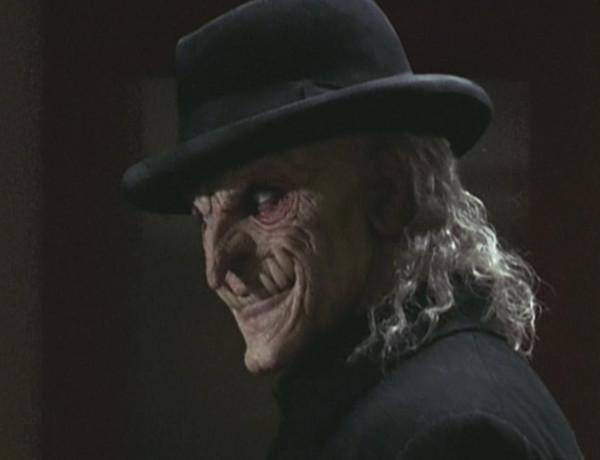
Der Kindestod is a great example of the special effects and design work that goes into making a Buffy villain. There's clear nods ahead to the design of the Gentlemen who appear later in the series; his elegant, long fingers and bowler hat giving him the oddest air of a banker with a bad skin problem and an underbite the Druids could use as a place of worship.* Similarly to the aforementioned Gentleman, there's a fairytale quality to Der Kindestod that adds to his creepiness; like Freddie Kreuger or Goethe's Erlking, he preys and feeds on children, taking them from under the watchful gaze of the adults. That the children must be ill and therefore even weaker makes him a truly despicable villain and surely one of the worst in Buffy's considerable list of adversaries.
The rewatch of Killed by Death also happened to coincide with me reading Stephen King's It, something which is thematically similar to the narrative here. In both stories, it is a monster who preys on children who cannot be seen by adults, forcing the children to take their own action and confront their fears. As King writes, 'The fears of children are simpler and usually more powerful' and this gets to the heart of why both It and Killed by Death are so scary. Children always possess vivid imaginations when it comes to scary things. Pennywise the Clown can easily be dismissed as the project of an over-active fear complex, likewise, because the adults can't see Der Kindestod, they ignore his existence. Cordelia even states outright that Buffy is making it up in order to have something to fight. Children aren't believed when they say there is a scary monster under their bed.
Watching this episode when I was eleven, I wasn't just seeing something for Buffy to fight, I was seeing a demon that was tailored specifically to get me. The fact that he lurks in doorways and has weird creepy eye tentacle things just made it that much worse. I had nightmares about Der Kindestod for a good couple of weeks after the episode aired and as I said before, I never went back to it. I've just finished reading It and I've also been scared stupid by it. There's something powerful in both narratives' ideas of facing your childhood fears and overcoming them. Der Kindestod may have been a small, fleeting one for me (compared with my ongoing battle with porcelain dolls), but even just going back to this episode felt like I'd said goodbye to something that used to scare the crap out of me.
Another link between both this episode and King's novel is the theme of survivor's guilt, faced by both Buffy and Bill Denborough in their respective stories. For Buffy, it's the double whammy of not being able to kill Angel before he killed Jenny and not being able to save her cousin Celia when she was younger. If there's a problem with Killed by Death, then it's here because it just doesn't push that psychology with Buffy enough. We get a few fleeting references as to how Celia died and that it affected Buffy by giving her a lifelong fear of hospitals, but there are very little consequences to this. It should have been entirely about Buffy overcoming this fear, learning that she can't save everyone and saving children in the process. In It, Bill eventually comes to terms with his brother's death over a long, troubled period from childhood to adulthood when he is forced once again to face the thing that killed it. Obviously, the novel has more room to explore this (and at 1400-odd pages, does so very well), but it felt like Buffy dropped the ball a little on the thematics of this episode.
That aside, it's still a chilling episode and one that I don't think gets enough credit in the Buffy fandom. I may be slightly biased as this is the first time I've seen it in thirteen years and I had quite the visceral reaction to it the first time round, but it's more than just a filler episode. It's just a shame that it only hints towards some strong character development, rather than actually following it through.
* Always wanted to link Buffy and Red Dwarf somehow. There'll be another one in Season 6 - props to people who can tell me what and in which episode.
Quote of the Week:
Xander: You don't know how to kill this thing.
Buffy: I thought I might try violence.
Let's Get Trivial: One of the things I loved on seeing this episode again was the reference to DC Comics' Power Girl and Buffy playing her in games with Celia. Our Summers has always been a superhero
You can read Becky's look at Passion here.
- Becky
Follow @AssortedBuffery on Twitter
Or like our Facebook page
 Over the course of October, I shall be watching one horror movie a day and reviewing it right here for your reading pleasure. I haven't seen any of the films I'll be watching before and you can find the full list here. Mild spoilers ahead.