Wednesday, 30 April 2014

TV REVIEW: Game of Thrones - Oathkeeper


The opening scene of Oathkeeper is perhaps one of my favourite moments in this season so far. It's such a simple one; Grey Worm is being taught to read and speak the Common Tongue by Missandei and through the process, the audience learns more about their backgrounds and the system of slavery in this world without heavy-handed exposition. The subsequent attack on Meereen is also brilliantly shot, with director Michelle MacLaren utilising the claustrophobic underbelly of the city to evoke the hellish slavery conditions before contrasting this in the wide shots of Dany as a conqueror looking over her new city. MacLaren is one of the best directors working on the show currently and this episode's strength lies with her. Even the scenes I wasn't particularly enamoured with were beautifully shot and composed.

The closing scene was also a sequence of note, the heavy blues contrasting sharply with the fiery oranges of the episode's opening. Any time the white walkers are seen in Game of Thrones, it's a reminder that, whilst everyone may be squabbling over the Iron Throne, the real threat is largely beyond the Wall and their numbers are growing. In a big surprise, it turns out that White Walkers can turn babies in a stunning final scene that saw poor Craster's son's eyes turn icy blue. Even us book readers didn't know they could do that (though it's obviously part of Martin's wider plan; I can't imagine the writers would be able to throw something like that in without him noticing).

Other strong scenes included a revelatory moment between Margaery and Olenna, in which her part in the killing of Joffrey is revealed (well done to people who called that one). The female Tyrells are a wonderful creation, endlessly spiky and difficult to control. The only sad thing is it's likely we won't see much more of Diana Rigg with Olenna returning to Highgarden. She's been absolutely marvellous from start to finish and I can't think of anyone else who could have played the Queen of Thorns with such attitude. Margaery also proved her worth with her late night visit to Tommen's room, in which she met Ser Pounce and demonstrated to the audience exactly why they've made Tommen a bit older in the series. 

And then there is the rest of the episode, which I'm just not all that enamoured with. With the theme of keeping oaths across the episode, it's not surprising that Jaime became one of the main focuses but, first of all, let's deal with the one-handed elephant in the room. The director of last week's episode insisted that that scene in the sept was meant to be consensual (which somehow makes the entire situation worse) and so the thread of that narrative continues . For a show that has done so much right, Game of Thrones has dropped the ball in a big way on this one, not even anticipating that sections of their audience might interpret that scene differently. Even David Benioff has stated that it was Jaime 'forcing himself on her', which is a further example of this disconnect. If the creative team have differing opinions on this, where does that leave the audience? This episode is clearly working with the angle that it was consensual because in fact, it feels like that scene didn't even happen at all. Jaime's back to being his usual slightly-heroic complex self whilst Cersei returns to her dry, cynical view of the world. 

It makes any scene with Jaime in this episode troubling to say the least; for those of us in the audience who saw rape, we're suddenly being asked to consider Jaime as one of the complex heroes of the show again (which he has clearly been positioned to be, given his redemptive arc in the previous season and despite the pushing of Bran). His one scene with Cersei shows that their relationship is over in what is barely a blip in the wider narrative of the episode. Instead, Jaime's focus is on the oaths he made and his honour, both to Tyrion and to Brienne. Both of his scenes sparkled with the kind of witty dialogue that we've come to expect when the Lannisters are involved. Before last week's debacle, the scene with Brienne would have been something I would have lavished praise on. Now, it just makes me feel a little uncomfortable.

Elsewhere in the episode, pacing was once again a bit of an issue. It's another filler episode in which everyone is repositioned for the next Big Event and which begins to deviate a fair way from the book in question. I've been accommodating of the changes made in adapting the books so far, because largely they have made sense and streamlined the narrative to make it more coherent. However, in this episode, it feels like it has gone another way. With the expansion of the mutineers at Craster's Keep, it just feels like its starting to play for time rather than continue to take the story forward. We had even more filler this week with numerous scenes on the Wall in which we're reminded that Jon Snow is fighting prejudice in the ranks, the wildlings are really dangerous and Castle Black is under a great threat. Which is exactly where we were at the last time we were there. 

Now, however, we get to see more of the oft-mentioned mutineers, the ones who betrayed Lord Commander Mormont last season. It's another one of those scenes in which exposition takes place whilst naked women are raped in the background and men drink out of skulls. Burn Gorman was suitably odious in his role but the scene dragged interminably and there was still no actual attack on Craster's Keep (despite Jon talking about it for two episodes and finally assembling a team to go and take them on). It was largely here to remind us that a) the mutineers are Really Bad People (which we sort of knew already) and b) to set up the big final scene of the episode with the White Walkers as Craster's last child, a son, is sacrificed to them. 

Alongside these events, we had Bran warging with Summer and getting trapped at Craster's Keep, seeing Ghost trapped himself in a cage. The warg effects are nicely simple and yet effective and any scene with the direwolves is immediately 20% better. By the end of the episode, Bran's crew are trapped with the mutineers (who they don't encounter like this in the books) and it seems to be heading towards a Jon-Bran reunion. I'm intrigued to see how they play this in the coming episodes, because part of Jon's plight is that he believes that his entire family are dead. To receive confirmation that this isn't the case would throw up an interesting new dynamic for the character. 

The first half of any given Game of Thrones season is always largely set-up for the revelations that get thrown up in later episodes. For Oathkeeper, this was certainly the case, though this is the first time that it felt like it was dragging. I'm hoping that now the pieces seem to be in place, we get a little forward momentum in the next few episodes because, at the moment, it feels like aspects are stalling.

- Becky

You can read Becky's review of the previous episode, Breaker of Chains, here.

Follow @AssortedBuffery on Twitter
Or like our Facebook page

Sunday, 27 April 2014

TV REVIEW: Fargo - The Rooster Prince


Lester (Martin Freeman) is still reeling from having killed his wife and giving himself a traumatic head injury to cover up his part in that murder and the one of the police chief. Deputy Molly Solverson (Allison Tolman) is sure he's involved somewhere along the line in those murders as well as the earlier murder of his childhood bully, Sam Hess. However, she faces increased resistance from the new Chief (Bill Odenkirk) as well as Lester himself. In Duluth, Gus Grimly (Colin Hanks) is tormented by his inaction when faced with Lorne (Billy Bob Thornton) and is attempting to justify his continue silence. Whilst all of this is going on, Lorne is sorting out a blackmail problem for local supermarket magnate, Stavros Milos (the wonderful, needs-to-be-in-more-scenes Oliver Platt).

The second episode of Fargo widens the playing field considerably, furthering the action in the little town of Bemidji alongside that of the Duluth subplots. It means the cast of characters increases and the plots are becoming slightly labyrinthine. As such, this episode is taken over slightly by the need to establish these various narrative strands and develop the characters within them. In doing so, it loses a little of the humour and darkness that made the opening episode such a joy, but the macabre atmosphere remains and there's a level of knowing throughout Fargo that ensures it is still enjoyable.

Much of this comes from the arrival of two men from Fargo, Mr Numbers and Mr Wrench (Adam Goldberg and Russell Harvard, respectively). Clearly a nod to Peter Stormare and Steve Buscemi's characters from the original Fargo film, Numbers and Wrench are cut from the same cloth as Lorne. Calm and disquieting, they also do very little to impose on those people around them and yet impose they do. In a nice nod to their cinematic counterparts, Wrench is deaf and the pair communicate in sign language (often at the expense of characters also in the conversation) in contrast to the verbosity of Stormare and Buscemi. This silence that exists between them, operating on another level of communication to the rest of Bemidji, builds up the enigma that is Fargo in this series.

The widening narrative also offers expansion in other areas. The first episode was tasked with place setting, introducing the characters, their surroundings and their backgrounds for the audience, as well as simultaneously aligning and distancing itself from the Coen brothers' film. Now that the characters and world in which they operate has largely been established, Noah Hawley becomes a little more ambitious in creating a work that is both satisfying at the level of plot, but also one that is multi-layered and explorable on a thematic level.

Violence is endemic in this society and something which the residents of Bemidji (and the wider Minnesotan area) don't seem to be all that aware of. Adam Bernstein's direction collaborates brilliantly with the characters' obliviousness by utilising the background to demonstrate just how surrounded by violence and death these figures are. The background of Lorne's meeting with Stavros about his failing marriage is a man butchering animals. During the conversation between Lester and his brother, Lester's nephew is seen playing with a gun on the stairs in a moment of supposed normality. Throughout these two episodes, there has been a constant juxtaposition between violence and domesticity, just like this one. Lester's murderous act takes place because he can't fix the washing machine. The Hess boys fight outside the family home. The presence of Lorne may have been the catalyst for actual violence occurring, but it's clear that Bemidji has always had its issues.

With this emphasis on the clash between violence and domesticity, there's also an intriguing depiction of gender roles going on here, particularly Gus looking after his daughter whilst having to take big moral decisions and Molly Solverson, striving to work hard in an environment everyone keeps telling her she shouldn't be in. Molly is consistently belittled and reminded of her gender by those around her, even her father. Allison Tolman's performance is excellent, capturing both the optimism and cynicism necessary for this role. Molly is extremely determined to catch her man, yet is constantly at war with the system around her that decides she isn't supposed to get that far ahead. Following Frances McDormand in the Marge Gunderson type role is no easy feat, but Tolman has that same steeliness about her character that made Marge so wonderful.

It may not have been quite as dark or bizarre as the first episode, but The Rooster Prince still maintains that macabre gallows humour and great performances that kicked it off. It's exceeding my expectations so far and I'm sincerely hoping it's a momentum that can be maintained right the way through.

- Becky

You can reading Becky's review of the previous episode, The Crocodile's Dilemma, here.

Follow @AssortedBuffery on Twitter
Or like our Facebook page

Wednesday, 23 April 2014

FEATURE: Buffy the Vampire Slayer - Anne

Previously on Buffy the Vampire Slayer: After killing Angel to stop the end of the world, Buffy heads to LA to mope around and listen to Sarah MacLachlan a lot, leaving nothing but a note to Joyce.

And so the third season begins! Last seen on a bus to Los Angeles, Buffy/Anne is now working in a diner, living in a scuzzy flat and having dreams about Angel returning to her and saying cryptic things in her ear. Despite wanting to carry on alone, a face from the past, Lily, the vampire lover formerly known as Chanterelle (from Lie to Me), wants Buffy's help in tracking down her missing boyfriend. The pair stumble upon a slave ring masquerading as a cult preying on vulnerable young people and forcing them to work in some weird time warp factory (alas, no one is doing the dance). Meanwhile, back in Sunnydale, the remaining Scoobies are trying to slay in Buffy's absence though they're not doing a particularly good job of it.

If Becoming was all about stripping everything away from Buffy until there was nothing left, then Anne is all about her re-discovering that again. Throughout the episode, she is asked her name and repeatedly gives it as 'Anne', so often in fact that it becomes almost automatic. However, she has not entirely become Anne just yet; when Lily calls out Anne to her, she doesn't respond until Lily says 'Buffy'. Dragged back in to solve the mystery of Ricky's disappearance, Buffy comes face to face with a cult that strips people's identities and re-discovers her own over the course of the episode.

Serving as an introduction of sorts to the Los Angeles we shall see more of in Angel, the episode is at great pains to point out what a hole the city is. Streets are dark and dank, sirens go off at all times of the day and young people are lost and ragged. It's hellish even before they get to the industrial slave factory thing. There's even a nice joke with the diner Buffy works in, called Helen's Kitchen. Buffy may have escaped with retreating into herself in mind and largely the city works to anonymise her. However, it also puts her in more danger than Sunnydale would because she is alone.

Sarah Michelle Gellar is particularly good in this episode, portraying the Anne side of the character as a completely blank slate, one who doesn't even react to the kind of sexual harassment that Buffy would have kicked the crap out of someone for. It makes the contrast all the more sharp when Buffy does make her return. The scene with the doctor in the blood bank is a good example, displaying the witticisms we come to expect from our slayer as well as the underlying rage of the Anne side. However, it's only when she is placed specifically within the cult slave ring where everyone is forced to declare 'I am no-one' that she finally resumes her identity and accepts that she hasn't changed.

Expendable Demon #1: Who are you?
Buffy: (pause) I'm Buffy... the Vampire Slayer. And you are?

It's not just Buffy that has issues with finding herself again. Forced into the slayer role, the remaining Scoobies all face a bit of an identity crisis as they return to school for their final year. Willow, hilariously, tries to take on Buffy's personality herself, facing down a vampire with a less than witty retort. In fact, she calls the vampire 'Big Boy'. It's all a bit cringe. Xander's fooled by a bit of gymnastics and Oz can't throw a stake to save anyone's life (it's a wonderful gag, that). With Buffy away, it serves to show how the Scoobies work as a well-oiled machine and when one is missing, it stops working quite so well. They tried to step into her role, but it will never work because they a) lack super Slayer strength and b) work for the gang in other ways.

By the end of the episode, everyone is back in their place; Oz and Willow are together as are Xander and Cordelia despite a brief spat and Buffy is back in Sunnydale and saving everyone's collective asses.  It may be a while before the air is cleared, but everyone is back in the right location at least. It's an important moment for Buffy, who is constantly torn between being selfless and selfish. By returning to Sunnydale, she's shedding the identity of Anne and therefore her own desires. Not only that, but Lily goes on to become Anne herself (and will become a recurring figure in Angel).

Technically speaking, the episode is notably strong, written and directed by Joss Whedon himself. After the cold open, we're greeted with a lengthy unbroken shot through the halls of Sunnydale High that begins with Giles and Willow and ends with Xander and Cordelia. It's a brilliant moment and one which perfectly captures not only the post-holiday chaos but the way in which everyone has been left reeling in Buffy's absence. In that one shot, we're instantly re-aquainted with everyone, even Larry. A smaller moment yes, but still a powerful one and a clear example of how exciting a director Joss Whedon can be. After all, he's only practicing for the unbroken shot through New York flying past all of the Avengers.

It's one of Buffy's best openings, having more work to do than most to get the characters back to the status quo. Though of course, it would be too easy if everything was back on an even keel...

Quote of the Week:

Larry (on Sunnydale High Razorbacks): If we can focus and keep our discipline... And not have quite so many mysterious deaths, Sunnydale is going to rule!

Inventive Kill:

Buffy: Hey Ken, wanna see my impression of Gandhi?
[beats him to death with a club]
Lily: Gandhi?
Buffy: Well, you know, if he was really pissed-off.


Sunnydale Who's Who: This is the first episode with Seth Green in the opening credits. Also, Carlos Jacott (Ken) will return in Angel, playing a different character and the pilot episode of Firefly. He doesn't really do nice people apparently.

- Becky

You can read Becky's review of Season 2's finale, Becoming.

Follow @AssortedBuffery on Twitter
Or like our Facebook page

Tuesday, 22 April 2014

FEATURE: My Movie Mastermind - Broken Arrow


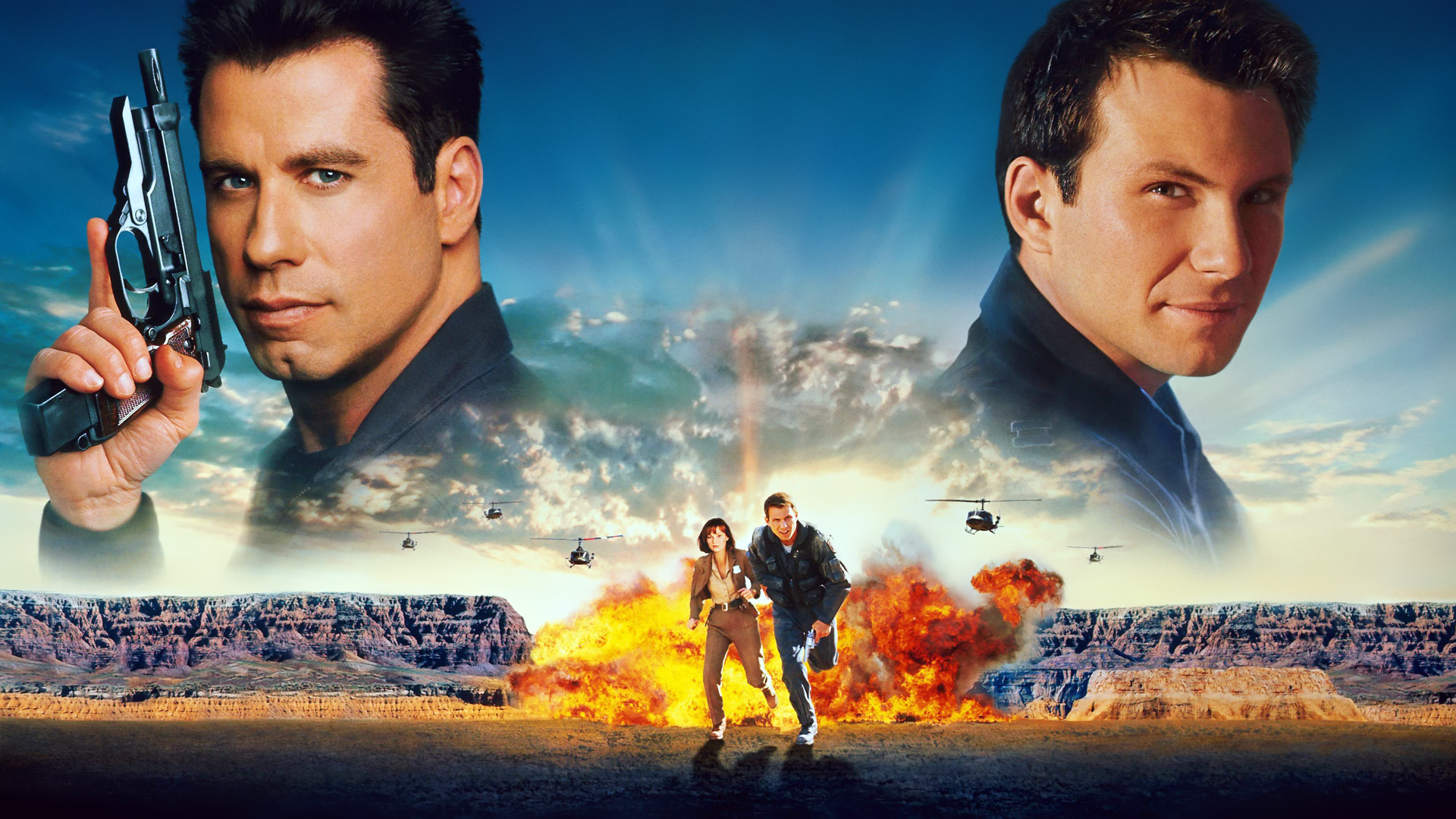
We've all played the game in our heads. We hear the "Mastermind" theme and imagine what our specialist subject will be. I've always had a few ideas kicking around in my head. Star Wars, Indiana Jones, Back to the Future, Die Hard and Jurassic Park are films I've seen a tom of times and would be able to rattle off answers no problem. But they're far too common. So I've gone for something a bit leftfield. It's a film I've seen more than anyone really should have, but I just love it too much. It is 1996's Broken Arrow starring John Travolta and Christian Slater. 

This was John Woo's second film since making the leap to the States after 1993's Hard Target starring Jean Claude Van Damme. That film is another guilty pleasure, but doesn't have a patch on this one. Conversely, Face/Off is arguably a better movie, but again this film has more charm to it.

Take the opening scene. In it we see a sparring match between Vic Deakins (Travolta) and Riley Hale (Slater) - you've got to love 90s action hero names. Rather than some lame exposition, we see the two communicate while sparring which gives us insight into the type of relationship they have. Deakins is clearly trying to groom Hale into being his equal, but Hale is the rebellious type and has his own style. The fight itself foreshadows whats to come in the film, and ends with an awesome shot of the two touching gloves, which signifies the end of their match, but can also be seen as the start of the "match" in the context of the movie.

We do end up with a bit of exposition while the two are flying with the live nukes, whereby it's established that Deakins is pissed off with the Air Force, and betrays Hale by giving him the genius "evil John Travolta look", backed by Hans Zimmer's incredible score (more on that later). There's hijinx in the desert as the two play tug of war with a nuclear bomb, with Hale being helped by Samantha Mathis' spunky sidekick Terry Carmichael and Deakins being backed up by his team of generic henchmen led by square haired Howie Long.

Woo's direction is spot on, as always. His use of slo-motion and two handed gunplay has been done to death, but in the mid 90s it was still refreshing and new. The film flies along at a frantic pace, as our heroes go from one inventive gunfight to the next, before reaching the cargo train based finale, where once again Deakins and Hale go mano-a-mano with more at stake than just the $20 they were sparring for at the start.

For all the stupidly enjoyable things in this movie, two things stand out more than any other. The first is the aforementioned Hans Zimmer score, which utilizes some of his usual tricks augmented with some electronic elements, but it's the piece that features Duane Eddy's playing a motif on baritone guitar that sticks in the memory. This, paired with the second memorable element in John Travolta's gloriously OTT performance makes for some great movie moments, and if not for this film who knows what Harry Knowles would have called aintitcoolnews.com?

So there you have it. I don't want people to think I'm not taking this topic seriously. I really love this film. I mean, I could have done The Godfather or any number of films that have been written about ad nauseam, but what can I say that hasn't been said before. With "Broken Arrow" it's a chance to revisit an underrated 90s action flick. Which my mother happens to love. If that's not an endorsement, I don't know what is.

- Kevin Dillon

Kevin writes reviews of new DVDs/Blu Rays to rent, along with the occasional feature for his own blog www.smallscreensaver.blogspot.ie. You can also follow Kevin on Twitter here.

Monday, 21 April 2014

TV REVIEW: Game of Thrones - Breaker of Chains


Following on the death of a character, particularly one so universally despised as Joffrey, was never going to be an easy task. Usually it is left to the tenth episode of a season to let the pieces fall back into place after a major shock. Yet this is only the third episode and it seems to have wrongfooted the writers, not quite knowing how to follow the Purple Wedding. What does happen are various expositional scenes that do little to advance the plot, but instead, reposition the characters for future event setpieces. It's one of the most pedestrian episodes yet and as such, feels rather disappointing. And then there's that scene which just about everyone is talking about.

The scene in which Jaime has sex with Cersei is straight from the novels themselves. Crucially though, it is written and made clear that it is consensual sex. In the show, it is rape. Cersei protests right up until the scene cuts away, but Jaime overpowers her and carries on anyway. Now, Game of Thrones has always been shocking and has always made sure that the audience is always aware of the hostile environment in which these characters are operating in. 

However, this is the first moment in which I've felt that this has been a shock for shock's sake, an attempt at audience exploitation that looks like it is backfiring. It is completely out of character for one thing; Jaime may be a complete and utter git (pushed a child out of the window, folks), but he has always been clear and, in his own twisted way, honourable when it comes to his love for Cersei (pushing the child was for her after all). He's also adopted a strong moral opposition to violence against women which has been a key part of his character from even before the events of the series. Think how many times he defended Brienne during their time together. It makes absolutely no sense on a character level and completely ruins any redemptive arc that they have been building for Jaime throughout the third season.

Does this serve a reminder of his gittishness in the face of us all growing to like him so much? Perhaps. But changing that septor-tryst into rape feels like a cynical ploy to get a gasp out of the audience. Game of Thrones' morality has always been the murky side of grey and I don't think that there is any issues with that. I've certainly never raised it in my reviews before as it has always been inbuilt to key character developments. I don't understand how this has anything to do with Jaime and Cersei's broken relationship other than Jaime taking what he has wanted since he's returned.

There is also the issue that Game of Thrones has never been very good with dealing with the consequences of sexual assault (beyond saying "ooh it makes a bit dangerous for women") and has muddied the ever-complicated waters even more than the books did. The closest example I can think of is the consummation of Dany and Khal Drogo's marriage in the first season in which it was also changed from (albeit iffy) consensual sex to outright rape. From there, Dany and Drogo go on to have a loving relationship, despite the foundations of sexual assault and it was never again raised as an aspect of their relationship. With that as a precedent, I can't see the consequences of Cersei's rape being explored. I sincerely hope I'm wrong and that the show uses it for character development, but considering we didn't get a fallout from that scene in this episode, I'm not holding out much hope.

Then there is the abrupt tonal shift which jars more than a little. Following the horror of that scene, we check-in with Arya and The Hound, currently wandering around the riverlands somewhere. Arya's wit is something that is a constant joy to see and I loved how she dealt with the farmer by coming up with an entire family history off the bat, but it felt completely incongruous to what had gone before. Her interactions with The Hound are some of this season's best moments, but again, this is hampered by a desire to jolt the audience. The Hound beats the farmer and steals from him after accepting his offer of work with a protesting Arya shouting in his wake. It's another scene that feels a little off, mostly because it doesn't advance anything. We all know that The Hound is just out to survive and doesn't give a fig for anyone but the Stark girls (granted, he does have a complicated relationship with them). This scene felt like filler, and not particularly satisfying filler at that.

The shocks didn't end here either, though the remaining gaspworthy moments felt less exploitative than those previously mentioned and more in keeping with the progressing narrative. Ser Dontos was never going to make it out of King's Landing and, though he was lovely and chivalrous in rescuing poor Sansa, he was dead from the moment he took orders from Littlefinger. Likewise, the wildling attack on the village was carried out in suitably brutal fashion, serving to remind us of the dangers awaiting the Night's Watch. 

The quieter scenes were also consistently strong in this episode, contrasting sharply with the more brash moments. As ever, Oberyn proves to be just wonderful, an impish blend of hedonism and politics who is never short of something to say. Pedro Pascal versus Charles Dance appears to be a new Game of Thrones event and I can't say I'm complaining. The subtle menace to their interactions makes them all the more compelling and is another classic example of how well the writers do political exposition when it comes to the history of King's Landing and Dornish relations.

Saving its best sequence for last, Dany finally reaches the city of Meereen and gives another one of her characteristically fire-and-brimstone speeches, but not before we get to see Daario Naharis in action. The recast Michiel Huisman has impressed in a couple of brief scenes and continues to do so here, getting in on the action on a one-on-one combat. He also showcases his strong chemistry with Emilia Clarke and with that wink, casts out any lingering memories of the departing Ed Skrein. After the champion of Meereen relieves himself in front of Dany, she selects Naharis as her own representative, quickly dispatches his opposition and lets Dany speechify. The production design in this sequence was beautiful, with Meereen looking every bit the rich and daunting city. 

In fact, the production design was probably this episode's greatest strength, from the haunting funereal look of the Septor to the dank and dingy Dragonstone. Sansa's escape to Littlefinger's ship was also beautifully realised, the blue of the fog contrasting sharply to the red hues of King's Landing. This is a plot development I've been looking forward to getting to, as Sophie Turner was starting to have very little to do with her character in the capital. Now, Sansa finds herself away from danger but in the clutches of Littlefinger (amusingly, Aiden Gillen seems to have given up on making his accent at all consistent) which isn't the greatest place to be for a Stark.

After a strong opening two episodes, Game of Thrones has delivered one of its most uneven and troubling chapters yet, one that managed to be both place-setting filler and exploitative drama. Because it has always been so consistently strong, I have found this episode of to be perhaps the most disappointing in a long time.

- Becky

You can read Becky's review of The Lion and the Rose here.

Follow @AssortedBuffery on Twitter
Or like our Facebook page
TV REVIEW: Fargo - The Crocodile's Dilemma


Set as a ten episode limited series, Fargo opens in Bemidji, Minnesota, with a car accident involving the mysterious Lorne Malvo (Billy Bob Thornton) and a man in his underwear trapped in the boot, who later freezes to death attempting to run away whilst Lorne wanders into town. The Bemidji police begin  to investigate with Chief Thurman (Shawn Doyle) and Deputy Molly Solverson (Allison Tollman) taking the lead. Meanwhile, Lester Nygaard (Martin Freeman) is dealing with his nagging wife Pearl (Kelly Holden Bashar) and the school bully, Sam Hess (Kevin O'Grady) returning to punch him in the face. However, a chance meeting with Lorne in the hospital waiting room sets off a chain of events which Lester had only begun to fantasise about.

The Coen Brothers' 1996 film Fargo is widely regarded as one of their masterpieces, a dark blend of murder, Minnesota and Marge Gunderson, Frances McDormand's heavily pregnant heroine. When a TV series based on the film was announced, it was met with equal parts quiet optimism and cynicism. Part of an ongoing trend of seeing films adapted into television series, of which Bates' Motel and Hannibal are the most popular examples, it was easy to dismiss Fargo as merely riding the wave and using the name of a beloved property to draw in viewers. Thankfully, however, the first episode manages to allay some of those fears with a deliciously dark opening episode.

There are still plenty of ties to the Coen Brothers' original film, but Noah Hawley's screenplay uses it as more of a framework to reference and gain ideas from. Like the film, the action doesn't actually take place in Fargo; it operates as a sort of dark place on the horizon where bad people come from. Similar plot points are in play (the sadsack insurance salesman getting in with criminals, a car crash to investigate etc.) as well as characters clearly using their cinematic counterparts for inspiration, but neither feel ripped off or stolen from the film, but rather operate as homages. There's even a Big Lebowski nod in there for the eagle-eyed Coens fan. 

The real strength in Hawley's screenplay lies in his ability to capture the tone of the film and the Coen Brothers' ear for whipsmart dialogue. The Bemidji police offer up a lot of laughs, particularly Bill Odenkirk's squeamish Deputy Oswalt, a man who can't face a crime scene for fear of losing his wife's spaghetti dinner. Then there is Billy Bob Thornton's Lorne, a disarmingly calm man with a penchant for knowing the rules of the motel before paying for a room there (his conversation with the concierge is a highlight). He acts as a sort of evil Puck figure, manipulating situations and people for his own ends, taking it upon himself to help Lester out with his Sam Hess problem and messing around with the family for fun.

However, Lorne also functions as the episode's line between black humour and outright malevolence. Thornton's calm performance is immediately sinister and his reactions to things around him are wonderfully deadpan. It's a scene towards the end of the episode in which this is showcased brilliantly; it's a face off between Lorne and Duluth police officer Gus Grimly (Colin Hanks) that is a masterclass in tension-building because it is impossible to interpret the scene's direction. With Lorne around, the tone shifts from outright comedy to suspense quickly and dangerously, offering an unpredictability that never quite lets the audience settle.

The casting of Martin Freeman as Lester Nygaard also proves to be a masterstroke. The bewildered expression has been so perfected by Freeman across his career that he really ought to trademark it, but here it is replaced with one of despair. Utterly downtrodden by his life and family, Lester is the kind of man you root for in these situations, willing him to stand up and take action against those who would demean him. Which, of course, Lester does, but not quite in the way you want him to. The moment he takes a hammer to his wife's head (in such a cheery, slapstick fashion) is the big shock of the episode, another point at which you go from laughter to shock to nervous laughter so fast it makes your head spin like the Nygaard's washing machine.

With a body count that's already alarmingly high, Fargo has set the tone for its upcoming instalments quickly and effectively.. It's a dark, bizarre delight that also happens to be riotously funny and I can't wait to see where Hawley takes it next. 

- Becky

Follow @AssortedBuffery on Twitter
Or like our Facebook page

Thursday, 17 April 2014

FEATURE: Buffy the Vampire Slayer - Becoming

Previously on Buffy the Vampire Slayer: Angel was cursed with a soul by gypsies he had scorned, but a moment of true happiness with Buffy ensured he lost it again. He's been wreaking havoc in the lives of the Scoobies, psychologically torturing them and going so far as to kill Jenny Calendar, who had been close to translating the spell to restore his soul.


Buffy gears herself up to face Angel, but he has other plans. With the recent discovery of the ancient demon Acathla who is able to send the entire world into a hell dimension with one breath, Angel decides he wants to end the world. Meanwhile, Buffy and Willow discover Jenny's translation of the restoration ritual and it's agreed they will try to restore Angel's soul. An attack on the library leads to Giles' capture to discover how to do the right ritual and Buffy heads to the mansion to face down Angel, armed with a new unlikely ally.

If there's one thing that Buffy did consistently well throughout its seven seasons, it's the finale episodes. Sometimes two-parters, sometimes standalone, always the result of a season long arc, Buffy finales have always been cracking episodes, capturing the humour and emotion that makes the series so strong. Partly, it's because the threat of cancellation always hung over the show, which meant that the writers always wrote each season to bring the series to a largely satisfying close should that happen.

There's a constant sense of horror to Becoming, building from Buffy's desire to finish her battle with Angel, the impending end of the world scenario (neatly paralleled with Buffy having to take finals), the self-immolating vampire at the front of a classroom and Giles' torture scenes. It returns the second season to the slow build of tension that has been mounting throughout the last few episodes and the building sense of dread climaxes spectacularly in the final scene of Part One.

It's the first of several major flashback episodes, one which use some element of the past to explain a character's motivations. For Angel, it shows the episodes in his life that have been the most talked about; his siring, the killing of his family, driving Dru insane and seeing Buffy for the first time. It starts building towards his solo quest for redemption with the spin-off wasn't in the pipeline (announced shortly after Becoming aired). It's a useful technique, demonstrating how Liam, Angel's pre-vamp self, was always a bit of a twit so the fact that Angelus turned out so evil isn't a surprise. It also gives us a greater understanding of how much he has to make up for and how significant the regaining of his soul was. As he said in an earlier episode, 'you have no idea what it's like to have done the things that I've done... and to care'.

With the discovery of the curse that could restore Angel's soul, Willow and Buffy set the proverbial cat amongst the pigeons when it comes to deciding his fate. It's a complicated moral decision and Whedon utilises the characters to represent different sides of the argument. Whenever the central characters fight, it's always particularly galling, like seeing a close family in the throes of a heated argument. Xander goes all out, bringing forth his callous streak to declare that Angel should die and Buffy is compromised by her feelings. Buffy sees it as a back-up plan, as does Willow who would perform the magic. Giles, meanwhile, is the most compromised of them all, understanding Buffy's position whilst also still reeling from Jenny's death.

Stakes always seems so much higher when the Scoobies are ripped apart and few scenes are as powerfully frightening as the one in which the gang are attacked in the library at the end of the first part. Whedon's reputation for killing off people suddenly wasn't quite as concrete as it is now, but after the death of Jenny, it felt like anyone could be next. At the end of the episode, Buffy is about to be arrested, Willow's unconscious, Xander's got a broken arm and Kendra's dead (goodbye Bianca Lawson, we barely knew you).

The haunting voiceover from Whistler about Big Moments cements this sense of loss; we have no idea how to follow this Big Moment and at this stage, neither do the characters. It's another example of a voiceover working particularly well and because it is a voice we're not used to, it adds a sense of detachment to the scene. Whistler is watching this play out with us. It also ties us back to Passion and recalls the slow motion discovering of Jenny's death. The message is clear; this is a game-changing episode and we still have the second part to come.

These Big Moments continue into the next episode, including Joyce finding out that her daughter is a Slayer. It's one of the lighter moments in the episode, post-alliance with Spike, which leads to a wonderful moment in which Joyce and Spike awkwardly bond over their previous meeting in School Hard. It soon gives way though into a conversation between Buffy and Joyce which leads to the latter running away from home. Their mother-daughter relationship is always one of the best aspects of the season, particularly as they try to negotiate understanding each other and this is sorely tested here. 

Everything that occurs in this episode determines that by the end, Buffy is left entirely alone. It's a common theme in the season finales and whilst the series is at great pains to prove that she is nothing without her friends, it also points out continually that when it comes to the big fights, there's only so much help they can give. Becoming features one of the best explorations of this. It may be really obvious that the fight is not entirely David Boreanaz and Sarah Michelle Gellar, but there's no denying that it is one of the best one-on-one showdowns of the series, probably second only to Buffy and Faith's clash in Graduation Day. The stakes are high and the tragedy of the outcome makes it just that bit worse. When Buffy kills Angel, she can't face her friends and departs alone; only now has she truly lost of everything.

Whilst Part One focuses on Angel's past, Part Two hints a lot towards key developments in future. There's another reference to the Mayor and his interest in Buffy, Xander tells Willow he loves her while she's unconscious and Willow begins practicing magic with the restoration ritual. These will have all flown over our heads when it first aired, but it's great to go back and catch them on the way through the rewatch.

And so to the heartbreaking end of the episode. It still pains me to this day that Xander is never called out on his lie, but without it, the ending wouldn't be so awful. Buffy saved the world again, but at great personal cost this time, something which this season has continually hinted towards. When she pulls off in the bus at the end, to the strains of Sarah MacLachlan's Full of Grace, it feels very final despite knowing that she'll come back. The ramifications of this episode also have a long-lasting impact on the third season, which is also arguably the series' most consistently good run. 

Well, that's the second season everyone. It's all going rather quickly now. Also, just as the Angel series was announced after Becoming, I'm announcing that I shall be doing an Angel re-watch alongside the Buffy one when we get to the end of the third season. How very exciting. Well, for me anyway, I've only seen the entirety of Angel once through.

Quote of the Week:

Angel: No weapons... No friends... No hope. Take all that away and what's left?
Buffy: Me.
*Air punch*

Let's Get Trivial: The Mutant Enemy monster at the end dispenses with his usual 'Grr arrgh' to say 'Oh I need a hug'. You and me both, fella.

Demonology 101: Whistler is the first instance of a good demon existing in the Buffyverse, something that becomes increasingly important to both Buffy and Angel in their respective series.

- Becky

You can read Becky's look at previous episode, Go Fish, here.

Follow @AssortedBuffery on Twitter
Or like our Facebook page

Wednesday, 16 April 2014

TV REVIEW: Game of Thrones - The Lion and The Rose

As ever, major spoilers in the following review... Please don't read ahead if you haven't seen this episode.


It's an outing at the writer's desk for George RR Martin himself this time as we enter the second episode of this season, The Lion and the Rose. It's a fairly big sign that something big is coming if you see Mr Martin's name in the opening credits and so it proves once again. The episode opens in brutal fashion as Ramsay Snow (Iwan Rheon) engages in a human hunt with companion and the newly christened Reek (Alfie Allen) by his side who has cast off his old identity as Theon Greyjoy. Bran (Isaac Hempstead-Wright) continues his journey north with Jojen (Thomas Brodie-Sangster), Meera (Ellie Kendrick) and Hodor (Kristian Nairn) and has visions of where they must go next. Then, to King's Landing, where the final preparations are being made for Joffrey (Jack Gleeson) and Margeary's (Natalie Dormer) wedding.

With a show such as Game of Thrones, there are always going to be those episodes where certain moments will overshadow the scenes that have gone before it for a variety of reasons. In some cases, it is from the sheer shock of what you had just seen, such as the Red Wedding. And it is to another wedding we turn for the other reaction that might overshadow the episode; sheer, unadulterated glee. It seems morally wrong to revel in the death of a character, but Game of Thrones doesn't exactly operate on an even keel when it comes to moral codes. Then there is the fact that the character in question is one of the most odious, most hated and downright evil characters to have ever walked across the screen.

Jack Gleeson's performance as Joffrey has always been one of the best in the series, capturing the Boy-King's maniacal love of power and the torture he inflicts on others. He's slowly grown into the character everybody loves to loathe and in some ways, it will be sad to see him go. However, just in case we had any sympathetic feelings at all, Martin leads up to the fatal moment with one of the worst acts of Joffrey's brutality not involving a crossbow. A not-so-subtle power-game between Joffrey and Tyrion showcases the King's hatred of his uncle, using a play with dwarfs to illustrate the War of Five Armies, not only humiliating Tyrion, but also torturing poor Sansa with some graphic attacks on the player representing her brother, Robb. Tyrion slowly placing his hand over his wife's during this scene was one of the sweetest moments in a dark episode.

And so to the death itself. Book readers will know how it is done, but I'm enjoying reading everyone's various theories around the internet (I won't be detailing it here). The episode had already been fairly brutal before we even got to King's Landing (more on that shortly), but there was an over-riding sense of things coming to an end slowly building throughout. With Shae sent away by Tyrion, Stannis and Melisandre regrouping at Dragonstone and the Boltons on the move, the episode felt more characteristic of the usual 'Episode 9' dramatic turns rather than the second episode. By the time we got to the wedding, the tension mounted slowly with every cruel comment or prank that Joffrey played. The moment itself was built beautifully as everyone slowly realised that he was choking; some hesitated, some rushed in gallantly, some stood back and watched it happen. And then for the fans, there was a nice, extended close-up of Joffrey's purple, bloated face, just so we could all make sure. It's not hard not to cheer at that.

Now to the scenes that we saw prior to the Purple Wedding. The episode opened far more brutally than it would later end, as Ramsay Snow uses his authority to engage in a hunt, chasing down a young woman with hounds and his bow-toting companion. The hunt itself was composed well, building throughout and getting considerably more graphic as the victim was chased down. Whilst not quite at the Joffrey level of hatred just yet, Snow is putting in a decent bid to replace him as the show's most reviled character. Theon may have been an ambitious but useless leader, but his plight is a sympathetic one and Allen's performance of the transition from the brash, over-compensating Theon to the maligned, broken Reek has been excellent. The look on his face when he found out that Robb was dead was heartbreaking.

Amidst all the death, we also got a few quieter scenes to highlight some of the underlying issues in Westeros. A particularly good scene was that between Tywin and Olenna (Diana Rigg is just marvellous isn't she?) which reminded everyone of the Westeros financial troubles. Tywin may shit gold as the saying goes, but the crown still owes a hell of a lot of money. Can we also have a round of applause for Oberyn, the sassiest man in Westeros? Seriously, Pedro Pascal is knocking this role out of the park. I want to see him go toe-to-toe with Tywin and Cersei at least once a week for this season. I also loved the scene between Jaime and Bronn. I may still remind myself that Jaime once pushed a child out of a window, but the fact I have to do this is a testament to Nikolaj Coster-Waldau and the writers for giving him such a compelling, sympathetic arc.

The fourth season is clearly set to pull no punches, starting with a major demise in the second episode. The big, dramatic moments will always be the ones that people remember, but where Game of Thrones really excels is those scenes in between.

- Becky

You can read Becky's review of the previous episode, Two Swords, here.

Follow @AssortedBuffery on Twitter
Or like our Facebook page

Saturday, 12 April 2014

FILM REVIEW: The Raid 2


The notion of 'bigger is better' is an old one when it comes to film-making and particularly when it comes to sequels. The Raid was as lean as they come, a film set entirely in one location and with a scant plot on which to hang a series of impressive fight sequences. Whilst character beats, particularly with Rama (the surely soon to be international action superstar Iko Uwais) and brother Andi (Donny Alamsyah), were well-handled, they aren't the bits that everyone talks about when they talk about The Raid. It's the door kill, or the drugs lab fight, or the stunning silhouette shot on the staircase before all hell breaks loose. To go bigger from there is the next logical step, zooming out from the microcosmic workings of the tower block to the wider criminal underworld in which it belongs.

Picking up just a couple of hours after the climax of the first film, The Raid 2 finds Rama tasked with an undercover mission to root out the corrupt cops within the Jakarta police force. He quickly befriends Uco (a scene-stealing Arifin Putra), the son of Bangun (Tio Pakusadewo), the head of the biggest crime family in Jakarta who has ruled for years in a truce with the Goto crime family from Japan. However, the uneasy peace is threatened by shadowy background dealings and Rama finds himself involved more and more until he realises he must fight his way out.

With a longer run-time, Evans allows the story to breathe in a way that the claustrophobic location of The Raid couldn't and the sequel is much stronger for it. For all of the violence and technical bravado, this is a film about the importance of family and not losing touch with yourself or your loved ones. Time is taken to establish family dynamics, relationship histories and character motivations to almost Shakespearian levels (Uco is a potent combination of Hal and Hotspur whilst Bangun displays all the world-weariness of a Henry IV). Even characters such as Hammer Girl (Julie Estelle) and Baseball Bat Man (Very Tri Yulisman) have a clear and tangible history to them. It may be simple character-based work (too often forgotten in the action genre), but it serves to enhance the film beyond just its action sequences and as it builds towards its climactic showdown, the emotional resonance deepens and the fights become that bit more involving.

Once again, the action sequences are going to be the bits that everyone will talk about when it comes to the film. Thankfully, the fight choreography is superb, each fight as unique and as unpredictable as the next, whether they're set in a prison yard or in the inside of a car. Evans' kinetic camera work is perfectly pitched, sweeping with the performers as they crash through their fight sequences, close enough to retain the immediacy of The Raid, but also with enough sense of when to hold back and let the punches speak for themselves. It is endlessly inventive; you watch from camera angles you never thought possible. The larger cityscape also gives Evans a broader canvas to paint red and each location is utilised well to keep the action fresh, be it a subway train or a swanky nightclub.

The brutality of the images are enhanced greatly by the film's soundscape; hits are felt with shuddering thuds, weapons carry their own unique soundtrack (Baseball Bat Man is more often heard before he is seen) and bodies hit walls with wince-inducing decibel levels. The music, scored by Fajar Yuskemal, Aria Prayogi and Joseph Trapanese, underpins the building tension well without threatening to overwhelm the action. However, Evans' real skill is knowing when to pull all of this back. Often, the film's quieter moments are its most powerful; it's the sense you get at the back of your neck when the music stops or a character composes themselves and the film develop its own rhythm of ebbs and flows to which you quickly become accustomed. 

There's a keen understanding here of the importance of the calm before the storm and the quiet that descends after it, even if it is just to allow the audience to breathe for a second (trust me, you'll need it). It's also in these quieter moments that the performances shine. Uwais is given more emotional work for Rama here and rises to the challenge admirably, retaining his quiet charisma and giving you an admirable hero to root for. Putra's Uco is an electric presence, all pent-up rage and swagger, whilst Yayan Ruhian gives a tragic performance as Prakoso and gets a fantastic fight sequence all to himself.

In a movie industry saturated with sequels and franchises, it is not only refreshing to see a sequel that more than lives up to the hype of the first film, but one that is brave enough to take risks, to expand and to explore a new story. The Raid 2 is something really quite exhilarating.

*****
- Becky

Follow @AssortedBuffery on Twitter
Or like our Facebook page

Thursday, 10 April 2014

FEATURE: Buffy the Vampire Slayer - Go Fish

Previously on Buffy the Vampire Slayer: Not a huge amount relevant to this episode. Angel's still evil, I guess.


Heading for the State Championships, the Sunnydale High swim team are taking advantage of their prestige, but soon one of their number is found eviscerated on the beach and one in the cafeteria. Xander spots a fish monster leaving the scene of the crime and decides to go undercover to investigate whilst Buffy protects the next swimmer on the list. Go Fish is probably one of Buffy's more science-fictiony episodes and it does attempt to provide a commentary on the lengths American schools will go to to enable their teams to win as well as the personal lengths athletes will go to. It's also still as bad as I remembered.

Flirting with B-movie territory, thanks in part to the obvious man in a fish monster suit, Go Fish is an episode about various kinds of body horror. First up, the swim team themselves obviously turn into giant gill monster fish things, leaving their human skin behind. Writer Marti Noxon has often spoken about the central metaphor of steroid usage and it's largely the most effective aspect of the episode, if not the most subtle. The swim team become overly aggressive and arrogant, almost territorial, as their success grows. However, it soon becomes clear it is as a result of bodily corruption so bad that Angel spits out Gage's blood and lets him go. We know it must be serious when Evil Angel doesn't want to kill someone.

The horror, then, is about the corruption from within, demonstrated brilliantly in the scene in which Gage transforms into a fish monster right before Buffy in the boy's locker room. It's a superb job of the make-up department and I can't help but wince every time Gage starts ripping open his own chest to see scales underneath. Even the aforementioned obvious man in a suit look is handled well, all scaly and oozy, despite the resemblance to the fish monster things from Stingray. The idea of your body out of your control is a common horror trope, particularly analogous to cancer or other bodily degenerative diseases. Here, the swim team's bodies are in the control of their coach, continuing a Soviet experiment that clearly didn't work out too well.

However, this isn't the only type of body horror explored in this episode and it's arguably the less subtle of the two. When taken out on a date with Cameron, swim team star and all round monologuing douchebag, Buffy finds herself having to fend off unwanted sexual advances; he locks her in the car and tries to force himself on her. Thankfully, Buffy manages to sprain his wrist and break his nose and escapes the situation. Though clearly not at fault, Cameron, the coach and Snyder all blame Buffy because of the way she dresses. Later, Buffy is thrown to the fish men because 'boys have other needs'. Basically, Buffy is about to be gang-raped by fish monsters. In both situations, her bodily autonomy is taken away from her and they are the most psychologically disturbing moments in the episode. Linking back to the episode's theme of the lengths American schools will go to to protect their own teams, I'm reminded of the recent Steubenville rape case and the way in which the footballers were treated not only by the town, but by the press. Go Fish aired 16 years ago and this aspect of it is still relevant. That's not only scary, it's depressing. 

It's not all depressing body stuff though. In fact, one of the most hilarious moments of the episode comes with the big reveal of Xander in Speedos. Depending on your feelings towards Xander, this may be one of his character highlights. It's a scene that showcases the sparkling dialogue that Noxon is brilliant at as well as the chemistry between the four high school leads. At Xander's proclamation that he's undercover, Buffy snorts and declares 'not under much'. Meanwhile, Cordelia and Willow can barely contain their glee. It's little moments like this, and the constant fish-related puns, that stop this episode from being entirely unsubtle metaphor and helps us to keep in mind that the show can be so much better.

If it does have all this stuff going on, then why do I think it is a bad episode? The trouble with Go Fish is it just feels completely out of sync with this stage in the season. This is the episode before the big two-part finale and it's a retrograde step, especially considering how well I Only Have Eyes For You set up the dynamics of the Buffy/Angel relationship. It says absolutely nothing about the central characters and does little to build anticipation going forward. Since Surprise, we've had such an excellent run of episodes, both arc-related and Monster-of-the-Week so I always find it disappointing when I get to Go Fish because it feels like it should be in the first half of the season and not the back run of episodes. In fact, as my 'Previously...' stated, there's nothing really in this episode to tie it into anything else. Substitute Angel for a random vamp and it could even be a first season episode.

Next week, thankfully, the show will return massively to form and I'll have more stuff to write about. I am never not an emotional wreck at the end of the Becoming two-parter. Why does Season 2 make me cry so much?!

Quote of the Week:

Buffy: I think we should lock up the rest of the swim team before they get in touch with their inner halibut.

Let's Get Trivial: This is the last episode in which the opening 'Into every generation...' speech is used.

Sunnydale Who's Who: Gage is played by Wentworth Miller, he of Prison Break fame and recent scribe of the magnificent Stoker. Also look out for a small part from Shane West, who he didn't really do much after the double whammy of a Nicholas Sparks movie and the League of Extraordinary Gentlemen, as another member of the swim team in one of Xander's steam room scenes.

- Becky

You can read Becky's look at I Only Have Eyes for You here.

Follow @AssortedBuffery on Twitter
Or like our Facebook page

Monday, 7 April 2014

TV REVIEW: Game of Thrones - Two Swords

After what feels like an interminable wait, Game of Thrones returns for its fourth season, promising the usual brand of sex, political wrangling and violence.


When a new season of Game of Thrones arrives, the first episode always has the most difficult job of the ten instalments, re-acquainting everyone with how Westeros lies after the events of its previous season. After the monumental events of the last season, Two Swords appears to have had the toughest job of the season openers so far with the status quo disrupted like never before. It is a testament to DB Weiss and David Benioff that it succeeds brilliantly, once again immersing us in the world and feeling for all the world like it had never been away. Using the tried and tested method of moving across the map and zooming in on the main players' activities, Two Swords gets the audience swiftly up to speed and hints towards the big events for the upcoming season.

The first episode opens with the re-forging of Ned Stark's sword, Ice, overseen by Tywin Lannister (Charles Dance) in a slow-burning (pun intended) metaphor for the climactic events of last season, which saw him cut down the final threatening members of the Stark clan. With Tywin looming out of the shadows, Game of Thrones quickly reminds the audience that the landscape of Westeros has changed hugely again. Gone are the Starks and therefore the last great threat to Joffrey's power and through underhand tactics; the honour that the family prided themselves on has always been their downfall and now, the Lannisters have sent a clear message that trying to attack them with honour is never going to work. Sleights of hand, betrayal and tricks are the way forward.

Speaking of which, we're swiftly introduced to a new political player, one who appears to understand the Lannisters more than most. Dornish prince, Oberyn Martell (Pedro Pascal), also known as the Red Viper, is in town with his paramour Ellaria Sand (Indira Varma) at the King's invitation for the upcoming nuptials. In this scene, Game of Thrones gives us an info-dump of great proportions The Martells' chequered past with the Lannisters has only previously been mentioned in passing when Myrcella Baratheon was married off to a Dornish prince. However, it's in these scenes that the writers really excel, granting us exposition through clever dialogue and thinly veiled political antagonism. We're soon up to speed on the nature of the tension between the Dornish and the Lannisters, as well as the nature of the Red Viper himself, without feeling subjected to endless exposition. Newcomers Pascal and Varma feel like they've been with us the entire time, so easily do they slip into the series' cast, and I'm especially impressed with Pascal, who fills the Red Viper with a calm and quiet rage, threatening to spill out at any second.

North, on the Wall, Jon Snow (Kit Harington) must deal with the fallout from his undercover mission with the wildlings, a mission so secret only Quorin Halfhand knew of it before he did. Jon Snow, like Ned Stark, has always been a bit of a one-note, if fascinating, character, bound by honour. He got interesting last season because he is forced into breaking his oath, engaging in a little duplicity and learning a few other things besides. In his one scene here, we're reminded of that conflict and the guilt that has resulted from both his espionage and his relationship with Ygritte (Rose Leslie). Harington shines in Jon's hearing scene, bringing out the Stark belligerence as well as the taunting wit that is a part of his character in the books and this bodes well for the rest of this season as Jon finds himself battling his former companions.

Whilst the entire episode is strong, there are two scenes in which Two Swords really hits its stride for two very different reasons, reflecting with ease the varying scale of the series. First of all, there is a focus in on Dany (Emilia Clarke) now travelling towards Mereen with her army and three growing dragons. Glimpses of the dragons are always at suitably important moments; here they are used to demonstrate Dany's growing power, as well as the instability of her situation. They are tempestuous and violent, scrapping with each other over a dead sheep which hits the ground unceremoniously at Dany's feet. It's an impressively technical scene with the special effects work on the dragons looking superb with swooping crane shots to highlight their growing strength. Alongside this, we also get wide shots of Dany's vast army and the treacherous ground they are covering. It's the biggest scale we see in the entire episode and acts as a reminder that the insular, often petty squabbling of Westeros is threatened by something far greater.

However, the other exemplar scene is one such petty squabble, a close-quarters, high stakes spat between the Hound (Rory McCann), Arya (Maisie Williams) and a group of bandits masquerading as the King's Men. The group includes Polliver, he who killed Lommy and stole Arya's sword Needle. It's an excellent example of a slow build of tension, as the Hound slowly gears himself up to fighting the assembled troupe. And then there is Arya. I spend a lot of these reviews heaping praise on Maisie Williams, but she is once again excellent here in a key scene for Arya's development. In a beautifully shot sequence, Arya strikes a water dancer pose and cuts Polliver down, striking the first name from her list herself. She slowly and deliberately kills him with Needle, repeating the words he himself had said prior to killing Lommy. The final shot of her standing over him, silhouetted in the light, was the perfect capture of her character and the dark acts towards which she has been driven.

A rousing opening then for Game of Thrones and plenty of hints towards what is promised to be an action-packed season. It has got steadily stronger as the seasons have gone on and if this instalment is anything to go by, we're in for more greatness.

- Becky

You can read Becky's review of Season 3's final episode, Mhysa, here.

Follow @AssortedBuffery on Twitter
Or like our Facebook page

Friday, 4 April 2014

FEATURE: Clint Mansell - 'Ark At Him!

Unless you're a fan of film scores or alternative music, Clint Mansell might not be the most recognisable name to you. However, you can be sure you've heard his music, not least if you've watched Sky Sports in the last few years. Born in Coventry, Mansell's stock has risen greatly over the years, especially with his partnership with filmmaker Darren Aronofsky, and that stock is now about to go through the roof with his score to Aronofsky's latest, the massive biblical blockbuster Noah.

Best known before his film career as the lead singer of Pop Will Eat Itself, Mansell followed composers like Cliff Martinez and Danny Elfman from the pop world to the scoring stage in 1998 after the break-up of PWEI. His first assignment would be the beginning of a relationship that has defined his film music career, coming together with first-time director Darren Aronofsky to score the surreal thriller PI. Joining songs from dance-orientated artists such as Roni Size and Aphex Twin, Mansell's score was influenced by the drum-n-bass movement as well as the industrial side of things, and was a perfect fit for the idiosyncratic film and its stark black and white photography. The unconventional score heightened the paranoid sense of the lead, Sean Guillette's Max, and was its own intense character in the film.

But while Pi was a success and a huge sign of the potential both Mansell and Aronofsky had, the score that would follow would introduce a piece of Mansell's music into pop culture iconography. Requiem for a Dream is probably the best anti-drug film you'll ever see, a haunting and horrifying work that follows the journey of four characters in a downward spiral of addiction. Mansell's music for the film used the Kronos Quartet to provide a cold and needling soundscape for the film, personified by the driving 'Lux Aeterna'. The latter would become Mansell's calling card, later becoming a theme for Sky Sports News and exploding further in a re-orchestrated "epic" rendition for the theatrical trailer for The Lord of the Rings: The Two Towers.

While Aronofsky looked at rebooting Batman and toiled away on a mysterious project known as The Last Man, Mansell worked on gangster film Knockaround Guys, horror film The Hole, thrillers Murder By Numbers and Suspect Zero amongst others, before ending his Aronosfky-less period with two Hollywood blockbusters, Sahara and Doom. These scores allowed Mansell to add more strings to his violin, combining his unique alternative sound with more conventional scoring techniques that brought a fusion that would further enhance his reputation in the score world. The following year, in 2006, Aronofsky's secret project that had gone through several iterations finally came to fruition. It was called The Fountain. 

Mansell's score reunited him with the Kronos Quartet for a film that was an attempt at heady hard science fiction, with religious and philosophical overtones. Echoing the three different storylines in the film, Mansell collaborated with Kronos Quartet and Scottish post-rock band Mogwai to create a sense of musical convergence that would suit the decidedly non-traditional film. What they brought to the film was a sense of force, of awe. Emotional intensity. The Fountain was critically acclaimed, with the score seen as a huge part of the success of the film. While it remains as one of Mansell's great achievements, it also serves as a precursor for events to come for both parties.

Mansell went on to score The Wrestler for Aronofsky, as well as films such as Smokin' Aces, The Rebound, and Duncan Jones' well-received science fiction thriller Moon. Patterned after the more esoteric SF films of the seventies such as Silent Running, Moon demanded music that was typically cold and almost computerised, but with a sense of introspective emotion for the character of Sam Bell. In response, Mansell's score was alien and eloquent, with a wonderful warm piano for Sam and electronics for the moon base. As the film neared its climax and Sam made his discoveries, more traditionally orchestral elements were introduced to mirror the human element with brilliant effect.

His next score was another Aronofsky collaboration, Black Swan, where he adapted Tchaikovsky's ballet score for the intense psychological thriller. Following this was drama Last Night, action film Faster, and video game Mass Effect 3, before moving on to Park-chan Wook's Stoker and the Irvine Welsh crime flick Filth. And then the flood came.


Noah is a bold move by many of the people involved. By the producers of the film, by Aronosfsky, and certainly by Mansell, who again employed the Kronos Quartet along with a huge orchestra to build a sound nothing quite like he had made before. Aronofsky's film is massive in scale and as such, Mansell's score had to match that while simultaneously providing intimate grounding for the title character and his family. And it's one hell of an achievement, with the soundtrack neatly chopped into four acts.

Noah begins with chugging strings and percussion that sounds like lightning. It immediately emits a "biblical" feel, and the mysterious motif that cuts through the opening of the act named 'Wickedness' sets a foreboding tone. What follows is a wave of cacophony, with biting Herrmannesque strings birthing a chaotic atmosphere for a jagged three-note repeating motif to slash its way through. It's overwhelming and terrifying, providing an instant doom-laden 'storm is coming' feel that is briefly soothed through a beautiful viola solo before the mysterious motif returns with driving percussion. Uncertainty is built through more strings and guitar, before brass and percussion take over to remind you of the sheer scale of the thing. 

Mansell refuses to go into what would be considered the traditional approach with over abundant choir, instead using the strings of the Kronos Quartet to play out the more emotional and familial side of things with the orchestra providing the texture and colour for the force of nature and wrath of man, and god. The second act - 'Innocence' - opens with the excellently-named 'Make Thee An Ark', which uses strings as percussion with a guitar overlay to build into a huge brass section with a gorgeous viola line. It's a modern equivalent to 'The Shark Cage Fugue' from Jaws, and certainly provides ample ark-building music. What's astonishing in Noah is the way it seamlessly switches from absolutely massive to microscopically intimate, so indicative of the way of nature, then driving back upwards with wondrous choir (it's not used as often as you'd expect, but when it is, it's so, so good).

In counterpoint, there's a malevolent tone to the darker music, with thundering war drums and sinister cello, as well as the return of the three-note motif, now getting closer and closer. In return, family is key and the viola and violins represent this, with the strings ending the act on a powerful and optimistic note. The third act - 'Judgement' - begins small with guitar, but quickly intensifies with some massive percussion, before the devastating 'By Man Shall His Blood Be Shed' that really qualifies as some of the best disaster music I've ever heard. It's just unrelenting, overwhelming, chaotic, with bellowing brass lines and haunting violin, along with the thunderclap percussion. Amazing. Electric guitar gives way to a discordant choir and some huge brass sections not only reprising the mystery motif but also developing it further, with a massive statement ending the track. 

A dose of serenity is injected with delicate guitar and viola, providing a small sense of respite before the storm returns and we are battered once again before the final act - 'Mercy' - takes hold. Here Mansell's music is calm and thoughtful, with an emotional viola used to reflect and philosophise. With the storm gone, the strings are left to pick up the pieces, and it's an act of catharcism that Mansell puts us through, one that's greatly needed. The Kronos Quartet are here at their most beautiful, as we reach a sense of finality. What's here is a celebration of survival, and an embracement of hope. The score ends on an absolutely beautiful note, both musically and thematically, before the album's denouement, where the song 'Mercy Is' - sung by Patti Smith - provides a mythic ending to the experience.

Having listened to it a few times now, I don't think there's any doubt that Noah is not only Clint Mansell's greatest score, but also a new chapter in the evolution of his career. The through-line has shown how quickly his sophistication and scoring intelligence has increased, and you can see a clear path from The Fountain to Noah, both in the ambition of the film, and that ambition being met by Mansell's music. A great career, and a great score that makes us hungry for what comes next.

- Charlie Brigden

Follow Charlie on Twitter for more excellent film music tips: @entractemg 

Follow @AssortedBuffery on Twitter
Or like our Facebook page