Showing posts with label Hans Zimmer. Show all posts

Tuesday, 22 April 2014

FEATURE: My Movie Mastermind - Broken Arrow


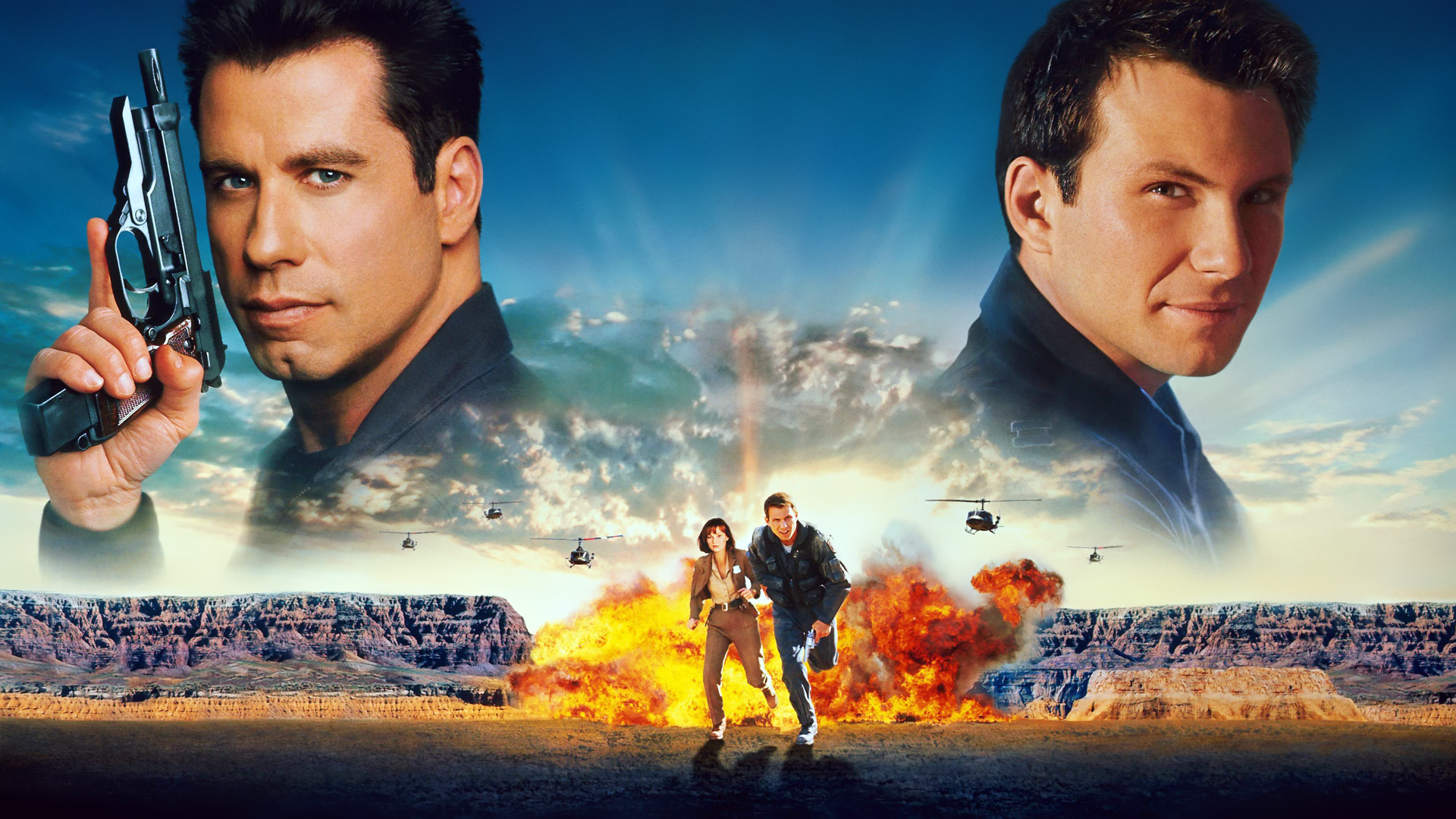
We've all played the game in our heads. We hear the "Mastermind" theme and imagine what our specialist subject will be. I've always had a few ideas kicking around in my head. Star Wars, Indiana Jones, Back to the Future, Die Hard and Jurassic Park are films I've seen a tom of times and would be able to rattle off answers no problem. But they're far too common. So I've gone for something a bit leftfield. It's a film I've seen more than anyone really should have, but I just love it too much. It is 1996's Broken Arrow starring John Travolta and Christian Slater. 

This was John Woo's second film since making the leap to the States after 1993's Hard Target starring Jean Claude Van Damme. That film is another guilty pleasure, but doesn't have a patch on this one. Conversely, Face/Off is arguably a better movie, but again this film has more charm to it.

Take the opening scene. In it we see a sparring match between Vic Deakins (Travolta) and Riley Hale (Slater) - you've got to love 90s action hero names. Rather than some lame exposition, we see the two communicate while sparring which gives us insight into the type of relationship they have. Deakins is clearly trying to groom Hale into being his equal, but Hale is the rebellious type and has his own style. The fight itself foreshadows whats to come in the film, and ends with an awesome shot of the two touching gloves, which signifies the end of their match, but can also be seen as the start of the "match" in the context of the movie.

We do end up with a bit of exposition while the two are flying with the live nukes, whereby it's established that Deakins is pissed off with the Air Force, and betrays Hale by giving him the genius "evil John Travolta look", backed by Hans Zimmer's incredible score (more on that later). There's hijinx in the desert as the two play tug of war with a nuclear bomb, with Hale being helped by Samantha Mathis' spunky sidekick Terry Carmichael and Deakins being backed up by his team of generic henchmen led by square haired Howie Long.

Woo's direction is spot on, as always. His use of slo-motion and two handed gunplay has been done to death, but in the mid 90s it was still refreshing and new. The film flies along at a frantic pace, as our heroes go from one inventive gunfight to the next, before reaching the cargo train based finale, where once again Deakins and Hale go mano-a-mano with more at stake than just the $20 they were sparring for at the start.

For all the stupidly enjoyable things in this movie, two things stand out more than any other. The first is the aforementioned Hans Zimmer score, which utilizes some of his usual tricks augmented with some electronic elements, but it's the piece that features Duane Eddy's playing a motif on baritone guitar that sticks in the memory. This, paired with the second memorable element in John Travolta's gloriously OTT performance makes for some great movie moments, and if not for this film who knows what Harry Knowles would have called aintitcoolnews.com?

So there you have it. I don't want people to think I'm not taking this topic seriously. I really love this film. I mean, I could have done The Godfather or any number of films that have been written about ad nauseam, but what can I say that hasn't been said before. With "Broken Arrow" it's a chance to revisit an underrated 90s action flick. Which my mother happens to love. If that's not an endorsement, I don't know what is.

- Kevin Dillon

Kevin writes reviews of new DVDs/Blu Rays to rent, along with the occasional feature for his own blog www.smallscreensaver.blogspot.ie. You can also follow Kevin on Twitter here.

Sunday, 11 August 2013

FILM REVIEW: The Lone Ranger


Gore Verbinski's latest collaboration with producer Jerry Bruckheimer and star Johnny Depp has arrived amidst a whole heap of negative publicity. There's been scathing reviews from across the pond, and a fair few over here, which the trio plus other star Armie Hammer have blamed for The Lone Ranger's lack of success, in turn creating even more discussion about whether they were right to do so. What a lot of these conversations recently have in common is a lot about the box office takings and the reported $190m loss for Disney. But what of the film itself?

Well, it's actually all right.

A young boy visits an old Wild West exhibition in San Francisco in 1933 where he meets an aged Tonto (Depp) who begins to tell him the story of the Lone Ranger. John Reid (Hammer) is journeying back to his home town as a fully qualified lawyer. Unfortunately, he is also sharing the train with the violent outlaw Butch Cavendish (William Fichtner) and a Native American with a bird on his head, Tonto. After Cavendish escapes, John and his brother, Texas Ranger Dan (James Badge Dale) gather up the other rangers and set off in pursuit, but the encounter leaves both brothers dead. Well, mostly dead. John returns to life with Tonto declaring him to be a spirit walker, a man who cannot be killed in battle. Tonto has his own scores to settle and the pair reluctantly combine forces to chase Cavendish down.

A big budget Western is always a risky prospect; it's a genre that has already had its heyday and recent genre mash-ups like Cowboys and Aliens and Jonah Hex have been, frankly, terrible. Then again, the same was once said of the pirate genre and just like he did with Pirates of the Caribbean: The Curse of the Black Pearl, Verbinski has breathed life into the Western, bringing with him a fair slab of subversion in the process. The Lone Ranger is a well-crafted a slick adventure and whilst it doesn't match up to the quality of its swashbuckling predecessor, it certainly makes for quite the spectacle.

What is perhaps the most surprising element is the level of subversion present in this film; The Lone Ranger has been reformed from a symbol of old fashioned American values into someone who actively critiques them. For a summer blockbuster financed by one of the USA's biggest film studios, it spends a lot of its time criticising the nation's past, particularly their many sins in the name of progress. The US Army in particular comes under fire whilst that good old American capitalist greed is the biggest motivator for the villains of the piece. Even the mythology of the Wild West isn't safe, deconstructed in the framing device between the boy and Tonto.

Alongside this, there is also a sympathetic portrayal of Native Americans, long the bad guys of the traditional Western, here presented as a people fighting to keep their traditions and place in the world. The casting of Depp as a Native American is rightly problematic but there does seem to have been a concerted effort to portray the horrors against this culture effectively. The scene in which Reid meets the Comanche and learns of their struggle is one of the quieter moments, but carries an emotional weight that adds another layer to the proceedings. Anyone with the vaguest knowledge of history knows how this turns out so the scenes with the Native American characters pack a decent amount of pathos for what initially comes across as a light-hearted adventure.

The central pairing of Hammer and Depp (which sounds like a badass law firm) generates enough charisma to anchor the film and their relationship evolves nicely over the narrative. Hammer is the straight man to Depp's now familiar gurning and copes with it admirably. His arc is also well-handled as Reid starts off as a bit of buffoon, but rather than this miraculously disappear once he dons the mask, it becomes something he has to deal with and get better at doing so. Tonto is a fascinating character, no longer the sidekick but the equal, a man who is formed from violence and a need for vengeance just as much as John Reid. 

Depp's usual schtick is present but more reigned in than he has been in other films and those fearing another Jack Sparrow need not worry. The tics are there, but not exhaustingly so and his Buster Keaton-esque walk through the big climactic battle is pitched perfectly. In the supporting cast, the excellent Ruth Wilson as the token love interest makes an impact with yet another underwritten female character; Rebecca isn't exactly a wilting damsel in distress and holds her own in the action sequences, but there weren't enough scenes between Wilson and Hammer to develop any sort of chemistry. William Fichtner and Tom Wilkinson as the villains of the piece are both excellent, standing at two ends of the spectrum with the repulsive snarler and the smooth operator respectively. And then there's Helena Bonham Carter with little more than a cameo but milking every moment of that for all it's worth. Plus, she has a prosthetic leg that doubles up as a gun. Of course.

And then there's the action sequences. With plenty of locomotive-based shenanigans to play with, Verbinski pulls off some amazing moments. The first train sequence sets the bar high and there are plenty of traditional Western gunfights and chases throughout to keep genre fans happy. Yet The Lone Ranger's crowning triumph is the climactic battle which really ramps up the action and delivers a thrilling sequence that enthrals from start to finish. Before this moment, Hans Zimmer's score had been largely by numbers but when his reworking of the William Tell Overture kicks in, the film steps up a gear and the results are nothing short of astounding.

It does have its problems however. It's another victim of the curse of the summer blockbuster, clocking in at two and a half hours long, but a stern edit could have cut the majority of the bloat. Expositional scenes abound and once the action set pieces stop and people start talking, the pace can slow to a glacial crawl. The tonal shifts are also a bit of an issue with the plot dealing with some dark subject matter only to have a scene of levity a moment later. Lighter moments to offset darker ones are to be expected in an adventure film, but occasionally, the transition feels rushed and can have a jarring effect. It's a shame really because with the unusually subversive message, the chemistry of its leads and some truly outstanding sequences, The Lone Ranger could have been a great blockbuster.

As it stands, The Lone Ranger is good, not great, but it is a refreshing little oddity of a film that doesn't deserve the vitriolic reception it has received. So don't believe the anti-hype; go and be entertained.

***

- Becky

Follow @AssortedBuffery on Twitter
Or like our Facebook page