Previously on Buffy the Vampire Slayer (and also on Angel): Faith caused havoc and fled to LA, leading to an almighty clash between Angel and Buffy. Riley's aware of their relationship now and is also on the run from the Initiative. Adam is on the loose and working with Spike whilst the Scoobies have been having issues in their friendship.
And so we continue with the Initiative plotline as things begin to descend towards the season finale. Spike revels in his new role as agitator, something bequeathed to him by Adam in order to weaken the Slayer before the monster's big move, Spike wisely pointing out she's nothing without her friends. As he proceeds, the faultlines that have been appearing throughout the season turn into wide, gaping cracks that turn them against each other at a time when a united front is necessary. Meanwhile, Riley learns from Xander the trigger for Angel's curse and when the vamp shows up in Sunnydale to apologise to Buffy after he beats the crap out of some commandos, Riley assumes the worst.
The Yoko Factor is a very mixed bag of an episode (a lot like the season as a whole), but it manages to be one of the marginally better offerings in the Initiative arc by the simple virtue of placing the Scoobies at the heart of it. Its big problem is that it doesn't do it enough. We've been seeing the issues in their friendship arise since Buffy and Willow first started at UC Sunnydale, but it's only really been Spike who noticed anything was amiss amongst the characters, a fact he exploits mercilessly. It's a great, little divide and conquer plan that builds to the episode's best scene that doesn't involve watching Riley get thrown across an alleyway; the Scoobies falling apart.
We've seen them fight before (third season, post-Angel reveal is the most memorable), but it still hurts to see them going out to deliberately hurt each other. The gloves are off, metaphorically speaking (though Buffy looks like she wants to throw down), and every tension that's been niggling away is brought to the fore. Giles' drunk commentary stops it from getting too vicious, but even then, his little barbs about his unemployment demonstrate an underlying anger: "No, I am no Alfred, sir. You forget, Alfred has a job." When Buffy storms out at the end, that's the cliffhanger the episode should've ended with. Despite being more tolerant of fourth season Riley than most, I simply don't give a fig about him going to Adam.
In fact, the only thing involving Riley that I do like in this episode is Buffy putting a stop to the fight between him and Angel by throwing them both across the room. Nothing like showing men who's the real boss. Angel showing up doesn't really do anything in the episode, other than to further Riley's toxic masculinity complex and apologising to Buffy for his actions in Sanctuary. It's nice that he does come back and I'm all for Angel and Buffy having slightly longing conversations about their doomed relationship, but it smacks of attempting to make the episode a bit more interesting.
One of the fun things about this episode (other than Drunk Giles) is spotting what things start to crop up in Restless (ie. one of the best episodes in the history of Buffy and possibly television). There's Willow on about taking a drama class, Xander thinking his friends want him to enlist in the army, Buffy's fear of being left alone and Giles' singing. I've still not worked out if there's a nod to the cheese man anywhere other than in The Initiative when Riley finds out Buffy's likes and dislikes though. The only trouble is, this aspect of the episode only works if you've already seen Restless. First time watchers need not apply just yet.
The final good thing about The Yoko Factor? It sets up for a cracking pair of conceptual finales in both Primeval and Restless respectively. Each deal with the isolation of the Scoobies and the power they yield when they work together. The Initiative arc might be a load of cobblers, but it does bring about some beautiful examinations of the Slayer and her gang.
Quote of the Week:
Buffy: Okay, that's enough! I see one more display of testosterone poisoning and I will personally put you both in the hospital.
(Un)Inventive Kill: Goodbye Forrest, your death (skewered by Adam) was as lame and as unmemorable as you were as a character.
The LA Connection: This episode follows pretty much directly on from the end of Angel episode Sanctuary. Wesley even asks Angel there and then if he wants to go after Buffy.
- Becky
You can read Becky's look at previous episode, New Moon Rising, here.
Follow @AssortedBuffery on Twitter
Or like our Facebook page
Thursday, 28 April 2016
Monday, 25 April 2016
FEATURE: Angel - Sanctuary
Previously on Angel: Faith arrived in LA after putting Buffy through hell in Sunnydale, looking to throw down with Angel and is employed by Wolfram & Hart to kill him. She beat Cordelia and tortured Wesley to get to him, but Angel quickly realised what she needed was help.
Sanctuary picks up from where Five by Five left off as Angel brings Faith back to the office in order to keep her safe. Naturally, Cordelia and Wesley are far from impressed; she uses the company expenses to take a vacation whilst he goes drinking. He's soon approached by the Watcher's Council hit squad, fresh from being beaten by Buffy-as-Faith in Who Are You, looking to finish their business with Faith. Angel's plan to rehabilitate her hits a stumbling block when an exceedingly angry Buffy arrives, demanding to know why her ex is cuddling her nemesis on the sofa. Meanwhile, Wolfram & Hart are attempting to cut their losses by hiring a demon to assassinate the rogue slayer and Kate at the LAPD is also trying to track her down.
I spoke in last week's post about how the show deals with Faith as a person who causes so much chaos but who refuses to deal with the consequences of such and it's a pattern reflected across the two episodes. In Five by Five (and Who Are You), we see the damage done whilst in Sanctuary, Faith takes a backseat as everyone else decides what to do with her. Her conversations with Angel are all theoretical, pondering how she could possibly begin to make up for the damage caused, whether 'sorry' will ever be enough (I love that Buffy won't let her apologise yet - forgiveness is about timing here). As such, it makes her first practical effort, to hand herself into the police, land better as a dramatic finish. It's the first choice she makes entirely on her own and it's her first step on a path to the redemption she, like Angel, will always be fighting for.
There's something about having Faith around that seems to make everyone involved up their game, whether it's on Buffy or Angel. The writing gets tighter, the acting gets better, the drama cuts keener. This episode is no different as the show continues to ponder the question of whether Faith is worth saving or not. Everyone splits into two camps depending on how much Faith has tortured/maimed/switched bodies with you. On the one side is Angel, seeing so much of Faith in himself that he is confident he needs to at least try and save her. On the other side is everyone else, each feeling the effects of the destruction Faith is capable of wreaking, led by Buffy.
Given the last time Angel and Buffy saw each other, it was the end of I Will Remember You (sob) so naturally feelings are still running a little raw, exacerbated by Angel's decision to help Faith who Buffy is, quite rightly, still furious with. This episode though, perhaps more than any other, marks the break between Angel and Buffy quite violently; it's the first time he hits her in his ensouled form and the shock of it, for both Buffy and us, is palpable. Likewise, his speech at the end to her about how she no longer gets to bark orders at him is on point, but so is her belief that Faith cannot be saved and doesn't deserve to be. There's no real wrong answer, but their positions are too different to be reconciled and that final exchange of verbal barbs will have long-lasting effects, particularly spilling over into Buffy.
Sarah Michelle Gellar is a force of nature in this episode, operating on a level of rage that we don't usually get to see from Buffy. "I've lost battles before, but no one has ever made me a victim" is such a great line and it reinforces the trauma that Faith inflicted; Buffy's weakest moments are when she loses her agency, the empowerment that naturally comes from being a Slayer. I love how unyielding she is too, having learnt nothing from her experience as Faith, but also from her experience with Angel. It's only a few months ago that she was arguing with Giles that Angel could still be redeemed, after all. Tim Minear brought in Joss Whedon to write the Buffy scenes and it pays off enormously, allowing the character to operate on the darker level that Angel allows whilst embodying Faith's capacity for destruction.
When speaking of this episode, Whedon states that it's the moment "the training wheels came off" and that he understood "what Angel is and it's not Buffy." That scene feels like a clean break for the audience too, a swift delineation for the new show that's finally standing on its own. The evil in Buffy, for the most part, tends to be easily categorised. People do bad things and Buffy dispatches them accordingly as the good guy, not resorting to anything particularly underhand to do so. The waters will muddy in the later seasons of the show, but it operates on that basic level. In Angel, nothing is defined in simple terms and Faith's involvement here illustrates that perfectly. He's in the business of saving now and will resort to whatever methods he can to do so (I'll definitely touch more on this in the fifth season).
Fittingly, it's the last time we see Buffy on the show, though Angel will return to Sunnydale a few more times. Although it would become an issue of scheduling difficulties rather than intent, it works to Angel's benefit. Sanctuary might not have a happy ending, but it's the right one. And I didn't even get to talk about the rooftop fight scene, which is so damn good (notice how Buffy immediately moves to protect Faith; she ain't all bad kids).
Quote of the Week:
Faith: I've got to be the first Slayer in history to be sponsored by a vampire.
The Sunnydale Connection: This episode follows on from the events of Who Are You and features the most crossover characters (five) in one go: Buffy, Faith, Collins, Smith and Weatherby, with eight if you count Angel, Wesley and Cordelia, considering they originated on that show.
- Becky
You can read Becky's look at the previous episode, Five by Five, here.
Follow @AssortedBuffery on Twitter
Or like our Facebook page
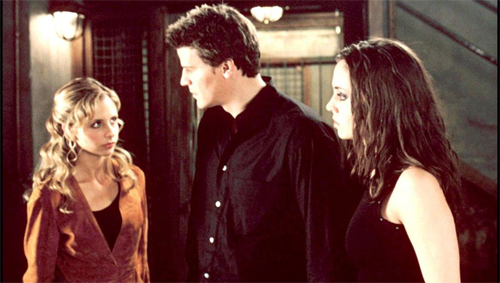
Sanctuary picks up from where Five by Five left off as Angel brings Faith back to the office in order to keep her safe. Naturally, Cordelia and Wesley are far from impressed; she uses the company expenses to take a vacation whilst he goes drinking. He's soon approached by the Watcher's Council hit squad, fresh from being beaten by Buffy-as-Faith in Who Are You, looking to finish their business with Faith. Angel's plan to rehabilitate her hits a stumbling block when an exceedingly angry Buffy arrives, demanding to know why her ex is cuddling her nemesis on the sofa. Meanwhile, Wolfram & Hart are attempting to cut their losses by hiring a demon to assassinate the rogue slayer and Kate at the LAPD is also trying to track her down.
I spoke in last week's post about how the show deals with Faith as a person who causes so much chaos but who refuses to deal with the consequences of such and it's a pattern reflected across the two episodes. In Five by Five (and Who Are You), we see the damage done whilst in Sanctuary, Faith takes a backseat as everyone else decides what to do with her. Her conversations with Angel are all theoretical, pondering how she could possibly begin to make up for the damage caused, whether 'sorry' will ever be enough (I love that Buffy won't let her apologise yet - forgiveness is about timing here). As such, it makes her first practical effort, to hand herself into the police, land better as a dramatic finish. It's the first choice she makes entirely on her own and it's her first step on a path to the redemption she, like Angel, will always be fighting for.
There's something about having Faith around that seems to make everyone involved up their game, whether it's on Buffy or Angel. The writing gets tighter, the acting gets better, the drama cuts keener. This episode is no different as the show continues to ponder the question of whether Faith is worth saving or not. Everyone splits into two camps depending on how much Faith has tortured/maimed/switched bodies with you. On the one side is Angel, seeing so much of Faith in himself that he is confident he needs to at least try and save her. On the other side is everyone else, each feeling the effects of the destruction Faith is capable of wreaking, led by Buffy.
Given the last time Angel and Buffy saw each other, it was the end of I Will Remember You (sob) so naturally feelings are still running a little raw, exacerbated by Angel's decision to help Faith who Buffy is, quite rightly, still furious with. This episode though, perhaps more than any other, marks the break between Angel and Buffy quite violently; it's the first time he hits her in his ensouled form and the shock of it, for both Buffy and us, is palpable. Likewise, his speech at the end to her about how she no longer gets to bark orders at him is on point, but so is her belief that Faith cannot be saved and doesn't deserve to be. There's no real wrong answer, but their positions are too different to be reconciled and that final exchange of verbal barbs will have long-lasting effects, particularly spilling over into Buffy.
Sarah Michelle Gellar is a force of nature in this episode, operating on a level of rage that we don't usually get to see from Buffy. "I've lost battles before, but no one has ever made me a victim" is such a great line and it reinforces the trauma that Faith inflicted; Buffy's weakest moments are when she loses her agency, the empowerment that naturally comes from being a Slayer. I love how unyielding she is too, having learnt nothing from her experience as Faith, but also from her experience with Angel. It's only a few months ago that she was arguing with Giles that Angel could still be redeemed, after all. Tim Minear brought in Joss Whedon to write the Buffy scenes and it pays off enormously, allowing the character to operate on the darker level that Angel allows whilst embodying Faith's capacity for destruction.
When speaking of this episode, Whedon states that it's the moment "the training wheels came off" and that he understood "what Angel is and it's not Buffy." That scene feels like a clean break for the audience too, a swift delineation for the new show that's finally standing on its own. The evil in Buffy, for the most part, tends to be easily categorised. People do bad things and Buffy dispatches them accordingly as the good guy, not resorting to anything particularly underhand to do so. The waters will muddy in the later seasons of the show, but it operates on that basic level. In Angel, nothing is defined in simple terms and Faith's involvement here illustrates that perfectly. He's in the business of saving now and will resort to whatever methods he can to do so (I'll definitely touch more on this in the fifth season).
Fittingly, it's the last time we see Buffy on the show, though Angel will return to Sunnydale a few more times. Although it would become an issue of scheduling difficulties rather than intent, it works to Angel's benefit. Sanctuary might not have a happy ending, but it's the right one. And I didn't even get to talk about the rooftop fight scene, which is so damn good (notice how Buffy immediately moves to protect Faith; she ain't all bad kids).
Quote of the Week:
Faith: I've got to be the first Slayer in history to be sponsored by a vampire.
The Sunnydale Connection: This episode follows on from the events of Who Are You and features the most crossover characters (five) in one go: Buffy, Faith, Collins, Smith and Weatherby, with eight if you count Angel, Wesley and Cordelia, considering they originated on that show.
- Becky
You can read Becky's look at the previous episode, Five by Five, here.
Follow @AssortedBuffery on Twitter
Or like our Facebook page
Wednesday, 20 April 2016
FEATURE: Buffy the Vampire Slayer - New Moon Rising
Previously on Buffy the Vampire Slayer: Oz departed Sunnydale after realising that he wasn't as in control over the werewolf as he thought, leaving a heartbroken Willow in his wake. She developed a relationship with Tara, a fellow witch, instead which is now a romantic one.
The Scooby Gang meet to discuss Buffy's recent lack of demonic activity and the Initiative's sudden rise in inmates with Tara joining them in an official capacity for the first time. However, at the end of the meeting, Oz returns, throwing the wolf amongst the pigeons. His return not only causes problems for Willow, but also for Buffy as the revelation that he's a werewolf prompts Riley to exhibit some extreme anti-demon sentiments, naturally getting Buffy's back up. When Oz runs into Tara on campus, he realises that she's involved with Willow and the resultant reaction causes him to wolf out. When he's captured by the Initiative, Riley is finally forced to choose between Buffy and his career in order to get Oz out before he gets hurt.
Oh Oz. You continue to break my heart with your wolfy soul-searching. It may be an episode heavy on the Initiative (though thankfully points out they're all dicks in the process), but it's also one heavy on the emotion, particularly for Willow. We all know how badly the break-up with Oz affected her so seeing him back tugs on the heartstrings almost instantly. It's a lovely little goodbye episode for the two of them after the abrupt end to their relationship back in Wild at Heart, whilst also marking a new beginning for Willow. She finally reveals her relationship with Tara to Buffy and confirms it to Tara too. It's all a bit heartwarming.
New Moon Rising itself deals with the unconventionality of love in a variety of ways, largely seen through the metaphorical prism of humans in love with demons in order to. Buffy reacts the way she does to Riley's black-and-white view of the world because she's no stranger to an unconventional relationship, as we all know, and ends the episode telling Riley about her past with Angel. His belief that Willow's relationship with Oz is somehow lesser because he happens to be a werewolf doesn't quite function entirely as a metaphorical homophobic reaction to a lesbian relationship, but the recognisable attitudes are there. Buffy flying off the handle at him in defence of her friends is a wonderful moment, built on beautifully by the scene in which she finds out that Willow and Tara are dating.
That scene is one of the best conversations in the Buffy-Willow friendship, a testament to how strong their connection is, but also to how the show functions as an examination of human experiences. There's no demonic parallel here; it's just simply two best friends having a heart to heart in which one happens to reveal she's in a lesbian relationship now. Buffy's reaction, momentary wiggins followed by complete and utter acceptance, feels so human as does the trust that Willow immediately places in her best friend. It takes a hell of a lot to shake that relationship, let's face it. Buffy gets the opportunity to practice the acceptance that she preaches to Riley and for Willow, it allows her to properly begin her relationship with Tara.
The episode itself, aside from having it as the source of conflict for Oz and Willow, doesn't make a huge deal out of it when it so easily could have done for effect. Oz's problem with Tara is just that she has replaced him in Willow's affections and he didn't expect that to have happened with anyone. But there's no soaring, dramatic music, no tearful revelations or torturous monologuing. It just happens that two people have fallen in love. The show has a few faults over the years, but the Tara and Willow relationship still feels like one of their most quietly revolutionary moments, particularly at a time in which gay relationships on TV weren't as commonplace as they perhaps are now.
Watching it all these years later, New Moon Rising feels as if it's another step in the show's maturity with its deft handling of social issues that it has always had, but with perhaps more confidence in itself. The fourth season is a tricksy one, as I've mentioned a few times before, but it does form an effective bridge between the high school years of seasons 1-3 and the more adult years of 5-7. It's not surprising it feels a little muddled after it has to refind its feet, but this episode is a good demonstration of how it's getting there.
Quote of the Week:
Giles: How did you get in?
Spike: The door was unlocked. You might want to watch that, Rupert, someone dangerous could get in.
Buffy: Or someone formerly dangerous and currently annoying.
Let's Get Trivial: Although she would go on to become one of the show's most beloved characters, there was an initially negative reaction to Tara following this episode because she was seen to be breaking up Willow and Oz all over again.
Demonology 101: This episode proves that the werewolf condition is something that can be controlled. It doesn't necessarily impact the television side of the series, but Oz's continuing story in Season 8 explores it further.
- Becky
You can read Becky's look at previous episode, Where the Wild Things Are, here.
Don't forget, Becky's also doing an Angel rewatch alongside the Buffy one. Check out her look at Five by Five here.
Follow @AssortedBuffery on Twitter
Or like our Facebook page
A Thank You to Victoria Wood
The news that comedian, actor, writer, singer, songwriter and goddamn hero, Victoria Wood, had passed away hit us both like a brick in the face. Her legacy is undeniable, adored by everyone, and she forms one of the squares in that great British patchwork of comedy heroes. Christmas isn’t Christmas without Morecambe & Wise, and Victoria Wood. But, as we're sure is the case for a lot of her fans (so beloved and important was she to all) there’s also a deep personal link for us with Victoria Wood because, you see, without her, Assorted Buffery might not have existed.
Back in 2008, we were but lowly first year English and American Literature students, meeting for the first time outside of our seminar group to put together a presentation on some literary theory or other that we didn't understand and now have no recollection of. Both of us were slightly awkward and nervous in that ‘enforced social situation’ way. We also happened to have northern accents in common, an affliction that felt like a rarity at our particular university. It shouldn’t matter, but it’s one of those little things you really notice when you’re anxious and in a new place.
It wasn’t until one or the other of us (neither can remember who) mentioned our Victoria that our friendship really began and within weeks of this meeting, we started writing together, something we’re still doing to this day (albeit more sporadically than we’d like). This blog is a product of that relationship. To quote someone offhand is such a little thing, but it changed our lives.
The 'little things' is a good way to describe Wood’s comedy. Her eye for details in everyday life, the banal and the ordinary defined her sense of humour and her wit. The infamous Let’s Do It (The Ballad of Barry and Freda) lyrics are a glorious mash of the everyday with the randiest housewife you’ve ever heard, each line thought through perfectly. The fact she can’t handle all of the tenors in a male voice choir, but only half, is the kind of detail you might miss when guffawing on first listen, but it adds to the richness that defines her brand of comedy. Because as someone once said, again we can't remember who*, she never just chose a word as her punchline, it was always the word. The perfect one. A genius, comic attention to detail.
However, none of it would’ve worked nearly as well without the extraordinary warmth that she brought to everything she did. Even when she was taking the mick out of daft soaps with wobbly sets in Acorn Antiques, period dramas in Lark Rise to Cranchesterford, or poor teenagers with ambitions of swimming the English Channel, whilst there was a cunning shadow of darkness lurking in every sketch, there was also a huge amount of affection for the material and her characters.
So we’d like to take this opportunity to say thank you to you, Victoria, for giving two nervous freshers a conversation topic that so thoroughly distracted us from our seminar presentation that we can’t even remember what it was on. Thank you for being the catalyst for a great working and personal relationship. Thank you for all the times that you’ve made us laugh until we’ve cried and/or felt sick (Barry and Freda, we’re looking at you). Thank you for teaching us to find the humour in the tiniest, most ordinary of details. Thank you, most of all, for teaching two northern girls that they could be funny and clever and witty and nerdy and that anything was possible. We miss you already.
*we think it might have been Celia Imrie.
- Jen & Becky
Monday, 18 April 2016
FEATURE: Angel - Five by Five
Previously on Angel: And Buffy technically. Faith is out of her coma and has already terrorised Buffy. Angel once tried to save her, but Wesley's intervention with the Watcher's Council destroyed her trust in any of them completely.
Faith arrives in LA and promptly beats a guy up, putting her on Wolfram & Hart's radar. After Angel convinces a witness to testify against a client of the demonic lawyers and loses them the case, they set Faith on his tail, paying her to kill him. She immediately starts messing with them and kidnaps Wesley, torturing him to tempt Angel into coming after her. Meanwhile, we get more flashbacks, this time of the curse as Angel's soul is returned to him and he struggles to cope with the initial guilt of all the people he's killed.
Oh, this episode is a bit good, isn't it?
Bringing in a lot of the things that have been developing over the course of the last few episodes such as Angel's redemption, Wesley's own desire to prove himself and the machinations of Wolfram & Hart all colliding as a result of the Faith catalyst. The episode's flashbacks serve a great purpose here too; it's not so much about Angel's own development, but allowing the audience to understand how well-positioned he is to work with Faith. He knows exactly what she's going through right now because he's been there himself, dejected, suicidal and alone. It provides a strong core through the episode that builds into the impressive climactic fight.
There's also a brutality here that is rarely seen in either Buffy or Angel except when Angelus is on the prowl, which solidifies further the comparisons between Angel and the rogue slayer. That final fight is an intense one, two incredibly strong beings fighting it out to the death, one reluctant to kill the other who is desperate to die. It's powerfully done too; the storm at the end that rains down on them and Angel's reluctance to fight back until the crucial moment builds that intensity to almost unbearable levels. When Faith finally breaks down, it's a relief for the audience too. Sure, she's a bad guy at this point, but she's too damn fascinating to want dead.
I love Wesley's trajectory over the course of the narrative too, occurring more in the background, for obvious reasons, than Angel and Faith. Angel makes it clear early that the former watcher is at fault for how Faith is now, something Wesley realises and clearly feels terrible about, to the point where he keeps trying to save her, only to be tortured for his efforts. He grows a little more backbone each time he's faced with adversity and this is no different, standing up to Faith admirably. It even pushes him to the point of being prepared to kill her in order to save Angel, but like the rest of us, doesn't want to see the act happen once he realises just how broken she is.
Eliza Dushku really owns the role here, channeling all of Faith's external arrogance and internal self-loathing into one huge, violent and unpredictable cocktail. It's easy to forget how few episodes Dushku actually appears in because she makes such a big impression when she does. Though her initial function was to be placed as an opposite to Buffy, she works hard to dig deep into the implications of that as well as transcend what could've been a simplistic alt-Slayer role.
The scene in the club is a perfect encapsulation of the character's act. She's fully prepared to start the fight and cause chaos, but utterly not fussed about the consequences happening around her. The beauty of Five by Five's narrative is that it breaks down that barrier, proving that not only is she paying attention to the consequences of her actions, but that they're affecting her deeply. Wanting to die is the only way out she can see for herself at this point. It's up to Angel to try and bring her back from that.
As we've seen in the first season, Angel's at its best when it dispenses with the procedural style affairs and instead uses the stories to focus on the characters we already care about. Sending Faith into Angel's world is a genius move; the two characters have so much in common (placed continually in parallel even beyond the TV series and into the comics). I didn't even get into the Wolfram & Hart stuff, but hey there Lindsey and Lilah, I love your sparring.
Quote of the Week:
Lindsey [as Faith kicks the crap out of his colleague]: Jesse, I think you'd better make it three for dinner instead of four...
Let's Get Trivial: The violence proved a little too much for our British censors and it lead to this being the only Angel episode to receive an 18 certificate in the UK.
Demonology 101: I love that Phantom Dennis tries to protect Cordelia from Faith. He's such a babe.
The Sunnydale Connection: The experience that Giles describes to Angel as "rough" is of course the events of This Year's Girl and Who Are You in which Faith swapped bodies with Buffy via a magical doohickey.
- Becky
You can see Becky's look at previous episode, Eternity, here.
Follow @AssortedBuffery on Twitter
Or like our Facebook page
Thursday, 14 April 2016
FEATURE: Buffy the Vampire Slayer - Where the Wild Things Are
Previously on Buffy the Vampire Slayer: Riley and Buffy have got things back on track after he accidentally slept with Faith in Buffy's body. Willow's in a relationship with Tara now and Xander's been with Anya for a while, who is still rather insecure in their relationship.
Ah. The sex house episode. There are some episodes you return to and wonder what on earth the writers' room had been imbibing the week they came up with this one. Buffy and Riley spend the entire episode having sex, pretty much, because of some weird curse that has been placed on Lowell House by the residents that haunt it. When a frat party is held, the sort-of-ghosts come out to play; there's all kinds of other weird sex things going on and it's up to the rest of the Scoobies to solve the mystery of the house and rescue Riley and Buffy before they're consumed by the building. It turns out the not-really-spirits that haunt the building were once ruled by a strict, conservative disciplinarian who would violently punish them for any transgressions.
I don't think this episode would be quite so odd if there was something concrete you could get your hands on as an audience. It's a weird jumble of ideas, each one able to fuel an entire episode, but smashing them all into a haunted house narrative doesn't work. Especially because the house itself isn't technically haunted and the explanation doesn't make a whole lot of sense; so, there are these kids, right, who get abused by their wacko Christian nutjob house director and it makes them really angry, obviously, so they manifest themselves in Lowell House, but only because Buffy and Riley start having sex a lot and their release of sexual energy turns them into human poltergeist batteries. Or something...
See what I mean?
At the heart of Where the Wild Things Are is a discussion about sex that the episode never seems to want to have. If ever there was a story crying out for some kind of sex positive message then this was it. The abuse of the kids happens because Genevieve Holt thinks they're all at it like rabbits behind closed doors. Riley and Buffy activate it because they are literally going at it like rabbits behind a closed door.
Xander and Anya are going through relationship issues because Anya fears that all they have is sex and once that stops, so does the relationship. Their fight to make it through the house becomes a metaphor for their relationship as they get tangled up in other things, but ultimately make it through together. It's about the only real coherent thread running throughout the episode, but it never makes anything of it. It could have been used to demonstrate that sex is a healthy part of a relationship, something to be discussed sure, but nothing to hide away from. Instead, we get an orgasm wall.
In a sense, it feels like a Beer Bad style episode in that it's pulling towards having a moral message, but never goes as far as that previous terrible example because it doesn't commit to that message. Beer Bad even had a relatively solid concept at the heart of it. Where the Wild Things Are never quite sinks to those same depths (perhaps because it does stay so woolly), but it's not far off.
The humour redeems it. Spike coming with Anya to an Initiative party and having to spend most of the night hiding from them is great, so too is the Scooby rallying moment in which he looks as if he's about to help but then, nope. Off he goes.Then there's the whole discovery that Willow used to have a crush on Giles and the fact that he's singing is made out to be the real horror of the episode. He's pretty good, you guys.
Quote of the Week:
Buffy: Ok, you get Fang, I'll get Horny! I mean-
Let's Get Trivial: GILES SINGS. It's the first time we see the musical talents of Anthony Head in the series and Behind Blue Eyes is great... It's no Exposition Song though. Bring on Restless.
Sunnydale Who's Who: Kathryn Jooston plays the horrible Genevieve Holt, but she's much more famous as cookie-wielding Mrs Landingham from The West Wing or battleaxe Mrs McCluskey from Desperate Housewives.
- Becky
You can read Becky's look at previous episode, Superstar, here.
Follow @AssortedBuffery on Twitter
Or like our Facebook page
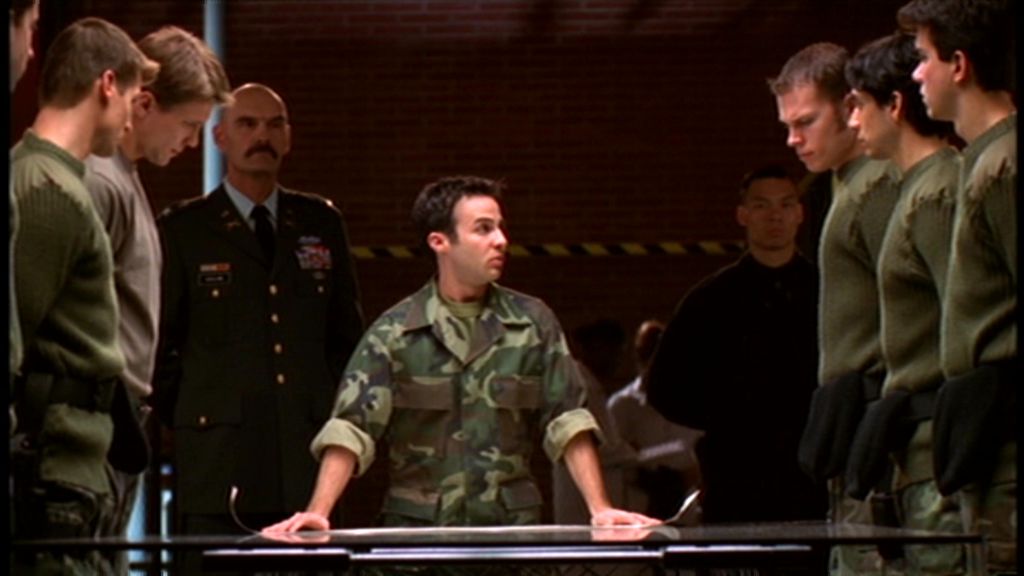
Ah. The sex house episode. There are some episodes you return to and wonder what on earth the writers' room had been imbibing the week they came up with this one. Buffy and Riley spend the entire episode having sex, pretty much, because of some weird curse that has been placed on Lowell House by the residents that haunt it. When a frat party is held, the sort-of-ghosts come out to play; there's all kinds of other weird sex things going on and it's up to the rest of the Scoobies to solve the mystery of the house and rescue Riley and Buffy before they're consumed by the building. It turns out the not-really-spirits that haunt the building were once ruled by a strict, conservative disciplinarian who would violently punish them for any transgressions.
I don't think this episode would be quite so odd if there was something concrete you could get your hands on as an audience. It's a weird jumble of ideas, each one able to fuel an entire episode, but smashing them all into a haunted house narrative doesn't work. Especially because the house itself isn't technically haunted and the explanation doesn't make a whole lot of sense; so, there are these kids, right, who get abused by their wacko Christian nutjob house director and it makes them really angry, obviously, so they manifest themselves in Lowell House, but only because Buffy and Riley start having sex a lot and their release of sexual energy turns them into human poltergeist batteries. Or something...
See what I mean?
At the heart of Where the Wild Things Are is a discussion about sex that the episode never seems to want to have. If ever there was a story crying out for some kind of sex positive message then this was it. The abuse of the kids happens because Genevieve Holt thinks they're all at it like rabbits behind closed doors. Riley and Buffy activate it because they are literally going at it like rabbits behind a closed door.
Xander and Anya are going through relationship issues because Anya fears that all they have is sex and once that stops, so does the relationship. Their fight to make it through the house becomes a metaphor for their relationship as they get tangled up in other things, but ultimately make it through together. It's about the only real coherent thread running throughout the episode, but it never makes anything of it. It could have been used to demonstrate that sex is a healthy part of a relationship, something to be discussed sure, but nothing to hide away from. Instead, we get an orgasm wall.
In a sense, it feels like a Beer Bad style episode in that it's pulling towards having a moral message, but never goes as far as that previous terrible example because it doesn't commit to that message. Beer Bad even had a relatively solid concept at the heart of it. Where the Wild Things Are never quite sinks to those same depths (perhaps because it does stay so woolly), but it's not far off.
The humour redeems it. Spike coming with Anya to an Initiative party and having to spend most of the night hiding from them is great, so too is the Scooby rallying moment in which he looks as if he's about to help but then, nope. Off he goes.Then there's the whole discovery that Willow used to have a crush on Giles and the fact that he's singing is made out to be the real horror of the episode. He's pretty good, you guys.
Quote of the Week:
Buffy: Ok, you get Fang, I'll get Horny! I mean-
Let's Get Trivial: GILES SINGS. It's the first time we see the musical talents of Anthony Head in the series and Behind Blue Eyes is great... It's no Exposition Song though. Bring on Restless.
Sunnydale Who's Who: Kathryn Jooston plays the horrible Genevieve Holt, but she's much more famous as cookie-wielding Mrs Landingham from The West Wing or battleaxe Mrs McCluskey from Desperate Housewives.
- Becky
You can read Becky's look at previous episode, Superstar, here.
Follow @AssortedBuffery on Twitter
Or like our Facebook page
Tuesday, 12 April 2016
FEATURE: Angel - Eternity
Previously on Angel: The gang found out first hand what it was like when Angelus got free after Angel experienced a moment of true happiness back in their Sunnydale days. He's not the kind of guy you want to party with.
After Angel and Wesley endure one of Cordelia's stage "performances" (you'll never look at Ibsen the same way again), the vampire with the soul of gold, saves the life of a considerably more famous and more talented actress, Rebecca Lowell. He naturally refuses any sort of payment for his services, but Rebecca returns, tasking Angel to help her out with a stalker issue she's been having. He's reluctant to take the case, much to Cordelia's annoyance, as he's attracted to her, but his natural heroic ways get in the way. However, little does he realise how affected Rebecca is by her flagging career and the lengths to which she'll go to save it, unleashing someone everyone would rather have kept hidden.
Eternity is one of the most memorable episodes in the first season run, a keen examination of isolation and desperation with a 'be careful what you wish for' kicker at the end. Like the other good episodes here, it focuses on the way in which the case affects one of our central characters and it's Angel's turn in the spotlight once again. Every now and again during this show, it likes to reacquiant us of the stakes (pun intended) of his battle against evil and, more importantly, his battle against himself.
We haven't seen the most recent version of Angelus proper since Becoming and Eternity offers up a timely reminder of just how sadistic and horrible Angel's alter-ego is. The episode does it very cleverly; as Angel succumbs to the drug Rebecca gives him, he gradually gets a little more mean before unleashing completely as Angel loses control. When he forcefeeds blood to Rebecca, it feels like a huge violation, not only of Rebecca, but also the audience, unprepared as we are for the arrival of Angelus.
It helps that, even if you've only started watching Angel rather than following Buffy, the cast completely sell the danger of the situation. Boreanaz's performances as Angelus have always been great, but the physical change here is extraordinary; he suddenly looms over everything rather than maintaining Angel's rather hunched presence. Even the slight change in vocal pitch is freaky. It's left with Carpenter to call back to Buffy as Cordy is the only character in this show that has firsthand experience of what Angelus is capable of. Her facing up to him is a brilliant character moment, as well as demonstrating how prepared she is should the worst happen again.
The rest of the episode deals with more universal matters of ageing and relevance as Rebecca's plan to become a vampire is entirely down to her desire to remain youthful enough for her career. The treatment of women in the entertainment industry is an even hotter topic now than it was back in the day as more and more women speak out about some of the horrific treatment they've received or how it makes them feel. Tamara Gorski puts in a solid performance as the desperate, lonely actress and sparks well with Boreanaz to make her one of the more memorable guest stars. You also forget how slimy Michael Mantell is as the Hollywood agent (last seen in City Of trying to land Angel as a client).
However, even though it is but a brief appearance from the monster with the angelic face, it's a memorable one and a keen reminder of the danger that Angel is placed in every day. Not only that, but the danger for those around him too.
Quote of the Week:
Angel [chained to the bed]: So, we're ok then?
Cordelia: I'm too big a person to let something so petty get in the way of our friendship.
Angel: I appreciate that. You're going to untie me, are you?
Cordelia: Pfffft. [She leaves]
Angel: Wesley? Cordelia? ...Guys?
Let's Get Trivial: Rebecca's mansion is the same location used for Lady Gaga's Poker Face video.
Demonology 101: Initially, the episode was simply supposed to focus on Rebecca and be a standard client-of-the-week type deal. It was Joss Whedon who decided that it should have the Angelus spin on it, thus providing the more emotional core that was needed. It is the evil vampire's penultimate appearance in the television Buffyverse.
- Becky
You can read Becky's look at previous episode, The Ring, here.
Follow @AssortedBuffery on Twitter
Or like our Facebook page
Wednesday, 6 April 2016
FEATURE: Buffy the Vampire Slayer - Superstar
Previously on Buffy the Vampire Slayer: Jonathan was a classmate, saved by Buffy when he wanted to commit suicide in the clocktower of Sunnydale High. Riley slept with Faith whilst she was in Buffy's body and Adam's still running around Sunnydale.
When Buffy and the gang feel like a simple vampire nest will be too much of a problem, they turn to the only person who knows how to help... Jonathan. Yes, that Jonathan. Something's happened to Sunnydale and Jonathan is now a superstar, plastered over everyone's walls, the subject of their collages and their master tactician for just about everything. However, the gang soon start to realise that this version of reality isn't quite right and that Jonathan may have been responsible for augmenting a new world that places him at the heart of it.
The episode is such a hilarious takedown of the male power fantasies lived out in stories such as Batman, Star Wars or The Matrix (starring Jonathan, of course) where the seemingly ordinary guy gets to do the coolest things by night and become a, you guessed it, superstar. Jonathan can sing, dance, play the trumpet, fight, solve crimes, inspire couples to go off and have sex, all kinds of things frankly. Danny Strong, so solid throughout his appearances so far in the series, clearly has a ball playing this combination of all awesome characters ever, striding through the episode with tongue firmly-in-cheek.
Superstar offers a kind of utopian vision that earlier Bizarro episode The Wish couldn't. In that episode, we find out what happened if Buffy never came to Sunnydale; here, it's what Sunnydale would be like if someone better came along. Like inserting himself into the credits, he insinuates himself into everyone's life, particularly Buffy's, attempting to solve problems like her relationship with Riley. The episode thrives on this new world, mining comedy from the audience's familiarity with Jonathan and his effect on everyone around it.
It helps that the show wholeheartedly commits to it too. Jane Espenson's screenplay plays up just about everything she can get her hands of, from situating Jonathan in a Wayne Mansion kind of deal to bringing out the Scoobies' insecurities through their relationship to him. Christophe Beck gets to go crazy with the Bond referencing, the score full of big, bold brass, guitar riffs and power motifs whenever Jonathan gets to do something awesome. It easily could've gone too far the other way (Jonathan's face is literally everywhere in the episode), but Espenson brings a pathos to it that keeps Superstar earthbound, especially when everything returns to normal and Jonathan has to face up to what he's done.
Jonathan is the stereotypical nerd of the Buffyverse and the episode finds him living out his ultimate fantasies. And yet, there is always a cost in a kind of Dorian Gray type deal; the ugliness of Jonathan's work manifests itself in the form of a vicious demon that the gang has to defeat. He also struggles with other people getting hurt at his expense, something which he still balks at even when conspiring as part of The Trio, showing his conscience is still there. He even experiences the hollowness of the experience; this superstardom hasn't been earned but wrought by magic. And that never ends well.
The final fight is a work of comedy referencing genius too; anyone who's seen Danny Kaye in The Court Jester will recognise Strong's comedic performance as ever strike by the monster gives him strength and prowess and against it sends him scurrying to hide again. It's a tonne of fun, this episode, and it works to demonstrate the cost of magic, an increasingly important theme. It also gives us a look at Jonathan's increasing ability with magic, something which will return when he hooks up with Warren and Andrew to become Buffy's self-declared nemeses.
Quote of the Week:
Giles: [After Xander accidentally sets a book on fire with a spell]: Xander, don't speak Latin in front of the books.
Let's Get Trivial: The last three cut scenes in the opening credits with Jonathan striding forth, coat billowing behind him, is a perfect Angel mock.
Demonology 101: This is the first time we see an instance of thaumogenesis in the grisly, beardy demon. Thaumogenesis is the creation of a new being, a resultant process of an augmentation spell. There is always a price to pay to balance the effects of the spell. This will happen again in both Buffy and Angel.
Sunnydale Who's Who: Brad Kane provides Jonathan's singing voice. He previously played Tucker Wells in The Prom and is also known as the singing voice for Aladdin. A Whole New World indeed.
- Becky
You can read Becky's look at previous episode, Who Are You, here.
Follow @AssortedBuffery on Twitter
Or like our Facebook page
FILM REVIEW: Batman v Superman: Dawn of Justice
Batman v Superman: Dawn of Justice opens with the same devastation that ended 2013’s Man of Steel, as Supes (Henry Cavill) and General Zod (Michael Shannon) threw down and battled, wreaking destruction upon Metropolis’ skyline. Only this time, it is seen from the vantage point of Bruce Wayne (Ben Affleck), choppered in from neighbouring Gotham City to watch helplessly as his employees are trapped and ultimately killed in the fallout.
It goes to explain away some of his contempt for the Kryptonian but only ever-so slightly. Yet again, we are treated to the now inevitable flashback to Bruce’s parents and their murder, except now they’re played by Jeffrey Dean Morgan and Lauren Cohan, and it’s 1981. There’s another bat sequence too. Necessary? Not remotely but it serves as a heavy-handed reminder that the two main things still driving Bruce are vengeance and fear. Clark is still working at the Daily Planet, loving/saving Lois (Amy Adams) and generally wondering whether Superman can actually exist in a world that doesn’t really know if it wants him or outside of Lois, he really wants it. He also finds himself judging the Bat’s from of vigilante justice. Eventually both are brought together by scheming sycophant Lex Luthor (Jesse Eisenberg) at the opening of a library, no less. Also in attendance is a mystery lady – could she be Wonder Woman? Of course she is, we’ve all seen the trailer.
The action flits between Gotham, Metropolis, the Indian Ocean, Africa and Bruce’s subconscious, all within the first hour or so. Sadly, this lack of focus remains as more subplots give way to some convolution and a few bloated set-pieces, in addition to some rather inexplicable moments which do not serve the overarching plot and feel wholly out of place. For example, Lois having a bath, or a sweaty Bruce hitting a large tyre with a sledge hammer and even the deceased Jonathan Kent atop a snowy mountain are head-scratchers and deserved to have seen the cutting room floor.
Usually, a superhero’s popularity depends upon the context of time and perhaps, due to the darkness of the world as it is, gives way to audiences wanting to see the character as he was - namely the Reeve guise; bumbling geek Clark and the heroic, always got a smile for everyone, Kal-El – or as he is on the page. Snyder has instead used 9/11, terrorism and illegal aliens and has the film(s) reflect this dark, angry, miserable and political world we inhabit. Apparently, in an attempt to ground Superman in some sort of reality; an alien from an extinct planet, who can fly, is indestructible save for interaction with a glowing green rock, and shoots lasers from his eyes… Can he ever really be that realistic? An audience doesn’t need to delve too far to see the potential allegorical readings, they are all fairly obvious.
On the one hand, I miss the red pants, and the confident, almost care-free caped chappy who didn’t really seem to have a temper and was a friend to everyone. Yet on the other, a change is as good as a rest, it worked (mostly) for Batman. The Superman of my childhood is still accessible, and this is the franchise which will see WW onscreen for the very first time so why wouldn’t I give it the benefit of the doubt? Cavill’s Superman is at odds with his alien heritage and human one – as his mother states “you don’t owe the world a thing” but then, when it comes down to it, it is his human side which is the most affected when Luthor finally reveals his play and ultimately his alien self/limitations which helps destroy him. Reeve, interviewed in 1987, told future inheritors of the cape to never lose the humanity of him; “to forget he can fly; [his] super strength. He’s a gentleman.” Cavill’s is a gentlemen but it has to be on his terms and the humanity is there but it has taken a film and a half to uncover it, little to no smiles, and a human Bat to help.
This Bruce is older, greying at the temples, grizzled, tired and so, very angry. There is a ruthlessness to the incarnation; Affleck is actually very good and the irony is, murderous intent aside, this Bruce needs Superman to give his life some (re)purpose. Alfred (Jeremy Irons) is a younger, more sardonic Pennyworth who seems to have less faith in his billionaire brat and wearily (often sarkily) mutters under his breath a lot of the time. The hallucinations/dream sequences (one too many if you ask me) can be read as an alcoholic’s delusions but then a fleeting face from the future may prove integral to the next film but, yes you’ve guessed it, slightly unclear. I like this Bruce. Yes, he’s different, just like all the other actors who have portrayed him, there’s a fury to this one that it great to watch if a little at times growling, ragey and largely unexplained.
As is Luthor’s motive in proceedings – he want Kryptonite for assassination purposes and access to the crash site and Zod’s remains. Why does he need Batman for that? Eisenberg seems to channel Edward Nygma via Mark Zuckerberg – if you’re going to give us Lex then do so, not some weird, obnoxious Riddler-hybrid. He’s a sociopathic teenager hell bent on destroying the one man getting more attention than him. Yes, he’s a villain but he’s irritating rather than intimidating; he is more memorable than Spacey’s turn but not sure how high a bar that is to set, and the hair – why? It’s more distracting than the weird noises he makes.
Which brings me to Wonder Woman, a character I adore, and finally, she’s here. She’s not given nearly enough screen-time, nor given enough dialogue and my expectations were not particularly high following Gadot’s casting but her presence gave me a buzz, people even clapped in my screening for her. I haven’t been lucky enough to see an evolution of character or multiple versions of WW and so, I was happy with the little I saw. She kicks Doomsday’s derriere and seems to thoroughly enjoy doing it and as for the Turkish Airlines bit, SHE GOT OFF THE PLANE (phew) presumably to fly her own invisible one…. But not before she sums up the entire film (and perhaps fanboy-dom in general) in one snarky sentence – about little boys and their lack of inclination to share.
The supporting cast are fine, no real standouts. Callan Mulvey is now Russian arms dealer Anatoli Knyazev, last seen as Jack Rollins in The Winter Soldier (and you thought there could be no DC and Marvel crossovers). Fishburne is back as Perry White and far more flamboyant than the MoS version, Holly Hunter is great as Senator June Finch, who stands in the way of Luthor Jr but whose senate spiel is pointless. “We know what Superman can do” Do we, really? “We haven’t considered what he should do.” What does that even mean? Run every potential saving by the US government? Say, “okay I’ll help those people over there but not those here”? Wait for a phone-call on a flashing red telephone…oh wait. The word unilateral is thrown about several times which is exasperating; as if Superman saving folk is somehow a selfish act. Diane Lane and Amy Adams are, for the most part, bait, or perhaps I’m being unfair. Adams is definitely stronger in her performance here but I am yet to be convinced by her Lois and then there’s all that running about amid rubble and destruction and swimming… all in heels.
Snyder has always been commended for his visuals and there is a depletion of colour (not always as depressing at it sounds) with red, white and blue colour motifs dotted throughout and Affleck’s batsuit appears to riff off of Adam West’s outfit with the black on grey. There are nostalgic nods but let’s face it, these aren’t the characters we grew up with, and as the last week or so have shown, few seem willing to welcome change. I really liked the intertextual links and the Justice League Easter eggs (although, shoehorned isn’t the word) and, obscurely, The Wizard of Oz. It is referenced multiple times and I’m still contemplating why. Perhaps, it is tenuous commentary on American commerce or Lex requires courage, Bruce a brain and Clark a heart and then there’s Dorothy, the infamous orphan as all of our boys here. Plus, 1939, the year of the film’s release and the year Batman was created and joined him in the DC universe and there’s even a witch, sort of but I digress.
By the time the big face off presents itself, it’s not quite worth the wait, actually a little dull and oh so futile but Luthor is the puppet master. When both titular characters realise they should be working together, it should be joyous and not just that they realise they both have mothers named Martha. The score is a little hit-and-miss, Zimmer is renowned for big anthems and when the two titans do finally square up, I was expecting fireworks, not just a damn squib. Lex’s theme (The Red Capes Are Coming) is a standout as is Wonder Woman’s (Is She With You?), that electric cello is really quite something.
All in all, Dawn of Justice plays with some heavy themes; democracy, xenophobia, terrorism – not so terribly far removed from the world we live in, Snyder is determined to make the world as realistic as possible yet removes most of the fun. Truth, Justice and the American way – this *is* the America of today but it all feels too horribly realistic and befuddling – I would have liked Kal to be the beacon of hope his birth parents intended him to be, not least to give Henry Cavill a bit more to do. The religious imagery is still there, Superman is the Messiah (and a very miserable boy) just as in MoS: God v Man, etcetera. There are a multitude of questions and it is left up to the audience to decipher the mess (small children may have difficulty) yet there is levity, nowhere near enough but present.
I’ve accepted the lack of comic-book iconography in Snyder’s interpretation and it’s only a little thing but would it hurt for Supes to smile? I enjoyed far more than I loathed, however, there is just one death that was a little too calculated…Zack, you meanie.
- Hel
Follow @AssortedBuffery on Twitter
Or like our Facebook page
Monday, 4 April 2016
FEATURE: Angel - The Ring
Previously on Angel: Angel's activities in Los Angeles have attracted the attention of a bunch of evil lawyers, Wolfram & Hart, running up against them a few times since he moved in.
A beaten man, Darin MacNamara wanders into the office during a standard Wesley-Cordelia bicker and asks Angel for his help solving the disappearance of his brother, Jack, who was captured by a group of demons. During his investigation, Angel discovers an underground demonic gladiator-type deal going down, not realising that Darin and Jack laid a trap for him until it's too late. He becomes one of the fighters, leaving it to Cordelia and Wesley to find out what's happened to their boss.
After last week's dull, paternal affair, The Ring offers us a tale of something considerably more entertaining, continuing with the darker, demonic underbelly of LA with the added bonus of gladitorial combat and an attempt at a Spartacus-style uprising. It's a simple story idea, but a solid one for a filler episode that mixes in the action thrills with the comedic skills of the main cast. It also presents Angel with the central 'kill or be killed' dilemma, something which goes against everything he's been fighting for since getting his soul back.
Taking Angel out of the picture and trapping him within the cages means that the bulk of the episode's investigating is done by Cordy and Wes, which is every bit as hilarious as it sounds. Watching them try and maintain their cover as undercover cops ("something's going down tonight... something with the man!") is brilliant, but it also shows how well they're starting to work as a team. Although it'll be a while before we see full action Wesley, we get a glimpse here that he's not as bumbling as the impression he tends to give, something that he uses to his advantage at various points.
Boreanaz is a lot of fun here too, given a chance to do both the heroism bit and the comedy bit, particularly in his early scenes in the cages with his more laconic counterpart. And to be more laconic than Angel is quite something. It's another step further away from the rather two-dimensional persona that Buffy Angel was characterised by, moving him into scenarios in which he has to do more than simply look concerned. He also gets to do a lot of action scenes, get his ass kicked and brood about in his vest a lot. So that's nice.
We've known for a while how powerful Wolfram & Hart are, but the episode starts to peel back a little more of their veil through the presence of Lilah and her attempt to free Angel from the fights to get him onside. Their tricksy relationship with him, something that continues right through to the end of the series, is starting to build too. Here, they try the softly-softly approach, but it won't be long before they're back trying to kill him again.
The Ring may be a filler episode, but it's a good one and it keeps the show carving out its own identity, even if it still doesn't quite know what it wants to be just yet. The beginning's a bit noiry, the middle goes a bit comedic and the end gets all Gladiator, but it's entertaining throughout.
Quote of the Week:
Cordelia: Someone ought to create an intra-demon dating base. You know like... archfriend.org, where the lonely and the slimy connect [or Tinder, as it's now known]
Let's Get Trivial: When Wesley asks Cordelia if the 'Demons Demons Demons' has the Vigories of Oden Tal, he's referring to the patriarchal bad guys from She.
LA Who's Who: This episode marks the first appearance of Lilah Morgan, who goes on to be increasingly influential throughout the series.
- Becky
You can read Becky's look at previous episode, The Prodigal, here.
Follow @AssortedBuffery on Twitter
Or like our Facebook page
Sunday, 3 April 2016
DIGITAL REVIEW: Star Wars: The Force Awakens
Episodes I and VII have a similar concept - both go back to a desert planet similar to Luke Skywalker; in The Phantom Menace it was still Tatooine, in Awakens, its analogue world Jakku. Both seek to emulate the pattern of the original film, although considering the "it's just a remake" cries from critics of the new film, Lucas' first prequel is just as guilty if more, right down to the victory parade that makes up the finale. But again, it's the re-occurance of images and themes, which in this case can easily be twisted to fit the narrative of whomever wants to either praise or criticise the given work.
But fuck that. Even with its flaws, Awakens is an experience great enough to make you forget that it was preceded by a middle trilogy. The basic parts are well-constructed; Lawrence Kasdan and Abrams' script is strong enough to provide a backbone for the huge task the film has to not only remind you of Star Wars but to reinvent it, and trusts the viewer enough to fill in the gaps without explicitly stating things, something which in this era of blockbusters is not at all a sure thing. The combination of practical effects and ILM's usual knockout CGI is a lovely thing and Dan Mindel's (film, not digital) cinematography has a somewhat rough texture to it that puts it firmly in a different generation than the glossiness of the prequels and the even rawer original trilogy.
But what will draw you in are the characters. Daisy Ridley's Rey is an instant classic, interestingly the opposite of Luke circa 1977 as all she wants to do is get back home, until the pull of adventure and making a real difference is too much. John Boyega's Finn also wants to get away from it all, especially as he has a First Order-full of stormtroopers on his tail, but again knows what he should be doing rather than what he's been told to do. And then there's Oscar Isaac's Poe, the Han Solo-esque rogue with a sense of adventure and cockiness as well as loyalty, an archetype very much missing from recent adventures.
And of course Han Solo is there himself, as well as Princess (General) Leia and Chewbacca, and we're all glad to see them, with a somewhat reluctant Solo in the mentor role. But again the new generation is what makes this movie, and we not only have BB-8 - an immediate fan favourite from his debut in that trailer so many moons ago and a wonderful combination of character and effects technology - and Adam Driver's Kylo Ren. What's interesting is how young Driver's villain is, and through his story, we learn not only what positions him as a somewhat tragic figure but also how it informs his terrifyingly unpredictable nature, driven by Driver's performance. It took three movies to see Darth Vader's real face but we see his acolyte's true visage early on, and Driver's fiery eyes and mix of arrogance and self-doubt gives a real dimension to the character.
There are some parts that seem perfunctory; the Rathtar scene is not terribly interesting and some of the pilot dialogue just seems to be there again as a callback to IV (same as the even worse pilot chat scenes in I), along with a couple of comedy moments that fall flat (Chewbacca's nurse is pretty irritating), but it's so much fun that you don't really care. So many images stand out as searing into the mind; the opening twist on the standard spaceship post-crawl shot as the gigantic monstrous new Star Destroyer blocks out the light of Jakku; the distant shot of Kylo Ren's shuttle landing amongst the flames where you see the true scale; Rey sliding down an embankment, clearly having fun, behind capital ship wreckage; the lightsaber flashback; the battle in the snow forest; and that final image of Luke Skywalker, clearly haunted and conflicted by seeing his weapon brought back to him.
Accompanying the film is a feature-length documentary, The Secrets of The Force Awakens, that charts the production from genesis to release. It's an essential companion to the film, not only with fantastic looks at the development of the film and the creation of the sets and effects and such, but also conversations with the cast and crew in different stages of production (at one point Ridley and Boyega are in a room together almost interviewing each other), and not only do you understand the incredible craft that produced this film but the love and dedication behind it. Gwendoline Christie tells us how she always loved Star Wars because she felt she fit in the world, Lupita Nyong'o hums the Imperial March as she films her motion-capture scenes, and we have all sorts of family members of those who worked on the original trilogy, along with ILM vet Dennis Muren who had a big hand in every episode so far.
Along with this are several deleted scenes, including one ('Maz's Tunnel') that is exclusive to the digital version. They're all pretty cool, but none of them add anything to the film and were rightly cut. We also have featurettes on the effects, the lightsaber battle in the snow (which incredibly was a set), the creature effects, and John Williams' wonderful score. So fairly substantial, although it does feel like a bigger set is probably in the offing, perhaps for when VIII comes out - hopefully in the vein of the huge Lord of the Rings sets.
But the biggest special feature is the film. As a fan since birth, it's been a painful journey full of mid-highs and depressing lows to have more filmic Star Wars that matches the original trilogy, and I guess it's maybe ironic that it finally happened without Lucas, but we all know of the collaborative nature on 77-83 that wasn't really the case on 99-05. Anyway, enough said - I'm off to watch it again.
- Charlie
Follow @AssortedBuffery on Twitter
Or like our Facebook page
Subscribe to:
Posts (Atom)

