Showing posts with label David Greenwalt. Show all posts

Monday, 13 June 2016

FEATURE: Angel - First Impressions

Previously on Angel: Angel has discovered the useful sanctuary of The Host, where people go to sing in order for him to "read" them. He's also made an ally with Charles Gunn, who had to stake his recently turned sister, and the office has moved into the Hyperion hotel. Elsewhere, Wolfram & Hart have resurrected Darla in order to get to Angel.


Gunn arrives at the hotel for an appointment with Angel to go after a snitch for information on a demon named Deevak, but Angel has been asleep all day, dreaming of a date with Darla. Eventually, they make it to the meet, but are attacked by vampires; they take them out, but Angel struggles in the fight. Later, Cordelia has a vision of Gunn in danger. Unable to reach Angel who is asleep and dreaming again, Cordelia heads out to help Gunn and the pair have to team up, but Deevak is lying in wait for them.

Whereas last week, the focus was very much on Angel himself, First Impressions is a chance for us all to get to know Gunn a little better as well as spending time getting to know the new, improved and more selfless Cordelia. As odd couple pairings go, he of the poverty-stricken minority and she of the white privilege, it's one that's not perhaps mined for as much as its potential would suggest, but it functions enough for the character explorations needed. Gunn's still smarting from losing his sister and his continuing spiral into self-destruction just isn't acceptable now he's part of the team. Cordelia's little pep talk to him at the end of the episode is one of her best moments, a big sign of her willingness to change and put herself out there for other people.

The other great moment of the episode, though not especially important to the plot, is the ongoing development of the friendship between Angel and Wes (which we all know is going to real rocky soon). I don't have much else to say about it, but it's a scene so good that I'm going to print it here:

Wesley: Come on. What are you waiting for?
Angel: [holds up a pink motorcycle helmet] I-I-I really don't think it's gonna fit.
Wesley: Oh, of course it will. Put it on.
Angel: You know, I-I don't need a helmet for protection.
Wesley: Angel. It's the law in California. Do you want us to get pulled over?
Angel: No.
Wesley: Then what's the problem?
Angel: Well, it-it's just, you know... the whole... visibility issue, not to mention the whole hat-head thing and, you know, when you really think about it, how come I have to wear the ladies helmet?

Wesley: Stop being such a wanker and put it on!
[Angel puts the pink helmet on]
Wesley: Looks good. Hop on board gorgeous.
Angel: You'll pay for this.

The other element of the episode and one that plays more into the season's ongoing storyline is the Darla dreams that Angel has been having. Dreams are a funny thing in the Buffyverse, often prophetic, but nearly always dangerous in some way. The episode has some sly fun with Angel's dreams, allowing The Host to crop back up and reference Angel's eclectic music taste as well as showing Angel and Darla moon-bathing, completely with sunglasses and beach loungers. 

I like that Darla's tactic is to tempt Angel away from his path, shortly after his resolve to continue down it and help people for little or no reward. It's especially key after we see his more apathetic state towards humanity in Are You Now or Have You Ever Been, demonstrating that Angel is perhaps a little more corruptible than he likes to think if his resentment is high enough. Having Julie Benz back in full devious Darla mode is always a joy because she's one of the few characters to have made a massive impression with just a little runtime. Exploring her relationship with Angel further, as well as allowing Benz to be all sly, offers a good undercurrent for the rest of the episode.


Quote of the Week:

Cordelia: Maybe *we* can help.

Gunn: You two? I find Deevak, I'm gonna need more than C-3PO and Stick-Figure Barbie backing me up, no offense.
Wesley: Very little taken.

Let's Get Trivial: It's a truth universally acknowledged that a Jane Austen reference is a fine thing to get into a fantasy series about vampires. The episode title is a nod to Pride and Prejudice's original title and the plot carries the familiar hallmarks of two very different people coming together after initially not getting along very well. Not much romance between Cordy and Gunn though.

- Becky

You can read Becky's look at previous episode, Are You Now Or Have You Ever Been, here.

Follow @AssortedBuffery on Twitter
Or like our Facebook page

Tuesday, 31 May 2016

FEATURE: Angel - Judgment

Previously on Angel: The gang are working LA to fight demonic crime and help the helpless. In the process, they find themselves on the wrong side of a bunch of lawyers determined to bring Angel down, resurrecting Darla as part of their plan. Angel has formed an unlikely alliance with a vampire hunter named Gunn.


Since the explosion that destroyed their offices last season, Angel Investigations has been working out of Cordelia's apartment, complete with assistance from Phantom Dennis who has been very keen to help. When Cordy has a vision of a horrific monster, Angel goes on the hunt to track it down, but discovers that, when he kills it, it's not an evil demon. It's protecting a young pregnant woman whose fate is to be decided by a mystical tribunal and Angel just killed her champion. Wracked with guilt, Angel sets about trying to help, taking on the role of protector himself in order to save the young woman and right the wrong he committed.

If ever there was an episode that functions as a microcosm of Angel's ongoing mission, then Judgment is it, boiling down to Angel kills someone and then has to atone for it. One thing Whedon shows (and films) have always excelled at is the reintroduction of the show's MO and key themes, as well as sometimes expanding the world beyond what we're used to. After the Shanshu Prophecy revealed that he will become human again once he achieves his redemption, Angel's been going after the demons in LA hard and fast, but quickly learns over the course of the episode that this isn't about keeping score, but doing the right thing. We're introduced to The Host and his sanctuary nightclub, swiftly confirming the idea that not all demons are evil and that safe places exist within the downtown area.

Within just a few scenes, Angel has reasserted everything we know, reiterated Angel's ongoing quest for redemption and widened the world out to explore something more in how the demon world works. Lorne's introduction and narration is a key part of that, reminding us all of the kind of city LA is in this world (and singing Gloria Gaynor is a cracking joke). Likewise, Angel, Wes and Cordy interrupting the sacrifice in the gym swiftly asserts their respective roles. It's an astonishing bit of exposition that never feels like it, but instead feels like we're cosying back down with a few friends we haven't seen for a while. 

Judgment also contains two of the most memorable images of the series' run. The first is David Boreanaz absolutely slaughtering 'Mandy' in order to get information out of Lorne and admitting he's a fan of Barry Manilow's hit because he thinks it's pretty. Then, there's the big joust itself. I've only seen this episode once prior to this rewatch viewing, but the sight of Angel, on a horse and kitted out like a Knight of the Round Table on an LA street is one so incongruous that it sticks like glue in the memory. Not many shows could pull of that kind of image.

The last scene with Faith is a lovely moment to end on. She and Angel share their respective roads to redemption and support each other accordingly, a nice continuation of the relationship that was touched upon back in the third season of Buffy and cemented in Angel's first season. It offers up a different, more vulnerable dynamic to Angel's character that isn't often seen in his more leadership role with the Angel Investigations crew. It fits nicely into the undercurrent of the episode, around second chances and the ability to change your nature and go against it. 

A strong return then for Angel in the second season. I didn't even touch on Wolfram & Hart, but their Darla plan is already rumbling along nicely in the background. Now, if you don't mind, I need to go and listen to something catchy to get that damn 'Mandy' out of my head.

Quote of the Week:

Angel: There are three things I don't do; tan, date, or sing in public.

Let's Get Trivial: The closing credits feature outtakes from Angel's hilarious performance of 'Mandy'; stay to the very end post "Grrr, Argh" to hear David Boreanaz's Elvis impersonation: "Thank you, thank you very much."

LA Who's Who: The late Andy Hallett joins Angel's revolving cast of regulars as The Host, later known as Lorne. J. August Richards is bumped up to series regular and Eliza Dushku makes a quick appearance as Faith, her name hidden in the closing credits rather than the opening ones to keep the surprise.

- Becky

You can check out Becky's look at previous episode, To Shanshu in LA, here.

Follow @AssortedBuffery on Twitter
Or like our Facebook page

Monday, 23 May 2016

FEATURE: Angel - To Shanshu in LA

Previously on Angel: During a daring raid on Wolfram & Hart with the help of Lindsey McDonald, Angel grabs a scroll for no discernible reason. Meanwhile, Lindsey had the opportunity to leave his employers alive, but instead opted for a considerable raise.


Wesley continues to work on the prophecy that Angel brought back with him from Wolfram & Hart and reveals that it is possibly fated for Angel to die. Rather than worry about it, Angel simply carries on with his usual occupation of saving people. However, the lawyers have a plan on the horizon, something called 'The Raising' and summon a big bad wormy dude to take care of Angel. When he promises to strip Angel of his connection to the Powers That Be, he really goes to town and Wesley and Cordelia's lives hang in the balance.

As finales go, To Shanshu in LA is not your typical, but then, the first season hasn't been particularly typical at any point. There's no real Big Bad to rally against, nor is there a discernible apocalypse to stop. Instead, the focus is on how Angel has now become reliant on his team, having moved from the loner that Doyle clung to in the beginning to the man concerned for his friends and willing to save them at any cost. It's also a pretty big hint towards his growing feelings for Cordelia, something that will bubble under the surface for a while yet.

That intimate focus gives the episode a stronger purpose than simply fighting a bad guy. It makes the world feel bigger, the stakes higher and the consequences more severe. David Boreanaz has to do some emotional heavy lifting here and it really works to illustrate Angel's concern for his friends. I love his final brush off to Kate, partly because it's a good measure of his determination and also because Kate has become such an irritating little role, cropping up at weird crime scenes to pseudo-moralise and look a bit peeved. She's the only weak link in this episode, but thankfully, Angel gives her a good talking to.

The character work elsewhere is lovely and neatly done too. Cordelia, so often seeing her role with Angel as a paycheck rather than a lifestyle, is suddenly subjected to the howls of pain in the city as her mind is opened up by Wormy Dude. It gives her a new sense of perspective, a much more selfless one that shifts her to see her work with Angel as both a necessity and a calling. It's a big development for her. She spent much of her time with the Scoobies resenting her role within the gang, often only helping out begrudgingly when it became clear the end of the world is at stake. Here though, she finally rises to the challenge and even starts making sandwiches.

The wider ramifications of the Shanshu prophecy add to the finale's sense of urgency. Wesley's little mistranslation of it to suggest that Angel is careening towards his death is a brief loss of meaning for Angel. He's already dead so it has no consequences for him and in this frame of mind, redemption is for little more than quenching his own guilt. However, discovering that it might lead to him becoming human again gives both the character and the show something to work towards. It's a positive, heroic endpoint. Naturally it becomes a little complicated as Angel's story to develop, but it gives the show a more concrete focus, something which will only benefit it as it moves forward.

Finally, there's that Darla reveal at the end. It's such a cool season cliffhanger that I almost wish I hadn't seen the rest of the show, just to get really excited about the first episode of the second season. Julie Benz has always been one of the Buffyverse's more memorable recurring characters and I'm looking forward to seeing her around again. Plus, it also means Drusilla will show up some point soon and that's always good for a laugh.

So we have reached the end of Angel's first season. Like the companion fourth season of Buffy, there has been quite the variation in quality, largely due to its need to establish itself as something of the same world, but also very different. Naturally, Angel couldn't go for the same kind of experimentation we see in Buffy''s fourth season, but it's something that has worked well to balance the two shows. The second season will be a little dodgy, but the show does begin to grow in confidence now that it has set out its parameters and darker, bloodier atmosphere. Poor Lindsey eh? Someone give him a hand...

Sorry.

Quote of the Week:

Wesley: Uhh... oops. I may have made a tiny mistake. The word 'shanshu' that I said meant you were going to die? Actually I think it means you're going to live.
Cordelia: Ok as tiny mistakes go, that's not one!

Let's Get Trivial: The episode title is a reference to the film To Live and Die in LA as 'shanshu' is revealed to mean 'to live and to die.'

You can read Becky's look at previous episode, Blind Date, here.

Follow @AssortedBuffery on Twitter
Or like our Facebook page
Tuesday, 17 May 2016

FEATURE: Angel - Blind Date

Previously on Angel: Angel's been causing problems for some shadier-than-normal lawyers from Wolfram & Hart whose previous efforts to stop him have been thwarted. Angel's also made an unlikely ally in the form of homeless street fighter, Charles Gunn.


Angel's on a routine patrol when he witnesses a blind woman, Vanessa Brewer, assassinate a man in front of him. He finds out that she's on trial and attempts to demonstrate her abilities by throwing her sunglasses back to her, which she catches without seemingly ever knowing they're coming. Of course, she's represented by Wolfram & Hart, Lindsey specifically, and she is acquitted of all charges. It turns out Lindsey's a bit of a rising star in the firm and as a result of this victory, he's offered another case when he's told that Vanessa will be employed to kill three children for undisclosed reasons. It's a step too far for the lawyer and he turns to Angel for help.

One of the main reasons I like this episode so much is that it gives me a chance to talk about Lindsey. Lindsey is one of the more fascinating characters of Angel's world, simply because he never quite operates within the same boundaries as everyone else. He can move freely between being good and evil as his situation dictates, but in the end, he will always be a slave to his ambition. Take this episode for instance; standing by whilst kids are killed is not something his rather dubious morality can tolerate, so he switches sides. However, in doing so, he witnesses the real power over life and death that his bosses wield and when they offer him a second chance, he takes it, returning to the darker side of the fence because it's tactically advantageous to do so.

It makes him unpredictable as the show continues because his boundaries are never quite clear to anyone but himself. He knows what he does is wrong, but he also knows what standing by looks like as this episode illustrates. He's a child of poverty and misfortune, someone who has had to claw their way out of a hole in order to have the kind of freedom denied to him. He's the dark, twisted embodiment of the American Dream, one of the few examples of this that the show offers us. 

Blind Date is a more sombre affair than we've seen recently, but it has a couple of really cool set pieces at its heart. The big one is of course the Wolfram & Hart heist that we see Angel and Lindsey pull off with the help of the returning Gunn. It's an elegant mix of comedy (mainly from Gunn's angry black man routine) and the kind of suave burglary you'd expect from Angel. Rather than beat up the demon guarding the vault, he simply blows a Wesley-concocted powder at it and tips it over. It's a nice comic beat in the heart of an otherwise dark episode, but one which will also prove to be a defining one.

Yes, as he goes to exit the vault, Angel notices an old scroll and picks it up for no other reason than he thinks he should. As Wesley reveals at the end of the episode, it contains writings on a vampire with a soul and possibly more information about Angel's place in the world. It's something that he's been struggling to find, particularly since his return from Hell, and this could point him in the way. Earlier in the episode, he finds himself frustrated by the powerlessness he feels in the face of a human world that Wolfram & Hart have got rigged. His vampirism hampers him from doing the best he can, but it also allows him to operate outside that system.

Somewhat helpfully, it's the first episode in a while where all successful parts of Angel have been firing at the same time (it certainly gives me far more to talk about than War Zone did). Though we don't see much of Cordy and Wes, they're both settled into their respective roles and work their way through the exposition with ease. But it's in the dark morality at the heart of the episode that the show really finds its feet. Angel chooses to fight his fight because he can and because it can offer him the redemption he seeks. Lindsey fights only when he has to. Their different views clash spectacularly here, but the two final scenes, where Lindsey accepts his new job and Angel watches over his city, is a perfect encapsulation of both. 

Quote of the Week:

Lindsey: I get myself killed, that'll convince you I've changed?
Angel: It'll be a start.

Inventive Kill: Angel suspends a vampire by the neck with a chain and then uses the pulley system to stake the vampire on a slat sticking out of a pile of pallets. Mad skillz.

LA Who's Who: Jennifer Badger, who plays Vanessa Brewer, was a stunt double for both Charisma Carpenter and Eliza Dushku across both series.

The Sunnydale Connection: When Cordelia comes up against encrypted files, she naturally calls in the wiz, Willow. The half-heard conversation is lovely; "Willow says hey!"

- Becky

You can check out Becky's look at previous episode, War Zone, here.

Follow @AssortedBuffery on Twitter
Or like our Facebook page

Tuesday, 10 May 2016

FEATURE: Angel - War Zone

Previously on Angel: The big guy's had a bit of a bust-up with Buffy over the Faith issue, but his reputation is starting to spread across LA. It's attracting new clients and his fair share of enemies.


Cordelia organises a meeting with a big software billionaire, David, who is having a little issue with the fact he got a bit too into Dungeons and Dragons and went to a demon brothel. Angel takes the case to retrieve any evidence of David's dalliances before his stakeholders can find out. His investigation leads him to a gang of homeless youths in South Central who have been waging a territorial war with LA's vampire population. Trouble is, they think he's a new Big Bad that needs defeating. Hijinks ensue, people are lost in the fight and Angel finds himself with a new begrudging ally in one amateur vampire hunter Charles Gunn.

War Zone suffers from its position in the season, right after the extraordinarily good Faith episodes and prior to the last two episodes, which are decidedly more meaty. It's a bit like Go Fish in the second season of Buffy though thankfully produces something a bit more successful than walking fish men. 

In fact, the whole episode is quite the heavy-handed social exploration, covering the gamut of class from the wealth of David to the grinding poverty that Gunn and his gang endure. There's references to race in there too, though, perhaps wisely, they let the casting of Gunn's people do it for them. It's not the show's best attempt at finding a real-world commonality with demon-fighting, but it's admirable of them to try, even if they don't really find any depth within it nor pursue it to any kind of meaningful outcome.

In truth, the biggest occurrence in this episode is the arrival of Gunn, full of rage and violence, markedly different from Angel's brooding, Wesley's repressed desperation and Cordy's openness. J. August Richards hits the ground running in a role that goes on to have one of the most interesting arcs across the series (though it takes until the fifth season to properly go for it). It's a sad introduction and a sobering one, having to stake his recently turned sister to prevent her from killing him. Although I grow increasingly tired of women being sacrificed in popular culture in order for men to learn lessons, I can't deny it tugs at the heartstrings. 

I do love the final scene between Gunn and Angel, a twist on the usual 'mentor' type relationship in that Gunn doesn't want any advice and Angel doesn't really need to give it. It's a begrudging alliance, for sure, but it'll prove to be a solid one. It also helps that it isn't a scene in which Angel offers to help Gunn, instead switching the power dynamic to leave Angel as the one who might come seeking Gunn's help in future. 

Quote of the Week:

Cordelia: They locked you in, huh?
Angel: No! I just love old meat lockers...
Wesley: You should have tried to call us on your cell phone. You probably forget you had it.
Angel: Those things hardly ever work. Besides, it was a lot easier and quicker to just- Look, I'm the boss here. I say when we use the cell phones and people are gonna die and I have to go.
Cordelia: You're welcome!

Inventive Kill: A badass stake gun on the back of Gunn's truck stakes a vamp from afar.

Let's Get Trivial: Charles Gunn was added to the cast thanks to Joss Whedon deciding that she show needed a character to work with Angel who was very different from either Cordelia or Wesley. It also helped to finally up the Buffyverse's diversity quota, albeit marginally.

- Becky

You can read Becky's look at previous episode, Sanctuary, here.

Follow @AssortedBuffery on Twitter
Or like our Facebook page

Monday, 18 April 2016

FEATURE: Angel - Five by Five

Previously on Angel: And Buffy technically. Faith is out of her coma and has already terrorised Buffy. Angel once tried to save her, but Wesley's intervention with the Watcher's Council destroyed her trust in any of them completely.


Faith arrives in LA and promptly beats a guy up, putting her on Wolfram & Hart's radar. After Angel convinces a witness to testify against a client of the demonic lawyers and loses them the case, they set Faith on his tail, paying her to kill him. She immediately starts messing with them and kidnaps Wesley, torturing him to tempt Angel into coming after her. Meanwhile, we get more flashbacks, this time of the curse as Angel's soul is returned to him and he struggles to cope with the initial guilt of all the people he's killed. 

Oh, this episode is a bit good, isn't it? 

Bringing in a lot of the things that have been developing over the course of the last few episodes such as Angel's redemption, Wesley's own desire to prove himself and the machinations of Wolfram & Hart all colliding as a result of the Faith catalyst. The episode's flashbacks serve a great purpose here too; it's not so much about Angel's own development, but allowing the audience to understand how well-positioned he is to work with Faith. He knows exactly what she's going through right now because he's been there himself, dejected, suicidal and alone. It provides a strong core through the episode that builds into the impressive climactic fight.

There's also a brutality here that is rarely seen in either Buffy or Angel except when Angelus is on the prowl, which solidifies further the comparisons between Angel and the rogue slayer. That final fight is an intense one, two incredibly strong beings fighting it out to the death, one reluctant to kill the other who is desperate to die. It's powerfully done too; the storm at the end that rains down on them and Angel's reluctance to fight back until the crucial moment builds that intensity to almost unbearable levels. When Faith finally breaks down, it's a relief for the audience too. Sure, she's a bad guy at this point, but she's too damn fascinating to want dead.

I love Wesley's trajectory over the course of the narrative too, occurring more in the background, for obvious reasons, than Angel and Faith. Angel makes it clear early that the former watcher is at fault for how Faith is now, something Wesley realises and clearly feels terrible about, to the point where he keeps trying to save her, only to be tortured for his efforts. He grows a little more backbone each time he's faced with adversity and this is no different, standing up to Faith admirably. It even pushes him to the point of being prepared to kill her in order to save Angel, but like the rest of us, doesn't want to see the act happen once he realises just how broken she is.

Eliza Dushku really owns the role here, channeling all of Faith's external arrogance and internal self-loathing into one huge, violent and unpredictable cocktail. It's easy to forget how few episodes Dushku actually appears in because she makes such a big impression when she does. Though her initial function was to be placed as an opposite to Buffy, she works hard to dig deep into the implications of that as well as transcend what could've been a simplistic alt-Slayer role.

The scene in the club is a perfect encapsulation of the character's act. She's fully prepared to start the fight and cause chaos, but utterly not fussed about the consequences happening around her. The beauty of Five by Five's narrative is that it breaks down that barrier, proving that not only is she paying attention to the consequences of her actions, but that they're affecting her deeply. Wanting to die is the only way out she can see for herself at this point. It's up to Angel to try and bring her back from that.

As we've seen in the first season, Angel's at its best when it dispenses with the procedural style affairs and instead uses the stories to focus on the characters we already care about. Sending Faith into Angel's world is a genius move; the two characters have so much in common (placed continually in parallel even beyond the TV series and into the comics). I didn't even get into the Wolfram & Hart stuff, but hey there Lindsey and Lilah, I love your sparring.

Quote of the Week: 

Lindsey [as Faith kicks the crap out of his colleague]: Jesse, I think you'd better make it three for dinner instead of four... 

Let's Get Trivial: The violence proved a little too much for our British censors and it lead to this being the only Angel episode to receive an 18 certificate in the UK.

Demonology 101: I love that Phantom Dennis tries to protect Cordelia from Faith. He's such a babe.

The Sunnydale Connection: The experience that Giles describes to Angel as "rough" is of course the events of This Year's Girl and Who Are You in which Faith swapped bodies with Buffy via a magical doohickey.

- Becky

You can see Becky's look at previous episode, Eternity, here.

Follow @AssortedBuffery on Twitter
Or like our Facebook page

Tuesday, 12 April 2016

FEATURE: Angel - Eternity

Previously on Angel: The gang found out first hand what it was like when Angelus got free after Angel experienced a moment of true happiness back in their Sunnydale days. He's not the kind of guy you want to party with.


After Angel and Wesley endure one of Cordelia's stage "performances" (you'll never look at Ibsen the same way again), the vampire with the soul of gold, saves the life of a considerably more famous and more talented actress, Rebecca Lowell. He naturally refuses any sort of payment for his services, but Rebecca returns, tasking Angel to help her out with a stalker issue she's been having. He's reluctant to take the case, much to Cordelia's annoyance, as he's attracted to her, but his natural heroic ways get in the way. However, little does he realise how affected Rebecca is by her flagging career and the lengths to which she'll go to save it, unleashing someone everyone would rather have kept hidden.

Eternity is one of the most memorable episodes in the first season run, a keen examination of isolation and desperation with a 'be careful what you wish for' kicker at the end. Like the other good episodes here, it focuses on the way in which the case affects one of our central characters and it's Angel's turn in the spotlight once again. Every now and again during this show, it likes to reacquiant us of the stakes (pun intended) of his battle against evil and, more importantly, his battle against himself. 

We haven't seen the most recent version of Angelus proper since Becoming and Eternity offers up a timely reminder of just how sadistic and horrible Angel's alter-ego is. The episode does it very cleverly; as Angel succumbs to the drug Rebecca gives him, he gradually gets a little more mean before unleashing completely as Angel loses control. When he forcefeeds blood to Rebecca, it feels like a huge violation, not only of Rebecca, but also the audience, unprepared as we are for the arrival of Angelus.

It helps that, even if you've only started watching Angel rather than following Buffy, the cast completely sell the danger of the situation. Boreanaz's performances as Angelus have always been great, but the physical change here is extraordinary; he suddenly looms over everything rather than maintaining Angel's rather hunched presence. Even the slight change in vocal pitch is freaky. It's left with Carpenter to call back to Buffy as Cordy is the only character in this show that has firsthand experience of what Angelus is capable of. Her facing up to him is a brilliant character moment, as well as demonstrating how prepared she is should the worst happen again.

The rest of the episode deals with more universal matters of ageing and relevance as Rebecca's plan to become a vampire is entirely down to her desire to remain youthful enough for her career. The treatment of women in the entertainment industry is an even hotter topic now than it was back in the day as more and more women speak out about some of the horrific treatment they've received or how it makes them feel. Tamara Gorski puts in a solid performance as the desperate, lonely actress and sparks well with Boreanaz to make her one of the more memorable guest stars. You also forget how slimy Michael Mantell is as the Hollywood agent (last seen in City Of trying to land Angel as a client).

However, even though it is but a brief appearance from the monster with the angelic face, it's a memorable one and a keen reminder of the danger that Angel is placed in every day. Not only that, but the danger for those around him too. 

Quote of the Week:

Angel [chained to the bed]: So, we're ok then?
Cordelia: I'm too big a person to let something so petty get in the way of our friendship.
Angel: I appreciate that. You're going to untie me, are you?
Cordelia: Pfffft. [She leaves]
Angel: Wesley? Cordelia? ...Guys?

Let's Get Trivial: Rebecca's mansion is the same location used for Lady Gaga's Poker Face video.

Demonology 101: Initially, the episode was simply supposed to focus on Rebecca and be a standard client-of-the-week type deal. It was Joss Whedon who decided that it should have the Angelus spin on it, thus providing the more emotional core that was needed. It is the evil vampire's penultimate appearance in the television Buffyverse.

- Becky

You can read Becky's look at previous episode, The Ring, here.

Follow @AssortedBuffery on Twitter
Or like our Facebook page

Monday, 4 April 2016

FEATURE: Angel - The Ring

Previously on Angel: Angel's activities in Los Angeles have attracted the attention of a bunch of evil lawyers, Wolfram & Hart, running up against them a few times since he moved in. 


A beaten man, Darin MacNamara wanders into the office during a standard Wesley-Cordelia bicker and asks Angel for his help solving the disappearance of his brother, Jack, who was captured by a group of demons. During his investigation, Angel discovers an underground demonic gladiator-type deal going down, not realising that Darin and Jack laid a trap for him until it's too late. He becomes one of the fighters, leaving it to Cordelia and Wesley to find out what's happened to their boss.

After last week's dull, paternal affair, The Ring offers us a tale of something considerably more entertaining, continuing with the darker, demonic underbelly of LA with the added bonus of gladitorial combat and an attempt at a Spartacus-style uprising. It's a simple story idea, but a solid one for a filler episode that mixes in the action thrills with the comedic skills of the main cast. It also presents Angel with the central 'kill or be killed' dilemma, something which goes against everything he's been fighting for since getting his soul back.

Taking Angel out of the picture and trapping him within the cages means that the bulk of the episode's investigating is done by Cordy and Wes, which is every bit as hilarious as it sounds. Watching them try and maintain their cover as undercover cops ("something's going down tonight... something with the man!") is brilliant, but it also shows how well they're starting to work as a team. Although it'll be a while before we see full action Wesley, we get a glimpse here that he's not as bumbling as the impression he tends to give, something that he uses to his advantage at various points.

Boreanaz is a lot of fun here too, given a chance to do both the heroism bit and the comedy bit, particularly in his early scenes in the cages with his more laconic counterpart. And to be more laconic than Angel is quite something. It's another step further away from the rather two-dimensional persona that Buffy Angel was characterised by, moving him into scenarios in which he has to do more than simply look concerned. He also gets to do a lot of action scenes, get his ass kicked and brood about in his vest a lot. So that's nice.

We've known for a while how powerful Wolfram & Hart are, but the episode starts to peel back a little more of their veil through the presence of Lilah and her attempt to free Angel from the fights to get him onside. Their tricksy relationship with him, something that continues right through to the end of the series, is starting to build too. Here, they try the softly-softly approach, but it won't be long before they're back trying to kill him again.

The Ring may be a filler episode, but it's a good one and it keeps the show carving out its own identity, even if it still doesn't quite know what it wants to be just yet. The beginning's a bit noiry, the middle goes a bit comedic and the end gets all Gladiator, but it's entertaining throughout.

Quote of the Week:

Cordelia: Someone ought to create an intra-demon dating base. You know like... archfriend.org, where the lonely and the slimy connect [or Tinder, as it's now known]

Let's Get Trivial: When Wesley asks Cordelia if the 'Demons Demons Demons' has the Vigories of Oden Tal, he's referring to the patriarchal bad guys from She.

LA Who's Who: This episode marks the first appearance of Lilah Morgan, who goes on to be increasingly influential throughout the series.

- Becky

You can read Becky's look at previous episode, The Prodigal, here.

Follow @AssortedBuffery on Twitter
Or like our Facebook page

Monday, 21 March 2016

FEATURE: Angel - I've Got You Under My Skin

Previously on Angel: Angel Investigations now consists of the Dark Avenger himself, Wesley and Cordelia, but the ghost (not literal ghost) of Doyle hangs over the three of them. 


After Cordelia has a vision of a suburban home and a young boy, Angel and Wesley head over to the address just in time for Angel to save the boy, Ryan, from being run over by a car. Wesley does a little investigating whilst Angel is with the family and discovers the luminescent bodily excretions (yum) of an Ethros demon, which is possessing one of the family. The gang spring into action, discovering that it's Ryan who is possessed, not the father as initially suspected. They decide an exorcism is the only way to go. However, as events take their course, it turns out that the demon might not be the biggest foe they have to face this week.

I've Got You Under My Skin marks another move into the darker territory that previous episode She explored, the whole episode defined by a deeply ominous quality from the moment of Cordelia's vision. It's probably the most full tilt that the series has so far gone into horror and the possession aspect of the story allows it liberally reference one of the pinnacles of the genre in The Exorcist. There are little nods, like Cordelia's fear that everything was about to get really vomity, to the wider themes of the episode; family and the traumas that they both suffer and inflict. 

For Angel, it's means of working through his grief surrounding Doyle and his empathy for Mr Anderson, the family patriarch, trying to desperately keep their family together despite the odd occurrences and violence that follows them around. There are the first hints towards Wesley's troubled relationship with his father through a brief line he has about fathers terrorising their children and it's something the demon uses against him during the exorcism. And it establishes that Wesley is prepared to kill Angel if he needs to, something which the vampire acknowledges is a good thing. Hey, we've all seen what he gets like.

The great twist in the episode, of course, is that the demon isn't the one everyone should be worrying about, but Ryan himself (a Whedon addition, reportedly). It's a really clever feint, especially the reveal that the demon was trying to get Ryan to kill himself in order to save those around him. When a soulsucking demon wants someone dead, they're probably not very nice. And so it proves when Ryan attempts to set fire to his sister whilst his parents are locked in their room. All of the work that his father had done to try and keep Ryan safe, protect him from the horrendous acts that have been committed, is undone by virtue of the demon escaping and Ryan being allowed to cut free.

It gives the episode a bleak message; some people simply can't be saved. Just as with Doyle, who willingly sacrificed himself and could never have been saved by Angel, Ryan isn't to be redeemed here. That's where the horror comes from in this episode. Although the score is wonderfully ominous and the atmosphere created by director RD Price and Jeannine Renshaw's script is fantastic, it's the simple, horrifying thought of powerlessness that defines the episode. 

I've Got You Under My Skin should feel like another filler episode and indeed starts off that way, but the marriage between the episode's plot and themes is perhaps one of the best so far and a real statement of darker intent. Ryan may have been taken into custody to get the help that's needed, but there feels like no real resolution simply because the bad guy here is just a little boy, not someone Angel can sink an axe into. Angel was always advertised as grimmer than its Sunnydale-based relative, but it gets fun when the show fully embraces that.

Quote of the Week:

Angel: [Cordelia's] making brownies.
Wesley: Oh is that what I smell? I thought I tracked something in...

- Becky

You can read Becky's look at previous episode, She, here.

Follow @AssortedBuffery on Twitter
Or like our Facebook page

Monday, 22 February 2016

FEATURE: Angel - She

Previously on Angel: Cordy's got a nice new flat and it's haunted, but with a nice ghost. Wesley's now hanging around and helping it out when he can. Angel's finding this whole interacting with humans thing a little hard to handle.


Cordelia's housewarming party gives us a brief insight into Angel's lack of social skills, Wesley's even worse and Phantom Dennis is still awesome. Realising that Wesley's hanging around because he needs a job, Angel welcomes him as an associate in the Investigations and he's on hand as Cordy has a vision of a man being burned alive from the inside out. Complete with exploding eyeballs. Yum. Angel finds himself in the middle of a transdimensional battle, aiding the demon princess Jhiera, who is attempting to free the women of her world, kept as slaves by men, who perform an operation equivalent to a lobotomy to ensure the women remain well-behaved.

Angel has already shown on several occasions so far that is a willingness to take on some of the darker aspects of life than Buffy could do with its lighter fare and She is a classic example of this. In its exploration of female slavery and mutilation at the hands of men, it continues the feminist slant of its sister show, but with more intent to explore the violence of it (though Buffy would tackle this later on). Jhiera's quest to free the women of her society is a fierce cry of independence follows nicely on from last week's exploration of female body violation in Expecting. Like Cordelia's experience, women are abused by the men of their race, forced into subservience. 

The men of her race remove the part of the woman's body that controls their desires and sexual power in order to more subdue them and keep them in their subservient place in society. The parallels to Female Genital Mutilation, an ongoing issue in our own society. Not only is there a physical destruction, but also one of identity as the women who have undergone the procedure refer to themselves as "it" once their bodies have been violated and they have become more malleable. Their sense of self is lost in the process. It's not a graphic horror in this episode, but it's an insidious one and sadly something that remains just as relevant to the way in which women are treated in our own society. 

The balance of the darker elements of the episode are met with some great moments of levity. Not only does Angel give a little speech on Manet's La Musique, he also hints that he is the eponymous creature in Baudelaire's Le Vampire, part of his collection Les Fleurs du mal. I love little references to what Angel got up to during his time as a vampire and it's always amusing when he gets to show off his considerable arts knowledge. This is especially amusing when contrasted to his sheer inability to use mobile phones. However, the crowning comedy moment has to be Angel and Wesley's imagined and real dancing skills respectively. It's just glorious. And I love that we got the end credits too.

With the now solid three member team of Angel Investigations, it's fitting that Wesley's first episode actually employed is such a good one. The writing team of Noxon and Greenwalt write a screenplay that sparkles with characteristic wit but also with an incisive exploration of violence against women. It's helped by a fierce performance from Bai Ling as Jhiera, one of the more memorable additions to the guest characters. I also like that she isn't given any leeway by Angel, despite the obvious support he has for her cause; you don't kill innocent people on Angel's turf, nor do you let his friends die.

It's a great little episode, this one, full to the brim of ideas, anger and charm. Not only do we get an allegory of the way in which women can be controlled and harmed by their own society, but also a look at Angel's code of conduct when it comes to his friend. Oh, and Wesley and Angel's dancing of course. Who could forget that?

Quote of the Week:

Cordelia [to Angel]: I was so glad you came. You know how parties are? You're always worried that no one's gonna suck the energy out of the room like a giant black hole of boring despair. But, there you were in a clinch!

Inventive Kill: Incinerated from the inside out, leading to inadvertent popping of the eyeballs. They didn't show that on Channel 4 back in the day.

LA Who's Who: This episode marks the second appearance of Sean Gunn.

- Becky

You can read Becky's look at the previous episode, Expecting, here.

Follow @AssortedBuffery on Twitter
Or like our Facebook page

Saturday, 30 January 2016

FEATURE: Angel - Somnambulist

Previously on Angel: Angel is still haunted by the crimes he committed in his alter-ego state as the infamous vampire, Angelus. Wesley is now residing in LA after he was fired from the Watcher's Council and wishes to help out with Angel Investigations.


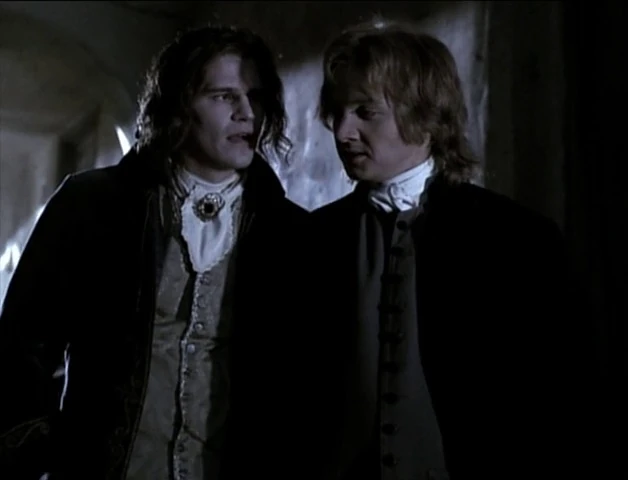
Angel's having nightmares about draining victims in LA and carving a Christian cross into their left cheek. It turns out that there just happens to be a serial killer doing the exact same thing and Kate is on the case. On his return to the office, Wesley notices the connection between the serial killer's modus operandi and that of the seventeenth century Angelus. Angel's spotted it too and upon realising that Angel is somehow committing the crimes in his sleep, they realise that it's the work of a vampire he sired back in the day, keen to relive their life of murderous crime together. With Kate on the case too, it's not long before she discovers the truth about Angel.

I feel like there needs to be some kind of health warning in any episodes where Angelus' Irish accent is deployed. Doubly so for this episode when Jeremy Renner is acting English. It's not quite on the Keanu Reeves in Dracula end of the Bad Accent spectrum, or indeed Angelus', but it's thankfully brief at its most potent and weirdly Transatlantic for the rest of the episode. He's a decent guest star, but nothing memorable, mainly because he's playing a caricature of Angelus, rather than a character of his own, which is kind of the point. I also like that he had no idea about Angel's curse, which suggests he was a pet project of Angelus' outside of the central crew of Darla, Drusilla and the Master, suffering an inferiority complex forever as a result.

After Parting Gifts, this episode becomes a reaffirmation of the show's structure. There's no mention of Doyle and the focus moves away from the team and back in on Angel himself. It's a key episode in terms of his relationship with Kate, transforming their relationship entirely now that she knows the truth. That's the big plot development here, but the episode suffers from treading over old ground too much in order to move the show on from the fairly big change that resulted from Doyle's death.

There have been a lot of references to Angelus throughout this series and in Angel's appearance on sister show Buffy in Amends when everyone keeps asking if he's evil again. There's a nice reminder of it here, not in the flashbacks, but in Kate's profile of the serial killer, overlaid with Angel wandering through LA trying to figure out how to stop Penn. Angelus is something he has to live with and something that becomes increasingly important to his fight across the five seasons of his own show.  But it's the same message we've had again and again throughout the season. 

It's here where the first season shows the cracks in its quality, never really having any thematic resonance beyond that. Even the idea that fuelled a couple of the early episodes, that the monsters of LA were the equivalent to the torment of being an adult, is a retread of the Buffy formula that quickly gets forgotten over the course of the episode. The Shanshu Prophecy is, of course, on the horizon and Wolfram & Hart are lurking in the background, but this is still a show searching for its own identity and not quite succeeding just yet.

Quote of the Week:

Wesley: No sign of any vampire attack... [gets grabbed by Penn] Which is maybe because he's here and has me by the throat. 

Inventive Kill: Kate bags her first vamp, stabbing a huge piece of wood through Angel, missing his heart but impaling Penn's. 

LA Who's Who: I can't not put Jeremy Renner in this little section. Since his brief appearance in Angel, he's gone on to an Oscar nomination, appearing as an Avenger and saying douchey sexist things to the press. So, that's nice. He also goes on to appear alongside Elizabeth Rohm (Kate) in American Hustle, playing husband and wife.

- Becky

You can read Becky's look at previous episode, Parting Gifts, here.

Follow @AssortedBuffery on Twitter
Or like our Facebook page
Tuesday, 8 December 2015

FEATURE: Angel - Parting Gifts

Previously on Angel: Angel's friend Doyle was gifted with visions that allowed him to find people in need. However, Doyle has sacrificed himself to save Angel, Cordy and a host of benevolent demons from the Scourge, but not before kissing Cordy and seemingly passing something to her.


Following Doyle's death, both Angel and Cordelia are dealing with his loss in different ways. Angel attempts to bargain with the Oracles in an attempt to get his friend back, citing that he needs Doyle's visions in order to proceed on his quest. They assure him that Doyle's noble death has to stand but that "when one door closes, another one opens." Back at HQ, he's approached by an empath demon named Barney who seems to have a mysterious figure chasing him, a leather-clad motorbike riding figure to be more precise. Angel agrees to help and Barney lies low at the office. Meanwhile, Cordelia is out for an audition when she is hit by a vision and suddenly the Oracles' meaning becomes clear for Angel. 

I used to think of this episode as a bit of a throwaway one in the aftermath of Doyle's passing, one that is designed to introduce Wesley as the new player in the Angel game and move him into place accordingly. On this rewatch though, I realise that's doing this episode a real disservice because it becomes the very embodiment of "don't judge a book by its cover." This is cleverly layered in from the start with Cordelia's appraisal of Doyle's character as a layabout without much worth who then proves it by saving everyone's lives. There's also Barney, an empath demon who can feel beyond the surface emotions everyone is projecting and find the truth in how they are actually feeling.

Of course, it goes further with Barney because he's the episode's bad guy but spends two-thirds of it under Angel's protection, trying to use him to take out the demon hunter chasing him. The demon hunter appears in shadow or in brief close-ups, stalking his prey with what feels like a cruel efficiency. Only to be revealed to be... Wesley. Angel quickly sees through his more macho leather-clad appearance and we're soon back to the nervous, posturing Wesley we're used to. The moment Angel swipes the crossbow out of Wesley's hands is just perfect.

The episode layers these kinds of switcheroos all the way through it. We go from believing the motorbike guy is the story's bad guy through to the Kungai demon looking like that's the foe, only he proves to be just as much of a victim as everyone else. That it's sadsack Barney whose about to harvest Cordelia's eyes is cleverly hidden. It's one of those instalments that constantly keeps you on your toes and is much more than simply re-introducing Wesley to the Buffyverse. We also get another brief glimpse of Wolfram & Hart; one of their lawyers is the final bidder for Cordelia's eyes at the auction. When the auction goes south and Angel arrives, we overhear her phone call and it's clear from her oblique reference to him that Angel remains on their radar. 

I'm not sure many shows handle a regular cast change-up with the adroitness that Angel manages here. The grieving process for Doyle fuels a lot of the episode, but it never holds it back from embracing the new. Cordelia is now having the visions that made Doyle initially vital to the team (even if she doesn't want them badly enough to kiss everyone she comes across in the city) and Wesley is invited to join them by the end of the episode. There's little ceremony here, but Doyle's death was grand enough. Now, the team rebuilds.

Quote of the Week:

Wesley: I'm a rogue demon hunter now.
Cordelia: Wow! What's a 'rogue demon'?

Inventive Kill: Cordy bags her first demon! She staked a vampire back in her Buffy dies but now she can add Barney to her list.

Let's Get Trivial: The Korean scenes are probably not going to win any awards for their authenticity. Angel's Korean is, in fact, gibberish with subtitles whilst the lady nursing the Kungai demon speaks sort of Korean, but with a terrible accent. Soon is the only one in the scene who manages to speak the language.

LA Who's Who: This marks the last appearance of Glenn Quinn in the main credits. Sob.

- Becky

You can read Becky's look at previous episode, Hero, here.

Follow @AssortedBuffery on Twitter
Or like our Facebook page

Tuesday, 29 September 2015

FEATURE: Angel - Rm W/A Vu

Previously on Angel: Cordelia is struggling to find herself in LA; her career is a non-starter and working for Angel doesn't exactly reap financial rewards. Not much is yet known about Doyle and Angel is still getting used to having people around him all the time.


Cordelia's tiny, messy apartment is a metaphor for how crappy her LA life is so far and when the exterminator not only leaves it covered in dead cockroaches, but in several live ones as well, she decides enough is enough and decamps to Angel's. He's naturally less than happy with this arrangement. Meanwhile, Doyle is approached by some demonic debt collectors. He manages to evade them momentarily and goes to Angel to help. Seeing a mutually beneficial arrangement is to be made, Angel agrees to help Doyle with his bailiffs if Doyle finds Cordelia an apartment. It's all going swimmingly until that apartment turns out to be haunted.

Having gone through some, shall we say, interesting living arrangements in my time, my already deep love of this episode is now combined with a kind of empathy with Cordelia. Granted, none of my places were strictly haunted, but there certainly dwelt in them creatures of odd backgrounds and habits. Continuing with the monster as metaphor here, Rm W/A Vu deals with that struggle to find somewhere to live, something which seems like a factor you can put up with until it starts to affect the rest of your life. For Cordelia, it represents everything that she's lost and finding the pretty little apartment with its view and its nice, tiled fireplace, it's a sign that she's starting to get her life back together.

The move to LA has proven to be one of the best things that the writers could've done for Cordelia; she was always a little too big for Sunnydale and they would have quickly run out of things for her to do there other than repeat her bitch phase at UC Sunnydale. Bringing her to LA, reducing her confidence and landing her in less than savoury circumstances gives them a chance to get the audience on her side. We've always known she has layers (she does well on standardised tests, after all), but now we get them peeled away and explored more fully.

This episode is all about her getting her groove back, the ghost attempting to decrease her self-worth so much that committing suicide seems like an easy way out. Of course, Mrs Pearson (played by the wonderful Beth Grant) didn't reckon on meeting the meanest girl in Sunnydale High. Who doesn't give a cheer when she says "the bitch is back?" Yet prior to that, the episode makes it clear that Cordelia has her own redemptive arc, similar but on a smaller scale to her vampiric boss'. She feels the need to atone for the hurt she caused during high school and to rediscover a more positive purpose that chimes well with working for Angel Investigations.

The focus on the sidekick characters of Angel is really the episode's strength because, whilst we have got the redemptive arc of Angel all sorted, the others have been neglected a little as the show has been finding its feet. Cordelia may be the focus here, but there's some quiet development going on with Doyle and his debt-collecting sub-plot. It's a further glimpse into the ragged, dangerous lifestyle he's been leading, something Angel perhaps offers a way out of with his higher purpose. As the vampire detective ominously warns, Doyle's kind of lifestyle doesn't tend to last too long. It's the kind of foreshadowing that Buffy has always been so good at and it's laying the foundations for one of the saddest yet brilliant episodes in Angel's run. (Just to warn you, that episode ruins me.)

The haunted apartment premise also allows writer Jane Espenson and director Scott McGinnis to hark back to some classic horror, as well as a few not-so classic nods too. Phantom Dennis' face looming through the wall has more than a hint of The Frighteners about it whilst his battles with his mom about the girls he likes is a little Norman Bates. Alas, this is a rewritten Psycho in which Norma sort of wins, at least for a little while, but built on that same kind of misogyny. Mrs Pearson's brand of benign evil is nicely creepy and I always love the moment she stops getting all poltergeisty to yell at someone for breaking a tile in the fireplace. And Phantom Dennis is one of Angel's best ancillary characters, one which I would have loved to have seen more of than we did.

Angel is still bobbing between the character driven episodes like this one and the more detective procedural angle that the show was still aiming for, but Rm W/A Vu is perhaps one of the best examples of the former. It gives Cordelia further motivation and development than simply needing to leave Sunnydale to make something of herself whilst also starting to shade in the background in Doyle's troubled life. It also helps that it's wickedly funny.

Quote of the Week:

Angel: Yeah, it's haunted.
Cordelia: It's rent-controlled!

Inventive Kill: Mrs Pearson bricks her son up into a partition wall so he doesn't run off with his girlfriend.

Let's Get Trivial: This is often cited by Charisma Carpenter as one of her favourite episodes.

LA Who's Who: You may recognise Beth Grant from Donnie Darko: "Sometimes I doubt your commitment to Sparkle Motion.

- Becky

You can read Becky's look at previous episode I Fall to Pieces here.

Follow @AssortedBuffery on Twitter
Or like our Facebook page

Tuesday, 8 September 2015

FEATURE: Angel - I Fall to Pieces

Previously on Angel: Angel Investigations is up and running, but Angel is still having a hard time asking people for money. He's built a foundation for a working relationship with Kate, a cop whose life he saved from a life-sucking sex demon.


As Cordelia's ongoing struggles with Angel Investigations' empty bank account deepen, a Doyle vision leads the gang to Melissa, a woman being stalked by a surgeon who has concocted a weird fantasy in which they're engaged. Angel uses his contact with Kate to get some background on the guy, Ronald Meltzer, a medical maverick who also happened to specialise in psychic surgery. The reason Melissa can always feel he's watching her? Because he is by detaching his eyeball and having it follow her around. As Cordelia would say, "bleurgh." 

Both Buffy and Angel often look at the dangers of gender stereotypes and expectations, particularly when it comes to performative masculinity; Buffy has to deal with entitled jocks and scheming college douchebags, Angel gets to deal with stalkers believing they should have access to a woman's body, just because. Ronald Meltzer is a doctor and a brilliant one at that, but that alone doesn't convince Melissa to fall in love with him and, for her, their relationship ends after one date. However, he's not happy with that and uses his power to insert himself into every aspect of her life. As Kate says, the power of stalkers is in how completely they can take over their victims, even if they're locked up and far away.

It elevates I Fall To Pieces beyond a simple monster-of-the-week instalment into something skincrawlingly creepy, a place where even the victim's home is no longer a safe haven. The voyeuristic aspects with the floating eyeball alone are enough to give you goosebumps, but the episode escalates that further by having Meltzer's hands grope Melissa in bed. It taps in to a very real social anxiety for women, the knowledge that a lot of men out there don't regard your body as your own, but feel they have access to it. The episode draws its power from that and watching it in our contemporary context adds to the creepiness. We live in a world where stories from sites like Everyday Sexism demonstrate how sexual harassment continues to be normalised.

It's to the episode's credit that it managed to take a one-off character like Melissa and make her something more than just the victim of her present situation. In a scene with Doyle in her office, we find out she used to be into extreme sports, specifically bungee-jumping, but the anxiety that has arisen from the stalking has stopped her from doing anything. It's a brief moment and one that benefits from Doyle's terrible way with words ("Don't you worry. When Angel is finished with his case, I can guarantee you'll be wanting to jump off a bridge again..."), but it gives her a little dimension and emphasises the traumatic effect that this situation has on her. That sympathy is also crucial for the unsettling nature of the episode; we already feel awful for her by default, but the extra detail gives it a greater depth.

However, the episode does fall down a little for me when it comes to the main characters; Doyle and Cordelia aren't given much to do beyond their generic vision-having/administration roles and the episode only makes an oblique reference to the connections between Angel and Meltzer. Angelus, Angel's more entertaining but downright evil other half, was famous for stalking, often tormenting his victims as part of his games with them. This was seen overtly in Passion, but also in his relationship with Drusilla. It's clear from a couple of lines that Angel is drawing on his own experience in his psychological profiling of Meltzer, but it doesn't go nearly far enough in making these parallels explicit. Given Angel's quest for redemption, the ongoing arc of the entire series, it could have been another little step forward in him accepting and atoning for his past.

After the unevenness of Lonely Heart, the episode falls into its investigative procedural groove a little faster, demonstrating that Angel has improved his social skills from the pilot and can actually draw in potential victims from Doyle's visions without freaking them out further. However, it still doesn't feel like the show doesn't know what it wants to be just yet. The last three episodes saw it trying to pull away from the Buffy tether, but never quite succeeding. This week, it feels like a lost X-Files episode from the blend of supernatural and scientific to the way in which Cordy briefly Scullys Angel with a possible 'normal' explanation of hidden cameras and the like. Fortunately, it still retains enough of the Whedon/Greenwalt schtick to remain firmly in the Buffyverse.

Though isn't an Angel/Mulder/Scully investigation something we'd all love to see?

Quote of the Week:

Cordelia: What is stalking nowadays? Like, the third most popular sport amongst men?
Angel: Fourth after luge. 

Inventive Kill: Angel disconnects Meltzer's head and then seals his body in separate boxes before depositing them at a building site where they get covered in concrete. Yum.

Let's Get Trivial: Often musical references are snuck into the Buffyverse and this episode finds Doyle repurposing lyrics from Funny Girl's 'People' to try and chat up Cordelia.

Demonology 101: Meltzer's lawyers are from Wolfram & Hart, another step towards the show integrating them into its landscape.

- Becky

You can read Becky's look at previous episode, In The Dark, here.

Follow @AssortedBuffery on Twitter
Or like our Facebook page