Previously on Buffy the Vampire Slayer: Buffy now has a little sister that everyone thinks has been around forever. Xander's dissatisfied with his lot in life as a result of still living in his parents' basement.
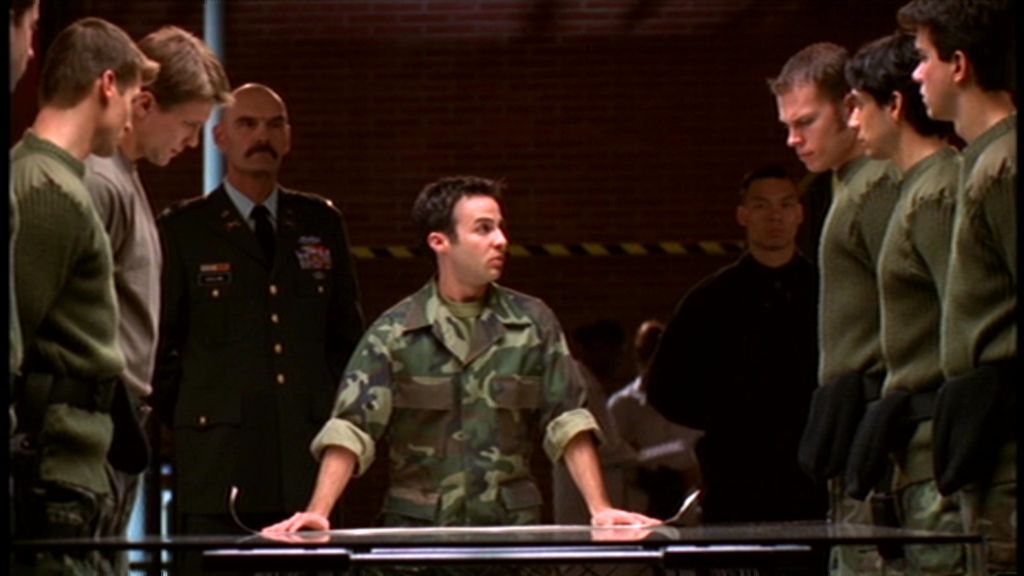
A big, veiny luminescent demon comes gunning for Buffy, but instead whacks Xander with his very own glowstick of destiny at the city dump. Initially, it seems as if our boy's ok and is taken away by the gang, but then, what we believe to be the actual Xander wakes up still in the dump. He's not particularly good at, well, everything, whilst a considerably suaver lookalike inserts himself into Xander's life. Schlubby Xander turns to his oldest friend Willow as Suave Xander gets the Slayer onside. Eventually they figure out that Suave Xander isn't a demonic replacement, but Xander's other half.
It's a Buffy classic storytelling device in this one; whenever any character needs to go through some kind of affirmation from the rest of the Scoobs, they have to go through some kind of transformation first. Think Giles turning into a demon in A New Man, Buffy when she turns invisible or Willow transforming everyone else. It's Xander's turn in this one as the two halves of himself battle it out for surpremacy without knowing they're two sides of the same coin rather than two distinct people. It's not quite Kirk in The Enemy Within but it does make for some good, concentrated Xander hijinks (also, they reference Star Trek together, which is just lovely).
It follows on from his desire to no longer be everyone's butt monkey, a rant seen in Buffy vs. Dracula. Xander's often the Buffy damsel-in-distress and frequently feels he is completely useless to the gang's efforts. It's Schlubby Xander's chief fear in this episode, that everyone's much more taken with Suave Xander and that he's of more use to the general scheme of things. Like The Zeppo, The Replacement is quick to demonstrate that, actually, that's really not the same. The promotion given to Suave Xander is earned by regular old Xander before the events of the episode, same with the credit check that lands him the apartment. As Giles says, everything in both Xanders already exists before the split. He is both Schlubby and Suave.
Also, the fact that the Scoobies keep saving Xander has got to count for something. As Primeval illustrated, he functions as the heart of the group and they'd quickly fall apart without him. His final scene with Riley, in which soldier boy admits he knows Buffy doesn't love him, is a clear indication of that; he's the one that people trust and he's the one that "sees" everything. It's something that will be more explored as the series continues, particularly in the seventh season where his sort-of outsider status helps with keeping Dawn on track. The Replacement is nowhere near as good as The Zeppo nor does it really say anything we don't already know, but it works as a solid reminder of Xander's strengths as well as building his confidence back up.
Quote of the Week:
Schlubby Xander: [Anya] entirely wants us to have sex together! Which would be wrong and very confusing...
Giles: We just, um, need to arrange the candles. Also, we should continue to pretend we heard none of the disturbing sex talk now.
Willow: Check. Candles and pretense.
Demonology 101: Jane Espenson revealed that Toth was so named, just so she could include the 'toth' is British slang gag.
Sunnydale Who's Who: Kelly Donovan, Nicholas Brendon's twin, plays the body double for Xander and gets to speak in the scenes where both Xanders have lines. Identical twins sure come in handy.
- Becky
You can check out Becky's look at the previous episode, Real Me, here.
Follow @AssortedBuffery on Twitter
Or like our Facebook page
Previously on Buffy the Vampire Slayer: Jonathan was a classmate, saved by Buffy when he wanted to commit suicide in the clocktower of Sunnydale High. Riley slept with Faith whilst she was in Buffy's body and Adam's still running around Sunnydale.
When Buffy and the gang feel like a simple vampire nest will be too much of a problem, they turn to the only person who knows how to help... Jonathan. Yes, that Jonathan. Something's happened to Sunnydale and Jonathan is now a superstar, plastered over everyone's walls, the subject of their collages and their master tactician for just about everything. However, the gang soon start to realise that this version of reality isn't quite right and that Jonathan may have been responsible for augmenting a new world that places him at the heart of it.
The episode is such a hilarious takedown of the male power fantasies lived out in stories such as Batman, Star Wars or The Matrix (starring Jonathan, of course) where the seemingly ordinary guy gets to do the coolest things by night and become a, you guessed it, superstar. Jonathan can sing, dance, play the trumpet, fight, solve crimes, inspire couples to go off and have sex, all kinds of things frankly. Danny Strong, so solid throughout his appearances so far in the series, clearly has a ball playing this combination of all awesome characters ever, striding through the episode with tongue firmly-in-cheek.
Superstar offers a kind of utopian vision that earlier Bizarro episode The Wish couldn't. In that episode, we find out what happened if Buffy never came to Sunnydale; here, it's what Sunnydale would be like if someone better came along. Like inserting himself into the credits, he insinuates himself into everyone's life, particularly Buffy's, attempting to solve problems like her relationship with Riley. The episode thrives on this new world, mining comedy from the audience's familiarity with Jonathan and his effect on everyone around it.
It helps that the show wholeheartedly commits to it too. Jane Espenson's screenplay plays up just about everything she can get her hands of, from situating Jonathan in a Wayne Mansion kind of deal to bringing out the Scoobies' insecurities through their relationship to him. Christophe Beck gets to go crazy with the Bond referencing, the score full of big, bold brass, guitar riffs and power motifs whenever Jonathan gets to do something awesome. It easily could've gone too far the other way (Jonathan's face is literally everywhere in the episode), but Espenson brings a pathos to it that keeps Superstar earthbound, especially when everything returns to normal and Jonathan has to face up to what he's done.
Jonathan is the stereotypical nerd of the Buffyverse and the episode finds him living out his ultimate fantasies. And yet, there is always a cost in a kind of Dorian Gray type deal; the ugliness of Jonathan's work manifests itself in the form of a vicious demon that the gang has to defeat. He also struggles with other people getting hurt at his expense, something which he still balks at even when conspiring as part of The Trio, showing his conscience is still there. He even experiences the hollowness of the experience; this superstardom hasn't been earned but wrought by magic. And that never ends well.
The final fight is a work of comedy referencing genius too; anyone who's seen Danny Kaye in The Court Jester will recognise Strong's comedic performance as ever strike by the monster gives him strength and prowess and against it sends him scurrying to hide again. It's a tonne of fun, this episode, and it works to demonstrate the cost of magic, an increasingly important theme. It also gives us a look at Jonathan's increasing ability with magic, something which will return when he hooks up with Warren and Andrew to become Buffy's self-declared nemeses.
Quote of the Week:
Giles: [After Xander accidentally sets a book on fire with a spell]: Xander, don't speak Latin in front of the books.
Let's Get Trivial: The last three cut scenes in the opening credits with Jonathan striding forth, coat billowing behind him, is a perfect Angel mock.
Demonology 101: This is the first time we see an instance of thaumogenesis in the grisly, beardy demon. Thaumogenesis is the creation of a new being, a resultant process of an augmentation spell. There is always a price to pay to balance the effects of the spell. This will happen again in both Buffy and Angel.
Sunnydale Who's Who: Brad Kane provides Jonathan's singing voice. He previously played Tucker Wells in The Prom and is also known as the singing voice for Aladdin. A Whole New World indeed.
- Becky
You can read Becky's look at previous episode, Who Are You, here.
Follow @AssortedBuffery on Twitter
Or like our Facebook page
Previously on Buffy the Vampire Slayer: Angel is now living in LA, but Doyle, his colleague, had a vision that Buffy was in some kind of danger. Spike was taken by The Initiative and fitted with a chip that prevents him from harming any living thing without an intense headache. Buffy is tentatively approaching a relationship with Riley, without realising that he's part of The Initiative.

Thanksgiving approaches and UC Sunnydale is about to launch its brand new Cultural Centre. At the opening, Xander, now a builder, begins the dig to start the building work on the new building, but instead falls into an old mission, buried in one of Sunnydale's many earthquakes. In doing so, he awakens a Chumash warrior, Hus, who also happens to be a vengeful spirit, determined to right the wrongs done to the Native American people. Meanwhile, Buffy is going about trying to create the perfect Thanksgiving Dinner as well as investigating Hus' activities and working out a friendly, non-Slay-ey way to stop him, given he has a pretty valid grievance. Also, Angel is in town, but remaining hidden from Buffy whilst trying to help the Scoobies protect her.
Pangs ranks amongst my favourite episodes of Buffy and is one of those soaring high points of the fourth season that I was talking about last week. Playing out like a disgruntled family gathering, the script is the star, thanks to superstar-writer-hero Jane Espenson who gives the cast memorable zingers all the way through the episode. She also manages to weave in some good old colonial guilt and the pressures that come with being the descendants of a people who committed mass genocide in order to take over the land.
The arguments build throughout the episode and give it that festive family feel; we've all known those kind of family gatherings where no one really agrees, someone lets fly with a political opinion and chaos ensues. Here, it's liberal, guiltridden Willow who kicks it all off with her opinions of what a load of horse-hooey Thanksgiving is. Buffy occupies the middle ground, determined to have Thanksgiving for more positive reasons and Giles butts heads with Willow by suggesting that actually, there isn't a huge amount they could do about the past given the enormity of what went on and Hus will kill them all if they dither about for too long.
Anthony Head deserves a mention here for the exasperation he manages to convey as events escalate around him as well as getting to play up his Englishness for the episode's subject matter: "I like mushy peas!" he exclaims, delighted at the prospect of something from the home country. Sarah Michelle Gellar is also a lot of fun to watch here, particularly in the smaller moments of physical comedy that is peppered throughout the episode. Buffy bustling around and trying to make dinner whilst everyone else argues about colonialism and vengeance spirits is used for great comedic effect, whether it's saying "I need to baste" to get out of an argument or vehemently beating pie mixture instead of answering an awkward question.
It's probably the first episode of the fourth season that captures the family dynamic of the first three season for obvious reasons, given the holiday theme. They even get a black sheep in the family, courtesy of Spike turning up, half-starved and in need of somewhere to lie low whilst the Initiative are still looking for him. Spike's interactions throughout the big final fight scene are hilarious with Marsters' dry sarcasm cutting through the drama unfolding around him as Spike is filled with arrows whilst tied to a chair. It's the start of him working with the Scoobies and the begrudged alliance will see a lot more comedy to come, with Spike at the heart of it.
I also love the Angel scenes in Pangs as he skulks around trying to protect Buffy without letting her know that he is there. As much as I love him in his own show, it's great when Angel returns to Sunnydale because it allows for a little pre-fourth season nostalgia. He's repeatedly asked if he's evil again and gets to ask Willow about Riley, hinting at the jealousy between the pair that will become instrumental to Riley's character development.
Pangs and the following episode Something Blue are two classic episodes of Buffy with all the humour and heart that we've come to expect from the series. Yes, the fourth season isn't the strongest as a whole, but the individual moments are worth it because they shine a lot brighter when sat next to something like Beer Bad.
Quote of the Week (very hard to pick this week - Spike's Caesar speech is a close runner-up):
Giles: It's very common for Indian spirits to change to animal form.
Buffy: Yeah well it's plenty uncommon for me to freeze up during a fight. I mean, I had the guy. I was ready for the takedown and I stopped... And Native American.
Giles: Sorry?
Buffy: We don't say Indian.
Giles: Oh right, yes, yes. I'm always behind on the terms. Still trying not to refer to you lot as 'Bloody Colonials.
Buffy: And the things is, I like my evil like I like my men. Evil! You know, straight up, black hat, tied to the train tracks, soon my electro-ray will destroy Metropolis bad. Not all mixed up with guilt and the destruction of an indigenous culture.
Let's Get Trivial: Pangs is the first of three episodes to feature all three of Buffy's major love interests in Angel, Spike and Riley. The other two are The Yoko Factor and Fool for Love.
The Angel Connection: This episode follows straight on from Doyle's vision in The Bachelor Party and leads straight into Buffy visiting LA for I Will Remember You.
- Becky
You can read Becky's look at previous episode, The Initiative, here.
Follow @AssortedBuffery on Twitter
Or like our Facebook page
Previously on Angel: Cordelia is struggling to find herself in LA; her career is a non-starter and working for Angel doesn't exactly reap financial rewards. Not much is yet known about Doyle and Angel is still getting used to having people around him all the time.
Cordelia's tiny, messy apartment is a metaphor for how crappy her LA life is so far and when the exterminator not only leaves it covered in dead cockroaches, but in several live ones as well, she decides enough is enough and decamps to Angel's. He's naturally less than happy with this arrangement. Meanwhile, Doyle is approached by some demonic debt collectors. He manages to evade them momentarily and goes to Angel to help. Seeing a mutually beneficial arrangement is to be made, Angel agrees to help Doyle with his bailiffs if Doyle finds Cordelia an apartment. It's all going swimmingly until that apartment turns out to be haunted.
Having gone through some, shall we say, interesting living arrangements in my time, my already deep love of this episode is now combined with a kind of empathy with Cordelia. Granted, none of my places were strictly haunted, but there certainly dwelt in them creatures of odd backgrounds and habits. Continuing with the monster as metaphor here, Rm W/A Vu deals with that struggle to find somewhere to live, something which seems like a factor you can put up with until it starts to affect the rest of your life. For Cordelia, it represents everything that she's lost and finding the pretty little apartment with its view and its nice, tiled fireplace, it's a sign that she's starting to get her life back together.
The move to LA has proven to be one of the best things that the writers could've done for Cordelia; she was always a little too big for Sunnydale and they would have quickly run out of things for her to do there other than repeat her bitch phase at UC Sunnydale. Bringing her to LA, reducing her confidence and landing her in less than savoury circumstances gives them a chance to get the audience on her side. We've always known she has layers (she does well on standardised tests, after all), but now we get them peeled away and explored more fully.
This episode is all about her getting her groove back, the ghost attempting to decrease her self-worth so much that committing suicide seems like an easy way out. Of course, Mrs Pearson (played by the wonderful Beth Grant) didn't reckon on meeting the meanest girl in Sunnydale High. Who doesn't give a cheer when she says "the bitch is back?" Yet prior to that, the episode makes it clear that Cordelia has her own redemptive arc, similar but on a smaller scale to her vampiric boss'. She feels the need to atone for the hurt she caused during high school and to rediscover a more positive purpose that chimes well with working for Angel Investigations.
The focus on the sidekick characters of Angel is really the episode's strength because, whilst we have got the redemptive arc of Angel all sorted, the others have been neglected a little as the show has been finding its feet. Cordelia may be the focus here, but there's some quiet development going on with Doyle and his debt-collecting sub-plot. It's a further glimpse into the ragged, dangerous lifestyle he's been leading, something Angel perhaps offers a way out of with his higher purpose. As the vampire detective ominously warns, Doyle's kind of lifestyle doesn't tend to last too long. It's the kind of foreshadowing that Buffy has always been so good at and it's laying the foundations for one of the saddest yet brilliant episodes in Angel's run. (Just to warn you, that episode ruins me.)
The haunted apartment premise also allows writer Jane Espenson and director Scott McGinnis to hark back to some classic horror, as well as a few not-so classic nods too. Phantom Dennis' face looming through the wall has more than a hint of The Frighteners about it whilst his battles with his mom about the girls he likes is a little Norman Bates. Alas, this is a rewritten Psycho in which Norma sort of wins, at least for a little while, but built on that same kind of misogyny. Mrs Pearson's brand of benign evil is nicely creepy and I always love the moment she stops getting all poltergeisty to yell at someone for breaking a tile in the fireplace. And Phantom Dennis is one of Angel's best ancillary characters, one which I would have loved to have seen more of than we did.
Angel is still bobbing between the character driven episodes like this one and the more detective procedural angle that the show was still aiming for, but Rm W/A Vu is perhaps one of the best examples of the former. It gives Cordelia further motivation and development than simply needing to leave Sunnydale to make something of herself whilst also starting to shade in the background in Doyle's troubled life. It also helps that it's wickedly funny.
Quote of the Week:
Angel: Yeah, it's haunted.
Cordelia: It's rent-controlled!
Inventive Kill: Mrs Pearson bricks her son up into a partition wall so he doesn't run off with his girlfriend.
Let's Get Trivial: This is often cited by Charisma Carpenter as one of her favourite episodes.
LA Who's Who: You may recognise Beth Grant from Donnie Darko: "Sometimes I doubt your commitment to Sparkle Motion.
- Becky
You can read Becky's look at previous episode I Fall to Pieces here.
Follow @AssortedBuffery on Twitter
Or like our Facebook page
Previously on Buffy the Vampire Slayer: Angel and Buffy are undergoing a bit of a rough patch after Angel pretends to lose his soul to get Faith to confess and ends up getting a bit too close in the process. Faith is now working full time for the Mayor and everyone knows the Ascension is on the way, but not what that is.

Even in a run as strong as the latter half of the third season, Earshot stands out for a number of reasons; for a start, it's an excellent standalone episode. On re-watching it, it struck me that this is the most Buffyish of Buffy episodes, packing in everything that makes it so astute and subversive. After tangling with two demons, Buffy gets bled on, giving her a nasty little rash on her hand and telepathy. Obviously. Initially useful, revealing that someone in the school is going to kill everyone, the new gift soon turns against Buffy and starts driving her mad. Whilst Angel goes about putting together a cure with Giles, the gang try to work out who is about to go on a murder spree.
For most of the early seasons' run, the monster as metaphors forms the background for the majority of episodes. Earshot subverts that slightly by making it a bit more literal; the monsters are the high school residents themselves and their thoughts and actions. The lack of empathy amongst the students for those around them is something apparent right from the moment Buffy begins hearing things, even amongst her friends. Jonathan wants to kill himself because no one notices him and he feels invisible. Buffy acquires her powers just in time to hear his cry for help and find him in time to save him and that insight also allows her to feel everyone's pain as acutely as she feels her own.
That scene in the clock tower, one of two written by Joss Whedon for Earshot, is one of the most powerful scenes that Buffy has ever produced, playing on those feelings of isolation to allow for the audience to empathise with Jonathan, even though at first we suspect him of being the wanna mass murderer. High school shootings in America are still a tricky topic to approach and Earshot aired only a few months after the Columbine massacre (it had been delayed from its original broadcast due to those events), meaning the potential subject matter was particularly sensitive. Even though it transpired to be a suicide attempt, something else that Buffy has tackled before, the episode handles both very carefully to produce something that isn't at all exploitative. Buffy once again saves someone from the monster, but here, it's simply by listening to someone who feels invisible.
Of course, the person actually planning the school attacks is a part of the institution itself in the crazy lunch lady attempting to poison everyone. And you can kind of understand where she's coming from about high schoolers being awful, even if everyone who thinks that doesn't resort to rat poison to make a point. It's also another way in which Earshot subverts the usual Buffy formula. It is a human perpetrating the crime with the demon acting more as a catalyst for the episode's events rather than its root cause. Human suffering is at the heart of Buffy; it's what makes it so relatable despite it coming with all the genre trappings of vampires, werewolves and other things with sharp, pointy teeth.
As I started with the end, it's only fitting that I go back to the beginning because the cold open forms the final piece of the ultimate Buffy episode. It recalls the very first scene of Welcome to the Hellmouth when Darla goes from being the scared blonde to the monster in a simple turn of the head, kicking off Buffy's horror subversions. The opening scenes finds Buffy on the run from two mouthless demons, pulling a classic horror film run and stumble in order to lure them into a trap. It's one of the episode's many comedic moments (something I've not gone into too much detail about it here) and just reminds us that Buffy's anything but conventional a lot of the time.
Ultimately though, Earshot is a plea for better communication, through which the majority of the episode's problems would have been solved. This is shown in Buffy's scene with Angel when she realises that she can't hear what he's thinking and is forced to say out loud how she feels, prompting him to return in kind. By the end of the episode, their relationship is back on track because she gets the answer she was looking for (and he fed a demon heart too her. Romance, people). If someone had noticed Jonathan feeling the way he did before he wanted to kill himself and took the time to find out what the matter was, it would never have got to that stage.
Although Earshot may not be in my top ten of episodes of all time (that's a tough list to crack), it's probably the episode I would show to someone to convince them of Buffy's merits and calling cards. Everything about it is meticulously constructed and pretty much perfect, not to mention heartwrenchingly relatable.
Quote of the Week:
Buffy - [to Jonathan]: My life happens on occasion to suck beyond the telling of it. Sometimes more than I can handle. And it’s not just mine. Every single person down there is ignoring your pain because they’re too busy with their own. The beautiful ones. The popular ones. The guys that pick on you. Everyone. If you could hear what they were feeling. The loneliness. The confusion. It looks quiet down there. It’s not. It’s deafening.
Let's Get Trivial: Anthony Head added in the bit where he walks into the tree at the end of the episode to make the scene funnier. It worked.
Demonology 101: Buffy worrying about having a tail is an in-joke because Joss Whedon hated tails on demons, thinking they always looked unrealistic.
- Becky
You can read Becky's review of Enemies here.
Follow @AssortedBuffery on Twitter
Or like our Facebook page
 Previously on Buffy the Vampire Slayer: Joyce has found out about her daughter's identity as the Slayer and is keen to remain an active role in Buffy's life.
A surprise Bring Your Parent To Work Day doesn't go so well for Buffy when Joyce joins her on a patrol to better understand the ways of the Slayer only to discover two murdered children in the park. With a mysterious symbol painted on their hand (and one that would go on to adorn my high school planner for many years to come), witchcraft is soon assumed to be the cause of the murder. Joyce turns her grief into a crusade, uniting the Sunnydale mob into a feeding frenzy and embarking on a quite literal witch hunt. However, things are not all as they seem as the Scoobies continue to investigate and discover that there is something manipulating the situation from behind the scenes.
It may be one of the less well-loved episodes of the third season and on the surface, it does look like a bit of a filler episode. However, it does happen to do some quite clever things with the themes that so often appear in the fairytale source material as well as being packed with references to other similarly-themed works like The Crucible. It's not the first fairytale adaptation to explore the mob mentality, something which Disney's Beauty and the Beast did beautifully in the unexpectedly violent The Mob Song. Writers Thania St. John and Jane Espenson use every opportunity to tear Mothers Opposed to the Occult, or MOO for short, down, whether it's their ridiculous acronym or the frankly medieval way of going about their anti-witchcraft business.
The central exploration of this mob mentality and the dangers of censorship in Buffy's world are expertly done, but there are several other explorations of fairytale tropes going on within the episode. So, if you'll indulge me, it'll be a slightly different post this week. Rather than talking about everything I liked or didn't in the episode, it's going to be a slightly closer reading of the way in which the episode takes these fairytale tropes and themes and remoulds them into something more fitting for the show's feminist leanings.
The narrative specifically references Hansel and Gretel; the two children are a split form of one demon which exists to sow discord amongst communities like Sunnydale. As Buffy says, a twist on their story is that Hansel and Gretel run home to tell everyone about the mean old witch and then sit back and watch as women are persecuted in the name of that very witch. This is what happens over the course of this episode, but there are several other subversions of fairytales. Perhaps the funniest is Xander and Oz taking on the Prince Charming rescue role, fighting their way through the building to save Buffy and Willow only to fall through the roof after everything has all been sorted out.
Often in fairytales (particularly in nineteenth century ones), the women who don't conform (ugly/old/outspoken/too clever/too inquisitive - basically, any that aren't silent or asleep) are the ones who are threatened with punishment by their respective narratives, or killed as a result of their actions, like Karen of The Red Shoes, vain and spoiled, who dances to her death. Buffy's non-conformism has long been one of her defining characteristics, just as it is for both Willow and Amy. They actively reject the straight and narrow path that society expects of them and go their own way, whether that's to do with being a Slayer, having a brain or actually being a witch. That these are the three picked to burn at stake is a direct nod back to the moralistic aims of the original tales.
As part of this whole suppression of non-conformist women thread, older women didn't tend to get off so lightly. The episode weaves the two threads nicely together; the actions of the younger women are directly influencing the actions of the older women and vice versa. If you were the nice, maternal older woman sort who told cuddly stories and looked after your kids, you were probably all right. The only trouble is biological mothers don't tend to last too long either; most mothers are already dead by the time the stories begin, leaving it to the evil stepmother to sweep in and torture the kids with abandon. The evil stepmother is not only so-called because she dislikes children (but is perfectly happy to marry a man with them), but because she's a disturbance of the traditional family order, subverting the traditional maternal role. In the original tale, it's Hansel and Gretel's stepmother who forces their father to send them into their forests to their deaths.
Now, in Buffy, there aren't any visible stepmothers around, but the events of the episode put a huge amount of pressure on the existing maternal relationships, most notably for Buffy and for Willow, subverting that aspect of the original fairytales. The episode opens with that surprise bonding session between Buffy and Joyce as the former is out on patrol. Since discovering her daughter's identity, Joyce has been attempting to come to terms with Buffy being the Slayer and her decision to join Buffy is one of many ways to get closer to her daughter; she could almost be accused of over-parenting. In contrast, Willow's relationship with her mother is remarkably distant. Sheila Rosenberg is, unsurprisingly, an academic and that seems to take priority over having anything to do with what is going on Willow's life.
Cut to the discovery of the two children and these maternal relationships rapidly shift into active antagonism as the two mothers suddenly see their daughters as part of Sunnydale's occult problem. The demon clearly targets maternal figures, knowing that they are pre-disposed to feeling sorry for victimised and murdered children and it's Joyce, chief matriarch here, who creates Mothers Opposed to the Occult. The demon causes the pre-existing maternal relationships to break down to the point of these women casting out their daughters, much like the evil stepmothers of fairytales did to their unwanted offspring. However, the demon fails because its true nature and its manipulation are revealed to all involved, even if they don't choose to remember it.
Like the fairytale evil stepmother, there's an external force at work here to try and break down these relationships. For Buffy, her relationship with her mother is a key foundation for her whole lifestyle (just look at The Body to see just how much Joyce's death impacts on her) and to see it break down puts Buffy in an extremely vulnerable position where she is relying on others to rescue her. However, once the demon is stopped, the relationships go back to the way they were or, in Willow's case, even improve as a result.
There's an undercurrent here about the way female relationships are presented in society; everyone is always quick to comment on how women are just as eager to trip each other up. In this episode, it's the external forces acting on these women that cause that breakdown, just like the societal pressure to remain beautiful forces the Evil Queen's hand against Snow White. It's a familiar narrative; the older women are threatened by the young women coming up through society, but in Buffy, it's just a hairy old demon with a misogynist streak. This is coincidentally how I tend to look at a lot of the mainstream media peddling these stupid narratives of female antagonism.
The episode still may not live up to the heights of some of the rest of the third season, but it's an interesting twist on fairytales (even if I may have read a bit too much into it). Thanks for joining me on this particular rambling. The next post will be shorter, I promise.
Quote of the Week:
Cordelia [to Giles]: How many times have you been knocked out anyway? I swear, one of these days you're going to wake up in a coma.
Let's Get Trivial: As Cordelia willingly illustrates, this marks the umpteenth time that Giles gets knocked out in the series, something which he becomes increasingly famous for amongst the group.
Inventive Kill: Buffy uses the stake she's supposed to burned at to impale the demon through the throat. As you do.
Sunnydale Who's Who: Shawn Pyfrom, who plays the little boy, would go on to play Andrew Van de Kamp in hit series Desperate Housewives.
- Becky
You can catch Becky's look at Amends here.
Follow @AssortedBuffery on Twitter
Or like our Facebook page
Previously on Buffy the Vampire Slayer: An old friend of Giles, Ethan Rayne, had previously used Sunnydale as his own chaotic playing ground, scarpering after a demon came after them. Mr Trick is now working with Mayor Wilkins on the Slayer problem after Slayerfest '98 and Buffy is still dealing with the consequences of running away.
There are some episodes of Buffy I can watch over and over again and never get bored with. Band Candy is one such episode. It's just a whirligig of fun from start to finish, one that picks up the magic as metaphor theme and runs the finest sprint you will ever see with it. The third season has a few such episodes, along with season four (yep, I'm a season four defender, sorry guys) and Band Candy shifts the focus on to the responsible adults being anything but, whilst the younger Sunnydale population are forced to deal with the consequences. Plus, there's a fairly gratuitous Angel topless shot. And he's sweaty. You're welcome Angel fans.
The gang are forced to sell candy on behalf of the Sunnydale Marching Band who are in need of new uniforms. Reluctantly, Buffy touts chocolate to Joyce and Giles whilst also playing them off against each other in order to have a bit of time with Angel. They soon discover her ruse and decide to meet to discuss a way in which Buffy can be supervised. However, that's no ordinary candy. The addictive bars start regressing those consuming them until the adults being acting like their teenage selves. As it's Ethan's plan, naturally chaos ensues as it's really just a cover so the Mayor can offer a load of babies as tribute to an underground demon snake thing called Lurconis.
The central concept of this episode already means that the potential for success is considerably high, but what is brilliant about Band Candy is how much fun everyone, from writers to actors, have fun with it. It's a classic 'be careful what you wish for' situation as Buffy, in the middle of revising for her SATs, begs to be given more responsibility from the authority figures in her life. It also provides endless comedy moments for the older actors in the Buffy troupe, particularly Kristine Sutherland and Anthony Head who look like they're having an absolute blast, both of them allowed to stop being the authority figures for a while.
Although much of Giles' past has been hinted at before, it's our first chance to get to see what Ripper was really like and it doesn't disappoint. The RP accent disappears, he opts for a grungy jeans and t-shirt combo, starts smoking and threatens policemen. His animosity towards Ethan is a particular highlight as well as any scene he shares with Joyce. They play well off each other, making the most of their simmering chemistry that has gone on through much of the series so far. Kristine Sutherland is great as a younger version of Joyce who in turn feels like a dorkier version of Buffy; they share some of the same vocal patterns and humour. It's a keen observation from Sutherland, just one of many smaller aspects that make up to a more satisfying whole.
The masterstroke of the episode is how deftly it shades in the backgrounds of each of the older characters without resorting to any exposition-based monologues, as well as building the older versions themselves. Snyder is easier to understand as the commandant of Sunnydale High when you realise he was a completely insecure dweeb with little to no social skills, now relishing the opportunity that authority affords him. Joyce's insecurities as a parent are founded in her insecurities as a teenager, desperate for Ripper's approval and hiding her true likes and dislikes to be more impressive.
Jane Espenson is on first-time writing duty and the script characteristically sparkles. In fact, picking a quote of the week proved to be very difficult because it's witty from start to finish and references abound (including a great Death of a Salesman nod, which will appear later in Restless). There's always a better atmosphere when the show's dialogue is at its tip-top best and whilst it might not be as quotable as others we could mention, it's consistently hilarious.
Certainly one of the best standalone Buffy episodes, particularly of the third season, Band Candy is one that has never diminished in my eyes. It's damn near perfect.
Quote of the Week:
Cordelia: At first it was fun, you know? They seemed like they were in this really good mood--not like parents--and then...
Willow: Badness?
Cordelia: Mom started borrowing my clothes. There should be an age limit on lycra pants. And Dad, he just locked himself in the bathroom with old copies of Esquire.
Inventive Kill: Buffy fashions a makeshift blowtorch and sets fire to dodgy-effects Lurconis.
Let's Get Trivial: This episode is referred back to multiple times; Giles and Joyce now avoid each other for a few episodes, Buffy discovers they actually did have sex in Earshot and Giles plays the Cream song Tales of Brave Ulysses after Joyce's funeral in Forever. Sob.
- Becky
You can catch Becky's look at Homecoming here.
Follow @AssortedBuffery on Twitter
Or like our Facebook page