Monday, 28 November 2016
TV REVIEW: Gilmore Girls: A Year in the Life
Many of us came to Gilmore Girls at different times in our lives. Some got swept up in the original run, others (like myself) in the endless repeats that seemed to run alongside One Tree Hill, whilst many more discovered it after the announcement of A Year in the Life and the original's addition to the Netflix catalogue. Its particular brand of fast-paced dialogue, focus on female relationships, and the wacky world of Stars Hollow has a huge amount of nostalgia attached to it and the immediate outpouring of excitement when new episodes were announced is a testament to the hold it still has over its fans.
A Year in the Life finds Rory still attempting, and sometimes succeeding in, her journalism career, flitting between London and New York like a high-powered jet-setter, but appearances bely the fragility of her existence. Lorelai is still happily running the Dragonfly and in a relationship with Luke who is continuing to run the diner with his unique form of customer service (make sure to look out for his new 'Forbidden' sign). Emily is struggling to find meaning in the wake of her husband Richard's death and Stars Hollow is fully in the grip of Taylor's next project, a sewer system.
The first episode, Winter, throws you straight back into the action with old quotes playing out over the titles before we get our the initial scene with Lorelai and Rory, instantly snapping back into the show's familiar style. The Palladinos gleefully start throwing Gilmore Girls' tropes at you, giving beloved characters an introduction suitable for existing fans of the show, and generally delighting at being able to play in this world again. There are a few continuity slip-ups, but everything is done with such enthusiasm and a genuine pleasure to be there that it doesn't matter too much. Frankly, why anyone would attempt to watch these new episodes without seeing the first seven seasons first is beyond me because this revival is designed for the show's longterm fans.
The focus is, of course, on Lorelai, Emily, and Rory and where their lives have gone since Rory left to travel with Barack Obama's presidential campaign. Much is made of the 'circle of life' from the way in which the four feature-length episodes play out across the seasons to the little moments between the three Gilmore women. It's a clever way of approaching the mini-series and throws up some wonderful scenes, as well as the odd gasp-out-loud shocker.
It's an emotional rollercoaster, not in the least because of the sad passing of Edward Herrmann in the show's absence from the airwaves. The way in which Richard Gilmore's death is handled throughout the four episodes is simply sublime. The character was such a big presence in the series and the Palladinos honour that by ensuring that Richard continues to affect his family in some touching and fitting ways.
The performances of the cast all build these emotional highs and lows beautifully. Lauren Graham, Alexis Bledel and Kelly Bishop slot back into the characters and their chemistry with such ease as does the cast around them. The characteristic fast-paced patter is back (it's definitely going to take a couple of watches to catch the many pop culture references) but there's also a fine balance to it. There's a moment, simply a look, in the Fall episode that absolutely broke my heart and it's proof that such a talky show can do great things with silence.
The big emotional beats punctuate the year, balancing nicely with the usual Stars Hollow mayhem and even secondary characters get to have their turn in the spotlight. It becomes part of the joy to cheer or hiss when certain characters show up, especially if you happen to be on certain Teams. The town meetings are every bit as riotous as you remember them and Taylor just as gloriously meddling. Babette and Miss Patty are especially fun during an audition scene, whilst Kirk continues his reign as Stars Hollow MVP.
Overall, A Year in the Life is entertaining and lovely, but there are a few little niggles that crop up along the way. Perhaps because it's been a while since I sat down with the series, but the humour feels harder, in some places nastier than the gentle fun had elsewhere. The feature length episodes are a great choice in some respects, allowing certain set pieces to get the kind of attention they wouldn't in the usual episode runtime and giving some of the bigger scenes room to breathe. However, occasionally the pacing feels off, or a joke runs on a little too long and tests the patience of the viewer. Some running gags outstay their welcome by some margin.
There's also the issue of the ending, which, whilst thematically on point, leaves a couple of characters feeling like their stories are left unresolved. Whether this means we might get new episodes or if it is truly the ending, it could be a sticking point for audiences. It feels especially unsatisfying when other characters, like Emily, are given such fantastic arcs across the four episodes. Rumours are already abounding that the show might return, but it would have been nice to have more of a sense of resolution.
There is so much to enjoy in A Year in the Life that I'll swing back to positive for the end of this review. The way in which the show embraces its past and finds a way to get everyone back to Stars Hollow, even for the briefest of cameos, is truly a joy to watch. I have missed the trials and tribulations of Rory, Lorelai and Emily and to get them back for 'a year' is a very exciting event indeed.
- Becky
Follow @AssortedBuffery on Twitter
Or like our Facebook page
Monday, 25 July 2016
FILM REVIEW: Star Trek Beyond
Star Trek holds a special place in my heart, as it has done for many people for its 50 year history, combining thoughtful science fiction with adventurous derring do, characters we have all come to love and a positive, progressive ethos that spoke of the best of humanity. I reviewed Star Trek Into Darkness here back in 2013 and it was written, like this one, in that initial post-viewing glow. I liked aspects of Into Darkness then, but over time, the frustrations I spoke of during that film deepened. I watched it once more and came to resent it a great deal. I'm still not over it.
Into Darkness made the mistake of infecting Star Trek with a cynicism the show rarely possessed and the way they approached the story, the bizarre retread of Khan and the appropriation of Trek history was such a disappointment that I was ready to outright ignore the Kelvin timeline and await Bryan Fuller's TV series. I speak of this now to provide some context to my emotions going into Star Trek Beyond. I've been deeply reserved throughout the marketing campaign, growing more cautiously optimistic when the early positive buzz started filtering through, but still very hesitant.
It is, therefore, a joy to report that not only did I enjoy Star Trek Beyond, but it has managed to almost entirely renew my faith in the Kelvin timeline; STID means I will never be 100%, but hey, this is one hell of a comeback.
Captain James T. Kirk is three years into his five year mission of discovery and boldly going with the rest of the Enterprise crew. He's a little weary and considering making a promotional step that would take him out of the captain's chair and behind a desk. When a distressed refugee arrives at the Yorktown starbase (a truly phenomenal piece of design) needing help to retrieve her crew, it is, naturally, the Enterprise that is tasked with the rescue mission. They head off into uncharted space and straight into a trap that scatters the crew. Kirk, Bones, Spock et al. are forced to combine their smarts to outwit their rather angry opponent and get the crew of the Enterprise back together again.
What strikes me most about Beyond is that it feels, from the start, like a Trek story. The world around them has a tangible history to it, allowing for subtle callbacks to the Federation's history that fans will understand. Unlike the heavy-handed reference-flinging of its predecessor, Beyond simply allows its world to exist rather than feeling the need to consistently and loudly point it out. Much of this comes for an inherent respect of the property that they're working with, helped enormously by Simon Pegg and Doug Jung's screenplay. The love of Trek practically bursts through the screen on occasion and it's hard not to get swept up in such enthusiasm.
And, like the best Trek tales, Beyond manages to combine its adventurous tone with a thematic weight and properly worked character arcs. The key message here, oft-repeated, is the idea of 'strength in unity,' what the Federation stands for across the galaxy. The bad guy, Krall (an imposing Idris Elba), believes it's all empty rhetoric and that his particular brand of conflicted, battle-scarred individuality is the way to go. It sets up an intriguing opposite to Kirk who acknowledges the need for his crew at all times; he's never the individual hero here, but part of a team.
Justin Lin's direction yields some beautiful moments of sublimity including a gorgeous shot of Kirk surveying recently wrought destruction from a position of powerlessness. But Lin also can't seem to keep still. There are great looping camera movements around characters or through Yorktown, all of which look very pretty, but becomes a little tiresome as the film goes on. The editing during the action sequences falls into one of the common traps of never quite being able to convey what is happening. Some fights are more than a little confusing, which is a shame during some of the higher concept action sequences as there's some inventive choreography going on there.
When it comes to the cast, Chris Pine is one of the major strengths of Beyond, depicting the loneliness of command early in the film before slotting instantly into the leadership role as the narrative demands. He anchors the core conflict of individuality versus community in his performance that, at times, feels Shatner-esque in tone or expression, but without resorting to the parody of the character that the other two films lapsed into on occasion. This Kirk is a product of his father's death and all the anxieties that come with that and it's in the little moments that that comes forth, such as a close up of his hand nervously gripping his chair arm during a battle sequence that feels deeply human. It's not all drama though; the wicked sense of humour gets a chance to shine frequently.
That sense of humour spills into the other characters too, especially Bones and Spock. Karl Urban and Zachary Quinto are the most Bonesy and Spockish they've ever been; their expanded relationship is given the time to explore their respective roles as representatives of the heart and the head. They have a conversation about mortality, a theme of the film that gets a little lost in the action elsewhere, but here feels like a near-perfect microcosm of how they work together as the clash of heart and hea. The Bones-Kirk-Spock trifecta is also seen more and carries a real sense of how the trio's inter-dependence becomes essential to their relationship. It's the closest they've come to matching their Prime timeline counterparts and it bodes well for future instalments.
The other crew members are served well with Sulu and Uhura each getting their turn in the spotlight. The use of Uhura as the audience proxy with Krall is a clever play on her communications role, her conversations with him offering us insight into his history and motivations. The late Anton Yelchin's enthusiastic performance as the adorable Chekov gives the film its bittersweet note and he's a joy once again here, all badly pronounced Vs and gesticulation. Newcomer Sofia Boutella's Jaylah slots in well to the existing line-up and allows for that strength in unity theme to be played out in another format as she learns to work with the crew.
Above all, the message of hope that runs through Beyond feels needed now more than ever. There is no problem here that can't be solved with a little ingenuity, no obstacle that feels insurmountable if everyone is working together. In the current unsettled political climate, it feels particularly timely. The threats are clear and present, the stakes high, but you have faith, just like Kirk, that the crew will find a way out of whatever dilemma they've wandered into because that's exactly what they're good at. It's an enormously positive message and a love letter to the power of a united population. And that, to me, is quintessential Star Trek.
Now if I could just stop thinking about Madness every time I read the title...
- Becky
Follow @AssortedBuffery on Twitter
Or like our Facebook page
Labels:
Anton Yelchin,
Chris Pine,
Doug Jung,
Idris Elba,
Joe Taslim,
John Cho,
Justin Lin,
Karl Urban,
Leonard Nimoy,
Simon Pegg,
Sofia Boutella,
Star Trek Beyond,
Zachary Quinto,
Zoe Saldana
Saturday, 23 July 2016
FILM REVIEW: Ghostbusters (2016)
I'll not dwell on the ongoing furore around the film until now because, ultimately, it falls away as soon as you watch the film, reduced to a classy punchline and closed as fast as an internet browser window. Ghostbusters counters those toxic attitudes with a relentless positivity. As with The Force Awakens, I want to bottle the feeling I get of seeing these women - in all their strength, vulnerabilities, quirks, body types, intelligence, wit and determination - up on that screen. I also want to bottle the feeling I get when I see women and girls responding to this. It's hard to explain how it feels to have heroes like these, entirely independent of men or the male gaze, but it's really, really awesome.
A huge part of that is down to the central four cast members with not a single weak link among them. Kristen Wiig and Melissa McCarthy's chemistry is present and correct, used to power the emotional core of the film. We may not see much of their prior friendship, but Wiig and McCarthy convey enough to make their key moments land as well as sparking off of each other to regularly bring the laughter. They're the heart of the film and ground it just enough to let the wackier comedy of McKinnon or Hemsworth's dumb blonde to keep the gag rate high.
McKinnon is the particular breakout here, walking away with most of the film's most memorable lines as well as carving out a character that is always eccentric but never rings hollow. Holtzmann is zany, hilarious and also very sweet. She also works well alongside Jones' Patty, whose more forthright humour contrasts Holtzmann's flightier moments. Then there's Chris Hemsworth, gleefully playing up his blockbuster beefcake persona with Kevin, who doesn't quite know how glasses work nor is he capable of answering a phone. The scenes with all five of them together have a dysfunctional family theme to them, playing well with the film's continual positive drive.
Even when dealing with Rowan, the walking version of toxic masculinity villain of the piece, Abby tries to save him first, the four only prompted into fighting when they have no other choice. Rowan's an intriguing character, a riposte to the types that have been hammering away at keyboards and furiously clicking their mouse to downrate a film they have no intention of seeing. He's the perfect villain to contrast our heroes with; he's been bullied and uses this as his excuse for his power grab and he's resentful of everyone around him, alone in his rage.
Despite what Rowan thinks, Abby is keen to point out that they're not so different; we see these women belittled, mistreated and suppressed by those around them, whether it's a cameoing Charles Dance's stern professor, Andy Garcia's polished mayor or Patty's customers on the subway. The difference between them and Rowan is that they own it and turn it to their advantage, trying to save the world regardless of how it treats them. It might be largely a kids' film, but Ghostbusters was a pretty insightful examination of how society treats men and women differently and how they react in turn. In truth, it could have made more of this analysis; it's a hopeful message about turning adversity into strengths and successes.
There's a couple of bumps along the way; Kevin goes through a bit of a character shift without any real explanation and there are one or two jokes that linger a little too long. However, the good-natured charm of it all and the crackling chemistry of the cast powers it through to a rather spectacular climax. The final battle arrives suddenly, but it's a vibrant sequence, full of wisecracks and badass moments (Holtzmann, man) with gorgeous and creepy ghost designs. It feels fitting for everything that has gone before, one in which the four women get a chance to show off not only their skills, but their love for each other in that so much of the battle is about them working together to solve the problem.
There will always be naysayers when it comes to this film, whether it comes from a deep, abiding love of the original or, as has been largely the case, because there are women in it. The important thing, however, is how it makes women and girls watching this film feel. And it feels awesome. I can forgive the bumps for that.
- Becky
Follow @AssortedBuffery on Twitter
Or like our Facebook page
Wednesday, 13 July 2016
FEATURE: I've Been Reading... Harriet by Elizabeth Jenkins
Welcome to a new, hopefully ongoing Assorted Buffery feature in which we wax lyrical about books we've read recently that we quite liked. Our book reviews will continue to focus on newer releases, so this is a chance to talk about older books we have discovered and feel deserve to be shared.
Harriet by Elizabeth Jenkins was first published in 1934, set in the 1870s, based on the true story of a notorious criminal case involving a woman called Harriet Staunton. The case of the Stauntons is a shocking one, a tale of unimaginable cruelty and neglect. Jenkins spins it into a domestic horror, telling the tale of the fictional Harriet Richardson; she's over 30, not yet married and is still living with her parents due to what we would recognise now as some form of learning difficulty. When she is sent to stay with family friends, she is wooed by the opportunistic Lewis Oman who swiftly marries her for her money, much to the disapproval of her parents. Not quite able to understand what is happening to her, Harriet slowly finds herself locked in an abusive and exploitative relationship with extremely dark consequences.
The novel begins as many do, with a young woman falling in love with a prospective suitor. During the eighteenth and nineteenth centuries in particular, the 'marriage plot' was a popular narrative, documenting a couple falling in love, overcoming certain trials and finally promising to marry at the end of the novel. It is a formula that persists to this day, most notably in rom-com formats (When Harry Met Sally is a classic marriage plot narrative). Other novels, such as George Eliot's Middlemarch, Thomas Hardy's Far From The Madding Crowd and Anne Bronte's The Tenant of Wildfell Hall offered alternative, and subversive looks, beyond the initial bliss of matrimony promised elsewhere by Jane Eyre or Pride and Prejudice (though it is worth noting that all three examples go on to end with a socially acceptable and happy marriage after all).
It is into the latter category that Elizabeth Jenkins' novel slides into, bringing with it a biting critique of the late nineteenth century social and legal systems that forced women to marry and ensured their husbands took control of their property and wealth. Alice, a chief antagonist of Harriet and originally Lewis' intended, buys into this system wholeheartedly and willingly encourages Lewis to abuse it out of her own jealousy of Harriet's much wealthier situation. Harriet's possessions are slowly appropriated by Alice, just as her money is appropriated by Lewis. Harriet's social confinement is still well within the realms of legality by Victorian standards. It is only later in the novel, when that confinement becomes physical, that the true horror of her situation is revealed.
Out of this situation, Jenkins crafts a slow-burning domestic nightmare without ever going into any graphic detail. In fact, any hints towards Harriet's abuse are dropped into the text with little to no fanfare. The first time you realise that she has been subject to physical violence is when she is offered a hat with a small veil to cover a bruise around her eye. Nor is her starvation examined in any great detail. It simply becomes a process that the family and their servant adheres to. As the Afterward by Rachel Cooke points out, there's the implication of sexual assault and, given that Harriet has trouble understanding the world around her, the connotations just keep getting darker.
That almost indifferent approach to Harriet's suffering gives the novel a truly chilling edge that persists right through to the last page. As it is based on a true story, the lack of sentimentality works well, simply allowing that "almost unbelievable callousness and cruelty," as she termed it, to speak for itself. Cooke states that "in Jenkins' hands, the quartet's unspoken complicity is deftly unpicked [...] She presents the Stauntons' crime not as a plan, but as a tacit agreement." Though there were doubts as to whether the Stauntons truly intended to commit the crime they did, Jenkins' fictional iterations of the counterparts are, without doubt, guilty. That judgement is the closest feeling of emotion you get from Jenkins, a quietly simmering fury that this family could agree to something so cruel.
Harriet is perhaps one of the most masterful explorations of the darker side of humanity that I have read; though the truth of the situation renders it horrible already, Jenkins manages to wring that into something so much worse by illustrating the plausibility of it all. She also never loses sight of Harriet at the heart of her tale, a woman victimised not only by those people around her who are supposed to care for her, but a social system that renders her powerless and refuses to understand her.
Harriet is available from Persephone Books.
- Becky
Follow @AssortedBuffery on Twitter
Or like our Facebook page
Harriet by Elizabeth Jenkins was first published in 1934, set in the 1870s, based on the true story of a notorious criminal case involving a woman called Harriet Staunton. The case of the Stauntons is a shocking one, a tale of unimaginable cruelty and neglect. Jenkins spins it into a domestic horror, telling the tale of the fictional Harriet Richardson; she's over 30, not yet married and is still living with her parents due to what we would recognise now as some form of learning difficulty. When she is sent to stay with family friends, she is wooed by the opportunistic Lewis Oman who swiftly marries her for her money, much to the disapproval of her parents. Not quite able to understand what is happening to her, Harriet slowly finds herself locked in an abusive and exploitative relationship with extremely dark consequences.
The novel begins as many do, with a young woman falling in love with a prospective suitor. During the eighteenth and nineteenth centuries in particular, the 'marriage plot' was a popular narrative, documenting a couple falling in love, overcoming certain trials and finally promising to marry at the end of the novel. It is a formula that persists to this day, most notably in rom-com formats (When Harry Met Sally is a classic marriage plot narrative). Other novels, such as George Eliot's Middlemarch, Thomas Hardy's Far From The Madding Crowd and Anne Bronte's The Tenant of Wildfell Hall offered alternative, and subversive looks, beyond the initial bliss of matrimony promised elsewhere by Jane Eyre or Pride and Prejudice (though it is worth noting that all three examples go on to end with a socially acceptable and happy marriage after all).
It is into the latter category that Elizabeth Jenkins' novel slides into, bringing with it a biting critique of the late nineteenth century social and legal systems that forced women to marry and ensured their husbands took control of their property and wealth. Alice, a chief antagonist of Harriet and originally Lewis' intended, buys into this system wholeheartedly and willingly encourages Lewis to abuse it out of her own jealousy of Harriet's much wealthier situation. Harriet's possessions are slowly appropriated by Alice, just as her money is appropriated by Lewis. Harriet's social confinement is still well within the realms of legality by Victorian standards. It is only later in the novel, when that confinement becomes physical, that the true horror of her situation is revealed.
Out of this situation, Jenkins crafts a slow-burning domestic nightmare without ever going into any graphic detail. In fact, any hints towards Harriet's abuse are dropped into the text with little to no fanfare. The first time you realise that she has been subject to physical violence is when she is offered a hat with a small veil to cover a bruise around her eye. Nor is her starvation examined in any great detail. It simply becomes a process that the family and their servant adheres to. As the Afterward by Rachel Cooke points out, there's the implication of sexual assault and, given that Harriet has trouble understanding the world around her, the connotations just keep getting darker.
That almost indifferent approach to Harriet's suffering gives the novel a truly chilling edge that persists right through to the last page. As it is based on a true story, the lack of sentimentality works well, simply allowing that "almost unbelievable callousness and cruelty," as she termed it, to speak for itself. Cooke states that "in Jenkins' hands, the quartet's unspoken complicity is deftly unpicked [...] She presents the Stauntons' crime not as a plan, but as a tacit agreement." Though there were doubts as to whether the Stauntons truly intended to commit the crime they did, Jenkins' fictional iterations of the counterparts are, without doubt, guilty. That judgement is the closest feeling of emotion you get from Jenkins, a quietly simmering fury that this family could agree to something so cruel.
Harriet is perhaps one of the most masterful explorations of the darker side of humanity that I have read; though the truth of the situation renders it horrible already, Jenkins manages to wring that into something so much worse by illustrating the plausibility of it all. She also never loses sight of Harriet at the heart of her tale, a woman victimised not only by those people around her who are supposed to care for her, but a social system that renders her powerless and refuses to understand her.
Harriet is available from Persephone Books.
- Becky
Follow @AssortedBuffery on Twitter
Or like our Facebook page
Monday, 20 June 2016
TV REVIEW: Game of Thrones - The Battle of the Bastards
Spoilers...
Well, we're a week away from the end of the season and this fact is killing me, but before all that there's a little matter called The Battle of the Bastards, which is one of many things this series has been building up to - the fight between Jon and the Wildlings, and Ramsay and the forces of House Bolton for the seat of Winterfell and control of the North. An incredible episode, it still played out fairly simply to how you'd have thought it would, and most of the episode was focused on the conflict.
However, it did take a little detour to show us what was happening in Mereen, as a somewhat parental Dany arrived to find the city on fire from the masters, with a rather apologetic Tyrion. It was easy for the three dragons to start nailing their ships, and after killing two of the three masters, we got down to finally bringing together the Ironborn and the Dothraki, who sliced through the Sons of the Harpy like Needle through a candle. Theon and Yara faced down Dany and Tyrion and agreed to join up, but the joy of the scene was seeing Dany and Yara flirting like crazy. We already know which side Yara's bread is buttered, so this could be an interesting development. Poor Dario Nahaaris.
Joy was the last thing happening in the North, as the armies faced each other at last. Poor Rickon immediately became another ex-Stark after being part of one of Ramsey's games, one that got Jon to fall into his trap, especially after Sansa warned Jon that Ramsay is a different kind of beast. From then on it was utterly grim, as bodies piled up and became almost ramparts to fight upon. Jon went on a mission to slaughter everyone he could see on the Bolton side, but the enemy army were able to surround them with their superior numbers and shields, and for a second it looked like curtains until Sansa and Littlefinger arrived with the knights of the Vale.
What came across in the battle is just how grim and desperate and claustrophobic this kind of combat could be, and with the sight of the Vale knights seeing Jon get trampled on by his own men. It was a terrifying sequence, with him unable to breath and see, and as he finally came out of the maw and gasped for air, it was almost like a rebirth, with the real Jon coming back to take care of business, which he did after Ramsay scarpered back to the fort. It was a pretty harrowing moment seeing Jon just beating Ramsay again and again and again, all pure anger and vengeance, but he realised at the last second that while this was his battle, someone else had a greater need for making him suffer. Sansa.
Her final scene was glorious and another example of how far she has come from the beginning, standing up to Ramsay and looking him in the eye as his hungry dogs ripped him apart. Her triumphant stride away was wonderful, especially the little smile that she gave at the end. Justice done. Speaking of justice, there was a lovely scene where Davos found Shereen's pyre, and discovered her toy stag in the ashes. It was beautifully shot with a fiery sun full of rage as his figure stood alone in the snow, and that is something that certainly has to be covered in the finale.
There is a fair bit that needs to be tied up really. Cersei's trial for one, whatever the Hound is doing, how to get thousands of Dothraki onto boats, plus where Benjen is taking Bran and Meera and how they're going to prepare for the assault of the Night King. It's been a saying since the first episode - in fact it was the title - but after six seasons of political intrigue and power struggles and relationships, it's finally at a point where we can safely say "Winter is coming."
Westeros had better be prepared.
Well, we're a week away from the end of the season and this fact is killing me, but before all that there's a little matter called The Battle of the Bastards, which is one of many things this series has been building up to - the fight between Jon and the Wildlings, and Ramsay and the forces of House Bolton for the seat of Winterfell and control of the North. An incredible episode, it still played out fairly simply to how you'd have thought it would, and most of the episode was focused on the conflict.
However, it did take a little detour to show us what was happening in Mereen, as a somewhat parental Dany arrived to find the city on fire from the masters, with a rather apologetic Tyrion. It was easy for the three dragons to start nailing their ships, and after killing two of the three masters, we got down to finally bringing together the Ironborn and the Dothraki, who sliced through the Sons of the Harpy like Needle through a candle. Theon and Yara faced down Dany and Tyrion and agreed to join up, but the joy of the scene was seeing Dany and Yara flirting like crazy. We already know which side Yara's bread is buttered, so this could be an interesting development. Poor Dario Nahaaris.
Joy was the last thing happening in the North, as the armies faced each other at last. Poor Rickon immediately became another ex-Stark after being part of one of Ramsey's games, one that got Jon to fall into his trap, especially after Sansa warned Jon that Ramsay is a different kind of beast. From then on it was utterly grim, as bodies piled up and became almost ramparts to fight upon. Jon went on a mission to slaughter everyone he could see on the Bolton side, but the enemy army were able to surround them with their superior numbers and shields, and for a second it looked like curtains until Sansa and Littlefinger arrived with the knights of the Vale.
What came across in the battle is just how grim and desperate and claustrophobic this kind of combat could be, and with the sight of the Vale knights seeing Jon get trampled on by his own men. It was a terrifying sequence, with him unable to breath and see, and as he finally came out of the maw and gasped for air, it was almost like a rebirth, with the real Jon coming back to take care of business, which he did after Ramsay scarpered back to the fort. It was a pretty harrowing moment seeing Jon just beating Ramsay again and again and again, all pure anger and vengeance, but he realised at the last second that while this was his battle, someone else had a greater need for making him suffer. Sansa.
Her final scene was glorious and another example of how far she has come from the beginning, standing up to Ramsay and looking him in the eye as his hungry dogs ripped him apart. Her triumphant stride away was wonderful, especially the little smile that she gave at the end. Justice done. Speaking of justice, there was a lovely scene where Davos found Shereen's pyre, and discovered her toy stag in the ashes. It was beautifully shot with a fiery sun full of rage as his figure stood alone in the snow, and that is something that certainly has to be covered in the finale.
There is a fair bit that needs to be tied up really. Cersei's trial for one, whatever the Hound is doing, how to get thousands of Dothraki onto boats, plus where Benjen is taking Bran and Meera and how they're going to prepare for the assault of the Night King. It's been a saying since the first episode - in fact it was the title - but after six seasons of political intrigue and power struggles and relationships, it's finally at a point where we can safely say "Winter is coming."
Westeros had better be prepared.
- Charlie
You can read Charlie's review of previous episode, No One, here.
Follow @AssortedBuffery on Twitter
Or like our Facebook page
Sunday, 19 June 2016
BOOK REVIEW: The Many by Wyl Menmuir
Wyl Menmuir's debut novel, The Many, revolves around the story of two men; Ethan is a fisherman and a well-embedded member of a community that's dwindling as a result of the poor fish stocks in the area. The waters are guarded by mysterious ships with the warning of strict penalties should the fleet cross that line. Timothy has just moved into the village, taking on a dilapidated house that holds a huge significance for the other residents. He's an outsider with his own story to tell and soon, he and Ethan find themselves drawn together by their respective experiences.
The decision to imbue the story with several mysteries, rather than just one, aids this enormously. The figure of Perran stands at the heart of it and is Menmuir’s most gothic element, a ghost of sorts that looms over the narrative and haunts the characters throughout. Ethan’s grief for Perran is the most easily-grasped element of the story and that exploration of loss builds out from him. The ever-present ships out in the horizon perform a similar function, commanding attention from afar, but never interfering directly. Answers to these mysteries aren’t readily offered or answered, simply left as symbols to decipher.
Menmuir crafts a kind of fable here, tinged with a folk horror element in the way the villagers close ranks against Timothy and their ways and sometimes ritualistic behaviour is presented as something uncanny and disturbing. The prose is sparse but effective in crafting a village that feels completely isolated from the rest of the world; we're offered no specifics, but none are needed. It is simply a feeling and an unsettling one at that.
It is sometimes difficult to get a handle on Menmuir’s tale, as it spends much of its time shifting like sand underneath your feet, though this is not a negative aspect of the book. Instead, it gives it a challenging quality, constantly asking questions of its reader without ever feeling that it is attempting to alienate. It aids the underlying horror inherent within the narrative, allowing imagination to take over from the skeletal frame that is laid out. It’s a tough balance to strike, but one which Menmuir handles assuredly in his debut work.
The decision to imbue the story with several mysteries, rather than just one, aids this enormously. The figure of Perran stands at the heart of it and is Menmuir’s most gothic element, a ghost of sorts that looms over the narrative and haunts the characters throughout. Ethan’s grief for Perran is the most easily-grasped element of the story and that exploration of loss builds out from him. The ever-present ships out in the horizon perform a similar function, commanding attention from afar, but never interfering directly. Answers to these mysteries aren’t readily offered or answered, simply left as symbols to decipher.
Menmuir crafts a kind of fable here, tinged with a folk horror element in the way the villagers close ranks against Timothy and their ways and sometimes ritualistic behaviour is presented as something uncanny and disturbing. The prose is sparse but effective in crafting a village that feels completely isolated from the rest of the world; we're offered no specifics, but none are needed. It is simply a feeling and an unsettling one at that.
It is sometimes difficult to get a handle on Menmuir’s tale, as it spends much of its time shifting like sand underneath your feet, though this is not a negative aspect of the book. Instead, it gives it a challenging quality, constantly asking questions of its reader without ever feeling that it is attempting to alienate. It aids the underlying horror inherent within the narrative, allowing imagination to take over from the skeletal frame that is laid out. It’s a tough balance to strike, but one which Menmuir handles assuredly in his debut work.
Though it was perhaps not written with this in mind, reading the novel during the nightmarish toxicity of the EU Referendum gives it an interesting prescience in its exploration of a failing, unwelcoming community's reaction to an outsider, the decaying environment that surrounds them both and the looming warnings of a distant bureaucracy. That fishing quotas, ecology and environmental regulations are also part of the ongoing debate feeds into that sense of a discussion in microcosm. The sense of loss that permeates here is not just related to the personal, but to the social and communal as well.
It might be a short novel, but it is a fascinating, searching piece of work. Wyl Menmuir’s The Many is a book for those readers who enjoy being challenged by fiction and left to decipher a meaning that isn't readily available.
- Becky
The Many is available now from Salt Publishing.
Follow @AssortedBuffery on Twitter
Or like our Facebook page
Wednesday, 15 June 2016
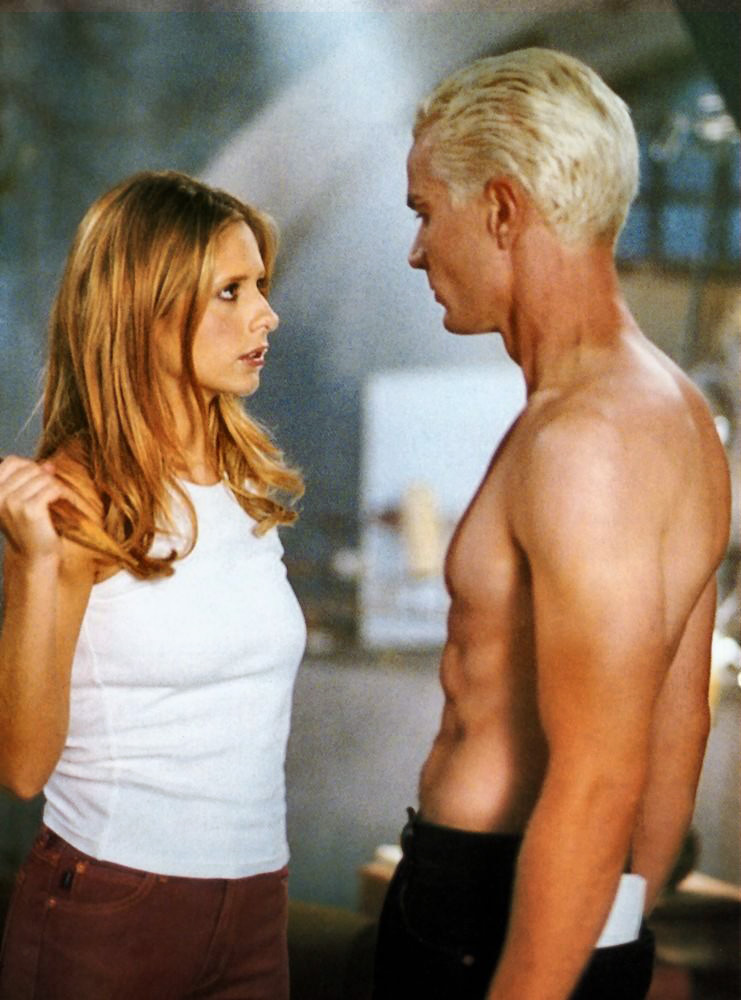
FEATURE: Buffy the Vampire Slayer - Out Of My Mind
Holy foreshadowing, Batman!
Seriously, there is so much of it in this episode and I'm finding it quite baffling that I barely remember it as a result of this fact. Sure, I remember the major developments like Spike realising he's in love with Buffy and Joyce starting to get sick (oh dear god), but the Riley stuff? Not a jot. Let's talk about the good stuff first though. Do you remember where you were when you first saw that kiss?
I do. It was, as ever, a Thursday night on BBC 2. I'm fairly sure we'd had something like spaghetti bolognese for dinner. I'd converted my family on to the Buffy wagon by this point, so we were all watching it together. No more sneaking around and messing with the VCR for me. Someone, I can't remember who, shouted "NO!" in shock. We stared aghast. Spike kissed Buffy. Buffy kissed Spike. Spike was dreaming! He's in love with Buffy! Ah, it's never going to go anywhere... Or is it?! Well, we all know the answer to that question now, but then? What a shock that was.
Elsewhere, we have the first arrival of the ongoing season arc outside of Dawn as Ben shows up to treat Joyce for the first time. He's still all Gentle Ben for now, but another jigsaw puzzle is in place. There's another in Tara starting to get a little concerned that Willow is overreaching a little with magic. The other key bit is that Joyce is on the decline, though again, we don't know it yet. Cleverly, the show distracts us with Riley's ongoing plight, yet it's all pretty ominous and, like her death will be, shockingly normal. There's nothing mystical in these bits of the episode, just cold, hard human reality. I'm not ready, you guys.
There was also the joy of seeing Spike and Harmony back together again. Exasperated and useless Spike really is the best Spike and it's amazing how successful the show managed to make him work that change as a character. Credit must go to James Marsters, of course, and to the writers, who'll keep crafting a truly fascinating ongoing and begrudging addition the gang. Plus, we get Mercedes McNab in full bimbo mode. Her scene with the surgeon is classic Harmony, full of little gems, but my favourite has to be her hastily extinguishing her cigarette upon seeing the No Smoking sign. Such a badass.
I supposed I have to return to the Riley stuff now. It's clear that they were running out of ideas for the character of Riley by this point. We've already done the Riley gets sick because of the Initiative's meddling bit, but now we get it with added masculine insecurity. As I've said before, I like that Buffy tackles the idea of men not being able to deal with Buffy's strength and doing it through Riley makes a tonne of sense. I love that Buffy immediately calls him out on it when he points out his differences to Angel. What I don't love about the episode is mostly that it, and the rest of the show, has forgotten to make us care. It also made Graham kinda sucky. The post-Angel relationship was always going to be tough to win people over, but Riley's just so beige. He really is everything that he fears he is, just not to Buffy.
Out Of My Mind is one of those episodes that's more important in the long run than it is in the moment. Buffy getting her life together and doing well is the biggest sign of doom we could possibly have, but there are plenty of other hints towards it in the episode. Oh boy.
Quote of the Week:
Spike: I will know your blood, Slayer. I will make your neck my chalice and drink deep. [Stalks off and immediately falls into an open grave.] OW!
Let's Get Trivial: Spike's watching an episode of Dawson's Creek in his crypt, which Mercedes McNab had previously guest-starred on.
- Becky
You can catch Becky's look at previous episode, The Replacement, here.
Follow @AssortedBuffery on Twitter
Or like our Facebook page
Monday, 13 June 2016
FEATURE: Angel - First Impressions
Previously on Angel: Angel has discovered the useful sanctuary of The Host, where people go to sing in order for him to "read" them. He's also made an ally with Charles Gunn, who had to stake his recently turned sister, and the office has moved into the Hyperion hotel. Elsewhere, Wolfram & Hart have resurrected Darla in order to get to Angel.
Gunn arrives at the hotel for an appointment with Angel to go after a snitch for information on a demon named Deevak, but Angel has been asleep all day, dreaming of a date with Darla. Eventually, they make it to the meet, but are attacked by vampires; they take them out, but Angel struggles in the fight. Later, Cordelia has a vision of Gunn in danger. Unable to reach Angel who is asleep and dreaming again, Cordelia heads out to help Gunn and the pair have to team up, but Deevak is lying in wait for them.
Whereas last week, the focus was very much on Angel himself, First Impressions is a chance for us all to get to know Gunn a little better as well as spending time getting to know the new, improved and more selfless Cordelia. As odd couple pairings go, he of the poverty-stricken minority and she of the white privilege, it's one that's not perhaps mined for as much as its potential would suggest, but it functions enough for the character explorations needed. Gunn's still smarting from losing his sister and his continuing spiral into self-destruction just isn't acceptable now he's part of the team. Cordelia's little pep talk to him at the end of the episode is one of her best moments, a big sign of her willingness to change and put herself out there for other people.
The other great moment of the episode, though not especially important to the plot, is the ongoing development of the friendship between Angel and Wes (which we all know is going to real rocky soon). I don't have much else to say about it, but it's a scene so good that I'm going to print it here:
Wesley: Come on. What are you waiting for?
Angel: [holds up a pink motorcycle helmet] I-I-I really don't think it's gonna fit.
Wesley: Oh, of course it will. Put it on.
Angel: You know, I-I don't need a helmet for protection.
Wesley: Angel. It's the law in California. Do you want us to get pulled over?
Angel: No.
Wesley: Then what's the problem?
Angel: Well, it-it's just, you know... the whole... visibility issue, not to mention the whole hat-head thing and, you know, when you really think about it, how come I have to wear the ladies helmet?
I like that Darla's tactic is to tempt Angel away from his path, shortly after his resolve to continue down it and help people for little or no reward. It's especially key after we see his more apathetic state towards humanity in Are You Now or Have You Ever Been, demonstrating that Angel is perhaps a little more corruptible than he likes to think if his resentment is high enough. Having Julie Benz back in full devious Darla mode is always a joy because she's one of the few characters to have made a massive impression with just a little runtime. Exploring her relationship with Angel further, as well as allowing Benz to be all sly, offers a good undercurrent for the rest of the episode.
Gunn arrives at the hotel for an appointment with Angel to go after a snitch for information on a demon named Deevak, but Angel has been asleep all day, dreaming of a date with Darla. Eventually, they make it to the meet, but are attacked by vampires; they take them out, but Angel struggles in the fight. Later, Cordelia has a vision of Gunn in danger. Unable to reach Angel who is asleep and dreaming again, Cordelia heads out to help Gunn and the pair have to team up, but Deevak is lying in wait for them.
Whereas last week, the focus was very much on Angel himself, First Impressions is a chance for us all to get to know Gunn a little better as well as spending time getting to know the new, improved and more selfless Cordelia. As odd couple pairings go, he of the poverty-stricken minority and she of the white privilege, it's one that's not perhaps mined for as much as its potential would suggest, but it functions enough for the character explorations needed. Gunn's still smarting from losing his sister and his continuing spiral into self-destruction just isn't acceptable now he's part of the team. Cordelia's little pep talk to him at the end of the episode is one of her best moments, a big sign of her willingness to change and put herself out there for other people.
The other great moment of the episode, though not especially important to the plot, is the ongoing development of the friendship between Angel and Wes (which we all know is going to real rocky soon). I don't have much else to say about it, but it's a scene so good that I'm going to print it here:
Wesley: Come on. What are you waiting for?
Angel: [holds up a pink motorcycle helmet] I-I-I really don't think it's gonna fit.
Wesley: Oh, of course it will. Put it on.
Angel: You know, I-I don't need a helmet for protection.
Wesley: Angel. It's the law in California. Do you want us to get pulled over?
Angel: No.
Wesley: Then what's the problem?
Angel: Well, it-it's just, you know... the whole... visibility issue, not to mention the whole hat-head thing and, you know, when you really think about it, how come I have to wear the ladies helmet?
Wesley: Stop being such a wanker and put it on!
[Angel puts the pink helmet on]
Wesley: Looks good. Hop on board gorgeous.
Angel: You'll pay for this.
The other element of the episode and one that plays more into the season's ongoing storyline is the Darla dreams that Angel has been having. Dreams are a funny thing in the Buffyverse, often prophetic, but nearly always dangerous in some way. The episode has some sly fun with Angel's dreams, allowing The Host to crop back up and reference Angel's eclectic music taste as well as showing Angel and Darla moon-bathing, completely with sunglasses and beach loungers.
I like that Darla's tactic is to tempt Angel away from his path, shortly after his resolve to continue down it and help people for little or no reward. It's especially key after we see his more apathetic state towards humanity in Are You Now or Have You Ever Been, demonstrating that Angel is perhaps a little more corruptible than he likes to think if his resentment is high enough. Having Julie Benz back in full devious Darla mode is always a joy because she's one of the few characters to have made a massive impression with just a little runtime. Exploring her relationship with Angel further, as well as allowing Benz to be all sly, offers a good undercurrent for the rest of the episode.
Quote of the Week:
Cordelia: Maybe *we* can help.
Gunn: You two? I find Deevak, I'm gonna need more than C-3PO and Stick-Figure Barbie backing me up, no offense.
Wesley: Very little taken.
Let's Get Trivial: It's a truth universally acknowledged that a Jane Austen reference is a fine thing to get into a fantasy series about vampires. The episode title is a nod to Pride and Prejudice's original title and the plot carries the familiar hallmarks of two very different people coming together after initially not getting along very well. Not much romance between Cordy and Gunn though.
- Becky
You can read Becky's look at previous episode, Are You Now Or Have You Ever Been, here.
Follow @AssortedBuffery on Twitter
Or like our Facebook page
TV REVIEW: Game of Thrones - No One
Spoilers...
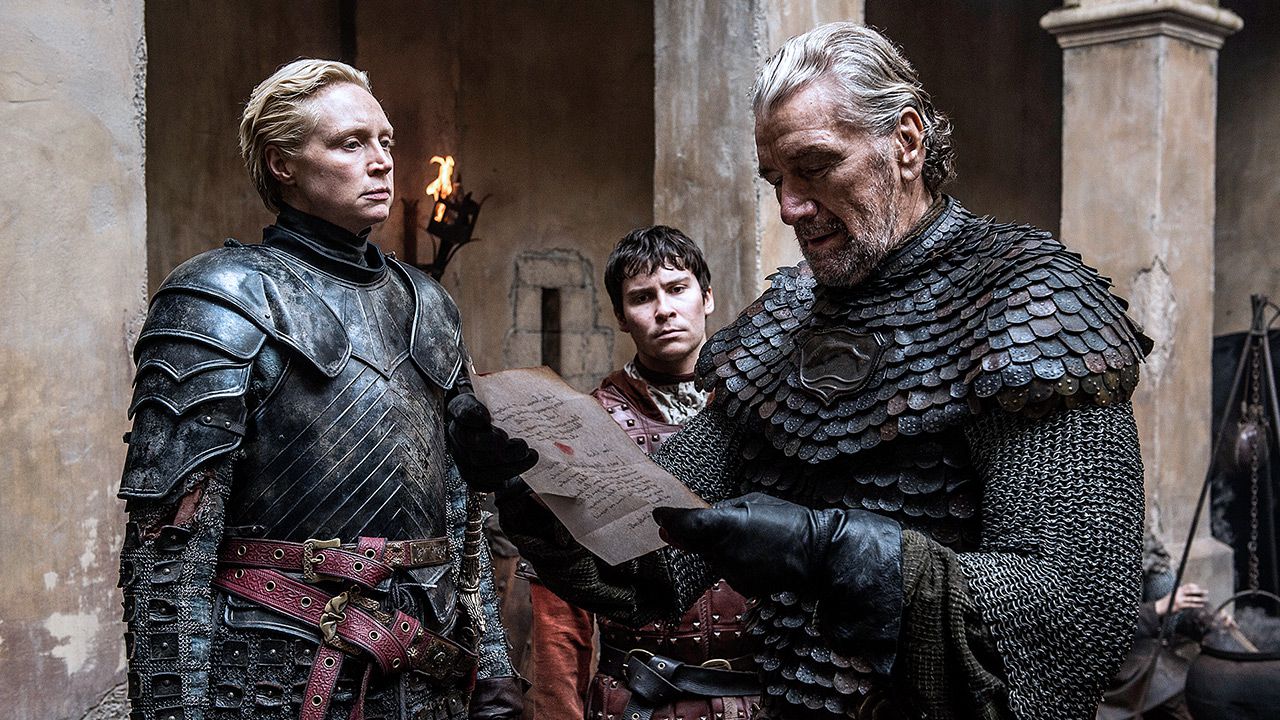
In terms of the latter, it's doing away with two widely rumoured events in the blink of an eye. Firstly, Lady Stoneheart - while it was always a slim chance, the show played around with her book iconography by showing the hanging men, but immediately brought back Beric Dondarrion and Thoros of Myr, both ready to head north to fight the real battle. Joining them temporarily was the Hound, who managed to get bloody vengeance on the killers of Lovejoy as well as taking our what I assume were four other BWB members. And in King's Landing, Tommen decided to dampen his mother's excitement at the possibility of having Ser Gregor win her freedom by banning trial by combat. I always thought the little king wouldn't survive the season, but it may end up being at the hand of his own mother. So no Stoneheart and no Cleganebowl. Hmph.
While Cersei no longer holds sway on her son, she certainly still casts a spell over Jaime, who spelled out his intentions to a captured Edmure Tully, namely that he just wanted to win so he could go home to her. And he did, thanks to Edmure first coming home to Riverrun and then convincing his men to surrender, despite the Blackfish's protestations that it was all a Lannister plot. Sadly, the Blackfish died off-screen, but not before sending Brienne and Pod off on a boat. Jaime's relationship with Brienne is interesting, he actually comes across something off less of a knob than he is, but unfortunately he is still nowhere near the redemption we thought he might be approaching. Maybe next season?
For once Tyrion's plans went awry, as the masters decided to take back Mereen via a whole fleet of ships, only for Dany to come and rescue them. Strangely this all very downplayed, with her landing on the roof and only a fleeting background shot of Drogon. But with her back there this hopefully sets in action her journey to Westeros with the iron fleet. Arya's arc - and fate - was a bit awkwardly resolved, but it was a nice touch to have her cut out the flame before beating the waif, before proclaiming to Jaqen triumphantly that she is "Arya Stark of Winterfell!". Given the big battle to come next week, maybe they don't want us to get fatigued.
It was a fine episode really, nice and thoughtful and a bit of a breather before next week's giant battle between Jon and Ramsay. The horror nut in me was happy to see a nice bit of gore from both Cleganes, notably the bit where The Mountain just ripped that dude's face clear off, and I imagine we're going to get a bit more with the Wildlings and the Boltons together, two groups that don't know the meaning of the word restraint. With any luck, this episode will be brought to us by the letters N and C and the number 17.
- Charlie
You can read Charlie's look at the previous episode, The Broken Man, here.
Follow @AssortedBuffery on Twitter
Or like our Facebook page
Wednesday, 8 June 2016
FEATURE: Buffy the Vampire Slayer - The Replacement
Previously on Buffy the Vampire Slayer: Buffy now has a little sister that everyone thinks has been around forever. Xander's dissatisfied with his lot in life as a result of still living in his parents' basement.
A big, veiny luminescent demon comes gunning for Buffy, but instead whacks Xander with his very own glowstick of destiny at the city dump. Initially, it seems as if our boy's ok and is taken away by the gang, but then, what we believe to be the actual Xander wakes up still in the dump. He's not particularly good at, well, everything, whilst a considerably suaver lookalike inserts himself into Xander's life. Schlubby Xander turns to his oldest friend Willow as Suave Xander gets the Slayer onside. Eventually they figure out that Suave Xander isn't a demonic replacement, but Xander's other half.
It's a Buffy classic storytelling device in this one; whenever any character needs to go through some kind of affirmation from the rest of the Scoobs, they have to go through some kind of transformation first. Think Giles turning into a demon in A New Man, Buffy when she turns invisible or Willow transforming everyone else. It's Xander's turn in this one as the two halves of himself battle it out for surpremacy without knowing they're two sides of the same coin rather than two distinct people. It's not quite Kirk in The Enemy Within but it does make for some good, concentrated Xander hijinks (also, they reference Star Trek together, which is just lovely).
It follows on from his desire to no longer be everyone's butt monkey, a rant seen in Buffy vs. Dracula. Xander's often the Buffy damsel-in-distress and frequently feels he is completely useless to the gang's efforts. It's Schlubby Xander's chief fear in this episode, that everyone's much more taken with Suave Xander and that he's of more use to the general scheme of things. Like The Zeppo, The Replacement is quick to demonstrate that, actually, that's really not the same. The promotion given to Suave Xander is earned by regular old Xander before the events of the episode, same with the credit check that lands him the apartment. As Giles says, everything in both Xanders already exists before the split. He is both Schlubby and Suave.
Also, the fact that the Scoobies keep saving Xander has got to count for something. As Primeval illustrated, he functions as the heart of the group and they'd quickly fall apart without him. His final scene with Riley, in which soldier boy admits he knows Buffy doesn't love him, is a clear indication of that; he's the one that people trust and he's the one that "sees" everything. It's something that will be more explored as the series continues, particularly in the seventh season where his sort-of outsider status helps with keeping Dawn on track. The Replacement is nowhere near as good as The Zeppo nor does it really say anything we don't already know, but it works as a solid reminder of Xander's strengths as well as building his confidence back up.
Quote of the Week:
Schlubby Xander: [Anya] entirely wants us to have sex together! Which would be wrong and very confusing...
Giles: We just, um, need to arrange the candles. Also, we should continue to pretend we heard none of the disturbing sex talk now.
Willow: Check. Candles and pretense.
Demonology 101: Jane Espenson revealed that Toth was so named, just so she could include the 'toth' is British slang gag.
Sunnydale Who's Who: Kelly Donovan, Nicholas Brendon's twin, plays the body double for Xander and gets to speak in the scenes where both Xanders have lines. Identical twins sure come in handy.
- Becky
You can check out Becky's look at the previous episode, Real Me, here.
Follow @AssortedBuffery on Twitter
Or like our Facebook page
A big, veiny luminescent demon comes gunning for Buffy, but instead whacks Xander with his very own glowstick of destiny at the city dump. Initially, it seems as if our boy's ok and is taken away by the gang, but then, what we believe to be the actual Xander wakes up still in the dump. He's not particularly good at, well, everything, whilst a considerably suaver lookalike inserts himself into Xander's life. Schlubby Xander turns to his oldest friend Willow as Suave Xander gets the Slayer onside. Eventually they figure out that Suave Xander isn't a demonic replacement, but Xander's other half.
It's a Buffy classic storytelling device in this one; whenever any character needs to go through some kind of affirmation from the rest of the Scoobs, they have to go through some kind of transformation first. Think Giles turning into a demon in A New Man, Buffy when she turns invisible or Willow transforming everyone else. It's Xander's turn in this one as the two halves of himself battle it out for surpremacy without knowing they're two sides of the same coin rather than two distinct people. It's not quite Kirk in The Enemy Within but it does make for some good, concentrated Xander hijinks (also, they reference Star Trek together, which is just lovely).
It follows on from his desire to no longer be everyone's butt monkey, a rant seen in Buffy vs. Dracula. Xander's often the Buffy damsel-in-distress and frequently feels he is completely useless to the gang's efforts. It's Schlubby Xander's chief fear in this episode, that everyone's much more taken with Suave Xander and that he's of more use to the general scheme of things. Like The Zeppo, The Replacement is quick to demonstrate that, actually, that's really not the same. The promotion given to Suave Xander is earned by regular old Xander before the events of the episode, same with the credit check that lands him the apartment. As Giles says, everything in both Xanders already exists before the split. He is both Schlubby and Suave.
Also, the fact that the Scoobies keep saving Xander has got to count for something. As Primeval illustrated, he functions as the heart of the group and they'd quickly fall apart without him. His final scene with Riley, in which soldier boy admits he knows Buffy doesn't love him, is a clear indication of that; he's the one that people trust and he's the one that "sees" everything. It's something that will be more explored as the series continues, particularly in the seventh season where his sort-of outsider status helps with keeping Dawn on track. The Replacement is nowhere near as good as The Zeppo nor does it really say anything we don't already know, but it works as a solid reminder of Xander's strengths as well as building his confidence back up.
Quote of the Week:
Schlubby Xander: [Anya] entirely wants us to have sex together! Which would be wrong and very confusing...
Giles: We just, um, need to arrange the candles. Also, we should continue to pretend we heard none of the disturbing sex talk now.
Willow: Check. Candles and pretense.
Demonology 101: Jane Espenson revealed that Toth was so named, just so she could include the 'toth' is British slang gag.
Sunnydale Who's Who: Kelly Donovan, Nicholas Brendon's twin, plays the body double for Xander and gets to speak in the scenes where both Xanders have lines. Identical twins sure come in handy.
- Becky
You can check out Becky's look at the previous episode, Real Me, here.
Follow @AssortedBuffery on Twitter
Or like our Facebook page
Monday, 6 June 2016
TV REVIEW: Game of Thrones - The Broken Man
Spoilers...
Is it really episode seven? This season has absolutely flown by, and has to be one of the most consistently brilliant so far, with The Broken Man, which is another great episode. And it doesn't waste any time in reintroducing a great character from previous seasons who had been theorised to return; The Hound aka Sandor Clegane, who is found being part of a religious commune building a sept. The show had taken Sandor on an interesting journey previous, having shifted not only loyalties but morality, with a somewhat different take on things after being paired with Arya.
Here, Clegane's story is given significant heft, with the episode structured around his story, itself a sad reminder of the inevitability of war in the world of Game of Thrones, and its effects on everywhere - nobody is safe, no matter how far, remote, or peaceful they are. And for a man with a history of violence, it's almost impossible to escape. He seems content as part of the commune, if still as cynical as ever, but it's fascinating watching his conversations with the leader Ray - played by Ian McShane - who has had seemingly as dark a past as Sandor. McShane's casting is a masterstroke, bringing wonderful gravitas and depth to a tiny part (in the scheme of things) which has a crucial role in reintroducing Sandor.
The warrior's attempt to get away is shattered by the Brotherhood of Banners, who kill everyone in the commune for no discernible reason - something we're unfortunately used to seeing in Game of Thrones. Joffrey may have become the king we all loved to hate, and Ramsay is doing a similar job, but they both did cruel and inhuman things not for tactical or leadership reasons, but because they wanted to and they had the power to do so. The episode ends powerfully, with Sandor finding the bodies of the commune members strewn across the field. In his scenes he was shown to be chopping wood with an axe, almost as a redirection of power from his previous use of similar items, but the final shot has him picking up the axe from a tree stump, his motivation clear.
Speaking of Arya, she's not having a wonderful time trying to escape Braavos and the faceless men, and after booking passage on a ship she was approached by an old lady who, hugely predictably, turned out to be the waif. It was a bit uncharacteristic for Arya to let her guard down like that, but it was after a little moment where it felt like was saying goodbye to the city - and ready to become a Stark again. She was stabbed quite a few times, although while the episode left her looking bleak, you know it's not going to kill her off (it doesn't help that you see her in the preview for the next episode afterwards). The other Starks aren't getting on particularly well either: While Tormund was able to rally the wildlings to Jon's cause, House Glover had no interest, and while House Mormont pledged their allegiance, they only have sixty-two men. Nevertheless, the young leader of House Mormont was a charming girl of ten years old who happily talked smack to Jon and Sansa, with Davos eventually getting through to her, possibly thinking of Shireen.
Things in King's Landing are beginning to pick up, and we finally have a bit more of an idea of Margarey's plan after she secretly passed a drawing of the Tyrell rose to her grandmother, confirming her allegiance under the watchful eye of the faith militant. Olenna had a brilliant scene with Cersei where she just absolutely railed against her leaving her absolutely struck dumb, and hopefully she'll stick around in the show even though she's back off to Highgarden. Cersei undoubtedly has something up her sleeve, and chances are the theorised "Cleganebowl" is about to come true with Cersei choosing zombie Gregor as her champion, and The Mountain versus The Hound sounds like a fantastic way to go.
PS Yara likes the ladies. Never saw that coming.
Is it really episode seven? This season has absolutely flown by, and has to be one of the most consistently brilliant so far, with The Broken Man, which is another great episode. And it doesn't waste any time in reintroducing a great character from previous seasons who had been theorised to return; The Hound aka Sandor Clegane, who is found being part of a religious commune building a sept. The show had taken Sandor on an interesting journey previous, having shifted not only loyalties but morality, with a somewhat different take on things after being paired with Arya.
Here, Clegane's story is given significant heft, with the episode structured around his story, itself a sad reminder of the inevitability of war in the world of Game of Thrones, and its effects on everywhere - nobody is safe, no matter how far, remote, or peaceful they are. And for a man with a history of violence, it's almost impossible to escape. He seems content as part of the commune, if still as cynical as ever, but it's fascinating watching his conversations with the leader Ray - played by Ian McShane - who has had seemingly as dark a past as Sandor. McShane's casting is a masterstroke, bringing wonderful gravitas and depth to a tiny part (in the scheme of things) which has a crucial role in reintroducing Sandor.
The warrior's attempt to get away is shattered by the Brotherhood of Banners, who kill everyone in the commune for no discernible reason - something we're unfortunately used to seeing in Game of Thrones. Joffrey may have become the king we all loved to hate, and Ramsay is doing a similar job, but they both did cruel and inhuman things not for tactical or leadership reasons, but because they wanted to and they had the power to do so. The episode ends powerfully, with Sandor finding the bodies of the commune members strewn across the field. In his scenes he was shown to be chopping wood with an axe, almost as a redirection of power from his previous use of similar items, but the final shot has him picking up the axe from a tree stump, his motivation clear.
Speaking of Arya, she's not having a wonderful time trying to escape Braavos and the faceless men, and after booking passage on a ship she was approached by an old lady who, hugely predictably, turned out to be the waif. It was a bit uncharacteristic for Arya to let her guard down like that, but it was after a little moment where it felt like was saying goodbye to the city - and ready to become a Stark again. She was stabbed quite a few times, although while the episode left her looking bleak, you know it's not going to kill her off (it doesn't help that you see her in the preview for the next episode afterwards). The other Starks aren't getting on particularly well either: While Tormund was able to rally the wildlings to Jon's cause, House Glover had no interest, and while House Mormont pledged their allegiance, they only have sixty-two men. Nevertheless, the young leader of House Mormont was a charming girl of ten years old who happily talked smack to Jon and Sansa, with Davos eventually getting through to her, possibly thinking of Shireen.
Things in King's Landing are beginning to pick up, and we finally have a bit more of an idea of Margarey's plan after she secretly passed a drawing of the Tyrell rose to her grandmother, confirming her allegiance under the watchful eye of the faith militant. Olenna had a brilliant scene with Cersei where she just absolutely railed against her leaving her absolutely struck dumb, and hopefully she'll stick around in the show even though she's back off to Highgarden. Cersei undoubtedly has something up her sleeve, and chances are the theorised "Cleganebowl" is about to come true with Cersei choosing zombie Gregor as her champion, and The Mountain versus The Hound sounds like a fantastic way to go.
PS Yara likes the ladies. Never saw that coming.
- Charlie
You can read Charlie's look at previous episode, Blood of my Blood, here.
Follow @AssortedBuffery on Twitter
Or like our Facebook page
FEATURE: Angel - Are You Now Or Have You Ever Been
Previously on Angel: In the ongoing battle against Wolfram & Hart, Angel's offices were the first casualty, blowing up rather spectacularly. They're in need of a new place.
After he briefly visited an old hotel in the previous episode, Angel becomes intrigued by the building’s past and gets Wesley and Cordelia to start investigating as he heads down to the hotel itself. The Hyperion dates back to the 1920s, but Angel has a history that he doesn’t disclose at first, having been a resident there in 1952. Strange events date back throughout the hotel’s past, including during Angel’s residency when a man in the room next door kills himself and sparks off an amateur investigation with disastrous results. Meanwhile, in the present, Angel seeks to destroy the Thesulac demon for good.
I adore the Hyperion set in all its 1920s glory. The production design and the way that it is shot in the 1950s flashbacks gives it a Gothic feel; long, dark corridors seem to stretch on forever, people lurk in shadows and it never feels entirely visible. Some of the colours used, muted greens and reds, also ensure that the episode has a pulp fiction look to it (of the Dashiell Hammett variety, not Tarantino). 1950s Judy is a classic mysterious dame with a stolen stack of cash and a secret; she's passing as a white woman at a time when being Other was not at all recommended. Like Angel, she's an outcast. He gets to be her brooding hero, begrudgingly deciding to help her.
That style builds into the world of the other guests of the hotel, glimpsed only through brief scenes in which they speculate about the guy who killed himself in 215. There's a blacklisted writer (McCarthyism is in full flow, seen briefly on a TV clip containing the episode's title) who sees it is as one of his plots, a blonde in a green dress with the kind of husky voice you expect in a noir and an actor who may as well have walked straight off the set of Dragnet. Just the facts, ma'am. Of course, they don’t actually have a clue what’s happened because it’s a Thesulac demon sucking the life out of the guests.
Everything, naturally, spirals out of control. Judy saves her own skin by pointing the finger at Angel and suggesting he’s a murderer. The angry mob hangs Angel and the Thesulac demon feeds on their rage. Setting it in the 1950s, a time of great paranoia and prejudice, is a masterstroke and really builds into the general uneasy atmosphere that the flashbacks carry. The moment is a crucial turning point in Angel’s post-soul life, trying to help out humans and receiving their ire and violence as a result. It’s hardly surprising that he allows the Thesulac to feed on the residents of the hotel after the lynching. It’s a really dark move and one which blurs the line between Angel and Angelus somewhat,
There’s a heavy foreshadowing of Angel’s indifference to Dru and Darla feeding on Wolfram & Hart lawyers later in the season, but there’s not just darkness there. There’s hope too. The final scene with Old Judy, in which he forgives and comforts her after her years of torment since his apparent death, shows Angel’s life is one of peaks and troughs. He may lose his way occasionally, but with the right people around him, he’ll find his way back.
Are You Now Or Have You Ever Been is a classy affair, one of Angel's finest, that both looks great and does a lot of solid character work for Tall, Dark and Forehead too. I like that there aren’t any really big set pieces here, no heavily choreographed scraps. Instead, it feels like Angel at its most human, exploring the kind of negative side of mankind whilst also demonstrating the need for forgiveness in order to move on. Plus, Angel looks pretty natty in 1950s threads.
Quote of the Week:
Cordelia: Excuse me?!
Wes: Tentacles.
Wes: Tentacles.
Cordelia: Ooh...
Let's Get Trivial: The odious bellhop's name is Frank Gilnitz, a reference back to writer Tim Minear's time as a writer and story editor on The X Files. "Gilnitz" was a name often used by The X Files writers' room for incidental or unseen characters, usually with the first name John. An amalgam of John Shiban, Vince Gilligan and Frank Spotnitz, the name became a running joke in the sci-fi series.
Demonology 101: Angel catches a Bible that is thrown at him by the bookshop owner and it burns his hands. This is the first time in the Buffyverse that it is confirmed that Bibles are harmful to vamps.
Let's Get Trivial: The odious bellhop's name is Frank Gilnitz, a reference back to writer Tim Minear's time as a writer and story editor on The X Files. "Gilnitz" was a name often used by The X Files writers' room for incidental or unseen characters, usually with the first name John. An amalgam of John Shiban, Vince Gilligan and Frank Spotnitz, the name became a running joke in the sci-fi series.
Demonology 101: Angel catches a Bible that is thrown at him by the bookshop owner and it burns his hands. This is the first time in the Buffyverse that it is confirmed that Bibles are harmful to vamps.
LA Who's Who: The concierge, Ronald Meeks, is played by John Kapelos. You Breakfast Clubbers might recognise him as Carl, Shermer High School's janitor.
- Becky
You can read Becky's look at previous episode, Judgment, here.
Follow @AssortedBuffery on Twitter
Or like our Facebook page
Wednesday, 1 June 2016
FEATURE: Buffy the Vampire Slayer - Real Me
Previously on Buffy the Vampire Slayer: Buffy has a sister. What?!
Dawn, Buffy's sister, is causing a few problems for the Slayer as she needs taking care of, seemingly full time given her habit of getting into mischief. When the gang head to the Magic Shop for supplies, Willow quite literally falls over the dead body of the owner. It's a vamp attack, announcing a new squad in town who are researching the Slayer and have a fondness for ceramic unicorns. Yes, Harmony's back in town and she wants a showdown with Buffy, but is thwarted when the Slayer happens to be on a date when Harmony calls for her. Dawn, being Dawn, inadvertently invites her in and the vamp returns later to kidnap the sister and lure Buffy into a trap.
So, Dawn's arrived. I'm going to get the negative stuff out of the way first because, Dawn aside, this episode is a joy. The new little sister? Not so much. God, Dawn's narration is horrible. Just gratingly irritating. And I think it jars so much because, at this stage, it feels like such a caricature of how a teen girl speaks, which is something the show has never done. The teenage characters of Buffy, Willow and Xander never fell into that trap of feeling cliched or sketched. Even Cordelia had layers. Real Me is not the best first impression of the character we could have had, though I know it's the sibling relationship that they clearly needed to set up. It just feels clumsy given how much of a mystery Dawn still is.
Which brings me nicely on to the positive aspect about Dawn; the writers have just dropped her in there. She got a few seconds in the last episode and now everyone in the show is acting like she's always been there. It's a clever, brave move and instantly gets the audience speculating about where this annoying, diary-writing teen has come from. There's not much of a hint to what she is here, just that she will become something, but the encounter with the mad, homeless man offers up a neat callback to Faith's prophecy of Dawn's arrival back in Graduation Day. He calls her "Curds and whey," referencing "Little Miss Muffet, counting down from 7-3-0."
Positives for the rest of the episode are numerous and mainly revolve around how hilarious it is. From Giles' brand new, shiny red penis car to Buffy's reaction to finding out that Harmony has minions. And then there's Harmony herself. I love that Harmony's plans seem to be taken from the ideas whiteboard of a crappy Bond villain, that she's got the management skills of Michael Scott and the villainous presence of a poodle. Mercedes McNab's comic timing is spectacular here and her sparring with Sarah Michelle Gellar ranks amongst the funniest of Buffy's exchanges with villains.
We also have the second big plot development of the fifth season as Giles decides to buy the Magic Shop, despite Buffy's understandable concern that Magic Shop owners have a very limited shelf life. The fourth season did suffer from having a particular location that the Scoobies could be based out of; Giles' place is lovely, but I always got the impression that everything was a bit cramped in there. Now, we'll have the Magic Shop, a nice training room for Buffy and plenty of magical items for hijinks.
Thankfully, there is enough about Real Me to love in the face of the annoyingly whiny teenager plonked into the middle of it. I understand why they drop Dawn into the midst of everything so equally, and why they do make her so irritating, but boy is it a culture shock.
Quote of the Week:
Harmony: So Slayer! At last we meet.
Buffy: We've met, Harmony, you halfwit.
Inventive Kill: Buffy slays Mort with a unicorn horn. Cabin in the Woods, eat your heart out. Um, not literally.
Let's Get Trivial: Michelle Trachtenberg's updated status from her first appearance in the show to series regular is the fastest in the series' history, appearing in just one episode before promotion. The show will now set the record for highest number of main cast members (8) until Riley leaves in Into The Woods.
Sunnydale Who's Who: Tom Lenk, who plays a Harmony minion, will return next season to play Tucker's brother... I mean, Andrew.
- Becky
You can read Becky's look at previous episode, Buffy vs. Dracula, here.
Follow @AssortedBuffery on Twitter
Or like our Facebook page
Dawn, Buffy's sister, is causing a few problems for the Slayer as she needs taking care of, seemingly full time given her habit of getting into mischief. When the gang head to the Magic Shop for supplies, Willow quite literally falls over the dead body of the owner. It's a vamp attack, announcing a new squad in town who are researching the Slayer and have a fondness for ceramic unicorns. Yes, Harmony's back in town and she wants a showdown with Buffy, but is thwarted when the Slayer happens to be on a date when Harmony calls for her. Dawn, being Dawn, inadvertently invites her in and the vamp returns later to kidnap the sister and lure Buffy into a trap.
So, Dawn's arrived. I'm going to get the negative stuff out of the way first because, Dawn aside, this episode is a joy. The new little sister? Not so much. God, Dawn's narration is horrible. Just gratingly irritating. And I think it jars so much because, at this stage, it feels like such a caricature of how a teen girl speaks, which is something the show has never done. The teenage characters of Buffy, Willow and Xander never fell into that trap of feeling cliched or sketched. Even Cordelia had layers. Real Me is not the best first impression of the character we could have had, though I know it's the sibling relationship that they clearly needed to set up. It just feels clumsy given how much of a mystery Dawn still is.
Which brings me nicely on to the positive aspect about Dawn; the writers have just dropped her in there. She got a few seconds in the last episode and now everyone in the show is acting like she's always been there. It's a clever, brave move and instantly gets the audience speculating about where this annoying, diary-writing teen has come from. There's not much of a hint to what she is here, just that she will become something, but the encounter with the mad, homeless man offers up a neat callback to Faith's prophecy of Dawn's arrival back in Graduation Day. He calls her "Curds and whey," referencing "Little Miss Muffet, counting down from 7-3-0."
Positives for the rest of the episode are numerous and mainly revolve around how hilarious it is. From Giles' brand new, shiny red penis car to Buffy's reaction to finding out that Harmony has minions. And then there's Harmony herself. I love that Harmony's plans seem to be taken from the ideas whiteboard of a crappy Bond villain, that she's got the management skills of Michael Scott and the villainous presence of a poodle. Mercedes McNab's comic timing is spectacular here and her sparring with Sarah Michelle Gellar ranks amongst the funniest of Buffy's exchanges with villains.
We also have the second big plot development of the fifth season as Giles decides to buy the Magic Shop, despite Buffy's understandable concern that Magic Shop owners have a very limited shelf life. The fourth season did suffer from having a particular location that the Scoobies could be based out of; Giles' place is lovely, but I always got the impression that everything was a bit cramped in there. Now, we'll have the Magic Shop, a nice training room for Buffy and plenty of magical items for hijinks.
Thankfully, there is enough about Real Me to love in the face of the annoyingly whiny teenager plonked into the middle of it. I understand why they drop Dawn into the midst of everything so equally, and why they do make her so irritating, but boy is it a culture shock.
Quote of the Week:
Harmony: So Slayer! At last we meet.
Buffy: We've met, Harmony, you halfwit.
Inventive Kill: Buffy slays Mort with a unicorn horn. Cabin in the Woods, eat your heart out. Um, not literally.
Let's Get Trivial: Michelle Trachtenberg's updated status from her first appearance in the show to series regular is the fastest in the series' history, appearing in just one episode before promotion. The show will now set the record for highest number of main cast members (8) until Riley leaves in Into The Woods.
Sunnydale Who's Who: Tom Lenk, who plays a Harmony minion, will return next season to play Tucker's brother... I mean, Andrew.
- Becky
You can read Becky's look at previous episode, Buffy vs. Dracula, here.
Follow @AssortedBuffery on Twitter
Or like our Facebook page
Tuesday, 31 May 2016
FEATURE: Angel - Judgment
Previously on Angel: The gang are working LA to fight demonic crime and help the helpless. In the process, they find themselves on the wrong side of a bunch of lawyers determined to bring Angel down, resurrecting Darla as part of their plan. Angel has formed an unlikely alliance with a vampire hunter named Gunn.
Since the explosion that destroyed their offices last season, Angel Investigations has been working out of Cordelia's apartment, complete with assistance from Phantom Dennis who has been very keen to help. When Cordy has a vision of a horrific monster, Angel goes on the hunt to track it down, but discovers that, when he kills it, it's not an evil demon. It's protecting a young pregnant woman whose fate is to be decided by a mystical tribunal and Angel just killed her champion. Wracked with guilt, Angel sets about trying to help, taking on the role of protector himself in order to save the young woman and right the wrong he committed.
If ever there was an episode that functions as a microcosm of Angel's ongoing mission, then Judgment is it, boiling down to Angel kills someone and then has to atone for it. One thing Whedon shows (and films) have always excelled at is the reintroduction of the show's MO and key themes, as well as sometimes expanding the world beyond what we're used to. After the Shanshu Prophecy revealed that he will become human again once he achieves his redemption, Angel's been going after the demons in LA hard and fast, but quickly learns over the course of the episode that this isn't about keeping score, but doing the right thing. We're introduced to The Host and his sanctuary nightclub, swiftly confirming the idea that not all demons are evil and that safe places exist within the downtown area.
Within just a few scenes, Angel has reasserted everything we know, reiterated Angel's ongoing quest for redemption and widened the world out to explore something more in how the demon world works. Lorne's introduction and narration is a key part of that, reminding us all of the kind of city LA is in this world (and singing Gloria Gaynor is a cracking joke). Likewise, Angel, Wes and Cordy interrupting the sacrifice in the gym swiftly asserts their respective roles. It's an astonishing bit of exposition that never feels like it, but instead feels like we're cosying back down with a few friends we haven't seen for a while.
Judgment also contains two of the most memorable images of the series' run. The first is David Boreanaz absolutely slaughtering 'Mandy' in order to get information out of Lorne and admitting he's a fan of Barry Manilow's hit because he thinks it's pretty. Then, there's the big joust itself. I've only seen this episode once prior to this rewatch viewing, but the sight of Angel, on a horse and kitted out like a Knight of the Round Table on an LA street is one so incongruous that it sticks like glue in the memory. Not many shows could pull of that kind of image.
The last scene with Faith is a lovely moment to end on. She and Angel share their respective roads to redemption and support each other accordingly, a nice continuation of the relationship that was touched upon back in the third season of Buffy and cemented in Angel's first season. It offers up a different, more vulnerable dynamic to Angel's character that isn't often seen in his more leadership role with the Angel Investigations crew. It fits nicely into the undercurrent of the episode, around second chances and the ability to change your nature and go against it.
A strong return then for Angel in the second season. I didn't even touch on Wolfram & Hart, but their Darla plan is already rumbling along nicely in the background. Now, if you don't mind, I need to go and listen to something catchy to get that damn 'Mandy' out of my head.
Quote of the Week:
Angel: There are three things I don't do; tan, date, or sing in public.
Let's Get Trivial: The closing credits feature outtakes from Angel's hilarious performance of 'Mandy'; stay to the very end post "Grrr, Argh" to hear David Boreanaz's Elvis impersonation: "Thank you, thank you very much."
LA Who's Who: The late Andy Hallett joins Angel's revolving cast of regulars as The Host, later known as Lorne. J. August Richards is bumped up to series regular and Eliza Dushku makes a quick appearance as Faith, her name hidden in the closing credits rather than the opening ones to keep the surprise.
- Becky
You can check out Becky's look at previous episode, To Shanshu in LA, here.
Follow @AssortedBuffery on Twitter
Or like our Facebook page
Since the explosion that destroyed their offices last season, Angel Investigations has been working out of Cordelia's apartment, complete with assistance from Phantom Dennis who has been very keen to help. When Cordy has a vision of a horrific monster, Angel goes on the hunt to track it down, but discovers that, when he kills it, it's not an evil demon. It's protecting a young pregnant woman whose fate is to be decided by a mystical tribunal and Angel just killed her champion. Wracked with guilt, Angel sets about trying to help, taking on the role of protector himself in order to save the young woman and right the wrong he committed.
If ever there was an episode that functions as a microcosm of Angel's ongoing mission, then Judgment is it, boiling down to Angel kills someone and then has to atone for it. One thing Whedon shows (and films) have always excelled at is the reintroduction of the show's MO and key themes, as well as sometimes expanding the world beyond what we're used to. After the Shanshu Prophecy revealed that he will become human again once he achieves his redemption, Angel's been going after the demons in LA hard and fast, but quickly learns over the course of the episode that this isn't about keeping score, but doing the right thing. We're introduced to The Host and his sanctuary nightclub, swiftly confirming the idea that not all demons are evil and that safe places exist within the downtown area.
Within just a few scenes, Angel has reasserted everything we know, reiterated Angel's ongoing quest for redemption and widened the world out to explore something more in how the demon world works. Lorne's introduction and narration is a key part of that, reminding us all of the kind of city LA is in this world (and singing Gloria Gaynor is a cracking joke). Likewise, Angel, Wes and Cordy interrupting the sacrifice in the gym swiftly asserts their respective roles. It's an astonishing bit of exposition that never feels like it, but instead feels like we're cosying back down with a few friends we haven't seen for a while.
Judgment also contains two of the most memorable images of the series' run. The first is David Boreanaz absolutely slaughtering 'Mandy' in order to get information out of Lorne and admitting he's a fan of Barry Manilow's hit because he thinks it's pretty. Then, there's the big joust itself. I've only seen this episode once prior to this rewatch viewing, but the sight of Angel, on a horse and kitted out like a Knight of the Round Table on an LA street is one so incongruous that it sticks like glue in the memory. Not many shows could pull of that kind of image.
The last scene with Faith is a lovely moment to end on. She and Angel share their respective roads to redemption and support each other accordingly, a nice continuation of the relationship that was touched upon back in the third season of Buffy and cemented in Angel's first season. It offers up a different, more vulnerable dynamic to Angel's character that isn't often seen in his more leadership role with the Angel Investigations crew. It fits nicely into the undercurrent of the episode, around second chances and the ability to change your nature and go against it.
A strong return then for Angel in the second season. I didn't even touch on Wolfram & Hart, but their Darla plan is already rumbling along nicely in the background. Now, if you don't mind, I need to go and listen to something catchy to get that damn 'Mandy' out of my head.
Quote of the Week:
Angel: There are three things I don't do; tan, date, or sing in public.
Let's Get Trivial: The closing credits feature outtakes from Angel's hilarious performance of 'Mandy'; stay to the very end post "Grrr, Argh" to hear David Boreanaz's Elvis impersonation: "Thank you, thank you very much."
LA Who's Who: The late Andy Hallett joins Angel's revolving cast of regulars as The Host, later known as Lorne. J. August Richards is bumped up to series regular and Eliza Dushku makes a quick appearance as Faith, her name hidden in the closing credits rather than the opening ones to keep the surprise.
- Becky
You can check out Becky's look at previous episode, To Shanshu in LA, here.
Follow @AssortedBuffery on Twitter
Or like our Facebook page
Subscribe to:
Posts (Atom)


