Showing posts with label Tobias Menzies. Show all posts

Monday, 13 June 2016

TV REVIEW: Game of Thrones - No One

Spoilers...


One of the interesting things about Game of Thrones as a show is its ability to laugh at your story expectations like Syrio Forel laughs at death. There were certain elements that were always going to happen like we imagined, for example Arya's victory against the waif, despite the "shock ending" of her being stabbed in the gut. But several things happened this week that are either going to surprise people or/and make them a bit angry.

In terms of the latter, it's doing away with two widely rumoured events in the blink of an eye. Firstly, Lady Stoneheart - while it was always a slim chance, the show played around with her book iconography by showing the hanging men, but immediately brought back Beric Dondarrion and Thoros of Myr, both ready to head north to fight the real battle. Joining them temporarily was the Hound, who managed to get bloody vengeance on the killers of Lovejoy as well as taking our what I assume were four other BWB members. And in King's Landing, Tommen decided to dampen his mother's excitement at the possibility of having Ser Gregor win her freedom by banning trial by combat. I always thought the little king wouldn't survive the season, but it may end up being at the hand of his own mother. So no Stoneheart and no Cleganebowl. Hmph.

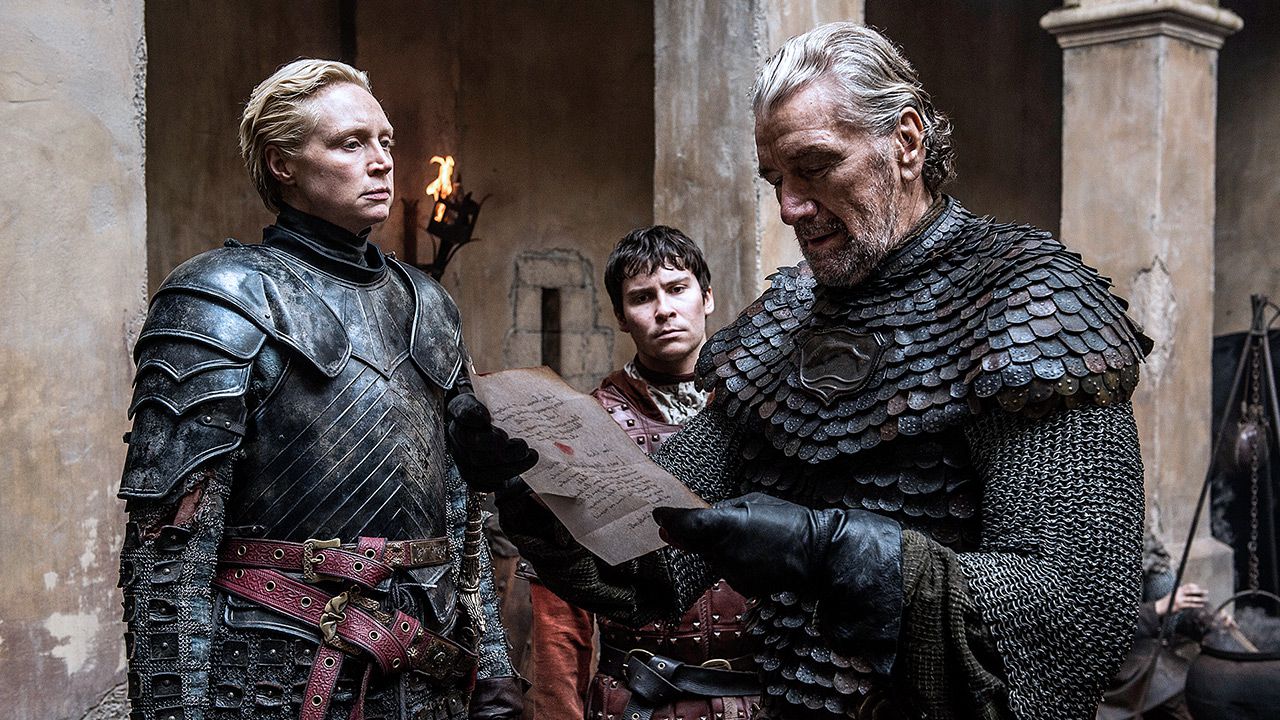
While Cersei no longer holds sway on her son, she certainly still casts a spell over Jaime, who spelled out his intentions to a captured Edmure Tully, namely that he just wanted to win so he could go home to her. And he did, thanks to Edmure first coming home to Riverrun and then convincing his men to surrender, despite the Blackfish's protestations that it was all a Lannister plot. Sadly, the Blackfish died off-screen, but not before sending Brienne and Pod off on a boat. Jaime's relationship with Brienne is interesting, he actually comes across something off less of a knob than he is, but unfortunately he is still nowhere near the redemption we thought he might be approaching. Maybe next season?

For once Tyrion's plans went awry, as the masters decided to take back Mereen via a whole fleet of ships, only for Dany to come and rescue them. Strangely this all very downplayed, with her landing on the roof and only a fleeting background shot of Drogon. But with her back there this hopefully sets in action her journey to Westeros with the iron fleet. Arya's arc - and fate - was a bit awkwardly resolved, but it was a nice touch to have her cut out the flame before beating the waif, before proclaiming to Jaqen triumphantly that she is "Arya Stark of Winterfell!". Given the big battle to come next week, maybe they don't want us to get fatigued.

It was a fine episode really, nice and thoughtful and a bit of a breather before next week's giant battle between Jon and Ramsay. The horror nut in me was happy to see a nice bit of gore from both Cleganes, notably the bit where The Mountain just ripped that dude's face clear off, and I imagine we're going to get a bit more with the Wildlings and the Boltons together, two groups that don't know the meaning of the word restraint. With any luck, this episode will be brought to us by the letters N and C and the number 17.

- Charlie

You can read Charlie's look at the previous episode, The Broken Man, here.

Follow @AssortedBuffery on Twitter
Or like our Facebook page

Wednesday, 8 April 2015

TV REVIEW: Outlander - The Reckoning

This review contains spoilers. You can read Becky's spoiler-free review of the first eight episodes here.


The first half of Outlander's season ended with Claire quite literally in the hands of Black Jack Randall and Jamie bursting in to her rescue. The second half picks up again with this moment, but takes us back to Jamie's perspective, crafting the episode with his narration. He is meeting with the Redcoat deserter who promised to give him the name of the man who actually committed the murder when he gets news of Claire's capture and dashes off to rescue her. The rest of the episode deals with the consequences of her actions and expanding on Jamie's character.

Twisting the format slightly to allow for the episode to take place from Jamie's perspective proves to be a bit of a masterstroke considering The Reckoning's subject matter. Jamie's narration revolves around the choices a man makes in his life and he meets varies problems throughout; Colum and Dougal's rift over the Jacobite gold, Laighoire throwing herself at him despite his marital status and the actions he must take over Claire's disobediance. Sam Heughan adapts Jamie easily to each situation from the noble diplomat that takes on Colum and Dougal to the flustered man faced with a woman in nought but her corset.

It's the situation with Claire that could have potentially been massively mishandled within the episode and it's a scene that I know a lot of book readers were sort of dreading. Because she has not only endangered Jamie, she has also endangered Dougal's men and the clan MacKenzie, who don't think she realises just quite how much trouble she has caused. It leads to the first monumental argument of the Fraser marriage as both Claire and Jamie go at each other tooth and nail in the woods; she is indignant at his assertions she did it on purpose whilst he is furious that she can't seem to realise how huge it was that he revealed himself to Black Jack Randall in order to save her.

Heughan and Caitriona Balfe play the escalation of the scene beautifully, with Heughan in particular excelling through Jamie's shifting emotions. What is also so refreshing about Claire in this episode is how unaware she is of the traditions she violates with her early twentieth century attitude. Too often in these kind of stories, people learn to adapt quickly by virtue of education, but Claire blunders her way through and it's the first episode where that has major consequences for her. Balfe gives Claire an insolent air as she faces the consequences of her actions and the thrashing scene is much better for building Claire up in this manner.

Whereas the argument between the two is played entirely seriously, the bedroom based and potentially contraversial thrashing is played as a farce. The music in particular gives the impression it's a reel around the bedroom as Jamie circulates the bed in which Claire prepares to mount her defence. It's a very fine line to tread but the episode manages it, giving it the serious edge that such a scene requires whilst also mining it for the wry comedy that has characterised much of the series so far. The cut aways to the men downstairs listening to the chaos of the bedroom provide some well-judged laughs too.

That this is from Jamie's perspective also softens the scene somewhat; he feels it is something he has to do because he has always been brought up to believe it. Claire challenges his assumptions and choices constantly, none more so than when she refuses to sleep with him after the event. The power shifts in the marriage is something that Jamie didn't expect amongst the choices that he talks about throughout his voiceover, but before the end of the episode, another negotiation takes place between the two of them that addresses the imbalance caused by Jamie's adherence to tradition. And in this second negotiation, Claire is very much on top in more ways than one.

The final moments of the episode set up another potential hurdle for the couple to deal with in the form of Laighoire's 'ill wishes' as well as the possibility that a tonne of Redcoats could come after Claire at any second. It's all very exciting.

- Becky

Follow @AssortedBuffery on Twitter
Or like our Facebook page

TV REVIEW: Outlander - Episodes One to Eight

This review of Outlander's first eight episodes is spoiler free, but Becky will be reviewing the remainder of the season individually and with spoilers, in our usual Buffery manner.

Based on Diana Gabaldon's rip-roaring and bestselling historical series, Outlander follows Claire Randall, a nurse in the Second World War who embarks on a holiday in Scotland with her husband, Frank, six months after VE Day. Whilst there, she finds herself drawn to a mysterious stone circle at Craigh na Dun and is pulled back in time to 1745, when Scotland was building to another Jacobite rebellion and intelligent, forthright women were viewed with suspicion. She attempts to get back to the stones and to her own time, but is soon drawn into the machinations of the MacKenzie clan and into a marriage of safety with the dashing Jamie Fraser.

Outlander has a huge weight of pedigree behind it, created by none other than television impresario, Ronald D. Moore (having previously worked on both Star Trek and the excellent Battlestar Galactica reboot), who brings his assured hand to Gabaldon's work. It's a smooth adaptation, streamlining out the story into something a little more manageable for a television audience that could be both in love with the books or without any knowledge whatsoever. Additions such as focusing on Frank in 1945 trying to find his wife, which didn't feature in the first book as it was Claire's first person narrative, builds the world up more and keeps alive the sympathy for an important character.

The world of 18th century Scotland is beautifully realised as the series sweeps through the Highlands. Muddy, brutal yet elegantly romantic, Claire's foray into the past carries the inherent thrill of seeing a world unknown, though it's considerably more bodice-ripping (literally) than your usual period drama. The sex, nudity and violence running through the story isn't sanitised from its source material, but nor does it feel gratuitous. Whilst there is the tendency carried over from the books to put Claire in as many potential sexual assault situations as possible, it's never supposed to be titillating; the focus on Claire herself in these moments ensures the focus is on her fear, not the man's enjoyment.

As Claire, Caitriona Balfe captures the character near-perfectly, from her belligerence in the face of 18th century attitudes towards women to a wicked sense of humour that bubbles beneath the surface. Claire already feels like a fully rounded character, naive in the face of these traditions for which she is an outlander, but learning to adapt quickly. It also helps that she has an excellent chemistry with both Tobias Menzies, in the dual role of Frank Randall and his 18th century ancestor, the Black Jack Randall, and Sam Heughan as Jamie Fraser.

Menzies has a particularly tough role in distinguishing the noble academic Frank from his sadistic ancestor. Black Jack Randall is the show's current outright villain and Menzies clearly relishes portraying someone who is convinced of his own inability to be redeemed. Frank is a gentler sort, but there are still the odd tics and reminders of their heritage, particularly when the desperation of both characters comes to the fore.

On the other side of Claire stands Jamie Fraser, the Highlander with a price on his head whom she helps when she first arrives in 1745. Heughan cuts a dashing figure in plaid and recreates Jamie's honourable ways as well as his wry humour that made readers all over fall in love with him on the page (myself included). Like the other main characters, Jamie arrives fully formed and the show works quickly to establish his back story, which will affect how the narrative develops.

It's a strong start for Outlander's first season, one which provides enough information for those unfamiliar with the story whilst hitting all the right narrative beats for those who are. There's a clear understanding of what makes the books work here and Moore has successfully translated that to the screen. Knowing what is to come for the remainder of the season adds a special level of tension to the developing relationships and I have every confidence that the show will continue to excel.

- Becky

Outlander is available to view now on Amazon Instant Video UK.

Follow @AssortedBuffery on Twitter
Or like our Facebook page

Saturday, 5 July 2014

TV REVIEW: The Honourable Woman - Episode One


Opening with a breathy voiceover from an accurately English-accented Maggie Gyllenhaal as businesswoman Nessa Stein, the first episode of The Honourable Woman begins twenty-nine years ago with a shocking and unexpectedly graphic moment and doesn't really let up from there. Fast forward to the present, we find Nessa receiving a life peerage, something which causes political turmoil due to her positioning as an Israeli engaged in philanthropic work in the Middle East.

The opening credit sequence feels like a perfect way to begin talking about this episode. It's full of enigmatic images at one stage before moving on to something considerably less subtle at others. It ends on a chess piece, long held as a symbol of political machinations from House of Cards to X-Men. So far, that's about as overt a symbol as you'll get for the rest of the narrative as the ramifications of Nessa's peerage manifest themselves in unexpected ways.

Like any good BBC political drama, cards are kept very close to the chest and Maggie Gyllenhaal with her inscrutable expression forms the cold centre of the unfolding mystery. She's imperious yet vulnerable, wracked with anxiety yet capable of delivering the kind of speech we all hope we'd be able to give in such a situation. It's a masterful performance that draws you in without offering too many answers just yet, dripfeeding us instead.

That goes for the narrative too which is set in motion by the apparent suicide of the communications CEO just awarded a multi-million pound contract with Nessa's company. That involves MI6 in the form of a bedraggled Stephen Rea, about to be retired and working on the suicide as his final case.

He's one of several players who are introduced here, most of whom are connected to Nessa or her family in some way. The ever-excellent Andrew Buchan plays her brother, Ephra, also shows the trauma of losing their father in such a sudden and brutal way as well as having his own secrets, possibly to do with Eve Best's MI6 agent. Though the episode doesn't focus too much on him or his family situation just yet, Buchan's nuanced performance promises much moving forward.

Throughout the episode, there's a sense of uneasiness as a result of the graphic deaths at the beginning that only grows as the episode progresses. Camera angles watch the characters from afar, as if dropping in on secretive aspects of their lives whilst other characters watch them from a distance. By the time we get to the climactic scenes at the Royal College of Music, that mysterious atmosphere is just as disquieting as the strobe lighting that begins to go off. The closing scenes leave us with even more questions, just as it should be in such a labyrnthine drama.

It's a promising start to a series that has been highly anticipated thanks to Gyllenhaal's presence and she doesn't disappoint. Whether it will reach the giddy heights set by State of Play remains to be seen, but it certainly has an atmosphere that has left me very intrigued.

- Becky

Follow @AssortedBuffery on Twitter

Or like our Facebook page

Thursday, 18 April 2013

TV REVIEW: Doctor Who - Cold War

After last week's philosophical and visual feast, the third episode of Doctor Who left me feeling, if you pardon the appalling pun, a little cold. The Doctor and Clara find themselves on a Russian submarine as everything starts to go wrong. Led by an impressively bearded Liam Cunningham as Captain Zhukov, bothered by Tobias Menzies on fine weaselly form as Stepashin and threatened by a pressuring ocean, the submarine also happens to be carrying nuclear warheads. As if the situation weren't already bad enough, we're also in the 80s during the Cold War. So really, the Doctor and Clara could not be in a worse position. Well, until they find themselves dealing with an Ice Warrior who has been frozen for 5000 years and has been recently thawed by a cocky Russian with a blowtorch.

Now, first of all the good points, of which there are a few, despite my low temperature level response. Having been written by Mark Gatiss, I was filled with a certain amount of trepidation approaching Cold War as his previous Whoniverse record isn't exactly glowing; his last outing, Victory of the Daleks, still leaves a bitter taste even with the Jammy Dodger speech and a neat Where Eagles Dare reference. Yet for Cold War, he manages to be on good form, offering us a decent narrative about honour and restraint with some major Hollywood influences.

The episode was notable for its bringing back of an old Doctor Who foe in the Ice Warrior and it was a welcome return for the honourable Martian. Skadlak was an intriguing character too, a Martian out of his time, believing himself to be the last of his race. The parallels to the Doctor were clear, if not explored in great depth, but it was clear enough that a lot of the Doctor's respect for his foe stemmed both from that and his previous dealings with them. It's always good when the show-runners bring back an old foe that hasn't suffered from over-exposure. With the Cybermen showing up later (at the hands of Neil Gaiman no less, colour me excited) and the Daleks having already appeared in the first half of the series, I really enjoyed seeing an old fore back again.

Speaking of the Ice Warrior, I also enjoyed the return to a more traditional Monster of the Week episode without the constant questioning of who Clara is or a wider narrative arc taking away from the events of the episode. It meant that we got a focus on the supporting cast who were all excellent. I'm a fan of Liam Cunningham anyway and he brought the necessary gravitas to the role of a beleaguered submarine captain (with more than a few shades of Sean Connery in Hunt for Red October). Tobias Menzies is another one of those actors who crops up in everything (most recently in Game of Thrones) and he's on fine form again here, as the over-eager yet also slightly cowardly first officer. But it was David Warner is the Walkman-toting Grisenko who stole the show, right from the point in which he burst in singing Ultravox.


However, the major problem with the episode was that it held about as much tension as a lettuce leaf. With clear influences from the likes of Alien and The Thing, it could have been a truly suspenseful, claustrophobic and memorable episode. Alas, once again a victim of the run-time, there was no real build-up in the scenes where Skaldak was on the loose in the submarine. Instead, we got a couple of head-grabby scenes, a couple of off-camera screams and that was about it. The emphasis on the distress signal that the ice warrior sent out also meant that, at the back of your mind, you knew someone was on the way to pick him up.

Like the films it references, Skaldak held much more potential to scare people who hadn't seen the ice warriors before by skulking in dark corners, never to be seen or heard until someone dies. Think of Alien with its monster only being seen in flashes, bursting out of ventilation shafts or grabbing people from the ceiling. Skaldak did the same thing, though without any of the build-up or without the sense of peril. Granted, Doctor Who is going out at primetime on a Saturday evening, but it is a show that doesn't tend to shy away from scares - Blink still terrifies me. Here though, it just didn't seem to be trying.

The first disappointment for me of this new series run, Cold War was less than the sum of its parts though it was probably the best of Gatiss' episodes. Still we have a fair few more episodes to come and next week's looks like a cracker. It has Dougray Scott in it for one thing. 

- Becky

You can read Jen's review of The Rings of Akhaten here.

Follow @AssortedBuffery on Twitter
Or like our Facebook page