Over the course of October, I'm going to be watching and reviewing 31 horror films, one each day. The full line-up is below and I'll keep updating this page with links as the month progresses. You can also find me on letterboxd.
As you can probably tell, I've tried to keep it pretty eclectic, running the gamut from classic horror to comedy horror and everything in between. All of them are first-time watches; I hope you enjoy it as much as I will.
1. The Babadook (2014)
2. Deep Rising (1998)
3. Invasion of the Body Snatchers (1978)
4. The Blood on Satan's Claw (1971)
5. Audition (1999)
6. Les Diaboliques (1955)
7. The Witches of Eastwick (1987)
8. Jacob's Ladder (1990)
9. Rogue (2007)
10. Suspiria (1977)
11. The Raven (1935)
12. The Loved Ones (2009)
13. The Fly (1986)
14. Eyes Without A Face (1960)
15. Lesson of the Evil (2012)
16. Near Dark (1987)
17. What We Do In The Shadows (2014)
18. The Witches (1966)
19. Eden Lake (2008)
20. The Exorcist (1973)
21. Antiviral (2012)
22. Leviathan (1989)
23. The People Under The Stairs (1991)
24. Oculus (2013)
25. Candyman (1992)
26. Pandorum (2009)
27. Poltergeist (1982)
28. Angel Heart (1987)
29. Thirst (2009)
30. The Last House on the Left (1972)
31. Peeping Tom (1960)
- Becky
Follow @AssortedBuffery on Twitter
Or like our Facebook page
Wednesday, 30 September 2015

Tuesday, 29 September 2015
FEATURE: Angel - Rm W/A Vu
Previously on Angel: Cordelia is struggling to find herself in LA; her career is a non-starter and working for Angel doesn't exactly reap financial rewards. Not much is yet known about Doyle and Angel is still getting used to having people around him all the time.

Cordelia's tiny, messy apartment is a metaphor for how crappy her LA life is so far and when the exterminator not only leaves it covered in dead cockroaches, but in several live ones as well, she decides enough is enough and decamps to Angel's. He's naturally less than happy with this arrangement. Meanwhile, Doyle is approached by some demonic debt collectors. He manages to evade them momentarily and goes to Angel to help. Seeing a mutually beneficial arrangement is to be made, Angel agrees to help Doyle with his bailiffs if Doyle finds Cordelia an apartment. It's all going swimmingly until that apartment turns out to be haunted.
Having gone through some, shall we say, interesting living arrangements in my time, my already deep love of this episode is now combined with a kind of empathy with Cordelia. Granted, none of my places were strictly haunted, but there certainly dwelt in them creatures of odd backgrounds and habits. Continuing with the monster as metaphor here, Rm W/A Vu deals with that struggle to find somewhere to live, something which seems like a factor you can put up with until it starts to affect the rest of your life. For Cordelia, it represents everything that she's lost and finding the pretty little apartment with its view and its nice, tiled fireplace, it's a sign that she's starting to get her life back together.
The move to LA has proven to be one of the best things that the writers could've done for Cordelia; she was always a little too big for Sunnydale and they would have quickly run out of things for her to do there other than repeat her bitch phase at UC Sunnydale. Bringing her to LA, reducing her confidence and landing her in less than savoury circumstances gives them a chance to get the audience on her side. We've always known she has layers (she does well on standardised tests, after all), but now we get them peeled away and explored more fully.
This episode is all about her getting her groove back, the ghost attempting to decrease her self-worth so much that committing suicide seems like an easy way out. Of course, Mrs Pearson (played by the wonderful Beth Grant) didn't reckon on meeting the meanest girl in Sunnydale High. Who doesn't give a cheer when she says "the bitch is back?" Yet prior to that, the episode makes it clear that Cordelia has her own redemptive arc, similar but on a smaller scale to her vampiric boss'. She feels the need to atone for the hurt she caused during high school and to rediscover a more positive purpose that chimes well with working for Angel Investigations.
The focus on the sidekick characters of Angel is really the episode's strength because, whilst we have got the redemptive arc of Angel all sorted, the others have been neglected a little as the show has been finding its feet. Cordelia may be the focus here, but there's some quiet development going on with Doyle and his debt-collecting sub-plot. It's a further glimpse into the ragged, dangerous lifestyle he's been leading, something Angel perhaps offers a way out of with his higher purpose. As the vampire detective ominously warns, Doyle's kind of lifestyle doesn't tend to last too long. It's the kind of foreshadowing that Buffy has always been so good at and it's laying the foundations for one of the saddest yet brilliant episodes in Angel's run. (Just to warn you, that episode ruins me.)
The haunted apartment premise also allows writer Jane Espenson and director Scott McGinnis to hark back to some classic horror, as well as a few not-so classic nods too. Phantom Dennis' face looming through the wall has more than a hint of The Frighteners about it whilst his battles with his mom about the girls he likes is a little Norman Bates. Alas, this is a rewritten Psycho in which Norma sort of wins, at least for a little while, but built on that same kind of misogyny. Mrs Pearson's brand of benign evil is nicely creepy and I always love the moment she stops getting all poltergeisty to yell at someone for breaking a tile in the fireplace. And Phantom Dennis is one of Angel's best ancillary characters, one which I would have loved to have seen more of than we did.
Angel is still bobbing between the character driven episodes like this one and the more detective procedural angle that the show was still aiming for, but Rm W/A Vu is perhaps one of the best examples of the former. It gives Cordelia further motivation and development than simply needing to leave Sunnydale to make something of herself whilst also starting to shade in the background in Doyle's troubled life. It also helps that it's wickedly funny.
Quote of the Week:
Angel: Yeah, it's haunted.
Cordelia: It's rent-controlled!
Inventive Kill: Mrs Pearson bricks her son up into a partition wall so he doesn't run off with his girlfriend.
Let's Get Trivial: This is often cited by Charisma Carpenter as one of her favourite episodes.
LA Who's Who: You may recognise Beth Grant from Donnie Darko: "Sometimes I doubt your commitment to Sparkle Motion.
- Becky
You can read Becky's look at previous episode I Fall to Pieces here.
Follow @AssortedBuffery on Twitter
Or like our Facebook page
Cordelia's tiny, messy apartment is a metaphor for how crappy her LA life is so far and when the exterminator not only leaves it covered in dead cockroaches, but in several live ones as well, she decides enough is enough and decamps to Angel's. He's naturally less than happy with this arrangement. Meanwhile, Doyle is approached by some demonic debt collectors. He manages to evade them momentarily and goes to Angel to help. Seeing a mutually beneficial arrangement is to be made, Angel agrees to help Doyle with his bailiffs if Doyle finds Cordelia an apartment. It's all going swimmingly until that apartment turns out to be haunted.
Having gone through some, shall we say, interesting living arrangements in my time, my already deep love of this episode is now combined with a kind of empathy with Cordelia. Granted, none of my places were strictly haunted, but there certainly dwelt in them creatures of odd backgrounds and habits. Continuing with the monster as metaphor here, Rm W/A Vu deals with that struggle to find somewhere to live, something which seems like a factor you can put up with until it starts to affect the rest of your life. For Cordelia, it represents everything that she's lost and finding the pretty little apartment with its view and its nice, tiled fireplace, it's a sign that she's starting to get her life back together.
The move to LA has proven to be one of the best things that the writers could've done for Cordelia; she was always a little too big for Sunnydale and they would have quickly run out of things for her to do there other than repeat her bitch phase at UC Sunnydale. Bringing her to LA, reducing her confidence and landing her in less than savoury circumstances gives them a chance to get the audience on her side. We've always known she has layers (she does well on standardised tests, after all), but now we get them peeled away and explored more fully.
This episode is all about her getting her groove back, the ghost attempting to decrease her self-worth so much that committing suicide seems like an easy way out. Of course, Mrs Pearson (played by the wonderful Beth Grant) didn't reckon on meeting the meanest girl in Sunnydale High. Who doesn't give a cheer when she says "the bitch is back?" Yet prior to that, the episode makes it clear that Cordelia has her own redemptive arc, similar but on a smaller scale to her vampiric boss'. She feels the need to atone for the hurt she caused during high school and to rediscover a more positive purpose that chimes well with working for Angel Investigations.
The focus on the sidekick characters of Angel is really the episode's strength because, whilst we have got the redemptive arc of Angel all sorted, the others have been neglected a little as the show has been finding its feet. Cordelia may be the focus here, but there's some quiet development going on with Doyle and his debt-collecting sub-plot. It's a further glimpse into the ragged, dangerous lifestyle he's been leading, something Angel perhaps offers a way out of with his higher purpose. As the vampire detective ominously warns, Doyle's kind of lifestyle doesn't tend to last too long. It's the kind of foreshadowing that Buffy has always been so good at and it's laying the foundations for one of the saddest yet brilliant episodes in Angel's run. (Just to warn you, that episode ruins me.)
The haunted apartment premise also allows writer Jane Espenson and director Scott McGinnis to hark back to some classic horror, as well as a few not-so classic nods too. Phantom Dennis' face looming through the wall has more than a hint of The Frighteners about it whilst his battles with his mom about the girls he likes is a little Norman Bates. Alas, this is a rewritten Psycho in which Norma sort of wins, at least for a little while, but built on that same kind of misogyny. Mrs Pearson's brand of benign evil is nicely creepy and I always love the moment she stops getting all poltergeisty to yell at someone for breaking a tile in the fireplace. And Phantom Dennis is one of Angel's best ancillary characters, one which I would have loved to have seen more of than we did.
Angel is still bobbing between the character driven episodes like this one and the more detective procedural angle that the show was still aiming for, but Rm W/A Vu is perhaps one of the best examples of the former. It gives Cordelia further motivation and development than simply needing to leave Sunnydale to make something of herself whilst also starting to shade in the background in Doyle's troubled life. It also helps that it's wickedly funny.
Quote of the Week:
Angel: Yeah, it's haunted.
Cordelia: It's rent-controlled!
Inventive Kill: Mrs Pearson bricks her son up into a partition wall so he doesn't run off with his girlfriend.
Let's Get Trivial: This is often cited by Charisma Carpenter as one of her favourite episodes.
LA Who's Who: You may recognise Beth Grant from Donnie Darko: "Sometimes I doubt your commitment to Sparkle Motion.
- Becky
You can read Becky's look at previous episode I Fall to Pieces here.
Follow @AssortedBuffery on Twitter
Or like our Facebook page
Monday, 28 September 2015
TV REVIEW: Doctor Who - The Witch's Familiar

Not to intentionally start on a negative note, but The Witch’s Familiar was always going to
be a bit of an anti-climax after last week’s excellent series opener.
Fortunately, however, the episode was good enough in
its own right that said anti-climax is really just a side note – one of a few
small niggles in what was otherwise a really rather good episode of Doctor Who.
As with Series 8, we’ve had an early appearance here for classic enemies the Daleks, albeit with a twist, as
Davros (Julian Bleach) emerges as more the star of the show than his creations.
Picking up pretty much exactly where The
Magician’s Apprentice left off, The
Witch’s Familiar (I’m with Becky on the series titles!) sees The Doctor
(Peter Capaldi) still trapped at heart of the Dalek empire, with no sonic
screwdriver, no TARDIS, no friends and, or so you’d think, no hope.
Except of course, he’s The Doctor, and his loyal
friends Clara (Jenna Coleman) and er, well Missy (Michelle Gomez) too I suppose,
aren’t too far away, having ejected themselves from the compound after Missy saw
through its spaceship disguise. Whilst The Doctor chats with his nemesis
Davros, providing us with some of the most compelling dialogue we’ve seen in
recent series to boot, Clara and Missy steal their way action-movie style through the Dalek sewers
in an attempt to rescue him.
Said dialogue provided ample and interesting
opportunities for the ‘What makes a good man?’ question to come up again, and what
that means when you can quite easily time travel back to the past and not save
the life of a small boy who will go on to murder billions – to pluck one
example totally at random. Both Capaldi and Bleach handled it magnificently.
Capaldi in general has really settled into the role in this second series. Now
that he’s not in anybody else’s shadow but his own, a new confidence is
emerging, symbolised rather well by his new shades (more on those later). And
despite such serious and poignant considerations going on in the foreground –
it’s marvellously good fun.
There were laugh out loud moments peppered through
the episode, “The only other chair on Skaro”, “Course, the real question is ‘Where
did he get his cup of tea?’” and the now infamous “pointy stick” to name but a handful.
Michelle Gomez’s continued presence no doubt adds to this general atmosphere of
amusement, with Who now unimaginable
without her.
She also provides an interesting contrast with Jenna
Coleman’s dutiful Clara, who can’t help but come across as much more than a
walking hairdo next to her eccentric antics. What Missy is really up to though,
remains to be seen. The fact that you can’t help but watch her from the edge of
your seat is in part due to the brilliant energy of her performance, but also
because at any moment she could drop the mask and dramatically change the
status quo. Or you know, just find a new pointy stick.
The episode’s most memorable moment for many will be that of Clara trapped inside the Dalek, itself in many ways a call back
to Soufflé girl, and through it our learning about how Daleks translate and
channel their emotion into killing. Turns out “Exterminate” isn’t just a
catchphrase, it’s their way of re-loading. Who knew? It also gave her a much
needed angle, in what was otherwise fast becoming a tea party of The Doctor and
his biggest nemeses.
We learn too, that Missy has, or at least had, a
daughter at some stage, which, coupled with her seemingly genuine efforts to
save The Doctor, leave us wondering just how many gaps need to be filled in our
knowledge of their friendship, as opposed to what we already know about how
many times they’ve tried to kill each other. Hopefully this reference means we’re
going to find out more.
On the downside, I’m not sure quite how to feel about
the ‘wearable technology’ instead of the screwdriver. It all felt rather too
James Bond for my liking, much as I do like the sunglasses as a fun accessory. The sewers were a bit mad, too. Interesting idea to have decaying Daleks down there, but I couldn't quite understand why they were so angry. Surely, as Daleks, they would understand that they are ultimately just expendable killing machines? And with the spirit of self-sacrifice for the Dalek cause which so many of them have shown over the years, you'd think they'd understand that it's all for the greater good of Skaro? Or maybe this is all part of the development of their emotional side, hinted at frequently in this episode.
Will the show continue down this intriguing vein of
balancing on knife edge between fun and sinister? Will we find out more about
The Doctor and Missy? What will Clara’s hair be doing next week?
Becky will be with you for all this and more.
-Jen
-
Tuesday, 22 September 2015
TV REVIEW: Doctor Who - The Magician's Apprentice
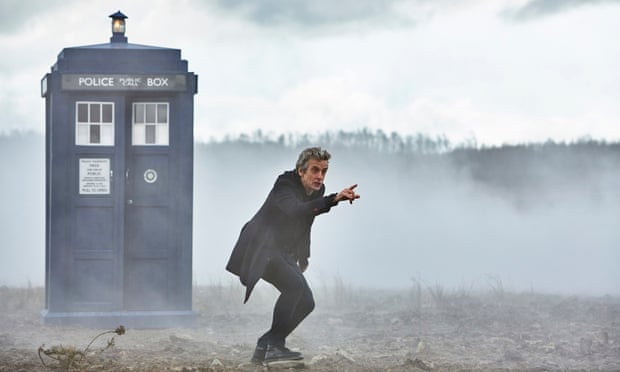
The cold open is eerily effective, the puntastic hand mines as creepy as anything Moffat has produced across his writing and showrunning work. The idea of a world shrouded in the fog of war, with little to no chance of survival, immediately gives the episode a murky morality, one which is further compounded by the Doctor arriving to save the boy. Although I was aware Davros would be in this series, I'd missed any reference to him in this episode and remained largely spoiler free (a somewhat momentous achievement in this day and age). The boy telling the Doctor his name during the rescue was a great shock, giving way to the lesser one of the TARDIS leaving, one of those heart-in-your-mouth moments that seemed to ring out throughout the opening credits.
This kind of opportunity to change time, supposedly for the better, is something that has cropped up before throughout New Who, particularly back in the haunting Fires of Pompeii episode (coincidentally, the one that Capaldi guest-starred in). There, we learn that Vesuvius' eruption is a fixed point in time. It cannot be changed, no matter how hard Donna attempts to convince the Doctor otherwise. As mentioned in The Magician's Apprentice itself, it's been previous concern of the Doctor about whether it is morally right to stop a child before he goes on to become a heinous adult. It was used for comic effect in Moffat's earlier season opener, Let's Kill Hitler, but nothing is more deadly serious here.
The episode lends great weight to the Doctor's decision to leave the boy Davros without hammering it home; Colony Sarff (great name) searching for the Doctor across the galaxy and amongst his known associates offered a neat touch. Not only does it allow us to check in with some faces we've not seen for a while, it also works to build the tension for the episode. It also helps that Colony Sarff is as creepy as anything. I'm with Indy: why did it have to be snakes? Missy's introduction, comical as it is, doesn't really shatter that tension either. Michelle Gomez treads a fine line between sinister and outlandish all the way through the episode, but it never crosses into pantomime. And past history dictates that the Master wanting to help out the Doctor is a pretty big deal.
When the Doctor finally gets his entrance (and what an entrance - Rock Star Capaldi needs to be a thing more often), Capaldi gets to shine because this is his episode. We've all seen the Doctor make the tough decisions and (not) destroying Gallifrey still stands at the heart of that; Davros becomes a representation of all of those tough decisions. Everything could have changed if that little boy had been lost to the hand mine. Instead, the Doctor is left with the responsibility that his inaction has led to everything that Davros became; the destruction of everything the Doctor holds dear. The end of the episode, the apparent destruction of Missy, Clara and the TARDIS, hammers that point home. Is this, like so many things he holds himself accountable for, the Doctor's fault?
And with that, we're back on the turrbulent road that is Doctor Who. After the last series possibly restored the faith of some and further alienated others, The Magician's Apprentice is going to do pretty much the exact same thing. It's dense, emotional and entirely character driven and for that, I loved it.
As ever, we will be reviewing alternate episodes across the series so Jen will be with you next week for the wonderfully named The Witch's Familiar (I am loving the episode titles for this series).
- Becky
Follow @AssortedBuffery on Twitter
Or like our Facebook page
Thursday, 10 September 2015
FEATURE: Buffy the Vampire Slayer - Beer Bad
Previously on Buffy the Vampire Slayer: Buffy continues to mourn the demise of non-relationship with Parker Abrams and ignoring the Riley-shaped man candy waiting in the wings. Xander's battle to fit in now the others have gone to college continues and Willow and Oz's relationship is showing signs of wear.

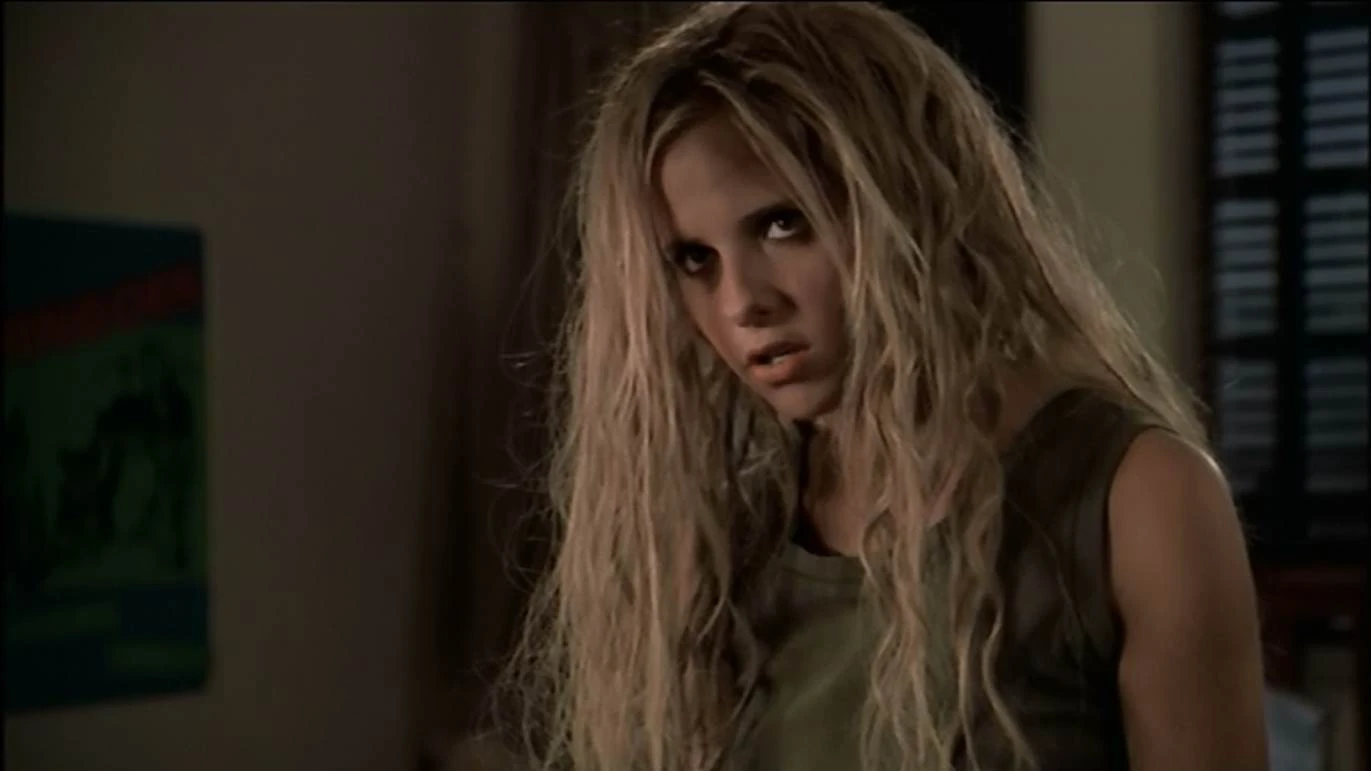
So here it is. An episode that lives in infamy amongst Buffy fans as the nadir of the series, a ball droppage of such proportions that mentioning it to a fellow fan will likely induce a shudder and a roll of the eyes. Xander gets a job at the campus pub to try and be closer to his friends, not realising that the bartender has such a grudge against Thomas Aquinas-spouting lunkheads that he concocts a beer that reduces them to cavemen. Unfortunately, a still-moping Buffy discovers she's not the only one of Parker's extra-curricular activities and is invited to drink with said lunkheads, meaning the Slayer's about to go all One Million Years BC.
Though there is a kind of vicarious thrill in seeing douchebags like the ones who used to speak over you in seminars getting a comeuppance, it nowhere near makes up for the fact that very little in this episode works. So few of the jokes land that it actually starts to feel like you're watching a Bizarro world version of Buffy where all the wit just drained away. I can only come to the conclusion that the writers' room must have been sampling their own brew throughout the entirety of the pre-production process.
The idea of beer reducing people to a kind of primal state isn't inherently a bad one. After all, I'm sure we've all experienced a town centre late on a Saturday night and observed the same thing. However, it's such a transparent concept for the traditionally super-clever show that it feels clumsy. It also gives it a preaching quality that the show has never had, nor would have again in its run because they were trying to get funding for an anti-drug plotline (which was unsurprisingly refused). Usually, the central metaphor allows the characters to come to an understand about themselves and the way they react to the world around them. Here, it's practically grabbing a megaphone and screaming the episode's title at you until you swear to be teetotal for life.
The Buffy-Parker thing comes under a lot of criticism for undermining Buffy as a character and I took issue with this assessment for The Harsh Light of Day because it's ok to see Buffy vulnerable in a relationship situation. It doesn't take anything away from the strength of her character. That being said, Beer Bad goes too far beyond that point. As amusing as the soaring romcom fantasies that open the episode try to be, dragging out the Parker situation to the point where she feels like she's grieved more for him than for her relationship with Angel was a bad move on the writers' part. The one night stand never earns that kind of narrative time and it feels like they're stalling here, trying to find yet another way of ensuring Buffy doesn't thrive at college.
Sarah Michelle Gellar throws herself into the outlandish performance and does her best to try and make a primal version of Buffy work, but even contemporary Buffy has nothing really to do but look sad and make excuses for Parker. However, it's Nicholas Brendon who has to do much of the work in this episode, for once playing the straight man to his comical co-star. His delivery of "you're a very bad man" to the bartender responsible is spot-on and his interactions with Buffy provide rueful smiles if not outright belly laughs. There's also a flash of the usual wit as Willow gleefully turns the tables on Parker and his pick-up techniques.
And yet, literally the only really good part of the episode is when Buffy knocks Parker on the head with a big stick as we, the audience, sincerely hope the show will soon do the same.
Quote of the Week:
Giles: You can't have beer.
Buffy: Want beer!
Xander: Giles, don't make Cave Slayer unhappy.
Sunnydale Who's Who: Hunt, Caveman #3, is played by a pre-Harold and Kumar Kal Penn; he also appears in Angel episode That Vision Thing.
- Becky
You can read Becky's look at previous episode, Fear, Itself, here.
Follow @AssortedBuffery on Twitter
Or like our Facebook page
So here it is. An episode that lives in infamy amongst Buffy fans as the nadir of the series, a ball droppage of such proportions that mentioning it to a fellow fan will likely induce a shudder and a roll of the eyes. Xander gets a job at the campus pub to try and be closer to his friends, not realising that the bartender has such a grudge against Thomas Aquinas-spouting lunkheads that he concocts a beer that reduces them to cavemen. Unfortunately, a still-moping Buffy discovers she's not the only one of Parker's extra-curricular activities and is invited to drink with said lunkheads, meaning the Slayer's about to go all One Million Years BC.
Though there is a kind of vicarious thrill in seeing douchebags like the ones who used to speak over you in seminars getting a comeuppance, it nowhere near makes up for the fact that very little in this episode works. So few of the jokes land that it actually starts to feel like you're watching a Bizarro world version of Buffy where all the wit just drained away. I can only come to the conclusion that the writers' room must have been sampling their own brew throughout the entirety of the pre-production process.
The idea of beer reducing people to a kind of primal state isn't inherently a bad one. After all, I'm sure we've all experienced a town centre late on a Saturday night and observed the same thing. However, it's such a transparent concept for the traditionally super-clever show that it feels clumsy. It also gives it a preaching quality that the show has never had, nor would have again in its run because they were trying to get funding for an anti-drug plotline (which was unsurprisingly refused). Usually, the central metaphor allows the characters to come to an understand about themselves and the way they react to the world around them. Here, it's practically grabbing a megaphone and screaming the episode's title at you until you swear to be teetotal for life.
The Buffy-Parker thing comes under a lot of criticism for undermining Buffy as a character and I took issue with this assessment for The Harsh Light of Day because it's ok to see Buffy vulnerable in a relationship situation. It doesn't take anything away from the strength of her character. That being said, Beer Bad goes too far beyond that point. As amusing as the soaring romcom fantasies that open the episode try to be, dragging out the Parker situation to the point where she feels like she's grieved more for him than for her relationship with Angel was a bad move on the writers' part. The one night stand never earns that kind of narrative time and it feels like they're stalling here, trying to find yet another way of ensuring Buffy doesn't thrive at college.
Sarah Michelle Gellar throws herself into the outlandish performance and does her best to try and make a primal version of Buffy work, but even contemporary Buffy has nothing really to do but look sad and make excuses for Parker. However, it's Nicholas Brendon who has to do much of the work in this episode, for once playing the straight man to his comical co-star. His delivery of "you're a very bad man" to the bartender responsible is spot-on and his interactions with Buffy provide rueful smiles if not outright belly laughs. There's also a flash of the usual wit as Willow gleefully turns the tables on Parker and his pick-up techniques.
And yet, literally the only really good part of the episode is when Buffy knocks Parker on the head with a big stick as we, the audience, sincerely hope the show will soon do the same.
Quote of the Week:
Giles: You can't have beer.
Buffy: Want beer!
Xander: Giles, don't make Cave Slayer unhappy.
Sunnydale Who's Who: Hunt, Caveman #3, is played by a pre-Harold and Kumar Kal Penn; he also appears in Angel episode That Vision Thing.
- Becky
You can read Becky's look at previous episode, Fear, Itself, here.
Follow @AssortedBuffery on Twitter
Or like our Facebook page
Tuesday, 8 September 2015
FEATURE: Angel - I Fall to Pieces
Previously on Angel: Angel Investigations is up and running, but Angel is still having a hard time asking people for money. He's built a foundation for a working relationship with Kate, a cop whose life he saved from a life-sucking sex demon.

As Cordelia's ongoing struggles with Angel Investigations' empty bank account deepen, a Doyle vision leads the gang to Melissa, a woman being stalked by a surgeon who has concocted a weird fantasy in which they're engaged. Angel uses his contact with Kate to get some background on the guy, Ronald Meltzer, a medical maverick who also happened to specialise in psychic surgery. The reason Melissa can always feel he's watching her? Because he is by detaching his eyeball and having it follow her around. As Cordelia would say, "bleurgh."
Both Buffy and Angel often look at the dangers of gender stereotypes and expectations, particularly when it comes to performative masculinity; Buffy has to deal with entitled jocks and scheming college douchebags, Angel gets to deal with stalkers believing they should have access to a woman's body, just because. Ronald Meltzer is a doctor and a brilliant one at that, but that alone doesn't convince Melissa to fall in love with him and, for her, their relationship ends after one date. However, he's not happy with that and uses his power to insert himself into every aspect of her life. As Kate says, the power of stalkers is in how completely they can take over their victims, even if they're locked up and far away.
It elevates I Fall To Pieces beyond a simple monster-of-the-week instalment into something skincrawlingly creepy, a place where even the victim's home is no longer a safe haven. The voyeuristic aspects with the floating eyeball alone are enough to give you goosebumps, but the episode escalates that further by having Meltzer's hands grope Melissa in bed. It taps in to a very real social anxiety for women, the knowledge that a lot of men out there don't regard your body as your own, but feel they have access to it. The episode draws its power from that and watching it in our contemporary context adds to the creepiness. We live in a world where stories from sites like Everyday Sexism demonstrate how sexual harassment continues to be normalised.
It's to the episode's credit that it managed to take a one-off character like Melissa and make her something more than just the victim of her present situation. In a scene with Doyle in her office, we find out she used to be into extreme sports, specifically bungee-jumping, but the anxiety that has arisen from the stalking has stopped her from doing anything. It's a brief moment and one that benefits from Doyle's terrible way with words ("Don't you worry. When Angel is finished with his case, I can guarantee you'll be wanting to jump off a bridge again..."), but it gives her a little dimension and emphasises the traumatic effect that this situation has on her. That sympathy is also crucial for the unsettling nature of the episode; we already feel awful for her by default, but the extra detail gives it a greater depth.
However, the episode does fall down a little for me when it comes to the main characters; Doyle and Cordelia aren't given much to do beyond their generic vision-having/administration roles and the episode only makes an oblique reference to the connections between Angel and Meltzer. Angelus, Angel's more entertaining but downright evil other half, was famous for stalking, often tormenting his victims as part of his games with them. This was seen overtly in Passion, but also in his relationship with Drusilla. It's clear from a couple of lines that Angel is drawing on his own experience in his psychological profiling of Meltzer, but it doesn't go nearly far enough in making these parallels explicit. Given Angel's quest for redemption, the ongoing arc of the entire series, it could have been another little step forward in him accepting and atoning for his past.
After the unevenness of Lonely Heart, the episode falls into its investigative procedural groove a little faster, demonstrating that Angel has improved his social skills from the pilot and can actually draw in potential victims from Doyle's visions without freaking them out further. However, it still doesn't feel like the show doesn't know what it wants to be just yet. The last three episodes saw it trying to pull away from the Buffy tether, but never quite succeeding. This week, it feels like a lost X-Files episode from the blend of supernatural and scientific to the way in which Cordy briefly Scullys Angel with a possible 'normal' explanation of hidden cameras and the like. Fortunately, it still retains enough of the Whedon/Greenwalt schtick to remain firmly in the Buffyverse.
Though isn't an Angel/Mulder/Scully investigation something we'd all love to see?
Quote of the Week:
Cordelia: What is stalking nowadays? Like, the third most popular sport amongst men?
Angel: Fourth after luge.
Inventive Kill: Angel disconnects Meltzer's head and then seals his body in separate boxes before depositing them at a building site where they get covered in concrete. Yum.
Let's Get Trivial: Often musical references are snuck into the Buffyverse and this episode finds Doyle repurposing lyrics from Funny Girl's 'People' to try and chat up Cordelia.
Demonology 101: Meltzer's lawyers are from Wolfram & Hart, another step towards the show integrating them into its landscape.
- Becky
You can read Becky's look at previous episode, In The Dark, here.
Follow @AssortedBuffery on Twitter
Or like our Facebook page

As Cordelia's ongoing struggles with Angel Investigations' empty bank account deepen, a Doyle vision leads the gang to Melissa, a woman being stalked by a surgeon who has concocted a weird fantasy in which they're engaged. Angel uses his contact with Kate to get some background on the guy, Ronald Meltzer, a medical maverick who also happened to specialise in psychic surgery. The reason Melissa can always feel he's watching her? Because he is by detaching his eyeball and having it follow her around. As Cordelia would say, "bleurgh."
Both Buffy and Angel often look at the dangers of gender stereotypes and expectations, particularly when it comes to performative masculinity; Buffy has to deal with entitled jocks and scheming college douchebags, Angel gets to deal with stalkers believing they should have access to a woman's body, just because. Ronald Meltzer is a doctor and a brilliant one at that, but that alone doesn't convince Melissa to fall in love with him and, for her, their relationship ends after one date. However, he's not happy with that and uses his power to insert himself into every aspect of her life. As Kate says, the power of stalkers is in how completely they can take over their victims, even if they're locked up and far away.
It elevates I Fall To Pieces beyond a simple monster-of-the-week instalment into something skincrawlingly creepy, a place where even the victim's home is no longer a safe haven. The voyeuristic aspects with the floating eyeball alone are enough to give you goosebumps, but the episode escalates that further by having Meltzer's hands grope Melissa in bed. It taps in to a very real social anxiety for women, the knowledge that a lot of men out there don't regard your body as your own, but feel they have access to it. The episode draws its power from that and watching it in our contemporary context adds to the creepiness. We live in a world where stories from sites like Everyday Sexism demonstrate how sexual harassment continues to be normalised.
It's to the episode's credit that it managed to take a one-off character like Melissa and make her something more than just the victim of her present situation. In a scene with Doyle in her office, we find out she used to be into extreme sports, specifically bungee-jumping, but the anxiety that has arisen from the stalking has stopped her from doing anything. It's a brief moment and one that benefits from Doyle's terrible way with words ("Don't you worry. When Angel is finished with his case, I can guarantee you'll be wanting to jump off a bridge again..."), but it gives her a little dimension and emphasises the traumatic effect that this situation has on her. That sympathy is also crucial for the unsettling nature of the episode; we already feel awful for her by default, but the extra detail gives it a greater depth.
However, the episode does fall down a little for me when it comes to the main characters; Doyle and Cordelia aren't given much to do beyond their generic vision-having/administration roles and the episode only makes an oblique reference to the connections between Angel and Meltzer. Angelus, Angel's more entertaining but downright evil other half, was famous for stalking, often tormenting his victims as part of his games with them. This was seen overtly in Passion, but also in his relationship with Drusilla. It's clear from a couple of lines that Angel is drawing on his own experience in his psychological profiling of Meltzer, but it doesn't go nearly far enough in making these parallels explicit. Given Angel's quest for redemption, the ongoing arc of the entire series, it could have been another little step forward in him accepting and atoning for his past.
After the unevenness of Lonely Heart, the episode falls into its investigative procedural groove a little faster, demonstrating that Angel has improved his social skills from the pilot and can actually draw in potential victims from Doyle's visions without freaking them out further. However, it still doesn't feel like the show doesn't know what it wants to be just yet. The last three episodes saw it trying to pull away from the Buffy tether, but never quite succeeding. This week, it feels like a lost X-Files episode from the blend of supernatural and scientific to the way in which Cordy briefly Scullys Angel with a possible 'normal' explanation of hidden cameras and the like. Fortunately, it still retains enough of the Whedon/Greenwalt schtick to remain firmly in the Buffyverse.
Though isn't an Angel/Mulder/Scully investigation something we'd all love to see?
Quote of the Week:
Cordelia: What is stalking nowadays? Like, the third most popular sport amongst men?
Angel: Fourth after luge.
Inventive Kill: Angel disconnects Meltzer's head and then seals his body in separate boxes before depositing them at a building site where they get covered in concrete. Yum.
Let's Get Trivial: Often musical references are snuck into the Buffyverse and this episode finds Doyle repurposing lyrics from Funny Girl's 'People' to try and chat up Cordelia.
Demonology 101: Meltzer's lawyers are from Wolfram & Hart, another step towards the show integrating them into its landscape.
- Becky
You can read Becky's look at previous episode, In The Dark, here.
Follow @AssortedBuffery on Twitter
Or like our Facebook page
Thursday, 3 September 2015
FEATURE: Buffy the Vampire Slayer - Fear, Itself
Previously on Buffy the Vampire Slayer: Buffy has been royally used and dumped by manipulative campus bicycle, Parker Abrams, Willow has been dabbling more and more in the magical arts and Xander is back living in his parents' basement and forming a tentative relationship with Anya.

Buffy Halloween episodes, appearing in even seasons, are always a treat; one of the in-Buffyverse jokes is that Halloween, the one night ghosts and ghouls are supposed to walk the earth, is actually a complete snorefest for the demonic and the undead. Thus begins Fear, Itself as a moping Buffy continues to mourn her treatment at the hands of Parker by trying to avoid life and a Halloween party. Giles reminds her that nothing ever happens on Halloween and so she dresses up and heads out to a frat house party as Little Red Riding Hood with James Bond (Xander), Joan of Arc (Willow) and God (Oz, obviously). However, frat boys being idiots, a demonic symbol they paint on the dancefloor triggers a summoning spell for the demon, Gachnar.
The gang's fears made manifest is something that the show has explored before, way back in the first season episode, Nightmares, when the gang's bad dreams came to life. It's an effective way of doing some character leg work and the show's maturity is evidenced here as Fear, Itself is a lot stronger in using the central conceit. Not only do we get several character arcs explored here through their respective fears, it also begins to sow the seeds for the rest of the season and seasons beyond that. For what appears on the surface to be a simple standalone episode like the excellent Halloween, Fear, Itself is another great example of how the show uses monsters-of-the-week to propel along the wider narrative arcs.
Chiefly, it's Buffy's episode as she's still coming to terms with another guy in her life walking away from her and leaving her behind. Connecting back to Nightmares, it's a fear that has built since her parents' divorce. If you remember, back in that episode, her first nightmare is that she is to blame for her father leaving and he tells her so in quite a malicious way. The post-Parker depression brings this all back, especially in light of Angel leaving on Graduation Day. It's a common thread throughout the series as a whole and is hammered home once again that no matter how many times her friends rush to help her, she feels she will be left to face her life alone, distanced by her Slayer powers or a mercurial sense that something is wrong with her. Much has been made of Buffy's isolation in the first three episodes of this series and it's still kind of repetitive, but the rest of the episode is so much fun that you can't really help but get swept along in it.
The other major character work here, albeit in a smaller and less obvious way, is that of Oz. Oz's manifesting fear is that he will lose control of the wolf within him and he starts to transform in the house, hurting and abandoning Willow in the process. The scene of him cowering, almost weeping as he chants "you're not gonna change" is the most emotion we've ever seen from the usually unflappable Oz and it's almost traumatic in its rawness. We always knew Seth Green could handle Oz's deadpan one liners with aplomb, but he deserves more credit for consistently nailing the more emotional side of the character when it appears. Given this fear is something that'll be increasingly important in the first half of the season, it's a sad foreshadowing to glimpse it now.
For Xander and Willow, their fears tap into something that is a continuation of old fears and the beginning of new ones respectively. Xander is still feeling isolated from his friends; back in school it was because he had no real physical strength or supernatural powers with which to contribute (see The Zeppo for details) and now, it's because he's not with them at college. He becomes invisible and ignored, the others bemoaning him for abandoning them. In later seasons, he comes to accept his role as the heart of the group, but it's the fourth season that really starts to cement that as his role from now onwards.
Willow's little nightmarish moment is a really interesting one to rewatch in the context of what happens in later seasons. After the opening credits, the episode begins with her discussing her desire to learn more about magic and continue her experimentation with spells. Both Buffy and Oz advise caution, but she ignores them and performs a spell for the lost in the haunted house; her fear is that she will not be able to control it and so it proves as the resultant little green balls of light start to drive her mad. Willow's path to magic addiction is paved with good intentions, the beginnings of which are seen here, both in her desire to help, but also her inability to resist magic's allure. It's effective foreshadowing once again and repeated viewings of the episode are richer for it.
With all the seriousness dealt with, focus has to turn to just how funny this episode is and how willing it is to experiment with the traditional grandiose formula of villain reveals. The build-up to Gachnar's arrival is perfectly pitched with the soaring score, Anthony Head's dramatic warnings and Buffy's hesitancy to fight what sounds like an awesome and powerful demon... who also happens to be about four inches tall. It's a hilarious moment, a classic example of the kind of subversion the show constantly played with, as well as leading up to one of the best episode punchlines: "actual size."
And yet, there's also something more to be said about the wider themes going on in the fourth season and the appearance of tiny little Gachnar. The episode isolates the characters to face their own fears, but it is only once they are all together again that these fears begin to ease. In its own, quirky way, the show reiterates the point that Joyce makes to Buffy earlier in the episode; she's never alone because she has her friends and from them, she draws her strength. It's something that'll be taken quite literally when the gang take on the season's Big Bad, but it's also another reminder that the Scoobies will always work best together.
Quote of the Week:
Xander: Prepare to have your spines tingled and your gooses bumped by the terrifying... Fantasia... Fantasia?
Oz: Maybe it's because of all the horrific things we've seen, but hippos wearing tutus just don't unnerve me the way they used to.
Inventive Kill: Buffy squishes Gachnar under her sneaker.
Let's Get Trivial: It's the first time that the running gag of Anya fearing bunnies is mentioned. It will come to the fore again in her showstopping rock number in Once More With Feeling.
- Becky
You can read Becky's review of The Harsh Light of Day here.
Follow @AssortedBuffery on Twitter
Or like our Facebook page

Buffy Halloween episodes, appearing in even seasons, are always a treat; one of the in-Buffyverse jokes is that Halloween, the one night ghosts and ghouls are supposed to walk the earth, is actually a complete snorefest for the demonic and the undead. Thus begins Fear, Itself as a moping Buffy continues to mourn her treatment at the hands of Parker by trying to avoid life and a Halloween party. Giles reminds her that nothing ever happens on Halloween and so she dresses up and heads out to a frat house party as Little Red Riding Hood with James Bond (Xander), Joan of Arc (Willow) and God (Oz, obviously). However, frat boys being idiots, a demonic symbol they paint on the dancefloor triggers a summoning spell for the demon, Gachnar.
The gang's fears made manifest is something that the show has explored before, way back in the first season episode, Nightmares, when the gang's bad dreams came to life. It's an effective way of doing some character leg work and the show's maturity is evidenced here as Fear, Itself is a lot stronger in using the central conceit. Not only do we get several character arcs explored here through their respective fears, it also begins to sow the seeds for the rest of the season and seasons beyond that. For what appears on the surface to be a simple standalone episode like the excellent Halloween, Fear, Itself is another great example of how the show uses monsters-of-the-week to propel along the wider narrative arcs.
Chiefly, it's Buffy's episode as she's still coming to terms with another guy in her life walking away from her and leaving her behind. Connecting back to Nightmares, it's a fear that has built since her parents' divorce. If you remember, back in that episode, her first nightmare is that she is to blame for her father leaving and he tells her so in quite a malicious way. The post-Parker depression brings this all back, especially in light of Angel leaving on Graduation Day. It's a common thread throughout the series as a whole and is hammered home once again that no matter how many times her friends rush to help her, she feels she will be left to face her life alone, distanced by her Slayer powers or a mercurial sense that something is wrong with her. Much has been made of Buffy's isolation in the first three episodes of this series and it's still kind of repetitive, but the rest of the episode is so much fun that you can't really help but get swept along in it.
The other major character work here, albeit in a smaller and less obvious way, is that of Oz. Oz's manifesting fear is that he will lose control of the wolf within him and he starts to transform in the house, hurting and abandoning Willow in the process. The scene of him cowering, almost weeping as he chants "you're not gonna change" is the most emotion we've ever seen from the usually unflappable Oz and it's almost traumatic in its rawness. We always knew Seth Green could handle Oz's deadpan one liners with aplomb, but he deserves more credit for consistently nailing the more emotional side of the character when it appears. Given this fear is something that'll be increasingly important in the first half of the season, it's a sad foreshadowing to glimpse it now.
For Xander and Willow, their fears tap into something that is a continuation of old fears and the beginning of new ones respectively. Xander is still feeling isolated from his friends; back in school it was because he had no real physical strength or supernatural powers with which to contribute (see The Zeppo for details) and now, it's because he's not with them at college. He becomes invisible and ignored, the others bemoaning him for abandoning them. In later seasons, he comes to accept his role as the heart of the group, but it's the fourth season that really starts to cement that as his role from now onwards.
Willow's little nightmarish moment is a really interesting one to rewatch in the context of what happens in later seasons. After the opening credits, the episode begins with her discussing her desire to learn more about magic and continue her experimentation with spells. Both Buffy and Oz advise caution, but she ignores them and performs a spell for the lost in the haunted house; her fear is that she will not be able to control it and so it proves as the resultant little green balls of light start to drive her mad. Willow's path to magic addiction is paved with good intentions, the beginnings of which are seen here, both in her desire to help, but also her inability to resist magic's allure. It's effective foreshadowing once again and repeated viewings of the episode are richer for it.
With all the seriousness dealt with, focus has to turn to just how funny this episode is and how willing it is to experiment with the traditional grandiose formula of villain reveals. The build-up to Gachnar's arrival is perfectly pitched with the soaring score, Anthony Head's dramatic warnings and Buffy's hesitancy to fight what sounds like an awesome and powerful demon... who also happens to be about four inches tall. It's a hilarious moment, a classic example of the kind of subversion the show constantly played with, as well as leading up to one of the best episode punchlines: "actual size."
And yet, there's also something more to be said about the wider themes going on in the fourth season and the appearance of tiny little Gachnar. The episode isolates the characters to face their own fears, but it is only once they are all together again that these fears begin to ease. In its own, quirky way, the show reiterates the point that Joyce makes to Buffy earlier in the episode; she's never alone because she has her friends and from them, she draws her strength. It's something that'll be taken quite literally when the gang take on the season's Big Bad, but it's also another reminder that the Scoobies will always work best together.
Quote of the Week:
Xander: Prepare to have your spines tingled and your gooses bumped by the terrifying... Fantasia... Fantasia?
Oz: Maybe it's because of all the horrific things we've seen, but hippos wearing tutus just don't unnerve me the way they used to.
Inventive Kill: Buffy squishes Gachnar under her sneaker.
Let's Get Trivial: It's the first time that the running gag of Anya fearing bunnies is mentioned. It will come to the fore again in her showstopping rock number in Once More With Feeling.
- Becky
You can read Becky's review of The Harsh Light of Day here.
Follow @AssortedBuffery on Twitter
Or like our Facebook page
Tuesday, 1 September 2015
FEATURE: Angel - In The Dark
Previously on Angel: Tall, dark and forehead is now working in LA as a sort-of private detective, aided by Cordelia Chase and a half-demon called Doyle who has visions that offer clues for upcoming cases.
Beginning with one of the funniest cold opens ever (and yes I have typed the entire Spike-dubbed conversation below, just for you guys), Spike lands in Los Angeles on the quest to recover the Gem of Amarra after Buffy kicked the crap out of him back in Sunnydale. Oz has the Gem and has taken it straight to Angel for a nice mini Scoobies reunion. However, with the help of the sadistic vampire Marcus, Spike traps Angel and tortures him for the Gem's location and it's up to Oz, Cordelia and Doyle to save the day.
Quote of the Week:
Spike [as Rachel]: How can I thank you, you mysterious black-clad hunk of a night thing?
Spike [as Angel]: No need, little lady. Your tears of gratitude are enough for me. You see, I was once a badass vampire, but love and a pesky curse defanged me and now, I'm just a big fluffy puppy with bad teeth.
[Rachel goes to touch Angel's hair]
Spike: No, not the hair! Never the hair.
Spike [as Rachel]: But there must be some way I can show my appreciation?
Spike [as Angel]: No helping those in need's my job and workin' up a load of sexual tension and prancing away like a magnificent poof is truly thanks enough.
Spike [as Rachel]: I understand... I have a nephew who's gay, so- [gasps]
Spike [as Angel]: Say no more. Evil's still afoot. And I'm almost out of that nancy-boy hair-gel I like so much. Quickly! To the Angel-mobile! Away!
Let's Get Trivial: This is Oz's only appearance on Angel and the episode marks the only time four original Buffy cast members are in the same episode together.
The Buffy Connection: This episode follows on from the events of The Harsh Light of Day in which Buffy gives Oz the Gem of Amarra to pass on to Angel.
- Becky
You can read Becky's look at previous episode Lonely Heart here.
Follow @AssortedBuffery on Twitter
Or like our Facebook page
Beginning with one of the funniest cold opens ever (and yes I have typed the entire Spike-dubbed conversation below, just for you guys), Spike lands in Los Angeles on the quest to recover the Gem of Amarra after Buffy kicked the crap out of him back in Sunnydale. Oz has the Gem and has taken it straight to Angel for a nice mini Scoobies reunion. However, with the help of the sadistic vampire Marcus, Spike traps Angel and tortures him for the Gem's location and it's up to Oz, Cordelia and Doyle to save the day.
Oz slots into the LA set-up with ease, his natural lack of verbosity allowing for some comedy moments with the equally laconic Angel and a motormouth Cordelia in need of some Sunnydale news. Likewise, Spike's particular brand of nastiness is allowed to be let loose in this darker setting, employing a sadistic vampire with a talent for torture to extract the information about the ring from Angel. And any adversarial interplay between James Marsters and David Boreanaz is worth it. Spike continues to be the Wile E. Coyote of the Buffyverse at this stage and it's always fun to see it all go wrong for him.
The episode also takes advantage of the opportunity to play with the show's not-yet-settled dynamics as Angel becomes the one in trouble with Cordelia and Doyle the ones who need to save him. Their gentle joshing is the most adorable aspect of these early Angel episodes. It's fun to see them be the heroes, coming up with a successful plan to rescue Angel, even if they do inadvertently give the ring to freaky torture vampire.
The use of the Gem of Amarra in the episode crystallises much of what has already been said about the direction that Angel's arc will take in his own series as it is in the torturing scenes. Destroying it is necessary; no one vampire should have that amount of power, particularly one as vicious as Angelus is if he turns up again. As he says to Rachel, the woman he's helping, there's the easy fix (which is what taking the ring would be) or the difficult road.
For Angel, it's achieving some form of atonement for his previous life and it has to be the hard road. The idea of light and dark is weaved throughout the episode and, just as the Shanzu prophecy which will crop later reinforces, Angel has to walk "in the dark" before he can achieve that redemption.
For Angel, it's achieving some form of atonement for his previous life and it has to be the hard road. The idea of light and dark is weaved throughout the episode and, just as the Shanzu prophecy which will crop later reinforces, Angel has to walk "in the dark" before he can achieve that redemption.
I also love that Angel positions himself as a champion for the marginalised, the ones living in the dark of society, without the help that the "9-5" people get. As a show, Buffy was always concerned with those people, the ones the rest of society forgets are there or refuses to see. Angel gleefully picks up that mantle and runs with it, the big city hiding more adult fears within its shadows. It isn't hard to understand why these shows became so popular with the people who felt like they didn't fit in anywhere. They placed us front and centre, whether we were nerds, unpopular, lonely or scared.
And that very final scene, of Angel and Doyle sitting as the sun goes down, allows us to glimpse our heroic vampire's vulnerability too as he admits he was on the verge of confessing everything under torture. It might be just a throwaway line that also chucks in a your mom joke for good measure, but it's just a little effort towards humanising Angel and building his character.
And that very final scene, of Angel and Doyle sitting as the sun goes down, allows us to glimpse our heroic vampire's vulnerability too as he admits he was on the verge of confessing everything under torture. It might be just a throwaway line that also chucks in a your mom joke for good measure, but it's just a little effort towards humanising Angel and building his character.
Quote of the Week:
Spike [as Rachel]: How can I thank you, you mysterious black-clad hunk of a night thing?
Spike [as Angel]: No need, little lady. Your tears of gratitude are enough for me. You see, I was once a badass vampire, but love and a pesky curse defanged me and now, I'm just a big fluffy puppy with bad teeth.
[Rachel goes to touch Angel's hair]
Spike: No, not the hair! Never the hair.
Spike [as Rachel]: But there must be some way I can show my appreciation?
Spike [as Angel]: No helping those in need's my job and workin' up a load of sexual tension and prancing away like a magnificent poof is truly thanks enough.
Spike [as Rachel]: I understand... I have a nephew who's gay, so- [gasps]
Spike [as Angel]: Say no more. Evil's still afoot. And I'm almost out of that nancy-boy hair-gel I like so much. Quickly! To the Angel-mobile! Away!
Let's Get Trivial: This is Oz's only appearance on Angel and the episode marks the only time four original Buffy cast members are in the same episode together.
The Buffy Connection: This episode follows on from the events of The Harsh Light of Day in which Buffy gives Oz the Gem of Amarra to pass on to Angel.
- Becky
You can read Becky's look at previous episode Lonely Heart here.
Follow @AssortedBuffery on Twitter
Or like our Facebook page
Subscribe to:
Posts (Atom)