The Power of Three finds the Ponds torn between their two lives, real life and life with the Doctor. Meanwhile, mysterious black cubes begin appearing everywhere with no explanation and no conceivable motive. Spoilers sweetie!
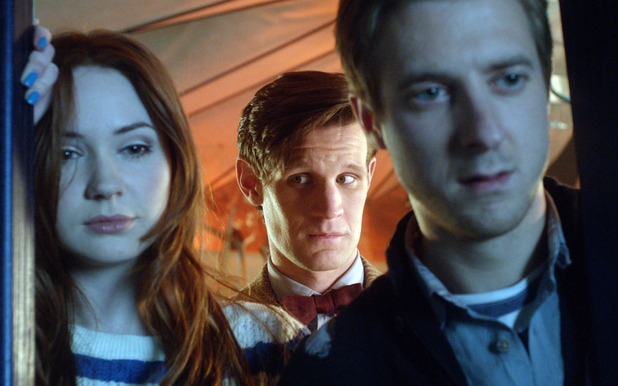
To try and sum up the plot of this episode, and do justice to everything that happened, briefly and succinctly would be near impossible. A ridiculous amount happened; from the welcome return of Brian Williams (Mark Williams), Rory (Arthur Darvill) actually doing his job whilst Amy (Karen Gillan) hangs out with her friends, then there's the supposed cube invasion which turned out to be an attempt at genocide, the Doctor (Matt Smith) starting to realise his companions are going to leave him, UNIT coming back, a Lethridge-Stewart (Jemma Redgrave) appearing and... well I'm not going to go on, you've probably seen the episode yourself.
Put simply, there was too much happening. As Jen has observed, Doctor Who is very much a victim of its episode run-time and nowhere was that more evident than in The Power of Three. The slow cube invasion was an excellent concept, a true sci-fi gem that could have been utilised to ramp up the tension before the big Steven Birkoff-related reveal. In between, however, we got a stupid amount of time-jumping as the Doctor got bored so swept Amy and Rory away to times gone by. Instead of creating a cohesive storyline, Chris Chibnall's script instead opted for mining the largest amount of jokes and references he could. It was still entertaining, but far too frenetic to become truly invested in.
As such, the reveal that it is the Shakri, a galactic pre-emptive policing system who want to get rid of the human race before they can conquer space, becomes both rushed and slightly anti-climactic. It is left to yet another convenient 'sonic screwdriver solves everything' conclusion, something which I had hopefully thought we'd left behind in the Davies era. Poor Steven Berkoff had barely anything to do except look evil then aggrieved. After the fantastic twist in Asylum of the Daleks or the ridiculously tense climax of A Town Called Mercy, this paled in comparison. It does, however, get points for providing some of the most terrifying facially challenged people since the "where's my mummy" child (Which still haunts me. Bloody Moffat).
Thankfully, despite the many plots, the episode still had an inherent strength and entertainment value because of the performances of the key players. Seeing the Ponds in their two lives added another depth to their characters because, whilst we've always seen companions' families, it is rare that you see their wider social circles. The ever-growing sense of doom surrounding their departure continues this week with Brian questioning the Doctor about his previous companions. His 'just get them back safe' at the end of the episode was practically dripping in dramatic irony.
As always, Smith remains the strongest performance and he was giving a fair amount of emotional yo-yo-ing to do this week, as well as demonstrating a Doctor at only half his coronary capacity. In amidst all the mania, he still manages to convey the darkness we've been seeing in previous episodes, the anger and the loneliness that never goes away. It's a masterful performance and Smith is further cementing himself as an iconic incarnation of everyone's favourite Time Lord.
For me, this episode has been the weakest of the current run with too much plot, frenetically jumping from one scene to the next whilst trying to cram as many jokes and references in as possible. That being said, it's a testament to the quality of this latest series that The Power of Three was still an enjoyable watch and further confirms that the Ponds' departure is going to be a very sad episode indeed. Both Jen and I will be reviewing The Angels Take Manhattan next week, together, at the same time. Who knows how on Gallifrey that will turn out.
- Becky
You can read Jen's review of A Town Called Mercy here.
Follow Becky on Twitter @beckygracelea
Or follow her blog beckygracelea.wordpress.com
Saturday, 22 September 2012
TV REVIEW: Parade's End - Episode Five
The period drama comes to an end as Christopher continues to serve in the trenches, Sylvia hatches even more plans to try and get him back and Valentine continues to wait for him to return, picking up a sex education via early (considerably better written) prototypes of Fifty Shades of Grey.
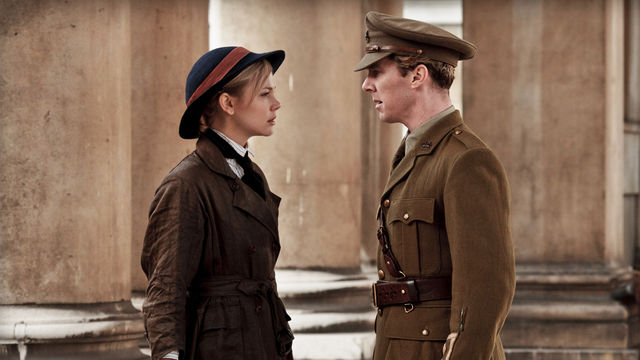
Though featuring artillery bombardments, the Parade's End finale wasn't so much an explosive revelation as a slow meander towards the conclusion we all knew was coming (though in my case, not necessarily the one I wanted). Christopher (Benedict Cumberbatch) remains in the trenches, facing strafes and slightly deranged officers continuing a sonnet competition and wandering round without appropriate headgear. Sylvia (Rebecca Hall), now returned from France, continues to prepare for Christopher's life to be a misery when he gets back whilst also ending her five-year man-drought with a quick tumble in the bedsheets with former flame Gerald Drake (Jack Huston). Valentine meanwhile is at last given something to do after she discovers a sexually explicit book owned by one of her students, leading to her very own sexual awakening and the decision that she will 'ruin herself' with Christopher when he gets back. Oo-er.
There has been a battle right from the beginning of the series embodied in Christopher, the tension between tradition and modernity, the old and the new. Cumberbatch's stiff upper lip performance has been one of the main draws throughout the series and continues here, demonstrating Tietjens' discomfort with the world with every eyebrow raise and mouth twitch. Attempting to cling gallantly to the past, Christopher's efforts have been focused throughout on maintaining the status quo that everything else has threatened to destroy. This is no more apparent than in the wonderful scene in which he has tea and sandwiches served to him on a tray whilst sitting in a trench at the front. The Hun may be firing on him from all sides but goddammit it's time for afternoon tea!
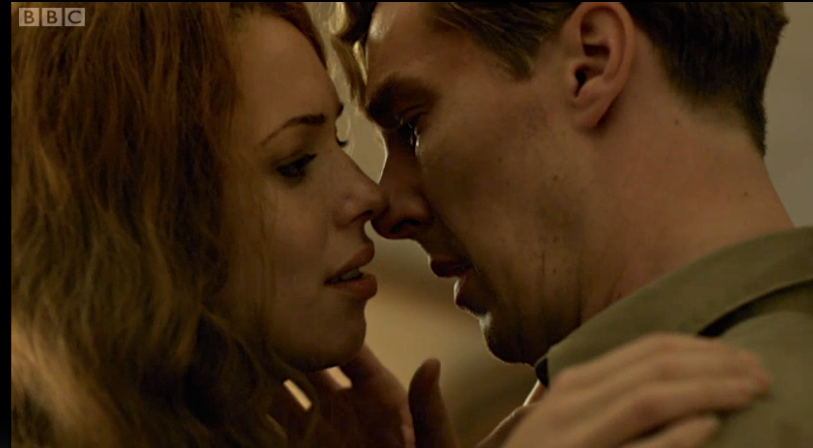
It's the kind of attitude Sylvia has exhibited throughout as well though with considerably less restraint than Christopher. Everything must continue as it always had done, though of course, it didn't work out this way. Hall has been the standout performance in the previous episodes but here, with the focus more on Christopher and Valentine's eventual union, Sylvia is sidelined a little in the overall plot. That didn't mean she faded from view however; her last ditch effort to fake an illness to draw Christopher back in was both comical and slightly tragic, as was her venomous destruction of the tree at Groby. She's been advocating that particular form of arboreal revenge for a while and the hacking down of the tree was the last straw for Christopher. She also gets one of the best lines in the entire series, referring to Valentine as 'that scrub-faced ladies champion of the regular bowel movement'. Just fantastic and the final scene in which Christopher conveys in a look just how committed he is to Valentine was electrifying between Cumberbatch and Hall, demonstrating the chemistry that has made them such a compelling couple.
Narratively, Christopher was always going to leave Sylvia for Valentine but I'm still a little disappointed with that conclusion. Adelaide Clemens gave terrific performances in the first couple of episodes in which she had something to do and was more about being a rebellious suffragette than swooning after Christopher. Against Hall's towering performance, Clemens faded and Sylvia became the more compelling character, making me want to see her get Christopher after all. I don't necessarily think it was Clemens' fault; she was simply outgunned by both Hall and the writing that she was given. Valentine was meant to represent the pure versus Sylvia's corruption and sadly, that was all she ever was.
It's the only thing that occurs to me to be slightly negative about because the final scenes of the series were a fitting end for all of the characters we had got to know over the course of four episodes. Sylvia managed to manoeuvre herself as the future wife to the possible Viceroy of India through the newly promoted General Campion (Roger Allam). Allam has been one of the best supporting actors, mastering the look of bemusement that caused one of the episode's big laughs after Sylvia's unexpected marriage proposal. Christopher learned to let go of the past too, burning the log leftover from the Groby tree as a symbol of the beginning of his new life as both a singing war veteran and lover of Valentine.
Parade's End has been in a different class right from its first episode; unashamedly literary and scripted with a wit and sophistication that is rarely seen in dramas of any kind at the moment. I'm going to call it now and say it will be heavily nominated when it comes to award season and well-deserved it would be too. Fridays nights are going to be poorer for its absence.
- Becky
You can read Becky's review of Episode Four here.
Follow Becky on Twitter @beckygracelea
Or follow her blog on beckygracelea.wordpress.com
Though featuring artillery bombardments, the Parade's End finale wasn't so much an explosive revelation as a slow meander towards the conclusion we all knew was coming (though in my case, not necessarily the one I wanted). Christopher (Benedict Cumberbatch) remains in the trenches, facing strafes and slightly deranged officers continuing a sonnet competition and wandering round without appropriate headgear. Sylvia (Rebecca Hall), now returned from France, continues to prepare for Christopher's life to be a misery when he gets back whilst also ending her five-year man-drought with a quick tumble in the bedsheets with former flame Gerald Drake (Jack Huston). Valentine meanwhile is at last given something to do after she discovers a sexually explicit book owned by one of her students, leading to her very own sexual awakening and the decision that she will 'ruin herself' with Christopher when he gets back. Oo-er.
There has been a battle right from the beginning of the series embodied in Christopher, the tension between tradition and modernity, the old and the new. Cumberbatch's stiff upper lip performance has been one of the main draws throughout the series and continues here, demonstrating Tietjens' discomfort with the world with every eyebrow raise and mouth twitch. Attempting to cling gallantly to the past, Christopher's efforts have been focused throughout on maintaining the status quo that everything else has threatened to destroy. This is no more apparent than in the wonderful scene in which he has tea and sandwiches served to him on a tray whilst sitting in a trench at the front. The Hun may be firing on him from all sides but goddammit it's time for afternoon tea!
It's the kind of attitude Sylvia has exhibited throughout as well though with considerably less restraint than Christopher. Everything must continue as it always had done, though of course, it didn't work out this way. Hall has been the standout performance in the previous episodes but here, with the focus more on Christopher and Valentine's eventual union, Sylvia is sidelined a little in the overall plot. That didn't mean she faded from view however; her last ditch effort to fake an illness to draw Christopher back in was both comical and slightly tragic, as was her venomous destruction of the tree at Groby. She's been advocating that particular form of arboreal revenge for a while and the hacking down of the tree was the last straw for Christopher. She also gets one of the best lines in the entire series, referring to Valentine as 'that scrub-faced ladies champion of the regular bowel movement'. Just fantastic and the final scene in which Christopher conveys in a look just how committed he is to Valentine was electrifying between Cumberbatch and Hall, demonstrating the chemistry that has made them such a compelling couple.
It's the only thing that occurs to me to be slightly negative about because the final scenes of the series were a fitting end for all of the characters we had got to know over the course of four episodes. Sylvia managed to manoeuvre herself as the future wife to the possible Viceroy of India through the newly promoted General Campion (Roger Allam). Allam has been one of the best supporting actors, mastering the look of bemusement that caused one of the episode's big laughs after Sylvia's unexpected marriage proposal. Christopher learned to let go of the past too, burning the log leftover from the Groby tree as a symbol of the beginning of his new life as both a singing war veteran and lover of Valentine.
Parade's End has been in a different class right from its first episode; unashamedly literary and scripted with a wit and sophistication that is rarely seen in dramas of any kind at the moment. I'm going to call it now and say it will be heavily nominated when it comes to award season and well-deserved it would be too. Fridays nights are going to be poorer for its absence.
- Becky
You can read Becky's review of Episode Four here.
Follow Becky on Twitter @beckygracelea
Or follow her blog on beckygracelea.wordpress.com
Monday, 17 September 2012
TV REVIEW: Doctor Who - A Town Called Mercy
Following on from last week’s ‘Dinosaurs on a Spaceship’, Doctor Who provides another cleverly named hour in the form of ‘A Town Called Mercy’, written by Toby Whithouse and continuing with the recent cinematic hints. With a reference to The Jam and the promise of a Stetson or two in the air, coolness points were off the chart from the start as we romp through the third episode in the current series of Doctor Who.
Dodgy American accents were very much ahoy as the Doctor found himself in a small town in the American ‘Wild’ West. A small town in the American West which happens to have electricity just a few years too early, a rather odd looking barrier fence, a resident physician with a face tattoo, a Cyborg gunslinger and a self-destructing spaceship that looks a lot like a Tic-Tac. Obviously.
It started well. It started really well. The Doctor finds himself in spot of bother almost straight away, when he is promptly picked up the townsfolk and kicked out of town Western style. Quite literally, actually, as he is unceremoniously dumped on the other side of the ominous looking perimeter fence. He is met there by a glimpse of a rather shady looking character we will come to know as ‘The Gunslinger’ (Andrew Brooke), an angry Cyborg on a mission. Where are all the nice, relaxed Cyborgs popping down the shops or having some down time in front of the telly I can’t help but wonder?
We then meet the real ‘alien doctor’, Kahler Jex (Adrian Scarborough) and things begin to make sense. Well, as much as they ever do. The Cyborg wants Jex, Marshall Isaac (Ben Browder) wants to protect him, the townspeople want to throw him to the wolf, the Doctor wants everyone to behave themselves, Amy wants to get her own way and Rory presumably just wants to go home. In short, and without giving too much away, The Doctor winds up looking after the town and having to make the decision for everyone.
There’s much to like in this episode. I know I mention this a lot some more absolutely stonking lines of dialogue including a gloriously Milton-esque moment late on in the episode. Amy and Rory are great in an ‘our days are numbered’ sort of way, with the team having clearly cottoned on to the thoroughly shocking fact that girls watch Doctor Who too, providing a healthy handful more Arthur Darvill close ups than usual, and is that a slightly new hairdo? The set was perfect, the lighting was lovely and there were some very well executed and indeed, very cinematic shots. Structurally, it worked well. The epic tone did admittedly at times feel shoe-horned it, but for the first time in a long time you could watch without the creeping sense that the creative team suddenly looked at their watches, found there to be 8 minutes to go and threw in a Cyberman or six to wrap things up. It was the best out and out story the show has produced in a while, with plot twists, morals an Stetsons in all the right places.
The only thing beginning to worry me in all of this, and I suspect it’s because of the Pond Williams focus, but I would like to know what on earth, for want of a better phrase, has happened to The Doctor? It may just be me, but all of a sudden he seems distracted. It’s been apparent since the series opening but in this episode in particular he always seems the last to ask obvious questions, plays with his hat instead of joining in and has wildly different changes of heart from one scene to the next. I’m all for character development, but there’s an uneasiness about this. It may well be intentional, in which case may the Lord High Dalek Prime Minister shoot me down with an electrified egg whisk, but there’s a lack of confidence in his decisions and moods which doesn’t sit quite right.
It was fun, well put together show, but something missed the spot somehow.
To continue with the theme of vaguely space related puns- let’s cross our fingers and watch this space.
- Jen
You can read Becky's review of Dinosaurs on a Spaceship here.
You can read more of Jen's writing here: https://memyselfandtheothers.wordpress.com/
Or you can follow her on twitter here: https://twitter.com/jenniferklarge
Labels:
A Town Called Mercy,
Adrian Scarborough,
Andrew Brooke,
Arthur Darvill,
BBC,
Ben Browder,
Cyberman,
Daleks,
Doctor Who,
Karen Gillan,
Matt Smith,
Steven Moffat,
TARDIS,
Toby Whithouse
TV REVIEW: Downton Abbey - Episode One
After what seems like an agonising wait after the awesome Christmas special that saw Matthew and Mary FINALLY get together, Downton Abbey returns to our screens with just the right amount of melodrama for some classic Sunday television.
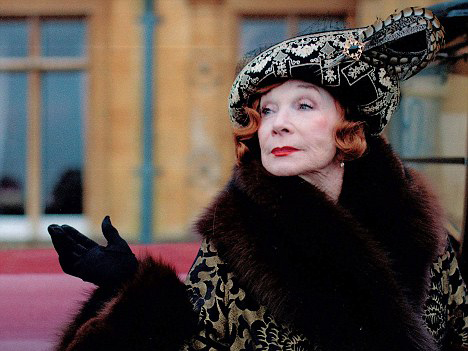
Speaking of clashes, the publicity all centered on the meeting of Maggie Smith's Dowager Countess and Shirley Maclaine's Martha Levinson and it did not disappoint. From the first awkward hallway meeting to the constant attempts to thwart each other over desserts, the two battleaxes are already engaged in a one-liner competition that looks set to go on all series. Smith has long been the fan-favourite for her comedy moments but it is in the more dramatic ones where she really soars; her revelation that it was her money that enabled Branson and Sybil to attend the wedding was understated yet perfectly pitched. If reports are true and Maggie Smith is to leave the series, her presence and acerbic wit will be sorely missed.
Meanwhile, Bates and Anna continue their relationship in the inconvenient location of the slammer. The Bates-Anna romance had me gripped throughout the previous two series, but I can't help thinking that it is starting to run out of steam. Perhaps the circumstances don't help; after all, you can't really have soaring romantic ups-and-downs if one party happens to be stuck in prison, but it all feels a little stale. Now that we know Bates' mysterious past was to do with his psychotic wife who tried to do everything to derail his new relationship and we know that he didn't commit the murder, there's no enigma left to uncover. Also, it's Downton Abbey; everything turns out neatly so therefore we know that, at some point, Bates is going to make it out of prison and return to Downton. There's no tension here anymore, which is a shame because it was previously one of the most gripping narratives.
It's a small gripe though in the scope of the wider episode which finally saw Matthew and Mary get married, despite a couple of hiccups along the way (solved by Branson - did I mention that he's awesome?). It's the moment most people have waited for since halfway through the first series and even those naysayers who disliked the pair must have cheered ever-so-slightly when they got to the church. It was a great end to a fantastic start to the new series and I cannot wait to see what Fellowes and the gang have in store for us. Sunday nights are officially all booked up.
- Becky
You can follow Becky on Twitter @beckygracelea
Or follow her blog here beckygracelea.wordpress.com
The last series veered from the sublime to the ridiculous so fast it made your head spin, which is no bad thing but let's face it, that was the most convenient outbreak of Spanish flu there has ever been. With it's Roaring 20s setting, the third series might be a little more grounded in some vague reality. Then again, why let real life get in the way of some bally good melodrama? A whole hour and a half of Downton Abbey packs in a hell of a lot of plot and thankfully Julian Fellowes' script keeps it zipping along at a fair pace. It's not for the first-time viewer though as there isn't really any major exposition to explain how everyone got to where they are apart from a few oblique references. The first episode kicks off some time after the Christmas special with all of Downton gearing up to possibly the most anticipated marital event since Kate Middleton rocked up to Westminster Cathedral in her lacy finery.
Naturally, the course to the oncoming nuptials does not run smooth. Lord Grantham (Hugh Bonneville) is called away to London to discover that he's practically lost all of Cora's fortune (Elizabeth McGovern) and Downton is under threat (thus providing the overall narrative anxiety for the series). Meanwhile, a pregnant Sybil (Jessica Brown-Findlay) and her husband, former chauffeur Tom Branson, (Allen Leech) return to Downton Abbey to face some awkward dinner conversation about coat-tails and Irish nationalism. Bates (Brendan Coyle) has a new, possibly (read definitely) dangerous cell-mate while Anna (Joanne Froggatt) continues to search for the evidence needed to free him. A new footman has started work leading to more plotting from Thomas (Rob James-Collier) and O'Brien (Siobhan Finneran), though for once they are not on the same side. Daisy (Sophie McShera) revolts against Mrs Patmore (Lesley Nicol) whilst Carson (Jim Carter) continues to struggle to maintain order. And I've not even covered half of it.
I should probably warn you in advance of this review that I adore both Matthew and Branson and there may be some slight swooning when discussing their roles in the first episode. I can't help it. One of them has the most amazing blue eyes in the world and the other one has a positively gorgeous Irish accent. Leech in particular excelled here, giving Branson an awkward charm and defiance in the face of the Crawleys. His scene with the Dowager Countess and Mrs Crawley forcing him into a mourning suit was a comic delight whilst his angry drunk Irishman acting was an excellent example of a horrendously awkward situation. The relationship between Matthew and Branson was also a great aspect of this episode with the Crawley heir taking it upon himself to make the former chauffeur feel as welcome as possible in the midst of all the class divides. Stevens and Leech sell the oncoming bromance well and the brother-in-law partnership versus the Crawleys should be an interesting development. It all fits into the wider theme of change that comes with the 20s setting and the various clashes between old and new.
Meanwhile, Bates and Anna continue their relationship in the inconvenient location of the slammer. The Bates-Anna romance had me gripped throughout the previous two series, but I can't help thinking that it is starting to run out of steam. Perhaps the circumstances don't help; after all, you can't really have soaring romantic ups-and-downs if one party happens to be stuck in prison, but it all feels a little stale. Now that we know Bates' mysterious past was to do with his psychotic wife who tried to do everything to derail his new relationship and we know that he didn't commit the murder, there's no enigma left to uncover. Also, it's Downton Abbey; everything turns out neatly so therefore we know that, at some point, Bates is going to make it out of prison and return to Downton. There's no tension here anymore, which is a shame because it was previously one of the most gripping narratives.
It's a small gripe though in the scope of the wider episode which finally saw Matthew and Mary get married, despite a couple of hiccups along the way (solved by Branson - did I mention that he's awesome?). It's the moment most people have waited for since halfway through the first series and even those naysayers who disliked the pair must have cheered ever-so-slightly when they got to the church. It was a great end to a fantastic start to the new series and I cannot wait to see what Fellowes and the gang have in store for us. Sunday nights are officially all booked up.
- Becky
You can follow Becky on Twitter @beckygracelea
Or follow her blog here beckygracelea.wordpress.com
Saturday, 15 September 2012
FEATURE: Congleton Film Festival
Situated about twenty miles south of Manchester, some of you may not have heard of Congleton, an old market town with a questionable relationship with bibles and bears, but those of you who have may have also heard that it's about to host the very first Congleton Film Festival on the 28th to the 30th of September.
The celebration of film, particularly on a local level, is the festival's main focus; "I felt that a film festival was the best way to explore Congleton's cultural heritage because the town has such a strong cinematic past, having had four cinemas over the years," Sam explains, "Film is also something that I believe can bring people together in a shared experience and as the town has an active connection to the past, this festival was a perfect way to represent this." As well as the film screenings themselves, Sam has organised various events to coincide with the festival weekend. One such event is a workshop being held at The Electric Picture House Artists' Co-Operative and will hopefully inspire a new generation of local film-makers that can keep the festival running.
Organised by resident Sam Astbury, the Congleton Film Festival has been designed as a celebration of the town's cinematic history and the screening locations were all formerly cinemas in their own right. Raising awareness of Congleton's cinematographic past, the festival will offer town residents an insight into the ongoings of regional film-making with entries from film-makers from Cheshire and the North-West region. The selection is an interesting and varied one, ranging from The P.O.W, following a prisoner-of-war attempting to escape, to Birdie about a faded and forgotten sportsman. In terms of the films' selection, Sam states that 'as it is the first year, I wasn't looking for anything in particular. The festival is not a competition so its main aim is to celebrate film in its entirety'.
The celebration of film, particularly on a local level, is the festival's main focus; "I felt that a film festival was the best way to explore Congleton's cultural heritage because the town has such a strong cinematic past, having had four cinemas over the years," Sam explains, "Film is also something that I believe can bring people together in a shared experience and as the town has an active connection to the past, this festival was a perfect way to represent this." As well as the film screenings themselves, Sam has organised various events to coincide with the festival weekend. One such event is a workshop being held at The Electric Picture House Artists' Co-Operative and will hopefully inspire a new generation of local film-makers that can keep the festival running.
My family have lived in Congleton for 15 years now and it came as a surprise to learn about the town's history with film and cinemas. Growing up in a fairly small town can often be dull and without any major events, I remember frequently lamenting that it never had any cinemas or indeed, much else to do but wander around and amuse ourselves in the park. This film festival is a really exciting event for Congleton, a chance to explore film-making in the local area and perhaps inspire more young people to pick up a camera. Wandering around a town can turn into fantastic films and capture little moments or memorable occasions.
Sam has big ambitions for the film festival and rightly so. Congleton has recently seen a burst in cultural happenings of which the cinematic is only one. As Sam explains, 'depending on the success of this one, I don't see why it couldn't become an annual event which could co-enside with those more established in the town such as the Jazz and Blues Festival.' The locality is also extremely important, particularly in the venues chosen for the screenings. Illucini's Cafe stands in Capitol Walk which takes its name from the Capitol Cinema which used to stand in its place while the Electric Picture House Artists' Co-Operative was formerly the Electric Picture Palace. It will be an event that is deeply rooted in the town's history and it will hopefully add to the town's sense of community.
So if you happen to be in the area or feel like journeying to a small market town with big ambitions, set aside a weekend and see what Congleton Film Festival has to offer.
Festival Timetable:
Friday 28th September - Illucinis Cafe Bar, Capitol Walk (7pm Start)
FOCUS: Congleton's Film-Makers.
Destiny Awaits - Directed by David Gowin
Escaped Loonies - Directed by David Gowin
MAIN FEATURE: Being Sold - Directed by Phil Hawkins (hopefully followed by Director's Q&A)
Saturday 29th September - The Electric Picture House Artists' Co-Op (7pm Start)
FOCUS: Varied and Further Afield
Birdie - Directed by Rhys Fullerton
The P.O.W. - Directed by John Hamlett
SPECIAL GUEST: Roger Shannon
For further information, please head over to the Congleton Film Festival website or the Facebook page.
- Becky
You can follow Becky on Twitter @beckygracelea
Or follow her blog beckygracelea.wordpress.com
Sam has big ambitions for the film festival and rightly so. Congleton has recently seen a burst in cultural happenings of which the cinematic is only one. As Sam explains, 'depending on the success of this one, I don't see why it couldn't become an annual event which could co-enside with those more established in the town such as the Jazz and Blues Festival.' The locality is also extremely important, particularly in the venues chosen for the screenings. Illucini's Cafe stands in Capitol Walk which takes its name from the Capitol Cinema which used to stand in its place while the Electric Picture House Artists' Co-Operative was formerly the Electric Picture Palace. It will be an event that is deeply rooted in the town's history and it will hopefully add to the town's sense of community.
So if you happen to be in the area or feel like journeying to a small market town with big ambitions, set aside a weekend and see what Congleton Film Festival has to offer.
Festival Timetable:
Friday 28th September - Illucinis Cafe Bar, Capitol Walk (7pm Start)
FOCUS: Congleton's Film-Makers.
Destiny Awaits - Directed by David Gowin
Escaped Loonies - Directed by David Gowin
MAIN FEATURE: Being Sold - Directed by Phil Hawkins (hopefully followed by Director's Q&A)
Saturday 29th September - The Electric Picture House Artists' Co-Op (7pm Start)
FOCUS: Varied and Further Afield
Birdie - Directed by Rhys Fullerton
The P.O.W. - Directed by John Hamlett
SPECIAL GUEST: Roger Shannon
Sunday 30th September - Congleton Community Garden (7pm Start - Subject to Change)
FOCUS: Family Film
Secret Screening - Film to be revealed.
For further information, please head over to the Congleton Film Festival website or the Facebook page.
- Becky
You can follow Becky on Twitter @beckygracelea
Or follow her blog beckygracelea.wordpress.com
TV REVIEW: Parade's End - Episode Four
The penultimate episode of the BBC adaptation of Parade's End finds Christopher (Benedict Cumberbatch) back on the front, leaving behind an anxious Valentine (Adelaide Clemens) whilst Sylvia (Rebecca Hall) makes her own plan to follow her husband to France.
Christopher has been helped to a safer position in the army training other soldiers thanks to brother Mark (Rupert Everett) and, despite General Campion (Roger Allam) finding him to be a nuisance, is doing rather well at it. Meanwhile back in London, Valentine anxiously awaits news of her would-be beau whilst continuing her job as a gym mistress. Elsewhere, Sylvia decides that now is absolutely the best time to go and visit Christopher in France and arrives in Rouen before anyone has the chance to do anything about it. There, she and Christopher attempt some sort of reconciliation but are interrupted before anything can truly be done.
After last week's slight dip, Parade's End was back on form in its fourth episode, providing more comedy and tragedy than you could shake a bayonet at. While the series has never been particularly sombre or po-faced, laugh-out-loud moments weren't exactly forthcoming outside of Rufus Sewell's appearances. In this episode however, the comedy is extremely well-pitched, though often erring on the side of black, and each time comes layered with a sense of poignancy that further highlights the drama of the characters' situations. In particular, the scene between Christopher and Patrick Kennedy's equally strung out McKechnie trying to outdo each other intellectually through sonnets and Latin was both very funny and deeply sad.
Another standout scene was the meeting between Christopher and Sylvia in the hotel, their first face-to-face conversation in a considerably long time. To use a technical term, both actors knocked it out of the park with Hall's monologue in particular adding a deep sadness to the pair's unsuccessful marriage. Just as it seems the pair are reconciling (with a spectacular grab-and-kiss move from Cumberbatch that no doubt resulted in a sudden outbreak of swooning), the poignant scene was replaced by a farcical confrontation between Christopher and Sylvia's former squeeze, Potty Perowne (Tom Mison) and a drunken superior officer. Had it not been handled with such skill, the transition from tragedy to farce could have been jarring and distracting, but fortunately it only enhanced what the previous scene had been demonstrating; Sylvia and Christopher just aren't meant to be together.
The focus on the central marriage means that some of the characters are found wanting in the wider episode arc. Most notable is Valentine, Christopher's not-yet mistress, who continues the pining and erstwhile glancing out of windows to fill the quota for this week's episode. I don't think it's necessarily Clemens' fault; she's not given much to work with narrative wise, other than thinking longingly about Christopher. As I've not read the books, I'm unaware of whether the much-touted union between Valentine and Christopher will ever actually happen, but Clemens' fading performance in contrast with Hall's towering screen presence is making me think I'd actually like Sylvia to get her man.
This week's episode is, to my mind, the best so far in a series that has been mostly consistent in its high standard. Blending comedy with drama is not always an easy balance to strike but this episode manages it well and is all the better for it. It's also easily the most action-packed instalment so far with more focus on Christopher's life in the army and his unfortunate scuffle with Potty.
And please, will someone just give Rebecca Hall an award already?
- Becky
You can read Becky's review of Parade's End - Episode Three here.
Follow Becky on Twitter @beckygracelea
Or follow her blog at beckygracelea.wordpress.com
Christopher has been helped to a safer position in the army training other soldiers thanks to brother Mark (Rupert Everett) and, despite General Campion (Roger Allam) finding him to be a nuisance, is doing rather well at it. Meanwhile back in London, Valentine anxiously awaits news of her would-be beau whilst continuing her job as a gym mistress. Elsewhere, Sylvia decides that now is absolutely the best time to go and visit Christopher in France and arrives in Rouen before anyone has the chance to do anything about it. There, she and Christopher attempt some sort of reconciliation but are interrupted before anything can truly be done.
After last week's slight dip, Parade's End was back on form in its fourth episode, providing more comedy and tragedy than you could shake a bayonet at. While the series has never been particularly sombre or po-faced, laugh-out-loud moments weren't exactly forthcoming outside of Rufus Sewell's appearances. In this episode however, the comedy is extremely well-pitched, though often erring on the side of black, and each time comes layered with a sense of poignancy that further highlights the drama of the characters' situations. In particular, the scene between Christopher and Patrick Kennedy's equally strung out McKechnie trying to outdo each other intellectually through sonnets and Latin was both very funny and deeply sad.
The focus on the central marriage means that some of the characters are found wanting in the wider episode arc. Most notable is Valentine, Christopher's not-yet mistress, who continues the pining and erstwhile glancing out of windows to fill the quota for this week's episode. I don't think it's necessarily Clemens' fault; she's not given much to work with narrative wise, other than thinking longingly about Christopher. As I've not read the books, I'm unaware of whether the much-touted union between Valentine and Christopher will ever actually happen, but Clemens' fading performance in contrast with Hall's towering screen presence is making me think I'd actually like Sylvia to get her man.
This week's episode is, to my mind, the best so far in a series that has been mostly consistent in its high standard. Blending comedy with drama is not always an easy balance to strike but this episode manages it well and is all the better for it. It's also easily the most action-packed instalment so far with more focus on Christopher's life in the army and his unfortunate scuffle with Potty.
And please, will someone just give Rebecca Hall an award already?
- Becky
You can read Becky's review of Parade's End - Episode Three here.
Follow Becky on Twitter @beckygracelea
Or follow her blog at beckygracelea.wordpress.com
TV REVIEW: Parade's End - Episode Three
Vicious rumours fly around London about Christopher Tietjens, returning wounded from the front, and his relationships with Valentine and Mrs Duchemin leading to a confrontation with Sylvia and his family. Sylvia meanwhile amuses herself with another admirer while McMaster ascends through the ranks of society whilst wrestling with his conscience.
Over the past couple of weeks, Parade's End was starting to become a nice little comfort blanket of a Friday evening, a gentle drama that takes in all the usual scandals, longing glances and the kind of performances that we just love to see in our BBC productions. This week, the burgeoning sense of comfort was offset slightly by the darker turn of events in the third episode, as the First World War is well and truly underway and the effects are felt both at the front and at home.
Christopher is wounded, harming his previously impressive mental faculties; watching a man who prides himself on his memory and knowledge struggle to remember someone's surname was unsettling and all credit to Benedict Cumberbatch for giving a truly moving performance. Elsewhere saw the sad demise of Rufus Sewell's Reverend Duchemin (a loss for comedy and Satan-spotting) and the accidental death of Christopher's father in an unfortunate shotgun/hedge incident.
It was this latter tragedy that gave us arguably one of the best scenes of the series so far between Cumberbatch's Christopher and his brother Mark, played by Rupert Everett. The chemistry between the two actors was excellent and it allowed for a greater understanding of Christopher's character, particularly in his fight for approval in both society and with his family. Tying into the rumours flying around about his alleged infidelity, you could see how Christopher has constantly striving for approval only to fall short and decide that if everyone thinks he's a philanderer, then he is going to prove them right by propositioning Valentine.
Adelaide Clemens has put in two good performances over the two previous episodes but here, I felt she had become severely underwritten. Gone was the feistiness and rebellious nature that had made her so compelling and in its place was a simpering little girl with nothing but eyes for Christopher. To be fair this had started in the last episode, but it became the overriding relationship dynamic here; instead of having sparky exchanges, conversations between the pair became all about her lifting his confidence. It is a shame, because previously, Valentine was a interesting character but now she seems to have been reduced to a stereotype, the virgin to Sylvia's whore.
Speaking of Mrs Tietjens, I can't heap enough praise on the trio of Rebecca Hall, Tom Stoppard and Susanna White for creating such a layered character for Sylvia, who in other hands could have easily become just another evil woman caricature. According to the little research I've done, the novel's version of Sylvia is just that, a harridan determined to ruin Christopher's happiness. The television series on the other hand, has created a woman desperately trying to get her husband back, just not being very good at doing it the nice way. Rebecca Hall's performance is the standout of the series so far and is fast becoming the main reason for sticking with the series (sorry Benedict).
The mid-point of the series sees a slight dip in quality from the previous two episodes, but there is still plenty to admire, particularly in the performances of the central duo of Cumberbatch and Hall (sounds like a specialist law firm). Next week promises more thwarting of the relationship between Valentine and Christopher as he returns to the front and Syliva makes a move.
- Becky
You can read Becky's review of Parade's End - Episode Two here.
Follow Becky on Twitter @beckygracelea
Or follow her blog at beckygracelea.wordpress.com
Adelaide Clemens has put in two good performances over the two previous episodes but here, I felt she had become severely underwritten. Gone was the feistiness and rebellious nature that had made her so compelling and in its place was a simpering little girl with nothing but eyes for Christopher. To be fair this had started in the last episode, but it became the overriding relationship dynamic here; instead of having sparky exchanges, conversations between the pair became all about her lifting his confidence. It is a shame, because previously, Valentine was a interesting character but now she seems to have been reduced to a stereotype, the virgin to Sylvia's whore.
Speaking of Mrs Tietjens, I can't heap enough praise on the trio of Rebecca Hall, Tom Stoppard and Susanna White for creating such a layered character for Sylvia, who in other hands could have easily become just another evil woman caricature. According to the little research I've done, the novel's version of Sylvia is just that, a harridan determined to ruin Christopher's happiness. The television series on the other hand, has created a woman desperately trying to get her husband back, just not being very good at doing it the nice way. Rebecca Hall's performance is the standout of the series so far and is fast becoming the main reason for sticking with the series (sorry Benedict).
The mid-point of the series sees a slight dip in quality from the previous two episodes, but there is still plenty to admire, particularly in the performances of the central duo of Cumberbatch and Hall (sounds like a specialist law firm). Next week promises more thwarting of the relationship between Valentine and Christopher as he returns to the front and Syliva makes a move.
- Becky
You can read Becky's review of Parade's End - Episode Two here.
Follow Becky on Twitter @beckygracelea
Or follow her blog at beckygracelea.wordpress.com
Sunday, 9 September 2012
TV REVIEW: Doctor Who - Dinosaurs on a Spaceship
With possibly the best title since last series' Let's Kill Hitler!, Dinosaurs on a Spaceship finds the Doctor and the Ponds aboard an abandoned craft populated by dinosaurs, with only an Egyptian Queen, a rather bemused member of the Pond Williams family and a Victorian game hunter for help. As always, there be spoilers ahead.
Finding himself propositioned rather strongly by Queen Nefertiti (Riann Steele), the Doctor (Matt Smith) is relieved to be called away to 2367 AD to help Earth out with a hurtling spaceship problem. Earth's authorities declare that they are going to blow up the ship in six hours if the Doctor can't stop it. Nefertiti has come along for the ride and the Doctor decides to enlist a friend, a big game hunter named Ridell (Rupert Graves), and the ever-reliable Ponds (Karen Gillan and Arthur Darvill), accidentally bringing Rory's father, Brian, along for the ride (Mark Williams).
The first thing that struck me about this episode, apart from the new episode-themed title sequence, was how much fun the cast seemed to be having. Matt Smith has really settled into the role of the Doctor now and the constant mood swings the character experiences are well-handled from his infectious humour to his despair at Solomon's actions (David Bradley). Chris Chibnall's script was packed full with great lines that offered each of the main actors, regular or guest, to shine whilst also offering us a fast-paced narrative that was both well constructed and easy to follow. It was a proper caper episode, from start to finish, and should go down as one of the more enjoyable adventures of the Eleventh Doctor, fitting well into Steven Moffat's new blockbuster mantra.
I've long been a fan of Rupert Graves and his gung-ho Victorian hunter was brilliant from start to finish with his innuendo-ridden chat-up line to Nefertiti providing one of the big laugh-out-loud moments. Also, his ongoing battle with Amy was a real highlight and played well with the actors' chemistry and their different social attitudes. David Bradley made a suitably scenery chewing villain but the most adorable member of the cast had to be his fellow Harry Potter alumnus Mark Williams. Given his very own character arc across the episode, he was both funny and poignant, going from a man who lives a staid life to one who travels the world, the universe and beyond. Williams handled the role perfectly and the shot of him sipping a cup of tea whilst looking at Earth from the TARDIS was a lovely moment.
There was one slight drawback in the proceedings however as the episode was also notable for the appearance of comedy duo David Mitchell and Robert Webb as a tempestuous pair of robots who looked like they had been sourced from The Fifth Element leftovers. Sadly, despite their considerable comedic skills, the pair unfortunately forgot to utilise their funny bones and were let down somewhat by the material they were given. Many of the supposed jokes that the pair came out with fell rather flat and paled in comparison to the considerably more hilarious scenes between Ridell, Nefertiti and Amy. All in all, their appearance was perhaps the only low point of the episode and detracted from the immense fun that was going on elsewhere.
It wasn't all laughs and positivity in the narrative either as the whole episode had an underlying air of doom, from the massacre of the Silurians to the impending departure of the Ponds. With Amy's declaration that the Doctor could be with her to her 'end', there was a rather ominous hint to her potential fate. Whilst my love of Arthur Darvill's Rory is both well-known and unabashed, I've had a rather difficult relationship with Amy throughout her time on the series. Recently though, Karen Gillan has proven herself repeatedly and has completely won me over. After the heartbreaking revelation about the consequences of Demon's Run in the last episode, feisty Amy was back and here, Gillan acquitted herself well, showing how Amy has developed into a competent time-traveller in her own right. I'm going to be extremely sad to see the Ponds go.
A rather worrying trend was beginning to emerge in the Moffat/Smith era of the second episodes in the series being rather, to put it bluntly, crap. Thankfully Dinosaurs on a Spaceship is a riot from start to finish and a great way to continue from the excellent Asylum of the Daleks. Next week sees our heroes hit the Wild West with cyborgs and Matt Smith donning a Stetson. Stetsons are cool.
- Becky
You can read Jen's review of Asylum of the Daleks here.
Follow Becky on Twitter @beckygracelea
Or find her at her blog: beckygracelea.wordpress.com
Finding himself propositioned rather strongly by Queen Nefertiti (Riann Steele), the Doctor (Matt Smith) is relieved to be called away to 2367 AD to help Earth out with a hurtling spaceship problem. Earth's authorities declare that they are going to blow up the ship in six hours if the Doctor can't stop it. Nefertiti has come along for the ride and the Doctor decides to enlist a friend, a big game hunter named Ridell (Rupert Graves), and the ever-reliable Ponds (Karen Gillan and Arthur Darvill), accidentally bringing Rory's father, Brian, along for the ride (Mark Williams).
The first thing that struck me about this episode, apart from the new episode-themed title sequence, was how much fun the cast seemed to be having. Matt Smith has really settled into the role of the Doctor now and the constant mood swings the character experiences are well-handled from his infectious humour to his despair at Solomon's actions (David Bradley). Chris Chibnall's script was packed full with great lines that offered each of the main actors, regular or guest, to shine whilst also offering us a fast-paced narrative that was both well constructed and easy to follow. It was a proper caper episode, from start to finish, and should go down as one of the more enjoyable adventures of the Eleventh Doctor, fitting well into Steven Moffat's new blockbuster mantra.
I've long been a fan of Rupert Graves and his gung-ho Victorian hunter was brilliant from start to finish with his innuendo-ridden chat-up line to Nefertiti providing one of the big laugh-out-loud moments. Also, his ongoing battle with Amy was a real highlight and played well with the actors' chemistry and their different social attitudes. David Bradley made a suitably scenery chewing villain but the most adorable member of the cast had to be his fellow Harry Potter alumnus Mark Williams. Given his very own character arc across the episode, he was both funny and poignant, going from a man who lives a staid life to one who travels the world, the universe and beyond. Williams handled the role perfectly and the shot of him sipping a cup of tea whilst looking at Earth from the TARDIS was a lovely moment.
There was one slight drawback in the proceedings however as the episode was also notable for the appearance of comedy duo David Mitchell and Robert Webb as a tempestuous pair of robots who looked like they had been sourced from The Fifth Element leftovers. Sadly, despite their considerable comedic skills, the pair unfortunately forgot to utilise their funny bones and were let down somewhat by the material they were given. Many of the supposed jokes that the pair came out with fell rather flat and paled in comparison to the considerably more hilarious scenes between Ridell, Nefertiti and Amy. All in all, their appearance was perhaps the only low point of the episode and detracted from the immense fun that was going on elsewhere.
A rather worrying trend was beginning to emerge in the Moffat/Smith era of the second episodes in the series being rather, to put it bluntly, crap. Thankfully Dinosaurs on a Spaceship is a riot from start to finish and a great way to continue from the excellent Asylum of the Daleks. Next week sees our heroes hit the Wild West with cyborgs and Matt Smith donning a Stetson. Stetsons are cool.
- Becky
You can read Jen's review of Asylum of the Daleks here.
Follow Becky on Twitter @beckygracelea
Or find her at her blog: beckygracelea.wordpress.com
Monday, 3 September 2012
TV REVIEW: Doctor Who - Asylum Of The Daleks
Doctor Who time has come around once again. Don’t worry- we’ve utterly no idea of when to expect it anymore, either.
On the plus side, the first episode of the next 5, Asylum of the Daleks, gave an altogether welcome departure from the norm. For starters, we were presented with the Daleks from the get go- in the first five minutes of the first episode, in fact. A lovely change from the usual practice of everybody carrying on in the vague pretence that the Daleks might not appear for six weeks. Look- it’s right there in the title: Daleks. Thankfully, this meant that Writer and Executive Producer Steven Moffat could stop worrying about hiding them until the last possible appropriate second and get on with the rest of the show.
And boy did it make a big difference.
The pre-titles sequence jumped straight in, with our beloved hero caught in the trap of a woman/Dalek tragically clueless as to the damage she’s about to cause in asking the Doctor (Matt Smith) to help rescue her daughter from a nearby prison ship. Meanwhile, as they say, back on Earth, a separated Amy (Karen Gillan) and Rory (Arthur Darvill) are in the process of signing their divorce papers. However it isn’t long before they too find themselves whisked off (apologies) to join The Doctor over on the Good Ship Dalek.
So far, so same old. However we get another tweak to the blueprint here in that this time, the Daleks want The Doctor, their ‘Predator’, to save them. Sure, they’re probably up to no good and have evil ulterior motives, they wouldn’t be Daleks and it wouldn’t be Doctor Who if they didn’t, but to essentially open the show not so much with a character twist but a complete species twist, is undeniably interesting. Add to this the fact that they want to be saved from themselves, from their own insane and defunct kind on the icy hospital planet down below, and you’ve got the makings of a strong episode.
The script’s as sparky as ever, and we know the character formulae well enough now for the actors to have some fun with it. Smith and Darvill consistently perform well, but Gillan in particular stands out here. We’re treated to a competent spot of character development and a rare insight into the realities of life with Rory post Demon’s Run . The slow introduction to Jenna Lousie Coleman’s character was well thought out, too. Fun, flirty and clever, she didn’t reveal too much, but just enough to pique our interest for future episodes. There’s also a classic Whovian ‘focus on a tiny seemingly insignificant detail and then reveal it to be crucially important in the last thirty seconds’ angle, but I won’t give it away here.
If there are criticisms to be had, and regrettably there are a few, they are very much the usual suspects. Doctor Who often falls foul of the length of its time slot, and Asylum is no exception. Overall, it feels every bit the well-crafted show, but the last five minutes are rushed, and we do get the impression that interesting areas for exploration have been dropped or completely ignored. A more thorough investigation into what exactly makes a ‘broken’ Dalek, to pick one example, might have made for an even more engaging episode. It seems ironic to be asking for more time for an episode when talking about Doctor Who, but that's often exactly what it seems in need of.
Other than a slight case of runaway plotline, this was a big idea for the show’s and ground is covered well. For me, Moffat really excels in the stand -alone episodes. They allow him to showcase his best jolting plot twists, and to juxtapose his sharpened dialogue with touching character relationships, without the complications of a narrative arc. Despite Asylum ‘s introduction of several big ideas, as well as a brand new series, this opening episode really does show him at his best with all of the above.
Pun intended, we might be in for a good time here.
http://www.bbc.co.uk/iplayer/episode/p00wqr14/Doctor_Who_Series_7_Asylum_of_the_Daleks/
- Jen
You can read more of Jen's writing here: https://memyselfandtheothers.wordpress.com
Or you can follow her on Twitter here: https://twitter.com/jenniferklarge
Subscribe to:
Posts (Atom)


.jpg)