Showing posts with label Benedict Cumberbatch. Show all posts

Monday, 15 December 2014

FILM REVIEW: The Hobbit: The Battle of the Five Armies


As year draws to its close, we’re due to embark on yet another journey to J.R.R. Tolkien’s Middle Earth. All of that thanks to director Peter Jackson and The Battle of the Five Armies, the third chapter of his The Hobbit trilogy. In what is supposed to be a final film ever set in his fictional land (unlikely!) our Dwarven, Elven and Human characters are entangled in a massive conflict over the control of Erebor and hearth stored under the Lonely Mountain. Friendships are being tested, blood being shed, lessons learned. Virtually everything one can expect from grand finale like this.

It is, of course, naïve and unrealistic to expect that this film will rectify and reverse everything wrong about two previous chapters. Indeed, The Battle of the Five Armies suffers from many of the sins these films were plagued by – choppy narrative, bloated running time, an unnecessarily excessive use of computer graphics, uneven pacing. However, what where it does exceed is in its increased focus on single narrative, probably for the very first time in The Hobbit trilogy. It feels less scattered around, largely due to it being set mostly in one location. The board for ensuing conflict was set already by The Desolation of Smaug and there is no exposition as such. And that is something quite new for Peter Jackson’s Tolkien adaptations.

Another strong point is an emphasis on character development and interactions, an ingredient criminally absent from both An Unexpected Journey and The Desolation of Smaug, save for a few cursory elements. In The Battle of the Five Armies, the execution of those elements might still be somewhat clunky but at least it’s there. Both Richard Armitage and Martin Freeman rise to the occasion and provide their characters with some emotion. Bilbo, curiously underused in a series of films revolved around his character, finally gets to fulfil a role in those and adding some necessary good-natured hobbit warmth into the grim plotline. At the same time, Armitage gets to expand upon both gloomy and warm aspects of Thorin Oakenshield as he’s battling his inherited greedy sickness. The usual suspects Ian McKellen is always a joy to watch on screen and his Gandalf definitely doesn’t disappoint, as expected.

What doesn’t work quite so well, however, is the battle spectacle itself. While all Tolkien-based films used CGI heavily to help enhance epic struggles portrayed on screen, there is a sense that The Battle of the Five Armies was filmed almost entirely in front of green screen. Gone are the breathtaking and lovely landscapes of New Zealand. It’s hard to care for an hour of swarming animated characters fighting other animated characters, with occasional shots of live actors swing a sword once or twice. There’s hardly any drama or tension in that and Middle-earth feels smaller than ever.

What’s even more frustrating, it turns out that many plot points and characters from previous two films were introduced for absolutely no reason. Sylvester McCoy, so prominently featured as Radagast in An Unexpected Journey, barely makes a cameo in both subsequent films. Same with Mikael Persbrandt’s Beorn. One has to wonder why Peter Jackson even bothered including those two, given their contribution to the overall story is quite minimal and could have been achieved in more efficient ways. On the other hand, the completely new Elven character of Tauriel, as played by Evangeline Lilly, could have used an expansion. Fortunately, Luke Evans’ Aragorn-inspired Bard the Bowman and Lee Pace’s Thranduil get a lot more screen time this time and this film is so much better for it.

Technically, The Battle of the Five Armies is adequate but strangely unpolished in some areas. Many of the effects seem unfinished and unconvincing, especially the opening fiery destruction of Lake-town and climactic confrontation between Thorin and pale orc Azog. The musical score by Howard Shore, such a crucial ingredient of The Lord of the Rings, is an accomplished and intelligent as ever but feels lost and neglected in overcrowded sound mix. Editorially, this film feels a bit awkward and uneven, as did the previous two. It will be interesting to see if the extended cut, due late next year, will change that.

The final chapter in Peter Jackson’s six-film series is ultimately successful in its basic entertainment factor but it falls short as a piece of epic fantasy cinema. The ultimate failure of The Hobbit trilogy is not as painful as the one suffered by Star Wars fans a decade ago but there’s an undeniable sense that something went terribly wrong in the development process. Still, strong performances from excellent cast and significantly tighter and focused narrative make up for many shortcomings.

- Karol

Follow @AssortedBuffery on Twitter
Or like our Facebook page

Sunday, 19 January 2014

TV REVIEW: Sherlock - His Last Vow

It's been one week since the swishy-coated detective and partner last graced our screens and we're all missing him already. In lieu of a full, in-depth review, we have decided to take you through our conversation following last week's finale, a glimpse at our thoughts if you will. As ever, there are spoilers (and if you have avoided any until now, please accept a generous round of applause).


Becky: If people were worried that Sherlock was becoming too light and fluffy, then surely they must have had their fears eased with this deliciously dark episode, as twisty turny as a twisty turny thing. There were plenty of things I sort of expected (Mary) and plenty of things I didn't (yes, Jim, I did miss you). But overall, what struck me most about this episode was how well the first two in the series built up to it. The time taken to really cement the relationship between John and Sherlock, as well as the addition of Mary, ensured that the second any one of them found themselves in jeopardy, I was a bit of a wreck. 

Jen: Personally I always enjoy a little bit of light and fluffy, but I do understand that this isn't necessarily what one would traditionally either expect or want from a modern re-imagining of a classic detective drama about a clever man incapable of normal social interaction, so in that sense this final episode did rather bring us back on track. Albeit at the eleventh hour. Totally agree about the development of Mary and John's relationship, although I have to admit I was just the teensiest bit disappointed that she didn't go totally rogue and become the villain of the series. But maybe I have just have a dark imagination? Speaking of both dark imaginations and villains, beyond delighted to see the return of Moriarty. He's my favourite, ever.

B: I'm fairly certain that it won't be Moriarty we see back though. Sherlock's resurrection (however it happened) was no mean feat and I'm not sure even Moffat and Gatiss could make lightening strike twice. Perhaps a mastermind using Moriarty to bring Sherlock back into the fold? Speaking of masterminds, how damn cool was Charles Augustus Magnusson? Talk about your skincrawlingly dastardly villain. I'm honestly not sure which was worse; the licking of the face or the flicking of the face? I would have loved to have seen more of him, he was wonderfully intimidating and seemed like such a good foil for Sherlock. I loved that they each had their own version of a mind palace but used them in ways befitting their status.

J: It will be Moriarty, Becky. It will. That is what I am telling and myself and will continue to do so. Agree that lightning doesn't usually strike twice, however I think now that they've brought Sherlock himself back to life, almost anything could happen. Didn't Moriarty keep popping back to life in the books or have I misremembered that? Magnusson was indeed creepy. He was just so rude! That was the main thing I took away from him. Also, that I would like a mind palace. I LOVED the parts when Sherlock was dead, and re-living all the useful bits of information from previous conversations and scenes. 

B: Moriarty dies at the Reichenbach Falls so there's no real precedent for bringing him back. 

Yes the mind palace with Sherlock was such a great piece of film-making, not only dramatically, but technically too; it worked just as well as the onscreen graphics for Sherlock's deducting. I also loved how he used people around him and it added another dimension to the character. He may not be able to show how much he admires them very well in reality, but they all occupy a special place in his head ready to save his life when he needs them. That being said, he also managed to re-assert his utter bastard status with poor Janine. I did that horrible nervous  laugh when he proposed through the camera with that terrifying grin.

J: Is the fact that I love him not enough of a reason? But yes fair enough.

I actually really liked Janine, I particularly enjoyed the way she got her own back on him with her kiss and tell stories to the press, and the way Sherlock reacted to it with something not unlike admiration. I much preferred her to The Woman, in fact I'd quite like to see her again, but I'm not too sure we will. Definitely a great character episode all in all, with a bit more in the way of a sleuth plot than we've seen recently. 

B: I did like that final scene with Janine, the pair had a really nice chemistry. And yes, the character beats worked very well along side the sleuthy aspect. Martin Freeman in particular has been just fantastic this series and broke my heart on more than one occasion. Cumberbatch does get the more demonstrative role, but Freeman puts in a hell of a lot of work as the more reserved half and their relationship felt so much deeper this series than it has I think before, primarily because we have spent so much time with them for the first couple of episodes.

Final verdicts then?

J: Final verdicts, hmm. I think a strong and satisfying end to a great series, one which really stretched the characters and took the show to new emotional levels. My prevailing thought however, is that yes, I did miss Jim, and I think Sherlock did, too. 

B: If it is him (and I'm still not so sure), then it's going to have to be one hell of an explanation to bring him back. But yes, I agree, it's been a different series to the previous too, no doubt, but it's moved everything in a very interesting direction and I can't wait to see what happens next.

- Jen and Becky

You can read Jen's review of The Sign of Three here and Becky's look at The Empty Hearse here.

Follow @AssortedBuffery on Twitter
Or like our Facebook page.

Monday, 6 January 2014

TV REVIEW: Sherlock - The Sign of Three

Do you want the good news or the bad news first? Bad, right. Well the bad news is that, currently resting on the far side of episode 2 as we are, we only have one episode in the current series of Sherlock left. I know, I can’t believe it either. The good news though, is that if episode 3 is even half as good as episode 2, it’ll be an absolute corker.

The Sign of Three saw Sherlock (Benedict Cumberbatch) face a case he never thought possible- the curious case of the unwritten best man’s speech. Having sort of proposed to Mary (Amanda Abbington) in the previous episode, albeit dramatically diverted at the time by the re-appearance of his supposedly dead best friend, John Watson (Martin Freeman)’s wedding day has now arrived. This has left a desperate Sherlock in the tricky situation of having to not only write an entire speech in which he must emotionally connect with a room full of tissue ready wedding guests, but, crucially, this is a situation in which he must act normal, and not like a ‘high functioning sociopath’ for an entire day. Premise established, the episode proceeds to use said speech as a vehicle for well -timed flashbacks on the adventures of groom and best man, from the stag do to an invisible man to a womanising ghost. As the speech trundles on, taking us from laughter to tears in minutes, so too do the stories of the different cases, until Sherlock’s dramatic and somewhat inevitable conclusion that a crime, a murder no less, has been planned for this very day, in this very room.

For now, however, back to the speech. Despite the fact that the speech itself transpired to be nothing short of a masterpiece, touchingly delivered and utterly true to the relationship of the three characters involved, Sherlock’s speech making skills are met with, at best, concern. Perhaps well founded given his previous behaviour towards any member of the opposite sex John has shown an interest in. Mrs Hudson Sherlock’s long suffering landlady, played with a splendid warmth and simplicity, as ever, by Una Stubbs, finds the concept of Sherlock talking about a subject other than grisly homicide in front of so many rapt, normal people so hilarious that she can’t get passed the idea of him reading out the telegrams without breaking down in fits of laughter so over the top she sounds like a woodland bird being poked with something hot and pointy, to paraphrase. Sherlock himself isn’t entirely thrilled with the situation either, with even Watson failing to notice how ‘terrified’ the detective clearly is.

Happily, it falls to the tremendously likeable Mary to save the day, as she cunningly plays the boys off against each other in order for them both to be re-assured that the wedding, and indeed life after it will all end happily, with both feeling all the while feeling comfortably superior that they are doing the other one a favour. A woman who can outsmart Sherlock and Watson to boot without having to take her dressing gown off? Nice. Very nice. In fact nice is exactly what Mary is. As I said a moment ago she really is very likeable. Not so much fortuitous as utterly crucial to the longevity of the series, the success of her character has clearly been meticulously discussed and planned to the nth degree. The requirements were probably something along the lines of, firstly, a character strong enough to hold her own when talking to the infamous sociopath as well as being a person in her own right, and finally not to mention somebody John Watson would want to marry. That’s a lot to achieve in the form of just one fiancée. Fortunately, the writing team, and indeed Amanda Abbington herself, more than achieve this.

I think it’s fair to say that her real life marriage to Martin Freeman goes some way towards making their on screen relationship work, too. The two have a warmth, ease and sense of fun about them on screen through which they manage to create that rare thing in TV partnerships – actual genuine seeming chemistry. Given how hand and glove-like Cumberbatch and Freeman’s performances fit each other, the latter’s relationship with his now wife really had to be absolutely spot on in order to have a chance at working. A fantastic performance here, too from Benedict Cumberbatch, who, whilst allowing us to see a more fragile, silly and ultimately more human side of the socially awkward sleuth remained 100% true to the man himself, even in this most uncharacteristic of situations.

The more detective-like elements of the episode were down played in favour of Sherlock’s old enemy, ‘sentiment’, which may well have angered some die-hard puzzle-solving fans, but for me there was just the right amount of background mystery and intrigue. It was as fascinating and mind-boggling as ever, but didn’t get in the way of either the hilarity of the stag-do flashbacks, in which we were treated to the rare and totally brilliant sight of a drunken Sherlock, nor the poignancy of the day itself and Sherlock’s heart felt congratulations and tributes to the happy couple.

It was the perfect, perfect mix of jokes, tears, laughter and excitement.  Just any wedding speech should be – although most don’t wind up with an attempted murder.

But then, that’s what you get when you pick Sherlock Holmes as your best man.


Jen

Follow @AssortedBuffery on Twitter
Or like our Facebook page.
You can read my own blog here or follow me on twitter here

Friday, 3 January 2014

TV REVIEW: Sherlock - The Empty Hearse

It's been two years since The Reichenbach Fall, but Sherlock has finally returned with a suitably witty and emotional first episode.


Sherlock (the character) has always swaggered about, confident in his own abilities and with a trademark, if often unintentional, biting wit. They are qualities that Sherlock the show has exhibited from its first episode; even A Study in Pink had an inbuilt confidence in its concept and execution thanks to Paul McGuigan's direction. The Empty Hearse was the most self-assured episode to date with Mark Gatiss' script revelling the impact of Sherlock's return and those around him, uniting them all into the big reveal one at a time.

In terms of the wider plot, Sherlock (Benedict Cumberbatch) has almost singlehandedly dismantled Moriarty's criminal network whilst being 'dead' only to find himself faced with his brother Mycroft (Mark Gatiss) in a jail cell. It turns out that there is a terror cell planning an imminent attack on London and Sherlock is required to help foil it. Returning to London, Sherlock is surprised to discover that not only has John Watson (Martin Freeman) moved on, but he is about to get engaged and has, shock horror, moved out of 221B. They are soon forced back together in the name of Mycroft's case, a seasonal plot to blow up Parliament, and the gang are once again reunited.

That confidence that I mentioned earlier permeated every aspect of The Empty Hearse, a fine return for everyone involved. Mark Gatiss' script was one of the wittiest yet, granted Cumberbatch and Freeman some truly brilliant lines. The editing was also nothing short of spectacular, particularly in the cross-cutting for Sherlock and Watson's respective scenes with clients and patients. It gave the episode a quick pace and a knowing air that never fell into arrogance, played with enough humour to keep it light whilst also allowing the more emotional moments to rise to the surface.

The restaurant scene was so beautifully played from the very beginning, not only allowing Benedict Cumberbatch to wheel out his comedy French accent, previously utilised to great effect in the radio series Cabin Pressure (and thus my customary plug for that show is worked in), but also for Martin Freeman to follow up that graveside speech with some of the best reactionary acting in the business. The balance between the comedy and the drama of the situation was perfectly pitched, allowing for the emotional resonance of John's reaction to hit the spot whilst the violent reactions, the changing locations and moustache-related running jokes to re-establish their relationship and the chemistry between the two actors.

It wasn't all about Watson though as Sherlock goes round, alerting his colleagues to his return. A particular favourite was his reunion with Lestrade which featured the best reaction, second only to Watson's. Rupert Graves is one of the unsung heroes of this series, absolutely sublime as the put-upon inspector who always finds himself a little sidelined. Elsewhere, Molly (Louise Brealey) as Sherlock's new sidekick allowed for some of the quieter moments of the episode as Gatiss rattled through seemingly as many textual references as he could. However, it was the expanded relationship with Mycroft that resonated most from the great visual joke of them playing Operation to the clear affection/antagonisation that they share.

These reunions also served to show how the two years on his own have taken their toll on Sherlock himself, as well as those around him. Throughout the series, he has displayed the lack of understanding when it comes to human relationships and does so here, incredulous when he discovers that John is no longer waiting for him to return. However, the fake Jack the Ripper scene has Sherlock hearing John's reactions to his comments and actions; there's a realisation here that he actually needs John by his side. Molly serves as a decent foil for a day, but that relationship isn't one based on challenging Sherlock, but adoring him (despite Molly's insistence that she has moved on). Likewise, in the final confrontation between Sherlock and John, he demonstrated his true reliance on John, but this being Sherlock, it couldn't be said in a genuine fashion, it had to be performed whilst he had the upper hand in knowing the bomb wouldn't go off.

The episode was easily the funniest it has been and acted almost as a love letter to the fans who had been kept waiting by the various delays in production. Anderson acted as the audience within the episode, the Sherlock fan with endless theories as to how he did it, pouring over angles of descent, Derren Brown and acts of derring do like flying through windows and kissing Molly. It was an affectionate nod to the endless, obsessive theorising that we've all gone through since The Reichenbach Fall (yours truly included) and, whilst it could have easily been a snarky swipe at all of us, it was clearly done with the greatest of appreciation. Fan fiction references even snuck in there with the scene with Moriarty on the roof which nodded towards the Moriarty-Sherlock shippers and allowed the brilliant Andrew Scott to return to the role, if only briefly.

Not having a definitive method of escape proved to be a masterstroke, allowing each and every member of the audience to cling on to their own personal theory or see it referenced in Anderson's group. It was probably the only way of dealing with the hype surrounding Sherlock's demise in a satisfying way and somehow, not actually knowing how he did it doesn't seem so awful, it just seems fitting for the character. If anything, the focus on Sherlock's return left the sub-plot about the terrorist attack a little underdone when compared to the rest of the episode, but The Empty Hearse was always going to be about re-establishing the central relationship, rather than having a complicated mystery to solve.

It certainly wasn't the strongest Sherlock episode in terms of driving the plot forward; the parliamentary explosion narrative seemed a little superfluous until the climactic scene in the underground train car. It served its purpose in getting John and Sherlock to be honest with each other in an extreme situation, but just felt a little underdone. The aspect I did like about it though was that it had Sherlock reaching for the most complicated answers when faced with the disappearing passenger or the underground network, only for it to be a ridiculously simple answer that he'd missed. Perhaps we might get slightly simpler mysteries in future, or at least ones whose explanations are a little more understandable.

Bringing Sherlock and Watson back after two years was always going to be a tough ask, but Gatiss managed it with aplomb, a fitting reunion for everyone and one which clearly has a huge amount of love for its audience. It's so good to have them back and with a new antagonist on the horizon too.

- Becky

Follow @AssortedBuffery on Twitter
Or like our Facebook page.


Tuesday, 14 May 2013

FILM REVIEW: Star Trek Into Darkness


Star Trek Into Darkness finds the crew of the Enterprise united against a new, all-powerful foe in the form of John Harrison (Benedict Cumberbatch) whilst Captain James T. Kirk (Chris Pine) is going through some issues of his own as his headstrong ways come into conflict with those around him, namely mentor Admiral Pike (Bruce Greenwood) and Spock (Zachary Quinto). However, once Harrison makes his move, Kirk sets off in pursuit and faces massive decisions that not only affect his life but the lives of his crew as well.

The 2009 reboot of Star Trek was a massive hit, pleasing hardcore Trekkies, casual fans and complete novices alike. With its gimmick of re-setting the timeline of the original franchise, it distanced itself from the existing Star Trek whilst allowing the new group to move off in their own direction. It was an excellent jumping off point with a great cast in place and felt like a bright, shiny new world of Trek to explore. Star Trek Into Darkness therefore, should have had it made and does well to recapture some of the spark that made the reboot such a joy.

This is thanks in large part to the cast, once again excelling in iconic roles and not becoming overshadowed by those who went before. One aspect that the reboot franchise has got right from the start is the dynamic between the crew although they don't spend nearly enough time with each other. A real highlight is the interaction between Kirk, Spock and Karl Urban's metaphor-happy Bones, perfectly re-capturing the humour of the three characters' relationship. Other characters don't quite get the same chance to shine though Scotty (Simon Pegg) is given a little more to do than comic relief this time around. Zoe Saldana's Uhura gets a couple of big moments but it is poor Alice Eve who does her best with very little as Carol Marcus, including a completely unnecessary underwear scene.

The big focus has been on a certain Mr Cumberbatch in all his floppy-haired, swishy-coated glory and he cuts a fine figure, balancing the emotional aspects of John Harrison with the more scenery-chewing villainy that we were all expecting. However, the film is rather surprisingly stolen by Chris Pine who turns in a quieter, yet very affecting performance as the headstrong Kirk. It's largely a film about his journey and so the focus is on Kirk much more as he learns about all the facets of becoming a captain and its difficulties. Pine proves to be more than a worthy foil to Cumberbatch and their scenes together crackle with an energy that deserved more screentime.

It is a shame that the same attention to detail that has clearly been paid to the characters was not transferred to the film's plot. There are some big themes in there - exploration vs destruction, the necessity of revenge, terrorism, impending war - but it never feels as if Abrams et.al want to go into these in any detail beyond Kirk's character arc. Likewise, we get plenty of nods to the original series, but they become so frequent, I found myself rolling my eyes whenever one was needlessly inserted into a conversation. 

Predictable right from the start, the storyline is telegraphed through various signifiers so twists come too soon and are seen a mile off and as a result, no real danger is felt. At no point in the entire film did I get the sense that the stakes were high or that the crew were in any real danger, lessening the impact of the action scenes somewhat. That is not to say the action scenes are dull, far from it in fact, as some sequences are spectacularly put together (even if one is recycled from the previous film) and the actors, particularly Cumberbatch, impress with their physicality.

Despite this predictability, the first three quarters of the film are wildly entertaining, amusing and thrilling in equal measure. However, this is completely undermined by the final act of the film. Whilst I won't reveal anything at all spoilery, the last thirty minutes sent me into a downward spiral of disappointment and frustration. This falls solely at the feet of screenwriters Roberto Orci, Alex Kurtzman and Damien Lindelof who wrap everything up in a conclusion that is not only forecasted from a long way off, but is incredibly lazy and so devoid of originality that it leaves a bitter taste. It's a frustrating shame because everything up until then had been a little flawed, but mostly entertaining. It took just one moment to pull me out of that completely.

Star Trek Into Darkness is proving to be quite divisive and sadly, I find myself on the negative side of the debate. The build-up to its release has been immense and rife with speculation, but the film plays its hand too early and provides an ending that is not at all satisfying.

** (and a half- mainly for Benedict Cumberbatch and Chris Pine)

- Becky

Follow @AssortedBuffery on Twitter
Or like our Facebook page.


Wednesday, 9 January 2013

FEATURE: Why You Should All Be Listening to Cabin Pressure

Here at Assorted Buffery, we're fairly big fans of certain rising star Benedict Cumberbatch, just in case you hadn't noticed. I've thought he was one to watch as far back as his starring role as Stephen Hawking and in the excellent but criminally under-seen Stuart: A Life Backwards (also starring Tom Hardy - do look it up if you get chance, both actors are truly brilliant). One thing that I've always done when I've liked an actor is to seek out other works of theirs and on one such hunt, I discovered Cabin Pressure.

In case you haven't come across it, Cabin Pressure is a BBC Radio 4 sitcom, written by John Finnemore, about an extremely small airline, MJN Air, which consists of one plane, two pilots, an airline manager/stewardess and a rather enthusiastic, though ultimately useless, steward. Captain Martin Crieff (Benedict Cumberbatch), First Officer Douglas Richardson (Roger Allam), Caroline Knapp-Shappey (Stephanie Cole) and her son Arthur (also John Finnemore) take on a wide variety of jobs across the world, but inevitably, things go awry and flights never go quite according to plan.

So why should you track down this particular radio gem? Well quite simply, it's one of the funniest things on radio (or television actually) right now, full of acerbic one-liners, devestating put-downs and intricately weaved plots leading to hilarious punchlines. Finnemore's scripts work in great partnership with the actors, generously granting each one their moment in the spotlight. What also helps is that the characters are well-rounded, adding pathos to their funniest moments. For example, the captain, Martin, is your classic under-achiever and much of his comedy is mined from this fact, but also a fair amount of character development too. He isn't just a stereotype, he's a person down on his luck who just happens to get into hilarious situations.

The performances are also routinely excellent; Roger Allam steals the show with his dry delivery, often getting the best one-liners and his battles with Stephanie Cole's Caroline are always a highlight. Finnemore's Arthur is a character that in the hands of a lesser performer could be extremely irritating, but instead thankfully remains endearing. The cast also have a great chemistry and I can imagine that attending the live recordings are an absolute riot. Should we be fortunate enough to get a fifth series, I'll most definitely be in line for tickets.

The fourth series of Cabin Pressure has just started, with the first episode airing earlier this evening and absence has not harmed the show one bit. There were fears that Benedict Cumberbatch might not return now that Hollywood has come knocking rather violently at his door (quite right too), but he's back in the Captain's hat as Martin. This episode covers a Birling Day, a big event in the Cabin Pressure world in which multi-millionaire Mr Birling pays them an absolute fortune to fly him to the rugby, usually the Six Nations, but here it's the World Cup. However, instead of going to Twickenham, they end up travelling to Timbuktu. Or should that be Timbuktu Timbuktu? 

You can now listen to the episode in full over on iPlayer here. Trust me, it's worth it!

- Becky

Follow Becky on Twitter @beckygracelea. She can also be found tweeting with Jen on the @AssortedBuffery account.

Or follow her blog beckygracelea.wordpress.com

Tuesday, 18 December 2012

FILM REVIEW: The Hobbit: An Unexpected Journey

In a hole in the ground, there lived a hobbit who finds himself swept into an adventure with thirteen dwarves and a wizard, all seeking the lost land of Erebor, taken from them by a fearsome dragon.


Bilbo Baggins (Martin Freeman) finds himself with a wizard (Sir Ian McKellen) and thirteen dwarves on his doorstep, led by the impressive Thorin Oakenshield (Richard Armitage). Seeking to reclaim the lost land of Erebor in the Lonely Mountain from the dragon Smaug (Benedict Cumberbatch), the dwarves enlist Bilbo as a burglar and embark on a quest across Middle Earth that takes in trolls, goblins, a visit to Rivendell and an encounter with Radagast the Brown (Sylvester McCoy) that hints that something evil may be rising in Middle Earth. Bilbo has his own personal encounters too, engaging in a riddle competition with Gollum (Andy Serkis) and finding a small gold ring that carries a mysterious power.

The Hobbit: An Unexpected Journey appears nine years after we last saw Middle Earth on the big screen and has brought along its fair share of baggage. A film that very nearly didn't happen for various reasons, when Peter Jackson announced that The Hobbit was to be screened at 48 frames per second instead of industry standard 24 and then that it was to be three films as opposed to the afore-confirmed two, it's created quite the storm. I didn't see the film in 48fps, just in 3D, so I can't comment as to the effect that the increased frame rate has on the film. I will say though, that the 3D utilised here was the best I've seen, working to enhance the world of Middle Earth rather than detract from it. In fact, it almost made me think that 3D was a good idea. Almost. 

Then there's the issue of The Hobbit becoming a trilogy, despite being only one, quite small book. First of all, let's get the problems out of the way because unfortunately, there are a couple. Nothing major I grant you, but it was inevitable that with the extension into three films, there were going to be some pacing issues. The middle act slows down a little, keen to connect the current Middle Earth events to those of the Lord of the Rings trilogy. The meeting of the White Council, in which Gandalf, Galadriel and Elrond meet with Saruman to discuss a potential rising evil, works well to establish plots of the later trilogy but unfortunately slows its own film down to a snail's pace.

The addition of other material doesn't necessarily always have the same effect. I really enjoyed the inclusion of dwarven history as helped to build a more complete picture of the dwarves' quest, adding an extra dimension to what could just seem like a fun jaunt to Erebor. Then there's the effect it has on the characters in the film, increasing their roles beyond the very brief sketches we get in the novel. It also enhances the relationship between Bilbo and Thorin Oakenshield, rather beautifully summed up in Bilbo's reasonings for remaining to help the dwarves on their quest. 

Now moving swiftly on to the positives, of which there are many. The Dol Guldur sequence with Radagast was a particular favourite of mine, packed full of visual and aural connections to the big brother trilogy and is a perfect example of one of the film's major highlights, the sound and Howard Shore's score. The new material is fantastic stuff, particularly the dwarves' theme which has been in my head ever since that first trailer was released last year and the choral fire-and-brimstone number during the goblin chase really aids the action. Then there's the nods to the LOTR soundtrack; the Shire theme gets a nice twist while the Dol Guldur sequence utilises memory to great effect to really up the chilling atmosphere. Some people may criticise the recycling of the music as unimaginative but it was one of my favourite aspects of The Hobbit and was probably the most effective method, for me, of linking the two trilogies completely.

An Unexpected Journey, despite its darker moments, operates a whole shade lighter than LOTR, embracing the comedic and the ridiculous moments in its source novel. The dwarves are a riot from the moment they appear, handling the comedy (and the inevitable singing) with aplomb though a couple of lines do grate a little. The thirteen actors have an easy chemistry though some do get more the spotlight than others. Gaining a nice Legolas-style transformation is Aidan Turner's Kili, given far more to do as one of the youngest and most adventurous dwarves, turning in a nice performance that balances both naivety and bravado. James Nesbitt's Bofur and Ken Stott's Balin both handle the kindly wise men roles well while Richard Armitage gives good Aragorn as the displaced leader of the troupe, destined to lead his people home.


Despite the strong support, there are still three performances in The Hobbit that stand out from the rest of the cast. Andy Serkis gets back in to the motion capture suit that made his name and brings back everyone's favourite jewellery-addict. It's a virtuoso performance that flits back between the two personalities of Smeagol and Gollum with ease, treading the fine line between the inherent tragedy and comedy of the character. Sir Ian McKellan's Gandalf is another highlight; a complete badass in the goblin scenes and the only one in Middle Earth who actually thinks something bad is about to go down. His flicker of recognition when Bilbo pockets the Ring is subtle, yet mightily effective.

Then there's Martin Freeman, the strong centre of the film who gives a career-best as Bilbo Baggins, presenting a multi-layered hobbit who has yet to achieve his true potential. Freeman naturally excels in the comedy scenes, even if he does play the first few scenes as a pointy-eared Arthur Dent (though the two characters have a fair amount in common) but it is in the later stages of the film, as Bilbo discovers his capacity for bravery and adventure that Freeman really excels. 

Whilst I still remain sceptical as to whether The Hobbit Trilogy will actually work as such, I was delighted by this first return to Middle Earth with its great sense of fun and some stunning set pieces. I'm already planning a return visit and may have to venture out to find a 48fps screening, just to see what all the fuss is about.

****

- Becky

You can follow Becky on Twitter @beckygracelea
Or follow her blog beckygracelea@wordpress.com

Saturday, 22 September 2012

TV REVIEW: Parade's End - Episode Five

The period drama comes to an end as Christopher continues to serve in the trenches, Sylvia hatches even more plans to try and get him back and Valentine continues to wait for him to return, picking up a sex education via early (considerably better written) prototypes of Fifty Shades of Grey.


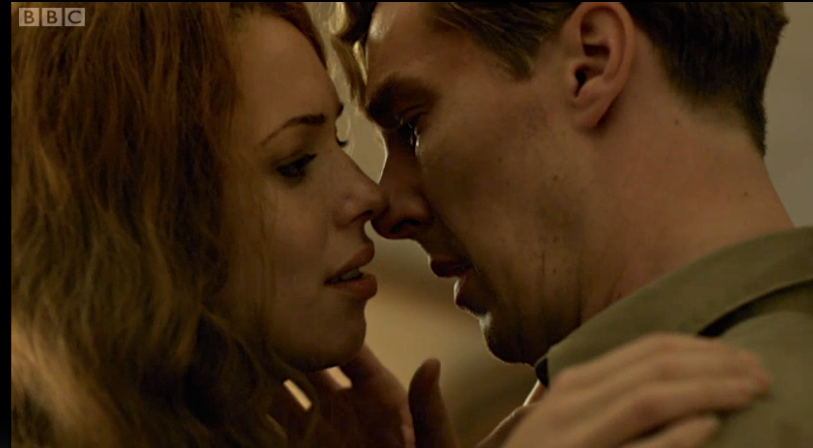
Though featuring artillery bombardments, the Parade's End finale wasn't so much an explosive revelation as a slow meander towards the conclusion we all knew was coming (though in my case, not necessarily the one I wanted). Christopher (Benedict Cumberbatch) remains in the trenches, facing strafes and slightly deranged officers continuing a sonnet competition and wandering round without appropriate headgear. Sylvia (Rebecca Hall), now returned from France, continues to prepare for Christopher's life to be a misery when he gets back whilst also ending her five-year man-drought with a quick tumble in the bedsheets with former flame Gerald Drake (Jack Huston). Valentine meanwhile is at last given something to do after she discovers a sexually explicit book owned by one of her students, leading to her very own sexual awakening and the decision that she will 'ruin herself' with Christopher when he gets back. Oo-er.

There has been a battle right from the beginning of the series embodied in Christopher, the tension between tradition and modernity, the old and the new. Cumberbatch's stiff upper lip performance has been one of the main draws throughout the series and continues here, demonstrating Tietjens' discomfort with the world with every eyebrow raise and mouth twitch. Attempting to cling gallantly to the past, Christopher's efforts have been focused throughout on maintaining the status quo that everything else has threatened to destroy. This is no more apparent than in the wonderful scene in which he has tea and sandwiches served to him on a tray whilst sitting in a trench at the front. The Hun may be firing on him from all sides but goddammit it's time for afternoon tea!

It's the kind of attitude Sylvia has exhibited throughout as well though with considerably less restraint than Christopher. Everything must continue as it always had done, though of course, it didn't work out this way. Hall has been the standout performance in the previous episodes but here, with the focus more on Christopher and Valentine's eventual union, Sylvia is sidelined a little in the overall plot. That didn't mean she faded from view however; her last ditch effort to fake an illness to draw Christopher back in was both comical and slightly tragic, as was her venomous destruction of the tree at Groby. She's been advocating that particular form of arboreal revenge for a while and the hacking down of the tree was the last straw for Christopher. She also gets one of the best lines in the entire series, referring to Valentine as 'that scrub-faced ladies champion of the regular bowel movement'. Just fantastic and the final scene in which Christopher conveys in a look just how committed he is to Valentine was electrifying between Cumberbatch and Hall, demonstrating the chemistry that has made them such a compelling couple.

Narratively, Christopher was always going to leave Sylvia for Valentine but I'm still a little disappointed with that conclusion. Adelaide Clemens gave terrific performances in the first couple of episodes in which she had something to do and was more about being a rebellious suffragette than swooning after Christopher. Against Hall's towering performance, Clemens faded and Sylvia became the more compelling character, making me want to see her get Christopher after all. I don't necessarily think it was Clemens' fault; she was simply outgunned by both Hall and the writing that she was given. Valentine was meant to represent the pure versus Sylvia's corruption and sadly, that was all she ever was.

It's the only thing that occurs to me to be slightly negative about because the final scenes of the series were a fitting end for all of the characters we had got to know over the course of four episodes. Sylvia managed to manoeuvre herself as the future wife to the possible Viceroy of India through the newly promoted General Campion (Roger Allam). Allam has been one of the best supporting actors, mastering the look of bemusement that caused one of the episode's big laughs after Sylvia's unexpected marriage proposal. Christopher learned to let go of the past too, burning the log leftover from the Groby tree as a symbol of the beginning of his new life as both a singing war veteran and lover of Valentine. 

Parade's End has been in a different class right from its first episode; unashamedly literary and scripted with a wit and sophistication that is rarely seen in dramas of any kind at the moment. I'm going to call it now and say it will be heavily nominated when it comes to award season and well-deserved it would be too. Fridays nights are going to be poorer for its absence.

- Becky

You can read Becky's review of Episode Four here.

Follow Becky on Twitter @beckygracelea
Or follow her blog on beckygracelea.wordpress.com

Saturday, 15 September 2012

TV REVIEW: Parade's End - Episode Four

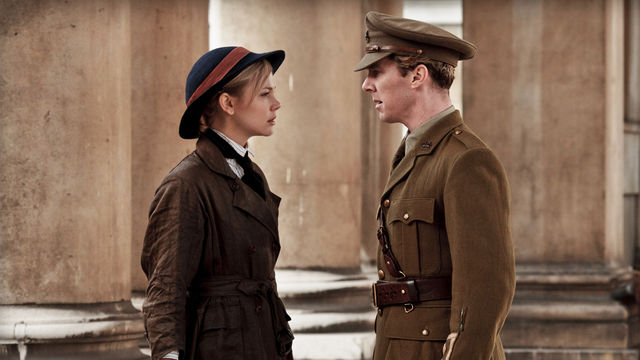
The penultimate episode of the BBC adaptation of Parade's End finds Christopher (Benedict Cumberbatch) back on the front, leaving behind an anxious Valentine (Adelaide Clemens) whilst Sylvia (Rebecca Hall) makes her own plan to follow her husband to France.


Christopher has been helped to a safer position in the army training other soldiers thanks to brother Mark (Rupert Everett) and, despite General Campion (Roger Allam) finding him to be a nuisance, is doing rather well at it. Meanwhile back in London, Valentine anxiously awaits news of her would-be beau whilst continuing her job as a gym mistress. Elsewhere, Sylvia decides that now is absolutely the best time to go and visit Christopher in France and arrives in Rouen before anyone has the chance to do anything about it. There, she and Christopher attempt some sort of reconciliation but are interrupted before anything can truly be done.

After last week's slight dip, Parade's End was back on form in its fourth episode, providing more comedy and tragedy than you could shake a bayonet at. While the series has never been particularly sombre or po-faced, laugh-out-loud moments weren't exactly forthcoming outside of Rufus Sewell's appearances. In this episode however, the comedy is extremely well-pitched, though often erring on the side of black, and each time comes layered with a sense of poignancy that further highlights the drama of the characters' situations. In particular, the scene between Christopher and Patrick Kennedy's equally strung out McKechnie trying to outdo each other intellectually through sonnets and Latin was both very funny and deeply sad.

Another standout scene was the meeting between Christopher and Sylvia in the hotel, their first face-to-face conversation in a considerably long time. To use a technical term, both actors knocked it out of the park with Hall's monologue in particular adding a deep sadness to the pair's unsuccessful marriage. Just as it seems the pair are reconciling (with a spectacular grab-and-kiss move from Cumberbatch that no doubt resulted in a sudden outbreak of swooning), the poignant scene was replaced by a farcical confrontation between Christopher and Sylvia's former squeeze, Potty Perowne (Tom Mison) and a drunken superior officer. Had it not been handled with such skill, the transition from tragedy to farce could have been jarring and distracting, but fortunately it only enhanced what the previous scene had been demonstrating; Sylvia and Christopher just aren't meant to be together.

The focus on the central marriage means that some of the characters are found wanting in the wider episode arc. Most notable is Valentine, Christopher's not-yet mistress, who continues the pining and erstwhile glancing out of windows to fill the quota for this week's episode. I don't think it's necessarily Clemens' fault; she's not given much to work with narrative wise, other than thinking longingly about Christopher. As I've not read the books, I'm unaware of whether the much-touted union between Valentine and Christopher will ever actually happen, but Clemens' fading performance in contrast with Hall's towering screen presence is making me think I'd actually like Sylvia to get her man.

This week's episode is, to my mind, the best so far in a series that has been mostly consistent in its high standard. Blending comedy with drama is not always an easy balance to strike but this episode manages it well and is all the better for it. It's also easily the most action-packed instalment so far with more focus on Christopher's life in the army and his unfortunate scuffle with Potty.

And please, will someone just give Rebecca Hall an award already?

- Becky

You can read Becky's review of Parade's End - Episode Three here.

Follow Becky on Twitter @beckygracelea
Or follow her blog at beckygracelea.wordpress.com

TV REVIEW: Parade's End - Episode Three

Vicious rumours fly around London about Christopher Tietjens, returning wounded from the front, and his relationships with Valentine and Mrs Duchemin leading to a confrontation with Sylvia and his family. Sylvia meanwhile amuses herself with another admirer while McMaster ascends through the ranks of society whilst wrestling with his conscience.


Over the past couple of weeks, Parade's End was starting to become a nice little comfort blanket of a Friday evening, a gentle drama that takes in all the usual scandals, longing glances and the kind of performances that we just love to see in our BBC productions. This week, the burgeoning sense of comfort was offset slightly by the darker turn of events in the third episode, as the First World War is well and truly underway and the effects are felt both at the front and at home.

Christopher is wounded, harming his previously impressive mental faculties; watching a man who prides himself on his memory and knowledge struggle to remember someone's surname was unsettling and all credit to Benedict Cumberbatch for giving a truly moving performance. Elsewhere saw the sad demise of Rufus Sewell's Reverend Duchemin (a loss for comedy and Satan-spotting) and the accidental death of Christopher's father in an unfortunate shotgun/hedge incident.

It was this latter tragedy that gave us arguably one of the best scenes of the series so far between Cumberbatch's Christopher and his brother Mark, played by Rupert Everett. The chemistry between the two actors was excellent and it allowed for a greater understanding of Christopher's character, particularly in his fight for approval in both society and with his family. Tying into the rumours flying around about his alleged infidelity, you could see how Christopher has constantly striving for approval only to fall short and decide that if everyone thinks he's a philanderer, then he is going to prove them right by propositioning Valentine.


Adelaide Clemens has put in two good performances over the two previous episodes but here, I felt she had become severely underwritten. Gone was the feistiness and rebellious nature that had made her so compelling and in its place was a simpering little girl with nothing but eyes for Christopher. To be fair this had started in the last episode, but it became the overriding relationship dynamic here; instead of having sparky exchanges, conversations between the pair became all about her lifting his confidence. It is a shame, because previously, Valentine was a interesting character but now she seems to have been reduced to a stereotype, the virgin to Sylvia's whore.

Speaking of Mrs Tietjens, I can't heap enough praise on the trio of Rebecca Hall, Tom Stoppard and Susanna White for creating such a layered character for Sylvia, who in other hands could have easily become just another evil woman caricature. According to the little research I've done, the novel's version of Sylvia is just that, a harridan determined to ruin Christopher's happiness. The television series on the other hand, has created a woman desperately trying to get her husband back, just not being very good at doing it the nice way. Rebecca Hall's performance is the standout of the series so far and is fast becoming the main reason for sticking with the series (sorry Benedict).

The mid-point of the series sees a slight dip in quality from the previous two episodes, but there is still plenty to admire, particularly in the performances of the central duo of Cumberbatch and Hall (sounds like a specialist law firm). Next week promises more thwarting of the relationship between Valentine and Christopher as he returns to the front and Syliva makes a move.

- Becky

You can read Becky's review of Parade's End - Episode Two here.

Follow Becky on Twitter @beckygracelea
Or follow her blog at beckygracelea.wordpress.com