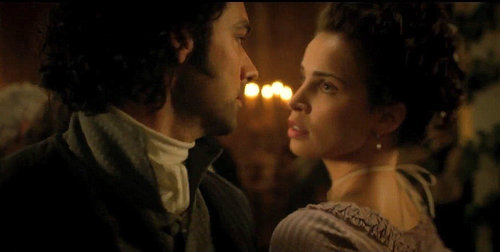
After last week's dramatic and family-based episode, the second instalment of Poldark finds Ross settling down to his role as both land and potential mine owner. The Warleggans have struck again, refusing to extend credit on one of the local mines, leading Ross' friends to lose their livelihoods and the mine owner to commit suicide. Ross decides to re-open the Wheal Leisure mine and begins to gather investors to his cause, including cousin Francis, hoping to rejuvenate the dying industry of his home. Meanwhile, Demelza is at the mercy of Jud and Prudy who keep attempting to convince her that she doesn't belong in the Poldark home and taking advantage of the new kitchenmaid. Verity's decision to attend the Assembly Ball proves to have massive repercussions for the family Poldark as gauntlets are thrown and shots are fired. Well, it is the eighteenth century. They had to find some way of entertaining themselves.
It's a bit of an uneven affair this week as the opening few scenes are laboured with the same problem that weighed the first episode down. There's still a little too much exposition going on in order to cement the current economic status of the mining industry in Poldark's Cornwall. Whilst the opening suicide provided a short, sharp shock to the system that hinted at the depth of the Warleggans' greed, it isn't until later in the episode that any of it begins to pay off. In fact, the later intertwining scenes of Ross meeting with his investors and George attempting to manipulate Francis does far more to establish these tensions than anything that had been seen previously. It's cut beautifully, written well and shot in such a manner that the closer the audience gets to the respective conversations, the more they feel the weight of these decisions.
The entire episode revolves around the ideas of decisions, choice and liberty and it's the ball at the heart of the story that gives rise to many of these themes. Any reader of eighteenth or nineteenth century based literature knows that you can't beat a good ball for getting the story going. Anna Karenina dances with Vronsky and sets tongues wagging, Madame Bovary does something very similar as does Irene Forsyte. Basically, if you're a woman even thinking about being a bit wayward, a ballroom is the place to do it. It also functions as a meat market for those women out to get a husband. For young, pretty things like Ruth Teague, practically throwing herself at Ross, it's a chance to avoid the fate of someone like Verity who, at 25, is already considered past it.
Poor Verity. Offered a chance to escape the dreariness of a life serving her family and being treated little better than a servant, it's not surprising she falls for the dashing Captain. She is by far the most sympathetic character in the series so far and one who stands as a stark reminder of the restrictions placed upon women by the ideas around freedom and choice. The relentless pursuit of Ross by Ruth Teague and her innuendo-spouting mother provides the levity before it all goes a bit mad. The climactic duel isn't even fought over her, but because Francis felt slightly put out by the unsurprising fact that a navy captain could punch harder than him. Now, Verity is once more left stranded with her family as honour dictates it's probably not a good idea to elope with the man who shot your brother. Francis really is a turnip.
I also have to single out the performance of Eleanor Tomlinson this week as Demelza is fast turning into the one character who I have to watch whenever she's on screen. Tomlinson does well with the dramatic and emotional stuff attached to the role, particularly in the final, touching scene where she declares her home to be in the Poldark household, but it's her physical performance that is astonishing. Her awkward, loping walk contrasts perfectly to the elegant, refined gliding of Elizabeth or Ruth Teague, conveying their differences beyond their respective dialogue. Her uncomfortable attempt at a proper curtsey provides one of the sweeter moments of the episode and the subtle changes to her posture and walk once she's wearing a proper corset and dress maybe barely noticeable, but enough to show that Demelza is moving up in the world.
Despite its unevenness, there is something compelling about Poldark. The balance between comedy and tragedy is neatly struck and now that the stage appears to be set, it will hopefully enable the rest of the show to even itself out. And look, I got through the whole review without mentioning that swimming scene. Go me.
- Becky
Read Becky's review of Poldark's first episode here.
Follow @AssortedBuffery on Twitter
Or like our Facebook page

When anyone mentions Poldark in a room full of people, there's usually someone who starts waxing lyrical about the virtues of the original adaptation of Winston Graham's series of novels. It was a popular and enduring production, one which casts a long shadow over the arrival of a new Poldark for the 21st century. With the original's stellar reputation, it seems a few people had written off Debbie Horsfield's new take on Graham's material before it had even begun. Such attitudes seem somewhat premature as the first episode gets everything off to a solid, if not entirely captivating start.
Ross Poldark arrives back on our screens, now in the form of Assorted Buffery favourite and Being Human star Aidan Turner, newly returned from fighting a losing battle in the American War of Independence. Presumed dead by his family, Ross returns to find his father dead, his inheritance in tatters and his unofficial intended, Elizabeth (Heida Reed), now betrothed to his wet cousin Francis. It's not long after he arrives home that everyone is telling him to leave again, bar his loyal tenants on his father's estate. However, a chance encounter with saucy wench (there really is no other term for this kind of thing), Demelza (Eleanor Tomlinson), and an ensuing familial brawl suggests to Ross that there is more for him in Cornwall than everyone would have him believe.
As one would expect from a series set in Cornwall, everything looks stunning, from the landscapes everyone wistfully gazes across to the costumes worn by the cast. Cornwall had also been showcased beautifully in last year's BBC adaptation of Jamaica Inn, but there it had been used to its full Gothic potential as storms closed in and the sea roared dangerously. The landscape of Poldark feels much more opportunistic. Although much is made of the exhaustion of the mines on which the Poldark fortune is built and the barrenness of the land they own, the sun glints off the sea and the fields looks luscious. It fits nicely into Ross' renewed determination to make his inheritance a success, not to mention ensuring that the production looks absolutely beautiful.
Of course, the show would be nothing without its Ross Poldark and Turner cuts a fine figure at the heart of the adaptation. It would have been easy to make Ross nothing but brooding looks and masculine posturing, but Turner also adds a quiet, emotional undercurrent to the character that remains restrained but visible. He also fires off a one liner or two with ease, particularly at the expense of his catty near-mother-in-law, which undercuts the tortured longing looks enough to bring some levity to the proceedings.
As for the rest of the ensemble, the cast are suitably strong in their respective roles, though most act more as satellites for Ross' return at this stage, rather than characters in their own right. Phil Davies nearly steals the show as he wraps himself up in a Cornish burr and engages in a good old fashioned fight before the episode's end. Heida Reed simpers very prettily as Elizabeth, but that amount of trembling can't possibly sustain a full character arc. Here's hoping she gets a little more to do as the series develops. Another standout is Jack Farthing as the scheming George Warleggan, clashing his bought and paid for elegance with the rugged Poldarks wonderfully, carrying on the well-worn tradition of the nicely speaking baddie with aplomb.
Horsfield's adaptation skilfully combines exposition and context for the ongoing storyline, but it is here that it feels like there is a spark lacking. With the sheer amount that this first episode needed to set up, it ensures that the story feels more like a primer for eventual events rather than anything particularly significant in its own right. Tensions of all kinds are set up with thwarted romances, financial burdens and socal climbing familial disputes all getting a look in, but it feels like place-setting rather than any particular advancement. If that was the intention, then the series now has a solid foundation from which to spring, hopefully ensuring that it all gets a little more like the comical brawl to end this episode's proceedings than the many exposition-heavy scenes of familial struggle.
If you've been following the blog for a while now, you all know I'm a sucker for a period drama so I'm immensely looking forward to seeing how Poldark unfolds. With everything set up now as Ross retakes his position in the county, it looks like it might be duelling pistols at dawn in next week's instalment. How exciting!
- Becky
Follow @AssortedBuffery on Twitter
Or like our Facebook page

As year draws to its close, we’re due to embark on yet another journey to J.R.R. Tolkien’s Middle Earth. All of that thanks to director Peter Jackson and The Battle of the Five Armies, the third chapter of his The Hobbit trilogy. In what is supposed to be a final film ever set in his fictional land (unlikely!) our Dwarven, Elven and Human characters are entangled in a massive conflict over the control of Erebor and hearth stored under the Lonely Mountain. Friendships are being tested, blood being shed, lessons learned. Virtually everything one can expect from grand finale like this.
It is, of course, naïve and unrealistic to expect that this film will rectify and reverse everything wrong about two previous chapters. Indeed, The Battle of the Five Armies suffers from many of the sins these films were plagued by – choppy narrative, bloated running time, an unnecessarily excessive use of computer graphics, uneven pacing. However, what where it does exceed is in its increased focus on single narrative, probably for the very first time in The Hobbit trilogy. It feels less scattered around, largely due to it being set mostly in one location. The board for ensuing conflict was set already by The Desolation of Smaug and there is no exposition as such. And that is something quite new for Peter Jackson’s Tolkien adaptations.
Another strong point is an emphasis on character development and interactions, an ingredient criminally absent from both An Unexpected Journey and The Desolation of Smaug, save for a few cursory elements. In The Battle of the Five Armies, the execution of those elements might still be somewhat clunky but at least it’s there. Both Richard Armitage and Martin Freeman rise to the occasion and provide their characters with some emotion. Bilbo, curiously underused in a series of films revolved around his character, finally gets to fulfil a role in those and adding some necessary good-natured hobbit warmth into the grim plotline. At the same time, Armitage gets to expand upon both gloomy and warm aspects of Thorin Oakenshield as he’s battling his inherited greedy sickness. The usual suspects Ian McKellen is always a joy to watch on screen and his Gandalf definitely doesn’t disappoint, as expected.
What doesn’t work quite so well, however, is the battle spectacle itself. While all Tolkien-based films used CGI heavily to help enhance epic struggles portrayed on screen, there is a sense that The Battle of the Five Armies was filmed almost entirely in front of green screen. Gone are the breathtaking and lovely landscapes of New Zealand. It’s hard to care for an hour of swarming animated characters fighting other animated characters, with occasional shots of live actors swing a sword once or twice. There’s hardly any drama or tension in that and Middle-earth feels smaller than ever.
What’s even more frustrating, it turns out that many plot points and characters from previous two films were introduced for absolutely no reason. Sylvester McCoy, so prominently featured as Radagast in An Unexpected Journey, barely makes a cameo in both subsequent films. Same with Mikael Persbrandt’s Beorn. One has to wonder why Peter Jackson even bothered including those two, given their contribution to the overall story is quite minimal and could have been achieved in more efficient ways. On the other hand, the completely new Elven character of Tauriel, as played by Evangeline Lilly, could have used an expansion. Fortunately, Luke Evans’ Aragorn-inspired Bard the Bowman and Lee Pace’s Thranduil get a lot more screen time this time and this film is so much better for it.
Technically, The Battle of the Five Armies is adequate but strangely unpolished in some areas. Many of the effects seem unfinished and unconvincing, especially the opening fiery destruction of Lake-town and climactic confrontation between Thorin and pale orc Azog. The musical score by Howard Shore, such a crucial ingredient of The Lord of the Rings, is an accomplished and intelligent as ever but feels lost and neglected in overcrowded sound mix. Editorially, this film feels a bit awkward and uneven, as did the previous two. It will be interesting to see if the extended cut, due late next year, will change that.
The final chapter in Peter Jackson’s six-film series is ultimately successful in its basic entertainment factor but it falls short as a piece of epic fantasy cinema. The ultimate failure of The Hobbit trilogy is not as painful as the one suffered by Star Wars fans a decade ago but there’s an undeniable sense that something went terribly wrong in the development process. Still, strong performances from excellent cast and significantly tighter and focused narrative make up for many shortcomings.
- Karol
In a hole in the ground, there lived a hobbit who finds himself swept into an adventure with thirteen dwarves and a wizard, all seeking the lost land of Erebor, taken from them by a fearsome dragon.
Bilbo Baggins (Martin Freeman) finds himself with a wizard (Sir Ian McKellen) and thirteen dwarves on his doorstep, led by the impressive Thorin Oakenshield (Richard Armitage). Seeking to reclaim the lost land of Erebor in the Lonely Mountain from the dragon Smaug (Benedict Cumberbatch), the dwarves enlist Bilbo as a burglar and embark on a quest across Middle Earth that takes in trolls, goblins, a visit to Rivendell and an encounter with Radagast the Brown (Sylvester McCoy) that hints that something evil may be rising in Middle Earth. Bilbo has his own personal encounters too, engaging in a riddle competition with Gollum (Andy Serkis) and finding a small gold ring that carries a mysterious power.
The Hobbit: An Unexpected Journey appears nine years after we last saw Middle Earth on the big screen and has brought along its fair share of baggage. A film that very nearly didn't happen for various reasons, when Peter Jackson announced that The Hobbit was to be screened at 48 frames per second instead of industry standard 24 and then that it was to be three films as opposed to the afore-confirmed two, it's created quite the storm. I didn't see the film in 48fps, just in 3D, so I can't comment as to the effect that the increased frame rate has on the film. I will say though, that the 3D utilised here was the best I've seen, working to enhance the world of Middle Earth rather than detract from it. In fact, it almost made me think that 3D was a good idea. Almost.
Then there's the issue of The Hobbit becoming a trilogy, despite being only one, quite small book. First of all, let's get the problems out of the way because unfortunately, there are a couple. Nothing major I grant you, but it was inevitable that with the extension into three films, there were going to be some pacing issues. The middle act slows down a little, keen to connect the current Middle Earth events to those of the Lord of the Rings trilogy. The meeting of the White Council, in which Gandalf, Galadriel and Elrond meet with Saruman to discuss a potential rising evil, works well to establish plots of the later trilogy but unfortunately slows its own film down to a snail's pace.
The addition of other material doesn't necessarily always have the same effect. I really enjoyed the inclusion of dwarven history as helped to build a more complete picture of the dwarves' quest, adding an extra dimension to what could just seem like a fun jaunt to Erebor. Then there's the effect it has on the characters in the film, increasing their roles beyond the very brief sketches we get in the novel. It also enhances the relationship between Bilbo and Thorin Oakenshield, rather beautifully summed up in Bilbo's reasonings for remaining to help the dwarves on their quest.
Now moving swiftly on to the positives, of which there are many. The Dol Guldur sequence with Radagast was a particular favourite of mine, packed full of visual and aural connections to the big brother trilogy and is a perfect example of one of the film's major highlights, the sound and Howard Shore's score. The new material is fantastic stuff, particularly the dwarves' theme which has been in my head ever since that first trailer was released last year and the choral fire-and-brimstone number during the goblin chase really aids the action. Then there's the nods to the LOTR soundtrack; the Shire theme gets a nice twist while the Dol Guldur sequence utilises memory to great effect to really up the chilling atmosphere. Some people may criticise the recycling of the music as unimaginative but it was one of my favourite aspects of The Hobbit and was probably the most effective method, for me, of linking the two trilogies completely.
An Unexpected Journey, despite its darker moments, operates a whole shade lighter than LOTR, embracing the comedic and the ridiculous moments in its source novel. The dwarves are a riot from the moment they appear, handling the comedy (and the inevitable singing) with aplomb though a couple of lines do grate a little. The thirteen actors have an easy chemistry though some do get more the spotlight than others. Gaining a nice Legolas-style transformation is Aidan Turner's Kili, given far more to do as one of the youngest and most adventurous dwarves, turning in a nice performance that balances both naivety and bravado. James Nesbitt's Bofur and Ken Stott's Balin both handle the kindly wise men roles well while Richard Armitage gives good Aragorn as the displaced leader of the troupe, destined to lead his people home.

Despite the strong support, there are still three performances in The Hobbit that stand out from the rest of the cast. Andy Serkis gets back in to the motion capture suit that made his name and brings back everyone's favourite jewellery-addict. It's a virtuoso performance that flits back between the two personalities of Smeagol and Gollum with ease, treading the fine line between the inherent tragedy and comedy of the character. Sir Ian McKellan's Gandalf is another highlight; a complete badass in the goblin scenes and the only one in Middle Earth who actually thinks something bad is about to go down. His flicker of recognition when Bilbo pockets the Ring is subtle, yet mightily effective.
Then there's Martin Freeman, the strong centre of the film who gives a career-best as Bilbo Baggins, presenting a multi-layered hobbit who has yet to achieve his true potential. Freeman naturally excels in the comedy scenes, even if he does play the first few scenes as a pointy-eared Arthur Dent (though the two characters have a fair amount in common) but it is in the later stages of the film, as Bilbo discovers his capacity for bravery and adventure that Freeman really excels.
Whilst I still remain sceptical as to whether The Hobbit Trilogy will actually work as such, I was delighted by this first return to Middle Earth with its great sense of fun and some stunning set pieces. I'm already planning a return visit and may have to venture out to find a 48fps screening, just to see what all the fuss is about.
****
- Becky
You can follow Becky on Twitter @beckygracelea
Or follow her blog beckygracelea@wordpress.com


