Showing posts with label Poldark. Show all posts

Monday, 16 March 2015

TV REVIEW: Poldark - Episode Two


After last week's dramatic and family-based episode, the second instalment of Poldark finds Ross settling down to his role as both land and potential mine owner. The Warleggans have struck again, refusing to extend credit on one of the local mines, leading Ross' friends to lose their livelihoods and the mine owner to commit suicide. Ross decides to re-open the Wheal Leisure mine and begins to gather investors to his cause, including cousin Francis, hoping to rejuvenate the dying industry of his home. Meanwhile, Demelza is at the mercy of Jud and Prudy who keep attempting to convince her that she doesn't belong in the Poldark home and taking advantage of the new kitchenmaid. Verity's decision to attend the Assembly Ball proves to have massive repercussions for the family Poldark as gauntlets are thrown and shots are fired. Well, it is the eighteenth century. They had to find some way of entertaining themselves.

It's a bit of an uneven affair this week as the opening few scenes are laboured with the same problem that weighed the first episode down. There's still a little too much exposition going on in order to cement the current economic status of the mining industry in Poldark's Cornwall. Whilst the opening suicide provided a short, sharp shock to the system that hinted at the depth of the Warleggans' greed, it isn't until later in the episode that any of it begins to pay off. In fact, the later intertwining scenes of Ross meeting with his investors and George attempting to manipulate Francis does far more to establish these tensions than anything that had been seen previously. It's cut beautifully, written well and shot in such a manner that the closer the audience gets to the respective conversations, the more they feel the weight of these decisions.

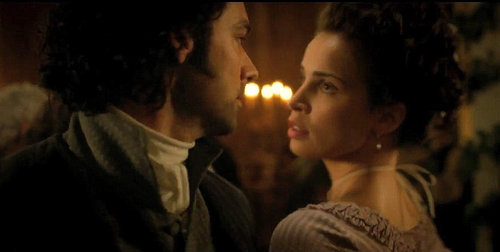
The entire episode revolves around the ideas of decisions, choice and liberty and it's the ball at the heart of the story that gives rise to many of these themes. Any reader of eighteenth or nineteenth century based literature knows that you can't beat a good ball for getting the story going. Anna Karenina dances with Vronsky and sets tongues wagging, Madame Bovary does something very similar as does Irene Forsyte. Basically, if you're a woman even thinking about being a bit wayward, a ballroom is the place to do it. It also functions as a meat market for those women out to get a husband. For young, pretty things like Ruth Teague, practically throwing herself at Ross, it's a chance to avoid the fate of someone like Verity who, at 25, is already considered past it.

Poor Verity. Offered a chance to escape the dreariness of a life serving her family and being treated little better than a servant, it's not surprising she falls for the dashing Captain. She is by far the most sympathetic character in the series so far and one who stands as a stark reminder of the restrictions placed upon women by the ideas around freedom and choice. The relentless pursuit of Ross by Ruth Teague and her innuendo-spouting mother provides the levity before it all goes a bit mad. The climactic duel isn't even fought over her, but because Francis felt slightly put out by the unsurprising fact that a navy captain could punch harder than him. Now, Verity is once more left stranded with her family as honour dictates it's probably not a good idea to elope with the man who shot your brother. Francis really is a turnip.

I also have to single out the performance of Eleanor Tomlinson this week as Demelza is fast turning into the one character who I have to watch whenever she's on screen. Tomlinson does well with the dramatic and emotional stuff attached to the role, particularly in the final, touching scene where she declares her home to be in the Poldark household, but it's her physical performance that is astonishing. Her awkward, loping walk contrasts perfectly to the elegant, refined gliding of Elizabeth or Ruth Teague, conveying their differences beyond their respective dialogue. Her uncomfortable attempt at a proper curtsey provides one of the sweeter moments of the episode and the subtle changes to her posture and walk once she's wearing a proper corset and dress maybe barely noticeable, but enough to show that Demelza is moving up in the world.

Despite its unevenness, there is something compelling about Poldark. The balance between comedy and tragedy is neatly struck and now that the stage appears to be set, it will hopefully enable the rest of the show to even itself out. And look, I got through the whole review without mentioning that swimming scene. Go me.

- Becky

Read Becky's review of Poldark's first episode here.

Follow @AssortedBuffery on Twitter
Or like our Facebook page

Monday, 9 March 2015

TV REVIEW: Poldark - Episode One


When anyone mentions Poldark in a room full of people, there's usually someone who starts waxing lyrical about the virtues of the original adaptation of Winston Graham's series of novels. It was a popular and enduring production, one which casts a long shadow over the arrival of a new Poldark for the 21st century. With the original's stellar reputation, it seems a few people had written off Debbie Horsfield's new take on Graham's material before it had even begun. Such attitudes seem somewhat premature as the first episode gets everything off to a solid, if not entirely captivating start.

Ross Poldark arrives back on our screens, now in the form of Assorted Buffery favourite and Being Human star Aidan Turner, newly returned from fighting a losing battle in the American War of Independence. Presumed dead by his family, Ross returns to find his father dead, his inheritance in tatters and his unofficial intended, Elizabeth (Heida Reed), now betrothed to his wet cousin Francis. It's not long after he arrives home that everyone is telling him to leave again, bar his loyal tenants on his father's estate. However, a chance encounter with saucy wench (there really is no other term for this kind of thing), Demelza (Eleanor Tomlinson), and an ensuing familial brawl suggests to Ross that there is more for him in Cornwall than everyone would have him believe.

As one would expect from a series set in Cornwall, everything looks stunning, from the landscapes everyone wistfully gazes across to the costumes worn by the cast. Cornwall had also been showcased beautifully in last year's BBC adaptation of Jamaica Inn, but there it had been used to its full Gothic potential as storms closed in and the sea roared dangerously. The landscape of Poldark feels much more opportunistic. Although much is made of the exhaustion of the mines on which the Poldark fortune is built and the barrenness of the land they own, the sun glints off the sea and the fields looks luscious. It fits nicely into Ross' renewed determination to make his inheritance a success, not to mention ensuring that the production looks absolutely beautiful.

Of course, the show would be nothing without its Ross Poldark and Turner cuts a fine figure at the heart of the adaptation. It would have been easy to make Ross nothing but brooding looks and masculine posturing, but Turner also adds a quiet, emotional undercurrent to the character that remains restrained but visible. He also fires off a one liner or two with ease, particularly at the expense of his catty near-mother-in-law, which undercuts the tortured longing looks enough to bring some levity to the proceedings.

As for the rest of the ensemble, the cast are suitably strong in their respective roles, though most act more as satellites for Ross' return at this stage, rather than characters in their own right. Phil Davies nearly steals the show as he wraps himself up in a Cornish burr and engages in a good old fashioned fight before the episode's end. Heida Reed simpers very prettily as Elizabeth, but that amount of trembling can't possibly sustain a full character arc. Here's hoping she gets a little more to do as the series develops. Another standout is Jack Farthing as the scheming George Warleggan, clashing his bought and paid for elegance with the rugged Poldarks wonderfully, carrying on the well-worn tradition of the nicely speaking baddie with aplomb.

Horsfield's adaptation skilfully combines exposition and context for the ongoing storyline, but it is here that it feels like there is a spark lacking. With the sheer amount that this first episode needed to set up, it ensures that the story feels more like a primer for eventual events rather than anything particularly significant in its own right. Tensions of all kinds are set up with thwarted romances, financial burdens and socal climbing familial disputes all getting a look in, but it feels like place-setting rather than any particular advancement. If that was the intention, then the series now has a solid foundation from which to spring, hopefully ensuring that it all gets a little more like the comical brawl to end this episode's proceedings than the many exposition-heavy scenes of familial struggle.

If you've been following the blog for a while now, you all know I'm a sucker for a period drama so I'm immensely looking forward to seeing how Poldark unfolds. With everything set up now as Ross retakes his position in the county, it looks like it might be duelling pistols at dawn in next week's instalment. How exciting!

- Becky

Follow @AssortedBuffery on Twitter
Or like our Facebook page