Showing posts with label Clint Mansell. Show all posts

Friday, 4 April 2014

FEATURE: Clint Mansell - 'Ark At Him!

Unless you're a fan of film scores or alternative music, Clint Mansell might not be the most recognisable name to you. However, you can be sure you've heard his music, not least if you've watched Sky Sports in the last few years. Born in Coventry, Mansell's stock has risen greatly over the years, especially with his partnership with filmmaker Darren Aronofsky, and that stock is now about to go through the roof with his score to Aronofsky's latest, the massive biblical blockbuster Noah.

Best known before his film career as the lead singer of Pop Will Eat Itself, Mansell followed composers like Cliff Martinez and Danny Elfman from the pop world to the scoring stage in 1998 after the break-up of PWEI. His first assignment would be the beginning of a relationship that has defined his film music career, coming together with first-time director Darren Aronofsky to score the surreal thriller PI. Joining songs from dance-orientated artists such as Roni Size and Aphex Twin, Mansell's score was influenced by the drum-n-bass movement as well as the industrial side of things, and was a perfect fit for the idiosyncratic film and its stark black and white photography. The unconventional score heightened the paranoid sense of the lead, Sean Guillette's Max, and was its own intense character in the film.

But while Pi was a success and a huge sign of the potential both Mansell and Aronofsky had, the score that would follow would introduce a piece of Mansell's music into pop culture iconography. Requiem for a Dream is probably the best anti-drug film you'll ever see, a haunting and horrifying work that follows the journey of four characters in a downward spiral of addiction. Mansell's music for the film used the Kronos Quartet to provide a cold and needling soundscape for the film, personified by the driving 'Lux Aeterna'. The latter would become Mansell's calling card, later becoming a theme for Sky Sports News and exploding further in a re-orchestrated "epic" rendition for the theatrical trailer for The Lord of the Rings: The Two Towers.

While Aronofsky looked at rebooting Batman and toiled away on a mysterious project known as The Last Man, Mansell worked on gangster film Knockaround Guys, horror film The Hole, thrillers Murder By Numbers and Suspect Zero amongst others, before ending his Aronosfky-less period with two Hollywood blockbusters, Sahara and Doom. These scores allowed Mansell to add more strings to his violin, combining his unique alternative sound with more conventional scoring techniques that brought a fusion that would further enhance his reputation in the score world. The following year, in 2006, Aronofsky's secret project that had gone through several iterations finally came to fruition. It was called The Fountain. 

Mansell's score reunited him with the Kronos Quartet for a film that was an attempt at heady hard science fiction, with religious and philosophical overtones. Echoing the three different storylines in the film, Mansell collaborated with Kronos Quartet and Scottish post-rock band Mogwai to create a sense of musical convergence that would suit the decidedly non-traditional film. What they brought to the film was a sense of force, of awe. Emotional intensity. The Fountain was critically acclaimed, with the score seen as a huge part of the success of the film. While it remains as one of Mansell's great achievements, it also serves as a precursor for events to come for both parties.

Mansell went on to score The Wrestler for Aronofsky, as well as films such as Smokin' Aces, The Rebound, and Duncan Jones' well-received science fiction thriller Moon. Patterned after the more esoteric SF films of the seventies such as Silent Running, Moon demanded music that was typically cold and almost computerised, but with a sense of introspective emotion for the character of Sam Bell. In response, Mansell's score was alien and eloquent, with a wonderful warm piano for Sam and electronics for the moon base. As the film neared its climax and Sam made his discoveries, more traditionally orchestral elements were introduced to mirror the human element with brilliant effect.

His next score was another Aronofsky collaboration, Black Swan, where he adapted Tchaikovsky's ballet score for the intense psychological thriller. Following this was drama Last Night, action film Faster, and video game Mass Effect 3, before moving on to Park-chan Wook's Stoker and the Irvine Welsh crime flick Filth. And then the flood came.


Noah is a bold move by many of the people involved. By the producers of the film, by Aronosfsky, and certainly by Mansell, who again employed the Kronos Quartet along with a huge orchestra to build a sound nothing quite like he had made before. Aronofsky's film is massive in scale and as such, Mansell's score had to match that while simultaneously providing intimate grounding for the title character and his family. And it's one hell of an achievement, with the soundtrack neatly chopped into four acts.

Noah begins with chugging strings and percussion that sounds like lightning. It immediately emits a "biblical" feel, and the mysterious motif that cuts through the opening of the act named 'Wickedness' sets a foreboding tone. What follows is a wave of cacophony, with biting Herrmannesque strings birthing a chaotic atmosphere for a jagged three-note repeating motif to slash its way through. It's overwhelming and terrifying, providing an instant doom-laden 'storm is coming' feel that is briefly soothed through a beautiful viola solo before the mysterious motif returns with driving percussion. Uncertainty is built through more strings and guitar, before brass and percussion take over to remind you of the sheer scale of the thing. 

Mansell refuses to go into what would be considered the traditional approach with over abundant choir, instead using the strings of the Kronos Quartet to play out the more emotional and familial side of things with the orchestra providing the texture and colour for the force of nature and wrath of man, and god. The second act - 'Innocence' - opens with the excellently-named 'Make Thee An Ark', which uses strings as percussion with a guitar overlay to build into a huge brass section with a gorgeous viola line. It's a modern equivalent to 'The Shark Cage Fugue' from Jaws, and certainly provides ample ark-building music. What's astonishing in Noah is the way it seamlessly switches from absolutely massive to microscopically intimate, so indicative of the way of nature, then driving back upwards with wondrous choir (it's not used as often as you'd expect, but when it is, it's so, so good).

In counterpoint, there's a malevolent tone to the darker music, with thundering war drums and sinister cello, as well as the return of the three-note motif, now getting closer and closer. In return, family is key and the viola and violins represent this, with the strings ending the act on a powerful and optimistic note. The third act - 'Judgement' - begins small with guitar, but quickly intensifies with some massive percussion, before the devastating 'By Man Shall His Blood Be Shed' that really qualifies as some of the best disaster music I've ever heard. It's just unrelenting, overwhelming, chaotic, with bellowing brass lines and haunting violin, along with the thunderclap percussion. Amazing. Electric guitar gives way to a discordant choir and some huge brass sections not only reprising the mystery motif but also developing it further, with a massive statement ending the track. 

A dose of serenity is injected with delicate guitar and viola, providing a small sense of respite before the storm returns and we are battered once again before the final act - 'Mercy' - takes hold. Here Mansell's music is calm and thoughtful, with an emotional viola used to reflect and philosophise. With the storm gone, the strings are left to pick up the pieces, and it's an act of catharcism that Mansell puts us through, one that's greatly needed. The Kronos Quartet are here at their most beautiful, as we reach a sense of finality. What's here is a celebration of survival, and an embracement of hope. The score ends on an absolutely beautiful note, both musically and thematically, before the album's denouement, where the song 'Mercy Is' - sung by Patti Smith - provides a mythic ending to the experience.

Having listened to it a few times now, I don't think there's any doubt that Noah is not only Clint Mansell's greatest score, but also a new chapter in the evolution of his career. The through-line has shown how quickly his sophistication and scoring intelligence has increased, and you can see a clear path from The Fountain to Noah, both in the ambition of the film, and that ambition being met by Mansell's music. A great career, and a great score that makes us hungry for what comes next.

- Charlie Brigden

Follow Charlie on Twitter for more excellent film music tips: @entractemg 

Follow @AssortedBuffery on Twitter
Or like our Facebook page

Thursday, 10 October 2013

FEATURE: Filth on Film

Today's feature is a guest post from Marginal Philosophy writer Alex Campbell. Just a quick warning, this post contains both strong language and spoilers.

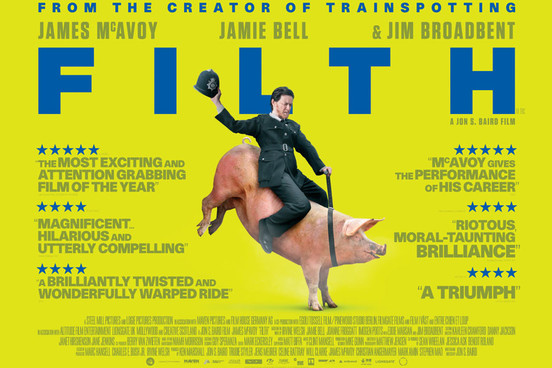
Filth Trailer: Treat yourself to the image of James McAvoy riding a pig to the tunes of the Scissor Sisters.
It’s been 17 years (yes really) since Danny Boyle first injected himself into the mainstream of British cinema with his gloriously squalid depiction of Irvine Welsh’s novel of the ‘chemical generation’ Trainspotting (novel 1994, film 1996). While subsequent attempts to transfer Welsh’s texts to screen have been relatively unsuccessful (The Acid House 1998 and Ecstasy 2011), Jon S. Baird has managed to adapt the depraved manic energy of Welsh’s third novel Filth into a triumphant cinematic experience. A cartoon aesthetic and hyperbolic-caricature is a feature of Baird’s adaptation, successfully distancing Filth from the haunting iconoclastic realism of Danny Boyle’s landmark film.

It has been well publicised that Filth struggled to find funding. As you can well imagine, pitching a film based on a novel whose protagonist’s inner most thoughts are narrated by an inebriated and destructive tapeworm would have raised more than a few eyebrows - luckily thanks to no less than 9 production companies, they raised the cash as well. In its opening weekend initial figures have Filth raking in around £250k at the Scottish Box office - cue an abundance of witty articles entitled ‘Filth cleans up at the box office’. And a bloody good job too. The film is a nihilistic riot, brutally funny and indulgently obscene.

Baird digs deep into the surreal and darkly comical underbelly of Welsh’s writing; embracing the wickedly weird elements of the novel and adapting them for the screen. Welsh’s novels are noted for their particular attention to deeply disturbed white, Scottish, male characters and Filth is a prime example. Alcoholic, sexist, and itchy-bollocked - misanthrope Detective Sergeant Bruce Robertson (James McAvoy) is about to be promoted. He’s fucking sure of it; in fact he’ll stop at nothing to get it. Champion of the people on the outside, and vindictive machiavellian on the inside, a good-cop/bad-cop rolled into one decaying body, Bruce Robertson is a man out for himself.

McAvoy’s performance is heroic in its commitment: any mentions from the audience of prior adoration or lust for our bearded thespian, were quickly switched into grimaces and muffled expressions of shock and confusion. It’s called Filth for a reason. Chips, chicks, and cocaine are on the menu every night and nothing helps a hangover like professional sabotage. McAvoy is wholly dedicated to the role and his comedic timing and cheeky smile manages to bring the audience onto his side - even if that side happens to be bigoted, sexist, and slovenly. Pantomime-esque cracks in the fourth wall allow the audience in on the various sinister schemes that our conniving copper has planned for his rivals. We are tipped the wink, and feel a certain amount of collusion with Bruce while we laugh at his gullible peers as much as he does. The joke is always on them. His malignant and magnificent plots to undermine his colleagues to ensure his own promotion are nothing short of comedic genius. Welsh’s writing is translated wonderfully, the audience collapses into laughing shrieks of vague horror at Bruce’s manipulative skills as he slowly but surely pulls the rug out from under his rivals; questioning their sexual orientation, sleeping with their wives, and setting them against one another. 

One of the most successful elements of the film is the blend of different eras; this is a film set in 2013, based on a novel written in 1998, and uses a soundtrack comprised mostly of 1960s/1970s classics set against a score by Clint Mansell. This seems to be a deliberate move by Baird; the swinging soundtrack serves to historicise the contemporary setting of the film, making you realise that these supposedly ‘outdated’ issues of racism, sexism, and homophobia are not simply contained to the dark ages but are still disturbingly relevant issues that stain the social fabric of modern day Britain. Baird however has been quick to stress that the film is not a commentary on the boys-in-blue. It’s true that there doesn’t seem to be any overt political or national agenda fuelling the fire (unlike the infamous “Scotland is shite” scene from Trainspotting) - references to Scotland are minimal, and outside of the name Bruce Robertson (a play on Robert the Bruce) and introductory scenes poking fun at the stereotypes of bagpipes and redheads, the film shies away from any focused commentary on life in modern Scotland.

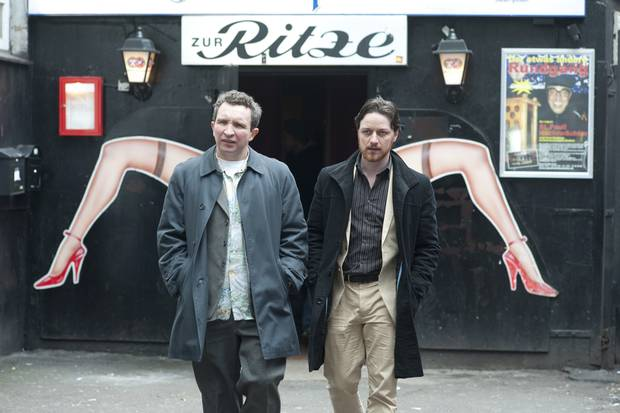
While the fluorescent promotional posters (the gaudy yellow and blue a nod towards today’s uniformed officers) boast a strong and intriguing cast, the weight of the film ultimately falls to McAvoy and his oblivious side-kick Clifford “Bladesy” Blades (Eddie Marsan). Much of the film’s comedy vigour comes from this unlikely pairing as Bladesy blindly follows Bruce down alleys into unintentional drug-fuelled nights with prostitutes and gay bars. The film taps into the rich comedic vein that is prevalent in Welsh’s writing; but more importantly it also delves into the more sordid and psychologically disturbed elements of his oeuvre. Baird, carefully emulating elements of the novel, strategically signposts deeper disturbances in Bruce’s psyche. We see flashes of a young boy covered in coal dust, and the intimate scenes with Bruce’s notably absent wife Carole (Shauna Macdonald) who narrates elements of their personal history in perfect make-up and decadent lingerie, jarr with the grungy and depraved actions of her mythically romanticised hubby. We slowly but surely get the idea that beyond Bruce’s obvious flaws, misogynist bigot that he is, there is something much deeper and darker going on.

In the closing death throes of the film, the dark humour rapidly deteriorates, along with the body and mental state of our fair hero. Previously comical relationships which had provided elements of lite relief now take on a disturbingly violent and threatening edge. The initially amusing relationship between Bruce and Chrissie (Kate Dickie) suddenly shifts as she violently forces herself upon a severely unstable and sick Bruce. The passage in the novel is one of the most bleak and unashamedly descriptive: ‘she’s pushing her c**t on to it against my will and thrusting on to me and the friction’s hurting me and she’s choking me harder and I can’t breathe or speak as the grip tightens’. In hindsight, their once previously amusing acts of erotic asphyxiation become a tool of ominous foreshadowing. This moment of sexual assault is one of McAvoy's shortest and yet most potent scenes. His depiction of an utterly disempowered being is heartbreaking, desolately lying on the floor with tears leaking out of his eyes softly whispering ‘I’m not well’. Bruce is met with a dismissive ‘you’re no fun anymore’ from Chrissie who luxuriously sucks on the end of a cigarette as she lounges content in her afterglow.


Welsh’s works have been acclaimed for their critique on what Berthold Schoene calls ‘the institutionalised politics of fucking’ which ultimately reveals the patriarchal systems of society which ‘irrespective of their biological sex [renders characters] into active “men” and passive “women”’- the victim and the victor. Filth should be championed in its undermining of traditionally sexist categorisations of women AND men. The exploration of issues such as cross-dressing and sexual orientation are insightful and challenging but ultimately it is this scene in which a previously powerless female character sexually assaults the male protagonist that resonates the most. Baird (through Welsh) exposes how the system is against men as much as it is against women, where Bruce represents the crippling necessity of conforming to an idealised myth of the interminable ‘hard man’. 


While Bruce obviously holds little respect for the women around him and leaves little space for their infringement into his personal sphere (apart from the idealised Carole of course), the female cast does well with their time on screen. Most notably Bunty Blades (Shirley Henderson) whose long-lashed wide-eyed infatuation of D.S. Robertson coupled with incredibly bouffant hair and a penchant for leopard print, steals every scene. The one non-sexual relationship between Bruce and a female character is unfortunately where I feel the film falls flat. One of the less successful scenes regarding the destabilisation of gender roles is in Bruce’s confrontation with colleague Amanda Drummond (Imogen Poots). The relationship between Drummond and Bruce in the novel is consistently high-strung; Drummond proves to be the level-headed politically correct antithesis to Bruce’s increasingly abhorrent behaviour. The confrontation between Drummond and Robertson in the film is a tumultuous and draining emotional ride and has moments of pure pathos. The script, however, lets down the animosity of the scene and the majority of Poots’ performance becomes likened to playground jibes and goading insinuations, though this is through no fault of the cast; Baird simply stays true to Welsh’s text.

After this encounter, Bruce is left a psychological mess. The audience is cast into the surreal and hallucinatory bowels of Dr. Rossi’s office (Jim Broadbent) where grotesque animal faces and more overt hints at a deep childhood trauma clutter the screen. The delusional office space of Rossi is perhaps the most unsuccessful text-to-screen adaptation of the whole film. Welsh’s novels characteristically disturb standard textual practice, using various fonts and typographic play to create a chaotic and unsettled edge and Filth is no different. The pages bulge with a visual representation of Bruce’s inner narrator, his friendly neighbourhood tapeworm, at times becoming so large it covers the narrative; bubbling across the page with an incessant drive to consume. The desolation and existential crisis exhibited by Bruce in the later stages of the film smacks of a typically Beckettian ‘protagonist’ struggling with a fractured memory of seemingly past events and a terrifying and incomprehensible present (indeed the idea of the Tapeworm perhaps an allusion to Beckett’s protagonist ‘Worm’ in The Unnameable). The substitution of the typographic worm for the doctor’s hedonistic office loses some of the more nuanced elements of Welsh’s writing, allowing the film to fall down a delusional rabbit hole that doesn’t necessarily enrich the already bizarre content. Baird’s adaptation, whilst putrid, violent, and exciting, did not portray the total physical wretchedness that encapsulates the character of Bruce Robertson. 

The fantastical and absurd elements draw the audience away from the overwhelmingly fetid decay of the central character which ultimately gives one the impression of leaving Filth feeling a bit too clean.

- Alex

You can read more of Alex's work over on Marginal Philosophy or follow her on Twitter: @ACamp_Bell


Follow @AssortedBuffery on Twitter
Or like our Facebook page.

Sunday, 10 March 2013

FILM REVIEW: Stoker


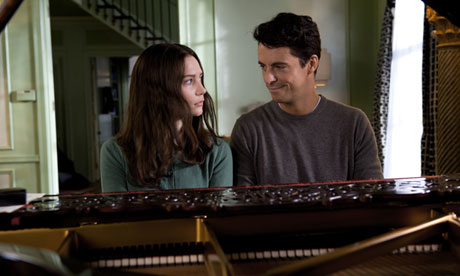
Written by Wentworth Miller, previously the star of Prison Break, Stoker depicts the events that occur after the death of Richard Stoker (Dermot Mulroney). At his funeral, his brother Charlie (Matthew Goode) returns to the family home, meeting Richard's wife Evie (Nicole Kidman) and his daughter India (Mia Wasikowska). Enigmatic and intriguing, Uncle Charlie immediately has the attentions of the two women and it's not long before a power struggle ensues between the three Stokers. 

Having already proved himself to be a visionary director with the Vengeance Trilogy, Park Chan-Wook was faced with the challenge of bringing his unique brand of twisted cinema to an English-speaking audience. With a starting point like Miller's screenplay, a resident of the 2010 Black List, the foundations were already there. Though predictable at times, the narrative is a twisted grim fairytale (pun intended), full of literary and cinematic references that give added meaning to its events. You only have to look at the detailed artwork for the film (see the poster above) to see how well put-together all of the references, both internal and external, are. Alfred Hitchcock's Shadow of a Doubt is the obvious one with their shared Uncle Charlies but everything from Shakespeare (for an excellent article on this, head over to Waxen Hearts for a look at Stoker and Hamlet) to the Brothers Grimm makes it in there. It may just be the literature geek in me, but it is a screenplay I would really like to read as it strikes me as a text in and of itself, ideally suited to analysis and criticism.

The fairytale element is one that struck a particular chord with me, as Stoker strikes me as a twisted retelling of Snow White, especially as a coming of age story. Despite it not being an overt aspect of the film, does far more with that story than either Snow White and the Huntsman or Mirror Mirror managed to as direct adaptations. India, with her pale skin, black hair and lips that become more red throughout the film, vies for the attention of her Uncle Charlie, a weird cypher for the prince. That leaves Evie as the evil stepmother, and though she is actually India's biological parent, they share little in common and it is clear that she sees her daughter as her rival, rather than her family. It's yet another aspect to what, on paper, could have simply been another family melodrama, but these allusions make the film a rich experience.

Like the multi-layered screenplay, technically speaking, Stoker is a true marriage of every element needed in a film. In particular, the combination of Chung-hoon Chung's cinematography with Nicolas de Toth's editing is wonderful throughout, bringing together key images from different moments in the film, changing and adapting their meanings as the story evolves. We see consequences of actions, before the actions themselves have chance to tell their own part of the story or bringing new meaning to scenes we saw in different parts of the film. It's a testament to the director and editor that these images don't alienate the audience, but enable the film to become even more engrossing whilst adding to the unsettling atmosphere.

Another example of this marriage of elements is the use of sound throughout the film. The sound editing is a masterful addition to the fragmented narrative, punctuating the more still scenes with jarring noises of ordinary actions, heightened by the stillness of the Stoker household. The scene in which Charlie offers India her first sip of wine would have been noteworthy anyway as a first temptation scene, but is granted more significance through the volume shift. India's drink of wine is not only visible, but highly audible, almost uncomfortably so. Clint Mansell's score works well with this discomfort and is excellent throughout, though slightly overshadowed by one piece by Philip Glass. Entitled Duet, it was written by Glass especially for the film and is a light motif throughout before getting an entire scene devoted to it. This scene was the standout from the entire film for me; a masterclass in building tension, exploring a wide variety of themes without any dialogue and it is, quite simply, breathtaking.


Kidman gives a pitch-perfect performance as the fragile trophy-wife, on the verge of tipping into hysteria. Her speech about why people have children was one of the most chilling moments in the film, a great example of motherhood gone awry. She is given the majority of the best lines as Evie determines to assert her superiority over her daughter. Goode is also excellent as the enigma that is Uncle Charlie, remaining seductive and charismatic even as his past is slowly revealed. However, it is to Wasikowska that this film belongs; it's a subtle performance, but one that captures brilliantly the awkward sullenness of adolescence as well as a growing sense of self, brought hurtling to its dramatic conclusion by the presence of her uncle. In the hands of a lesser actor, India could easily have become a void in the centre of the film, but Wasikowska brings an intensity to the performance that ensures that it is the quiet India, rather than the histrionic Evie or the manipulative Charlie, who lingers in the memory.

Stoker is a film that demands repeat viewings; it is too layered and too intricate for one viewing to simply do it justice. It won't be to everybody's tastes and it is certainly one of the most unsettling films I've seen for a long time, but this is to its credit. I just can't get it out of my head.

*****

- Becky

You can find us now over on Facebook and also on Twitter @AssortedBuffery