Over the course of October, I shall be watching one horror movie a day and reviewing it right here for your reading pleasure. I haven't seen any of the films I'll be watching before and you can find the full list here.
Father Sang-hyun (Song Kang-ho) is a well respected priest who volunteers at a local hospital, providing comfort to those in need. He finds himself wavering and decides to volunteer for an experiment to find a vaccine for the Emmanual virus, a deadly infection sweeping through the population. The experiment goes wrong and he contracts the EV, but is the only one of 500 to survive the process. Given his newfound aversion to sunlight and desire for human blood, he quickly deduces he is a vampire. He's still desperate to uphold his faith and not fall into sin, including killing people, but an affair with a childhood friend's wife, Tae-ju (Kim Ok-bin), leads him down a path full of carnal and fleshly desires.
Thirst is, rather surprisingly, based on the Emile Zola novel, Thérese Raquin, taking several plot elements into the narrative structure. I say surprisingly because there aren't actually any vampires in the book and as a 19th century work set in France, it seems like a bit of a leap for a contemporary Korean horror film. And yet, what the two texts share is the same kind of thematic exploration, following individuals imprisoned by faith or society and pushing them to their psychological breaking point with the conflict their circumstances induce. The stories differ on choosing who to follow; Zola places Thérese in focus, while director Park Chan-Wook builds his narrative around Father Sang-hyun (who corresponds to Laurent in Zola's novel).
In Zola's novel, Laurent and Thérese's behaviour is often described in animalistic terms and as a novelist, Zola was fascinated in the blurred lines between the human and the bestial. The vampire is a figure that occupies those blurred lines, managing to be both all at once so it makes complete sense that Park and fellow screenwriter Jeong Seo-kyeong combine their narrative with that of Zola's. The film is called Bakjwi in Korean, which translates literally as Bat, already hinting that it is exploring its lead's humanity through his vampirism.
That conflict is bound up within Sang-hyun, played beautifully by Song, who spends much of the movie wrestling his faith and desire not to sin with his need to consume human blood. He uses to both his advantage and that of the people helps, taking blood from people who desire to commit suicide to ease their passing and to assuage his own hunger. It's only when he takes Tae-ju into that world that this balance is thrown out; their murderous scheme to kill her sick and spoilt husband Kang-woo (Shin Ha-kyun) sets off a chain of events that sees everything spiral out of Sang-hyun's control. Her animalistic side takes over and he is forced into confronting his own humanity in order to redress that balance.
Their relationship is what gives the film its heart, a story of two people broken by circumstances out of their control and finding each other to take solace in. Before the husband's murder, it plays out with a sweetness that wouldn't be out of place in a romantic comedy. There's lots of humour in there too, some as black as it comes (Kang-woo's grinning post-murder apparitions) as well as things like a wardrobe doubling as a coffin for Sang-hyun to sleep in or the inventive use of his priest's cassock billowing around him as he leaps, connoting a bat's wings. Park deftly keeps all of these aspects running throughout the film and achieving a balance that never tips it into parody, nor become too meditative.
Thirst is wonderfully idiosyncratic and a refreshing kind of adaptation, opting to use its literary basis to explore the soulfulness of vampirism rather than simply the capacity for violence. It makes for an elegant, contemporary vampire tale and a memorable experience.
- Becky
You can find my other Shocktober '15 reviews here.
Follow @AssortedBuffery on Twitter
Or like our Facebook page
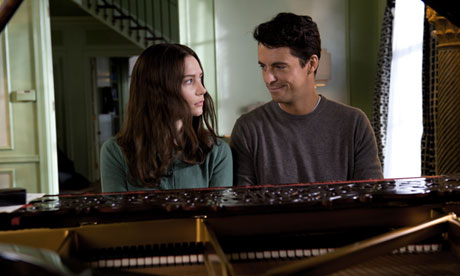
Written by Wentworth Miller, previously the star of Prison Break, Stoker depicts the events that occur after the death of Richard Stoker (Dermot Mulroney). At his funeral, his brother Charlie (Matthew Goode) returns to the family home, meeting Richard's wife Evie (Nicole Kidman) and his daughter India (Mia Wasikowska). Enigmatic and intriguing, Uncle Charlie immediately has the attentions of the two women and it's not long before a power struggle ensues between the three Stokers.
Having already proved himself to be a visionary director with the Vengeance Trilogy, Park Chan-Wook was faced with the challenge of bringing his unique brand of twisted cinema to an English-speaking audience. With a starting point like Miller's screenplay, a resident of the 2010 Black List, the foundations were already there. Though predictable at times, the narrative is a twisted grim fairytale (pun intended), full of literary and cinematic references that give added meaning to its events. You only have to look at the detailed artwork for the film (see the poster above) to see how well put-together all of the references, both internal and external, are. Alfred Hitchcock's Shadow of a Doubt is the obvious one with their shared Uncle Charlies but everything from Shakespeare (for an excellent article on this, head over to Waxen Hearts for a look at Stoker and Hamlet) to the Brothers Grimm makes it in there. It may just be the literature geek in me, but it is a screenplay I would really like to read as it strikes me as a text in and of itself, ideally suited to analysis and criticism.
The fairytale element is one that struck a particular chord with me, as Stoker strikes me as a twisted retelling of Snow White, especially as a coming of age story. Despite it not being an overt aspect of the film, does far more with that story than either Snow White and the Huntsman or Mirror Mirror managed to as direct adaptations. India, with her pale skin, black hair and lips that become more red throughout the film, vies for the attention of her Uncle Charlie, a weird cypher for the prince. That leaves Evie as the evil stepmother, and though she is actually India's biological parent, they share little in common and it is clear that she sees her daughter as her rival, rather than her family. It's yet another aspect to what, on paper, could have simply been another family melodrama, but these allusions make the film a rich experience.
Like the multi-layered screenplay, technically speaking, Stoker is a true marriage of every element needed in a film. In particular, the combination of Chung-hoon Chung's cinematography with Nicolas de Toth's editing is wonderful throughout, bringing together key images from different moments in the film, changing and adapting their meanings as the story evolves. We see consequences of actions, before the actions themselves have chance to tell their own part of the story or bringing new meaning to scenes we saw in different parts of the film. It's a testament to the director and editor that these images don't alienate the audience, but enable the film to become even more engrossing whilst adding to the unsettling atmosphere.
Another example of this marriage of elements is the use of sound throughout the film. The sound editing is a masterful addition to the fragmented narrative, punctuating the more still scenes with jarring noises of ordinary actions, heightened by the stillness of the Stoker household. The scene in which Charlie offers India her first sip of wine would have been noteworthy anyway as a first temptation scene, but is granted more significance through the volume shift. India's drink of wine is not only visible, but highly audible, almost uncomfortably so. Clint Mansell's score works well with this discomfort and is excellent throughout, though slightly overshadowed by one piece by Philip Glass. Entitled Duet, it was written by Glass especially for the film and is a light motif throughout before getting an entire scene devoted to it. This scene was the standout from the entire film for me; a masterclass in building tension, exploring a wide variety of themes without any dialogue and it is, quite simply, breathtaking.
Kidman gives a pitch-perfect performance as the fragile trophy-wife, on the verge of tipping into hysteria. Her speech about why people have children was one of the most chilling moments in the film, a great example of motherhood gone awry. She is given the majority of the best lines as Evie determines to assert her superiority over her daughter. Goode is also excellent as the enigma that is Uncle Charlie, remaining seductive and charismatic even as his past is slowly revealed. However, it is to Wasikowska that this film belongs; it's a subtle performance, but one that captures brilliantly the awkward sullenness of adolescence as well as a growing sense of self, brought hurtling to its dramatic conclusion by the presence of her uncle. In the hands of a lesser actor, India could easily have become a void in the centre of the film, but Wasikowska brings an intensity to the performance that ensures that it is the quiet India, rather than the histrionic Evie or the manipulative Charlie, who lingers in the memory.
Stoker is a film that demands repeat viewings; it is too layered and too intricate for one viewing to simply do it justice. It won't be to everybody's tastes and it is certainly one of the most unsettling films I've seen for a long time, but this is to its credit. I just can't get it out of my head.
*****
- Becky
You can find us now over on Facebook and also on Twitter @AssortedBuffery