Over the course of October, I shall be watching one horror movie a day and reviewing it right here for your reading pleasure. I haven't seen any of the films I'll be watching before and you can find the full list here.
Helen Lyle (Virginia Madsen) is a Chicago-based grad student working with her friend Bernadette (Kasi Lemmons) on a thesis about urban legends. During one of the research interviews, she hears a tale about the local Candyman legend. Supposedly, if you say his name into a mirror five times, he'll appear behind you and he has been linked to a recent unsolved murder in the infamous Cabrini-Green projects. Both sceptical, she and Bernadette jokingly say his name five times into a mirror, unaware that he might not actually be as fictional as they think.
Adapted by Bernard Rose from a Clive Barker story, The Forbidden, it's a haunting urban fairytale that doesn't shy away from its own intelligence, nor that of the audience. As you've probably guessed from these reviews if you've been following along all month, I really enjoy horrors that operate as explorations of fear, rather than simply manifestations of scary things that go bump in the night. Candyman is packed full of ideas, utilising disenfranchised voices, racial tensions and the power of the imagination to spin out what could have been an average slasher into something more exploratory and poignant.
The idea that gods and monsters thrive on the faith that people have for them is a theme often found throughout genre fiction (one that immediately sprang to mind was Neil Gaiman's American Gods). In Candyman, it's rather Helen's scepticism that brings him forth, her efforts to debunk his existence and thus demythologise him in the eyes of the residents of Cabrini-Green act as a threat to him. Making Helen believe he exists fuels his power, but there is still an ambiguity here; are we seeing Candyman because he really exists in this urban nightmare? Or does he exist because we're seeing Helen's imagination flourish a little too much?
In that respect, Candyman is akin to The Innocents in which the reader is never quite sure whether the ghosts are real or if they are simply the release of the main character's unhealthy repression. There's an element of that going on here too. Helen is frustrated by a lot of the things going on around her; she's got a husband who is quite obviously having an affair with one of his pretty blonde students (and that, I suspect, is how Helen's own relationship started, thus adding fuel to that particular fire) and her academic colleagues are determined to point out that she's not contributing anything new to the field and they all got there first.
When the Candyman legend arrives in her lap, she seizes it with enthusiasm, venturing into dangerous ground and finding evidence that suggests he may be a real serial killer operating in the building, but has become a mythic figure in the eyes of the residents. She finds pictures of him on walls, candies on the floor with razorblades in, even graffiti boldly declaring "sweets for the sweet". It's easy to see that he becomes an obsession for her, rather than simply a research project. When he shows up, he isn't the usual silent slash-first have-a-character-in-the-sequel killers. He arrives fully formed, a character born of injustice and rage, but he's not simply violent; he's seductive, even romantic in his own way, bewitching Helen. The mellifluous tones of Tony Todd only add to this element. He becomes her release from those people in her life restraining her, at one point, even literally so.
The film itself is bewitching for its audience, thanks to the way in which Rose manages to bring a dreamlike quality to the harshest of locations. The projects themselves are more on the nightmarish end of the scale, an endless maze of threats on Helen and Bernadette even before we're aware of the Candyman's true existence. It also helps that Philip Glass' score operates as darkly reverent motif throughout the film, evoking the idea of that key theme of worship through the choral arrangements for the Candyman himself and a carnivalesque lullaby motif that is at once both beautiful and unsettling.
There's still so much more going on in Candyman that I could wax lyrical on for ages. I didn't even get to the whole urban legend/modern fairytale idea. It's a fascinating, thoughtful and provocative horror and a great example of the genre operating on multiple levels to produce something really quite masterful.
- Becky
You can find my other Shocktober '15 reviews here.
Follow @AssortedBuffery on Twitter
Or like our Facebook page
Written by Wentworth Miller, previously the star of Prison Break, Stoker depicts the events that occur after the death of Richard Stoker (Dermot Mulroney). At his funeral, his brother Charlie (Matthew Goode) returns to the family home, meeting Richard's wife Evie (Nicole Kidman) and his daughter India (Mia Wasikowska). Enigmatic and intriguing, Uncle Charlie immediately has the attentions of the two women and it's not long before a power struggle ensues between the three Stokers.
Having already proved himself to be a visionary director with the Vengeance Trilogy, Park Chan-Wook was faced with the challenge of bringing his unique brand of twisted cinema to an English-speaking audience. With a starting point like Miller's screenplay, a resident of the 2010 Black List, the foundations were already there. Though predictable at times, the narrative is a twisted grim fairytale (pun intended), full of literary and cinematic references that give added meaning to its events. You only have to look at the detailed artwork for the film (see the poster above) to see how well put-together all of the references, both internal and external, are. Alfred Hitchcock's Shadow of a Doubt is the obvious one with their shared Uncle Charlies but everything from Shakespeare (for an excellent article on this, head over to Waxen Hearts for a look at Stoker and Hamlet) to the Brothers Grimm makes it in there. It may just be the literature geek in me, but it is a screenplay I would really like to read as it strikes me as a text in and of itself, ideally suited to analysis and criticism.
The fairytale element is one that struck a particular chord with me, as Stoker strikes me as a twisted retelling of Snow White, especially as a coming of age story. Despite it not being an overt aspect of the film, does far more with that story than either Snow White and the Huntsman or Mirror Mirror managed to as direct adaptations. India, with her pale skin, black hair and lips that become more red throughout the film, vies for the attention of her Uncle Charlie, a weird cypher for the prince. That leaves Evie as the evil stepmother, and though she is actually India's biological parent, they share little in common and it is clear that she sees her daughter as her rival, rather than her family. It's yet another aspect to what, on paper, could have simply been another family melodrama, but these allusions make the film a rich experience.
Like the multi-layered screenplay, technically speaking, Stoker is a true marriage of every element needed in a film. In particular, the combination of Chung-hoon Chung's cinematography with Nicolas de Toth's editing is wonderful throughout, bringing together key images from different moments in the film, changing and adapting their meanings as the story evolves. We see consequences of actions, before the actions themselves have chance to tell their own part of the story or bringing new meaning to scenes we saw in different parts of the film. It's a testament to the director and editor that these images don't alienate the audience, but enable the film to become even more engrossing whilst adding to the unsettling atmosphere.
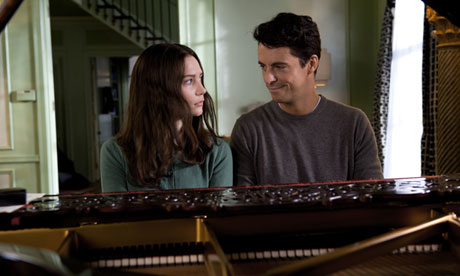
Another example of this marriage of elements is the use of sound throughout the film. The sound editing is a masterful addition to the fragmented narrative, punctuating the more still scenes with jarring noises of ordinary actions, heightened by the stillness of the Stoker household. The scene in which Charlie offers India her first sip of wine would have been noteworthy anyway as a first temptation scene, but is granted more significance through the volume shift. India's drink of wine is not only visible, but highly audible, almost uncomfortably so. Clint Mansell's score works well with this discomfort and is excellent throughout, though slightly overshadowed by one piece by Philip Glass. Entitled Duet, it was written by Glass especially for the film and is a light motif throughout before getting an entire scene devoted to it. This scene was the standout from the entire film for me; a masterclass in building tension, exploring a wide variety of themes without any dialogue and it is, quite simply, breathtaking.
Kidman gives a pitch-perfect performance as the fragile trophy-wife, on the verge of tipping into hysteria. Her speech about why people have children was one of the most chilling moments in the film, a great example of motherhood gone awry. She is given the majority of the best lines as Evie determines to assert her superiority over her daughter. Goode is also excellent as the enigma that is Uncle Charlie, remaining seductive and charismatic even as his past is slowly revealed. However, it is to Wasikowska that this film belongs; it's a subtle performance, but one that captures brilliantly the awkward sullenness of adolescence as well as a growing sense of self, brought hurtling to its dramatic conclusion by the presence of her uncle. In the hands of a lesser actor, India could easily have become a void in the centre of the film, but Wasikowska brings an intensity to the performance that ensures that it is the quiet India, rather than the histrionic Evie or the manipulative Charlie, who lingers in the memory.
Stoker is a film that demands repeat viewings; it is too layered and too intricate for one viewing to simply do it justice. It won't be to everybody's tastes and it is certainly one of the most unsettling films I've seen for a long time, but this is to its credit. I just can't get it out of my head.
*****
- Becky
You can find us now over on Facebook and also on Twitter @AssortedBuffery