Dear reader, I must begin this review with a confession. I have never managed to finish Jane Austen's classic Pride & Prejudice. I have attempted it three times and have slowly lost the will to live during each and every attempt. However, despite my ongoing internal battle with my determination to get through that book, I was mightily intrigued by the adaptation of Death Comes to Pemberley, based on the novel by PD James, which follows on from the events of Austen's narrative but takes on the guise of a murder mystery. Coupled with the excellent cast and the high standard which comes with a BBC period drama, I settled down to the series with a little expectation and smidgeon of anticipation.
Set a few years after the events of Pride & Prejudice, Lizzie (Anna Maxwell Martin) and Darcy (Matthew Rhys) are happily married and residing at the Darcy family pile, Pemberley. The house is in the process of getting ready for a ball, with the majority of the Bennets on their way to attend, except of course, Lydia (Jenna Coleman), married to the wicked George Wickham (Matthew Goode) and therefore uninvited. Not to be outdone, the Wickhams set off for the ball with their friend Captain Denny (Tom Canton) but a fight along the way and a dastardly murder in the woods finds Wickham arrested and Lizzie and Darcy trying to solve the crime.
The first episode got off to a slow start, but it had so many pieces to put into play that it was a necessary beginning. Once they were all in place, the tension ramped up steadily to the series' slightly heartstopping conclusion. Fortunately those like me who had never managed to finish Austen's novel, an extensive prior knowledge was not required as flashbacks and other references in the dialogue give you enough information to provide a good background to these events. Usually exposition scenes tend to detract from the main event, but here they provided a nice link between the two works, as well as highlighting some of our characters' anxieties, particularly Lizzie's.
As with any good murder mystery, there were a few red herrings to be fished out amongst the other clues but what resonated most was the way in which the murder acted as a catalyst for an analysis on relationships, rather than simply driving the plot towards to its conclusion. Both the Darcys and the Wickhams achieved their supposed happily-ever-afters (one genuine, one as the result of some fast monetary intervention), but the murder pries open cracks in each relationship. For the Darcys, it comes back to the idea of status and Lizzie's worry that Darcy regrets their marriage because he married for love not money. With Lydia, it is trying desperately to keep up the charade that she and Wickham are happy, whilst possessing the knowledge that he's been unfaithful.
There is also a typical marriage plot buried in one of the developing narratives alongside the main one, that of Georgiana Darcy's desire to marry the lawyer Alveston (James Norton) whilst her cousin Colonel Fitzwilliam (Tom Ward) vies for her hand. Both relationships are disrupted as a result of the murder with Darcy forcing Georgiana into an engagement with her cousin before he realises that his cousin is just trying to keep his reputation untainted. It lends a fascinating element to what could have been just a straight murder mystery and one that is enhanced by PD James' decision to use these existing characters; we're offered a chance to see what hand life has dealt them and how in turn they respond to it.
It helped that the performances were all excellent with Matthew Rhys and Anna Maxwell Martin bringing a lovely chemistry to one of literature's most famous couples. Though they remain the stoic centre at the heart of the chaos, they are never dull, always observing with a quick intelligence and Martin gets in some great one liners with Lizzie's trademark wit. Matthew Goode is another standout, carving a fine niche for himself in the charming reprobate category after this year's Stoker, whose Wickham may be all kinds of awful, but has enough charm and vulnerability about him that you keep rooting for him throughout.
Trevor Eve made for a suitably gruff investigator, one whose motives remained in doubt throughout but ultimately came good in the end. Initially, Jenna Coleman and Rebecca Front hold up much of the comedic end in the first half of the series as Lydia and Mrs Bennet, but Lydia in particular far from one-dimensional. In just one scene she is transformed from a selfish, inconsiderate irritant to a put-upon wife determined not to allow her marriage to fall apart. It's a testament to Coleman's performance that this seen registered so strongly.

Finally, the most interesting element was the way in which Pemberley became a character in itself. Using the beautiful grounds of Chatsworth in Derbyshire (as well as interiors at Castle Howard and Harewood House), the estate itself became a crucial part of the narrative, not only as its location, but also because of the regard in which it is held by the characters. Whilst the murder itself was motivated more by individual concerns, the reason behind it, mainly the existence of baby George, was founded on Wickham's love of Pemberley and the memories he had of it. Darcy's attempts to rein in the scandal are to save its name as is Georgiana's decision to marry her cousin despite not really caring for him.
Much more than just a simple murder-at-a-country-house tale, Death Comes to Pemberley was a beautiful exercise in how to create a compelling story of family and scandal, with fantastic performances and a real dedication to bringing Austen's characters back to life. It may have just inspired me to give Pride & Prejudice another go.
- Becky
Follow @AssortedBuffery on Twitter
Or like our Facebook page.
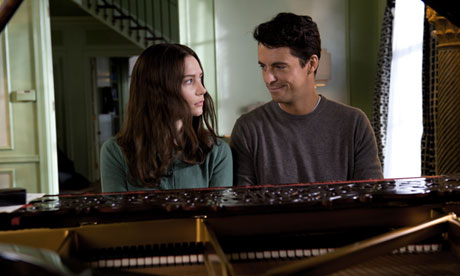
Written by Wentworth Miller, previously the star of Prison Break, Stoker depicts the events that occur after the death of Richard Stoker (Dermot Mulroney). At his funeral, his brother Charlie (Matthew Goode) returns to the family home, meeting Richard's wife Evie (Nicole Kidman) and his daughter India (Mia Wasikowska). Enigmatic and intriguing, Uncle Charlie immediately has the attentions of the two women and it's not long before a power struggle ensues between the three Stokers.
Having already proved himself to be a visionary director with the Vengeance Trilogy, Park Chan-Wook was faced with the challenge of bringing his unique brand of twisted cinema to an English-speaking audience. With a starting point like Miller's screenplay, a resident of the 2010 Black List, the foundations were already there. Though predictable at times, the narrative is a twisted grim fairytale (pun intended), full of literary and cinematic references that give added meaning to its events. You only have to look at the detailed artwork for the film (see the poster above) to see how well put-together all of the references, both internal and external, are. Alfred Hitchcock's Shadow of a Doubt is the obvious one with their shared Uncle Charlies but everything from Shakespeare (for an excellent article on this, head over to Waxen Hearts for a look at Stoker and Hamlet) to the Brothers Grimm makes it in there. It may just be the literature geek in me, but it is a screenplay I would really like to read as it strikes me as a text in and of itself, ideally suited to analysis and criticism.
The fairytale element is one that struck a particular chord with me, as Stoker strikes me as a twisted retelling of Snow White, especially as a coming of age story. Despite it not being an overt aspect of the film, does far more with that story than either Snow White and the Huntsman or Mirror Mirror managed to as direct adaptations. India, with her pale skin, black hair and lips that become more red throughout the film, vies for the attention of her Uncle Charlie, a weird cypher for the prince. That leaves Evie as the evil stepmother, and though she is actually India's biological parent, they share little in common and it is clear that she sees her daughter as her rival, rather than her family. It's yet another aspect to what, on paper, could have simply been another family melodrama, but these allusions make the film a rich experience.
Like the multi-layered screenplay, technically speaking, Stoker is a true marriage of every element needed in a film. In particular, the combination of Chung-hoon Chung's cinematography with Nicolas de Toth's editing is wonderful throughout, bringing together key images from different moments in the film, changing and adapting their meanings as the story evolves. We see consequences of actions, before the actions themselves have chance to tell their own part of the story or bringing new meaning to scenes we saw in different parts of the film. It's a testament to the director and editor that these images don't alienate the audience, but enable the film to become even more engrossing whilst adding to the unsettling atmosphere.
Another example of this marriage of elements is the use of sound throughout the film. The sound editing is a masterful addition to the fragmented narrative, punctuating the more still scenes with jarring noises of ordinary actions, heightened by the stillness of the Stoker household. The scene in which Charlie offers India her first sip of wine would have been noteworthy anyway as a first temptation scene, but is granted more significance through the volume shift. India's drink of wine is not only visible, but highly audible, almost uncomfortably so. Clint Mansell's score works well with this discomfort and is excellent throughout, though slightly overshadowed by one piece by Philip Glass. Entitled Duet, it was written by Glass especially for the film and is a light motif throughout before getting an entire scene devoted to it. This scene was the standout from the entire film for me; a masterclass in building tension, exploring a wide variety of themes without any dialogue and it is, quite simply, breathtaking.
Kidman gives a pitch-perfect performance as the fragile trophy-wife, on the verge of tipping into hysteria. Her speech about why people have children was one of the most chilling moments in the film, a great example of motherhood gone awry. She is given the majority of the best lines as Evie determines to assert her superiority over her daughter. Goode is also excellent as the enigma that is Uncle Charlie, remaining seductive and charismatic even as his past is slowly revealed. However, it is to Wasikowska that this film belongs; it's a subtle performance, but one that captures brilliantly the awkward sullenness of adolescence as well as a growing sense of self, brought hurtling to its dramatic conclusion by the presence of her uncle. In the hands of a lesser actor, India could easily have become a void in the centre of the film, but Wasikowska brings an intensity to the performance that ensures that it is the quiet India, rather than the histrionic Evie or the manipulative Charlie, who lingers in the memory.
Stoker is a film that demands repeat viewings; it is too layered and too intricate for one viewing to simply do it justice. It won't be to everybody's tastes and it is certainly one of the most unsettling films I've seen for a long time, but this is to its credit. I just can't get it out of my head.
*****
- Becky
You can find us now over on Facebook and also on Twitter @AssortedBuffery