
Written by Wentworth Miller, previously the star of Prison Break, Stoker depicts the events that occur after the death of Richard Stoker (Dermot Mulroney). At his funeral, his brother Charlie (Matthew Goode) returns to the family home, meeting Richard's wife Evie (Nicole Kidman) and his daughter India (Mia Wasikowska). Enigmatic and intriguing, Uncle Charlie immediately has the attentions of the two women and it's not long before a power struggle ensues between the three Stokers.
Having already proved himself to be a visionary director with the Vengeance Trilogy, Park Chan-Wook was faced with the challenge of bringing his unique brand of twisted cinema to an English-speaking audience. With a starting point like Miller's screenplay, a resident of the 2010 Black List, the foundations were already there. Though predictable at times, the narrative is a twisted grim fairytale (pun intended), full of literary and cinematic references that give added meaning to its events. You only have to look at the detailed artwork for the film (see the poster above) to see how well put-together all of the references, both internal and external, are. Alfred Hitchcock's Shadow of a Doubt is the obvious one with their shared Uncle Charlies but everything from Shakespeare (for an excellent article on this, head over to Waxen Hearts for a look at Stoker and Hamlet) to the Brothers Grimm makes it in there. It may just be the literature geek in me, but it is a screenplay I would really like to read as it strikes me as a text in and of itself, ideally suited to analysis and criticism.
The fairytale element is one that struck a particular chord with me, as Stoker strikes me as a twisted retelling of Snow White, especially as a coming of age story. Despite it not being an overt aspect of the film, does far more with that story than either Snow White and the Huntsman or Mirror Mirror managed to as direct adaptations. India, with her pale skin, black hair and lips that become more red throughout the film, vies for the attention of her Uncle Charlie, a weird cypher for the prince. That leaves Evie as the evil stepmother, and though she is actually India's biological parent, they share little in common and it is clear that she sees her daughter as her rival, rather than her family. It's yet another aspect to what, on paper, could have simply been another family melodrama, but these allusions make the film a rich experience.
Like the multi-layered screenplay, technically speaking, Stoker is a true marriage of every element needed in a film. In particular, the combination of Chung-hoon Chung's cinematography with Nicolas de Toth's editing is wonderful throughout, bringing together key images from different moments in the film, changing and adapting their meanings as the story evolves. We see consequences of actions, before the actions themselves have chance to tell their own part of the story or bringing new meaning to scenes we saw in different parts of the film. It's a testament to the director and editor that these images don't alienate the audience, but enable the film to become even more engrossing whilst adding to the unsettling atmosphere.
Another example of this marriage of elements is the use of sound throughout the film. The sound editing is a masterful addition to the fragmented narrative, punctuating the more still scenes with jarring noises of ordinary actions, heightened by the stillness of the Stoker household. The scene in which Charlie offers India her first sip of wine would have been noteworthy anyway as a first temptation scene, but is granted more significance through the volume shift. India's drink of wine is not only visible, but highly audible, almost uncomfortably so. Clint Mansell's score works well with this discomfort and is excellent throughout, though slightly overshadowed by one piece by Philip Glass. Entitled Duet, it was written by Glass especially for the film and is a light motif throughout before getting an entire scene devoted to it. This scene was the standout from the entire film for me; a masterclass in building tension, exploring a wide variety of themes without any dialogue and it is, quite simply, breathtaking.
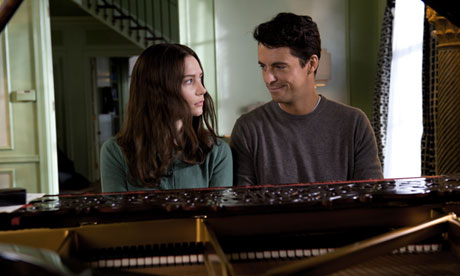
Stoker is a film that demands repeat viewings; it is too layered and too intricate for one viewing to simply do it justice. It won't be to everybody's tastes and it is certainly one of the most unsettling films I've seen for a long time, but this is to its credit. I just can't get it out of my head.
*****
- Becky
You can find us now over on Facebook and also on Twitter @AssortedBuffery

me too.. it just lingers here in my head!
ReplyDelete