Today's feature is a guest post from Marginal Philosophy writer Alex Campbell. Just a quick warning, this post contains both strong language and spoilers.
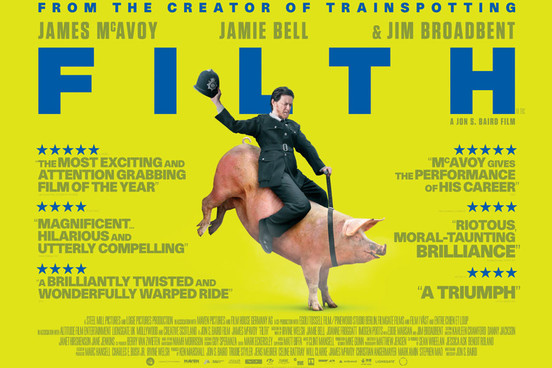 |
| Filth Trailer: Treat yourself to the image of James McAvoy riding a pig to the tunes of the Scissor Sisters. |
It has been well publicised that Filth struggled to find funding. As you can well imagine, pitching a film based on a novel whose protagonist’s inner most thoughts are narrated by an inebriated and destructive tapeworm would have raised more than a few eyebrows - luckily thanks to no less than 9 production companies, they raised the cash as well. In its opening weekend initial figures have Filth raking in around £250k at the Scottish Box office - cue an abundance of witty articles entitled ‘Filth cleans up at the box office’. And a bloody good job too. The film is a nihilistic riot, brutally funny and indulgently obscene.
Baird digs deep into the surreal and darkly comical underbelly of Welsh’s writing; embracing the wickedly weird elements of the novel and adapting them for the screen. Welsh’s novels are noted for their particular attention to deeply disturbed white, Scottish, male characters and Filth is a prime example. Alcoholic, sexist, and itchy-bollocked - misanthrope Detective Sergeant Bruce Robertson (James McAvoy) is about to be promoted. He’s fucking sure of it; in fact he’ll stop at nothing to get it. Champion of the people on the outside, and vindictive machiavellian on the inside, a good-cop/bad-cop rolled into one decaying body, Bruce Robertson is a man out for himself.
McAvoy’s performance is heroic in its commitment: any mentions from the audience of prior adoration or lust for our bearded thespian, were quickly switched into grimaces and muffled expressions of shock and confusion. It’s called Filth for a reason. Chips, chicks, and cocaine are on the menu every night and nothing helps a hangover like professional sabotage. McAvoy is wholly dedicated to the role and his comedic timing and cheeky smile manages to bring the audience onto his side - even if that side happens to be bigoted, sexist, and slovenly. Pantomime-esque cracks in the fourth wall allow the audience in on the various sinister schemes that our conniving copper has planned for his rivals. We are tipped the wink, and feel a certain amount of collusion with Bruce while we laugh at his gullible peers as much as he does. The joke is always on them. His malignant and magnificent plots to undermine his colleagues to ensure his own promotion are nothing short of comedic genius. Welsh’s writing is translated wonderfully, the audience collapses into laughing shrieks of vague horror at Bruce’s manipulative skills as he slowly but surely pulls the rug out from under his rivals; questioning their sexual orientation, sleeping with their wives, and setting them against one another.
One of the most successful elements of the film is the blend of different eras; this is a film set in 2013, based on a novel written in 1998, and uses a soundtrack comprised mostly of 1960s/1970s classics set against a score by Clint Mansell. This seems to be a deliberate move by Baird; the swinging soundtrack serves to historicise the contemporary setting of the film, making you realise that these supposedly ‘outdated’ issues of racism, sexism, and homophobia are not simply contained to the dark ages but are still disturbingly relevant issues that stain the social fabric of modern day Britain. Baird however has been quick to stress that the film is not a commentary on the boys-in-blue. It’s true that there doesn’t seem to be any overt political or national agenda fuelling the fire (unlike the infamous “Scotland is shite” scene from Trainspotting) - references to Scotland are minimal, and outside of the name Bruce Robertson (a play on Robert the Bruce) and introductory scenes poking fun at the stereotypes of bagpipes and redheads, the film shies away from any focused commentary on life in modern Scotland.

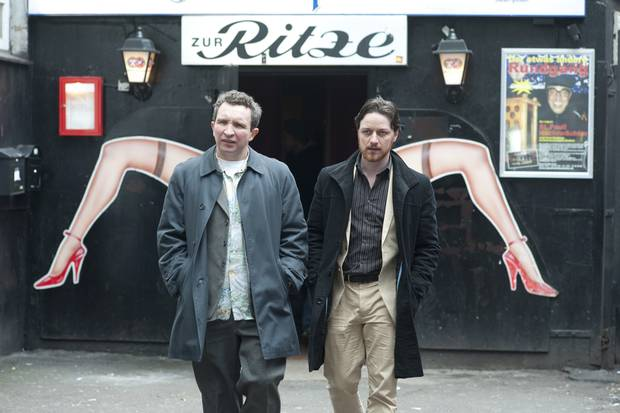
While the fluorescent promotional posters (the gaudy yellow and blue a nod towards today’s uniformed officers) boast a strong and intriguing cast, the weight of the film ultimately falls to McAvoy and his oblivious side-kick Clifford “Bladesy” Blades (Eddie Marsan). Much of the film’s comedy vigour comes from this unlikely pairing as Bladesy blindly follows Bruce down alleys into unintentional drug-fuelled nights with prostitutes and gay bars. The film taps into the rich comedic vein that is prevalent in Welsh’s writing; but more importantly it also delves into the more sordid and psychologically disturbed elements of his oeuvre. Baird, carefully emulating elements of the novel, strategically signposts deeper disturbances in Bruce’s psyche. We see flashes of a young boy covered in coal dust, and the intimate scenes with Bruce’s notably absent wife Carole (Shauna Macdonald) who narrates elements of their personal history in perfect make-up and decadent lingerie, jarr with the grungy and depraved actions of her mythically romanticised hubby. We slowly but surely get the idea that beyond Bruce’s obvious flaws, misogynist bigot that he is, there is something much deeper and darker going on.
In the closing death throes of the film, the dark humour rapidly deteriorates, along with the body and mental state of our fair hero. Previously comical relationships which had provided elements of lite relief now take on a disturbingly violent and threatening edge. The initially amusing relationship between Bruce and Chrissie (Kate Dickie) suddenly shifts as she violently forces herself upon a severely unstable and sick Bruce. The passage in the novel is one of the most bleak and unashamedly descriptive: ‘she’s pushing her c**t on to it against my will and thrusting on to me and the friction’s hurting me and she’s choking me harder and I can’t breathe or speak as the grip tightens’. In hindsight, their once previously amusing acts of erotic asphyxiation become a tool of ominous foreshadowing. This moment of sexual assault is one of McAvoy's shortest and yet most potent scenes. His depiction of an utterly disempowered being is heartbreaking, desolately lying on the floor with tears leaking out of his eyes softly whispering ‘I’m not well’. Bruce is met with a dismissive ‘you’re no fun anymore’ from Chrissie who luxuriously sucks on the end of a cigarette as she lounges content in her afterglow.
Welsh’s works have been acclaimed for their critique on what Berthold Schoene calls ‘the institutionalised politics of fucking’ which ultimately reveals the patriarchal systems of society which ‘irrespective of their biological sex [renders characters] into active “men” and passive “women”’- the victim and the victor. Filth should be championed in its undermining of traditionally sexist categorisations of women AND men. The exploration of issues such as cross-dressing and sexual orientation are insightful and challenging but ultimately it is this scene in which a previously powerless female character sexually assaults the male protagonist that resonates the most. Baird (through Welsh) exposes how the system is against men as much as it is against women, where Bruce represents the crippling necessity of conforming to an idealised myth of the interminable ‘hard man’.

While Bruce obviously holds little respect for the women around him and leaves little space for their infringement into his personal sphere (apart from the idealised Carole of course), the female cast does well with their time on screen. Most notably Bunty Blades (Shirley Henderson) whose long-lashed wide-eyed infatuation of D.S. Robertson coupled with incredibly bouffant hair and a penchant for leopard print, steals every scene. The one non-sexual relationship between Bruce and a female character is unfortunately where I feel the film falls flat. One of the less successful scenes regarding the destabilisation of gender roles is in Bruce’s confrontation with colleague Amanda Drummond (Imogen Poots). The relationship between Drummond and Bruce in the novel is consistently high-strung; Drummond proves to be the level-headed politically correct antithesis to Bruce’s increasingly abhorrent behaviour. The confrontation between Drummond and Robertson in the film is a tumultuous and draining emotional ride and has moments of pure pathos. The script, however, lets down the animosity of the scene and the majority of Poots’ performance becomes likened to playground jibes and goading insinuations, though this is through no fault of the cast; Baird simply stays true to Welsh’s text.
After this encounter, Bruce is left a psychological mess. The audience is cast into the surreal and hallucinatory bowels of Dr. Rossi’s office (Jim Broadbent) where grotesque animal faces and more overt hints at a deep childhood trauma clutter the screen. The delusional office space of Rossi is perhaps the most unsuccessful text-to-screen adaptation of the whole film. Welsh’s novels characteristically disturb standard textual practice, using various fonts and typographic play to create a chaotic and unsettled edge and Filth is no different. The pages bulge with a visual representation of Bruce’s inner narrator, his friendly neighbourhood tapeworm, at times becoming so large it covers the narrative; bubbling across the page with an incessant drive to consume. The desolation and existential crisis exhibited by Bruce in the later stages of the film smacks of a typically Beckettian ‘protagonist’ struggling with a fractured memory of seemingly past events and a terrifying and incomprehensible present (indeed the idea of the Tapeworm perhaps an allusion to Beckett’s protagonist ‘Worm’ in The Unnameable). The substitution of the typographic worm for the doctor’s hedonistic office loses some of the more nuanced elements of Welsh’s writing, allowing the film to fall down a delusional rabbit hole that doesn’t necessarily enrich the already bizarre content. Baird’s adaptation, whilst putrid, violent, and exciting, did not portray the total physical wretchedness that encapsulates the character of Bruce Robertson.
The fantastical and absurd elements draw the audience away from the overwhelmingly fetid decay of the central character which ultimately gives one the impression of leaving Filth feeling a bit too clean.
- Alex
You can read more of Alex's work over on Marginal Philosophy or follow her on Twitter: @ACamp_Bell
Follow @AssortedBuffery on Twitter
Or like our Facebook page.


