Over the course of October, I shall be watching one horror movie a day and reviewing it right here for your reading pleasure. I haven't seen any of the films I'll be watching before and you can find the full list here.
Near Dark sees a good ole Oklahoma boy, Caleb (Adrian Pasdar), lured by the enigmatic May (Jenny Wright) into a quasi-family of drifters who may be more than initially meets the eye. They are led by the charismatic Jesse (Lance Henriksen) and wander across the American landscape at night, shunning the sun and thriving on blood. It all starts to go awry when Caleb refuses to kill another human and drink their blood, something which would complete his 'turn' into a vampire. His family are also on the hunt for Caleb and the clash of the two worlds forces him to make a choice between the day or the night.
1987 saw another vampire movie of similar ideas in The Lost Boys in one of those curious instances of movie doubling. Whilst Joel Schumacher's tale of teenage rebellion was steeped in schlock and humour, Near Dark takes an altogether more macabre approach to the material. Bigelow and fellow screenwriter Eric Red combine the vampire element with that of the Western in one of the few Western genre hybrids that actually works. The Lost Boys may be the more fun of the two films, but Near Dark is much more atmospheric.
Much of that is achieved by the fact that the film takes place in the same level of light suggested by its title, with the cold glow of street lamps or car headlights providing some scenes only illumination. It's a world that operates in shadow too; we're never told exactly that Jesse and his gang are vampires, left to draw our own conclusions from years of pop culture and horror knowledge. We never know exactly what their motivations are, other than to feed, nor how their particular brand of vampirism works. It's neatly done with Bigelow and Red giving us just enough information for us to be satisfied whilst retaining an air of enigma around the vampiric family.
The fusion with the Western genre also lends itself to that dusky aesthetic, where morality is a weird grey area predicated on the need to survive rather than the need to be good. Caleb spends much of the movie occupying that curious middle ground having been offered the chance to live up to the lifestyle his cowboy hat and boots represent. Jesse's people have formed themselves into a corrupted domestic setup that functions like parents with kids and they offer Caleb a reckless existence.
It helps that these are made up of some of the finest character actors in the business who had also recently worked on a little film called Aliens together; Henriksen, Jenette Goldstein and Bill Paxton have an easy chemistry that clashes nicely with the quieter May and the new arrival Caleb. Paxton in particular looks like he's having a ball, playing Hudson without the fear, but with the same amount of jokey assholery. My only complaint is that Goldstein was relegated to a sort of maternal figure without really doing anything else.
Kathryn Bigelow's directorial debut is a brooding yet violent take on the vampire genre, taking something that could have easily tired with the Western sensibilities that give it a rejuvenating kick. It might not be quite as fun or memorable as The Lost Boys, but it offers what is perhaps a more interesting take on the same story.
- Becky
You can find my other Shocktober '15 reviews here.
Follow @AssortedBuffery on Twitter
Or like our Facebook page
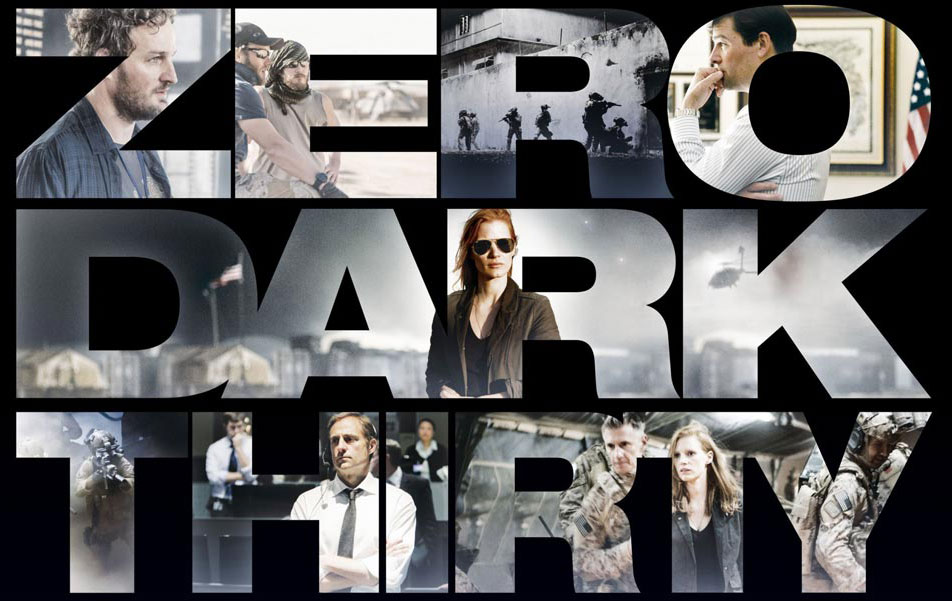
Following the twelve-year hunt for al-Qaeda head, Osama Bin Laden, Zero Dark Thirty focusses in on Maya (Jessica Chastain), a young CIA agent who believes that a courier may hold the key to his location. Aided by an elite team of intelligence operatives, Maya painstakingly narrows in on Bin Laden's location, devoting her entire career to this one objective. Despite attacks being made on her life and those around her, Maya's determination persists throughout the twelve years, eventually leading to a raid on what is believed to be Bin Laden's hiding place.
Opening with audio from 9/11, Zero Dark Thirty states its intent right from the start; this isn't going to be a comfortable watch. It is in fact, a surprisingly exhausting film that, despite its nearly 3 hour run time, never really lets you have a moment to breathe and take it all in. Whilst the compound raid is one of the most tense sequences I've seen for a long time, the rest of the film is a constantly mounting crescendo to that point. It's a testament to Kathryn Bigelow and screenwriter Mark Boal that they have managed to craft such a compelling and thrilling account of over a decade long of surveillance where the audience already knows the outcome. This isn't the espionage world of Fleming, but more that of Le Carre, where most of the time is spent at desks, pouring over footage or phone records than actually running around chasing the bad guys down the street. In this film, the bad guy is never seen until his death; he's spectral, haunting the moves of each character, particularly that of Chastain's Maya who devotes her entire career to his capture.
Chastain's performance is the film's strongest element, subtle and understated but also extremely powerful. Maya's arc from a CIA rookie who flinches during torture to a woman who barely emotes when someone attempts to kill her is well-measured and authentic. Despite not being an overly emotional performance, Chastain provides a figure with which we cannot empathise with, but align ourselves to. It's also incredibly refreshing to see a female character in a film who isn't immediately given a love interest or a tragic back story to give her a motive for being so strong-willed and driven. She exists as a single character in her own right, rather than as a result of a relationship with another character. Of course, it does help that she is based on a real CIA agent, but Bigelow's dramatic license could have seen her given a personal tragedy to make her pursue this course. Thankfully, Maya is defined purely by her actions within the film; she's a CIA agent just trying to do her job and the film is all the better for it.

Chastain is well-supported by the other cast members too, each with varying levels of screen time. None are given any form of back story beyond the realm of the film, but each character feels fully rounded and essential to the unfolding narrative. As Maya's colleagues, Jason Clarke's Dan and Jennifer Ehle's Jessica create the most lasting impressions, representing both the agents' inhumanity and their compassion; Dan tortures his detainees for leads whilst Jessica bakes a cake for a potential source. Mark Strong's battle-weary George also stands out and his scene with Stephen Dillane was noticeable for its sheer desperation and even with their smaller roles, both Joel Edgerton and Chris Pratt make their mark on the third act of the film. The strength here is that Bigelow takes what is a highly political topic with global ramifications and transforms it into something smaller, more intimate; it's a film about the people who brought about these events and the sacrifices they make to do so, rather than the events themselves.
Zero Dark Thirty has also come in for its fair share of criticism regarding the film's depiction of torture as the way in which this trail to Bin Laden was started. However, as Bigelow stated herself, 'depiction is not endorsement' and in no way does it ever feel as if tortured detainees are the reason behind Bin Laden's death. The film makes the point in different ways that intel gathered under duress was not wholly reliable, nearly putting an end to Maya's courier theory at one point and failing to prevent attacks in others. The torture scenes (a small part of the film, despite what the media furore would have you believe) themselves are graphic and deeply unsettling and the audience is placed in a highly uncomfortable position throughout, but at no point does it feel as if the film-makers are supporting the detainee programme. In fact, the film remains curiously apolitical on this subject; it is presented as a fact without emotion, without an argument either way. When Obama declares that the detainee programme is to end, it does and no comment is made on the subject other than that the CIA must now adapt its methods. It's left to the audience to decide whether this was the right course of action or not.
Admittedly, I was quite surprised by the distance that was placed between the film-makers and the subject of the film as I had gone in expecting it to be a pro-American retelling of the death of the man who was behind one of the greatest tragedies in history. The apolitical stance taken on the torture scenes continues throughout the film however, again forcing the audience to judge the ethics of what is taking place. This was especially present during the raid on the Abbottabad compound itself. Rather than presenting a SEAL team who knew exactly what they were doing, the level of uncertainty in the group is palpable, from the briefing to the raid itself. Bigelow doesn't shy away from showing the more controversial aspects of the raid, with women and children present in the compound. It's the most impressive sequence in the film and, despite knowing the outcome, you wait with baited breath as SEAL Team 6 make their move.
Technically speaking, Zero Dark Thirty is meticulously crafted with an attention to detail that creates a greater feeling of authenticity and adds to the documentarian style of the film. In particular, the production design deserves a special mention with its accurate reproduction of the compound at Abbottabad; without this, the raid sequence would not have been so effective and, combined with the use of night vision, the final act of the film was completely immersive. Elsewhere throughout, the excellent score was also essential in the build-up of tension; never intrusive yet always mildly unsettling. Quite why it didn't receive an Oscar nomination is frankly beyond me.
Bigelow's direction works well to combine all of these elements to create a film that is not what I would describe as likeable or entertaining, but challenging, fascinating and a thoroughly deserving topic of discussion. There's a lot left to say about Zero Dark Thirty because it is a film that does not provide you with any of the moral or political answers you might expect it to; instead, it simply tells you a story. Where you stand on the events of that story, or how you feel about it, is left entirely with you to decide.
*****
- Becky
Follow Becky on Twitter @beckygracelea
Or on her blog beckygracelea.wordpress.com