Everyone has a story when it comes to Star Wars, and I'm certainly no different. But unlike most folks', which begins with it being the first film they saw in the cinema and that kind of thing, mine at least starts a little differently. It began with snowspeeders.

I don't really know for sure if The Empire Strikes Back was the first film I ever saw, or if it was the original Star Wars, but one of my earliest memories is of a grainy stretched image of the aforementioned snowspeeders rocketing over the snow plains of Hoth. It was grainy and stretched because it was a pirated VHS - this was 1982 - with poor quality and stretched due to the aspect ratio not being adjusted as with pan and scan. This was not the ideal way to view the film, but nevertheless, from that moment onwards I was a rabid fan of that galaxy far, far away. And yes, the first film I saw in a cinema was a Star Wars movie (Return of the Jedi to be precise). Now one of the direct offshoots of the pirate experience was my love affair with Marvel's run of Star Wars comics, specifically their reprints in the UK.
Star Wars was a huge deal for Marvel, but at the time it almost wasn't a deal at all. With the original film seen as a low-budget B-movie that was a potential disaster, Lucasfilm's marketing team went out to try and make deals with all sorts of merchandise companies to create tie-ins to raise awareness of the forthcoming film. They were turned down by a lot of people (toy company Mego for one), as well as Stan Lee at Marvel, and it wasn't until editor Roy Thomas went to Lee and showed him what Star Wars potentially had both in terms of story, but also monetary value.
Funnily enough, it actually was seen by many as saving Marvel from going under. Marvel's run was a huge undertaking, with a revolving creative team of people like Carmine Infantino, Al Williamson, Mary Jo Duffy, Howard Chaykin, and Archie Goodwin, and introduced a vast number of colourful characters to the universe, as well as adapting the three movies of the original trilogy. The Marvel series in the UK was published weekly rather than the usual monthly comics cycle, and as such we got a quarter of a story per week, which wasn't brilliant but at least it felt like better value because it was 20p per day as well as being magazine-sized. Also notable were the titles: while the US comic run was simply known as "Star Wars", the title of the UK mag changed dependent on which film was out at the time, there for we had Star Wars, The Empire Strikes Back, and Return Of The Jedi weekly, with the latter being the one my mother used to buy for me from Tesco.
So this is both a voyage of nostalgia and discovery, as I go back through Marvel's run seeing what holds up, what doesn't, and whether any of it is as good as it used to be. If you have an mp3 of the Fox Fanfare, you should play that now.
Issue #1 - #6 - STAR WARS
#1: Star Wars; #2: Six Against The Galaxy; #3: Death Star; #4: In Battle With Darth Vader; #5: Lo, The Moons of Yavin; #6: The Final Chapter?
The first six issues of Star Wars were devoted to the adaptation of the original film, by Roy Thomas and Howard Chaykin and Steve Leialoha. Like many comic adaptations, it was quite different in places to the film due to the huge lead-in periods for these kind of things. You actually wonder which cut was viewed - some scenes are in a different order, notably the "Help I think I'm melting!" line from C-3PO, which was originally to happen aboard the blockade runner but was switched to the TIE fighter attack near the end - here, it's back at the beginning.
It's also full of scenes cut from the film, notably new material concerning Luke Skywalker. While much of this has now been seen on the blu-ray (with the more hardcore geeks seeing it on the Behind The Magic CD-ROM) including the infamous Biggs scene, this was a major thing, especially after everyone who read the comic saw the film. We also get a glimpse at Jabba the Hutt, although instead of the Scottish actor in a furry costume, we instead get a different alien in his place, and a bipedal one at that.
The comic has a weird feel, not in an especially bad way, but it doesn't really feel a hundred percent like Star Wars. It captures the space opera part of it, and there's a certain throwback to the pulp stories and old westerns, especially with the dialogue. It's interesting reading the comic and seeing new lines filled in the space before and after existing lines (although there's nothing to say they weren't in the script), especially when they're illustrative - the scene where Princess Leia is captured, you have the stormtrooper saying "Set for stun!" as in the film, but Leia replies with "I've set mine to KILL!" - and it has a neat effect of adding a new dimension to the film, especially if, like me, you've seen it trillions of times.
One thing the comic doesn't fare so well in is capturing the innocent fairytale spirit of the film. It was something that seemingly felt so effortless, and I have a feeling it's very much to do with John Williams' musical score. Star Wars has been described many times, not least by George Lucas, as a silent film, and it's right on the nose. But with that, Williams' music fills in the narrative and emotional blanks not covered by the visuals, so when you have those memorable sequences, like when Princess Leia gives the tapes to Artoo (which has a strange narrated part intimating that C-3PO thinks Leia is “probably beautiful by human standards”, or even the most iconic part, Luke looking at the twin suns, the music supports the film so the comic either adds in dialogue or narration, or in the case of the latter, excises it completely.
The artwork is a strange beast. Credited to Chaykin and Leiahola, sometimes as illustrators, sometimes with Chaykin as illustrator and Leiahola as “embellisher”, it often seems like they were given sections, as the style changes like the wind. I prefer Chaykin's, as it has a bit of a rougher style, but Leiahola's is perhaps more traditional. It's all relatively faithful, give or take a few things. Chewie always looks more like an ape, especially as they use two-tone to distinguish his facial features, and there's a weird TIE fighter pilot who, with his/her elongated helmet and ear muffs, looks right out of a Polish film poster. The Millennium Falcon suffers a bit as well, with most of its surface detail wiped out, kind of missing the point about the style of the ship.
I do enjoy Thomas' dialogue and narration - it's very brash and fits in with the film's fast-talking dialogue style. The narration is fun and has to support the story a lot, so there's little bits like “like angry mosquitos, the rebel fighters streak upward from their hidden hangars” and “the rebel leader spoke earlier of its one weakness which may be exploited if the space gods are kind”. My favourite is the final panel, where as the gang get their medals (we're actually told Chewie will get one but Leia isn't tall enough to put it on) and it ends with “What the future holds for these six daring souls, only time and the space-winds know. But, for today... for now... they are content.” Poetry.
There are a few other inaccuracies – Luke's call-sign is 'Blue Five', which was actually the same as in the novel by Alan Dean Foster. I have a feeling that somewhere along the line they changed it to red due to the high use of bluescreen, so it's understandable. Also, all the lightsabers are pink, which is a bit of an odd choice. I'm guessing they saw footage before it was rotoscoped, so again, I can understand it. However, there are two inappropriate kiss klaxons throughout the story, although again, back then Leia wasn't any relation to Luke so it's not a massive deal. However, it does try and play it a bit more romantic, where both kisses in the film (at the chasm and on Yavin) were pecks on the cheek, this is as hot and heavy as it gets. Pretty sure they were smoking afterwards.
It's not a bad start, really. I've seen better and worse movie adaptations, but it captures the swashbuckling nature of the film fairly well, and it's a fun read. It's strange to see characters and events that you've spent your life revisiting reinterpreted, and if I have a big criticism, it's that the characters maybe weren't distilled down enough, especially with Luke. This doesn't really feel like his story, more that he's just one of the gang, which is perhaps a bit of a cardinal sin. But like the original film, it's a jumping off point with a galaxy full of potential for all kinds of stories. Who knows what we'll see?
Next: New Planets, New Perils!
- Charlie
Today marks the 30th Anniversary of the cinematic release of Indiana Jones and the Temple of Doom. Paul Bullock of From Director Steven Spielberg has been leading a week-long celebration, culminating in a live tweet commentary of the film tonight (May 23rd, 8pm GMT). Our contribution is from Charlie as he turns his attention to Dr Jones...

It's almost impossible to create art that doesn't reflect some facet of the creator. The moods, the relationships, the events that happen during the creation more often than not seep through to shape it, whether you like it or not. One of the better examples of this is Indiana Jones and the Temple of Doom, which is notorious for being uber-dark and nasty, violent, and generally quite scary, as well as in some quarters being seen as racist. The film celebrates its thirtieth anniversary this May, so it's perhaps an ample time to talk about what is a severely underrated film.
The situation is this: Raiders of the Lost Ark has just made a bundle of money, Harrison Ford is even more of a global superstar than he was before, and Indiana Jones is an instant heroic icon. So George Lucas and Steven Spielberg get to thinking about another one, while Spielberg makes E.T. and George puts the finishing touches to the Star Wars saga via Return of the Jedi. But despite the huge success of the film, the production of Jedi has a bittersweet ending as Lucas' marriage to editor Marcia Lucas ends in bitter circumstances (Spielberg had also ended a relationship in 1980 with actress Amy Irving).
Screenwriter Lawrence Kasdan, who wrote Raiders (as well as Jedi and The Empire Strikes Back), refused to be involved citing his dislike of the story, and has since said that the film comes out of a "chaotic time" in both Spielberg and Lucas' lives. He's not wrong. Temple of Doom has a mean streak a mile wide, but I don't see it as a bad thing - after all, much of it's a horror film. The funny thing is that it almost feels like Spielberg and Lucas made two different movies and threw them together - George an intense and nasty horror movie, Steven a parody of the previous film (as well as many others). What was birthed from those two fathers is a child that may be dysfunctional at times, but is still a hard one not to love. After all, who doesn't enjoy seeing hearts being ripped out of people's chests?
But before we look at the good points, let's see what gets people so up in arms about the film. First: the racism. In the film, Indiana travels to India and meets people who not only eat bugs, but enslave children and make people drink blood, as well as the aforementioned removal of the major organ. The Thuggee cult in the film is actually semi-based in reality, albeit much less fantastic. It was more of a gang, and they were literally thugs - they went around India murdering people. The idea of a terrifying cult that did unmentionable things was something that was thought to exist, only recently have theories come forward that it was created by the British in Colonial India to reflect their fears. It's also a massive homage to Gunga Din, which reflects Spielberg's love of old movies.
Things like the dinner scene - where the guests are served up beetles, snakes, and eyeball soup, not to mention chilled monkey brains - are mean but fun gags, although this is the part where I could genuinely see people being upset at the portrayal of the Indian people. But I don't think it's intentional, and I don't think Lucas and Spielberg set out to make the 1984 version of Birth of a Nation as many people seem to think. Willie Scott, however, is another matter.
After the smart, resourceful, and strong female character of Marion Ravenwood, Willie Scott seems like a trip back to the stone age. She's vapid, materialistic, and does very little besides scream or complain. It's not hard to see her character being birthed out of the bad feelings of George Lucas' broken marriage. She also has no significance to anything in the film, other than being a love interest for Indy. I can tolerate her in the film, but I can certainly see why people hate her guts. It's also pretty uncomfortable seeing what she's put through, from walking through a tunnel crawling with insects, to being lowered into a hot pit.
The film also creates its own problem simply by adding a title card that says "Shanghai, 1935". This immediately sets it as being a prequel, which means what follows doesn't make a huge amount of sense. I can deal with a couple of things - the sword gag callback where Indy reaches for his gun only to find his holster is empty is brilliant - but Indy in Raiders begins the film as a skeptic who states "I don't believe in magic, a lot of superstitious hocus-pocus" but ends the film as a changed man after witnessing the power of the almighty first hand. Surely he would be a bit more open-minded if he'd previously seen the effects of black magic and the sankara stones going up in flames due to the misappropriation of Kali and Shiva?
So yeah, the picture is not without its flaws. But it's also breathlessly exciting, funny, scary, and absolute bonkers, and a massive tribute to movies. The opening is spectacular, as Kate Capshaw twirls her way through a Cantonese version of the Cole Porter standard 'Anything Goes'. There's a double-meaning here, as Spielberg and Lucas here tell the audience that they better prepare themselves, as there's no telling what the pair are going to throw at them. Anything goes indeed.
The Indiana Jones here is not really the same as the reluctant hero in Raiders. The UK marketing for Temple stated in bold letters "THE HERO IS BACK", and while it's an obvious sequel reference, it's also reflective of the old-school heroism in the film, where Indy ends up taking up a moral crusade on behalf of the village and as a result we get the kind of swashbuckling heroics that would turn Errol Flynn to jelly, under the guise of "fortune and glory". But also unlike Raiders, in Temple the hero falls.
As I mentioned earlier, much of the film dives into horror territory, with much of the tropes of the genre around that time such as legions of bugs, human sacrifice (no cats and dogs living together), and Mola Ram's heart-removal service. Even the setpiece at the beginning in the nightclub, where a poisoned Indy stumbles around Club Obi-Wan looking for the antidote, has some surprising violence, from the death of Jones' waiter friend ("Into the great adventure, I go first Indy!") - which by the way is filmed in a fantastic way, with the picture following popping champagne bottles around the room, until one of the pops turns out to be a gunshot, with copious amounts of blood blooming on the waiter's shirt. But that's like Sesame Street compared to when Indy skewers one of villain Lao Che's cohorts with a flaming kebab.
There are plenty of nasty deaths in the film - from simple gunshot victims to the vicious hanging of a thuggee from a ceiling fan to the uber-thuggee (played by Pat Roach, the massive bloke who kicked Indy's ass by the flying plane) who gets pulled under a rock crushing machine, leaving a ghastly trail of claret behind. But the obvious one is that heart scene - where Mola Ram reaches into the chest of a poor gentleman and rips out his still-beating heart, displayed in full technicolor glory. Dripping with bright red blood, the heart is animatronic and actually pulsates as Mola Ram grins with a lusty relish.
So the picture is pretty mean, and as a result of not only containing lots of deaths but almost revelling in them, it ended up inspiring the PG-13 rating in the USA (along with another project under the double-S, Joe Dante's Gremlins). But it's also ridiculously funny and dripping with uber-quotable wisecracks. The most famous is funnily enough oft-misquoted - Short Round's "Hey Dr. Jones, no time for love!" after Indy sticks his hand down Willie Scott's dress - but there's also "Hold on to your potatoes", "That's why they call it the jungle, sweetheart!", "This Nurhache's a real small guy!", and the brilliant "Short cut!" "Yes Indy?" "I said Short CUT!". Like Raiders, Temple is at its best when it makes light of desperate situations. It's both mean and funny seeing Kate Capshaw squirming through the bug tunnel while all sorts of giant insects crawl all over her, but it's funnier when she's fumbling at the release mechanism while Indy is shouting at her, ending with that impeccable line reading by Harrison Ford: "We. Are Going. To DIE!"
And the humour is needed to counteract some terribly bleak material, mainly around Indy actually turning to the dark side courtesy of a little blood cocktail. Seeing Jones drink blood from the creepiest goblet in the history of the world - a zombified human head that looks like something Leatherface would be proud of making - is bad enough, but it's horrifying to see the hero of the picture being a complete asshole, not only sending Willie down into the fire pit (although I think some would applaud that) but striking child sidekick Short Round. The scene that always disturbed me the most was seeing Indy alone in a darkened room convulsing while under the influence of the Black Sleep of the Kali Ma. There's a sense of hopelessness throughout that section of the film that makes Indy's eventual awakening from the trance all the more triumphantly powerful.
The scene where Indy comes back is also the one sequence that really brings up Spielberg's family motif. Shorty's act of catching Indy with fire to bring him out is prefaced by "I love you, Indy!" and the scene ends with the trio together - but while Indy and Willie share a Hollywood kiss, the real warmth comes from the exchange of hats between Indy and Shorty, and the following embrace. Another father-son moment that has a lot of heart, and the only scene in the film that comes close to Spielberg's much-accused - and generally misunderstood - "sentimental" side.
And of course, there's the action scenes. While on the subject, the reunion scene is followed by the longest period of action in the film that doesn't stop until they return to the village, beginning with the most iconic image from the picture: that uber-heroic shot of Indy's silhoutte in the tunnel. The first half of the film is no slouch either - we get a great nightclub fight that includes Indy and and Willie running across the room behind a gong as it's spattered by gunfire; the jump from a crashing plane and subsequent slalom down a giant mountain and into rapids in a dinghy; and the fight between Indy, Shorty and the Thuggees to save Willie. It's all at a breathlessly exciting pace, which is why the film was was actually slowed down to allow it to breathe a little.
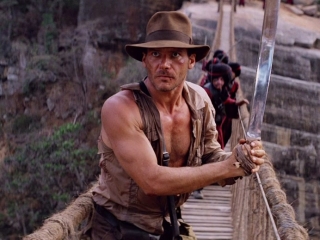
But there's not much breathing room, especially not towards the end, where you have Indy freeing all the slaves who themselves overrun their captors followed by that nutty mine car chase (which was an idea left over from Raiders) followed by our heroes being chased by a mass of water ("Water! Water!.... WATER!") followed by *that* rope bridge scene. It's just an incredible spectacle seeing Indy in the middle of that rickety bridge surrounded by enemies, and suddenly he comes out with his version of the Kobayashi Maru, with another immortal line: "Mola Ram! Prepare to meet Kali - IN HELL!" Rope bridge, meet machete. And then you have Indy and Mola Ram fighting on the remains of the bridge, ending in the evil bastard being eaten by crocodiles.

The ending is something I've always loved, just because of how damn happy it is. Indy, Willie, and Shorty walking into the village to the strains of the Raiders March is such a great moment, and then when the bridge kicks in the kids run to their parents and, well, it's bloody emotional. And while the final moments where Indy wraps his whip around a departing Willie may be seen as a bit inappropriate, it follows another quotable set of lines by Capshaw ("I'm going home to Missouri, where they never feed you snakes before ripping your heart and lowering you into a hot pit!"). Of course, it ends on another Hollywood kiss, but it's a great one, accompanied by a bunch of cheering kids and a wonderfully effervescent rendition of the march. 'Scuse me, I have something in my eye.
Actually, it's probably a tie between John Williams and Harrison Ford in terms of who contributes the most to the success of the film. Ford is never better as Jones, and handles both the action and the comedy perfectly, as well as the Black Sleep scenes. Williams' score is a marvel, from his brilliant intro to the opening musical number, to the great themes of the slaves, the love theme, and Short Round's theme, with the latter being used especially well in the end titles when it's interpolated with the Raiders March. The music walks the mickey-mousing line and features copious renditions of the march, so much so that Spielberg asked Williams to tone it down for The Last Crusade.
A special note has to go to Amrish Puri: he's amazing as Mola Ram, with a great commanding screen presence, and the creepiest laugh this side of Mark Hamill's Joker. But everyone does a fine job, even Capshaw, especially with what she's given to work with. I have a multitude of reasons for loving this movie, but the main one is just that it's so barmy, and as a result so much fun. It's kind of sad that both Lucas and Spielberg have basically disowned it, and that it has so much of a bad reputation, especially when there are so many other movies out there that ape it and get better press.
I guess considering it's been thirty years, Indiana Jones and the Temple of Doom's chances of being reassessed as a classic are probably not too great. But I don't mind too much being in a minority as long as this flick is around. Great action, great comedy, great music. You never know, maybe a future generation may discover it and rate it up a bit higher than most people. That's one of the best things about being a father and a movie fan, you can introduce all these great pictures to your kids regardless of what the masses say about them.
Of course I'll wait until they're thirteen...
- Charlie
To keep up with the rest of Temple of Doom week, follow @paulbullock on Twitter or check out the hashtag #TODweek