Showing posts with label Richard Eyre. Show all posts

Wednesday, 18 July 2012

TV REVIEW: The Hollow Crown - Henry IV Part Two

The third episode of The Hollow Crown and the second part of Henry IV follows the aftermath of the Battle of Shrewsbury, the decaying relationship between Prince Hal and Falstaff and the King dealing with the rebellions which continue to flourish in an uneasy England.


Lord Northumberland learns of Harry Hotspur's death and flees to Scotland for safety. The Archbishop of York plots another rebellion against Henry IV who is weakening after the toll of the battle. Hal is still torn between his old life and his new role as the heir apparent and has to come to terms with the fact that he soon might be King. Meanwhile, Falstaff is being chased by the Lord Justice, determined to keep him away from corrupting the young prince once again, but Falstaff is confident in Hal's love for him, believing that once Hal is King, he will bestow Royal offices upon his portly friend.


While still possessing the bawdy comedy and the slapstick of the first part of Henry IV, Part Two is a much more serious piece of work, dealing with the complications of growing up and accepting your responsibilities. The journey here is Prince Hal's, begun in Part One, but reaching its destination in Part Two as he cements his position as the honourable heir apparent and shedding the rebellious youth who we saw in the previous play. Tom Hiddleston, reliable as ever, manages to avoid falling into the trap of playing the two as very different halves of the same person, but instead gives us a nuanced performance that captures the development of Hal. The cheeky prankster is still there but is measured by his realisation that shedding Falstaff and the other residents of East Cheep is the way to go. The coronation scene in which Hal finally banishes Falstaff from his life and the country was emotional, both in terms of seeing finally become King Henry V but also the act of banishment itself. Simon Russell Beale has portrayed one of Shakespeare's most famous characters with a great balance of both the comic and tragic elements that Falstaff possesses.


As always with Shakespeare, a lot of the very important character developments are shown through the use of soliloquy and the two most powerful scenes in this episode were those given over to Henry and Hal as they contemplate the effects of kingship, for as Henry mournfully observes, 'uneasy lies the head that wears the crown'. Both Jeremy Irons and Hiddleston capture your attention in their separate moments and the setting of both scenes in the throne room really develop the sense of the inevitablity of kingship. Hal is very aware that his father's death is necessary for him to become King and the internal conflict of this was well-pitched and enhanced the emotional weight of the scene. The focus isn't all on the kingly pair though with Hal's younger brother John also getting a look in on the action. His takedown of the rebellion alongside Westmoreland was a properly triumphant moment and whilst not entirely honourable, it was a well-handled bait-and-switch for both the audience and the doomed rebels.


The episode's shortcomings are few but can probably be traced back to the play itself. Nowhere near as famous as the plays that come before or after, it is also not as strong structurally or dramatically. The few standout scenes I've mentioned are just that, exceptional pieces of theatre that provide great moments for actors and audiences alike. However, those in between lack some of the punch of the other moments. Whilst the farcical chase between the Lord Justice and Falstaff culminating in all out street brawl would probably work very well on stage, on screen it felt out of place with the more sombre tone that Part Two took. I'm well aware of the necessity to further separate the characters of Hal and Falstaff, but the jumps in tone sometimes felt a little jarring. That being said, I would watch Julie Walters in anything and her take on the beleaguered Mistress Quickly was one of the highlights of both plays.
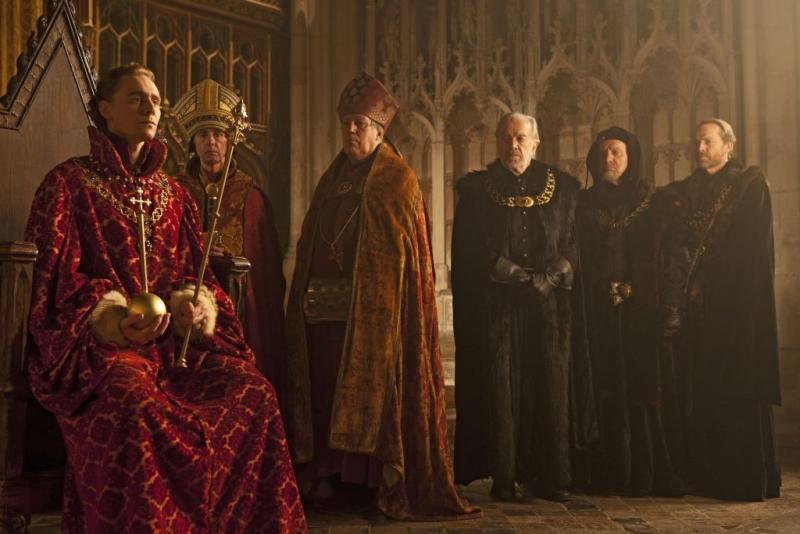

The Hollow Crown is one impressive piece of television and I'm already eagerly awaiting the next instalment. Whilst Part Two didn't quite match up to the dizzying heights set by the truly brilliant Henry IV Part One, it held its own for the most part and gave Irons, Hiddleston and Beale plenty of moments to shine. Next week, we get to see Hal as Henry V in all his St. Crispin's Day glory and I'm already feeling just that little bit more patriotic.


- Becky


You can read both Becky's and Jen's reviews for Henry IV Part One here and here.
Or follow Becky on Twitter @beckygracelea

Monday, 9 July 2012

TV REVIEW: The Hollow Crown - Henry IV Part One: A Thoroughly Modern Monmouth


Having been a fan of Henry IV Part 1 for many years now, I feel obliged to present my own addition to Becky’s already ample review.

You’ve already read Becky’s review (and if you haven’t, go do so here) and so assuming you’ve got the Henry basics down by now, I’m just going to jump straight in.

Crucial to this tale of a wayward prince’s return to honour in defence of his father, is the Bard’s slick use of contrast. Much like a modern day domestic soap opera, no sooner have we settled into one group dynamic, be it that of the court, the rebels or the tavern, than some imaginary narrator figure clicks their fingers and we’re propelled headlong into a whole new atmosphere, usually one the total antithesis of the place we’ve just left.

The play just wouldn’t work without it, and Richard Eyre’s version captures it beautifully. I’m not usually one to praise scene shortening in adaptations, primarily because it means I then feel the need to explain the missing bits to everyone else in the near vicinity, but here, the editing marries the different plotlines together in a way which does not take away from the original pattern, but adds to it. Moving slyly from scene to scene, Eyre’s adaptation catapults Hal’s coming of age (and sobriety) story into something more epic, clever, heartfelt and ultimately more modern than I’ve seen this play before.

The magic of cinema, as it were, and as Becky has already mentioned,  allows it a bigger scale than previously, the real terror and grit of war coming across in the frost bitten, blood soaked battle scenes. The wardrobe and set decisions fit the brief, too. In fact I’d like to take my hat off immediately to whoever had the idea of putting Hal in a vaguely Elizabethan leather jacket, and you can almost smell the beer from the tavern scenes and feel the laughter reverberating from the walls.

It all feels generously updated, cinematic and well thought out.

Ultimately though, it’s the performances in this production that make it feel as thoroughly modern as it has long deserved to be.  Eyre’s shift in focus from the history of the play to the relationships within it puts to bed my one traditional criticism of this play- the slightly two dimensional nature of its main characters.  All too frequently they are concepts and symbols for directors to play with before they are people, and we can only guess at their inner world.  Not so here. Eyre’s cut and paste approach to the longer speeches comes into its own, and we’re given much needed proof that there’s more in the heads of Hal and Falstaff than big ideas, ego and booze.

Speaking of Hal, kicking the notable performances list off in style is Tom Hiddleston’s Prince. I’ve long thought Harry Monmouth the original lovable rogue, and Hiddlseton shows him off for exactly what he is. He’s sexy, suave and self-centred but with enough of a prankster’s cheeky streak to make you fall head over heels for Shakespeare’s most dapper royal regardless. Here he’s a joy to watch, with Hiddleston’s inclusive and charismatic performance making you not only want to be a part of his gang, but really feel that you’re in on the joke, whichever one it is at the time, every step of the way.
Eyre also goes to town on the gleeful closeness and camaraderie of Hal and best pal Poins (one of our beloved Unsung Heroes), who, through a combination of careful direction and well-timed close-ups, is finally brought to the foreground not as a plot device, but as an accomplice in his own right. (Hooray!)  


 The pivotal relationship between Hal and Falstaff is just as spot on, with the score brought in at key moments to highlight their tragic co-dependence. It’s not hugely subtle, but it does the job, and again, they all feel like real people you could meet down your local of a Friday night, rather than stuffed up Received Pronunciation cut outs. 
 
 Hostpur, I had a few initial problems with. Apologies, Becky. Brilliant though Joe Armstrong’s performance is, I just didn’t feel the parallels between himself and fellow Harry, Prince Hal, were as obvious as they should be for the play’s intricate design to be seen at its best.

But then I decided that I’d missed the point. It does happen, from time to time. I decided that Eyre’s Hotspur wasn’t an obvious parallel, not in error, but precisely because he wasn’t supposed to be. You wouldn’t get two similar looking kids, both born of power, born on the exact same today and mirroring each other’s stance and booming voices in a modern drama or in reality for that matter, and so you don’t here. Hotspur suitably rants and raves enough to do his name proud, but again he’s a character in his own right, with his own motivations and merriments- not just there as a mirror image of his adversary.   

Oh and Julie Walters? A born Mistress Quickly, a fantastic casting coup and a great excuse to have her sat in a pub with an equally grubby looking Maxine Peake.

The effect of all of the above is that this production feels more like an action film, the story of which could have been thought up last week, not an adaptation of a play from four hundred years ago, based on an even older story. Its blend of domestic drama, friendship and battle drama is alive and well here, and as a result we can empathise with its characters and see ourselves and our friends in them more than we ever have.

It’s gritty, edgy and even tragic, but most of all it’s just gloriously good fun.

And you can’t say fairer than that for a play set in a tavern. 

- Jen


You can read more of Jen's writing here: www.memyselfandtheothers.wordpress.com 
And can follow her on twitter here: www.twitter.com/jenniferklarge