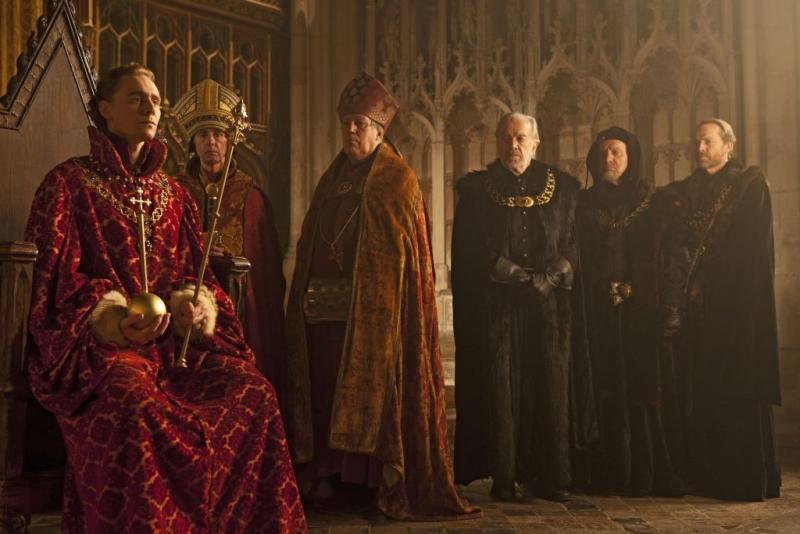
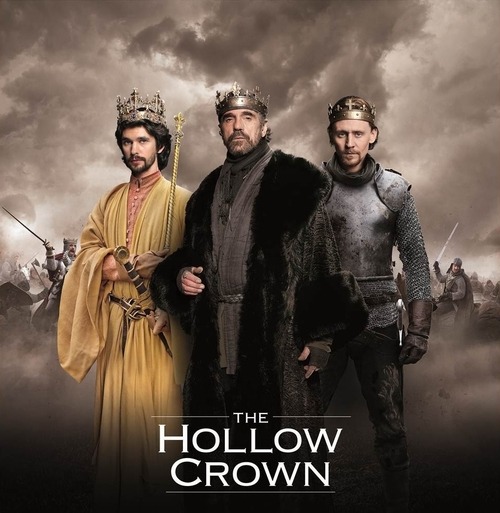
The third episode of The Hollow Crown and the second part of Henry IV follows the aftermath of the Battle of Shrewsbury, the decaying relationship between Prince Hal and Falstaff and the King dealing with the rebellions which continue to flourish in an uneasy England.
Lord Northumberland learns of Harry Hotspur's death and flees to Scotland for safety. The Archbishop of York plots another rebellion against Henry IV who is weakening after the toll of the battle. Hal is still torn between his old life and his new role as the heir apparent and has to come to terms with the fact that he soon might be King. Meanwhile, Falstaff is being chased by the Lord Justice, determined to keep him away from corrupting the young prince once again, but Falstaff is confident in Hal's love for him, believing that once Hal is King, he will bestow Royal offices upon his portly friend.
While still possessing the bawdy comedy and the slapstick of the first part of Henry IV, Part Two is a much more serious piece of work, dealing with the complications of growing up and accepting your responsibilities. The journey here is Prince Hal's, begun in Part One, but reaching its destination in Part Two as he cements his position as the honourable heir apparent and shedding the rebellious youth who we saw in the previous play. Tom Hiddleston, reliable as ever, manages to avoid falling into the trap of playing the two as very different halves of the same person, but instead gives us a nuanced performance that captures the development of Hal. The cheeky prankster is still there but is measured by his realisation that shedding Falstaff and the other residents of East Cheep is the way to go. The coronation scene in which Hal finally banishes Falstaff from his life and the country was emotional, both in terms of seeing finally become King Henry V but also the act of banishment itself. Simon Russell Beale has portrayed one of Shakespeare's most famous characters with a great balance of both the comic and tragic elements that Falstaff possesses.
 As always with Shakespeare, a lot of the very important character developments are shown through the use of soliloquy and the two most powerful scenes in this episode were those given over to Henry and Hal as they contemplate the effects of kingship, for as Henry mournfully observes, 'uneasy lies the head that wears the crown'. Both Jeremy Irons and Hiddleston capture your attention in their separate moments and the setting of both scenes in the throne room really develop the sense of the inevitablity of kingship. Hal is very aware that his father's death is necessary for him to become King and the internal conflict of this was well-pitched and enhanced the emotional weight of the scene. The focus isn't all on the kingly pair though with Hal's younger brother John also getting a look in on the action. His takedown of the rebellion alongside Westmoreland was a properly triumphant moment and whilst not entirely honourable, it was a well-handled bait-and-switch for both the audience and the doomed rebels.
The episode's shortcomings are few but can probably be traced back to the play itself. Nowhere near as famous as the plays that come before or after, it is also not as strong structurally or dramatically. The few standout scenes I've mentioned are just that, exceptional pieces of theatre that provide great moments for actors and audiences alike. However, those in between lack some of the punch of the other moments. Whilst the farcical chase between the Lord Justice and Falstaff culminating in all out street brawl would probably work very well on stage, on screen it felt out of place with the more sombre tone that Part Two took. I'm well aware of the necessity to further separate the characters of Hal and Falstaff, but the jumps in tone sometimes felt a little jarring. That being said, I would watch Julie Walters in anything and her take on the beleaguered Mistress Quickly was one of the highlights of both plays.

The Hollow Crown is one impressive piece of television and I'm already eagerly awaiting the next instalment. Whilst Part Two didn't quite match up to the dizzying heights set by the truly brilliant Henry IV Part One, it held its own for the most part and gave Irons, Hiddleston and Beale plenty of moments to shine. Next week, we get to see Hal as Henry V in all his St. Crispin's Day glory and I'm already feeling just that little bit more patriotic.
- Becky
You can read both Becky's and Jen's reviews for Henry IV Part One here and here.
Or follow Becky on Twitter @beckygracelea
The Hollow Crown continues this week with Henry IV Part One, the second in the tetralogy of history plays and a personal favourite of both of us here at Assorted Buffery. With Richard II establishing Henry Bolingbroke as King, Shakespeare moves into showing the events of his troubled reign.
Henry IV Part One follows the rise of Prince Hal (Tom Hiddleston) from drunken reprobate to warrior heir apparent after his father, King Henry (Jeremy Irons) faces an uprising from the Welsh rebel, Owen Glendower (Robert Pugh) and Harry Hotspur (Joe Armstrong). Beginning in East Cheap with Poins, Shakespearian Unsung Hero Number 10 (David Dawson), Mistress Quickly (Julie Walters) and the excessive drinker and cowardly storyteller, John Falstaff (Simon Russell Beale), Hal must grow up from playing pranks to leading his father's army and, as this is Shakespeare, we get tragedy, fearsome confrontations and more than your usual amount of debauchery.
 As with Richard II, the action flits between several places as the play follows the King, his son and the rebellious Hotspur throughout, but unlike the previous episode, the cuts in between felt a lot more measured and well-judged. The tavern scenes in particular were a highlight, providing much of the comedy as Hal and Poins humiliate Falstaff repeatedly for no particular reason other than that they can. The battle scenes towards the end of the play did betray the episode's budget somewhat as, rather than being treated to extensive armies a la Lord of the Rings, we got close-ups of twenty men crammed into a shot to make it look like there's a lot. Thankfully, it didn't detract too much from the drama itself as once the fighting started, the frenetic battling was enough to hold your attention. My only complaint was that they didn't include the hilarious scenes in which Hotspur's ally, the Douglas, marches round the battlefield attempting to kill the King, only to repeatedly discover he's just killed another man dressed like the King. However, when you've got Falstaff bumbling through the battle trying not to die, the laughs were still there to be had.
It's safe to say that there is not one bad performance in this entire episode. The minor characters, particularly those in the tavern, provide a great background for the central figures to shine, supporting them well. Even Maxine Peake managed to steal a scene without saying more than one or two lines. Simon Russell Beale's Falstaff was every inch the drunken, bombastic figure that we all know and love, combining the comic and tragic inherent in the character well, especially in the scene in which he is 'playing' Hal. His plea to not leave Falstaff behind was heartbreaking, a man desperate to cling on to what little vicarious glory he has left. As the wilful and aptly-named Hotspur, Joe Armstrong was a forceful presence and never resorted to simply playing the villain. Hotspur in the play provides an opposite character arc to Hal, beginning as noble and honourable before falling too far from grace to be truly redeemed and Armstrong captured his inner conflict perfectly. Michelle Dockery, as his wife Kate, provided a great foil to her husband with excellent chemistry between the pair showing a fiery marriage based on a mutual respect, adding to the tragedy of the play's outcome.
 But Part One belonged very much to Jeremy Irons and Tom Hiddleston as the central father and son who begin in conflict but end united. Hiddleston's star is firmly in the ascendancy after fantastic performances in big blockbusters like Avengers Assemble, but here he proves he can play the conflicted hero too. In the afore-mentioned play scene in the tavern, the moment in which he realises that he must re-take his place at the heir apparent was excellently pitched with just the loss of a smile to convey a key character development. Also, his impression of Jeremy Irons was brilliant, spot-on in everything from intonation to posture, providing extra comedy to an already funny scene. Irons' acting talent has long been something to be reckoned with and their confrontation scene was a masterclass to watch. As a king struggling to hold on to a legacy that was never his to begin with, Irons lets the conflicted emotions come to the forefront, the guilt at his own situation and the rage towards his son filling every single line.
My expectations were particularly high as it is the play I've been most looking forward to seeing adapted, but Henry IV Part One more than surpassed them, offering all of the themes that make the play so compelling. Next week, we're into the sequel, Henry IV Part Two, as we see a father and son united and Hal moves further away from Falstaff to his destiny as the future King of England.
- Becky
You can read Becky's review of The Hollow Crown - Richard II here.