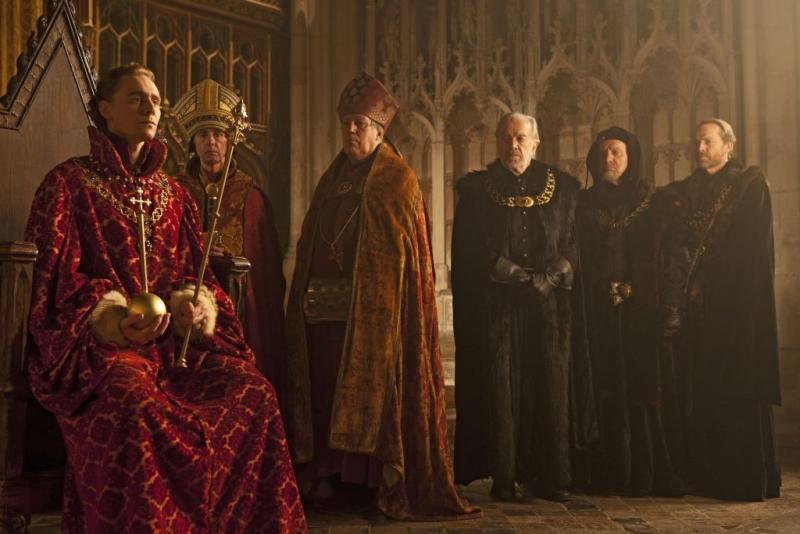
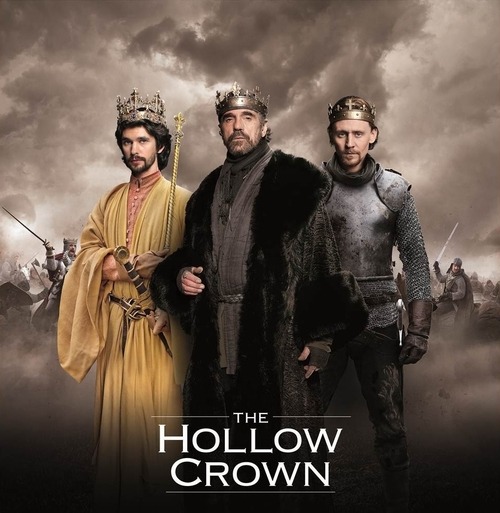
Showing posts with label Tom Hiddleston. Show all posts

Sunday, 22 July 2012

TV REVIEW: The Hollow Crown - Henry V

The final episode of The Hollow Crown charts the reign of Henry V and in particular, his rise to become a warrior king, accepting the challenge to invade France with the scene set for a crucial battle on a field in Agincourt.


King Henry (Tom Hiddleston), now sporting a rather impressive goatee and a kingly codpiece (I wasn't actively looking, it was just very obvious), is reigning over a more peaceful England. That is until the French ambassador shows up with the challenge from the Dauphin to test his mettle against the French forces. Never one to back down from a fight, Henry accepts the gauntlet, deftly avoiding an assassination attempt and assembling an invading force from across England with the encouragement of Exeter (Anton Lesser) and York (Paterson Joseph). The scene is set for one of the most famous confrontations ever and as the two armies close in on the fields of Agincourt, Henry must prove that he is worthy to wear the English crown.


The character arc for Henry, going from Prince Hal to the King of England over the course of three plays, has been one of the highlights of The Hollow Crown with assured performances from Tom Hiddleston charting each stage of the character's progression. His first appearance in the episode, riding across the fields before hurrying into the throne room, demonstrate that he's still the same man who enjoyed partaking in a pint or two at the tavern but has now accepted his responsibilities as King. Keen to prove himself, the challenge from the French ambassador allows him to do so and his acceptance was a great point of entry into the most war-ridden plays of the Henriad. Whilst it's not quite a 'This is Sparta' moment, Henry's message to the Dauphin's ambassador is very clear; he's on his way and he's bringing a lot of friends with him. 


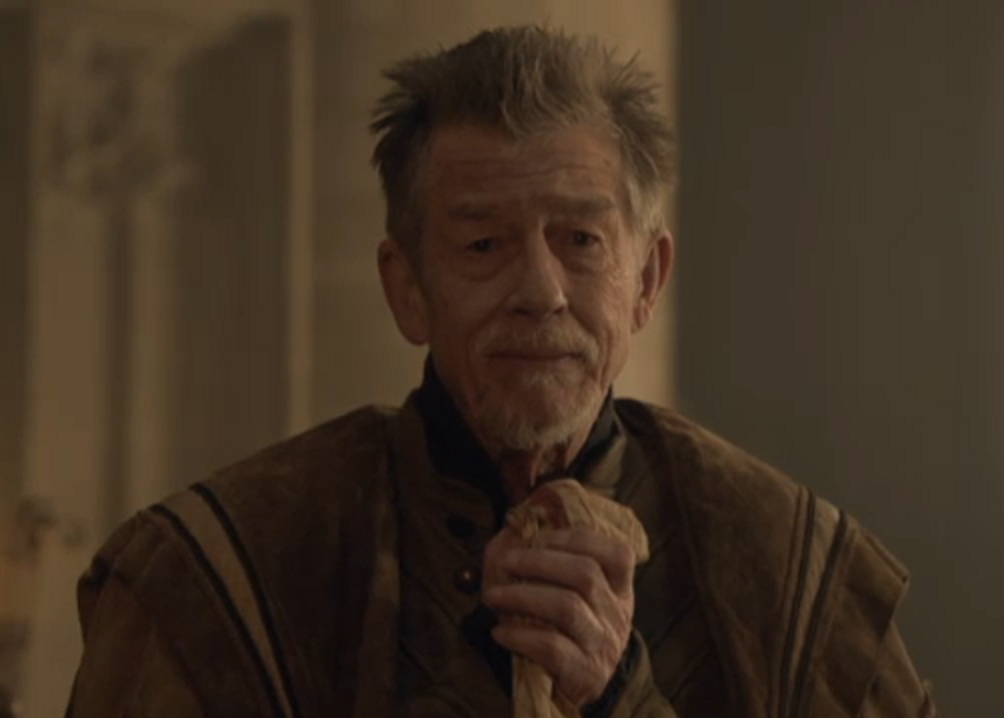
Famously, Shakespeare knew of the problems of presenting a play set mostly at war in France whilst having very little scenery to convey this setting so he created the role of the Chorus, a character whose sole purpose was to aid the audience in their imagination. Naturally a television programme has considerably more resources than an Elizabethan theatre but the decision to include the Chorus as a narrator in the guise of John Hurt's raspy tones proves inspired. The narration adds to the cinematic feel the series has worked hard to create and adds an increasing sense of familiarity to the proceedings. After all, Henry is a character we have followed since his youth and becomes someone you feel you know and could fight alongside, evident within the narrative itself; Henry spends half of his time conversing with the men around him, regardless of whether he is low or high-born.


This continues when we get to the actual war scenes, some of the most well-known in literature, the drama and pace is continued but with the emphasis placed on Henry as a king of the people (as practised with Falstaff in Mistress Quickly's tavern). The 'Once more unto the breach' scene is a particular highlight and rather than the usual posturing adopted for a rallying speech that has been seen in the likes of 300 and Troy, director Thea Sharrock adopts a more intimate approach. Henry is on the ground with his men rather than sat astride his horse, speaking to each one of them in turn and the speech becomes more than just a soundbite to later be termed 'epic'. The St. Crispin's Day speech, a bastion of English Literature, is similarly understated yet just as powerful, rousing and inspiring without descending into over-dramatic shouting. Hiddleston delivers both as measured, well-thought out addresses and with a gravitas that suits the King of England on a battefield. This king is very much one of the people, a link back to his earlier days as an honourary resident of East Cheap and the loyalty he inspires is easily seen in these moments.


The Battle of Agincourt itself is a thrilling piece of television, well-befitting of one of the most famous battles in English history. From the overwhelming odds stacked against the invading forces to the bloodiness of the battle itself, the audience is allowed to get up close and personal to the fighting, making it the best battle sequence in the whole of The Hollow Crown. Shakespeare did not shy away from presenting the negative aspects of the battle either, namely Henry's decision to execute the French prisoners they had taken and neither does Sharrock, showing the scene in all its cold brutality. It adds to Henry's character, given him a multi-dimensional quality; he's not just a hero to be glorified but also a man who makes rash decisions and mistakes as a result. 

Additionally, we also see that Henry's romantic side as he must secure the hand of the French princess. Yes, this episode isn't all manly blood and guts, we even get some romance in the mix with a lovely scene between the King and his future bride, Princess Katherine. One of the best scenes in the play, the couple have to navigate the language barrier between them, offering Hiddleston a chance to show his romantic lead potential with the kind of bumbling attempt at wooing that Hugh Grant would be proud of. This scene, also thanks to an adorable turn from Melanie Thierry as Katherine, provides a peaceful and (mostly) happy ending to a character that we've seen develop over the course of the series. The decision to include Henry's funeral as the final scene provides a bittersweet note to the finale. It returns the series full circle to its themes of inheritance and the weighty responsibility of kingship, leaving the throne to Henry's infant son and I'm not ashamed to admit, I shed a tear or two during the Chorus' final speech.


The Hollow Crown has been a triumph from start to finish and Saturday nights are going to be poorer now that it has all finished. Well-edited and beautifully presented, this is Shakespeare as it should be experienced in all its muddy, bloody and drunken glory. From the tumultuous reign of Richard II, through the family dramas of Henry IV and the final, climactic battles of Henry V, each episode has brought its own themes and classic moments to the fore with fantastic performances from every single cast member. I cannot praise it enough and, if you haven't caught it or missed an episode, I urge to go and watch it all because it could be a while before we see Shakespeare done in such a fantastic and enjoyable way for some time.


- Becky


You can read Becky's review of The Hollow Crown - Henry IV Part Two here


You can find more of Becky's writings here http://beckygracelea.blogspot.com or follow her on Twitter @beckygracelea

Wednesday, 18 July 2012

TV REVIEW: The Hollow Crown - Henry IV Part Two

The third episode of The Hollow Crown and the second part of Henry IV follows the aftermath of the Battle of Shrewsbury, the decaying relationship between Prince Hal and Falstaff and the King dealing with the rebellions which continue to flourish in an uneasy England.


Lord Northumberland learns of Harry Hotspur's death and flees to Scotland for safety. The Archbishop of York plots another rebellion against Henry IV who is weakening after the toll of the battle. Hal is still torn between his old life and his new role as the heir apparent and has to come to terms with the fact that he soon might be King. Meanwhile, Falstaff is being chased by the Lord Justice, determined to keep him away from corrupting the young prince once again, but Falstaff is confident in Hal's love for him, believing that once Hal is King, he will bestow Royal offices upon his portly friend.


While still possessing the bawdy comedy and the slapstick of the first part of Henry IV, Part Two is a much more serious piece of work, dealing with the complications of growing up and accepting your responsibilities. The journey here is Prince Hal's, begun in Part One, but reaching its destination in Part Two as he cements his position as the honourable heir apparent and shedding the rebellious youth who we saw in the previous play. Tom Hiddleston, reliable as ever, manages to avoid falling into the trap of playing the two as very different halves of the same person, but instead gives us a nuanced performance that captures the development of Hal. The cheeky prankster is still there but is measured by his realisation that shedding Falstaff and the other residents of East Cheep is the way to go. The coronation scene in which Hal finally banishes Falstaff from his life and the country was emotional, both in terms of seeing finally become King Henry V but also the act of banishment itself. Simon Russell Beale has portrayed one of Shakespeare's most famous characters with a great balance of both the comic and tragic elements that Falstaff possesses.


As always with Shakespeare, a lot of the very important character developments are shown through the use of soliloquy and the two most powerful scenes in this episode were those given over to Henry and Hal as they contemplate the effects of kingship, for as Henry mournfully observes, 'uneasy lies the head that wears the crown'. Both Jeremy Irons and Hiddleston capture your attention in their separate moments and the setting of both scenes in the throne room really develop the sense of the inevitablity of kingship. Hal is very aware that his father's death is necessary for him to become King and the internal conflict of this was well-pitched and enhanced the emotional weight of the scene. The focus isn't all on the kingly pair though with Hal's younger brother John also getting a look in on the action. His takedown of the rebellion alongside Westmoreland was a properly triumphant moment and whilst not entirely honourable, it was a well-handled bait-and-switch for both the audience and the doomed rebels.


The episode's shortcomings are few but can probably be traced back to the play itself. Nowhere near as famous as the plays that come before or after, it is also not as strong structurally or dramatically. The few standout scenes I've mentioned are just that, exceptional pieces of theatre that provide great moments for actors and audiences alike. However, those in between lack some of the punch of the other moments. Whilst the farcical chase between the Lord Justice and Falstaff culminating in all out street brawl would probably work very well on stage, on screen it felt out of place with the more sombre tone that Part Two took. I'm well aware of the necessity to further separate the characters of Hal and Falstaff, but the jumps in tone sometimes felt a little jarring. That being said, I would watch Julie Walters in anything and her take on the beleaguered Mistress Quickly was one of the highlights of both plays.


The Hollow Crown is one impressive piece of television and I'm already eagerly awaiting the next instalment. Whilst Part Two didn't quite match up to the dizzying heights set by the truly brilliant Henry IV Part One, it held its own for the most part and gave Irons, Hiddleston and Beale plenty of moments to shine. Next week, we get to see Hal as Henry V in all his St. Crispin's Day glory and I'm already feeling just that little bit more patriotic.


- Becky


You can read both Becky's and Jen's reviews for Henry IV Part One here and here.
Or follow Becky on Twitter @beckygracelea

Monday, 9 July 2012

TV REVIEW: The Hollow Crown - Henry IV Part One: A Thoroughly Modern Monmouth


Having been a fan of Henry IV Part 1 for many years now, I feel obliged to present my own addition to Becky’s already ample review.

You’ve already read Becky’s review (and if you haven’t, go do so here) and so assuming you’ve got the Henry basics down by now, I’m just going to jump straight in.

Crucial to this tale of a wayward prince’s return to honour in defence of his father, is the Bard’s slick use of contrast. Much like a modern day domestic soap opera, no sooner have we settled into one group dynamic, be it that of the court, the rebels or the tavern, than some imaginary narrator figure clicks their fingers and we’re propelled headlong into a whole new atmosphere, usually one the total antithesis of the place we’ve just left.

The play just wouldn’t work without it, and Richard Eyre’s version captures it beautifully. I’m not usually one to praise scene shortening in adaptations, primarily because it means I then feel the need to explain the missing bits to everyone else in the near vicinity, but here, the editing marries the different plotlines together in a way which does not take away from the original pattern, but adds to it. Moving slyly from scene to scene, Eyre’s adaptation catapults Hal’s coming of age (and sobriety) story into something more epic, clever, heartfelt and ultimately more modern than I’ve seen this play before.

The magic of cinema, as it were, and as Becky has already mentioned,  allows it a bigger scale than previously, the real terror and grit of war coming across in the frost bitten, blood soaked battle scenes. The wardrobe and set decisions fit the brief, too. In fact I’d like to take my hat off immediately to whoever had the idea of putting Hal in a vaguely Elizabethan leather jacket, and you can almost smell the beer from the tavern scenes and feel the laughter reverberating from the walls.

It all feels generously updated, cinematic and well thought out.

Ultimately though, it’s the performances in this production that make it feel as thoroughly modern as it has long deserved to be.  Eyre’s shift in focus from the history of the play to the relationships within it puts to bed my one traditional criticism of this play- the slightly two dimensional nature of its main characters.  All too frequently they are concepts and symbols for directors to play with before they are people, and we can only guess at their inner world.  Not so here. Eyre’s cut and paste approach to the longer speeches comes into its own, and we’re given much needed proof that there’s more in the heads of Hal and Falstaff than big ideas, ego and booze.

Speaking of Hal, kicking the notable performances list off in style is Tom Hiddleston’s Prince. I’ve long thought Harry Monmouth the original lovable rogue, and Hiddlseton shows him off for exactly what he is. He’s sexy, suave and self-centred but with enough of a prankster’s cheeky streak to make you fall head over heels for Shakespeare’s most dapper royal regardless. Here he’s a joy to watch, with Hiddleston’s inclusive and charismatic performance making you not only want to be a part of his gang, but really feel that you’re in on the joke, whichever one it is at the time, every step of the way.
Eyre also goes to town on the gleeful closeness and camaraderie of Hal and best pal Poins (one of our beloved Unsung Heroes), who, through a combination of careful direction and well-timed close-ups, is finally brought to the foreground not as a plot device, but as an accomplice in his own right. (Hooray!)  


 The pivotal relationship between Hal and Falstaff is just as spot on, with the score brought in at key moments to highlight their tragic co-dependence. It’s not hugely subtle, but it does the job, and again, they all feel like real people you could meet down your local of a Friday night, rather than stuffed up Received Pronunciation cut outs. 
 
 Hostpur, I had a few initial problems with. Apologies, Becky. Brilliant though Joe Armstrong’s performance is, I just didn’t feel the parallels between himself and fellow Harry, Prince Hal, were as obvious as they should be for the play’s intricate design to be seen at its best.

But then I decided that I’d missed the point. It does happen, from time to time. I decided that Eyre’s Hotspur wasn’t an obvious parallel, not in error, but precisely because he wasn’t supposed to be. You wouldn’t get two similar looking kids, both born of power, born on the exact same today and mirroring each other’s stance and booming voices in a modern drama or in reality for that matter, and so you don’t here. Hotspur suitably rants and raves enough to do his name proud, but again he’s a character in his own right, with his own motivations and merriments- not just there as a mirror image of his adversary.   

Oh and Julie Walters? A born Mistress Quickly, a fantastic casting coup and a great excuse to have her sat in a pub with an equally grubby looking Maxine Peake.

The effect of all of the above is that this production feels more like an action film, the story of which could have been thought up last week, not an adaptation of a play from four hundred years ago, based on an even older story. Its blend of domestic drama, friendship and battle drama is alive and well here, and as a result we can empathise with its characters and see ourselves and our friends in them more than we ever have.

It’s gritty, edgy and even tragic, but most of all it’s just gloriously good fun.

And you can’t say fairer than that for a play set in a tavern. 

- Jen


You can read more of Jen's writing here: www.memyselfandtheothers.wordpress.com 
And can follow her on twitter here: www.twitter.com/jenniferklarge

Sunday, 8 July 2012

TV REVIEW: The Hollow Crown - Henry IV Part One

The Hollow Crown continues this week with Henry IV Part One, the second in the tetralogy of history plays and a personal favourite of both of us here at Assorted Buffery. With Richard II establishing Henry Bolingbroke as King, Shakespeare moves into showing the events of his troubled reign.


Henry IV Part One follows the rise of Prince Hal (Tom Hiddleston) from drunken reprobate to warrior heir apparent after his father, King Henry (Jeremy Irons) faces an uprising from the Welsh rebel, Owen Glendower (Robert Pugh) and Harry Hotspur (Joe Armstrong). Beginning in East Cheap with Poins, Shakespearian Unsung Hero Number 10 (David Dawson), Mistress Quickly (Julie Walters) and the excessive drinker and cowardly storyteller, John Falstaff (Simon Russell Beale), Hal must grow up from playing pranks to leading his father's army and, as this is Shakespeare, we get tragedy, fearsome confrontations and more than your usual amount of debauchery.


As with Richard II, the action flits between several places as the play follows the King, his son and the rebellious Hotspur throughout, but unlike the previous episode, the cuts in between felt a lot more measured and well-judged. The tavern scenes in particular were a highlight, providing much of the comedy as Hal and Poins humiliate Falstaff repeatedly for no particular reason other than that they can. The battle scenes towards the end of the play did betray the episode's budget somewhat as, rather than being treated to extensive armies a la Lord of the Rings, we got close-ups of twenty men crammed into a shot to make it look like there's a lot. Thankfully, it didn't detract too much from the drama itself as once the fighting started, the frenetic battling was enough to hold your attention. My only complaint was that they didn't include the hilarious scenes in which Hotspur's ally, the Douglas, marches round the battlefield attempting to kill the King, only to repeatedly discover he's just killed another man dressed like the King. However, when you've got Falstaff bumbling through the battle trying not to die, the laughs were still there to be had.


It's safe to say that there is not one bad performance in this entire episode. The minor characters, particularly those in the tavern, provide a great background for the central figures to shine, supporting them well. Even Maxine Peake managed to steal a scene without saying more than one or two lines. Simon Russell Beale's Falstaff was every inch the drunken, bombastic figure that we all know and love, combining the comic and tragic inherent in the character well, especially in the scene in which he is 'playing' Hal. His plea to not leave Falstaff behind was heartbreaking, a man desperate to cling on to what little vicarious glory he has left. As the wilful and aptly-named Hotspur, Joe Armstrong was a forceful presence and never resorted to simply playing the villain. Hotspur in the play provides an opposite character arc to Hal, beginning as noble and honourable before falling too far from grace to be truly redeemed and Armstrong captured his inner conflict perfectly. Michelle Dockery, as his wife Kate, provided a great foil to her husband with excellent chemistry between the pair showing a fiery marriage based on a mutual respect, adding to the tragedy of the play's outcome. 


But Part One belonged very much to Jeremy Irons and Tom Hiddleston as the central father and son who begin in conflict but end united. Hiddleston's star is firmly in the ascendancy after fantastic performances in big blockbusters like Avengers Assemble, but here he proves he can play the conflicted hero too. In the afore-mentioned play scene in the tavern, the moment in which he realises that he must re-take his place at the heir apparent was excellently pitched with just the loss of a smile to convey a key character development. Also, his impression of Jeremy Irons was brilliant, spot-on in everything from intonation to posture, providing extra comedy to an already funny scene. Irons' acting talent has long been something to be reckoned with and their confrontation scene was a masterclass to watch. As a king struggling to hold on to a legacy that was never his to begin with, Irons lets the conflicted emotions come to the forefront, the guilt at his own situation and the rage towards his son filling every single line. 


My expectations were particularly high as it is the play I've been most looking forward to seeing adapted, but Henry IV Part One more than surpassed them, offering all of the themes that make the play so compelling. Next week, we're into the sequel, Henry IV Part Two, as we see a father and son united and Hal moves further away from Falstaff to his destiny as the future King of England.


- Becky


You can read Becky's review of The Hollow Crown - Richard II here.

Thursday, 3 May 2012

FILM REVIEW: Avengers Assemble

When the Asgardian god of mischief, Loki, returns to Earth with his very own brand of villainy, SHIELD works to unite several superheroes into one team, the Avengers, in order to put a stop to him bringing the world to its knees.


The Avengers (I'll call it this throughout the review as it sounds less like a vendetta against furniture instructions) has been a long time coming, building across five films to form a Marvel Universe the likes of which many comic book fans had only ever dreamed of seeing on screen. Though I'm relatively new to the full extent of the Marvel mythology, I've always grown up with the cartoons, the stories and the iconic characters. The Avengers was a bit of a fantasy; something that was a good idea and would be amazing to see on the big screen but that would probably never happen. It would just be too big. Then Iron Man happened. Ever since Nick Fury (Samuel L. Jackson) showed up in the Iron Man post-credits sting talking about the Avengers Initiative, Marvel have been building towards this moment, a film that saw several superheroes, stars in their own right, come together to form Earth's Mightiest Heroes. After an expert marketing campaign that meant the (already considerable) hype had been ramped up to the maximum, The Avengers finally hit the big screen last week. And it's fantastic.


The plot centres around your friendly neighbourhood macguffin, the Tesseract, a Cosmic Cube of pure, self-generating energy that holds the key to a lot of things for a lot of people, last seen in Captain America: The First Avenger. SHIELD (i.e. Nick Fury and Clark Gregg's Agent Phil Coulson) are currently in possession of the Cube but with Loki (Tom Hiddleston) on the move, this isn't the case for very long. Soon, Bruce Banner/The Hulk (Mark Ruffalo), Tony Stark/Iron Man (Robert Downey Jr.), Natasha Romanoff/Black Widow (Scarlett Johansson), Clint Barton/Hawkeye (Jeremy Renner), Steve Rogers/Captain America (Chris Evans) and Thor (Chris Hemsworth) are brought together to try and stop Loki from destroying Earth as we know it.


First things first, director and co-writer, Joss Whedon really did have a hell of a job on his hands. Being able to juggle seven main characters, four of whom with super-powers and all with their own baggage, a villain with more angst than the average episode of Dawson's Creek and a decent plot with good action sequences then making sure that all of this makes a good film is no easy task. Thankfully, the screenplay Whedon and fellow writer Zak Penn have put together manages all of these things and more. Despite having to contend with a huge cast of major characters, every single one gets a moment in the spotlight and the cast seize each chance with both hands. Although many people are claiming that the Hulk steals the show (he is brilliant), for me, it's Tom Hiddleston's Loki who really shines in this film. As with his appearance in Thor, Hiddleston manages to create a villain that is thoroughly evil, compelling and yet still a little sympathetic. His desire to rule essentially comes from a place of low self-esteem thanks to some serious daddy issues and Thor's explanation for this is one of my highlights of the film. 


That's not to say the other actors do badly, in fact, I'd go so far as to say there wasn't really a dud performance in the film. Thanks to some classic Whedonesque one liners, the interplay between the superheroes offers each one a chance in the spotlight. Whether you want to see Thor going ten rounds with Captain America, Tony Stark verbally sparring with Bruce Banner or the Black Widow taking on the Hulk, every scene between the heroes is great to watch. Naturally with a film of this magnitude, a couple of characters are going to get a little less attention and in this case, it was Cobie Smulders' Agent Maria Hill and Renner's Hawkeye. The script does give both of them a chance to shine in their respective roles but I didn't feel like they got the same amount of development devoted to the other characters. That being said, it never felt that they were included simply to be filler, both playing an integral part in the story as the eyes and ears of the operation. Whedon is used to handling big casts of big characters with his experience on ensemble shows like Buffy the Vampire Slayer and Firefly and the same skill is transferred here.


As always with a superhero film of this magnitude, the action scenes were going to have to be big and bold. Thankfully the action scenes are both necessary for the story and extremely well put-together. Not once did I lose track of what was happening or who was fighting who, a welcome feeling in an action film. Every scene was entirely organic to the developing narrative, never once feeling as if it was inserted just to kickstart the plot as the pacing was also well-handled. As with the interplay between all the characters, the fight scenes between the various heroes were every bit as thrilling as they should have been. The Chitauri, the alien race employed by Loki to take over the Earth, didn't exactly live up to the fearsome reputation that had been talked up earlier in the film. As they practically had 'canon fodder' stamped on their grisly foreheads, it makes enough sense that they could be dispatched without great difficulty but they could have a little more threatening. That's a very minor criticism though as these action sequences were really all about seeing the Avengers throw down. Even with the slightly dodgy foe, the final action sequence barely let you stop for breath with all the heroes pulling their weight in one of the most epic battles in recent history. It's a testament to both the writers and the cast that these action scenes actually further both plot and character development rather than merely being mindless violence for a few minutes at a time.


The Avengers always had the potential to be something revolutionary, a film that finally realised the full grandeur that the Marvel Universe had to offer but then it could also have been a complete flop. Thankfully in the hands of Joss Whedon and a truly committed cast, it's the former, a rollercoaster ride of action, comedy and spectacle from start to finish. It took all my strength to not clap and cheer loudly at several moments during the film and, for me, that's a sign of a truly great superhero film.


*****


- Becky