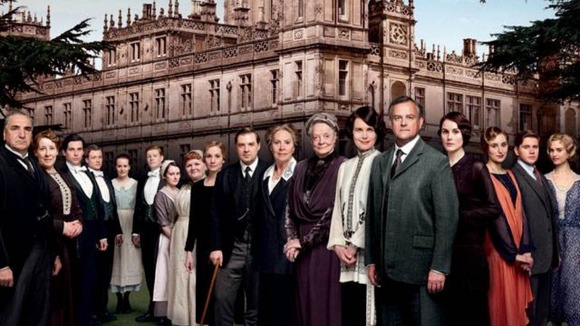
There's all sorts of romantic entanglements going on at Downton this episode. We've got Lady Mary off gallivanting with Tony Gillingham, Charles Blake turns back up to throw a spanner in the works and then there's Cora flirting with Withnail, I mean Mr Bricker (this was the one I was rooting for - Cora needs a plot of her own goddammit! Also RICHARD E. GRANT). Then Bricker starts flirting with Isis the dog. God forbid! Oh and then there's Molesley and the thieving ladies' maid whose name I've not learnt yet, but I'm struggling to retain interest in that particular plot line.
And with love comes war, more specifically, Lord Grantham arguing with just about everyone he can reach with a booming voice and a shake of his head. The tone was set in an early mealtime which was less a luncheon, more a battle ground before dinner that evening became the dining room equivalent of the Western Front. Amongst the more trivial stuff is resisting Rose's attempts to get a wireless for Downton, but that soon gave way to the Lord and Branson going at it about whose politics were better. Everyone bristled beautifully when Branson mentioned the killing of Charles I in response to Lord Grantham's repeated accusations about the atrocities occurring in Russia. It's all delightfully polite but shots were most definitely fired.
I think Fellowes is missing a trick by not adopting the Hero versus Big Bad approach for a series. It may just be my liberal politics, but Branson is the unsung hero of the piece, fighting for justice and an end to the oppressive social class system that he has managed through the convenience of marriage to rise through. Clearly in opposition, the Big Bad could be Lord Grantham. I want to see Hugh Bonneville in full villain mode, tearing down any threat to the establishment and bellowing "BUT WHAT ABOUT THE CRICKET?!" in the faces of bewildered villagers.
Lady Mary's impending sexpedition with Tony Gillingham led to some beautiful comedy moments, both with Anna and Charles Blake who turns up all charming and mentioning sex to get her a bit flustered. But still, Gillingham's got his allotted week to prove he's the man for Mary. Contraception according to Lady Mary is wonderful; read a book and send your maid out for condoms. It's like the equivalent of your mate asking you to pop to the pharmacy for you because her parents are wandering around town, but with enforced societal servitude instead. I also loved the judgemental pharmacist; things haven't changed all that much apparently.
The much-anticipated meeting of Gillingham and Lady Mary was all awkward and not at all romantic. Doing the gentlemanly thing, Gillingham gets separate rooms connected by an adjoining door and allowing Mary to stay under her own name to not attract any suspicion. But this struck me as a little silly really. The manager's in on the arrangement and it's hardly going to take investigative skills to find out Gillingham was staying next door, put two and two together and get 'illicit sexual affair'. Apparently a scrumptious dinner was the going rate for a whole week of 'making love' in those days, so clearly interest rates in that respect haven't changed all that much either.
I could talk about Lady Edith's struggle to gain control over daughter Marigold, but I kept being distracted at those points. I am obviously sympathetic to her plight, but she needs a bit of spark about her. Bring back Gregson I say! Yes, I know he's likely dead at the hands of some proto-Nazis, but still, she was much more interesting when he was around (which goes entirely against my usual rage about women characters who are only defined by the men around them, I know).
- Becky
Catch Becky's review of the previous episode here.
Follow @AssortedBuffery on Twitter
Or like our Facebook page
I've developed a rather love/hate relationship with Downton Abbey of late with its shoehorned historical context, clunky exposition and paper-thin characterisation. I've returned for this series in the hope that it might have been a particularly cranky mood that made me give up on it last time. As the first instalment progressed however, I realise it may not have just been me...
This episode finds the Downton gang reeling from the news that a Labour government is in power. We know this because we get a whole scene in the library in which the family talk about it all in nicely phrased pieces that let us know exactly what this means for this particular class. Lord Grantham thinks it's about the most apocalyptic thing to happen since the working class began demanding things in the first place, Mary uses it to wind him up and Branson's there to lend an air of 'working class hero' to the proceedings.
Below stairs, we have a similar discussion from the servants' perspectives, once again divided between Carson's 'it's the end of all we know' attitude to Jimmy's enthusiasm for a Prime Minister who is representative of a different social class. It quickly fades into the background though once the more salacious plot developments take hold; Thomas is plotting (obviously), Jimmy is fending off the amorous attentions of Lady Astruther (a wickedly game Anna Chancellor) and Lady Mary is wondering how to know who to marry without trying to, ahem, test drive him first (does she not remember the last time she tried this, she ended up in bed with a corpse?).
Oh, and there's a fire. But it's neither as dramatic or as spectacular as you might have hoped.
The historical context has always been used to hang plot points on from the moment Lady Sybil decided to become a not-very-committed suffragette to the arrival of the First World War. It's dropped on us with all the subtlety of a grand piano crashing through the library roof and comes across as a little insulting. But then again, Mr Fellowes is the man who also thought he needed to rewrite Romeo & Juliet because us poor people without expensive educations couldn't possibly understand Shakespeare in its original form.
It may be that I was too enamoured with all the glamourous trappings of the Abbey and its inhabitants, but it felt at several points in this episode as if it was lurching into self-parody. Thomas loomed from shadows like a moustache-twiddling pantomime villain even more so than usual whilst the aforementioned contextual conversations may as well have been offered a companion history textbook in a sort of readalong game. I also get the increasing sense that these characters simply cease to exist when the camera isn't on them. Anna and Mr Baaates have a conversation about Lady Mary which seems to pause once their offscreen and just resume from where they left off in a scene taking place a day later. I don't expect to have a detailed update from each one on what they've been up to since they were last onscreen, but it would help to at least have a sense that they do something other than stand prettily until the plot requires them.
I make a point of never watching things 'ironically'; if I enjoy something, I'm more than happy to admit it. I still enjoy Downton. I love how completely unaware of its failings it is, how the characters might as well just freeze in one place until the camera is back on them and they can carry on their conversation (despite it being days/years since the first half of their talk) and I still love these characters. Despite the newer faces amongst the cast acting as largely ciphers of whichever issue Fellowes has decided to explore this week, the old guard are still as brilliant as ever.
It's the regular cast that consistently keep me interested, rising above even the dullest material (honestly, how many times can Daisy try to do something different only to be told not to by Mrs Patmore. Every. Damn. Series). Michelle Dockery still brings a lovely warmth to the icy cold exterior of Mary and her romantic woes once again form her storyline, but that's all right, because she clearly knows how to handle a farming business. Rob James-Collier may fall into moustache-twirling, but there's a great inner conflict to Thomas that looks set to be explored further than it has been before. Obviously, Maggie Smith is awesome too. I love any scene where she goes up against Penelope Wilton.
And so it all begins again with a wiggle of a dog's bum and the usual upstairs/downstairs shenanigans that we've come to know and, in my case, begrudgingly love. However, one can't help thinking that when Lord Grantham announced at the end of this episode 'the entertainment's over', he might just be right.
- Becky
Follow @AssortedBuffery on Twitter
Or like our Facebook page
Julian Fellowes, he of the popular Sunday night entertainment and now morality play Downton Abbey, has written an adaptation of William Shakespeare's most famous romance, the tragedy of Romeo & Juliet. It turns out, tragedy is entirely the right term, though not necessarily in the context meant by the Warwickshire wordsmith. For Fellowes has crafted what I am confident in saying is the worst adaptation of a Shakespeare that I have ever seen. And that's a list that includes She's The Man.
When tackling a play with such a lengthy, memorable performance and cinematic history as Romeo & Juliet, it is necessary to take a new approach to the material and provide audiences with a chance to look with fresh eyes at this giddy teenage (and very silly) romance. Zeferelli provided a beautiful, timeless adaptation that took a historical approach to the material, casting teen leads and giving us a story for the ages. Laurents, Bernstein and Sondheim gave us an all-singing, all-dancing version in one of the best musicals ever. Luhrmann cranked it up to eleven and brought the play screaming into the modern day, launching stars Leonardo DiCaprio and Claire Danes in the process. All wildly different interpretations of the same play and each with something to say about the material. So what do Fellowes and director Carlo Calei give us? The flattest, dullest and most bog-standard interpretation of Shakespeare's text.
Now I am no Shakespeare purist by any means; he is one of those rare writers that can be transported into a wide variety of locations and situations that bring new meaning to his centuries-old words. Fellowes and Carlei could have taken us anywhere, done anything with the text that they wanted to. So we got 16th century Verona. Right. Not only that, but Fellowes kindly did us the honour of each character repeating all the major plot points first in modern(ish) language and then the actual Shakespearean line. Sometimes, just in case we poor souls were completely lost, he even let us hear the same line in modern English again. Thanks Julian. It's just so hard to pay attention to films these days. It's nice to have it repeated at great length.
This insulting and arrogant attitude to the audience was not confined to Fellowes' additions to existing scenes, but also in his creation of entirely new ones. Sometimes, this can be used to great effect, much like re-setting the play in a different location. Here, it seems to have been simply to give supporting cast member Damian Lewis more scenery to gnaw through. These extra scenes served little to advance the plot beyond making sure the audience knew exactly what was going on at any given moment. There were odd scenes such as the one in which Tybalt (a hilariously growling Ed Westwick) swore Juliet's honour was his only care. It set up an odd dynamic to their relationship that was picked up and dropped again as Tybalt's corpse hit the ground. Poor Natascha McElhone got saddled with the brunt of these scenes in an attempt to flesh out her character of Lady Capulet. It didn't work.
It also ensured that the pacing to the film was completely off. Big moments like Romeo (Douglas Booth) and Juliet's (Hailee Steinfeld) meeting at the dance is sped through and culminates in a scene my friend memorably described as a 'kissing behind the bike sheds' moment. Likewise, Mercutio (Christian Cooke) is barely a footnote in a play in which he's one of the most popular characters. His death scene that is full of fantastic language and damning speeches is reduced to about three lines and a bloody cough. Even the many fencing scenes are boring, badly choreographed and over far too quickly. Instead, we get the lengthy scene in which the Friar tells Juliet of his plan that gives us an alternate reality version of climax of the play for seemingly no other reason than to labour the tragedy of the ending.
Scenes that should carry some emotional heft barely even register; Mercutio and Tybalt's deaths carry so little weight that as the turning point of the play, it feels like a slight bend rather than the complete hairpin that it should do. In fact, Fellowes seems in such a rush to get to the final scenes, because we all know how it happens, that he forgets to make us care about these characters. None of the family dynamics are present, none of the conflict that family loyalty brings is present for the central pair beyond the words they speak. For someone so confident in his audience not understanding the play, Fellowes has managed to completely misread it in just about every way possible. Relying on the tragic ending alone to inspire sympathy for your characters is just lazy.
The butcher's approach to the text bled into the performances of the cast, a random hotch-potch that felt like every single one of them was in a completely different film to the next character along. Westwick tries to bring a weighty gravitas to Tybalt by scowling and stalking through every scene he's let near; the effect is rather comical and I defy anyone not to laugh when he appears for the duel, hair blowing in his face and dust rising from his heavy footsteps. Paul Giamatti's Friar Lawrence manages to bring actual gravitas to his role and seems to be the only person who understands the emotional beats of the scenes he is in. Damian Lewis, on the other hand, veers from comical to patriarchal tyrant so fast, it feels like he's filming various different films at once.
As central duos go, there could have been a less appealing combination than Hailee Steinfeld and Douglas Booth. Though their delivery of the Shakespearean dialogue occasionally reminded me of many an afternoon sat listening to classmates murder blank verse, they imbue their characters with a wide-eyed enthusiasm that carries them through the film as the rest of it falls apart. She is pretty and floaty, he is heroically masculine yet sensitive. Just to hammer that home, Romeo's introduction finds him carving a statue whilst wearing a shirt open to the navel, bearing his sweaty, manly, manly chest for all to see. I think I was supposed to swoon, but instead I rolled my eyes. It was the first of many.
Perhaps the only positive that can be salvaged from the film, and I am really struggling to find much more, is that it looks beautiful; light casts down in angelic beams that highlight the production design. The costumes are beautiful though the colour schemes seemed a little confused when it came to distinguishing Montagues and Capulets. The fact that it looks so pretty softens the blow slightly as you are watching Shakespeare's text ripped to shreds in front of your eyes.
A film so heavy-handed, it feels like being bashed over the head with a copy of The Complete Works, Romeo & Juliet will do absolutely nothing to challenge the existing iconic adaptations of the play. In fact, it may just make you appreciate them that little bit more.
*
- Becky
Follow @AssortedBuffery on Twitter
Or like our Facebook page
First of all a quick recap; if you remember the Christmas Special, one that was lacking in cheer or you know, anything that happened, there were a few clues as to where this series was headed. The big issue, and practically the only thing that happened in the special, was Matthew Crawley's rather horrific and graphic death at the hands of bad driving and an ill-timed fork in the road. Oh the symbolism. Mary had just given birth, Branson had to deal with advances from a wayward housemaid and the family had visited Scotland and Miss O'Brien manoeuvred her way into a new job. I can't really remember if anything else happened, but if it did, it's probably not important. That or one of the characters will tell us explicitly what we need to know.
Was Downton always so obvious? So neon-lit "here's an upcoming plot point/historical reference/danger on the horizon" flashing neon sign obvious? I mean, I know it's always been less than subtle and that's part of its charm, but this episode just seemed determined to whack you across the head with one of Mrs Patmore's copper ladles every time something significant cropped up. Some of my favourite examples included "he's in the workhouse and yes, it's every bit as something you'd read in a Charles Dickens novel". Thanks Mrs Hughes. There was also Edith's speech about how everyone hated the Germans, Mrs Patmore's statement about her being the old and Daisy being the new and just about anything that the Dowager Countess said.
This may have just been me noticing how obvious everything was in this episode, but it did just seem a tad more telegraphed than usual. Like I said, it's always been par for the course in Downton and Julian Fellowes throws more than enough at us in this series opener to keep us occupied. Grieving was the major theme in this episode with Mary moping around and doing even less emoting than usual, Isabel Crawley was doing something similar and Branson was doing his level best with Carson and Mrs Hughes to get everyone back and functioning again. Branson (I should really start calling him Tom soon) and Mary look like they're set to be quite the team and I'm intrigued to see where that goes.
Below stairs, we had Thomas doing his usual scheming. With Miss O'Brien gone, I was worried that Thomas wasn't going to have to scheme all too much, but it's good to know he's back with a sneer and some casual manipulation. Only this time, it turned out he was actually right about the villainous Nanny West who happened to casually abuse baby Sybby when she thought no one was looking. Elizabeth McGovern's Cora was particularly fierce in this moment and I liked seeing her do something other than placate the rest of the family, which she seemed to do a lot last time around.
The dynamic between Daisy and Mrs Patmore continues to be one of the highlights with this episode seeing them get to grips with an electric whisk. Also, Mrs Hughes and Carson continue to dance around the romantic question, but let's face it, if this series doesn't end with at least one of them acknowledging the other, Fellowes may have a mutiny on his hands. The rest of the romance in the episode was confined to the Ivy-Alfred-Daisy-Jimmy love quadrangle continues but I must admit, I switched off whenever they came on screen. I don't know enough about the new people to care just yet, but I did like the Mrs Patmore reveal.
We also seem to be getting a more feminist angle going in Downton this time around and not anachronistically considering we are now in the 20s. Though we're yet to hear a big hint of rebellion, Edith is well on her way with the prospect of 'living in sin' with her publisher chap. Oh just go for it Edith, you deserve it. Even if it does mean moving to Germany. Elsewhere, there's another hoo-ha about Mary's inability to inherit because of her gender, not to mention the return of the manipulative Edna Braithwaite to Downton. I love MyAnna Buring, she's a great actress, but Edna was a terrible character in the Christmas special and I'm not holding out much hope for the future.
Largely the usual Downton intrigue, if just a little more obvious about its context than it ever seemed before. I didn't really miss Matthew, something which I'd never thought I'd say, but at least we still have Branson.
- Becky
Follow @AssortedBuffery on Twitter
Or like our Facebook page