Utopian fiction sprung up a lot towards the end of the nineteenth century and into the twentieth, a way of counteracting the constant driving development of industry and technology by finding something pure. Utopias varied from novel to novel, but a predominant trait was that this society had somehow got something right in their social system by engineering it somehow. For Charlotte Perkins Gilman, this was to imagine a society without men, a matriarchal structure that had evolved to reproduce asexually. H.G. Wells imagined a eugenically produced society founded on socialist principles and William Morris created something similar with a focus on health to lengthen life spans.
One of the key things that all of these novels and more had in common was the character of the outsider, someone travelling from their contemporary society into one of these utopias and reporting on what they found and the differences they discovered. It allowed not only for an exploration of the these differences and the possible benefits they could provide, but also for an examination of what contemporary societies were lacking. It also led to the more satirical side of the genre to arise, one that pointed out all the various flaws in creating such utopias and the outsider characters came to be recognised as the sensible ones in the situation (think Aldous Huxley's Brave New World).
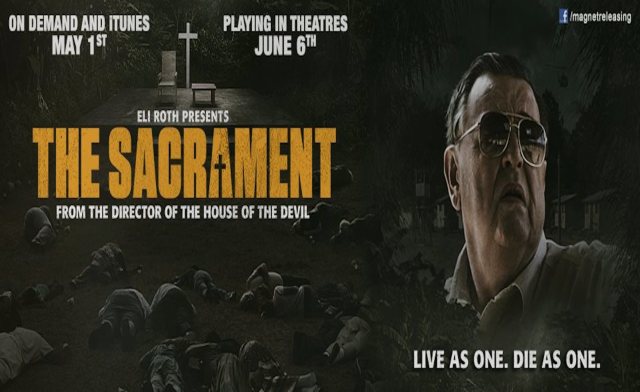
Although the film is largely cribbed from the true events of the Jonestown Massacre, there's a lot of this utopian exploration going on in The Sacrament. Journalists Sam and Jake tag along with Patrick who goes to visit the commune Eden Parish at the request of his sister, Caroline, who has been living there. It's a Christian settlement shrouded in secrecy; they have to fly to a certain location before being picked up and transported by helicopter. When they are there, they find a largely peaceful commune, ruled over by the charismatic Father, who everyone seems to obey happily.
The film adopts a found footage documentary approach which works well within this utopian context; like the diaries or narrations of the original utopian genre, the documentary serves to contrast the filmmakers' ideals, which also stand for the audience's, with those of Father and his 'children'. In the hands of the filmmakers, the camera becomes a questioning eye, evaluating each aspect of the commune for both the documentary and the audience. Initially, everything seems a little too good to be true. Everyone's happy and satisfied with their peaceful existence and there's an understanding on behalf of the filmmakers; they accept why people would want to live like this, but don't feel they could do it themselves.
However, even though things look calm on the surface, Ti West's screenplay drops in little hints that everything is not all right in paradise. There's men with guns guarding the gate, some people aren't so happy to see a camera crew wandering around and there's a general sense of unease. When Father finally appears amidst a round of applause and general rock star treatment, the film crew are granted an interview, which he quickly spins against them. He's a charismatic figure and it's easy to understand why people would flock to him, specifically the vulnerable people that the crew meet throughout the day. Gene Jones plays Father with a quiet menace and it's here that the presence of outsiders begins to affect those around them.
The crucial point in any utopian novel is when the outsiders have too much of an effect on the world they've wandered into. In Herland, for example, this break occurs when one of the male travellers attempts to force himself upon his female companion, a huge violation of Herland's rules. In The Sacrament, it's the opportunity to leave that the outsiders represent. Several residents assume that the filmmakers will be able to take people with them and this quickly causes a riot as they beg to be taken. However, like all utopias, steps are quickly taken to ensure that the status quo is maintained. In this case, it's to keep everyone together in death if they can't in life. Father's paranoia about the outside world leads to a plan that will find everyone committing mass suicide.
It's significant then that the camera is no longer in the hands of the filmmakers when the massacre itself begins. They are removed from the action and the film no longer carries the same judgemental quality that characterised it before, simply because their gaze isn't focused on these events. Instead, it is in the hands of Caroline who agrees entirely with what Father is doing to the point of killing her own brother. When the massacre begins, the film becomes considerably calmer, a sharp contrast to the hysteria that characterised it before Jake left for the helicopter. It makes the massacre itself incredibly chilling and a balance is struck as a result.
Seeing these people die for their faith doesn't feel exploitative because we're left to form our own opinions on what we're seeing. When babies are fed syringes as their mothers willingly look on, when children drink the 'potion' down in one gulp because they're asked to or when a family begs their son to join them, the camera presents it coldly, in a matter of fact way. This in turn makes the events feel that much worse because the audience are. It's here that The Sacrament naturally must diverge from the utopian genre as the society is well and truly destroyed by Father's actions.
It's at this point that the camera is returned to the filmmakers, a necessity in order to align the audience back with the emotional core of the film and to observe the horrific aftermath of the massacre. The outsiders manage to escape, but not without leaving pretty much everyone in the camp dead in contrast to traditional utopias which would see the society continue as the outsiders leave. Here, the film closes with the tragic results of the massacre, a haunting reminder of the dangers of exploitation and fanaticism.
- Becky
Follow @AssortedBuffery on Twitter
Or like our Facebook page

