Showing posts with label Happy Birthday Shakespeare. Show all posts

Friday, 26 April 2013

FEATURE: Top Five Worst Holiday Destinations According to Shakespeare

It's that time of year again as theatre-types and general lovers of literature celebrate the birth of the Bard, William Shakespeare, this year reaching the ripe old age of 449. Last year Assorted Buffery took part in the Happy Birthday Shakespeare blogging project and we are delighted to be doing it again this year for www.happybirthdayshakespeare.com. The project aims to share what Shakespeare means to various people across the world and as you've probably noticed, we're rather large fans of the man from Stratford. Last year, we decided to celebrate the Unsung Heroes of the Shakespearian canon and we're approaching the proceedings from another odd angle this time around.

Famously, Shakespeare used a wide variety of locations in his plays to offer his audiences a little bit of escapism. From the African continent to muddy East Cheep, there are a lot of places that can call themselves Shakespearian locations. Now the 23rd April was an absolutely gorgeous day in Stratford-Upon-Avon (I happen to be lucky enough to work there) and we are fast approaching the time of year in which people decide to go gallivanting off to exotic locations to enjoy a nice, relaxing holiday. So if you decided to take a nice Shakespearian themed vacation, there are a whole host of places you should avoid because 'relaxing' would not exactly be the term used to describe them. Because we care for our readers' well-being, and because the thought of writing a Bard-themed holiday guide was just too much fun, we now present to you a tour of the Top Five Worst Holiday Destinations According to Shakespeare. 

Disclaimer - we're positive that in reality, these places are really quite lovely - we've actually been to some of them - we're just looking at the Shakespearian versions.


England - 'This royal throne of kings, this sceptred isle' (Richard II - A2.S1)

As seen in: The History Plays, King Lear

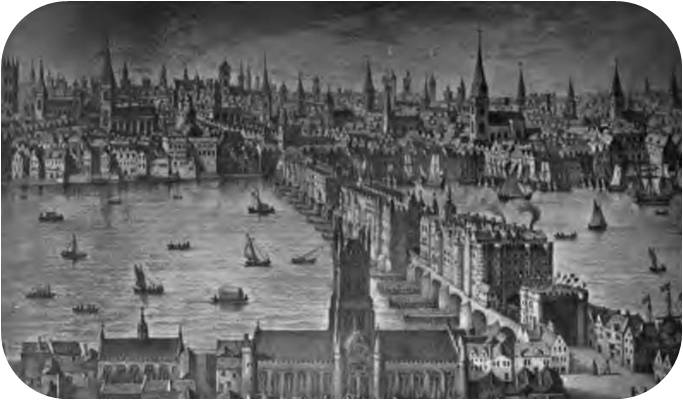
It's fair to say that according to Shakespeare, this green and 'sceptred isle' is not the best place to go a'roving at pretty much any period in history from your early mediaeval kings right up until the Tudors. If the country isn't in the middle of a civil war, it's in the grip of a tyrannical King going bonkers because one of his daughters answered a tough question perfectly logically. It's torn apart in Richard II, sort-of rebuilt again briefly in the Henry IVs before the Percys and Glendower decide to muck it all up. Henry V makes a decent stab of putting it back together again by buggering off to France and much later on Richard III seizes power and kills a bunch of people. If you're in the Royal Court and on the wrong side, it won't be too long before you find yourself locked up or missing your head. If you're in the peasantry and capable of wielding a pike, it's a good chance you'll find yourself up to your knees in mud whilst people poetically die around you. Put simply, it's probably best not to stick around. 

So the solution is to head up north to Scotland then is it? 


Scotland - 'Now o'er the one half world/Nature seems dead, and wicked dreams abuse' (Macbeth A2.S1)

As seen in: Macbeth

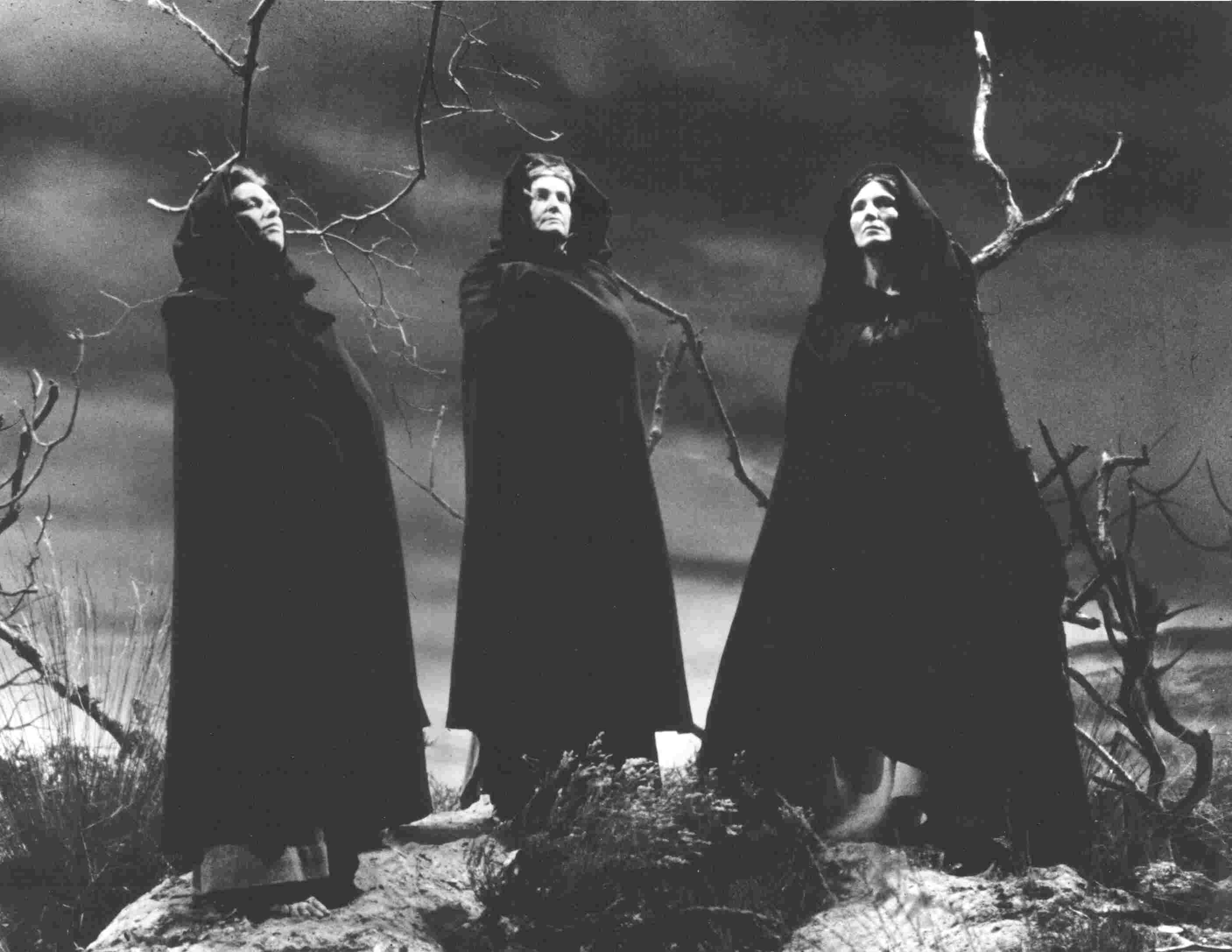
Probably not actually. The above quote may not refer directly to the Scotland of Macbeth, more the general landscape itself, but there's no denying that it pretty much sums up the location of the play that must not be named. Whilst it may seem like an ideal idyll away from the tumult of England, it's not something that lasts. Witches lurk around dark and foreboding corners waiting to pounce on the nearest ambitious general and promise him the throne and it goes on to be ruled by a man with a delicate grip on the throne whose wife may be a little more than completely and utterly mental. Then of course, there's all of the ghosts wandering around the place, prophecies coming true left, right and centre and the small matter that trees develop a habit of moving about. Granted, this does tend to be if you're holed up in the Royal residence, but given that a lot of violence also takes place on the road (poor Banquo), it's probably not best to stay put.

Therefore, the solution must be in foreign climes.


Athens - 'May all to Athens back again repair / And think no more of this night's accidents' (A Midsummer Night's Dream A4.S1)

As seen in: A Midsummer Night's Dream, Timon of Athens

One of Shakespeare's many inventions, amongst his many contributions to the English language, was the discovery of woods outside Athens which, as far as I'm aware, don't actually exist (Athenians, feel free to correct me if I'm wrong). Athens itself is pretty bad; if you want to marry someone who your father doesn't like, you might end up as a nun, or worse, dead. If you love someone who doesn't love you back, you'll end up outside of the city and later on wrestling against your former best friend who everyone seems to have inexplicably fallen in love with. Timon hated Athens that much, he actually preferred to live on his own in the wild. Then of course once you make it into the woods, you may find yourself at the behest of the fairy-folk who aren't exactly kind to city dwellers. They have a tendency to give you the head of a donkey and make you sleep with a fairy queen. Of course you may like that sort of thing...

Let's move swiftly on eh?


Bohemia - 'Our ship hath touch'd upon/The deserts of Bohemia?' (The Winter's Tale A3.S3)

As seen in: The Winter's Tale

For the majority of the play, Bohemia is largely a nice friendly place, full of shepherds, bawdy lasses and the odd comedy peddler. Indeed, if one of the most recent productions is anything to go by, it's a world where endless morris dances take place and people in disguise get up to all sorts of hijinks. So in that case, you may be wondering what it is doing on this list. You see, the key to unlocking Bohemia's rich treasure of sheep and jingling anklets is to actually survive that long to see it because the country is going to throw all sorts of things in your way to try and stop you getting there. Much like Shakespeare's fictional Athenian woods, Bohemia in this play is actually on the sea, so finding the real landlocked region whilst on a boat is your first task. Then there is a massive storm that kills your entire crew and smashes up on the rocks on a shore that doesn't technically exist. If you've managed to survive all that then there is the small issue of a great big bloody bear ready to chase you offstage and then eat you.

Let us not stop there. It is a silly place.


Anywhere in the Roman Empire - 'Shall Rome stand under one man's awe?' (Julius Caesar A2.S1)

As seen in: Julius Caesar, Coriolanus, Antony and Cleopatra, Titus Andronicus

A lot of bad stuff goes on in the Roman Empire according to Shakespeare; there's maiming  mutinies, betrayals, wars, sieges and the odd death by snake. Much like the England of the History Plays, the Roman Empire of the tragedies just isn't all that fun for any member of the strictly hierarchical society. A celebrated general who can't talk to the people will find himself exiled, any member of the proletariat is probably starving, a woman in the knowledge of a vicious murder will be raped and mutilated, a leader who just wants to show Rome a good time (sort of) will be assassinated by his closest friend and if you happen to be a queen across the sea in love with a Roman general? Yeah, you're probably not going to survive all that long either.

Well that's exhausted most of Shakespeare's known world... How about instead we all take one of those staycations people are talking about these days? Let's just lock the doors, ignore any calls to arms and just play a board game. It's probably for the best.

- Becky

You can read our previous Happy Birthday Shakespeare post here and find out more about the project here.

Follow @AssortedBuffery on Twitter.
Or like our Facebook page.

Monday, 23 April 2012

FEATURE: Shakespeare's Unsung Heroes


As you may or may not be aware by the sudden influx of productions, parades and celebrations, it's William Shakespeare's birthday. That's right, 448 years ago today, Shakespeare was brought kicking and screaming into this world to write in 52 years what it would theoretically take a lot of monkeys on typewriters an eternity to do. This blog post comes to you in conjunction with www.happybirthdayshakespeare.com, a blogging project all over the world to get everyone celebrating the good old Bard. For the Assorted Buffery part of the festivities, we're taking a look at the unsung heroes of the Shakespearian canon with tongue stuck firmly in cheek. We love those characters who don't hog the limelight (Hamlet, I'm looking at you) or aren't remembered for being the comic relief or that person who dies in Act 3. They're the ones who work alongside our heroes, going predominantly unnoticed, or not even appearing at all. Yet we can guarantee the plays would be a whole lot different if they weren't there. So without any further ado (about nothing), here's our top ten Unsung Heroes.


10). Poins

Perhaps a point in his favour, in terms of his position on this list at least, is that at least three of you reading this (out of the four of you) haven’t a clue who Poins even is. And nor would you, unless you’d taken it upon yourself to read or see Henry IV Part 1. Which again, not many have. To give you the briefest of summaries, Henry IV Part 1 is not actually about Henry IV at all, it’s about his son, Prince Hal, who will later become Henry V in the play of the same name. So he, in effect, gets two plays. 4, if you count the different parts. Which strikes me as a little greedy to say the least. Poins, to get back to the point and move the limelight away from the Prince for just a second, is Hal’s sidekick. His right hand man, his buddy. He goes everywhere with Harry for 4 plays, joins in all his mischief, goes to battle with him, eats and drinks with him, plays at highwaymen with him and is, at least in the productions I’ve seen, just as devilishly sexy as him. By rights, he should be as well known a character as Horatio, or Banquo perhaps, yet still no one has the faintest idea who he is. Whenever I think of Poins, I’m reminded of Gretechen Weiner’s now youtube-infamous speech in Tina Fey’s Mean Girls, which states “Brutus is just as cute as Ceasar…everyone totally likes Brutus just as much as they like Ceasar”… both of which are true of Poins. It’ just that, somehow, like Brutus, he’s just not the one you’re going to remember. Bless him. 


9). Diana


All's Well That Ends Well is one of the lesser known of Shakespeare's plays but it contains another one of our unsung heroes, Diana, a woman pursued by wayward Bertram as he attempts to run away from his wife Helena. The central story is one of unrequited love; Helena loves Bertram but she isn't of noble birth and he isn't interested, but after saving the life of the King, Helena is given the choice of any man at court. Naturally she picks good old Bertie who promptly runs away to war saying he will only be truly married once Helena bears him a child and wears his ring. This is a bit difficult whilst he's off fighting battles but, thanks to a cunning bed-switch scheme, Diana helps Helena get her man. Not that anyone really praises her; everyone's all about Helena's cunning. Like the other women on our list, Diana is feisty, independent and knows exactly what she doesn't want to do... which is sleep with Bertram. Thanks to her desire to remain pure and virginal, Helena gets her man and everyone lives happily ever after.


8). The King Of France

Yes. The King of France we say. From which play, we hear you cry. Why King Lear, of course. Is the King of France actually in King Lear? Would no doubt be your next query. No, we would reply, he’s not. Well, he is, obviously, but only for approximately half a scene. He swoops in, all regal and French, and is the only suitor willing to marry the youngest of the Lear family girls, Cordelia, despite knowing that he won’t be getting any financial reward for it. I think it’s worth stressing at this point that in Shakespeare’s day, that was a bloody big deal. Especially for a King. And especially for a King who’s just heard two other Kings reject her, and heard her own father and sister tell him not to bother. Good on him, you might say. Except, no, he then disappears off from the play entirely, with Cordelia, and is never seen again. Admittedly he does go back to France, being, after all, the King of it, but it has always struck me as odd that he does not return with his beloved to help her fight her evil sisters. (Cordelia/Cinderella anyone? Just occurred to me…) A decision which ultimately results in her death. Full marks, King of France, full marks. Oh well, he never was going to be the most memorable King in King Lear, we suppose.


7). Peter Quince


A Midsummer Night's Dream is one of the most beloved of all of Shakespeare's plays, a heady mix of romance, magic and the downright weird. The Mechanicals, a troupe of craftsmen getting together to put on a performance of Pyramus and Thisbe for the King's wedding, are the most grounded characters, getting swept up in all the madness without any real clue about what is going on in the Athenian forest. Bottom the weaver, the donkey-eared fool of the group who thinks he's the Greek Laurence Olivier, is clearly the most memorable of the group with his romance with Titania being one of the weirdest moments in an entire play of them. But what about the man who made it all possible? Peter Quince is a carpenter, just an ordinary soul trying to put on a play that he wrote himself but all this fairy nonsense gets in the way. Without Peter Quince we wouldn't have had what is, without doubt, one of the most riotously funny scenes in the canon. The performance of Pyramus and Thisbe is a fantastic end to a wonderful play and, thanks to Peter, we get to see how well a moon can shine and a second-to-none appearance by a wall.


6). Portia's Father

The only character on this list to never actually appear in the play in question, Portia's father is nevertheless one of the most crucial in The Merchant of Venice. Now we can hear your snorts of disbelief from here and your questioning glares are practically burning through your computer screen. But Portia's father, both unnamed and already dead at the play's opening, does much to influence proceedings for he constructs the Casket puzzle, the test for all of Portia's suitors, one that she manipulates with the greatest of ease in order to secure Bassanio's love. It also has a great effect on the other plot of the play, the power games between Shylock and Antonio that was brought about through Bassanio's pursuit of Portia and leads to the infamous court scene at the end. Which of course, Portia cleverly resolves through an exceedingly good bit of logic. So in our own burst of exceedingly good logic, Portia's father sorts out a fitting marriage for Portia, also sorts out a marriage for Portia's handmaiden through this and saves Antonio from being deprived of a crucial pound of flesh, all without appearing in the play, saying a word and in fact, being dead the whole time. Now that's what we call inadvertent heroism.


5). Lavinia

Quite literally the most unsung heroine in Shakespeare, Lavinia doesn't half suffer for her art. Over the course Titus Andronicus, she's told she can't marry the man she loves, watches him get brutally murdered, then she's raped, her hands are cut off and her tongue cut out. And that's all in the first two acts of the play. She spends the rest of the play being led about by various family members, all attempting to speak for her and getting it impressively wrong every single time. Before her unfortunate dismemberment, Lavinia was on track to be one of the most badass of all Shakespearian females, running off with her lover, standing up to evil Goth queen Tamara (no, not that kind of Goth) and generally being pretty darn feisty. Sadly, losing a tongue does tend to lessen one's impact in a play and Lavinia becomes a grim, slightly bloody reminder of the dangers of this Roman world. Despite the stumpy opening, Lavinia gets a place on this list because it's her efforts, despite the lack of hands and tongue, that enables her father to learn the truth about those conspiring against him. Not that that helps her as Titus promptly kills her to prevent her from feeling her shame. Charming.


4). Emilia

The characters in Othello are all fairly conflicted people, divided between love and loyalty or driven downright insane by a jealous friend. Emilia is no different, caught between her devotion to charismatic but mad-as-a-box-of-frogs Iago, her husband, and the beautiful but doomed Desdemona, her mistress. Although initially an accomplice in her husband's schemes, she's never entirely made aware of just how evil he's being. Once she realises what's going on however... Well, you remember that old phrase, 'hell hath no fury like a woman scorned'... Seeing Desdemona's prone body, she quickly pieces everything together and screams her lungs out, telling everyone in the near vicinity, including Othello, just what her husband has been up to, revealing to everyone what the audience has known all along. She's quickly dispatched by Iago in attempt to silence her but it is too late. Brave enough to go against her psychotic husband and loyal enough to die for her mistress, Emilia is one of the fiercest female characters across Shakespeare and well deserving of a place on this list. Our favourite part of Emilia's story is that the misogynistic Iago is completely undone by his own wife in a piece of delicious Shakespearian irony.


3). Queen Margaret

The absolutely stonkingly fantastic Queen Margaret is again possibly not a character you would necessarily have heard of. She pops up for a bit in Richard III, as well as couple of the other Histories I believe, shouts a few profanities and then stomps off again. At least that’s the situation as I understand it. In terms of the plot, apart from giving Richard several golden witty retort opportunities, she doesn’t really do a lot. The little known fact about her though, and it’s a pretty good one, is that she was actually Shakespeare’s favourite character. Of all the ones he’d ever written. And he wrote a lot. In fact, he liked her so much, that whenever he graced the stage in one of his own productions, she was the character he would insist on playing, every time. Maybe he just liked to curse people? Maybe she had the nicest frocks? We’ll never know. But she deserves a place on this unsung heroes list because that’s exactly what she is. She’s in the background, is quirky and mysterious, we don’t really know a lot about her and critics all too often don’t really know what to do with her. Just like the man himself. I can’t help thinking that, on some level at least seeing as, for all his talents, he could hardly have predicted the future, that that’s exactly why he liked her so much. 


2). The Bear

Yes, (Exit, pursued by a bear) is the most famous stage direction in the whole of the Shakespeare canon and it only makes no more than a fleeting appearance. The Bear doesn't come under the not-remembered part of our list because, let's face it, you're going to remember a wacking great bear chasing poor Antigonus off the stage. But think about it. The Bear is actually a crucial component in The Winter's Tale, heralding in the new pastoral half of the play, violently killing off the tragic first half that sees a queen die and a baby abandoned on the shores of Bohemia. As a symbol of the destruction of Leontes' unfounded anger, it's a fairly obvious one and we could go into all the things that the Bear represents. For sheer spectacle, and for stealing a highly interesting play without saying a word, it is one of the greatest of all unsung heroes in the Shakespearian oeuvre simply because everyone knows it. Whether you choose to have a man in a bear suit, a puppet or, if you're really brave, a very real big old grizzly, it's likely to be one of the most memorable moments of the play. 


1). Macbeth

Macbeth, in our opinion, is the greatest unsung hero of the Elizabethan canon, never mind the Bard’s works. Admittedly, like several of the other big characters, he does have a whole play all to himself in which to royally cock things up. And he does it fairly well. Quite a few people die, making it at least a successful tragedy, and he briefly manages to be King of Scotland, have the odd banquet and make a lovely couple of speeches whilst he’s at it. But which character from Macbeth sticks in your mind? Because I bet you a couple of comedy codpieces it isn’t Macbeth. Is it his wife, perhaps? Sure, he does all the ‘is this a dagger’-ing and all the actual killing, but at who’s bequest? His wife’s of course. And aside from said ‘Is this a dagger?’ speech, I’m also willing to bet that ‘Out, out damned spot’ is more famous than any of Macbeth’s lines, no matter how many times he says ‘Tomorrow’. She also has a much cooler exit. No waiting to be attacked by a bunch of overgrown Christmas trees for her, oh no. She’ll chuck herself off a balcony before anybody else gets the chance, thankyou very much. But, bad-ass as Lady Macbeth is, she’s not the only character in Macbeth, other than Macbeth, who we remember. Call to mind the three witches, possibly the most famous old hags in the whole of literary history, and first utterers of the now much-used, thanks to Warner Brothers, ‘Something wicked this way comes’. Banquo, too, is a hugely memorable character. In fact I think it’s fair to say that even Banquo’s ghost makes more of an independent impact than Macbeth, and he’s invisible. 

Whilst Macbeth is outdone by pretty much every other character in his own play, there is still one more reason why we think he’s the greatest unsung hero of Shakespeare’s works. And it’s probably the most significant one. Macbeth may have a play named after him, granted, but, our pointis that, crucially, we’re not even supposed to say it. Macbeth is more commonly referred to these days as The Scottish Play, as his name is considered to be an omen of such terrible luck that many actors won’t even say it. That’s right, the very actors set to be bring poor old Macbeth’s story to life on a stage, won’t even say his name in the very venue they’re about to bring him to life in. In fact, in some anthologies these days, the play is actually listed as Macbeth, or The Scottish Play so as not to offend any sensitive thespians. Before long, Macbeth may even be phased out of his own title without so much as a by your leave. 

No wonder his missus gave up on him. 


- Jen and Becky