Over the course of October, I shall be watching one horror movie a day and reviewing it right here for your reading pleasure. I haven't seen any of the films I'll be watching before and you can find the full list here.
Fool (Brandon Adams) is forced to accompany Leroy (Ving Rhames) and Spencer (Jeremy Roberts) on one of their burgling expeditions by a raise in rent that could see him and his sick mother evicted from their apartment. They pick the Robeson house, their grasping landlords, and Fool follows Leroy into the house when Spencer doesn't return from casing the place. Once inside, they realise they got more than they bargained for; there's people trapped in the basement, a boy running riot through the walls and a vicious dog that's got the taste for men. As Fool tries to escape, he meets Alice (AJ Langer), the little girl kidnapped by Mommy (Wendy Robie) and Daddy Robeson (Everett McGill) and kept as their own, and the pair agree to try and make a run for it.
The film's a difficult one to characterise, covering a lot of genre ground in its 100 minute runtime. There's a horror in there obviously with the sadistic ways of Mommy and Daddy fuelled by a religious mania and, as this is Wes Craven, there's liberal lashings of black comedy throughout. What struck me about it most though was how it functioned as a 20th century, almost Grimm-like fairytale as Fool takes on the hero role and attempts to rescue the pretty young Alice from her tormentors. He sees it as something he has to do, redeeming himself as the child burglar by becoming the boy who reveals the Robesons' to the world, gets the money for his family and saving Alice in the process.
There's a few nods to famous children's stories here; Roach (Sean Whalen), the boy who escaped into the walls to torment the Robesons, has all the cheek and adaptability of Peter Pan. Alice's name is an obvious nod to her Wonderland-visiting literary counterpart whilst her escape with Fool often feels like a Hansel and Gretel style fable, the pair of them lured in by the promise of safety or money respectively and threatened instead. There's even a moment when the Mommy puts her head in the oven to look for Alice. If only Fool were there to kick her in and have done with it at the time.
It also helps the film's gleeful grotesque with Mommy and Daddy like any witch or nasty huntsman you've ever read about. Robie is particularly good as the seemingly genteel Mommy, capable of turning into a knife-wielding Mrs Bates wannabe at any second. Both she and McGill dial it up to eleven throughout their performances, but the film around them is so mad that it only ever works. They may be considerably more adult, but they feel like they could've walked out of a Grimm fairytale full of wicked step-parents, although Daddy's black gimp suit probably wouldn't have featured there. (American Horror Story really does steal everything, doesn't it?)
The house itself is a nice twist on the idea of a haunted house, full of traps, trick staircases and arms that might come out of the walls and grab you. Before you realise that there are people in the basement and Roach running around, it feels like the entire place is alive, full to the brim of stories and nightmares just waiting for Fool to discover them. It gives a nice unpredictable feel to the proceedings; even when it seems that Fool and Alice are safe in a room or wall somewhere, there's the suggestion that at any moment, their environment could switch and become the thing that's most immediately threatening. It certainly keeps you on your toes.
It's the first of two Wes Craven films on our list this month and it's an occasion to once again mourn his passing by celebrating the works he left behind. The People Under The Stairs displays much of his wit and inventiveness and, though one of the more forgotten films in his canon, still an impressive display from a horror impresario.
- Becky
You can find my other Shocktober '15 reviews here.
Follow @AssortedBuffery on Twitter
Or like our Facebook page
Over the course of October, I shall be watching one horror movie a day and reviewing it right here for your reading pleasure. I haven't seen any of the films I'll be watching before and you can find the full list here.
Major spoilers ahead.
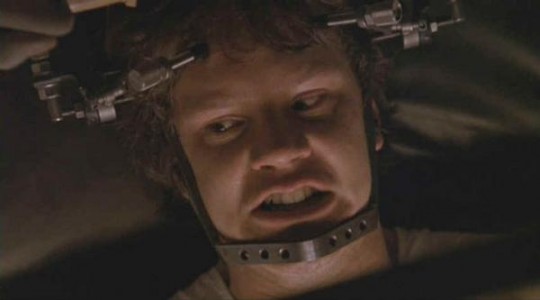
Jacob Singer is a Vietnam war veteran who is still recovering both from the trauma of his military career and losing his young son, Gabe. He begins experiencing flashbacks to his time in Vietnam, particularly one chaotic evening, as well as hallucinating in his everyday life, seeing demonic creatures and odd faces leering at him. Unable to see his doctor, recently killed in a car explosion, his symptoms begin to manifest physically. When his former colleague and friend is killed in an another explosion, Jacob reunites with his squad to investigate what happened to him and what might be affecting them all.
I should probably open this with the warning that this isn't going to be a particularly decisive view on the film as I'm not quite sure what I think of it just yet, but the immediacy of these reviews means you will inevitably get my raw reaction. And this film has left me feeling quite unfulfilled.
To clarify why this is, we have to skip straight to the end. Jacob, revealed to have been experimented on by the army and returning to his family home after his wayward time with Jezzie, sees his dead son, Gabe, playing on the stairs. He takes his son's hand and they walk up the steps as the film reveals that Jacob never actually left Vietnam, but died of the injuries we see him receiving in the flashbacks. It's supposed to be a moment of release, of catharsis, as Jacob accepts what has happened to him and dies peacefully. But, for me (and I know others have a very different opinion), it's all over too quickly, an anti-climax to the involving, chilling story that has gone before.
The build-up to his discovery of 'the Ladder', an experimental drug used on his battalion to make them more aggressive, is excellent. Adrian Lyne's direction gives the whole film a hallucinogenic feel that never quite lets you relax into it. The infamous hospital scene is a classic example; a dizzying array of imagery, sounds and emotion that is almost torturous to watch. It's an incredibly creepy film at times and that makes Jacob's journey so involving; we're attempting to piece together what he's seeing as much as he himself is. It helps that Tim Robbins is such a great everyman actor and he provides a solid anchor for the audience within the nightmarish world that the film places him in.
Prior to the car explosion that kills his former squad mate, Jacob's Ladder operates as an eloquent look at the effects of grief and trauma upon a person. The treatment of veterans, particularly from such horrific exercises as the Vietnam War (and wars since), has long been a social wound in American society and the film doesn't shy away from making the links between Jacob's experiences and his time in Vietnam. The flashbacks occur during his episodes which act like triggers, taking him back to night he was wounded as well as his time with his son, Gabe. These scenes function as an examination of the horrors of mental illness and how the sufferers are rendered powerless against it. It's an emotional form of horror, similar to that of this month's earlier film The Babadook, and it's when the film is at its most powerful.
The shift into a paranoid conspiracy thriller is smoothly done, but it also marks the point at which the film begins unravelling for me. Jacob's investigation into what has happened to him and his squad feels much pacier than the elegant build-up and is over almost too quickly. He meets the scientist who devised the experimental drugs and boom, the mystery is solved. The ending follows shortly after and lo, it was all a dream.
This kind of ending is an ongoing personal narrative bug-bear for me; I'd list the places I've had this problem before, but that's one massive spoiler minefield. I'm aware that Jacob's journey here is attempting to accept that he is dying and the various traumatic episodes, the flashbacks (that then technically aren't flashbacks but the film's narrative proper) and the visions ahead to what his life could become all build into that. But it also undermines what is a truly absorbing first half, in which Jacob functions as a man trying to come to terms with the traumas and loss he has experienced. I didn't feel emotional when he met his son Gabe on the stairs, I felt cheated.
It's not that the film doesn't clue you in to what's going on; Jacob's Ladder is the biblical staircase to heaven, after all, and there's plenty of religious thematics running through the film to alert you to the almost purgatory-like state that Jacob finds himself in. Normally, I'd love that kind of thing and I'm sure if I go back to it, looking at the symbolism peppered throughout might win me round to what is obviously a multi-layered film, ripe for textual analysis. However, a raw reaction is the aim of these reviews and so, on first viewing, Jacob's Ladder has left me cold.
- Becky
You can find my other Shocktober '15 reviews here.
Follow @AssortedBuffery on Twitter
Or like our Facebook page