Over the course of October, I shall be watching one horror movie a day and reviewing it right here for your reading pleasure. I haven't seen any of the films I'll be watching before and you can find the full list here.

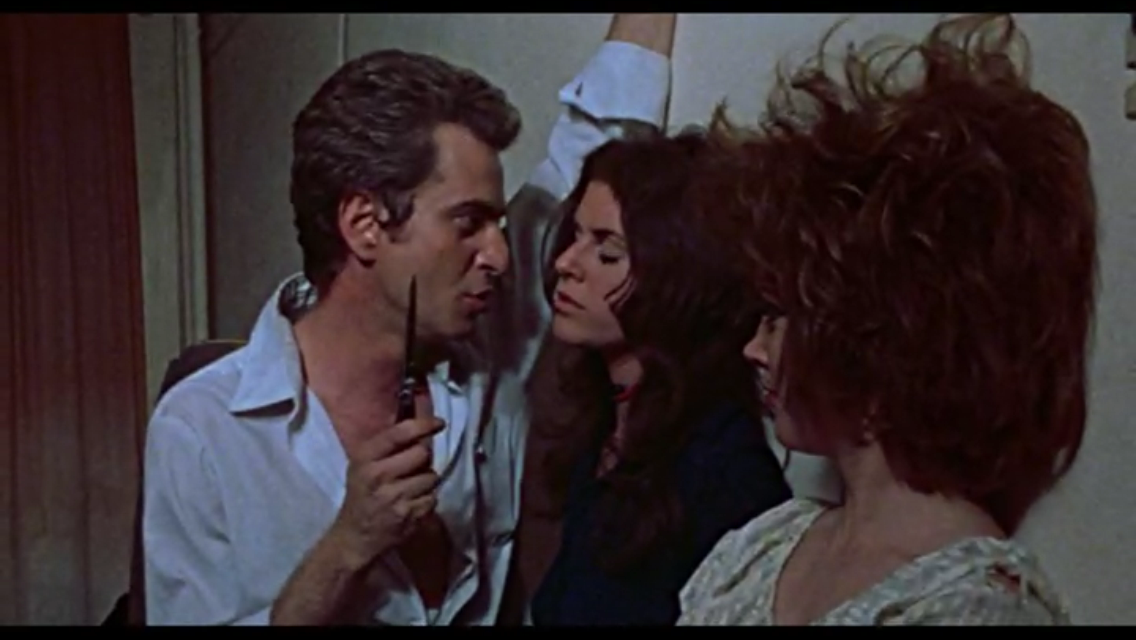
Estelle and John (Cynthia Carr and Gaylord St. James) are the proud parents of teenager Mari (Sandra Cassei) who is off into the big city to go to a concert with her friend, Phyllis (Lucy Grantham). On their way, they decide to try and get hold of some weed, meeting Junior (Marc Sheffler) who says he can help them out. In actual fact, he leads them to his apartment where his father, Krug (David A. Hess), Sadie (Jeramie Rain) and Weasel (Fred Lincoln) trap them. All are recently escaped criminals with nasty rap sheets and take great pleasure in torturing the two girls before killing them. Somehow, the gang end up at Mari's house, seeking shelter with her parents for the night. It's not long until Estelle and John realise what they've done and establish their own plan for revenge.
The Last House on the Left is a film of contrasts, seemingly designed to pull you one way before drastically changing the mood and dragging you another. This is most obvious in the scenes in the woods; at one point, you are uncomfortably positioned as a voyeur, watching on helplessly like Junior as Mari and Phyllis are assaulted and raped. In the very next scene, we're with the bumbling local sheriff and his deputy and watching them get up to all sorts of hijinks, knowing full well there's escaped convicts in the near vicinity. The music is similar, all jaunty and jolly when there's torture happening, contrasting sharply with what is happening on screen. It's deeply unsettling and though I'm sure the effect was intended, the constant shifts in tone are not particularly refined (something which I think Craven gets better at as his career develops).
Some of the other contrasts in the film work much better. The bucolic setting of Mari's idyllic home and her parents preparing the house for her birthday celebrations are cut between the two girls being set upon in the dark and foreboding city. There's another level of horror working here as her parents are blissfully unaware of what their daughter is about to get into. The beauty of that woodland setting is used later for the scenes in which the girls are tortured, clashing the two worlds of the film in a nightmarish fashion. Then of course, there's the contrast between the heroes and the villains, the domestic setting becoming the place in which that distinction becomes horribly muddied as morals start to look very grey indeed.
The film is based on Ingmar Bergman's The Virgin Spring, which sets the events in medieval Sweden. The context of a father killing his daughter's tormentors carries the historical element too; it's a paternal act of honour. In The Last House on the Left, both parents are involved in the violence that occurs, the wife actively taking part and not just facilitating the events. Rather than a question of medieval honour, it's a simple act of raw, violent grief. In The Virgin Spring, the father begs for forgiveness from God and pledges to build a church on the site of his daughter's murder. Mari's parents offer no such plea and in fact, aren't given that much of a chance, the film ending as the police arrive too late to stop the killing.
As a debut film, it's a confident effort from Craven, a bizarre mix of humour and horror that would continue to define many of the films of his career. It asks plenty of questions of its audience too, forcing them to keep up with the tonal lurches and presenting them with horrific situations which play out with a doomladen inevitability. It's not a film of jump scares or special effects, but simple, horrible scenes of man's inhumanity that positions its audience as a helpless onlooker, powerless to do anything but watch.
- Becky
You can find my other Shocktober '15 reviews here.
Follow @AssortedBuffery on Twitter
Or like our Facebook page
Over the course of October, I shall be watching one horror movie a day and reviewing it right here for your reading pleasure. I haven't seen any of the films I'll be watching before and you can find the full list here.
Fool (Brandon Adams) is forced to accompany Leroy (Ving Rhames) and Spencer (Jeremy Roberts) on one of their burgling expeditions by a raise in rent that could see him and his sick mother evicted from their apartment. They pick the Robeson house, their grasping landlords, and Fool follows Leroy into the house when Spencer doesn't return from casing the place. Once inside, they realise they got more than they bargained for; there's people trapped in the basement, a boy running riot through the walls and a vicious dog that's got the taste for men. As Fool tries to escape, he meets Alice (AJ Langer), the little girl kidnapped by Mommy (Wendy Robie) and Daddy Robeson (Everett McGill) and kept as their own, and the pair agree to try and make a run for it.
The film's a difficult one to characterise, covering a lot of genre ground in its 100 minute runtime. There's a horror in there obviously with the sadistic ways of Mommy and Daddy fuelled by a religious mania and, as this is Wes Craven, there's liberal lashings of black comedy throughout. What struck me about it most though was how it functioned as a 20th century, almost Grimm-like fairytale as Fool takes on the hero role and attempts to rescue the pretty young Alice from her tormentors. He sees it as something he has to do, redeeming himself as the child burglar by becoming the boy who reveals the Robesons' to the world, gets the money for his family and saving Alice in the process.
There's a few nods to famous children's stories here; Roach (Sean Whalen), the boy who escaped into the walls to torment the Robesons, has all the cheek and adaptability of Peter Pan. Alice's name is an obvious nod to her Wonderland-visiting literary counterpart whilst her escape with Fool often feels like a Hansel and Gretel style fable, the pair of them lured in by the promise of safety or money respectively and threatened instead. There's even a moment when the Mommy puts her head in the oven to look for Alice. If only Fool were there to kick her in and have done with it at the time.
It also helps the film's gleeful grotesque with Mommy and Daddy like any witch or nasty huntsman you've ever read about. Robie is particularly good as the seemingly genteel Mommy, capable of turning into a knife-wielding Mrs Bates wannabe at any second. Both she and McGill dial it up to eleven throughout their performances, but the film around them is so mad that it only ever works. They may be considerably more adult, but they feel like they could've walked out of a Grimm fairytale full of wicked step-parents, although Daddy's black gimp suit probably wouldn't have featured there. (American Horror Story really does steal everything, doesn't it?)
The house itself is a nice twist on the idea of a haunted house, full of traps, trick staircases and arms that might come out of the walls and grab you. Before you realise that there are people in the basement and Roach running around, it feels like the entire place is alive, full to the brim of stories and nightmares just waiting for Fool to discover them. It gives a nice unpredictable feel to the proceedings; even when it seems that Fool and Alice are safe in a room or wall somewhere, there's the suggestion that at any moment, their environment could switch and become the thing that's most immediately threatening. It certainly keeps you on your toes.
It's the first of two Wes Craven films on our list this month and it's an occasion to once again mourn his passing by celebrating the works he left behind. The People Under The Stairs displays much of his wit and inventiveness and, though one of the more forgotten films in his canon, still an impressive display from a horror impresario.
- Becky
You can find my other Shocktober '15 reviews here.
Follow @AssortedBuffery on Twitter
Or like our Facebook page