Over the course of October, I shall be watching one horror movie a day and reviewing it right here for your reading pleasure. I haven't seen any of the films I'll be watching before and you can find the full list here.
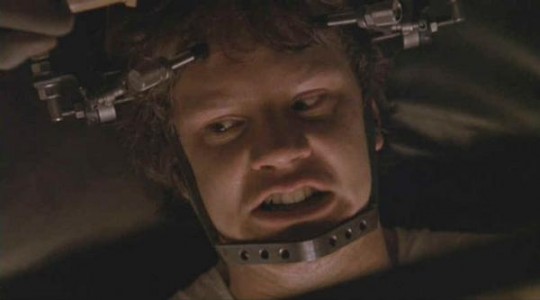
You can't have a whole season dedicated to horror movies and not watch a film in which either Bela Lugosi or Boris Karloff appear, or even both at the same time. The Raven finds Universal's gruesome twosome starring together; Lugosi plays the Edgar Allan Poe-obsessed Dr Vollin who teams up with Karloff's escaped convict Edmond Bateman to capture and torture the people preventing Vollin's relationship with dancer Jean Thatcher (Irene Ware). Having saved her life after a car accident, Vollin has become infatuated with her, but she intends to marry another and her father, Judge Thatcher (Lester Matthews) wants to ensure that happens.
Despite the fact that they belong to the horror genre, I've always found something vaguely comforting about the old black-and-white Universal canon. There's a familiarity with its subjects even without any extensive knowledge of the films themselves. The Raven bears all the classic hallmarks too; menacing sophistication from Lugosi, Karloff acting his socks off through a layer of make-up (in fact, he's billed solely as his surname in the credits, ), hidden staircases, a wall of switches, medieval-style torture chambers, the lot. It's a wonderful little slice of the macabre that uses its stars well.
The poster above bills the film as an adaptation of Poe's poem The Raven, which it really isn't, though it does use lines from it throughout. Instead, Poe acts as an inspiration for the narrative and it's a tale that makes good use of his particular brand of Gothic. Obsession is a big feature across Poe's works, particularly the idea of a romantic one, and Vollin as a character could easily slot into one of Poe's tales. The raven itself is no more than a talisman for Vollin, silhouetted beautifully against the wall of his study in his first scene and setting the tone for the rest of the film.
The other major Poe reference is that Vollin has created his own versions of several of Poe's torture devices, including the infamous pendulum and the shrinking room. He boasts of this early on and if there was ever a big red warning sign hanging over a character, that was it. Lugosi is great fun here, always on the edge of hamming it up, but managing to stay the right side of ludicrously menacing (arguably his big evil laugh in the final moments tips him over the edge though).
The climax of the film, in which those torture devices are put to use (though not graphically, this is 1935 after all), is easily its strongest moment. The pendulum device has already been demonstrated at this point so the mechanics are known to the audience, given its use on Judge Thatcher a delicious element of dramatic irony. It also acts as a countdown; once the pendulum starts swinging, there's 15 minutes until it begins slicing into the Judge. The shrinking room is even faster and the film wrings its tension from close ups of the descending pendulum or the long shot of the room as the walls close in. It's an effective sequence and one which relies more on the audience's anticipation of impending doom than it does in showing it, which is sometimes very welcome.
The tale of the film after its release is quite a sad one. Not massively popular with audiences at the time, possibly due to its disfigurement and torture scenes, it marked the moment at which horror started to decline in popularity. It's not particularly hard to see why; it doesn't carry the same majesty as either Frankenstein or Dracula, the roles which made its stars famous, but it's still an entertaining slice of old-fashioned horror.
- Becky
You can find my other Shocktober '15 reviews here.
Follow @AssortedBuffery on Twitter
Or like our Facebook page
Over the course of October, I shall be watching one horror movie a day and reviewing it right here for your reading pleasure. I haven't seen any of the films I'll be watching before and you can find the full list here.
Suzy Bannion (Jessica Harper) arrives late to her new ballet academy in Germany, nearly colliding at the door with another student, Pat, leaving the school in some distress. Pat seeks refuge at a friend's apartment, only for them both to be murdered in a suitably grisly fashion. When Suzy takes her place at the school, the teachers appear to be hiding something and the murders continue. She begins to investigate and soon uncovers the dark history of the academy and the secret it hides behind its blood-red walls.
What struck me most about Suspiria was how traditionally Gothic it is, albeit with the freedom to show the kind of shocks and gore that 18th century writers could suggest. Most early Gothic follows a pattern; they're set in Europe, feature a young, virginal maiden at its heart who is trapped in some kind of creepy castle with something preying on her (usually a randy older man). Suspiria sticks to this format fairly rigidly, not even updating it massively for the 20th century apart from the psychological paranormal angle. It helps that I've also re-read The Castle of Otranto recently, which is widely acknowledged as the first Gothic novel and key exponent of the above formula, and adheres to the same kind of frenetic atmosphere that Suspiria creates.
In Otranto, the helmet of a statue falls on the head of a prince and kills him instantly within the first three pages. What follows is a hilariously short tale of inheritance, marriage and death where long lost sons are found, prophecies are fulfilled and daughters are stabbed by their fathers. The plot isn't so important, but the shocks are. Walpole sets out to sensationalise his audience and give them an experience rather than a story. Suspiria strikes me as having very similar intentions. Argento isn't focused on just telling Suzy's story, but making it into something that will provide an experience for his audience, one in which narrative comes second to the way in which its told.
Of course, Suspiria sticks to that classic narrative formula too (minus the randy old man bit). From the moment the film starts, it's an assault on the senses. The visuals are riotously bright, with liberal splashes of red across the screen and the other primary colours dialled up to a garish maximum. The double murders are inventively staged in such a way that immediately establishes the heightened, hyper-real story. The apartment building in which it takes place is an exercise in the sublime, in the more traditional sense of the word, an effect carried over into the dance academy set. The outdoor red facade is a Gothic delight in itself, the inner corridors grandly claustrophobic and threatening.
The score, by Italian prog rock band Goblin with director Dario Argento, captures that combination of nightmare and fairytale, with the main theme reminiscent of a child's music box. It's at once both creepy and comforting, abrasive yet gentle and gives the film a fairytale quality that, combined with the visuals, is more Angela Carter's disturbing rewrites than Disney's sanitised renditions. At times, the score is of such a volume that it can feel quite overwhelming, an effect that I've no doubt was entirely intentional. It almost threatens to engulf the film, but Argento balances it masterfully, knowing the exact moment at which to dial it back and let the visual components take over.
As a big fan of the Gothic in all its forms, it is always exciting to come across one which is so enthusiastically traditional and like the works of Walpole or Radcliffe, goes full tilt for sensation and shocks. The reveal of what's behind the curtain here is almost incidental to the experience of the film, a sensory nightmare of the most thrilling variety.
- Becky
You can find my other Shocktober '15 reviews here.
Follow @AssortedBuffery on Twitter
Or like our Facebook page
Over the course of October, I shall be watching one horror movie a day and reviewing it right here for your reading pleasure. I haven't seen any of the films I'll be watching before and you can find the full list here.
Pete (Michael Vartan) is an American travel writer, newly arrived in Australia and embarking on a crocodile-spotting river tour, helmed by Kate (Radha Mitchell). The tour follows the river through Kakadu National Park in the Northern Territory and, after an encounter with some bullish locals (one of whom is played by Sam Worthington), they start to head home. It all goes awry when one of the tourists spots a flare through his camera and Kate, deciding to do the right thing, diverts the tour to see if they can help. However, she unwittingly leads them into the territory of a large crocodile, who is not particularly obliging to his guests.
Any crocodile-based creature feature has, in my mind, to directly compete with the wonder that is Lake Placid. It's one of my favourites of the genre where edible deputies and a giant crocodile pretty much come second to a witty, hilarious screenplay. Rogue doesn't really go for any comedy, treating its subject as a much more serious man vs. nature tale (it does, however, have a wicked joke for the end credits' music very much in the American Werewolf in London vein), but it works very well.
It's written, directed and produced by Greg McLean, who was also responsible for Wolf Creek (a film which I am not a fan of) and it treads some familiar ground, placing out of towners amongst the dangers of the Outback. This time, they're also placed alongside a couple of characters who know what they're doing, not that it offers much comfort in the scheme of things. The river setting is the film's big star and McLean and cinematographer Will Gibson showcase it beautifully; it's at once both jawdroppingly stunning and deeply dangerous. There's also an unknowable quality to it, fitting for when the sun goes down and the tidal river starts creeping up to the shore.
That same unknowable quality is used for the crocodile itself. Like any good creature movie, we only see glimpses for the majority of the film, allowing our imaginations to take over. The first death isn't even scene, just its aftermath as we hear the splash and see the ripples spreading out across the water. McLean only shows us snippets of the croc, a tail vanishing into the water, the ridges gliding towards the people. There's a particularly effective shot as a character hears a growl, only to turn and see wide open jaws coming towards him. The effects are also still pretty impressive when the full crocodile is revealed, but even then, it's used sparingly in order to give a sense of scale.
Rogue is also economical in its storytelling, allowing the crocodile-based scares to shine in the midst of the simple narrative. We're given the sparsest of information about the characters which would usually be a bad thing, but here it works. Their plight is compelling enough so they don't have to be. Any details are dropped through conversations between the characters, little moments that grant them enough depth to be more than crocodile food. Vartan's Pete gets the most development, forming a tentative friendship with Kate and engaging in some macho posturing with Sam Worthington and that's really all it needs.
The second creature feature of the month, Rogue doesn't go in for the comedy adventure stylings like Deep Rising, instead opting for a more serious approach that prioritises tension over any one-liners. It's beautifully shot and methodically constructed, ramping up the croc-based anxiety by sticking to the creature feature formula and executing it very well indeed.
- Becky
You can find my other Shocktober '15 reviews here.
Follow @AssortedBuffery on Twitter
Or like our Facebook page
Over the course of October, I shall be watching one horror movie a day and reviewing it right here for your reading pleasure. I haven't seen any of the films I'll be watching before and you can find the full list here.
Major spoilers ahead.
Jacob Singer is a Vietnam war veteran who is still recovering both from the trauma of his military career and losing his young son, Gabe. He begins experiencing flashbacks to his time in Vietnam, particularly one chaotic evening, as well as hallucinating in his everyday life, seeing demonic creatures and odd faces leering at him. Unable to see his doctor, recently killed in a car explosion, his symptoms begin to manifest physically. When his former colleague and friend is killed in an another explosion, Jacob reunites with his squad to investigate what happened to him and what might be affecting them all.
I should probably open this with the warning that this isn't going to be a particularly decisive view on the film as I'm not quite sure what I think of it just yet, but the immediacy of these reviews means you will inevitably get my raw reaction. And this film has left me feeling quite unfulfilled.
To clarify why this is, we have to skip straight to the end. Jacob, revealed to have been experimented on by the army and returning to his family home after his wayward time with Jezzie, sees his dead son, Gabe, playing on the stairs. He takes his son's hand and they walk up the steps as the film reveals that Jacob never actually left Vietnam, but died of the injuries we see him receiving in the flashbacks. It's supposed to be a moment of release, of catharsis, as Jacob accepts what has happened to him and dies peacefully. But, for me (and I know others have a very different opinion), it's all over too quickly, an anti-climax to the involving, chilling story that has gone before.
The build-up to his discovery of 'the Ladder', an experimental drug used on his battalion to make them more aggressive, is excellent. Adrian Lyne's direction gives the whole film a hallucinogenic feel that never quite lets you relax into it. The infamous hospital scene is a classic example; a dizzying array of imagery, sounds and emotion that is almost torturous to watch. It's an incredibly creepy film at times and that makes Jacob's journey so involving; we're attempting to piece together what he's seeing as much as he himself is. It helps that Tim Robbins is such a great everyman actor and he provides a solid anchor for the audience within the nightmarish world that the film places him in.
Prior to the car explosion that kills his former squad mate, Jacob's Ladder operates as an eloquent look at the effects of grief and trauma upon a person. The treatment of veterans, particularly from such horrific exercises as the Vietnam War (and wars since), has long been a social wound in American society and the film doesn't shy away from making the links between Jacob's experiences and his time in Vietnam. The flashbacks occur during his episodes which act like triggers, taking him back to night he was wounded as well as his time with his son, Gabe. These scenes function as an examination of the horrors of mental illness and how the sufferers are rendered powerless against it. It's an emotional form of horror, similar to that of this month's earlier film The Babadook, and it's when the film is at its most powerful.
The shift into a paranoid conspiracy thriller is smoothly done, but it also marks the point at which the film begins unravelling for me. Jacob's investigation into what has happened to him and his squad feels much pacier than the elegant build-up and is over almost too quickly. He meets the scientist who devised the experimental drugs and boom, the mystery is solved. The ending follows shortly after and lo, it was all a dream.
This kind of ending is an ongoing personal narrative bug-bear for me; I'd list the places I've had this problem before, but that's one massive spoiler minefield. I'm aware that Jacob's journey here is attempting to accept that he is dying and the various traumatic episodes, the flashbacks (that then technically aren't flashbacks but the film's narrative proper) and the visions ahead to what his life could become all build into that. But it also undermines what is a truly absorbing first half, in which Jacob functions as a man trying to come to terms with the traumas and loss he has experienced. I didn't feel emotional when he met his son Gabe on the stairs, I felt cheated.
It's not that the film doesn't clue you in to what's going on; Jacob's Ladder is the biblical staircase to heaven, after all, and there's plenty of religious thematics running through the film to alert you to the almost purgatory-like state that Jacob finds himself in. Normally, I'd love that kind of thing and I'm sure if I go back to it, looking at the symbolism peppered throughout might win me round to what is obviously a multi-layered film, ripe for textual analysis. However, a raw reaction is the aim of these reviews and so, on first viewing, Jacob's Ladder has left me cold.
- Becky
You can find my other Shocktober '15 reviews here.
Follow @AssortedBuffery on Twitter
Or like our Facebook page
Over the course of October, I shall be watching one horror movie a day and reviewing it right here for your reading pleasure. I haven't seen any of the films I'll be watching before and you can find the full list here. Mild spoilers ahead.
Witches are one of those pop culture figures who have gone through the most fascinating evolution through the ages. The witch as a cultural figure is present at various stages of literature with examples in Homer's epic poetry and early European medieval beliefs, but it was the witch trials and the accompanying misogyny across the 16th, 17th and 18th centuries that remain one of the defining images. These women were supposed to have made a pact with the Devil for their powers to inflict misery upon those around them and were quickly ostracised, silenced and murdered by those who believed them to be witches.
However, during that latter half of the 20th century, the witch undergoes something of a reappropriation, transformed into a symbol of female empowerment and resistance to patriarchal rule. Over the course of the century, we go from the traditional Wicked Witch of the West to the ultimate badass Wicca that is Willow Rosenburg (we'll be looking at another cinematic treatment later this month in The Witches with Joan Fontaine). Films such as The Craft and Practical Magic spun the same message of empowerment as well as using it to examine female friendships and gender politics. Television shows such as Charmed helping it along the way.
The Witches of Eastwick is a great example of this, a film in which female autonomy, male entitlement and the clash between the two are all examined. Based on the John Updike novel of the same name, the film tells the tale of three women, Alex (Cher), Sukie (Michelle Pfeiffer) and Jane (Susan Sarandon), each abandoned by their husbands in their own way and finding themselves increasingly lonely. In what amounts to a spectacular case of 'be careful what you wish for,' they inadvertently summon the devilish Daryl van Horne (Jack Nicholson) who begins to play havoc in their small town.
It also happens to be directed by George Miller, he of the triumphant feminist cry that is Mad Max: Fury Road, and a lot of the same gender dynamics are examined here through the relationship between Alex, Sukie and Jane, and van Horne. Jack Nicholson's portrayal of Daryl van Horne is really fun and it's hard to imagine anyone else in the role. As an actor, he's adept at playing multi-faceted villains, ones who can charm and seduce you, wisecracking and producing some outrageous physical comedy at times, yet always with that sinister edge that never quite lets you settle.
Daryl van Horne is the schism that rocks the town, turning women against each other, allowing them to be ostracised and turning violent and manipulative when those women start to take a stand against him. In other words, he's the patriarchy. When other women call Jane a slut for the change they see in her and the rumours start to spread about the sexual activities she and her friends have willingly and consensually engaged in, it is van Horne who causes them. Felicia (a wonderfully histrionic Veronica Cartwright) is the only one to realise instantly that something is wrong, but it's put down to mental illness and she ultimately falls victim to male violence in an attempt to bring her into line.
This is where the witchcraft side of things comes in; at the beginning of the film, Alex, Sukie and Jane don't realise the power they wield with only Sukie observing that they might have caused the rain to fall on a speech all three were wishing would end. It takes the adversity and emotional turmoil of meeting with van Horne to realise just how much power they actually wield and that, yes, they would be better off without him. What follows is an awesome moment of sisterhood as they conspire to get rid of him, first by seducing him and then subjecting him to every torment they can think of. It's a great switcheroo and one that is air-punchingly satisfying. The effects of giant Jack Nicholson may look a little wobbly now, but there's something really amusing about the expression on his face once he's shrunken and about to go poof.
A lighter film than some of the last few, but no less welcome, The Witches of Eastwick is a great tale of female empowerment and devilish behaviour. It's also a welcome sight in the current dearth of films about female friendship and solidarity. We need more films like The Witches of Eastwick.
- Becky
You can find my other Shocktober '15 reviews here.
Follow @AssortedBuffery on Twitter
Or like our Facebook page
Over the course of October, I shall be watching one horror movie a day and reviewing it right here for your reading pleasure. I haven't seen any of the films I'll be watching before and you can find the full list here.
The frail Christina (Véra Clouzot) is married to the cruel and bullish Michel Delassalle (Paul Meurisse) who runs the school that is paid for by her wealth. He's having an affair with another teacher at the school, Nicole Horner (Simone Signoret) and is as abusive to one as he is to the other. Despite their seeming rivalry, the two women share a close relationship and hatch a plan to murder him and dispose of the body in the school swimming pool. Everything seems to go off without a hitch until the swimming pool has drained and the body has mysteriously disappeared. Soon, mysterious occurrences start happening around the school, suggesting Delassalle might be as dead as he first appeared.
Suspense is a tricky thing to get right. You can be building it up slowly and carefully for several scenes before one thing ruins the moment and takes all that suspense away. If you lose your audience, you lose your effect and any moments after that don't carry the same weight. It was something an earlier film in this ongoing feature was guilty of (The Blood on Satan's Claw) and it can leave a narrative feeling disjointed. Les Diaboliques, however, is a masterclass in films of its type and Clouzot is rightly compared to Hitchcock (who reportedly went after the rights to the book on which this is based too) in his ability to rack up the tension to near-unbearable levels.
After the intense torture factor of a film like Audition or the effects-laden adventure of Deep Rising, it's refreshing to watch something that uses the basics, but uses them well. Clouzot's film revolves around spinning the macabre out of in the innocuous; a lingering close up on the bottle containing the all-important sedative, the tapping of a typewriter or the sound of bathwater through the pipes become ominous and threatening. Clouzot also relies heavily on lighting and shadows to make everything that bit more eerie as lit windows reveal silhouettes and dark corridors hide people walking within them.
Paul Muerisse is given only a few scenes in which to cement his portrayal of the vicious Delassalle and he seizes it with relish, creating a figure of such malice that sympathy is immediately placed with the women, despite the plan they are hatching. It also ensures that Delassalle and the threat he poses towers over the film and it is never called into question the kind of damage he could wreak from beyond the supposed grave. Véra Clouzot's fragility and constant state of anxiety contrasts nicely with the quiet strength and sophistication of Simone Signoret, balancing out as the narrative progresses. There is also some excellent light relief from the supporting cast and a great turn from Charles Vanel as a proto-Columbo detective.
The final twist is there to be figured out all the way through the film; hints are dropped and there's a massive case of Chekov's Heart Condition that looms over the proceedings like an ominous ticking bomb. However, the film sweeps you up so completely in its atmospheric suspense that it doesn't occur to you to think about it, nor does it matter when that twist comes. It's a gripping finale, packed full of images that linger long after the film ends.
- Becky
You can find my other Shocktober '15 reviews here.
Follow @AssortedBuffery on Twitter
Or like our Facebook page
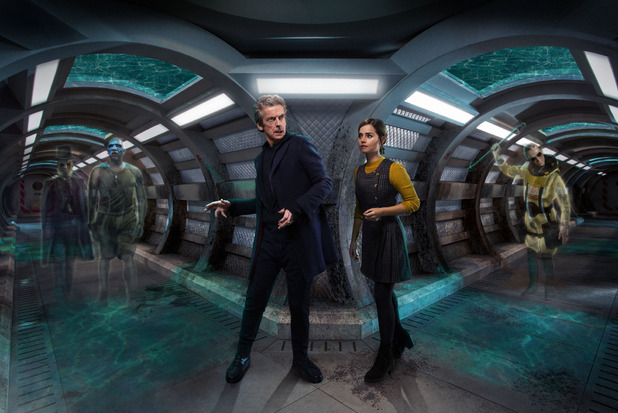
The Doctor and Clara find themselves on an underwater base, amongst the ruins of a world once flooded after a dam collapse. The base is now an oil-drilling operation, ruled over by the bureaucratic Pritchard and looked after by a military and scientific crew. They discover mysterious writing on the wall of a salvaged spaceship, their commander dying shortly afterwards. However, it's soon apparent he's come back from the dead and accompanied by another ghost, they start attacking the living crew members. When the Doctor and Clara join them, they start setting about solving the mystery of the ghosts and the answer may lie back in time.
A crew trapped on their vessel/base and menaced by something horrible is a fairly standard Doctor Who format, but it's produced some great episodes over the course of New Who. It also happens to be a particular favourite format of mine because they often come down to the Doctor using his ingenuity to solve a puzzle. It may end up being overly-complicated or make no sense (this is, after all, Moffat's tenure), but it's always fun watching the process. Under the Lake is one of the better examples of this particular episode type, piling on the atmospherics and allowing Peter Capaldi to command the screen with his grumpy enthusiast Doctor.
It doesn't really stretch the formula at all, but the one thing that does help the episode greatly is the return to the two-parter format. One of our most common complaints here on Assorted Buffery when it comes to Doctor Who is that so often stories are rushed to get through them in the 45(ish) minutes that defines the running time. Because Under The Lake is only the first part of the story, it's a much more effective episode, giving the story time to breathe and the mystery to evolve. The solution doesn't have to be rushed because the plot can space itself out over the course of the two episodes and as a result, it's a much more satisfying experience.
It helps that it's one of the creepier Who episodes too, the ghosts with their lack of eyes providing suitably ethereal and chilling antagonists. The story uses them sparingly too; we're not subjected to endless chases or ghostly apparitions behind the living characters, but they lurk threateningly over the course of the episode. The last shot of the Doctor as one of them, despite being so obviously not what it seems (we're only on the third episode after all), is also pretty creepy. Capaldi cuts a darker figure than his predecessors anyway, but an eyeless Doctor is a scary Doctor.
Another enjoyable aspect of the episode was the relationship with Clara and the Doctor, now a full mutually dependent that melds her people skills with his intelligence. I loved the cards that she now has ready for some of his more difficult situations, which offer further glimpses into their travels together. Who else wants to know what happened to the guy from Aberdeen? It's great that their relationship extends beyond the scenes we see as part of the episodes and it creates the impression of a wealth of experiences that we're only allowed glimpses of.
Under the Lake continues the Capaldi-era trend of producing strong, atmospheric and yes, creepy episodes with a doozy of a cliffhanger to finish with. It may not do anything particularly revolutionary with the formula, but it's a lot of fun to watch. Jen will be with you for the next instalment, Before the Flood.
- Becky
You can read Jen's review of The Witch's Familiar here.
Follow @AssortedBuffery on Twitter
Or like our Facebook page