Over the course of October, I shall be watching one horror movie a day and reviewing it right here for your reading pleasure. I haven't seen any of the films I'll be watching before and you can find the full list here.
Fool (Brandon Adams) is forced to accompany Leroy (Ving Rhames) and Spencer (Jeremy Roberts) on one of their burgling expeditions by a raise in rent that could see him and his sick mother evicted from their apartment. They pick the Robeson house, their grasping landlords, and Fool follows Leroy into the house when Spencer doesn't return from casing the place. Once inside, they realise they got more than they bargained for; there's people trapped in the basement, a boy running riot through the walls and a vicious dog that's got the taste for men. As Fool tries to escape, he meets Alice (AJ Langer), the little girl kidnapped by Mommy (Wendy Robie) and Daddy Robeson (Everett McGill) and kept as their own, and the pair agree to try and make a run for it.
The film's a difficult one to characterise, covering a lot of genre ground in its 100 minute runtime. There's a horror in there obviously with the sadistic ways of Mommy and Daddy fuelled by a religious mania and, as this is Wes Craven, there's liberal lashings of black comedy throughout. What struck me about it most though was how it functioned as a 20th century, almost Grimm-like fairytale as Fool takes on the hero role and attempts to rescue the pretty young Alice from her tormentors. He sees it as something he has to do, redeeming himself as the child burglar by becoming the boy who reveals the Robesons' to the world, gets the money for his family and saving Alice in the process.
There's a few nods to famous children's stories here; Roach (Sean Whalen), the boy who escaped into the walls to torment the Robesons, has all the cheek and adaptability of Peter Pan. Alice's name is an obvious nod to her Wonderland-visiting literary counterpart whilst her escape with Fool often feels like a Hansel and Gretel style fable, the pair of them lured in by the promise of safety or money respectively and threatened instead. There's even a moment when the Mommy puts her head in the oven to look for Alice. If only Fool were there to kick her in and have done with it at the time.
It also helps the film's gleeful grotesque with Mommy and Daddy like any witch or nasty huntsman you've ever read about. Robie is particularly good as the seemingly genteel Mommy, capable of turning into a knife-wielding Mrs Bates wannabe at any second. Both she and McGill dial it up to eleven throughout their performances, but the film around them is so mad that it only ever works. They may be considerably more adult, but they feel like they could've walked out of a Grimm fairytale full of wicked step-parents, although Daddy's black gimp suit probably wouldn't have featured there. (American Horror Story really does steal everything, doesn't it?)
The house itself is a nice twist on the idea of a haunted house, full of traps, trick staircases and arms that might come out of the walls and grab you. Before you realise that there are people in the basement and Roach running around, it feels like the entire place is alive, full to the brim of stories and nightmares just waiting for Fool to discover them. It gives a nice unpredictable feel to the proceedings; even when it seems that Fool and Alice are safe in a room or wall somewhere, there's the suggestion that at any moment, their environment could switch and become the thing that's most immediately threatening. It certainly keeps you on your toes.
It's the first of two Wes Craven films on our list this month and it's an occasion to once again mourn his passing by celebrating the works he left behind. The People Under The Stairs displays much of his wit and inventiveness and, though one of the more forgotten films in his canon, still an impressive display from a horror impresario.
- Becky
You can find my other Shocktober '15 reviews here.
Follow @AssortedBuffery on Twitter
Or like our Facebook page
Over the course of October, I shall be watching one horror movie a day and reviewing it right here for your reading pleasure. I haven't seen any of the films I'll be watching before and you can find the full list here.
Peter Weller plays Steven Beck, a geologist who is given command of a mining shack deep in the Atlantic Ocean. The team, including Amanda Pays' Elizabeth 'Willie' Williams, Ernie Hudson's Justin Jones and Hector Elizondo as Cobb, are coming to the end of a 90 day shift. On a routine patrol, Willie and crew member/red shirt Six Pack (Daniel Stern) happen across a wrecked Russian sub. Beck and the Doc (Richard Crenna) investigate, discovering that the crew had seemingly been killed off by a mysterious disease. Meanwhile, Six Pack takes a swig from some stolen vodka and soon begins to show signs of infection, before transforming into something truly monstrous.
We've done a couple of creature features so far for this month and each one has brought something different to the table. Deep Rising was pretty much everything you expect from a Stephen Sommers' film, pithy and entertaining. Rogue was a more suspenseful, realistic portrayal of man lost in nature and nature out to bite back. Leviathan sits itself squarely in the middle of this, not really offering up anything too original, but doing it in such a way that you don't really mind. What really helps it is that it's got quite the cast, all of whom do their bit to keep you interested as the plot ticks inevitably along.
Leviathan is, like the eponymous creature that threatens the mining team, a mish-mash of just about everything you'd expect from a team stranded in a remote location and forced to deal with a threat to their existence. Alien is clearly the most obvious influence from its slightly dodgy medical officer, the weapons used, the claustrophobic corridors and, for good measure, there's even a couple of chest-burster moments threatened. It doesn't quite manage the same oppressive atmosphere as its superlative predecessor.
The creature is created through some impressive special effects, both tangible and icky, which makes the crew's reactions to it feel suitably real. Everything's all a bit slimy. It also happens to be a combination of pretty much everything from real life marine horrors via Creature from the Black Lagoon and The Thing. The body horror transformation element, seen as Six Pack makes that transition between man and fish, feels like it could also have come from The Fly. The creature is rarely seen in full, which works to its benefit and allows its appearances to be rendered a little more creatively, dangling from vents and the like.
The ending over-eggs the pudding somewhat, packing in several near-death experiences even when it seems the end is near. There's also the small matter that the film seems to develop a more blackly comic sense of humour in its last couple of minutes than there is in the rest of the film. Whilst it makes Beck's triumphant cry upon exploding the creature an air-punch of a moment, the decision to punch the female executive as his final act of the film is hilarious, but also completely out of the blue, given Beck's peacekeeping role previously. Also, you just don't expect the hero of your film to punch a woman.
It's an odd fish this (pun very much intended), but Leviathan is still pretty entertaining. It feels like one of those films you watch with takeaway and beer on a Friday night; harmless, throwaway entertainment that pits man versus nature with a couple of explosions and some slightly dodgy one liners. Sometimes, that's just exactly what you need.
- Becky
You can find my other Shocktober '15 reviews here.
Follow @AssortedBuffery on Twitter
Or like our Facebook page
Over the course of October, I shall be watching one horror movie a day and reviewing it right here for your reading pleasure. I haven't seen any of the films I'll be watching before and you can find the full list here.
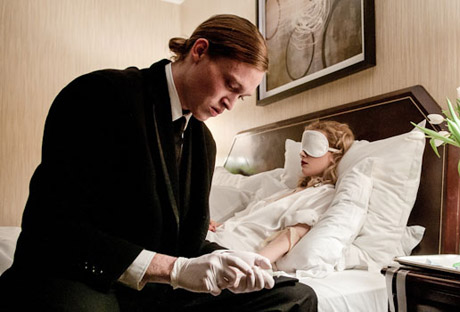
Antiviral depicts a near-future world even more obsessed with celebrity than the one we currently live in; such a thing is clearly possible. Here, fans have the opportunity to inject themselves with the viruses experienced by their favourite celebs, rendering them joined at a "biological level". The Lucas Clinic provides such a service and has one Syd March (Caleb Landry Jones) in its employment. He makes money off the side of his day job by using his body to incubate the viruses and sell them on through the black market. His well-oiled routine falters when he injects himself with the blood of the ill Hannah Geist (Sarah Gadon), a much loved and popular figure, only to find out the next morning that the current virus killed her.
Tabloid press, gossip mags, reality television all push this idea of consuming celebrities and their lives, but it is a metaphorical consumption. In Antiviral, Brandon Cronenberg (son of David) has crafted a bleak satire around the idea of body commodification and that culture, taking our obsessions and making them a literal consumption. That idea gives birth to the film's one of the more disturbing elements as people will buy and eat meat made grown artificially from celebrity cells; it's pallid and fake-looking, but the near-rabid consumers waiting to buy a piece of their favourite celebrity don't care. Faces of famous people adorn the walls of just about everywhere and entire news programmes are devoted to their every move.
Cronenberg isn't saying anything we don't really know about celebrity culture here, but he manages to craft a world that feels remarkably plausible as well as full. Little details are dropped throughout the film that just enhance the fictional landscape and demonstrate how widespread it all is. Conversations that aren't central to the plot are all about the most intimate details of the big name stars or their latest illnesses or relationships. That builds into the corporate satire at the heart of the film in the Lucas Clinic or Vole & Tesser, companies which have literally commodified viruses to sell on to their fans. These companies, like our very own pharmaceutical industry, are always looking for the next big seller with little or no regard to any destruction they may cause.
It's an interesting concept and one which is served, for the most part, well by the film around it. Cronenberg doesn't go for his father's more visceral versions of body horror, though the blood splatters mount up before the end. Despite a couple of very trippy hallucination scenes, he instead opts for something more insidious by having Syd slowly being killed by something we can't see, but is desired by everyone for having been the virus that killed Hannah Geist. There's also something innately disquieting about the idea of people willingly infecting themselves with these viruses whilst living in our own world that does everything possible to stop that from happening. It's body modification at the biological level.
The film's languid pace works to its advantage initially, teasing out the world in which Syd operates and having faith in its audience to piece it all together. It contrasts sharply with the urgency that is exhibited by the ancillary characters, desperate to get their piece of the celebrity pie (or steak), marking Syd out swiftly as almost above this world, taking advantage of it without really buying in. However, when the mystery starts ramping up and Syd's life is in danger, the film barely ramps up a gear and it needs just that little bit more urgency to keep it going to what is a really unsettling and effective ending.
There is a lot going on in this film and for a debut directorial effort, it is remarkably self-assured. However, it doesn't quite capture you enough on a dramatic level and a film can have all the best concepts in the world, but if you start to lose interest in what's happening, something has gone awry. As it stands, Antiviral just about gets away with it thanks to a solid central performance from Jones and an ending to make you shiver.
- Becky
You can find my other Shocktober '15 reviews here.
Follow @AssortedBuffery on Twitter
Or like our Facebook page
Over the course of October, I shall be watching one horror movie a day and reviewing it right here for your reading pleasure. I haven't seen any of the films I'll be watching before and you can find the full list here.
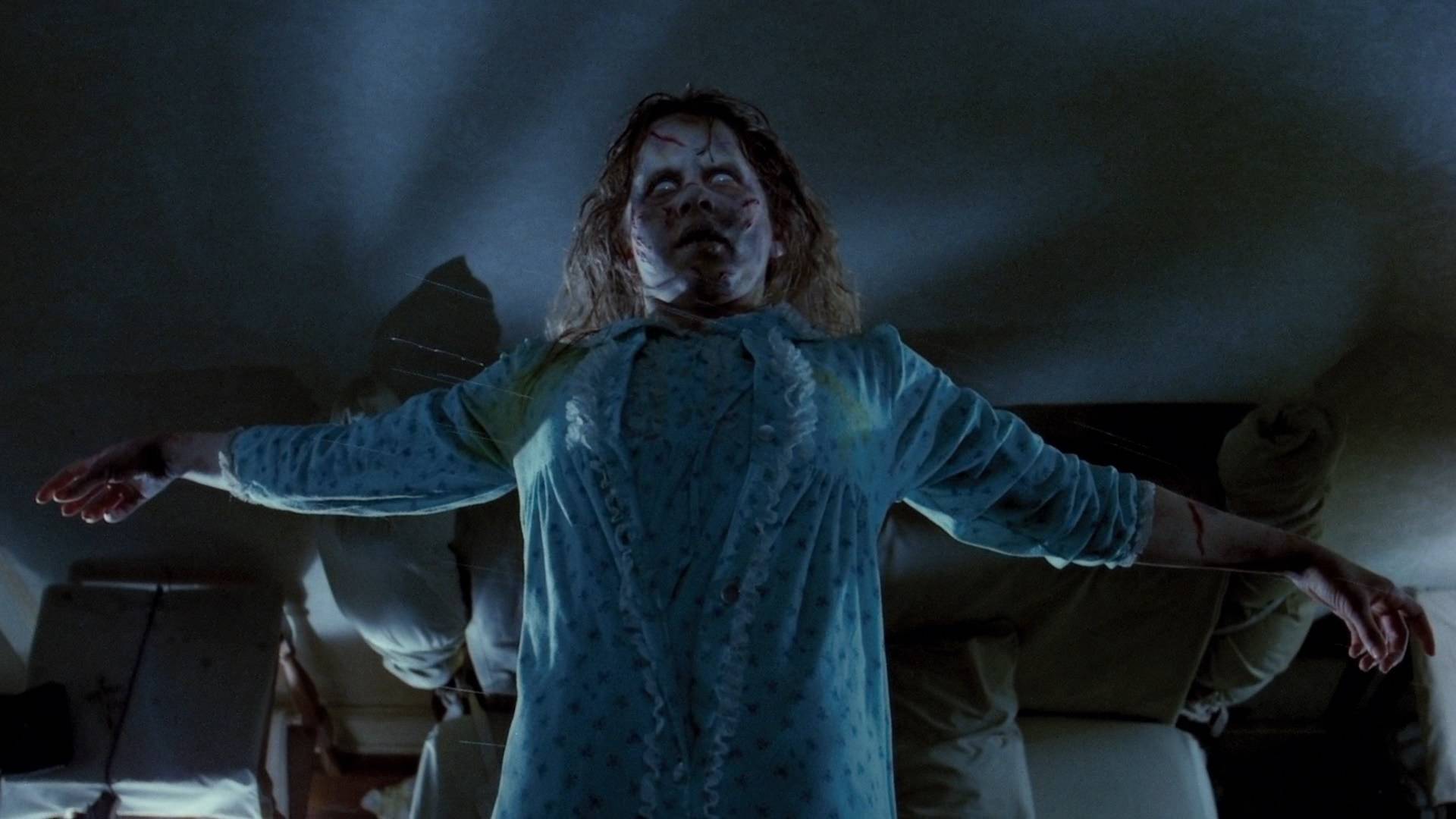
There's always a danger when watching truly iconic horror films for the first time, or indeed iconic films of any genre. The weight of expectation can sometimes be too much or the ubiquitousness of the film's imagery can prevent any of its scares from carrying the same weight as they would unseen. It's part of the reason why it took me so long to get to The Exorcist; from the instantly recognisable use of Tubular Bells to Linda Blair's battered face via pea soup vomit and liberal use of foul language, I felt I knew too much. I like films to be a surprise, an unknown quantity that is allowed to unfold as its creators intended, but in some cases, it's just not possible. I needn't have worried here though. It turns out I didn't really know anything about The Exorcist at all.
The biggest surprise? The exorcism itself takes up very little of the narrative. Instead, it's a melancholic exploration of faith in its various forms and the horror that arises when this faith is called into question. Naturally, religious faith is at the forefront, captured in the contradictory, troubled figure of Father Damian Karras. The embodiment of the clash between modern science and old Catholicism, Karras is the brain of the film, questioning everything around him through the lens of his psychological learning yet unable to reconcile that with his faith. It's also coloured by his own still raw grief at the death of his mother, something which he was neither there for nor had the ability to prevent. His work with Regan becomes an act of redemption almost, a seizing of control at a time in which he feels he's lost it entirely.
This lack of control is a running theme throughout the film, most obviously in the possession itself, but also in the circumstances that surround it as Chris tries to help her daughter. The MacNeils' most horrific experiences aren't necessarily the possession scenes, but the medical procedures she is forced to undergo as a world of science attempts to apply a rational diagnosis on an irrational occurrence. Anyone who has been through the illness of a loved one instantly understands the frustration felt by Regan's mother, Chris, unable to protect her family and surrounded by people who don't appear to know what they're dealing with. It's a form of emotional torture, a visceral pain that the film continues to capture in various ways.
Weaving these two stories together, a mother trying not to lose her child and a man mourning the death of his own mother, gives The Exorcist an emotional core that so many quickfire horrors tend to forget. In order to truly feel the scares and empathise with their plight, we need to care about these characters and Friedkin takes his time to slowly build their world and their relationships. It helps that this lack of control is something every one of us has experienced, but dialled up to such heightened proportions that it taps into our worst fears without us ever really realising it. Karras' grief or Chris' frustration are entirely within the realms of human experience, but dealing with something inhuman and unknowable as a result.
Perhaps the other big surprise was how well the representations of that inhumanity in the film's special effects have held up over the years. The practical effects are still pretty much seamless; unlike say, the staircase fall in Psycho, nothing works to remove you from the proceedings, only enhance that raw quality the film possesses. Mercedes McCambridge's vocal work as the demon Pazuzu is excellent, often feeling like the human voice equivalent of nails scraping down a chalkboard and even those iconic moments carry a certain power that I never expected to experience. The tension is mounted so expertly throughout these scenes that the exorcism's final moments feel like huge, emotional release.
It's such a great feeling when you finally get to a film like The Exorcist and it still manages to defy your already high expectations. With an intense exploration of faith at its heart and some wickedly effective make-up, the film still has the power to shock.
- Becky
You can find my other Shocktober '15 reviews here.
Follow @AssortedBuffery on Twitter
Or like our Facebook page
Over the course of October, I shall be watching one horror movie a day and reviewing it right here for your reading pleasure. I haven't seen any of the films I'll be watching before and you can find the full list here.
Nice, middle class primary school teacher Jenny (the should-be-in-more-things Kelly Reilly) is off on a romantic weekend away to an abandoned quarry with handsome boyfriend, Steve (Michael Fassbender). He's planning to propose on the trip, but a tussle with some local youths, led by Brett (Jack O'Connell) threatens to derail the whole affair. As things spiral wildly out of control, Steve finds himself on the wrong end of a knife and Jenny is forced to fight for her life against the gang of kids that have her in their sights.
Writer-director James Watkins mounts the tension well and it's a tautly constructed piece of cinema, operating very simply throughout on simple cause-and-effect plotting. It's punctuated with aerial shots of Steve or Jenny making their way through the woods around the lake that manage to convey the enormity of their situation simply without resorting to anything more showy. There are a few moments when it falls into cliché, but it whips on at such a pace that you're never left thinking about them for too long.
It's hard not to find the aggressive class commentary in the film unsettling, so thoroughly British tabloid fearmongering that it may as well have been sponsored by them. It's basically a Daily Mail anxiety attack writ large, transforming Cameron's oft-mocked hug a hoody campaign into run away from one as fast as you can (unsurprisingly, they gave the film 5/5). It's a curious slice of the Britain of five years ago, before the refugee crisis was even a glint in Europe's collective eye and it manages to date the film more than any special effects ever will.
Eden Lake functions a microcosm of that particular British social anxiety that revolved around chavs, happy slapping and the violent crime associated with it. There was a dehumanisation at work there (much like you see with said refugee crisis now) that rendered hoodies and chavs into monstrous masses coming to take your nice, middle class suburbia. The film doesn't quite go that far, shading in Brett's gang with moments of doubt and fear, but that's the undercurrent running through it.
It's a deeply unnerving film, both on that thematic level and the acts themselves and it's hard to leave it behind without anything other than a bitter taste in the mouth. I'm not sure whether that's because of the events depicted or how completely Daily Mail it all feels. Eden Lake certainly not a film that I can like.
- Becky
You can find my other Shocktober '15 reviews here.
Follow @AssortedBuffery on Twitter
Or like our Facebook page
Over the course of October, I shall be watching one horror movie a day and reviewing it right here for your reading pleasure. I haven't seen any of the films I'll be watching before and you can find the full list here.
In her final film role, the wonderful Joan Fontaine stars as Gwen Mayfield, a teacher recently returned from teaching in an African school after a frightful experience with the occult. She accepts a teaching post in the quiet, little farming village of Heddaby, which seems like the perfect English tonic to Gwen's recent woes. However, strange events soon start occurring in the village; a boy is taken ill in mysterious circumstances and old Granny Rigg seems to be at the heart of it. Gwen begins to investigate and is shocked to realise she may have discovered instances of black magic.
In my earlier review for The Witches of Eastwick, I talked about the extraordinary change that the witch had gone through as a symbol of femininity. In Eastwick, it's a form of empowerment, a way in which the female leads can take back control of their lives. The Witches is much more traditional and reductionist in its approach, even incorporating the very fairytale villain motivation of growing old as the reason for the nefarious goings-on. It's a corruption of femininity here, just as the magic is a corruption of its countryside location.
The eagle-eyed among you will spot the Buckinghamshire filming location as the village from Band of Brothers. It's a quintessential English village, that nationalistic bastion that has long stood as a cultural image of quaint gentility. Of course, Hammer were adept at taking that kind of supposedly friendly setting and render it more nightmarish. After the colonial panic scenes in the African opening to the film, the village is supposed to represent safety for Gwen, a comforting retreat to the world she knows.
It's clear something isn't quite right with squeaky clean, not-actually-a-reverend Alan Bax from the get go and there's a few looks between the villagers that should've had Gwen retreating. I've spoken before about the innate creepiness of close-knit and small communities with their own weird traditions and relationships. The Witches doesn't manage to pull it off quite as successfully like the sort of similar The Wicker Man, but it does succeed in keeping Gwen firmly as the outsider. She's a woman of the world and Fontaine is an actress of a keen intelligence, which helps distinguish Gwen from the dowdier, accented locals.
Fontaine is the film's shining star and, with her amazingly bouffant hair, gives a great performance as the centre of the film. She's always managed a fine line in conveying a deep, emotional anguish and she utilises it here, keeping Gwen firmly at the heart of the supernatural mystery. Kay Walsh is in imperious form as Stephanie Bax, the only other cast member to really go toe-to-toe with Fontaine, while Alec McCowen's contrasting cowardly Alan may as well walk around with a sign over his head saying "Chief Suspect" for most of it, but it does work to distract you from the film's main twist.
But then there's the ending after that twist, which takes pretty much every bit of tension that the film had managed to build in the preceding scenes. There's a head-dress with what look like birthday cake candles on it, there's a lot of emphatic gesturing and a dance routine that wouldn't look out of place in a crappy boyband video. All of it is absolutely hilarious. It also goes on for what feels like an absolute age. I assume all the ritualistic gesticulating is supposed to make us all fear for Linda as the intended sacrifice, but then she joins in and starts throwing herself about with abandon. Poor Fontaine looks very regal in the midst of it, but you're just screaming at her do something to make the dancing go away.
It's a real shame because, prior to arm-waving and silly chanting, there's a nice uneasiness to Fontaine's plight, recalling the paranoia of a film like The Innocents. The film never really pushes the ambiguity angle far, but there's always the sense that the villagers are playing Gwen, messing with her head until she's forced into a nursing home to recover. It also seems rather tame by Hammer standards with ending feeling like a last gasp effort to retain some shock value. Which, to be fair, it does, but it's more likely to produce a belly laugh than a horrified cry.
- Becky
You can find my other Shocktober '15 reviews here.
Follow @AssortedBuffery on Twitter
Or like our Facebook page
Over the course of October, I shall be watching one horror movie a day and reviewing it right here for your reading pleasure. I haven't seen any of the films I'll be watching before and you can find the full list here.
After the vampiric delights of Near Dark yesterday, more traditional horror fare, it seemed only fitting to follow it up with What We Do In The Shadows, an affectionate look at vampire flatmates - Viago (Taika Waititi), Vladlislav (Jemaine Clement) and Deacon (Jonathan Brugh) - trying to navigate the 21st century. Over the course of the film, we see them take on a new flatmate with less than stellar consequences, rumble with local werewolves and attend the Unholy Masquerade, the event for New Zealand's undead.
On its release in 2014, the particular film-y section of Twitter I inhabit was alive with talk of What We Do In The Shadows and it was also a critical comedy darling. The central conceit seemed initially to be a slight one, but the film finds a great vein of comedy running through the cultural shock between age-old aristocratic vampires and the modernity of 21st century Wellington. This is captured hilariously with Nick, the new vampire, who hasn't quite grasped the need for secrecy nor is too keen to play along with the house rules. It's a familar experience for even the humans amongst us, but to see that conflict play out through the vampiric prism is amusing indeed.
To stop that conceit spreading too thin, there's also plenty of jokes mined from the history of vampires in popular culture. The film that clearly adores the stories it is spoofing. The use of old woodcut images and paintings photoshopped with the characters in them is a really amusing touch, often providing punchlines of their own. Gary Oldman's Dracula performance is riffed on spectacularly by Clement, his brooding Vladislav stealing the show as the Gothic lord with a penchant for poking people.
There's also room in there to mock the latest iterations of those who walk in the night. Twilight cops considerable flak, especially in the fight with the politically correct werewolves. Petyr might just be my favourite though, an ancient soul made-up like Nosferatu and with a deadpan expression that clashes beautifully with the overly expressive Viago.
I'm not overly familar with the stars' work outside of this film (Flight of the Conchords is one particular comedy phenomena that has completely passed me by) so I wasn't entirely sure what to expect. On reflection, this was probably for the best. I'm always a bit wary of improvisational comedy, particularly in recent years, as the American output has been very hit and miss. Shadows succeeds where many don't through the judicious editing process that the film has clearly gone through. No scene plays out for too long, nor do they labour any jokes too much. It's refreshing and the film only gets funnier as you settle into its offbeat style.
It doesn't shy away from finding the poignancy in eternal life either. The ongoing story of Viago's love for Katherine, whom he followed to New Zealand to confess his love, only to be thwarted by incorrect postage, forms an emotional hook through the narrative. Likewise, Stu's humanity is used as a reflection for the vampires' experiences and leads to a lovely little speech about witnessing mortality and being unable to prevent it from Deacon. They're small moments in the scheme of things, but it gives the film a depth that is most welcome.
I didn't really know what to expect from this film and I think it's going to take a couple of watches for me to truly appreciate some of the gags here, but What We Do In The Shadows is an elegantly constructed supernatural comedy.
- Becky
You can find my other Shocktober '15 reviews here.
Follow @AssortedBuffery on Twitter
Or like our Facebook page