Over the course of October, I shall be watching one horror movie a day and reviewing it right here for your reading pleasure. I haven't seen any of the films I'll be watching before and you can find the full list here.
Near Dark sees a good ole Oklahoma boy, Caleb (Adrian Pasdar), lured by the enigmatic May (Jenny Wright) into a quasi-family of drifters who may be more than initially meets the eye. They are led by the charismatic Jesse (Lance Henriksen) and wander across the American landscape at night, shunning the sun and thriving on blood. It all starts to go awry when Caleb refuses to kill another human and drink their blood, something which would complete his 'turn' into a vampire. His family are also on the hunt for Caleb and the clash of the two worlds forces him to make a choice between the day or the night.
1987 saw another vampire movie of similar ideas in The Lost Boys in one of those curious instances of movie doubling. Whilst Joel Schumacher's tale of teenage rebellion was steeped in schlock and humour, Near Dark takes an altogether more macabre approach to the material. Bigelow and fellow screenwriter Eric Red combine the vampire element with that of the Western in one of the few Western genre hybrids that actually works. The Lost Boys may be the more fun of the two films, but Near Dark is much more atmospheric.
Much of that is achieved by the fact that the film takes place in the same level of light suggested by its title, with the cold glow of street lamps or car headlights providing some scenes only illumination. It's a world that operates in shadow too; we're never told exactly that Jesse and his gang are vampires, left to draw our own conclusions from years of pop culture and horror knowledge. We never know exactly what their motivations are, other than to feed, nor how their particular brand of vampirism works. It's neatly done with Bigelow and Red giving us just enough information for us to be satisfied whilst retaining an air of enigma around the vampiric family.
The fusion with the Western genre also lends itself to that dusky aesthetic, where morality is a weird grey area predicated on the need to survive rather than the need to be good. Caleb spends much of the movie occupying that curious middle ground having been offered the chance to live up to the lifestyle his cowboy hat and boots represent. Jesse's people have formed themselves into a corrupted domestic setup that functions like parents with kids and they offer Caleb a reckless existence.
It helps that these are made up of some of the finest character actors in the business who had also recently worked on a little film called Aliens together; Henriksen, Jenette Goldstein and Bill Paxton have an easy chemistry that clashes nicely with the quieter May and the new arrival Caleb. Paxton in particular looks like he's having a ball, playing Hudson without the fear, but with the same amount of jokey assholery. My only complaint is that Goldstein was relegated to a sort of maternal figure without really doing anything else.
Kathryn Bigelow's directorial debut is a brooding yet violent take on the vampire genre, taking something that could have easily tired with the Western sensibilities that give it a rejuvenating kick. It might not be quite as fun or memorable as The Lost Boys, but it offers what is perhaps a more interesting take on the same story.
- Becky
You can find my other Shocktober '15 reviews here.
Follow @AssortedBuffery on Twitter
Or like our Facebook page
Friday, 16 October 2015
Thursday, 15 October 2015
FEATURE: Shocktober '15 - Lesson of the Evil
Over the course of October, I shall be watching one horror movie a day and reviewing it right here for your reading pleasure. I haven't seen any of the films I'll be watching before and you can find the full list here. Spoilers!
Based on the novel of the same name by Yusuke Kishi, Takashi Miike's Lesson of the Evil takes place at an elite Japanese high school where discipline is a rarity for both the teachers and the students. In the middle of it all is charismatic English teacher, Hasumi (Hideaki Ito), who is popular with the young female students, revered by the male students and impresses his fellow teaching staff. However, beneath the cleancut exterior lies the beating heart of a sadistic killer. Warning bells ring when he begins an affair with a student who had previously been sexually assaulted by a PE teacher as well as blackmailing another teacher having an affair with a male student. Hasumi's not a nice guy, no matter how much the film seems to want us to support him.
Excess is what you expect when it comes to the filmography of Takashi Miike, a director not known for either subtlety or restraint. Lesson of the Evil doesn't buck the trend at all, layering on repetitive and graphic murders to a jazzy soundtrack consisting solely of different versions of Mack the Knife. It's a neat joke at first; Mack the Knife is of course a famous song about a serial killer and is taken from by Bertolt Brecht and Kurt Weill (it is this, the German version, that plays first), but the final whistling version of it, you're about ready to find a copy of the CD just to throw it out the window or stamp on it a bit. The joke wears thin, an apt metaphor for the film itself.
It's hard not to compare it to the Miike film I watched earlier in the month, Audition, because everything that worked so well in that repeats itself in Lesson of the Evil, but with far less elegance. The idea of a person with an innate capacity for extreme violence existing in plain sight is such a good one, one which roots itself deep within the fear that we can never know what another person is thinking. The beauty of Audition is that doubt wasn't confirmed until right towards the end of the film, the violence that it resulted in compounded in to about twenty minutes of near-unbearable intensity. Also, the pacing was exquisite, building the atmosphere slowly until the finale's big release.
Lesson of the Evil, in contrast, makes the audience feel every second of the runtime, operating at such a languid pace at times that it feels as if the narrative will just peter out rather than build to anything. Of course, what it does build to is like the constant use of Mack the Knife, excessive and repetitive to the point of meaningless by the end. Hasumi is also the only character who is really allowed to present himself to the audience either. The students themselves, the victims of the situation, are barely given time to register outside a couple of scenes and as such, the impact of that shooting at the end is lessened before it even happens.
I don't expect horror films to be anything other than disturbing or unsettling because that's their place in film, to take our nightmares, render them semi-real and provide an outlet for them that ends when the credits roll. Sometimes though, the crossover between reality and a horror movie can be too on the nose. Given the sheer, horrifying amount of campus shootings that have taken place in recent years, Lesson of the Evil is just too on the nose to feel anything but distasteful. It doesn't help that the charismatic performance from Ito is designed to make you half-root for Hasumi as he's going round, gunning down hysterical teenagers. There's a little too much glee taken in these actions here.
Overwrought and by the numbers, Lesson of the Evil is the first film of the month that I've found myself actively not enjoying. Well, it had to happen eventually. It cuts a little too keenly at times to work whilst at others, it was simply too dull. With a director as prolific as Miike, there's bound to be a few bumps in the road.
- Becky
You can find my other Shocktober '15 reviews here.
Follow @AssortedBuffery on Twitter
Or like our Facebook page
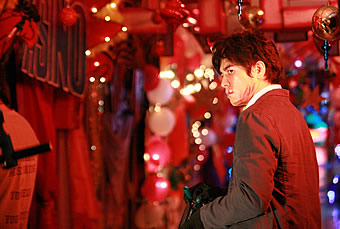
Based on the novel of the same name by Yusuke Kishi, Takashi Miike's Lesson of the Evil takes place at an elite Japanese high school where discipline is a rarity for both the teachers and the students. In the middle of it all is charismatic English teacher, Hasumi (Hideaki Ito), who is popular with the young female students, revered by the male students and impresses his fellow teaching staff. However, beneath the cleancut exterior lies the beating heart of a sadistic killer. Warning bells ring when he begins an affair with a student who had previously been sexually assaulted by a PE teacher as well as blackmailing another teacher having an affair with a male student. Hasumi's not a nice guy, no matter how much the film seems to want us to support him.
Excess is what you expect when it comes to the filmography of Takashi Miike, a director not known for either subtlety or restraint. Lesson of the Evil doesn't buck the trend at all, layering on repetitive and graphic murders to a jazzy soundtrack consisting solely of different versions of Mack the Knife. It's a neat joke at first; Mack the Knife is of course a famous song about a serial killer and is taken from by Bertolt Brecht and Kurt Weill (it is this, the German version, that plays first), but the final whistling version of it, you're about ready to find a copy of the CD just to throw it out the window or stamp on it a bit. The joke wears thin, an apt metaphor for the film itself.
It's hard not to compare it to the Miike film I watched earlier in the month, Audition, because everything that worked so well in that repeats itself in Lesson of the Evil, but with far less elegance. The idea of a person with an innate capacity for extreme violence existing in plain sight is such a good one, one which roots itself deep within the fear that we can never know what another person is thinking. The beauty of Audition is that doubt wasn't confirmed until right towards the end of the film, the violence that it resulted in compounded in to about twenty minutes of near-unbearable intensity. Also, the pacing was exquisite, building the atmosphere slowly until the finale's big release.
Lesson of the Evil, in contrast, makes the audience feel every second of the runtime, operating at such a languid pace at times that it feels as if the narrative will just peter out rather than build to anything. Of course, what it does build to is like the constant use of Mack the Knife, excessive and repetitive to the point of meaningless by the end. Hasumi is also the only character who is really allowed to present himself to the audience either. The students themselves, the victims of the situation, are barely given time to register outside a couple of scenes and as such, the impact of that shooting at the end is lessened before it even happens.
I don't expect horror films to be anything other than disturbing or unsettling because that's their place in film, to take our nightmares, render them semi-real and provide an outlet for them that ends when the credits roll. Sometimes though, the crossover between reality and a horror movie can be too on the nose. Given the sheer, horrifying amount of campus shootings that have taken place in recent years, Lesson of the Evil is just too on the nose to feel anything but distasteful. It doesn't help that the charismatic performance from Ito is designed to make you half-root for Hasumi as he's going round, gunning down hysterical teenagers. There's a little too much glee taken in these actions here.
Overwrought and by the numbers, Lesson of the Evil is the first film of the month that I've found myself actively not enjoying. Well, it had to happen eventually. It cuts a little too keenly at times to work whilst at others, it was simply too dull. With a director as prolific as Miike, there's bound to be a few bumps in the road.
- Becky
You can find my other Shocktober '15 reviews here.
Follow @AssortedBuffery on Twitter
Or like our Facebook page
Wednesday, 14 October 2015
FEATURE: Shocktober '15 - Eyes Without A Face
Over the course of October, I shall be watching one horror movie a day and reviewing it right here for your reading pleasure. I haven't seen any of the films I'll be watching before and you can find the full list here.
The film is the second of the month to feature the enormously successful writing partnership, Boileau-Narcejac, on whose story Les Diaboliques was based. Here, they worked alongside Georges Franju and Claude Sautet to adapt Jean Redon's novel of the same name. Eyes Without A Face shares several similarities with Les Diaboliques in the way the characters function within the narrative, often occupying the dual roles of heroine/victim or hero/villain. The lines blur between them as morality is impacted by emotion or ambition without ever losing the humanity at the heart of it.
Dr Génessier (Pierre Brasseur) is a plastic surgeon at the top of his field and with a successful clinic to show for it, but he is haunted by the car accident that horribly disfigured his daughter, Christiane (Edith Scob). She must now wear a mask that hides her deformity and acts as a flawless reminder of how she used to look prior to the accident, but it allows no expression beyond her eyes, her solely visible and undamaged facial feature. Obsessed with righting that wrong and restoring her face, Génessier begins secret surgical experiments in his chateau, aided by his assistant Louise (Alida Valli). She finds girls of the right physical appearance and skin tone to match Christiane and lures them back to Génessier, where he takes their face and grafts it on to Christiane.
Christiane haunts the film in her mask, Scob's slight frame drifting through the chateau in over-sized gowns that emphasise her doll-like appearance. The mask itself is both beautiful and unnerving in its inability to convey Christiane's expressions, giving it a strangeness that is both human and inanimate. Scob offers the most emotional performance of the three main characters, shining through the mask that could have proven restrictive, but only serves to emphasise her frustration and fragility.
That may be the only literal mask in the film, but metaphorical ones abound, particularly when it comes to the enigmatic Louise. Valli cuts a distinguished and authoritative figure when out on the streets of Paris finding her next victim, before transforming into something much more approachable and maternal when it comes to luring them in. In her interactions with Génessier though, she is humble and subservient, forever indebted to him for his work in restoring her own face, but still uneasy with the tasks she is forced to carry out.
Franju refuses to moralise, presenting a character's motivations alongside their actions without attempting to justify or condemn either one. The film also doesn't intend to operate on any level that is outright scary. Instead, Franju opts for something akin to a cold winter chill rather than any sudden autumnal storms, playing out a family tragedy that also happens to feature a particularly graphic but coldly presented surgery scene. It's a meditative and melancholic film, determined to render the familiar strange and vice versa.
The score is an essential aspect to the film's ongoing relationship with the strange and Maurice Jarre's music renders sounds of supposed jollity into something considerably more sinister. The jaunty waltz, the motif used to accompany Louise's movements throughout the film, is at once both comic and jarring, played on a barrel organ. It's the kind of music that should be heard at fairs or carnivals, but is instead scoring the deposit of a dead body in the river or stalking a new potential victim. Likewise, Christiane's music, 'Theme Romantique', is a ballet-like refrain, a lyrical dance that works nicely into the film's fairytale-like quality as well as emphasising Christiane's ethereal existence throughout.
Eyes Without A Face is a completely absorbing piece of work, a haunting melancholic fairytale that has been massively influential since its appearance in 1960. It has also recently been restored by the BFI and re-released on Blu-Ray; with extensive special features and accompanying booklet, I heartily recommend it for film enthusiasts.
- Becky
You can find my other Shocktober '15 reviews here.
Follow @AssortedBuffery on Twitter
Or like our Facebook page
Dr Génessier (Pierre Brasseur) is a plastic surgeon at the top of his field and with a successful clinic to show for it, but he is haunted by the car accident that horribly disfigured his daughter, Christiane (Edith Scob). She must now wear a mask that hides her deformity and acts as a flawless reminder of how she used to look prior to the accident, but it allows no expression beyond her eyes, her solely visible and undamaged facial feature. Obsessed with righting that wrong and restoring her face, Génessier begins secret surgical experiments in his chateau, aided by his assistant Louise (Alida Valli). She finds girls of the right physical appearance and skin tone to match Christiane and lures them back to Génessier, where he takes their face and grafts it on to Christiane.
Christiane haunts the film in her mask, Scob's slight frame drifting through the chateau in over-sized gowns that emphasise her doll-like appearance. The mask itself is both beautiful and unnerving in its inability to convey Christiane's expressions, giving it a strangeness that is both human and inanimate. Scob offers the most emotional performance of the three main characters, shining through the mask that could have proven restrictive, but only serves to emphasise her frustration and fragility.
That may be the only literal mask in the film, but metaphorical ones abound, particularly when it comes to the enigmatic Louise. Valli cuts a distinguished and authoritative figure when out on the streets of Paris finding her next victim, before transforming into something much more approachable and maternal when it comes to luring them in. In her interactions with Génessier though, she is humble and subservient, forever indebted to him for his work in restoring her own face, but still uneasy with the tasks she is forced to carry out.
Franju refuses to moralise, presenting a character's motivations alongside their actions without attempting to justify or condemn either one. The film also doesn't intend to operate on any level that is outright scary. Instead, Franju opts for something akin to a cold winter chill rather than any sudden autumnal storms, playing out a family tragedy that also happens to feature a particularly graphic but coldly presented surgery scene. It's a meditative and melancholic film, determined to render the familiar strange and vice versa.
The score is an essential aspect to the film's ongoing relationship with the strange and Maurice Jarre's music renders sounds of supposed jollity into something considerably more sinister. The jaunty waltz, the motif used to accompany Louise's movements throughout the film, is at once both comic and jarring, played on a barrel organ. It's the kind of music that should be heard at fairs or carnivals, but is instead scoring the deposit of a dead body in the river or stalking a new potential victim. Likewise, Christiane's music, 'Theme Romantique', is a ballet-like refrain, a lyrical dance that works nicely into the film's fairytale-like quality as well as emphasising Christiane's ethereal existence throughout.
Eyes Without A Face is a completely absorbing piece of work, a haunting melancholic fairytale that has been massively influential since its appearance in 1960. It has also recently been restored by the BFI and re-released on Blu-Ray; with extensive special features and accompanying booklet, I heartily recommend it for film enthusiasts.
- Becky
You can find my other Shocktober '15 reviews here.
Follow @AssortedBuffery on Twitter
Or like our Facebook page
Tuesday, 13 October 2015
TV REVIEW: Doctor Who - Before The Flood
Having spent a good deal of the forty five minutes of Before The Flood watching from behind my hands, I can happily conclude that this episode scared me more than most Doctor Who episodes.
Travelling
back to the time the spaceship first landed, The Doctor (Peter Capaldi) left
Clara (Jenna Coleman) et al behind on the submarine fending off the ghosts –
who now included an eerie ghost Doctor in their number. Inconveniently locked
in his own time stream, he found himself up against the terrifying Fisher King,
desperately trying to stop anyone else, winding up as a ghostly transmission
device.
Terrifying
seems a good place to start with this episode. Several scenes of the episode
wouldn’t have felt out of place in an indie horror film. And that’s before we
even consider the Fisher King. A shell-fish, cockroach type of creature with
all the warmth of The Grim Reaper, The Fisher King gave us our second, totally
brand new, totally nightmare-inducing monster of the series – not bad for
episode four. It was also a noticeably long time before we got a good look at
him, which may have frustrated some, but for me, artfully built on our innate
fear of the unknown.
When we
weren’t busy being terrified of the Fisher King, it’s worth mentioning that the
invasion themes, Cold War and military style settings of Toby Whithouse’s
writing married together perfectly. So too did the two different time streams
and locations in that perfectly executed countdown sequence, The Doctor linking
the two with this own timeline. Much akin to the night and day settings of the
submarine, this episode was very much the shade to Under The Lake's light,
literally much darker in places because of the minimal lighting, and with far
fewer jokes, the stakes felt high here, even though we knew that, ultimately,
The Doctor and Clara would probably be fine.
Particular
stand out moments include Sophie Leigh Stone’s Cass having to feel for the
vibrations along the floor to find out that an axe wielding ghost was right
behind her, and O’Donnell (Morven Christie) cowering round a corner from the
Fisher King. Indeed senses were a key theme throughout, with Cass without
hearing, the ghosts without eyes and, without the phone, Clara and The Doctor
unable to talk. The Beethoven’s 5th Framing Device worked well, too
- the episode needed tying together somewhat as the timey-wimey elements were
slightly more complicated than usual and not terribly well explained in places.
Fortunately, Capaldi’s style is perfectly suited to the occasional breaking of
the Fourth Wall.
I
couldn’t help but slightly regret the fact that Missy didn’t jump out of the
preservation pod at the end, umbrella in tow, yelling ‘surprise!’ at the top of
her voice, so integral does her character now feel to the Doctor Who universe.
But admittedly that may just have been me.
Ably
supported by a fantastic cast of secondary characters in both episodes of this
pairing, the Capaldi/Coleman partnership itself continues to flourish (another
reason why the absence of Missy was perhaps a good thing). Naturally this can
only mean, even if we didn’t know it already, that we may well be about to lose
Clara. The Doctor departing the scene without her, with two other companions in
tow, felt a little like a test run for Capaldi sans Coleman. Much as Clara can be
outshone by the nearest 40 watt desk lamp in some of her more 2D moments, she
feeds off Capaldi’s energy well, provided a great straight woman to The
Doctor’s emotional eccentricities. It will certainly be interesting to see who
ends up replacing her.
Again, I
pulled slightly the short straw here reviewing part two of the story, as the
concluded episodes do tend to suffer a little of the anti-climax. But it’s a
minor quibble really in what was another strong episode. So many of last
series’ outings just felt like filler – I’m still waiting for that to happen
this time around, but I feel like it might be a while off yet.
Next week
look’s brilliant, as has every next episode preview so far.
Becky
will be here to walk you through The Girl Who Died.
Follow @AssortedBuffery on Twitter
Or like our Facebook page
FEATURE: Shocktober '15 - The Fly (1986)
Over the course of October, I shall be watching one horror movie a day and reviewing it right here for your reading pleasure. I haven't seen any of the films I'll be watching before and you can find the full list here.
Adapted from the story by George Langelaan (also the basis for the 1958 version), The Fly tells the tale of Seth Brundle (Jeff Goldblum), a scientist who is clearly exceptionally brilliant, but also a bit socially inept. He's been working on a teleportation device that he manages to convince journalist Veronica Quaife (Geena Davis) to see. She witnesses it working and decides to follow Seth as he continues his experiments, the pair of them developing a romantic relationship at the same time. In a drunken moment of hubris, he decides to use the machine himself, not realising that a fly has entered the pod with him; the transportation process fuses them at a genetic level and Seth slowly finds himself transformed.
I've already done the Darwinian thing in the earlier review of Invasion of the Body Snatchers (incidentally also starring Jeff Goldblum) so I won't do it again too much here, but a large part of the anxiety that grew out of The Origin of Species was to do with humans being aligned with beasts. Monsters in fiction often depict this by presenting a corruption of humanity; think the vampires who can transform themselves into animals and werewolves to name the two most obvious examples. Transformations have also been used to explore humanity and the loss of it in other literary works, the most obvious of which is probably Franz Kafka's Metamorphosis, in which poor Gregor Samsa is transformed into a large insect for no real reason.
That's the work that probably comes to mind most whilst watching The Fly, but the idea of the bestial corrupting the human body and destroying it is in there too. David Cronenberg not only operates at this level, but also within the very late 20th century world of health scares and viral epidemics. The transformation into the fly is not only a corruption of humanity, but a betrayal of the human body itself. Seth compares his ongoing plight as a transformative disease, eroding him like a cancer. Veronica's pregnancy too taps into fears surrounding that particular experience, though thankfully I've never heard of anyone actually giving birth to a maggot baby, but what she experiences is invasive and just as unpredictable as the Brundlefly.
I like to think of myself as having a fairly high tolerance for body horror, but the fingernails and teeth scenes even managed to defeat me. Watching it before a meal time was not the best idea I have ever had. There were goosebumps and queasy feelings. In fact, that reaction pretty much sums up my response to the film. The effects are so impressive, particularly the make-up work with Goldblum in the latter stages of Seth's transformation. There's a tangibility that can only be achieved practically and it aids every aspect of Goldblum's performance, transforming himself physically as the make-up allows whilst retaining, at all times, the semblance of humanity that is needed.
It's the human element that makes the more outlandish moments in the film work, but it takes a while for the film to find it. The relationship between Seth and Veronica happens too quickly to feel invested in it straight away and as such, Seth's drunken jealous moment feels like it comes out of nowhere. Cronenberg is clearly interested in getting to the meat of the story far more than he is in setting it up, but as the film progresses, it's understandable why he does it. The transformation is the interesting bit, not only visually, but thematically as discussed. Post-transformation, the urgency in Seth and Veronica's relationship suddenly works as well as the ease with which it starts to fracture.
I'm not sure I'll ever want to watch it again or at least for a long time, simply because I'm still feeling pretty nauseous over an hour after it finishing, but The Fly is a fascinating piece of film-making that ties into a long tradition of using the monstrous to explore the human, albeit in new and certainly ickier ways.
- Becky
You can find my other Shocktober '15 reviews here.
Follow @AssortedBuffery on Twitter
Or like our Facebook page
Adapted from the story by George Langelaan (also the basis for the 1958 version), The Fly tells the tale of Seth Brundle (Jeff Goldblum), a scientist who is clearly exceptionally brilliant, but also a bit socially inept. He's been working on a teleportation device that he manages to convince journalist Veronica Quaife (Geena Davis) to see. She witnesses it working and decides to follow Seth as he continues his experiments, the pair of them developing a romantic relationship at the same time. In a drunken moment of hubris, he decides to use the machine himself, not realising that a fly has entered the pod with him; the transportation process fuses them at a genetic level and Seth slowly finds himself transformed.
I've already done the Darwinian thing in the earlier review of Invasion of the Body Snatchers (incidentally also starring Jeff Goldblum) so I won't do it again too much here, but a large part of the anxiety that grew out of The Origin of Species was to do with humans being aligned with beasts. Monsters in fiction often depict this by presenting a corruption of humanity; think the vampires who can transform themselves into animals and werewolves to name the two most obvious examples. Transformations have also been used to explore humanity and the loss of it in other literary works, the most obvious of which is probably Franz Kafka's Metamorphosis, in which poor Gregor Samsa is transformed into a large insect for no real reason.
That's the work that probably comes to mind most whilst watching The Fly, but the idea of the bestial corrupting the human body and destroying it is in there too. David Cronenberg not only operates at this level, but also within the very late 20th century world of health scares and viral epidemics. The transformation into the fly is not only a corruption of humanity, but a betrayal of the human body itself. Seth compares his ongoing plight as a transformative disease, eroding him like a cancer. Veronica's pregnancy too taps into fears surrounding that particular experience, though thankfully I've never heard of anyone actually giving birth to a maggot baby, but what she experiences is invasive and just as unpredictable as the Brundlefly.
I like to think of myself as having a fairly high tolerance for body horror, but the fingernails and teeth scenes even managed to defeat me. Watching it before a meal time was not the best idea I have ever had. There were goosebumps and queasy feelings. In fact, that reaction pretty much sums up my response to the film. The effects are so impressive, particularly the make-up work with Goldblum in the latter stages of Seth's transformation. There's a tangibility that can only be achieved practically and it aids every aspect of Goldblum's performance, transforming himself physically as the make-up allows whilst retaining, at all times, the semblance of humanity that is needed.
I'm not sure I'll ever want to watch it again or at least for a long time, simply because I'm still feeling pretty nauseous over an hour after it finishing, but The Fly is a fascinating piece of film-making that ties into a long tradition of using the monstrous to explore the human, albeit in new and certainly ickier ways.
- Becky
You can find my other Shocktober '15 reviews here.
Follow @AssortedBuffery on Twitter
Or like our Facebook page
Monday, 12 October 2015
FEATURE: Shocktober '15 - The Loved Ones
Over the course of October, I shall be watching one horror movie a day and reviewing it right here for your reading pleasure. I haven't seen any of the films I'll be watching before and you can find the full list here.
Xavier Samuel stars as Brent Mitchell, a teen who has become a full stoner burnout since the death of his father in a car accident, in which Brent was driving, six months earlier. When Lola Stone (Robin McLeavy) asks to be his date to the end of school dance, he politely refuses, saying that he is going with girlfriend Holly (Victoria Thaine), the one bright spot in his life at the moment. Lola, however, has other ideas, working with her father to kidnap Brent and put him through a prom night experience he isn't likely to get over quickly.
The Loved Ones is the directorial debut of Sean Byrne and operates with the kind of no-holds-barred attitude that first time directors often bring to their work, free from the pressure of expectation. He weaves together a film that successfully spins the usual teen format into a witty, tongue-in-cheek horror marvel that's both riotously entertaining, bloodcurdling and extremely funny. It also has at its heart a family tragedy, one which at times feels plucked from another film entirely. It's a heady mix and occasionally, the film's wacky tone threatens to get in the way of everything else going on, but Byrne navigates it with a sure hand, never quite letting it go too far.
All the hallmarks of a good teen movie are there; the girly outsider who just wants the perfect prom, the moody guy she falls in love with, the comedy sidekick and his very own romantic subplot. There just also happens to be torture, maiming and a basement full of emaciated kidnap victims. Lola is Andy from Pretty in Pink taken to the extreme, her scrapbook of former torture victims as treasured as the clothes Andy makes herself. She also quite the close relationship with her father, but John Brumpton is miles creepier than Harry Dean Stanton. So yeah, it's John Hughes... but with drill bits.
Samuel gets the most grounded role in The Loved Ones and provides a strong core, navigating Brent's guilt over his father's death, the difficult relationship with his mother as well as his suicidal and self-harm tendencies. Brent is someone who has repeatedly wished for death, only to fight back accordingly when the actual possibility is presented to him. The film does, however, belong to McLeavy's deliciously wicked Lola, all teen innocence in a pink cocktail dress and impractical heels. She throws herself into the sheer absurdity of it, playing Lola as that teen heroine in her own twisted prom story. "This is my first drilling," she says coyly, with all the shy excitement of a girl out with her boyfriend for the first time. It's brilliant.
For people like me who are fans of both teen horrors and teen comedies, the blend of the two in The Loved Ones is very nearly perfect, finding that line where laughing in horrified glee becomes the norm.
- Becky
You can find my other Shocktober '15 reviews here.
Follow @AssortedBuffery on Twitter
Or like our Facebook page
Xavier Samuel stars as Brent Mitchell, a teen who has become a full stoner burnout since the death of his father in a car accident, in which Brent was driving, six months earlier. When Lola Stone (Robin McLeavy) asks to be his date to the end of school dance, he politely refuses, saying that he is going with girlfriend Holly (Victoria Thaine), the one bright spot in his life at the moment. Lola, however, has other ideas, working with her father to kidnap Brent and put him through a prom night experience he isn't likely to get over quickly.
The Loved Ones is the directorial debut of Sean Byrne and operates with the kind of no-holds-barred attitude that first time directors often bring to their work, free from the pressure of expectation. He weaves together a film that successfully spins the usual teen format into a witty, tongue-in-cheek horror marvel that's both riotously entertaining, bloodcurdling and extremely funny. It also has at its heart a family tragedy, one which at times feels plucked from another film entirely. It's a heady mix and occasionally, the film's wacky tone threatens to get in the way of everything else going on, but Byrne navigates it with a sure hand, never quite letting it go too far.
All the hallmarks of a good teen movie are there; the girly outsider who just wants the perfect prom, the moody guy she falls in love with, the comedy sidekick and his very own romantic subplot. There just also happens to be torture, maiming and a basement full of emaciated kidnap victims. Lola is Andy from Pretty in Pink taken to the extreme, her scrapbook of former torture victims as treasured as the clothes Andy makes herself. She also quite the close relationship with her father, but John Brumpton is miles creepier than Harry Dean Stanton. So yeah, it's John Hughes... but with drill bits.
Samuel gets the most grounded role in The Loved Ones and provides a strong core, navigating Brent's guilt over his father's death, the difficult relationship with his mother as well as his suicidal and self-harm tendencies. Brent is someone who has repeatedly wished for death, only to fight back accordingly when the actual possibility is presented to him. The film does, however, belong to McLeavy's deliciously wicked Lola, all teen innocence in a pink cocktail dress and impractical heels. She throws herself into the sheer absurdity of it, playing Lola as that teen heroine in her own twisted prom story. "This is my first drilling," she says coyly, with all the shy excitement of a girl out with her boyfriend for the first time. It's brilliant.
For people like me who are fans of both teen horrors and teen comedies, the blend of the two in The Loved Ones is very nearly perfect, finding that line where laughing in horrified glee becomes the norm.
- Becky
You can find my other Shocktober '15 reviews here.
Follow @AssortedBuffery on Twitter
Or like our Facebook page
Sunday, 11 October 2015
FEATURE: Shocktober '15 - The Raven (1935)
Over the course of October, I shall be watching one horror movie a day and reviewing it right here for your reading pleasure. I haven't seen any of the films I'll be watching before and you can find the full list here.
You can't have a whole season dedicated to horror movies and not watch a film in which either Bela Lugosi or Boris Karloff appear, or even both at the same time. The Raven finds Universal's gruesome twosome starring together; Lugosi plays the Edgar Allan Poe-obsessed Dr Vollin who teams up with Karloff's escaped convict Edmond Bateman to capture and torture the people preventing Vollin's relationship with dancer Jean Thatcher (Irene Ware). Having saved her life after a car accident, Vollin has become infatuated with her, but she intends to marry another and her father, Judge Thatcher (Lester Matthews) wants to ensure that happens.
Despite the fact that they belong to the horror genre, I've always found something vaguely comforting about the old black-and-white Universal canon. There's a familiarity with its subjects even without any extensive knowledge of the films themselves. The Raven bears all the classic hallmarks too; menacing sophistication from Lugosi, Karloff acting his socks off through a layer of make-up (in fact, he's billed solely as his surname in the credits, ), hidden staircases, a wall of switches, medieval-style torture chambers, the lot. It's a wonderful little slice of the macabre that uses its stars well.
The poster above bills the film as an adaptation of Poe's poem The Raven, which it really isn't, though it does use lines from it throughout. Instead, Poe acts as an inspiration for the narrative and it's a tale that makes good use of his particular brand of Gothic. Obsession is a big feature across Poe's works, particularly the idea of a romantic one, and Vollin as a character could easily slot into one of Poe's tales. The raven itself is no more than a talisman for Vollin, silhouetted beautifully against the wall of his study in his first scene and setting the tone for the rest of the film.
The other major Poe reference is that Vollin has created his own versions of several of Poe's torture devices, including the infamous pendulum and the shrinking room. He boasts of this early on and if there was ever a big red warning sign hanging over a character, that was it. Lugosi is great fun here, always on the edge of hamming it up, but managing to stay the right side of ludicrously menacing (arguably his big evil laugh in the final moments tips him over the edge though).
The climax of the film, in which those torture devices are put to use (though not graphically, this is 1935 after all), is easily its strongest moment. The pendulum device has already been demonstrated at this point so the mechanics are known to the audience, given its use on Judge Thatcher a delicious element of dramatic irony. It also acts as a countdown; once the pendulum starts swinging, there's 15 minutes until it begins slicing into the Judge. The shrinking room is even faster and the film wrings its tension from close ups of the descending pendulum or the long shot of the room as the walls close in. It's an effective sequence and one which relies more on the audience's anticipation of impending doom than it does in showing it, which is sometimes very welcome.
The tale of the film after its release is quite a sad one. Not massively popular with audiences at the time, possibly due to its disfigurement and torture scenes, it marked the moment at which horror started to decline in popularity. It's not particularly hard to see why; it doesn't carry the same majesty as either Frankenstein or Dracula, the roles which made its stars famous, but it's still an entertaining slice of old-fashioned horror.
- Becky
You can find my other Shocktober '15 reviews here.
Follow @AssortedBuffery on Twitter
Or like our Facebook page
You can't have a whole season dedicated to horror movies and not watch a film in which either Bela Lugosi or Boris Karloff appear, or even both at the same time. The Raven finds Universal's gruesome twosome starring together; Lugosi plays the Edgar Allan Poe-obsessed Dr Vollin who teams up with Karloff's escaped convict Edmond Bateman to capture and torture the people preventing Vollin's relationship with dancer Jean Thatcher (Irene Ware). Having saved her life after a car accident, Vollin has become infatuated with her, but she intends to marry another and her father, Judge Thatcher (Lester Matthews) wants to ensure that happens.
Despite the fact that they belong to the horror genre, I've always found something vaguely comforting about the old black-and-white Universal canon. There's a familiarity with its subjects even without any extensive knowledge of the films themselves. The Raven bears all the classic hallmarks too; menacing sophistication from Lugosi, Karloff acting his socks off through a layer of make-up (in fact, he's billed solely as his surname in the credits, ), hidden staircases, a wall of switches, medieval-style torture chambers, the lot. It's a wonderful little slice of the macabre that uses its stars well.
The poster above bills the film as an adaptation of Poe's poem The Raven, which it really isn't, though it does use lines from it throughout. Instead, Poe acts as an inspiration for the narrative and it's a tale that makes good use of his particular brand of Gothic. Obsession is a big feature across Poe's works, particularly the idea of a romantic one, and Vollin as a character could easily slot into one of Poe's tales. The raven itself is no more than a talisman for Vollin, silhouetted beautifully against the wall of his study in his first scene and setting the tone for the rest of the film.
The other major Poe reference is that Vollin has created his own versions of several of Poe's torture devices, including the infamous pendulum and the shrinking room. He boasts of this early on and if there was ever a big red warning sign hanging over a character, that was it. Lugosi is great fun here, always on the edge of hamming it up, but managing to stay the right side of ludicrously menacing (arguably his big evil laugh in the final moments tips him over the edge though).
The climax of the film, in which those torture devices are put to use (though not graphically, this is 1935 after all), is easily its strongest moment. The pendulum device has already been demonstrated at this point so the mechanics are known to the audience, given its use on Judge Thatcher a delicious element of dramatic irony. It also acts as a countdown; once the pendulum starts swinging, there's 15 minutes until it begins slicing into the Judge. The shrinking room is even faster and the film wrings its tension from close ups of the descending pendulum or the long shot of the room as the walls close in. It's an effective sequence and one which relies more on the audience's anticipation of impending doom than it does in showing it, which is sometimes very welcome.
The tale of the film after its release is quite a sad one. Not massively popular with audiences at the time, possibly due to its disfigurement and torture scenes, it marked the moment at which horror started to decline in popularity. It's not particularly hard to see why; it doesn't carry the same majesty as either Frankenstein or Dracula, the roles which made its stars famous, but it's still an entertaining slice of old-fashioned horror.
- Becky
You can find my other Shocktober '15 reviews here.
Follow @AssortedBuffery on Twitter
Or like our Facebook page
Subscribe to:
Posts (Atom)

