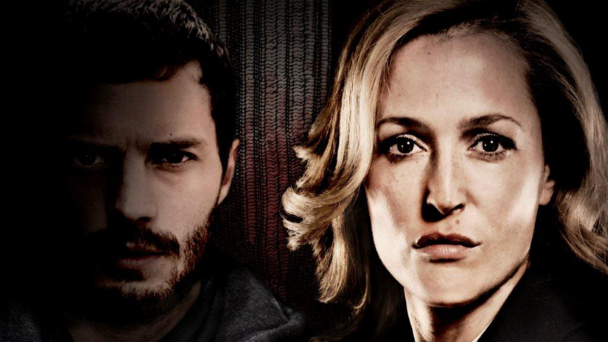
With the news that The Fall has been picked up for a second series, my enthusiasm for this show is at a serious high, aided in no small way by the fact that the third episode was so good, I'd quite happily sit and write an essay about it and the themes it has brought to the fore. I won't, not in this review anyway, but it has impressed me in a way that no police procedural has for quite some time. Rather than a simple whodunnit, with the twists and turns you can spot a mile away, The Fall has opted for the whydunnit approach by following both DSI Stella Gibson (Gillian Anderson) and serial killer Paul Spector (Jamie Dornan) going about their businesses in all their vast differences. Far from just a gimmick, it has proved essential to individualising the show and allowing it to explore more cerebral themes in amongst the autopsies.
The episode began with a lighter atmosphere than we had seen in the previous two episodes, employing some well-pitched gallows humour to allow us to see a little bit more of Gibson. Whip-smart and ready with a handy putdown, Anderson's Gibson has been a great centre to all of the goings-on but I shall return to her shortly. Dornan has been nothing short of a revelation as Spector given that he has very little mainstream acting experience beyond a few episodes in Once Upon A Time and in Sofia Coppola's Marie Antoinette. He may be one of the more outwardly bland serial killers committed to celluloid (especially if you contrast him with Seven's John Doe, who he is starting to have some crossovers with), but Spector is a compelling watch and Dornan captures his two sides brilliantly, without ever losing that edge which makes the character so chilling.
Last week's episode opening was an uncomfortable intercut sequence and these are fast becoming one of the show's most used techniques to connect our two main characters. It displays an assured use of dramatic irony that treads a fine line between rolling our eyes at the obvious points, to becoming so engrossed as to shout at the television when Spector hugged his client. Or was that just me? Personally, I find myself getting worried whenever a brunette in her 30s appears on the screen. The final intercutting sequence as the detectives sat around discussing their profile of the killer whilst Spector haunts the house of his next victim proved the effectiveness of the technique. It provided us some motive exposition for Spector whilst seeing it play out with his movements.

It is also a theme that appears to be cropping up in the language of the series as well. We see Spector writing in his journals dedicated to his victims about 'the shadow'. Gibson's briefing is full of light-related imagery; she again likens the killer to the dark as he works in the shadows unseen whereas the police operate under the glare of the media. Even the environments in which the two main characters operate are characterised by these differences, for example the sterile, artificially-lit police headquarters where Gibson is most likely to be found in contrast to the muted, domestic tones of Spector's home.
Other binaries were also of the order of the day in this particular episode with plenty of commentary about the way women are portrayed in the media and thought of in society. Cropping up first in the selection of operation names was 'Eden', brushed aside by Gibson because it would ensure that the women were seen to be to blame for the murders. Likewise, in the discussion about whether to call the victim innocent, Gibson observes that the media likes to slot women neatly into the categories of virgin and whore and that it is best not to encourage them. Honestly, these little moments were ones which had me punching the air with perhaps a little too much glee considering what I was watching. Nevertheless, it is this treatment of women, in particular the victims, that should be commended in The Fall.
Linking back to the last episode once again, it featured a large amount of nudity, more than we'd seen on the show so far as Spector washed and cleaned his victim. However, the female body wasn't sexualised in the same way that say, a show like Game of Thrones would have done. Spector even demurely covers her up and this episode revealed that her pregnancy has somehow tainted the murder for him. He likes his victims pure and he is categorising them at the virgin end of the female spectrum. This is clearly going to matter in the series as the religious undertones are slowly coming to the fore; the title itself is an explicit reference to Eve and the repeated mentions of Eden and Genesis cropping up. There is one character who refuses to be defined in any such terms though and in doing so, is fast becoming one of the most intriguing characters on television.
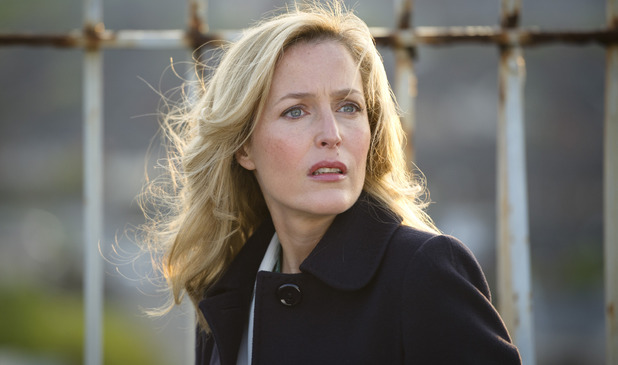
It also becomes a wider commentary of the show itself if you remove the sexual activity of the previous quote, it simply becomes 'woman - subject. Man - object'. For Spector, it is the other way around; women are objects for his sexual gratification. However, for the series, Gibson is most definitely the subject hunting down her object which is Spector, the killer. As the police officers working the case observe, he has an issue with women in powerful positions. 'Don't we all' one character wryly observes, but The Fall seems to be reversing this balance. Gibson is the one in power and it is only a matter of time before she succeeds in possessing her object. When she comments that Spector's killing is about 'power and control and the thrill', she could almost be talking about herself. It's a fascinating way of showing this kind of character and I can't wait to see how she develops further.
I've tried not to be too hyperbolic throughout this review as that can often put people off or raise expectations to a stupidly unachievable level, but The Fall really is one of the best shows on television at the moment. I also apologise for it turning into a bit of an essay, despite what I said at the beginning. If you haven't yet caught it, I urge you to head to iPlayer and settle yourself in for the first three episodes. It's as creepy as hell and as bleak as the foggiest of Dickens, but it's something quite special.
- Becky
You can read Becky's review of Episode Two here.
Follow @AssortedBuffery on Twitter
Or like our Facebook page

No comments:
Post a Comment