I have a confession to make. I didn't choose to stop reviewing Atlantis (if any of you had noticed that I had). I simply forgot it was on. Completely. It didn't even enter my head that I'd missed any episodes until this weekend. So I've just marathoned the three episodes I missed; The Song of the Sirens, Rules of Engagement and The Furies.
This was a bad plan.
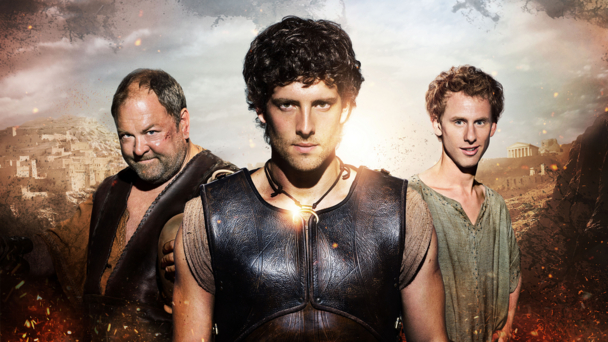
Watching it week by week was enough to expose the faults inherent in this series; the uninspired plotlines, the weak characterisation, the frankly odd combination of archaic turns of phrase with regular 2013 speak. Most of all, it's just dull. Watching it in one go just meant these faults screamed themselves at me over the course of over two hours. And yet I kept watching because the world they've created has such potential (until it left my memory of course). Atlantis could be a huge playing field for all sorts of Greek mythological beings to come into contact with our characters. Some have already, but they've done little with them. Even Circe, one of the most powerful and vindictive witches in all legend, is reduced to a quick episode appearance in a mysterious cloak.
Atlantis would do well to look to the American television series Once Upon A Time for advice on how to weave these characters together into a cohesive, believable whole. The fairytale series has taken the original stories as their base and gone in a wide variety of directions with it, changing characters' pasts and futures to suit their needs. Importantly though, it creates characters with depth, emotional ties and fascinating conflicts. Atlantis attempts to, but beyond Hercules (and I suspect this is more to do with Mark Addy than the writers), characters have had little to do but function as plot devices.
Nowhere is this more apparent than in the female characters, of which we have four main figures who interact with the main male trio. Even with such figures as Pasiphae, Ariadne, Medusa and The Oracle, the female characters are woefully underwritten, serving as little more than plot propellers even in episodes supposed to be around them. Ariadne seems to be there to look pretty, Medusa's doom-laden, The Oracle dispenses narrative and Pasiphae's evil. That's pretty much all there is to them. The male characters don't fare much better, but at least there are attempts to give them depth. The female characters are little more than bejewelled cardboard cutouts.
And now I follow with a short review of each of the episodes. May contain ranting.
The Song of the Sirens: Weaving in various elements of The Odyssey, the episode follows Hercules' attempts to win the heart of Medusa by resorting to magic. Needless to say, it goes awry. You know what the major problem with this episode is? I mean, aside from the terrible humour (again with the farting...). Hercules DRUGS Medusa into loving him. She then follows him around before succumbing to a disease which nearly kills her AND THEN DOESN'T GET TO CONFRONT HERCULES ABOUT IT. Way to go writers. That's exactly the kind of message we want to see on TV: You can't get a girl lads? Don't worry, just drug the one you want and it'll all be fine! I mean really BBC. Let's not have a plotline about roofying someone and not deal with the consequences.
Then there is The Rules of Engagement is, quite frankly, ridiculous. After spending all of about half an hour in each other's company, Jason and Ariadne get to suffer the starcrossed lovers riff as she becomes engaged to Heptarian. She weeps a lot and doesn't do much else. Jason mopes about a bit, gets his shirt off and decides to fight in the Pankration (which I'm well aware was an actual thing, but it sounds like a disease). There's lots of sweaty fighting and plotting in corners, but Ariadne has had about as much character development as the table Jason lies on when he's injured. The whole injured but continuing to fight for love thing is also a bit stolen from A Knight's Tale which has done nothing to endear me to Atlantis' attempts at originality. But, you know, the fight sequences were quite impressive.
And finally we get to The Furies in which Hercules, Pythagorus and Jason take the dullest road trip ever. It starts well, giving Pythagorus some much needed screentime that wasn't based on humiliating Hercules or healing Jason, but it centres on a brother he never met and features the darkest plotline yet to hit Atlantis in his abuse as a child. It could have been an interesting examination of family dynamics, of how the sins of the parents are visited on the child. Pythagorus is revealed as a murderer and... well it just seemed to come out of nowhere. Robert Emms does the best he can with it and gives an emotional performance but it seems completely incongruous with that which has gone before. Not to mention, the inclusion of The Furies was a wasted opportunity.
And what happened to Jason being from 2013? Seriously, where did that plotline go?
In short, I'm done with Atlantis.
- Becky
You can follow @AssortedBuffery on Twitter
Or like our Facebook page
Showing posts with label Juliet Stevenson. Show all posts
Tuesday, 19 November 2013
Sunday, 27 October 2013
TV REVIEW: Atlantis - White Lies
This week, Ariadne receives a message from her exiled brother and asks for Jason's help to find him before Pasiphae finds out that he still lives.
A messenger breaks into the palace in Atlantis and delivers word to Ariadne of her exiled brother Therus (Darwin Shaw). The messenger is caught and reveals his mission to Pasiphae who promptly charges her co-conspirator Heptarian to track Therus down as he could reveal something about his exile that would shake the foundations of the royal family. Ariadne employs Jason, Pythagorus and Hercules to help get her to her brother and must choose where her loyalties lie. And there's a subplot about a racing beetle. I kid you not.
The royal family have been a rather distant element to Atlantis so far; Ariadne has been there to glance alluringly at Jason, Pasiphae plots evilly in a corner and Minos gets to be imperious. So, therefore, it's about time that we get an episode devoted to them, even if it is only to confirm what we already knew in terms of Pasiphae's scheming. Sarah Parish once again gives a grand performance and her scene with Juliet Stevenson's Oracle was just about the best thing Atlantis has done. The romantic plot between Ariadne and Jason was also quite sweet too, finally giving the two actors a chance to actually do something with their respective roles. In fact, Jason even got to do some emoting and talking, two things he's not done a whole lot of in between all the slow-motion fighting.
Yes, Slow Motion Jason didn't actually appear in any great prominence this week which was mightily refreshing. Although his back story (ie. time travel, dead father) seems to have entirely disappeared from the realm of his concern for a while now which seems a tad strange, this episode did much more than any other to endear me to the character. He's not interesting yet, but at least his attempt to clean up the table and subsequent awkward conversations with Ariadne were rather amusing and showed he's more than just an action man. In fact, his only action sequence was a tad disappointing as it took place almost entirely in the dark and with both Shaw and Jack Donnelly possessing curly dark hair, it was impossible to tell who was who. Still, that was only a minor problem in the scheme of things.
Speaking of other problems, the intrusive score does little to ramp up the tension and there were several points where the woman wailing over the percussion sounded like she was in so much pain that I wanted the episode to switch and help her instead. That's nothing though compared to the bloody beetle plotline which drained away any enthusiasm that was building for this episode. Why the writers keep insisting on including this ridiculous humour is beyond me. I'm aware that it is a family show but they also have the responsibility to tell a good story and that will capture children's imagination too. That should be where the focus lies, not in whatever Hercules is doing to make an idiot of himself. I don't know about anyone else, but I just kept wanting to shout STOP TALKING ABOUT THE BEETLE.
An episode that promises all the elements that make up Greek tragedy; family secrets, subsequent squabbles and a bit of bloodshed, White Lies takes steps to give us a tense mystery around the exile of the Prince Therus. It doesn't quite manage it but it is a much better episode than last week's nightmare. However, the plot with the beetle was just ridiculous.
- Becky
You can read Becky's review of the previous episode here
Follow @AssortedBuffery on Twitter
Or like our Facebook page
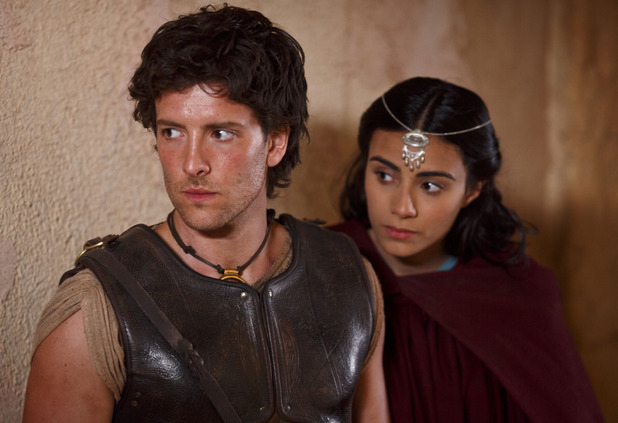
A messenger breaks into the palace in Atlantis and delivers word to Ariadne of her exiled brother Therus (Darwin Shaw). The messenger is caught and reveals his mission to Pasiphae who promptly charges her co-conspirator Heptarian to track Therus down as he could reveal something about his exile that would shake the foundations of the royal family. Ariadne employs Jason, Pythagorus and Hercules to help get her to her brother and must choose where her loyalties lie. And there's a subplot about a racing beetle. I kid you not.
The royal family have been a rather distant element to Atlantis so far; Ariadne has been there to glance alluringly at Jason, Pasiphae plots evilly in a corner and Minos gets to be imperious. So, therefore, it's about time that we get an episode devoted to them, even if it is only to confirm what we already knew in terms of Pasiphae's scheming. Sarah Parish once again gives a grand performance and her scene with Juliet Stevenson's Oracle was just about the best thing Atlantis has done. The romantic plot between Ariadne and Jason was also quite sweet too, finally giving the two actors a chance to actually do something with their respective roles. In fact, Jason even got to do some emoting and talking, two things he's not done a whole lot of in between all the slow-motion fighting.
Yes, Slow Motion Jason didn't actually appear in any great prominence this week which was mightily refreshing. Although his back story (ie. time travel, dead father) seems to have entirely disappeared from the realm of his concern for a while now which seems a tad strange, this episode did much more than any other to endear me to the character. He's not interesting yet, but at least his attempt to clean up the table and subsequent awkward conversations with Ariadne were rather amusing and showed he's more than just an action man. In fact, his only action sequence was a tad disappointing as it took place almost entirely in the dark and with both Shaw and Jack Donnelly possessing curly dark hair, it was impossible to tell who was who. Still, that was only a minor problem in the scheme of things.
Speaking of other problems, the intrusive score does little to ramp up the tension and there were several points where the woman wailing over the percussion sounded like she was in so much pain that I wanted the episode to switch and help her instead. That's nothing though compared to the bloody beetle plotline which drained away any enthusiasm that was building for this episode. Why the writers keep insisting on including this ridiculous humour is beyond me. I'm aware that it is a family show but they also have the responsibility to tell a good story and that will capture children's imagination too. That should be where the focus lies, not in whatever Hercules is doing to make an idiot of himself. I don't know about anyone else, but I just kept wanting to shout STOP TALKING ABOUT THE BEETLE.
An episode that promises all the elements that make up Greek tragedy; family secrets, subsequent squabbles and a bit of bloodshed, White Lies takes steps to give us a tense mystery around the exile of the Prince Therus. It doesn't quite manage it but it is a much better episode than last week's nightmare. However, the plot with the beetle was just ridiculous.
- Becky
You can read Becky's review of the previous episode here
Follow @AssortedBuffery on Twitter
Or like our Facebook page
Wednesday, 16 October 2013
TV REVIEW: Atlantis - A Boy of No Consequence
After tussling with an equally glowering and strapping young man, Jason, Pythagorus and Hercules find out they've offended Poseidon and they are left to the mercy of the bulls. Yes, the plot this week is based on leaping bulls.
Once again, Jason's time travel becomes a convenient excuse to get him into trouble as he leaps to the aid of an old man who was being smacked around by said glowering young man, Heptarian (Oliver Walker), a servant of the god Poseidon and nephew of the Queen. This series of unfortunate events leads to expositioning abound as every character has to bring both Jason and the audience up to speed with such wondrous customs as the favour of the Gods (a huge thing in Greek mythology though given little weight here) and bull leaping. Yes. Leaping bulls was actually a thing. At least we can't criticise Atlantis for not teaching us anything. Naturally, the fact that Jason et al. saved Atlantis from the minotaur is, as Hercules points out, is conveniently forgotten.
The amount of times people say that Jason is a 'natural born bull leaper' with a straight face has to be commended, particularly Sarah Parish who is just about wonderful in anything she does, even with lines like that. She gets to do some nefarious plotting this week and is the subject of some brilliantly stilted dialogue. In fact, the dialogue this week is so laughably terrible that it actually became painful to watch. When Pythagorus isn't saying obvious things like "or maybe you thought that was the only way to get us to work as a team", Jason is saying ridiculous statements like "it's as though her eyes burn right through me". I know the writers need to convey that this is a different time period, but it's getting ever so grating listening to characters say sentences that no human being could ever say naturally.
The thing with this episode is that I spent the entire time thinking that it would be far more interesting if it was gladiatorial combat or Greek wrestling or anything remotely interesting. Obviously this is a Saturday evening show and is therefore limited on how much gore they can show, if any at all, but the inexpensive special effects and lack of peril drew any tension out of the bull-leaping scenes. The fact that they try to equate these scenes with the importance of the gladiator battles seen in the likes of Ridley Scott's film or even the ludicrous Spartacus: Blood and Sand (which takes bad dialogue to a new level, but somehow it works), just makes them seem all the more inferior. Of course, they did mean that Slow-Motion Jason could appear, sans shirt and with curly hair wafting softly in the breeze.
I'm trying desperately to find good points in this show beyond 'it looks really pretty' because the concept is interesting and the actors deserve better. However, it's just dull and borderline uncomfortable to watch. The humour falls flat, the characters rarely seem actually in danger and even Merlin and Robin Hood had more going for them at this stage in their admittedly awful first series.
For the love of the Gods Atlantis, please get better.
- Becky
You can read Becky's review of the previous episode here.
Follow @AssortedBuffery on Twitter
Or like our Facebook page.
Once again, Jason's time travel becomes a convenient excuse to get him into trouble as he leaps to the aid of an old man who was being smacked around by said glowering young man, Heptarian (Oliver Walker), a servant of the god Poseidon and nephew of the Queen. This series of unfortunate events leads to expositioning abound as every character has to bring both Jason and the audience up to speed with such wondrous customs as the favour of the Gods (a huge thing in Greek mythology though given little weight here) and bull leaping. Yes. Leaping bulls was actually a thing. At least we can't criticise Atlantis for not teaching us anything. Naturally, the fact that Jason et al. saved Atlantis from the minotaur is, as Hercules points out, is conveniently forgotten.
The amount of times people say that Jason is a 'natural born bull leaper' with a straight face has to be commended, particularly Sarah Parish who is just about wonderful in anything she does, even with lines like that. She gets to do some nefarious plotting this week and is the subject of some brilliantly stilted dialogue. In fact, the dialogue this week is so laughably terrible that it actually became painful to watch. When Pythagorus isn't saying obvious things like "or maybe you thought that was the only way to get us to work as a team", Jason is saying ridiculous statements like "it's as though her eyes burn right through me". I know the writers need to convey that this is a different time period, but it's getting ever so grating listening to characters say sentences that no human being could ever say naturally.
The thing with this episode is that I spent the entire time thinking that it would be far more interesting if it was gladiatorial combat or Greek wrestling or anything remotely interesting. Obviously this is a Saturday evening show and is therefore limited on how much gore they can show, if any at all, but the inexpensive special effects and lack of peril drew any tension out of the bull-leaping scenes. The fact that they try to equate these scenes with the importance of the gladiator battles seen in the likes of Ridley Scott's film or even the ludicrous Spartacus: Blood and Sand (which takes bad dialogue to a new level, but somehow it works), just makes them seem all the more inferior. Of course, they did mean that Slow-Motion Jason could appear, sans shirt and with curly hair wafting softly in the breeze.
I'm trying desperately to find good points in this show beyond 'it looks really pretty' because the concept is interesting and the actors deserve better. However, it's just dull and borderline uncomfortable to watch. The humour falls flat, the characters rarely seem actually in danger and even Merlin and Robin Hood had more going for them at this stage in their admittedly awful first series.
For the love of the Gods Atlantis, please get better.
- Becky
You can read Becky's review of the previous episode here.
Follow @AssortedBuffery on Twitter
Or like our Facebook page.
Sunday, 6 October 2013
TV REVIEW: Atlantis - A Girl By Any Other Name
This week, Jason finds himself tangling with the Maenads, followers of Dionysus, questioning his destiny, fighting in slow-motion and meeting a woman called Medusa.
For what initially appears to be a simple plotline, there's a lot going on in this episode, starting with Jason and Hercules working security for a merchant only for Hercules to get drunk on the job and allow the theft of the frankincense that he's supposed to be protecting. Then, an old man comes to seek Jason's help in finding his missing daughter, Demetria, who he wishes to see before he dies. Jason agrees to help, Hercules does to in order to escape the rich merchant and Pythagorus is mostly filler. The three get tangled up with the Maenads who follow the god Dionysus (in a rather tame version of his rites and rituals, as befitting a Saturday night audience) and incorrectly represented satyrs, where they also meet Medusa.
So yes, many many things going on in this episode and not all of them good. The balance between levity and drama across the narrative is misjudged a fair amount of the time and Hercules' bombast is going to become irritating before long. I love Mark Addy, but his performance is particularly one-note at the moment, all shouting and guffawing, which is occasionally humourous, but sticks out like a sore thumb when the tone shifts to weightier stuff. Performances elsewhere are more successful than others; it's great to see Jemima Rooper on screen again and she's the best thing in this as Medusa, currently a lot nicer than the destiny that awaits her. Jack Donnelly, on the other hand, is a charisma vacuum, saddled with some terrible, clunky lines which he can't help but deliver in a stilted fashion. If he's supposed to be from the 21st century, why is he speaking like a character from a Charlton Heston swords-and-sandals epic?
That Jason comes from the 21st century seems to be just a convenient plot device for him to be able to know who characters like Medusa are well in advance. It is serving little purpose anywhere else as he seems more than comfortable loitering about in Ancient Greece. Returning to the lines poor Donnelly has to deliver, if he's supposed to be from the 21st century, why is he speaking like a character from a Charlton Heston swords-and-sandals epic? Dialogue should involve you in this world, but in Atlantis, it just seems to be a way of providing exposition or getting to the next joke. Or reminding you about Jason's destiny, which was referred to at least five times over the course of the episode. Action Jason, or as he will now be called, Slow-Mo Jason, got a run out a couple of times in this episode, but we cannot rely on action scenes alone to carry this character.
Atlantis may have started well, but it's going to have to pull its sandals up if it is going to keep people watching; the episode is muddled, badly written and ever-so-slightly dull. Yes, Merlin took a while to bed in properly, but it still had a spark at the heart of it that kept people interested. Rooper was a highlight but there is only so much good she can do when even Hercules can't do the heavy lifting. I'm not expecting Emmy-award winning stuff here, but a good story would be a start.
- Becky
You can read Becky's review of the first episode here.
Follow @AssortedBuffery on Twitter
Or like our Facebook page.
Sunday, 29 September 2013
TV REVIEW: Atlantis - The Earth Bull
Over the past few years, the BBC has carved a bit of a niche in folklore-related entertainment, bringing back Robin Hood and Merlin to Saturday night television and introducing a whole new generation to these stories. Or the closes approximation of these stories anyway. This time, they're taking on Greek mythology in Atlantis, as in the Lost City of, which seems to be some sort of melting pot for just about every Greek myth you've ever heard of. Well, cleaned up for family audiences of course (the Minotaur was not just a cursed man - Den of Geek did a great look at the real myths here).
Opening in the present day with Jason (Jack Donnelly) on the hunt for his father in a submarine, Atlantis finds our hero returned back to the a time when gods and monsters roam and the famed city still exists above the ocean. After angering the local guards, Jason goes on the run until he is aided by Pythagorus (Robert Emms) and Hercules (Mark Addy). When he visits the Oracle (Juliet Stevenson), he discovers some shocking news about his past and his family, but he, Pythagorus and Hercules soon find themselves involved in a local ritual in which residents are chosen to be sacrificed to the Minotaur in the Labyrinth while Jason has the help and the eye of Ariadne (Aiysha Hart).
The time travel device was an odd way to go with the opening episode. I can think of plenty of different ways in which Jason could have found himself on Atlantis that might not have been quite so surprising. Then again, it is a handy device through which to introduce people to figures such as Pythagorus and Hercules without endless exposition for a younger audience who may not be aware. It certainly adds an interesting dynamic to the proceedings because at its centre is a character who already knows what is going to happen to a large majority of occupants and Atlantis itself.
At this stage, I'm willing to be optimistic and say that this could be building into a theme surrounding the idea of destiny, a big thing in Greek mythology. There's certainly a lot of this going on. The big hook is the mystery about just who Jason is, why he's travelled back in time and just about everyone who knows Jason already keeps going on about what he's destined to do. It's not quite the same as the thru-line with Merlin of Arthur going on to become King, but it's a start. In the myths, Jason went to fetch the Golden Fleece with the Argonauts (coincidentally, also involving Heracles - Greek spelling of course). I'm hoping they do take this story on because it would be a shame not to and there's already been a brief reference to Colchis in there.
As openings go, it's all fairly standard. There's a nice wailing woman score and the sets look stunning with lavish costumes and sun-baked exteriors. Comic beats are hit well and timed to near-perfection with Mark Addy in particular giving us a reason to stick around with his drunken, not-quite heroic version of Hercules. In this first episode, Donnelly certainly has the chops to be a leading man, as well as gamely fulfilling the torso quota left empty since the departure of Eoin Macken's Gwaine from our screens. It is the supporting cast that intrigues most though, particularly Alexander Siddig as King Minos and Juliet Stevenson, all quivering lips and doom-mongering as the Oracle. And then there's Sarah Parish who makes more of an impact in a two-minute scene than the rest of the cast put together.
I can't deny that Atlantis was entertaining and the cast is likeable enough to keep me watching. I'm also aware that it took a while for Merlin to bed in properly and start really using the mythology effectively for its characters. The real test for Atlantis will be when it comes to the more serious episodes in which it can't use light humour in place of character development.
- Becky
Follow @AssortedBuffery on Twitter
Or like our Facebook page
Sunday, 12 May 2013
TV REVIEW: The Village - Episode Six
Last
week, in my review of the penultimate episode of The Village, I wrote that it had begun to seem like the show was
going somewhere, that there was a point to the endless misery and bleak
outlook. Fortunately, it seems I was right to have faith.
Having
jumped forward in time, the final episode is set in what is now 1920. War is
over, and the villagers are dealing with the aftermath, discussing the building
of a memorial to their dead. Naturally, this leads to several disagreements,
namely whether or not to include Joe Middleton’s name, as his ill-timed shell
shock meant he was shot at dawn for cowardice. Bert (Alfie Stewart) now a
teenager, has continued in the role of photographer entrusted to him by teacher
Gerard Eyre (Matt Stokoe). Happily, the latter has returned to the village
having been imprisoned rather than executed for refusing enlistment, although
his psychological state has been considerably damaged by the experience.
Meanwhile,
Lady Clem (Juliet Stevenson), continuing to go from strength to strength,
stands against creepy Doctor Wylie (Jonny Phillips) and his intentions with
Caro (Emily Beecham) and Grace (Maxine Peake) makes her views clear on Joe’s
exclusion, as well as on grief as a collective consciousness at a village
meeting. Poor George (Augustus Prew), my favourite,
considerably more subdued after his time at war, is later dumped by goody-two
shoes Martha (Charlie Murphy), who admits she does not love him, having always
been in love with Joe. Needless to say I shouted at the screen at that point. Finally,
a bout of influenza, leading to quarantine, does nothing to lift spirits, and
leads the memorial service in jeopardy.
Fantastically
well-paced and carried out with a hefty helping of class, this series finale
certainly packed one hell of an emotional punch. Thrilled as we were (well, I
certainly was) that Mr Eyre returned safely to the village, we were no sooner
allowed to enjoy this than we had to endure his being humiliated by weedy,
hateful fellow teacher Crispin Ingham (Stephen Walters) in the classroom. It
was also difficult to work out why Eyre had escaped with a prison sentence for
being a shirker where poor Joe Middleton, having already given years of his
life to the war effort, was executed for refusing to return. This certainly
goes some of the way to explaining why the reformed John Middleton (John Simm) is
so hostile towards Eyre. There were, however, several touching moments between
father and his sons, both dead and living, as the family come to terms with Joe’s
death, and John notices that Bert has photos of the entire village, apart from
his father.
The
real highlights of the episode though, well and truly belonged to Lady Clem and
Grace- clever parallels having been drawn between the two all series. As one
lost her husband to suicide, and the other to religious fanaticism, both grew
steadily stronger, tougher and far happier to express their opinions. This came
to a head in the finale, with the revelation, for both, that they share a
grandchild, as Joe was the father of Caro’s baby. Maxine Peake was fantastic as
the grieving Grace, embittered and betrayed by the state whilst still desperately
fighting for her rights as a working woman. The town meeting scene, in
particular, saw Peake excel. Juliet Stevenson’s Lady Clem had some absolutely
corking lines which not only showed the intensity of her character developed,
but summed up the mood of the hour perfectly. The poignant ‘Time to change’,
when choosing a different dress stood out in particular.
This
was a classy, beautifully produced end to what has been, at times, rather a
hard going series to watch. This last hour of brilliantly well-executed
television made it oh so very worth it.
I do
hope it returns for a second series, so it can do such a fabulous job of making
us miserable all over again.
Jen
Follow @AssortedBuffery on Twitter
Or like our Facebook page.
Saturday, 4 May 2013
TV REVIEW: The Village - Episode Five
Once
again, it seems that times have not improved for the residents of The Village. But then you weren’t really
expecting them to, were you? On the plus side, however, it can perhaps be said
that the point of this laugh a minute chuckle fest (and the Sarcasm of the Week
Award goes to…) is now slowly becoming apparent.
Episode
5 saw the shell-shocked Joe Middleton (Nico Mirallegro), clearly suffering terribly
from post-traumatic stress syndrome, reach the end of his latest period of
leave. Knowing he must go back to the front line, he struggles to hide his distress
from his family, in actual fact breaking down before making it over the borders
of the farm. Collapsing in a heap in the middle of a field, he is helped back
home in no fit state to return to duty. Naturally, the terrifying red-capped military
police have other ideas, meaning harrowing consequences for Joe, and distressing viewing for us. Meanwhile, young Bert (Bill Jones), blaming himself
for the mental state of his older brother, runs off into the night, injuring
himself in the process. Grace (Maxine Peake) meets with union leaders in an attempt
to secure better working conditions for the factory women, Martha (Charlie
Murphy) continues her flawless performance in the role of irritating busybody
and John (John Simm) continues to do little with his time but pray.
Unsurprisingly,
all is not well up at the Allingham household, either. The family, still reeling
from the suicide of its patriarch, must continue with business as usual.
Business as usual, however, means shady dealings for Edmund (Rupert Evans), as
his employment of Detective Bairstow (Joe Armstrong) as a spy grows
complicated, dredging up the private life of Arnold Hankin (Anthony Flanagan)
in the process. As it were. Caro (Emily Beecham) is still lost to the spell of
Britain’s creepiest and most unprofessional psychiatrist, Wylie (Jonny
Phillips), with even her mother, Clem (Juliet Stevenson) beginning to show her
suspicions. Poor, poor George (Augustus Prew), ever the Assorted Buffery
favourite, is now also a soldier, thanks to good old Wylie, and is distraught
that he wasn’t able to come home sooner after the death of his father, but he
did not wish to desert his men. God love
him.
The
horror of war was the key theme this week, with Caro and Grace’s storylines
very much taking a back seat. Nico Mirallegro was outstanding as the
traumatised Joe, and even Augustus Prew’s George (aww) carried with him a
quiet, frightened dignity- a chilling contrast to his pre-war personality, and
an excellent device for highlighting the sheer extremity of Joe’s own
condition. Two female performances also shone through this week, and they
belong to Maxine Peake and Juliet Stevenson. The former’s anger at God, the world
and specifically Martha at the suggestion that Joe’s illness was somehow God’s
will, and that she herself had no part in the saving of her husband from alcoholism
was perfectly judged, and showed a far tougher, almost more admirable side to
Grace’s character, as did her stunning response to the military police. She’s
gone from downtrodden alcoholic’s wife to campaigning, self-confident
superwoman in just five short episodes. She looks good on it, too. Not that it
will get her anywhere in this village.
The same for Juliet Stevenson’s Lady
Clem. Suddenly much more assertive, not just in name only but in her own
opinions, we saw her make jokes over dinner about impotence and her husband’s
suicide. To the outside observer she’d lost the plot. However, as she said
herself, things can’t get any worse, and ‘that, in itself, is a form of freedom’.
These
words actually sum up rather nicely how I’ve come to feel about The Village as a whole. Expect the
worst, and not only will you never be shocked, but you can step back and appreciate
the show for what it is. It’s been a sharp, if bleak, human condition
commentary, highlighting the terrible effects of war, poverty and contemporary
attitudes upon peoples’ lives. It hasn’t been a cheerful ride, but it’s been a
profound one.
I’m
looking forward to the final episode next week, half because of a genuine
desire to watch it, and half out of sheer delight that this televisual ordeal
is coming to a close.
Although
I dread to think what the writers are going to throw at us for the big finale.
The Village is next on tomorrow night, 9pm,
BBC One.
Jen
Sunday, 14 April 2013
TV REVIEW: The Village - Episode Two
In my
review of last week’s The Village, I
remarked, at length, upon the darkness of the series, and that it certainly didn’t seem set
to be a ‘cosy fireside drama’. And judging by this week’s episode, it isn’t
about to get any brighter.
Since
Joe’s departure for the front line, things have only really gone from bad to
worse for the Middleton family. Grace (Maxine Peake) has another baby on the
way- meaning another mouth they cannot afford to feed. Meanwhile John (John
Simm) relies on alcohol more than ever, and Bert is in perpetual trouble at
school, receiving regular corporal punishment from a teacher with not such much
a chip on his shoulder as a big gaping hole. For a change, things aren’t
actually much better up at the big house, either. Already struggling to keep their reputation in tact during wartime, Lady Clem is
devastated to discover daughter Caro is pregnant by a mystery man, quickly
crying foul play and laying the blame at the Middleton door. This is to
have potentially devastating consequences for him and his family, due to an
apparent previous conviction. Caro isn’t having a great time with all of this
either, still grieving and confused over the torture and murder of her dog,
Baby the dachshund.
So reasonably
bleak, then. It wasn’t all bad news though. At the end Grace gave birth and John
bought a cow...Also on the plus side, there were some moving performances
throughout, particularly from John Simm, who captures well the essence of a man constantly finding himself in terrible circumstances without any understanding
of what he could possibly have done to deserve them. Maxine Peake is brilliant
as the much put upon Grace, lurching between sadness and a desperate desire to
keep her family in one piece. Her reaction to John’s *spoiler alert* suicide
attempt was genuinely affecting. Young Bert Middleton (Bill Jones) is coming
along a treat as well, particularly in his relationships with both the other
boys at school and with his tyrannical teacher. Juliet Stevenson is great as the haughty
Clem Allingham, but I think that one’s sort of a given.
In
fact all of the characters seem to be developing well as we find out more about
them, and as we settle in to this depiction of village life. We’re learning more
and more about how things worked in that time week by week, and as a result it is actually becoming
progressively more uncomfortable to watch the villagers have to turn and face
the wall when the Lord and Lady arrive/do anything/are spotted half a mile away
sneezing delicately into a handkerchief, because know they're no better than the rest of them. The only character
writer Peter Moffat (I don’t know if there’s any relation) doesn’t seem to know
what to do with, is Martha Lane (Charlie Murphy). He clearly wanted her to fill
the shoes of educated feisty suffragette, and there is a good deal of potential
for her to be exactly that, but it isn’t going to work out so well if she
carries on storming into places, making a couple of half-arsed speeches, then
storming out again in a sulk two minutes later when it becomes clear that no
one actually gives a monkey’s.
Nevertheless,
this is shaping up to be a strong series, dealing with the passing of time in a
compact and not all that confusing way. Which can be rare. I just can’t help
but wish something nice would happen to someone. Just once. Like maybe they get
a free sponge cake or something, or go for a nice walk. Anything.
I’ll
let you know- but I don’t think I’ll be holding my breath.
The
Village is next on tonight, BBC One, 9pm.
- Jen
You can read my own blog here or follow me on
twitter here
http://www.facebook.com/AssortedBuffery
@AssortedBuffery
http://www.facebook.com/AssortedBuffery
@AssortedBuffery
Subscribe to:
Posts (Atom)


