Thursday, 10 October 2013

FEATURE: Buffy the Vampire Slayer - School Hard

Previously on Buffy the Vampire Slayer: The Anointed One has survived into the second season and has put together another posse of vampires to ritualistically take on the Slayer. Also, Principle Snyder is totally gunning to get Buffy kicked out of school

Ladies and gentlemen, the talent has arrived, crashing into the Welcome to Sunnydale sign with a cool car, a reckless attitude and a knack for killing slayers. Yes people, Spike's in town.


I think it's fair to say that School Hard is where Buffy really kicks it up a notch and starts hinting at not only the bigger picture, but the highs that this season in particular is about to hit. Buffy faces the prospect of Parent-Teacher Night and organising the whole event with fellow delinquent student Sheila (I heard she ate a live duck once). Snyder is determined to prove Buffy's inadequacy and Joyce is out to find out just what is going on in Buffy's school life. Not only that, but the Night of St Vigeous is coming up and the Anointed One is gunning for the Slayer. It's the one night of the year that vamps' abilities are heightened and they actually stand a chance of cutting down everyone's favourite blonde bombshell. It never comes again mind, this St Vigeous thing, so maybe when Spike shows up, he really does ruin it forever.

So called because it's Die Hard in a high school (something I only actually realised a couple of months ago), School Hard sets a whole bunch of stuff up for the coming series in one handy 45 minute slot. First up, and the most obvious, is the arrival of Spike and Dru, the Buffyverse's very own Sid and Nancy, mad, bad and dangerous for just about everyone. Spike's entrance to the factory, all posturing and kickass attitude, was exactly the shake-up the show needed in terms of its bad guys. The Master's dogmatic nature may have worked to set up the Buffyverse in the first season, but let's face it, there's only so much ritualising you can take and Spike demonstrates the punky, subversive attitude that Buffy will become known for. This also happens to set up two of the Big Bads for the season with bonkers Dru in toe.

The third is but glimpsed in this episode as Angel uses his former self and friendship with Spike to get into the school once the hostage situation has arisen. With Boreanaz' voice shifting up an octave for play-acting Angelus and offering Xander as bait, it's a hint at what is on the way for the season, another bit of foreshadowing to go along with that in When She Was Bad. It also introduces us to the concept of a sire (the process of making a vampire) and though this would go on to be proven factually incorrect (Drusilla sires Spike), Spike yelling 'you were my sire man' at Angel hints at a deeper connection between the two as well as an expansion of Buffy's vampire lore.

As far as the human characters go, it also proffers some foreshadowing in the form of Joyce attending Parent-Teacher Night and seeing Buffy in action. Well, sort of. Buffy's very careful to make sure she doesn't see all that much, just enough for Joyce to give her a week and a half's grace. It's a great episode for their relationship, one that hints at Joyce discovering the truth about her daughter later in the season whilst also demonstrating Buffy's desire to retain her mum's approval. Oh and Joyce does get her very own Ripley moment when she bashes Spike over the head with an axe. So that's nice.

The dialogue is characteristically snappy, with James Marsters announcing his unique presence on the show immediately with a series of quips about vampire boasting; "If every vampire who said he was at the Crucifixion was actually there, it would've been like Woodstock." Spike's bravura also makes him a good villain; as it's his first appearance, and other characters are emphasising just how good he can be, it lends a degree of tension to the episode (let's just ignore the worst stunt-doubling EVER). Without this, the concept of everyone being held hostage in the school by a load of vampires could have fallen completely flat. 

As it stands, School Hard is the first truly great episode of the second season, thanks in no small part to a blistering performance from Marsters, who was initially only supposed to be in a few episodes. Think how different the mythology would have been then.

Next Time: Inca Mummy Girl

Quote of the Week: Spike - "From now on, we're going to have a little less ritual and a little more fun around here.

Inventive Kill: Spike wacks the Anointed One in a cage and hoists him up into a beam of sunlight. Mmm. Crispy.

Let's Get Trivial: Spike casually mentions/brags that he has killed two Slayers. He only mentions the one in the Boxer Rebellion, Xin Rong, and later he will talk about Nikki in New York (both seen in Fool For Love)

- Becky

You can read Becky's bumper Frankenstein edition of Some Assembly Required here.

Follow @AssortedBuffery on Twitter
Or like our Facebook page.

FEATURE: Filth on Film

Today's feature is a guest post from Marginal Philosophy writer Alex Campbell. Just a quick warning, this post contains both strong language and spoilers.

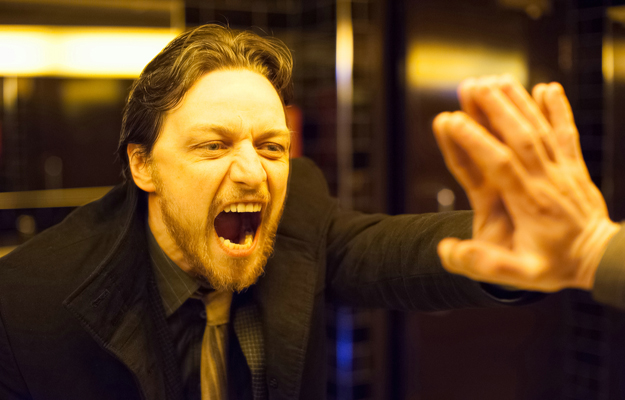
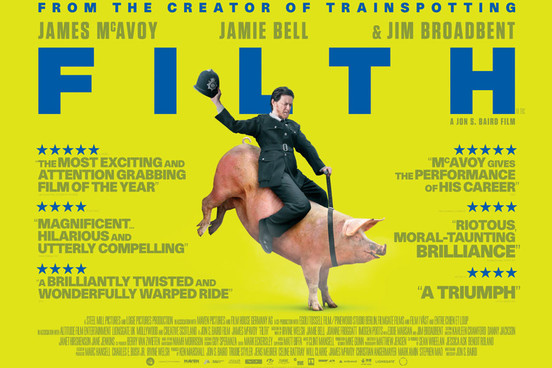
Filth Trailer: Treat yourself to the image of James McAvoy riding a pig to the tunes of the Scissor Sisters.
It’s been 17 years (yes really) since Danny Boyle first injected himself into the mainstream of British cinema with his gloriously squalid depiction of Irvine Welsh’s novel of the ‘chemical generation’ Trainspotting (novel 1994, film 1996). While subsequent attempts to transfer Welsh’s texts to screen have been relatively unsuccessful (The Acid House 1998 and Ecstasy 2011), Jon S. Baird has managed to adapt the depraved manic energy of Welsh’s third novel Filth into a triumphant cinematic experience. A cartoon aesthetic and hyperbolic-caricature is a feature of Baird’s adaptation, successfully distancing Filth from the haunting iconoclastic realism of Danny Boyle’s landmark film.

It has been well publicised that Filth struggled to find funding. As you can well imagine, pitching a film based on a novel whose protagonist’s inner most thoughts are narrated by an inebriated and destructive tapeworm would have raised more than a few eyebrows - luckily thanks to no less than 9 production companies, they raised the cash as well. In its opening weekend initial figures have Filth raking in around £250k at the Scottish Box office - cue an abundance of witty articles entitled ‘Filth cleans up at the box office’. And a bloody good job too. The film is a nihilistic riot, brutally funny and indulgently obscene.

Baird digs deep into the surreal and darkly comical underbelly of Welsh’s writing; embracing the wickedly weird elements of the novel and adapting them for the screen. Welsh’s novels are noted for their particular attention to deeply disturbed white, Scottish, male characters and Filth is a prime example. Alcoholic, sexist, and itchy-bollocked - misanthrope Detective Sergeant Bruce Robertson (James McAvoy) is about to be promoted. He’s fucking sure of it; in fact he’ll stop at nothing to get it. Champion of the people on the outside, and vindictive machiavellian on the inside, a good-cop/bad-cop rolled into one decaying body, Bruce Robertson is a man out for himself.

McAvoy’s performance is heroic in its commitment: any mentions from the audience of prior adoration or lust for our bearded thespian, were quickly switched into grimaces and muffled expressions of shock and confusion. It’s called Filth for a reason. Chips, chicks, and cocaine are on the menu every night and nothing helps a hangover like professional sabotage. McAvoy is wholly dedicated to the role and his comedic timing and cheeky smile manages to bring the audience onto his side - even if that side happens to be bigoted, sexist, and slovenly. Pantomime-esque cracks in the fourth wall allow the audience in on the various sinister schemes that our conniving copper has planned for his rivals. We are tipped the wink, and feel a certain amount of collusion with Bruce while we laugh at his gullible peers as much as he does. The joke is always on them. His malignant and magnificent plots to undermine his colleagues to ensure his own promotion are nothing short of comedic genius. Welsh’s writing is translated wonderfully, the audience collapses into laughing shrieks of vague horror at Bruce’s manipulative skills as he slowly but surely pulls the rug out from under his rivals; questioning their sexual orientation, sleeping with their wives, and setting them against one another. 

One of the most successful elements of the film is the blend of different eras; this is a film set in 2013, based on a novel written in 1998, and uses a soundtrack comprised mostly of 1960s/1970s classics set against a score by Clint Mansell. This seems to be a deliberate move by Baird; the swinging soundtrack serves to historicise the contemporary setting of the film, making you realise that these supposedly ‘outdated’ issues of racism, sexism, and homophobia are not simply contained to the dark ages but are still disturbingly relevant issues that stain the social fabric of modern day Britain. Baird however has been quick to stress that the film is not a commentary on the boys-in-blue. It’s true that there doesn’t seem to be any overt political or national agenda fuelling the fire (unlike the infamous “Scotland is shite” scene from Trainspotting) - references to Scotland are minimal, and outside of the name Bruce Robertson (a play on Robert the Bruce) and introductory scenes poking fun at the stereotypes of bagpipes and redheads, the film shies away from any focused commentary on life in modern Scotland.

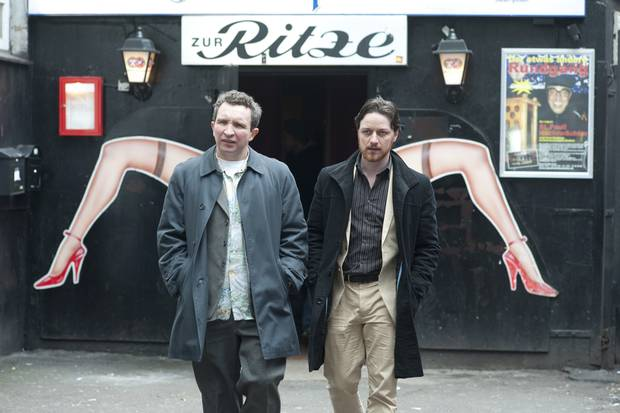
While the fluorescent promotional posters (the gaudy yellow and blue a nod towards today’s uniformed officers) boast a strong and intriguing cast, the weight of the film ultimately falls to McAvoy and his oblivious side-kick Clifford “Bladesy” Blades (Eddie Marsan). Much of the film’s comedy vigour comes from this unlikely pairing as Bladesy blindly follows Bruce down alleys into unintentional drug-fuelled nights with prostitutes and gay bars. The film taps into the rich comedic vein that is prevalent in Welsh’s writing; but more importantly it also delves into the more sordid and psychologically disturbed elements of his oeuvre. Baird, carefully emulating elements of the novel, strategically signposts deeper disturbances in Bruce’s psyche. We see flashes of a young boy covered in coal dust, and the intimate scenes with Bruce’s notably absent wife Carole (Shauna Macdonald) who narrates elements of their personal history in perfect make-up and decadent lingerie, jarr with the grungy and depraved actions of her mythically romanticised hubby. We slowly but surely get the idea that beyond Bruce’s obvious flaws, misogynist bigot that he is, there is something much deeper and darker going on.

In the closing death throes of the film, the dark humour rapidly deteriorates, along with the body and mental state of our fair hero. Previously comical relationships which had provided elements of lite relief now take on a disturbingly violent and threatening edge. The initially amusing relationship between Bruce and Chrissie (Kate Dickie) suddenly shifts as she violently forces herself upon a severely unstable and sick Bruce. The passage in the novel is one of the most bleak and unashamedly descriptive: ‘she’s pushing her c**t on to it against my will and thrusting on to me and the friction’s hurting me and she’s choking me harder and I can’t breathe or speak as the grip tightens’. In hindsight, their once previously amusing acts of erotic asphyxiation become a tool of ominous foreshadowing. This moment of sexual assault is one of McAvoy's shortest and yet most potent scenes. His depiction of an utterly disempowered being is heartbreaking, desolately lying on the floor with tears leaking out of his eyes softly whispering ‘I’m not well’. Bruce is met with a dismissive ‘you’re no fun anymore’ from Chrissie who luxuriously sucks on the end of a cigarette as she lounges content in her afterglow.


Welsh’s works have been acclaimed for their critique on what Berthold Schoene calls ‘the institutionalised politics of fucking’ which ultimately reveals the patriarchal systems of society which ‘irrespective of their biological sex [renders characters] into active “men” and passive “women”’- the victim and the victor. Filth should be championed in its undermining of traditionally sexist categorisations of women AND men. The exploration of issues such as cross-dressing and sexual orientation are insightful and challenging but ultimately it is this scene in which a previously powerless female character sexually assaults the male protagonist that resonates the most. Baird (through Welsh) exposes how the system is against men as much as it is against women, where Bruce represents the crippling necessity of conforming to an idealised myth of the interminable ‘hard man’. 


While Bruce obviously holds little respect for the women around him and leaves little space for their infringement into his personal sphere (apart from the idealised Carole of course), the female cast does well with their time on screen. Most notably Bunty Blades (Shirley Henderson) whose long-lashed wide-eyed infatuation of D.S. Robertson coupled with incredibly bouffant hair and a penchant for leopard print, steals every scene. The one non-sexual relationship between Bruce and a female character is unfortunately where I feel the film falls flat. One of the less successful scenes regarding the destabilisation of gender roles is in Bruce’s confrontation with colleague Amanda Drummond (Imogen Poots). The relationship between Drummond and Bruce in the novel is consistently high-strung; Drummond proves to be the level-headed politically correct antithesis to Bruce’s increasingly abhorrent behaviour. The confrontation between Drummond and Robertson in the film is a tumultuous and draining emotional ride and has moments of pure pathos. The script, however, lets down the animosity of the scene and the majority of Poots’ performance becomes likened to playground jibes and goading insinuations, though this is through no fault of the cast; Baird simply stays true to Welsh’s text.

After this encounter, Bruce is left a psychological mess. The audience is cast into the surreal and hallucinatory bowels of Dr. Rossi’s office (Jim Broadbent) where grotesque animal faces and more overt hints at a deep childhood trauma clutter the screen. The delusional office space of Rossi is perhaps the most unsuccessful text-to-screen adaptation of the whole film. Welsh’s novels characteristically disturb standard textual practice, using various fonts and typographic play to create a chaotic and unsettled edge and Filth is no different. The pages bulge with a visual representation of Bruce’s inner narrator, his friendly neighbourhood tapeworm, at times becoming so large it covers the narrative; bubbling across the page with an incessant drive to consume. The desolation and existential crisis exhibited by Bruce in the later stages of the film smacks of a typically Beckettian ‘protagonist’ struggling with a fractured memory of seemingly past events and a terrifying and incomprehensible present (indeed the idea of the Tapeworm perhaps an allusion to Beckett’s protagonist ‘Worm’ in The Unnameable). The substitution of the typographic worm for the doctor’s hedonistic office loses some of the more nuanced elements of Welsh’s writing, allowing the film to fall down a delusional rabbit hole that doesn’t necessarily enrich the already bizarre content. Baird’s adaptation, whilst putrid, violent, and exciting, did not portray the total physical wretchedness that encapsulates the character of Bruce Robertson. 

The fantastical and absurd elements draw the audience away from the overwhelmingly fetid decay of the central character which ultimately gives one the impression of leaving Filth feeling a bit too clean.

- Alex

You can read more of Alex's work over on Marginal Philosophy or follow her on Twitter: @ACamp_Bell


Follow @AssortedBuffery on Twitter
Or like our Facebook page.
Monday, 7 October 2013

TV REVIEW: Agents of S.H.I.E.L.D. - 0-8-4

Marvel's agents return with a much stronger second episode, hinting at better group dynamics and snappier writing in the show's future.


With the team assembled and sort of ready to go in the pilot episode, it is left to second instalment 0-8-4 to see if these mismatched individuals can actually work together as a cohesive whole. When the titular 0-8-4, SHIELD lingo for an 'object of unknown origin', is discovered in Peru, our heroes are dispatched to the site in order to work out what it is. Coulson brings Skye along as a consultant, much to the disappointment of May and Ward, both of whom think that the last thing they need is more inexperienced agents in the field. And it turns out, they may have point when the team are put to the test by a face from Coulson's past.

Now this is more like it. A much stronger episode all round, 0-8-4 benefitted from all of the admittedly clunky leg-work done in the pilot to hit the ground running with a good storyline in which we got to see how the dynamics of the cast regulars would work. First of all, it was a great move to address the fact that, without computers to hack, Skye doesn't seem to have much to offer the SHIELD team, something which is repeatedly referred to throughout the episode. However, she does naturally find out where she fits over the course of the narrative which develops in a suitably organic way as the other characters also slot into their various roles with ease.

The conference between Ward, May and Coulson was a nice way of pointing out where a lot of the dramatic conflict will arise throughout the season, particularly in relation to the inexperienced characters. Ward and May are quite right to question Coulson's thinking and let's face it, I bet there were a few audience members thinking the same. However, not only does he clearly see some potential, so do we as the audience; it's going to be much more interesting watching a group of people learning to overcome obstacles together whilst dealing with their own anxieties than it would if these characters arrived fully formed and heroic. After all, that's part of what made the Avengers so compelling.

The 0-8-4 of the title turns out to be a weapon powered by Tesseract technology, granting us both a decent MacGuffin and a chance to shoehorn in some clunky Marvel Cinematic Universe references: "HYDRA! Captain America!". Thanks Fitz, we got it. Whilst I'm loving some of the easter eggs dropped in (the hammer one was great and a good example of how it should be done), they still feel like they are pandering to people rather than putting these references in for the good of the story. I'm fairly confident in saying that the audience watching the series will already be fans of the MCU and will know what you mean when you say the Tesseract by now. What also needs to happen is less of the technological babble. We know Fitz and Simmons are smart, but we shouldn't be alienated in the process.

Speaking of MCU references, the cameo was not so long-awaited as I thought it would be and proved to be a welcome reminder of SHIELD's movie origins in both character and tone. For Coulson, it was especially good as we had been seeing Action Man Coulson a lot, a side we were not used to from the movies (other than his Marvel One-Shot). Having Fury back in reminded us of Admin Coulson, a man who still seems to have an inferiority complex around certain characters. Clark Gregg plays both aspects of the character well and the novelty of seeing good old Phil back again has not worn off just yet.

As for the action of the episode itself, less reliance on special effects and a couple of neat set pieces made this quite the thriller. Though I don't think the physics of a rubber dinghy re-pressuring an aircraft necessarily checks out, the scene of the team pulling together to solve the problem, culminating in said inflatable was a quick and confident way of developing these characters as an ensemble. Individually, Skye and Ward shared some nice scenes and it's always good to see Ming-Na Wen's May kicking all kinds of arse. We're still lacking depth for Fitz and Simmons but I'm enjoying the pair's chemistry and they will no doubt get an episode devoted to their third dimensions very soon.

A much stronger episode all round for SHIELD then. There are still kinks to be ironed out and a couple of awkward phrasings still stick out. However, the potential is still very much apparent. It's likely to be a while before we see any more cameos, but hands up, who else wants to see Tony Stark get to grips with Fitz and Simmons?

You gotta love it when a team comes together.

- Becky

You can see Becky's review of the Pilot episode here.

Follow @AssortedBuffery on Twitter
Or like our Facebook page

Sunday, 6 October 2013

FILM REVIEW: Insidious Chapter 2 ****


It is a truth universally recognised, at least in the world of Film, that unless you’re Peter Jackson and you’ve already got some pretty spot-on source material on your side, sequels are rarely a good idea. This is a thesis particularly applicable to horror movies. I need only say Jeepers Creepers 2 in order to make a a reasonably substantial jab at my point. Thankfully though, with Director James Wan still at the helm, Insidious: Chapter 2 turned out to be just as unnervingly wacky, witty and jumpy as its predecessor, with a few surprises of its own thrown in.

...Chapter 2 sees us back with the Lambert family, Josh (Patrick Wilson), Renai (Rose Byrne) and their two sons. They’re staying with Patrick’s mother Lorraine (Barbara Hershey) whilst the police inspect their house, after the as yet unexplained murder of hands-on medium Elise (Lin Shaye) at the end of the first film. The family are desperate to put the haunting of son Dalton (Ty Simpkins) by disembodied spectres desperate to steal his young body from beyond the grave behind them. However, this proves somewhat difficult as it becomes increasingly clear that not only have they been followed by the deceased inhabitants of purgatory reminiscent The Further once again, but that something is also very, very wrong with Josh. Lorraine, as well as psychic assistants Specs, played by screenwriter Leigh Whannell and Tucker (Angus Samson) set out to figure out the childhood family secret from whence all this began in order to avenge Elise’s death and save the Lambert family from their torment once and for all.


As with Insidous, this second offering from Whannell and Wan began with typically jumpy, sinister, bog-standard horror film fare. Only, as fans have now come to expect from the pair, with far more wit and originality than much of their competition.  Flashbacks to Josh’s childhood, set long before the timeline of the first film, work particularly well, especially during an exceptional set of scenes later on in which it and the present timeline are set side by side. Again, as with the first movie, the second half of the film wandered off into a totally bonkers area of imagination that will probably prove just as marmite as it did back in 2010. The truly wonderful element of the franchise, though, remains the utter sense of chaos we’re treated to as an audience, the feeling that absolutely anything could happen next. This only intensifies with every passing minute of the film, particularly as its frankly gorgeous cinematography gives the absolute maximum exposure to all the scares. 

The return of principles Byrne and Wilson for the sequel also worked strongly in the film’s favour, lending continuity as well as a familiarity that makes you genuinely root for them throughout all of the madness, parallel worlds and ladies in period costume with creepy lipstick. This tactical use of an anchor is only added to by the marvellous Specs and Tucker, a comic relief double act I have long waxed lyrical about. Their reassuring presence somehow puts us as an audience on even more of an emotional rollercoaster than we would otherwise be, making the laughs bigger and the scares scarier. Maximum credit also to Patrick Wilson, who, without giving too much away, gives an utterly outstanding performance as the father trying to protect his family, eventually becoming just as haunted as they are.

With its descent into total discord, vaguely historical costumes and ever growing body-count Insidious: Chapter 2 is just as gloriously, unashamedly barmy as its predecessor.  If it’s your cup of tea, it’ll knock you out of your seat. Perhaps not to the same extent as with the Lambert family’s first outing, but enough. Certainly enough to warrant the lost popcorn you’ll end up ferreting around on the floor for after the first few door slams. Above all though, its enough to make you nod your head on the way out of the cinema, believing that this was a sequel worth making.

Which in horror film terms at least, is pretty high praise.

****

-          Jen


Follow @AssortedBuffery on Twitter
Or like our Facebook page.
You can read my own blog here or follow me on twitter here


TV REVIEW: Atlantis - A Girl By Any Other Name

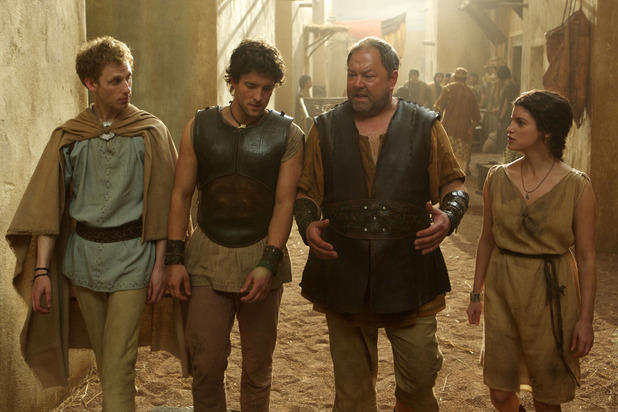
This week, Jason finds himself tangling with the Maenads, followers of Dionysus, questioning his destiny, fighting in slow-motion and meeting a woman called Medusa.


For what initially appears to be a simple plotline, there's a lot going on in this episode, starting with Jason and Hercules working security for a merchant only for Hercules to get drunk on the job and allow the theft of the frankincense that he's supposed to be protecting. Then, an old man comes to seek Jason's help in finding his missing daughter, Demetria, who he wishes to see before he dies. Jason agrees to help, Hercules does to in order to escape the rich merchant and Pythagorus is mostly filler. The three get tangled up with the Maenads who follow the god Dionysus (in a rather tame version of his rites and rituals, as befitting a Saturday night audience) and incorrectly represented satyrs, where they also meet Medusa.

So yes, many many things going on in this episode and not all of them good. The balance between levity and drama across the narrative is misjudged a fair amount of the time and Hercules' bombast is going to become irritating before long. I love Mark Addy, but his performance is particularly one-note at the moment, all shouting and guffawing, which is occasionally humourous, but sticks out like a sore thumb when the tone shifts to weightier stuff. Performances elsewhere are more successful than others; it's great to see Jemima Rooper on screen again and she's the best thing in this as Medusa, currently a lot nicer than the destiny that awaits her. Jack Donnelly, on the other hand, is a charisma vacuum, saddled with some terrible, clunky lines which he can't help but deliver in a stilted fashion. If he's supposed to be from the 21st century, why is he speaking like a character from a Charlton Heston swords-and-sandals epic?

That Jason comes from the 21st century seems to be just a convenient plot device for him to be able to know who characters like Medusa are well in advance. It is serving little purpose anywhere else as he seems more than comfortable loitering about in Ancient Greece. Returning to the lines poor Donnelly has to deliver, if he's supposed to be from the 21st century, why is he speaking like a character from a Charlton Heston swords-and-sandals epic? Dialogue should involve you in this world, but in Atlantis, it just seems to be a way of providing exposition or getting to the next joke. Or reminding you about Jason's destiny, which was referred to at least five times over the course of the episode. Action Jason, or as he will now be called, Slow-Mo Jason, got a run out a couple of times in this episode, but we cannot rely on action scenes alone to carry this character.

And then there's the Greek mythology aspect itself. I'm trying not to get too caught up in the fact that this isn't an accurate representation of these legends, more a melting pot, which is largely fine. I'm interested in seeing how the Medusa thread develops because it has to be different from the original (Medusa is raped by Poseidon in Athena's temple; the goddess then transforms her as punishment. Yep, the Greeks victim-blamed a lot). However, the satyrs were just plain wrong. So wrong. Like ridiculously wrong. For example, on the right is a satyr. Half man, half goat, no monkey. I don't understand the decision to transform them into something else. Why not just invent another monster?

Atlantis may have started well, but it's going to have to pull its sandals up if it is going to keep people watching; the episode is muddled, badly written and ever-so-slightly dull. Yes, Merlin took a while to bed in properly, but it still had a spark at the heart of it that kept people interested. Rooper was a highlight but there is only so much good she can do when even Hercules can't do the heavy lifting. I'm not expecting Emmy-award winning stuff here, but a good story would be a start.

- Becky

You can read Becky's review of the first episode here.

Follow @AssortedBuffery on Twitter
Or like our Facebook page.
Thursday, 3 October 2013

FEATURE: Buffy the Vampire Slayer - Some Assembly Required

Previously on Buffy the Vampire Slayer: Cordelia has discovered just what the Scooby Gang get up to in the library and finds herself increasingly involved. Also, she's crushing on Angel who is crushing on Buffy who is also crushing on Angel but no one's really doing anything about it.

So far in my Buffy posts, I've been following a fairly standard formula; watch the episode, talk about what I like about it, go for some brief analysis if anything interesting crops up. This is great, and I'm really enjoying it, but this week is going to be a little different for two reasons. 1). Some Assembly Required isn't all that great as episodes go and I think I'd run out of stuff to talk about quite quickly and 2). It's an homage to one of my favourite novels of all time and that alone means I get to do some nice intertextual comparison here. 

Oh and 3) (sorry, a bit Spanish Inquisition of me), there just happened to be an X-Files episode dealing with similar themes and also based on Frankenstein that same year, airing just two months after Some Assembly Required, called The Post-Modern Prometheus. So in this post, I'm basically going to be looking at how two genre shows approach the Frankenstein story and the way in which they interpret the novel, but also other adaptations that have gone before.

Mary Shelley's Frankenstein is a seminal piece of work, kickstarting the science fiction genre way back in 1818 and is now widely considered to be a critical darling. If you haven't read it, please do. It's the perfect book for dreary autumnal evenings. Boris Karloff may be the most iconic image of the creature (not Frankenstein, that's the doctor and yes this totally matters) but he appears, as does the mad scientist Dr Frankenstein (not all that mad in the book, just proud and lacking in common sense), in many incarnations across various art forms, particularly film and television. 

Buffy the Vampire Slayer will tackle the Frankenstein story several times over the course of its seven season run, particularly in the fourth season when monstrous creation Adam takes over from his creators and nearly fulfils Victor Frankenstein's fear of a race of monsters, but also in Warren's creation of his girlfriend April and the Buffy bot. But we get ahead of ourselves. Whedon first tackles it in Some Assembly Required, in which two science nerds attempt to create the perfect woman for a deceased, and now reanimated, student. In The X-Files, Mulder and Scully are called to investigate the mysterious impregnation of a woman who claims to have been knocked up by The Great Mutato, a character in her 18 year old son's comic book.

Both shows treat their Frankenstein references in very different ways, exploring separate points of the narrative and themes of the novel. The results are... interesting. For Buffy, Some Assembly Required takes the moment in which the creature commissions Frankenstein to create a female companion for him who could share his isolation from the world. Daryl Epps is the version of the creature, reconstructed and reanimated by his distraught brother Chris, who is the instructed to piece together female students for his companion. 

The importance of fraternity is one of the key themes in Frankenstein and is key to the way in which the female companion episode plays out. After killing Victor's brother, the creature tells him his story (which we will return to in The X-Files) and then begs him to create a companion. Like Chris, Victor initially complies before destroying the female, an act which results in the creature declaring outright war upon Victor, later killing both his creator's wife and best friend. Buffy deconstructs this idea by having the creature as the brother of the creator. Here, Chris is not bound by the duty of creator to created, but by a fraternal bond. Whereas the creature is consistently shunned by Victor, Daryl is embraced by Chris and the conflict that arises between them stems directly from this sense of duty. It is one that Chris and Victor both struggle against, but thanks to Buffy and the gang, Chris is allowed his redemption as Daryl must perish.

In The Post-Modern Prometheus (a wonderful play on Frankenstein's subtitle, The Modern Prometheus), The X-Files takes a completely meta-fictional approach to the material; it is shot entirely in black and white with a superb classic Universal horror-themed score by Mark Snow. There's a mad scientist called Polidori (a nod to Byron's doctor who was present on the night on which Frankenstein was conceived during a competition between Polidori, Byron and the Shelleys). It's more of an homage to James Whale's Frankenstein from 1931 than Shelley's original text, but as a result, it still has a fair amount to tie it back to the novel. Particularly, it explores the moment in which the creature is taken in by a blind old man who, oblivious to his looks, teaches him a range of things, including the idea of understanding. Then upon the return of the old man's family, the creature is hounded away, much like Mutato.


The main theme is the idea of understanding and conversely, the rejection of the unfamiliar. This is best represented in the actions of the population in the unnamed town who actively pursue the Great Mutato, not from a lack of understanding or education, but from a willingness to pre-judge, to point, laugh and stare. In short, to actively choose not to understand the unfamiliar. In this respect, The X-Files is particularly vicious; the mob are fed on Jerry Springer and other such reality TV shows where being judgemental is par for the course. When faced with the creature, they are actively prepared to go into an attack, fuelled by Dr Polidori's framing of the creature for the murder of his father. Therefore, like the mob in Frankenstein, they rush to drive the Great Mutato out of their town, without really understanding why he did what he did.

Whilst The X-Files deals much better with the themes that arise from the use of the Frankenstein narrative, it also remains problematic; Mutato is essentially date-raping these women and, after an admittedly eloquent tale, he is sympathised with and rewarded with a visit to see his hero Cher. For a show that makes a big deal about women not in control of their bodies and the subsequent reproduction (the 'wrong' reproduction being a key theme in Frankenstein incidentally), it's odd that there is no reprimand for Mutato. However, Buffy tackles the inherent misogyny in Chris, Eric and Daryl's decision to create their 'perfect woman' based entirely on objectification. This is apparent most in Eric's locker in which a woman composed entirely from magazine pictures. Buffy outwardly criticises their actions several times, vehemently so, on these grounds. 

The one theme that both episodes explore successfully is that of isolation, the loneliness the respective creatures feel as a result of their appearance. For Daryl in Buffy, it is clearest in a scene in which he watches his former Sunnydale football teammates from underneath the bleachers. The haunting music perfectly scores the scene and, whilst not justifying his actions, serves to demonstrate his desire for a companion. For Mutato, it is his eloquent speech to the mob about his origin and upbringing, a direct reference back to the intelligence of Shelley's creature; he learns compassion from Cher's role in Mask while the creature learns of human nature from Milton's Paradise Lost, amongst others. 

The two characters of Daryl and Mutato get very different endings, each underscoring their respective episodes' key themes. Daryl dies in the fire that consumes his companion, unable to live with the thought of being the only one of his kind. Narratively, he is punished for his actions in both forcing his brother to nearly kill for him. For Mutato, he inspires a level of understanding that ensures his safety, and the safety of his offspring, in his town. He also gets to go to a Cher concert, thus kicking off one of the best endings to an X-Files episode ever; Mulder and Scully dance. What is not to love? Seriously, I defy anyone to watch that ending without a big grin on their face.

And so to conclude. It is inevitable that I must talk about the quality of the two episodes discussed here. Some Assembly Required is one of the poorest Buffy episodes, reaching too high for a concept that it never quite tackles very well. It's handled much better when Buffy is a more mature show and has found its place a bit more. The Post-Modern Prometheus, on the other hand, is a joy from start to finish, worth it for the range of Gillian Anderson's cynical facial expressions alone. No one does wary dismissal in quite the same way. If you haven't seen it, I suggest a watch, even if you've never seen an X-Files episode before. Trust me, no prior knowledge is required.

Right, I must now try and get Gypsies, Tramps and Thieves out of my head.

Next Time: School Hard (SPIKE!)

Quote of the Week: Buffy on gender roles - "I'm an old-fashioned gal. I was raised to believe that men dig up the corpses and women have the babies."

- Becky

You can read Becky's look at the Season Two opener here.

Follow @AssortedBuffery on Twitter
Or like our Facebook page


Monday, 30 September 2013

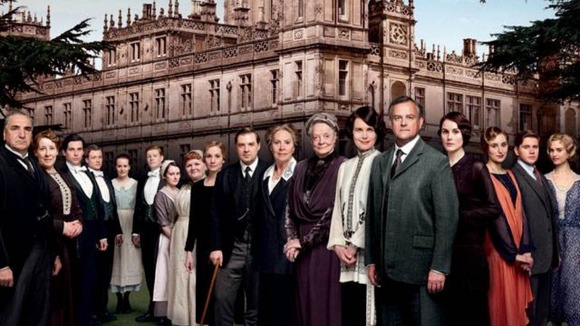
TV REVIEW: Downton Abbey - Episode Two

The pace at Downton has slowed of late, what with the passing of Matthew and the transformation of Mary into a beautiful walking corpse. Thankfully, the show itself isn't entirely lifeless, though it's still a little lacking in the madcap plot twist department.


I'll mention the Ivy-Alfred-Jimmy-Daisy-possibly now Rose polygon briefly because it happened but still failed to get me caring about it. I'm not even sure who likes who really, just that there seems to be a lot of furtive glances and whispering about it. I also add Rose in now because Jimmy accompanied them to the dance and then caught her dallying with her bit of rough before dinner. Jimmy was an interesting character last series when he was the target for Thomas' affections, but he seems to have been reduced to wallpaper so far. Maybe a fling with Rose will liven the place up? Give them both something to do? Romances on Downton have certainly started for less and yes I'm totally grasping at straws here because the episode left me very little to go on ok?

Speaking of potential romances, might there be a possibility of a Mary-Branson relationship in the offing? Or a Mary-Tom relationship... I'm with the Dowager, it's too difficult. Anyway, now that Dame Maggie has instructed Tom/Branson to be Mary's instructor in the ways of the estate, the pair are about to spend a lot of time together and in TV Land, that's tantamount to getting engaged. Not to mention all the knowing grins that Tom/Branson was exhibiting throughout the episode. 

Well there's that and the fact that it would royally get up Lord Grantham's nose, a man already campaigning fervently for 'Git of the Year'. I'm aware it would have been completely anachronistic for Mary to chuck her no doubt expensive Sauvignon Blanc right in his face at dinner, but I was totally gunning for it. However, whilst Lord Grantham may have given a wonderfully contradictory speech (remember when he was campaigning for Mary to inherit the estate?), it was left to the deceased Matthew to steal the show in the most convenient plot development since Miss Lavinia Swire felt a bit ill.

From the moment Lord Grantham began reading the letter, I knew it was going to be a moment of pure Downton gold. And it did not disappoint. "I suddenly realised..." Did you now Matthew? How very prescient of you. Speaking positively, whilst it may have been hilariously convenient, it also wrapped up the whole issue of Mary's inheritance neatly and quickly because I don't think anyone could have been bothered with another Series One entail plotline running all the way through it. On the other hand, it was terrible writing. Just terrible. Nuance has never been one of Downton's strong points, but if there was ever a moment for it, that was it.

It was left to the below stairs crew to get the nice storylines this week as Carson finally came around to forgiving his old friend in a lovely station-set scene with Grigg (though I was half-expecting a 'Daddy! Oh my Daddy!' moment a la Jenny Agutter). The story of Alice was quaint stuff, the type of story you'd expect to hear over tea and scones and therefore proper Downton stuff. I also enjoyed the Molesley-Mr Baaates storyline though Thomas' meddling with the Baaates family is getting a tad dull. Where's Miss O'Brien when you need her?

Oh and Edith is well on her way to become 'the other woman'. Brilliant. There's never a dull moment is there?

- Becky

You can read Becky's review of the previous episode here.

Follow @AssortedBuffery on Twitter
Or like our Facebook page